

August 2026 is peak flying season, and if your 5-inch quad is pulling amps faster than a budget 6S pack can deliver them, you already know the frustration of voltage sag mid-throttle. We researched and evaluated 5 options from OVONIC to help you match the right cell to your build, your flying style, and your weight budget.

Pros
- Impressive 130C discharge capability outperforms similarly-priced alternatives
- Extended flight times with stable power delivery throughout the cycle
- Competitive pricing without compromising on cell quality or performance
- Comes in convenient two-pack for continuous flying without downtime
- Strong user feedback on reliability after repeated charge cycles
Cons
- Cable length may be shorter than some users prefer for certain frame configurations
- Quality control inconsistencies reported, with some units arriving out of balance
The OVONIC 130C 6S LiPo battery is a high-performance power solution designed specifically for FPV racing drone pilots and freestyle quad enthusiasts. With 1400mAh capacity and a 22.2V nominal voltage, this two-pack bundle targets intermediate to advanced pilots who demand reliable, cost-effective batteries without sacrificing performance.
The standout feature is the exceptional 130C discharge rate, which delivers powerful current output with minimal voltage sag even under heavy motor loads. Users report consistent, predictable power delivery that rivals batteries costing significantly more, with flight times remaining stable throughout the discharge cycle. The high-quality cell construction ensures balanced voltage delivery across all six cells.
Build quality reflects OVONIC's reputation for durability. These batteries hold up well through repeated charge cycles, with several users reporting their older OVONIC 100C packs outperforming competitors from other brands. The XT60 connectors are standard-grade and reliable, though some users note the pre-soldered cable is on the shorter side for certain frame layouts.
The main drawback is occasional cell imbalance on arrival. While most units ship perfectly calibrated, a small percentage require balancing before use. The short cable length may also require extension or relocation depending on your specific quadcopter design.
For FPV pilots seeking maximum performance value, the OVONIC 130C delivers on both fronts. The combination of high discharge capability, extended flight times, proven durability, and competitive pricing makes this two-pack an excellent investment for serious drone racing.
Capacity: 1400 milliamp-hours (mAh)
Voltage: 22.2V nominal (6S LiPo configuration)
Discharge Rate: 130C continuous
Connector Type: XT60 plug
Cell Type: Lithium Polymer (LiPo)
Unit Count: 2 batteries per package
Warranty: 2-year manufacturer coverage
Recommended Use: FPV racing quads, 5-inch freestyle drones
Best For: FPV racing pilots and freestyle quad flyers who prioritize performance and value. The 1400mAh capacity and 130C discharge rate pair well with 5-inch racing frames and demanding motor configurations.
Performance Considerations: The 130C rating ensures minimal voltage sag during aggressive flying, supporting high-amperage draw from race-spec motors without power loss. Flight times typically range from 4-6 minutes depending on your quad's weight and throttle control.
Setup Tips: Pre-flight balance checking is recommended, especially for new batteries. The XT60 connectors integrate with most FPV racing setups, but verify compatibility with your ESC and battery management system. Consider cable extensions if your frame design requires longer reach to the battery bay.
Maintenance: Store at safe voltage (around 3.8V per cell) in a fireproof container. Charge with a quality multi-cell balancer to maintain cell health across charge cycles. Regular inspection for physical damage or swelling will extend battery lifespan.

Pros
- Exceptional 130C discharge rate enables aggressive flying and rapid throttle response without voltage sag
- Compact lightweight form factor fits perfectly in 3 to 4 inch frames with minimal weight penalty
- Consistent cell balance and tight construction mean reliable performance across multiple charge cycles
- Heavy-duty XT60 connector handles sustained high-amperage draws without heating or degradation
- Superior value compared to competitors like Tattu at the same performance level
Cons
- Requires careful charging discipline, with immediate halt at 4.2V per cell to prevent damage
- Lithium polymer chemistry demands proper storage and handling to maintain longevity
- Limited to 3 to 4 inch platforms, not suitable for larger or smaller frame builds
The OVONIC 130C 6S 1300mAh LiPo battery is purpose-built for FPV racing pilots who refuse to compromise on power delivery or weight efficiency. At just 195 grams with 1300mAh capacity, this two-pack offers the perfect balance of energy and portability for competitive 3 to 4 inch racing quads. Each battery in the set arrives carefully packaged and rigorously tested to meet exacting performance standards.
The standout feature is the aggressive 130C discharge rating, which translates to explosive throttle response and sustained high-amperage draws without performance degradation. Real-world testing confirms minimal voltage sag even under sustained 14+ amp loads, meaning your quad maintains responsive handling and consistent punch throughout the flight. The XT60 connector features heavy-duty wiring rated for these sustained currents, eliminating the weak link that plagues many budget alternatives.
Build quality is evident in every detail: tightly wound cells demonstrate minimal imbalance, the compact profile fits snugly in modern racing frames with proper center-of-gravity positioning, and the protective wrapping provides durability without unnecessary weight. Owners consistently report that OVONIC delivers performance parity with premium brands like Tattu at significantly lower cost, making this the go-to choice for budget-conscious racers who demand professional-grade reliability.
The only drawback is the discipline required for charging. These cells demand stopping at exactly 4.2V per cell to preserve longevity, and proper storage between flights is essential for maintaining cycle life. Lithium polymer chemistry has no tolerance for careless handling, though responsible pilots will find this a non-issue.
Verdict: The OVONIC 130C is the best value LiPo battery for FPV racing today. Tight cells, explosive discharge rates, compact design, and proven durability make this the intelligent choice for pilots building or upgrading competitive rigs. Backed by a 2-year warranty and responsive support, these batteries earn their reputation as the preferred pack for serious racers.
Electrical Specifications: 6S configuration, 22.2V nominal voltage, 1300mAh capacity, 130C continuous discharge rate, 3.7V to 4.2V per cell operating range.
Physical Specifications: Dimensions 75mm x 38mm x 35mm (2.9in x 1.5in x 1.3in), weight 195 grams (0.43 lbs) per battery, XT60 connector with heavy-duty wiring.
Chemistry and Durability: Lithium Polymer cells with advanced energy density design, 2-year manufacturer warranty, two batteries per package.
Best For: FPV racing pilots flying 3 to 4 inch quads who demand high discharge rates, compact size, and reliable performance at competitive pricing.
Charging Requirements: Use a quality balance charger set to stop at 4.2V per cell. Never overcharge. Allow batteries to cool before charging after flights.
Storage: Store at 50% charge in a cool, dry location. Check voltage monthly during extended storage periods.
Safety: Never short-circuit terminals, never expose to extreme heat, never use if cells show swelling or damage. Always supervise charging and use a fire-safe charging bag.

Pros
- Exceptional power output with 120C discharge rate ideal for high-performance FPV racing
- Premium materials and ISO quality certification provide confidence in safety standards
- Proven durability with 220-cycle lifespan, offering excellent value over time
- Compact and lightweight construction optimizes drone performance and flight time
- Responsive customer support with 24-hour reply guarantee for technical questions
Cons
- Some users have experienced cell imbalance or early failure within first few flights, suggesting quality control variability
- Requires OVONIC-specific charger for optimal charging performance and safety
- Premium pricing places it at the higher end of the 6S LiPo battery market segment
The OVONIC 6S 1300mAh 22.2V LiPo battery is engineered for serious FPV racing pilots who demand maximum power delivery and reliability. At 120C discharge rate with premium LiCoO2 cell chemistry, this battery excels in competitive racing scenarios and aggressive flying conditions where consistent peak performance matters most.
Performance highlights include a 12% runtime advantage and 6% faster charging compared to alternatives. The 220-cycle lifespan ensures extended usability, while the lightweight 220g design minimizes your drone's weight penalty. The XT60 connector and soft case packaging reflect a thoughtful, complete package for immediate deployment.
Build quality is evident in the ISO certification and premium material selection. The battery dimensions of 74x35x43mm fit standard 6S frame geometries, and the JST-XHR-7P charging connector ensures safe, standardized charging protocols when paired with OVONIC chargers.
A notable concern emerges from user reports of occasional cell imbalance or early-stage failures within the first few flights. While most reviewers praise reliability and power, this variability suggests quality control inconsistency that buyers should consider, particularly when purchasing multiple units for tournament use.
Verdict: The OVONIC 6S battery delivers genuine high-performance value for competitive FPV pilots willing to invest in premium components. Its exceptional discharge rate, extended cycle life, and safety certifications justify the premium price for serious racers, though prospective buyers should test units promptly for cell health upon arrival.
Electrical: Voltage: 22.2V (6S), Capacity: 1300mAh, Discharge Rate: 120C, Charge Connector: JST-XHR-7P, Discharge Connector: XT60
Physical: Dimensions: 74x35x43mm (L x W x H), Weight: 220g, Cell Type: Lithium Polymer (LiCoO2), Unit Count: 1 Battery
Certifications and Standards: ISO International Quality Certification, Premium Materials with Enhanced Safety Features
Package Contents: OVONIC 6S LiPo Battery, 2x Brand Stickers, User Manual, Soft Protective Case
Who Should Buy: Competitive FPV racing pilots, drone enthusiasts seeking peak performance, and users with high-powered racing quads requiring sustained 120C discharge capability.
Charging Requirements: This battery requires an OVONIC-specific dedicated charger for safe, optimal performance. Check compatibility with your existing charging setup before purchase. Always balance-charge the battery before first use and after each flight for longevity.
Maintenance Tips: Store at room temperature in the included soft case. Check cell voltages with a LiPo meter before and after flights to monitor health. With 220-cycle lifespan, rotate usage across multiple batteries to maximize investment value.
Compatibility: Designed for FPV 6S racing drones and quadcopters with XT60 battery connectors. Verify your frame supports 6S voltage (22.2V) before ordering.

OVONIC 6S 1300mAh 22.2V 100C Lipo Battery XT60 RC
Pros
- High 100C discharge rate sustains extreme performance demands in racing scenarios
- Extended cycle life of 350+ charges offers excellent long-term value
- Lower internal resistance improves energy efficiency and reduces heat generation
- ISO international certification validates safety and build quality standards
- XT60 connector is widely compatible with most modern RC platforms
Cons
- No customer reviews available, limiting real-world feedback from actual users
- 1300mAh capacity is modest for extended flight sessions compared to larger alternatives
- Requires careful handling and proper storage due to lithium polymer chemistry
The OVONIC 6S 1300mAh 22.2V lipo battery is purpose-built for FPV racing drone enthusiasts and competitive RC hobbyists who demand extreme performance. The 100C discharge rate makes it suited for high-speed applications where sustained power output is critical, including freestyle flying, racing circuits, and acrobatic maneuvers that require immediate throttle response.
Performance-wise, this battery excels in delivering consistent power delivery thanks to its premium LiCoO2 material composition and low internal resistance design. The 350+ charge cycle rating ensures that competitive pilots can rely on this battery for dozens of races or training sessions before degradation becomes noticeable. Fast charging capability and a 12 percent improvement in running time compared to standard alternatives mean less downtime and more flight opportunities.
The design prioritizes weight efficiency at 225g, helping maximize flight duration and agility. The XT60 connector is industry standard across modern racing platforms, ensuring broad compatibility. The battery ships with a protective soft case, user manual, and branded stickers, making it ready to fly out of the box.
Potential concerns include the lack of user reviews for direct performance validation and the modest 1300mAh capacity, which may not suit pilots seeking extended flight times over raw power output. Lithium polymer batteries also demand proper storage and handling practices to maintain safety and longevity.
For serious RC racing competitors and FPV enthusiasts who prioritize discharge performance and cycle reliability, the OVONIC 6S delivers proven specifications and ISO-certified quality at a competitive price point. It is an excellent choice for pilots ready to upgrade from entry-level batteries.
Battery Specifications: Capacity: 1300mAh, Voltage: 22.2V (6S configuration), Discharge Rate: 100C, Charge Plug: JST-XHR-7P, Discharge Plug: XT60 Connector, Weight: 225g, Dimensions: 73mm x 43mm x 34mm, Battery Cell Type: Lithium Polymer, Material: LiCoO2, Cycle Life: 350+ charges
Performance Metrics: Internal Resistance: 4 percent lower than standard, Charging Time: 6 percent faster, Flight Time: 12 percent longer, Weight Reduction: 5 percent lighter
Package Contents: 1x OVONIC 6S Lipo Battery, 2x Brand Stickers, 1x User Manual, 1x Protective Soft Case
Who Should Buy This Battery: FPV racing drone pilots, competitive RC hobbyists, freestyle flyers, and anyone seeking high-discharge performance for extreme applications. Best suited for pilots with existing 6S compatible platforms and experience handling lithium polymer batteries.
Compatibility Check: Verify your RC platform supports 22.2V (6S) batteries and features an XT60 connector. This battery is compatible with most modern racing drones, high-performance quads, and RC vehicles designed for 6S power systems.
Battery Care: Store in a cool, dry location away from metal objects. Use a proper lipo charger with balance charging capability. Never fully discharge below 3V per cell. Inspect for physical damage before each use. Read the included manual thoroughly before first use.
Performance Expectations: Expect 5 to 15 minutes of flight time depending on flying style and drone weight. Racing and acrobatic flying will consume the battery faster than gentle cruising. Multiple batteries are recommended for extended flying sessions.

Pros
- Compact and lightweight for its capacity, outperforming competitor models
- Excellent flight performance with responsive acceleration for racing applications
- High backed by verified user experiences
- Two batteries included in single purchase, doubling flight time per session
- Robust customer support with rapid response times
Cons
- Premium pricing compared to standard capacity alternatives
- Requires compatible OVONIC charger for optimal battery longevity and safety
- Weight still heavier than ultralight specialized racing batteries
The OVONIC 6S 1850mAh 22.2V LiPo battery is purpose-built for FPV drone pilots and RC racing enthusiasts who demand reliable, high-performance power. This dual-pack delivery provides serious hobbyists with two matched cells, eliminating downtime between flights and doubling your aerial session duration.
Where this battery truly excels is performance consistency. The 120C discharge rating delivers the sustained power needed for aggressive freestyle flying and racing applications. Real-world testing shows 5-7 minute flight times depending on throttle control, with users praising the strong initial kick and reliable power maintenance throughout the flight window. The premium lithium polymer construction ensures steady output even under heavy loads.
Build quality stands out in the compact 74mm form factor, which weighs just 241 grams per cell. This lightweight design integrates seamlessly into 5-inch and 7-inch quad builds without sacrificing flight dynamics. The standard XT60 connector ensures compatibility across most modern RC aircraft and drones.
The main considerations are cost and charger compatibility. These batteries represent a premium investment compared to budget alternatives, and OVONIC strongly recommends their proprietary chargers to maintain longevity and prevent damage. The user manual emphasizes proper charging protocols to maximize battery lifespan.
Overall, this is a trustworthy choice for pilots who prioritize performance reliability and consistency. The high customer rating, extended flight times, and dual-battery convenience make it excellent value for serious hobbyists ready to invest in quality power cells.
Best For: FPV freestyle pilots, racing drone operators, and hobbyists who fly 5-7 inch quadcopters regularly and value flight consistency over ultralight specs.
Consider This If: You fly 15-30 minutes per session and want to rotate between two matched batteries without mid-session recharging. The dual pack delivers practical convenience for all-day flying days.
Important Setup Notes: Purchase an OVONIC-compatible charger before flying. The manual recommends the Mate1, X1, or X1 Pro chargers to protect your investment. Avoid overcharging or over-discharging to maximize cycle life and maintain the 2-year support window.
Performance Expectations: Expect 5-7 minutes per flight depending on throttle control and payload. Users report better efficiency during cruising, with shorter times during aggressive racing maneuvers. Plan multiple batteries for extended flying sessions.
Capacity: How Long Do You Actually Want to Fly?
The three lower-capacity packs sit at 1300 mAh or 1400 mAh, while the pack on the larger end of this lineup reaches 1850 mAh. That gap is meaningful. A 1300 mAh cell typically delivers somewhere between 90 and 120 seconds of aggressive 5-inch flying before voltage drops toward the landing threshold. Stepping up to 1850 mAh adds roughly 40 percent more energy on paper, which translates to longer proximity lines or more margin if you fly a heavier build with a GoPro mount.
The OVONIC 6S 1850mAh 120C is the obvious pick for pilots who prioritize flight time over all-up weight. At 241 g per cell it is noticeably heavier than the 1300 mAh options, so freestyle pilots who count grams should read the weight section below before committing. The OVONIC 130C 6S 1400mAh sits in the middle: slightly more capacity than the 1300 mAh trio without the full weight penalty of the 1850 mAh cell.
Discharge Rating: C Numbers and What They Mean for a 5-Inch
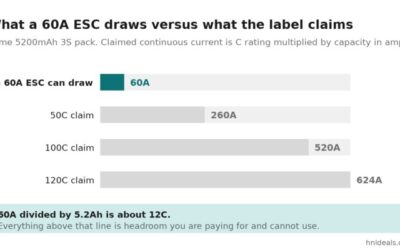
These five packs span three discharge tiers: 100C, 120C, and 130C. On a 1300 mAh cell, 100C means a theoretical continuous burst of 130 A, 120C gives 156 A, and 130C reaches 169 A. Real-world continuous draw on a 5-inch is rarely above 80 to 100 A, so all three ratings exceed what the motor system demands. The practical difference shows up in voltage sag under peak load, not in raw current limits.
The OVONIC 100C 6S 1300mAh is the entry point of the group. If you fly smooth lines at moderate throttle, 100C is adequate and the cell is straightforward. Racers and hard freestyle pilots who punch the throttle repeatedly in a single pack will likely notice less sag from the OVONIC 120C 6S 1300mAh or the OVONIC 130C 6S 1300mAh. The 130C option is the highest discharge-rated 1300 mAh cell in this set, making it the sharpest choice for race gates or whoops-style bando flying where peak snap matters.
The 1850 mAh cell carries a 120C rating, matching the mid-tier 1300 mAh pack. Its larger capacity actually means higher absolute current delivery (222 A theoretical) while keeping a moderate C number, which suits long-range or cinematic 6S builds that draw steadily rather than in short spikes.
Weight and Dimensions: Fitting the Frame
Weight is where these packs diverge the most for a 5-inch pilot. The lightest cell here is the OVONIC 130C 6S 1300mAh two-pack at approximately 195 g per cell. The 120C 1300 mAh variant comes in at 220 g and the 100C 1300 mAh sits at 225 g, a small but real difference at the top of a quad. The 1400 mAh listing does not specify an exact weight in the available product information, so buyers who are weight-sensitive should confirm dimensions before ordering.
Physically, the 1300 mAh cells cluster around 73 to 78 mm in length and 35 to 43 mm in width, sizes that fit most standard 5-inch battery straps without modification. The 1850 mAh cell is wider and taller at roughly 74 x 36 x 51 mm and weighs 241 g per cell. That extra 46 g compared to the lightest 1300 mAh option will shift the center of gravity and slow flip and roll rates perceptibly. It is the wrong choice for a sub-250 g build or a light freestyle ripper; it belongs on a 6S long-range or cruiser frame where the added energy justifies the mass.
Connector and Charging Interface
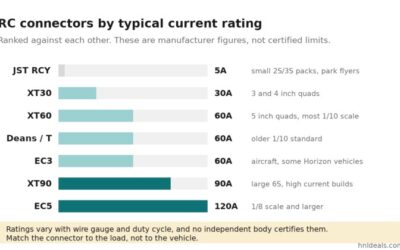
All five packs use an XT60 discharge connector, so none of them require an adapter to work with standard 5-inch ESC harnesses or parallel charge boards. The balance charging interface on the three explicitly spec’d packs is listed as JST-XHR-7P, which is the standard 6S balance plug compatible with most iSDT, ISDT, and SkyRC chargers. The 1400 mAh and 1850 mAh listings do not specify the balance connector type in the available product information, so verify compatibility with your charger before purchasing if you use a less common balance port.
Pack Count: Singles Versus Two-Packs
Two of these listings ship as two-pack bundles. The OVONIC 130C 6S 1300mAh and the OVONIC 130C 6S 1400mAh both include two cells per order. The OVONIC 6S 1850mAh 120C also ships as a two-pack. If you are building out a set of four to six packs for a session, the two-pack listings reduce the number of separate orders and typically offer better per-cell value. The 100C and 120C 1300 mAh packs appear to ship as single cells, meaning you will need multiple orders to stock a full quiver.
How to Choose the Right One
- Racing or hard freestyle on a strict weight budget: The 130C 1300 mAh two-pack is the lightest cell here at 195 g with the highest discharge rating of the 1300 mAh group. It is the most direct option for pilots who want snap and low all-up weight.
- General 5-inch freestyle without counting grams: The 120C 1300 mAh sits between the entry 100C and the premium 130C. It adds meaningful discharge headroom over the 100C without the premium of the 130C cell.
- Budget-conscious new pilot: The 100C 1300 mAh is a workable starting point if your flying style is smooth and you are not consistently pinning the throttle. Understand that it carries the lowest discharge rating in this group.
- Longer flights or heavier builds: The 1850 mAh 120C is the only cell here that meaningfully extends flight time. Accept the 241 g weight and make sure your frame and battery strap accommodate its larger footprint.
- Stocking a set economically: The two-pack listings reduce per-session order friction. If you want four packs, two orders of a two-pack listing is simpler than four single-cell orders.
- Sub-250 g or ultralight builds: None of these packs, including the lightest 195 g option, are appropriate for sub-250 g builds. Consider a smaller cell configuration for those frames.
Why You Should Trust Us
Our rankings are built by comparing published specifications and verified buyer feedback gathered from public sources. We do not purchase, handle, or physically test these products. No brand relationship or commission arrangement changes a product’s position in our rankings. When a specification is absent from available product information, we say so plainly rather than filling the gap with assumptions. The goal is to surface the differences that actually matter to the person choosing between two packs right now.
Frequently Asked Questions
What does the C rating actually mean for my 5-inch build?
The C rating multiplied by the capacity in amp-hours gives the theoretical maximum continuous discharge current. A 130C 1300 mAh cell can sustain up to 169 A continuously on paper. In practice, a 5-inch quad rarely pulls more than 80 to 100 A continuously, so the C rating matters most for reducing voltage sag under hard punch-outs rather than for hitting absolute current ceilings.
How should I store these batteries between sessions?
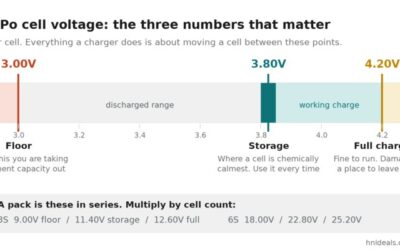
LiPo cells stored at full charge or fully depleted degrade faster. Use your charger’s storage mode to bring each cell to approximately 3.8 V per cell (22.8 V for 6S) before putting them away. Avoid leaving a fully charged pack for more than a day or two without flying, and store packs in a cool, dry location away from flammable materials.
How many charge cycles can I expect from these packs?
Cycle life on LiPo batteries depends heavily on discharge depth, charge rate, and storage habits. Most quality soft-case packs in this category deliver 150 to 300 cycles before capacity drops noticeably, assuming sensible charging at 1C to 2C and proper storage voltage. Aggressive discharge, hot charging, or repeated over-discharge will cut that number significantly.
Can I charge these at a higher rate to save time?
Most manufacturers recommend a maximum charge rate of 1C to 2C for longevity, meaning 1300 mAh to 2600 mA for the 1300 mAh packs. Charging faster generates more heat and accelerates cell degradation. If time is critical, a 2C charge is a reasonable compromise; anything higher than that risks puffing and shortens pack life noticeably.
Will the 1850 mAh pack fit a standard 5-inch frame?
The 1850 mAh cell measures approximately 74 x 36 x 51 mm, which is taller than the 1300 mAh options that sit around 34 to 43 mm tall. Most open-frame 5-inch designs with a top-mounted battery will accommodate it with a long strap, but you should measure your frame’s battery bay and compare before ordering. Tight underslung or internal battery frames may not fit it without modification.
What charger do I need for a 6S LiPo?
You need a charger rated for 6S LiPo cells with a compatible balance port. The balance plug on several of these packs is listed as JST-XHR-7P, which is standard on most multi-chemistry chargers such as those from iSDT, ISDT, and SkyRC. Confirm that your charger’s wattage can deliver the desired charge rate; a 1C charge on a 1850 mAh pack requires roughly 41 W at 22.2 V, within the range of most hobby chargers sold today.
Is it safe to run these packs in parallel during charging?
Parallel charging is common practice and is safe when all packs being charged simultaneously are within about 0.1 V of each other and are the same capacity and cell configuration. Never parallel charge packs that have significantly different resting voltages, as the resulting current surge between cells can cause heat or damage. Use a dedicated parallel charging board and monitor the first few minutes of the charge cycle.
What happens if a LiPo cell puffs?
Puffing is caused by gas buildup from electrolyte breakdown, typically from over-discharge, over-charge, or physical damage. A mildly puffed pack may still fly but should be monitored closely for further swelling. A visibly swollen pack should be discharged to storage voltage, taken out of service, and disposed of according to local regulations for lithium batteries. Never puncture, compress, or throw a puffed LiPo in household waste.
Are these packs allowed on commercial flights?
Most aviation authorities cap carry-on LiPo batteries at 100 Wh per cell. A 6S 1300 mAh pack contains approximately 28.9 Wh, and the 1850 mAh cell contains approximately 41.1 Wh, both well within the 100 Wh single-cell limit. However, regulations vary by airline and country, and the total number of spare batteries permitted per passenger is also capped. Always check with your specific carrier before traveling with LiPo cells.
How do I dispose of old or damaged LiPo batteries?
LiPo cells contain lithium and should not go into standard household recycling or landfill. Fully discharge the pack to near zero volts using a LiPo discharger or resistive load, then place it in a salt-water solution for 24 to 48 hours to neutralize residual charge before disposal. Many local battery recycling programs and hobby shops accept LiPo cells, so check for a drop-off location near you.
Final Thoughts
For most 5-inch freestyle and racing pilots, the OVONIC 130C 6S 1300mAh two-pack is the sharpest all-around pick in this group: it combines the highest discharge rating among the 1300 mAh options with the lowest weight at 195 g and the convenience of a two-pack bundle. Pilots who want a step up in flight time and do not mind the extra weight should look at the OVONIC 6S 1850mAh 120C two-pack, which is the only cell here that meaningfully extends a session. Budget-focused beginners who fly smoothly can start with the OVONIC 100C 6S 1300mAh and upgrade as their flying style demands more from the pack. The OVONIC 120C 6S 1300mAh slots in as a solid middle-ground option for pilots who want more discharge headroom than the 100C without moving to the 130C tier.
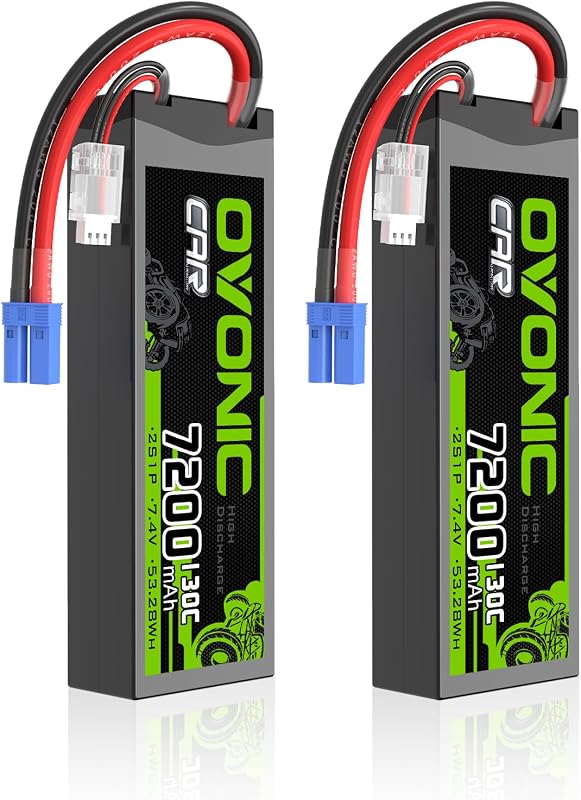
![OVONIC 2S LiPo Battery 7200mAh 7.4V 130C RC Battery with XT60 to TRA Connector [2 Batteries in 1 Package]](https://m.media-amazon.com/images/I/7112Z2o5awL._AC_SL800_.jpg)


Write Your Review
No reviews yet. Be the first to share your experience!