

Running a high-end GPU like the NVIDIA RTX 50 series or stacking a powerful workstation demands more than just raw wattage. Efficiency matters just as much. A poorly rated power supply wastes energy as heat, pushes your cooling hardware harder, and can introduce instability under load. That is exactly where 80 Plus Titanium certification separates itself from the pack, delivering over 90% efficiency across a wide load range.
This guide walks you through nine of the top 80 Plus Titanium power supplies available right now. Whether you are building a compact SFF rig, a high-performance gaming tower, or a demanding AI workstation, you will find a well-matched option here. If you are still deciding on total wattage, our roundup of the best PSUs for high-end gaming PCs is a great starting point alongside this guide.
Quick Comparison
Ratings reflect the most recent data pull. Check each listing for current price and availability.
Quick answer
This guide compares 9 picks, with MSI MPG Ai1300TS PCIe 5 1300W 80+ Titanium Fully ranked first. CORSAIR RM850x 850W Modular Power Supply, ATX 3.1, PCIe holds the highest customer rating among them. Thermaltake Toughpower GT 850W 80+ Gold ATX 3.1 PCIe has the most customer reviews.

This 1300 watt Titanium unit brings dual 12V-2x6 cables and GPU Safeguard+ protection, suited to gaming builds sitting between mainstream and extreme wattage tiers. SiC MOSFETs support the Titanium efficiency claim, making it a fit for readers who want headroom above 1000 watts without going all the way to 1600.
Pros
- 80+ Titanium certification with 94% efficiency rating
- GPU Safeguard+ real-time current monitoring for damage prevention
- Server-grade SiC MOSFETs and quiet 135mm fluid-dynamic bearing fan
- Native dual 12V-2x6 connectors with ATX 3.1 and PCIe 5.1 support
Cons
- 1300W capacity is excessive for mainstream or mid-range systems
- Titanium efficiency benefit is most noticeable in 24/7 workloads, less so in casual use
The MSI MPG Ai1300TS earns its place on an efficiency-focused list by pairing 80+ Titanium certification and 94% efficiency with hardware built to sustain that performance under extreme loads. Server-grade SiC MOSFETs and a 135mm fluid-dynamic bearing fan keep the unit running efficiently and quietly even when pushed hard, which matters most in the exact 24/7 or heavy-workload scenarios where Titanium efficiency pays off. GPU Safeguard+ adds real-time current monitoring that protects the efficiency investment by catching abnormal power delivery before it causes damage. Native dual 12V-2x6 connectors and full ATX 3.1 and PCIe 5.1 support mean the efficiency gains stay relevant as GPU power demands climb with newer hardware. Fully modular UL-embossed cables with copper alloy connectors keep the compact 5.9 x 7.48 x 3.4 inch chassis easy to manage. Backed by a 12 year warranty, it's built for readers who want Titanium efficiency to translate into sustained, protected performance rather than a certification on paper alone.
Power Output: 1300W
Efficiency Rating: 80+ Titanium (up to 94%)
Form Factor: ATX
Cooling: Single 135mm fluid-dynamic bearing fan
Connectors: 1x motherboard, 2x CPU, 2x 12V-2x6 (PCIe 5.1), 5x PCIe, 1x dual PCIe adapter, 2x SATA, 2x peripheral
Input Voltage: 120V AC
Dimensions: 5.9 x 7.48 x 3.4 inches
Weight: 10.1 pounds
Warranty: 12 years
Model: MSI MPG Ai1300TS PCIE5
Manufacturer: MSI
Suited to high-end gaming, streaming, or AI PC builds pulling serious sustained power, especially with the latest GPUs, where 24/7-grade Titanium efficiency and GPU protection matter most. Skip it for mid-range gaming PCs or light productivity use, where the Titanium efficiency edge and 1300W capacity go largely unused. A 750W or 850W unit will suit those systems better.

This one carries Cybenetics Gold rather than Titanium certification, so readers strictly hunting for the highest efficiency tier should note the difference. Still, its 850 watt fully modular design with a native 12V-2x6 connector suits ATX 3.1 builds needing clean cable management and steady power delivery for modern GPUs.
Pros
- 91% Cybenetics Gold efficiency
- Native ATX 3.1 and 12V-2x6 connector
- Three PCIe 8-pin connectors included
- 100% Japanese 105C capacitors
Cons
- Not Titanium certified, Gold tier only
- Fan noise increases under sustained heavy load
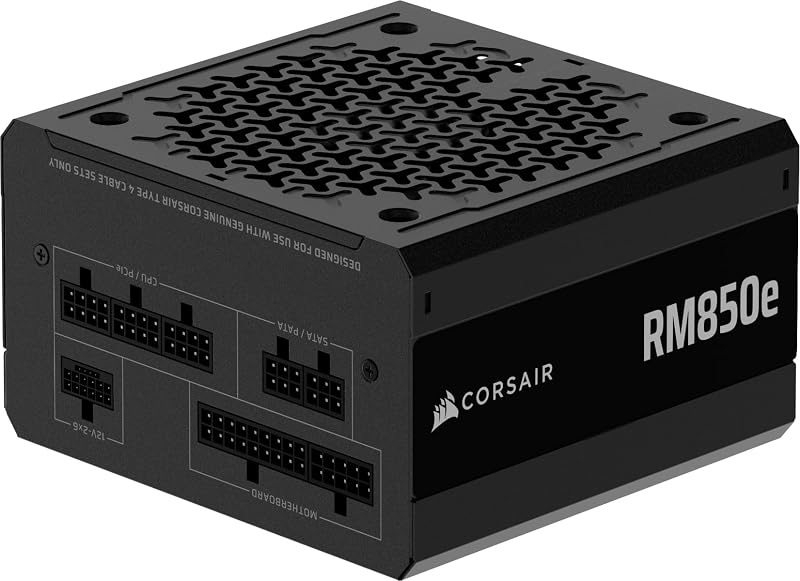
If your search for a Titanium-tier PSU has you comparing efficiency numbers, the RM850x is worth a look even though it sits at Cybenetics Gold rather than Titanium. At 91% efficiency it lands close to the lower end of what Titanium units achieve, while offering something many Titanium models skip: native ATX 3.1 and 12V-2x6 support for current-generation GPUs. Three PCIe 8-pin connectors mean no daisy-chaining for power-hungry cards. The 100% Japanese 105C capacitors and fully modular design with embossed, low-profile cables point to the kind of build quality efficiency-focused buyers tend to prioritize. Users report quieter systems and fewer stability issues after switching to this unit, which matters as much as the efficiency badge itself. The 850W capacity gives headroom for future upgrades rather than running near capacity. If Gold-level efficiency with excellent stability and modern connector support meets your bar, this is a strong pick, even if it falls just short of true Titanium certification.
Power Output: 850W
Efficiency Rating: Cybenetics Gold, up to 91%
Form Factor: ATX
Modular Design: Fully Modular
Cooling: 140mm FDB fan with manual and auto modes
Input Voltage: 100-240V AC
Connectors: Native 12V-2x6, (3) PCIe 8-pin, ATX standard
Capacitors: 100% Japanese 105C rated
Warranty: 10 years manufacturer
Dimensions: 2.3 x 3.39 x 5.91 inches
Weight: 3.9 pounds
Model: RM850x (CP-9020270-NA/AM)
Good for builders who want near-Titanium efficiency and rock-solid power delivery for flagship GPUs and CPUs, and who value quiet, stable operation over chasing the highest certification tier. Skip it if Titanium certification itself is a hard requirement, since this unit is Cybenetics Gold rated. Also skip it for budget or mid-range builds that won't use the 850W capacity.

With Titanium efficiency and a Noctua-designed cooling setup, this 1600 watt ATX unit targets quiet, high-end desktops running power-hungry components. The sheer wattage headroom paired with Titanium certification makes it a fit for builders who want minimal heat loss alongside near-silent operation under load.
Pros
- 80 PLUS Titanium with Cybenetics Lambda A++ verified efficiency
- Semi-passive design keeps fan off below 50% load in cool rooms
- Noctua NF-A12x25 fan and branded cables reduce noise and clutter
- ATX 3.1 and PCIe 5.1 compliant with 12V-2x6 connectors
Cons
- Weight of about 5.86kg is noticeable when moving the case
- Full silent mode needs ambient temperatures below 25°C
Efficiency ratings only tell part of the story, and the Seasonic Prime TX-1600 Noctua Edition backs its 80 PLUS Titanium certification with real-world proof: Cybenetics Lambda A++ status and 94% efficiency at 50% load. For this list, it stands out as the pick for builders who want titanium-grade efficiency paired with genuinely quiet operation, not just a badge on the box. The semi-passive design keeps the fan off entirely below 50% load in cool ambient conditions, and Noctua's NF-A12x25 fan ramps gradually rather than spiking. That efficiency-to-noise relationship matters for anyone running a system for hours at a time, since less wasted power also means less heat for the fan to fight. Noctua-branded braided cables and metal connectors round out a build that treats efficiency as part of a larger quality package rather than an isolated spec. At 1600W, it also has the headroom for high-draw multi-component systems without pushing load percentages into louder territory.
Power Output: 1600W, 1600A maximum current
Efficiency: 80 PLUS Titanium, 94% at 50% load, Cybenetics ETA Titanium certified
Cooling: Single Noctua NF-A12x25 fan with semi-passive operation (fan off until 50% load at ambient temps under 25°C)
Noise Level: Cybenetics Lambda A++ certified, approximately 8-10dB(A) quieter than standard PRIME TX-1600
Form Factor: ATX full modular design
Connectors: ATX 3.1 and PCIe 5.1 compliant with 12V-2x6 connectors for high-end graphics cards
Cabling: Fully modular with Noctua-themed braided cables included
Input Voltage: 100-240V AC
Operating Temperature: 25°C ambient
Physical Dimensions: 8.27 x 5.91 x 3.39 inches
Weight: 5.86 kg
Warranty: 12 years manufacturer's warranty
Buy this if you want top-tier titanium efficiency combined with near-silent operation for a long-term build, especially in a room with good ambient cooling below 25°C. It suits content creators and gamers who value quiet running as much as low power waste. Skip it if your room runs warm, since semi-passive silence depends on cooler ambient temperatures, or if you're not ready for the added weight of roughly 5.86kg.
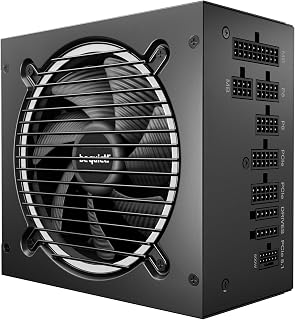
Another Gold-rated pick rather than Titanium, this 850 watt fully modular ATX 3.1 unit is worth mentioning for context. The fully modular ATX connector setup keeps builds tidy, but readers comparing strictly on 80 Plus Titanium efficiency should treat this as a Gold-tier alternative, not a direct match for the category.
Pros
- 94.4% efficiency, near Titanium-level performance
- Semi-passive cooling stays off under light loads
- Native 12V-2x6 connector for PCIe 5.1 cards
- Single 12V rail with LLC topology for stable delivery
Cons
- 80+ Gold certified, not Titanium
- Compact form factor needs careful cable management in smaller cases
For readers hunting Titanium-level efficiency, the Pure Power 13 M 850W comes close in spirit even though its certification is 80+ Gold. Its 94.4% efficiency figure is genuinely impressive and approaches Titanium territory in real terms, backed by a single robust 12V rail with LLC topology for stable delivery even when GPUs spike their draw. The semi-passive cooling design means the fan can stay off entirely under light loads, which matters for anyone chasing both efficiency and quiet operation. Native 12V-2x6 connectors support PCIe 5.1 cards without adapter cables, keeping the build clean and current. Be quiet!'s German engineering shows in the modular connector system, with sturdy yet flexible cables and generous lengths for easier routing. Real-world reports include power-hungry RTX 2080 Ti setups running virtually inaudible. If you want efficiency numbers that punch above their Gold rating along with near-silent behavior, this is a compelling option, just not a Titanium-certified one.
Power Output: 850W continuous, handles transients up to 1700W (2x rated power)
Efficiency: 80+ Gold certified, up to 94.4% efficiency rating
Form Factor: ATX, fully modular design
Cooling: Semi-passive 120mm fan with zero-RPM mode under light load
Connectors: Native 12V-2x6 for PCIe 5.1, plus 4 PCIe 6+2-pin for current-gen GPUs
Rail Configuration: Single 12V rail with LLC topology
Input Voltage: 100-120 VAC
Warranty: 10 years
Dimensions: 6.3 x 5.91 x 3.39 inches
Good for builders who want efficiency and silence at a near-Titanium level without paying for the Titanium badge itself, particularly for high-end gaming or content creation rigs. Skip it if certification tier is a strict requirement, since this is 80+ Gold. Also worth skipping in smaller cases where the compact form factor complicates cable routing.

Certified 80 Plus Cybenetics Titanium at 1000 watts, this ATX supply fits builders who want Titanium-level efficiency without stepping up to 1600 watt territory. It suits mid-to-high-end desktops where minimizing wasted heat and power draw matters more than chasing maximum wattage headroom.
Pros
- Dual Titanium efficiency certifications with 94% efficiency rating
- Near-silent semi-fanless operation under light loads
- Compact 150mm length despite 1000W output
- Conformal coating tested for humidity resistance up to 95%
Cons
- Stock cables are stiff and may need extensions in taller cases
- 1000W ceiling may not suit higher-power builds
For a list focused on efficiency, the FSP Hydro Ti Pro 1000W stands out for stacking two Titanium efficiency certifications rather than one, alongside a 94% efficiency rating that measurably reduces power consumption and heat output. That efficiency doesn't come at the cost of noise either, since the 135mm Fluid Dynamic Bearing fan runs in near-silent semi-fanless mode until load actually demands active cooling. Native ATX 3.1 and PCIe 5.1 support mean the efficiency gains carry forward into next-generation GPU compatibility rather than becoming obsolete. At 150mm long, it delivers that dual-certified efficiency in a notably compact footprint, useful for anyone trying to fit high efficiency into a mid-tower build. Conformal coating tested up to 95% relative humidity adds a layer of environmental durability that supports consistent efficient operation over time. For readers specifically prioritizing efficiency metrics over raw wattage, the dual Titanium certification here is a genuinely differentiating detail worth weighing against single-certified competitors.
Good for builders who want Titanium efficiency validated by more than one certification body, plus quiet operation and a compact form factor for mid-tower cases. Best suited to gaming rigs or workstations around the 1000W mark rather than higher-wattage systems. Skip it if you need more than 1000W of capacity, or if stiff stock cables and careful routing in taller cases would be a dealbreaker for your build.
Core Specs
Wattage: 1000W continuous output
Form Factor: ATX full modular
Dimensions: 150 x 150 x 86mm (5.91 x 5.91 x 3.39 inches)
Weight: Compact design optimized for mid-tower cases
Connectivity and Standards
ATX 3.1 and PCIe 5.1 compliant
Native 12V-2x6 GPU connector
5x PCIe 6+2 pin connectors for maximum GPU flexibility
Standard 24-pin motherboard and 8-pin CPU power connectors
Full modular cable system
Efficiency and Protection
80 PLUS Titanium and Cybenetics Titanium dual certification
Over 94% efficiency at typical loads
Conformal coating for moisture, dust, and environmental protection
135mm Fluid Dynamic Bearing fan with Zero-RPM semi-fanless mode
10-year warranty coverage
Input Specifications
Input Voltage: 100-240V AC
Cooling: Active air cooling with intelligent thermal management

Rated 80 Plus Gold, not Titanium, this 850 watt unit falls short of the efficiency tier this roundup targets. Its native 450W PCIe 5.1 connector and Smart Zero Fan mode make it a capable ATX 3.1 supply, but shoppers focused specifically on Titanium ratings will want to look elsewhere on this list.
Pros
- Native PCIe 5.1 450W connector, no adapters needed
- 80 Plus Gold efficiency up to 90%
- Smart Zero Fan for near-silent idle operation
- Broad connector compatibility: ATX, PCIe, Molex, SATA
Cons
- Gold certified, not Titanium
- 850W capacity underused in mid-range builds
Efficiency-focused buyers scanning for Titanium-class performance should know upfront that the Toughpower GT 850W carries an 80 Plus Gold certification, delivering up to 90% efficiency rather than Titanium's higher bar. What it does bring to the table is native PCIe 5.1 support with a 450W connector, meaning no adapters for the latest high-wattage GPUs, plus ATX 3.1 compliance for modern power delivery standards. The Smart Zero Fan technology keeps the 120mm hydraulic bearing fan off or nearly silent during lighter loads, which pairs well with efficiency-minded builds that want less wasted energy and less noise. Real users report stable performance under demanding workloads like 4K gaming and Unreal Engine 5 tasks. The fully modular design with flat black cables covers ATX, PCIe, Molex, and SATA connectors for broad compatibility. If your priority is cutting-edge connector tech and solid Gold-level efficiency backed by a 5-year warranty, this unit delivers, but it won't satisfy a strict Titanium-only requirement.
Power Output and Standards: 850W capacity, ATX 3.1 compliant, PCIe 5.1 support with native 450W 12+4 pin connector. Single high-amperage 12V rail for stable delivery.
Efficiency and Certification: 80 PLUS Gold rated, achieving up to 90% efficiency at 115Vac input. Safety approvals include CE, UKCA, ICES, TUV, LVD, RCM, CB, FCC, cTUVus, BSMI, CCC, BIS, and S-MARK.
Cooling and Design: 120mm hydraulic bearing fan with Smart Zero Fan technology. Fully modular design with four 6+2 pin PCIe connectors plus one 12+4 pin native PCIe Gen 5.1 connector. Dimensions: 150mm W x 86mm H x 140mm D.
Environmental Specs: Operating temperature range 0°C to 40°C, humidity 5% to 85%. Storage temperature minus 40°C to 70°C. Input voltage 100-240V, 50-60Hz, max 10A input current. Hold-up time 17ms at 80% load. Power Good Signal 100-250ms. MTBF 100,000 hours. 5-year warranty.

Built around an 80+ Titanium rating in a compact SFX-L form factor, this 1200 watt unit suits small form factor builds that still need serious headroom. The PWM ARGB fan and PCIe 5.0 ready connectors give compact-case builders Titanium efficiency without forcing a full ATX chassis.
Pros
- 80+ Titanium efficiency in a space-saving SFX-L form factor
- 16-pin PCIe 5.0 cable supports up to 600W for modern GPUs
- Dual ball-bearing fan and ROG heatsinks manage heat in tight cases
- Fully modular, individually sleeved cables for clean SFF routing
Cons
- Only single CPU and GPU power connectors limit some configurations
- Compact size may require careful case selection or minor modification
When efficiency is the goal but space is tight, the ASUS ROG Loki SFX-L 1200W solves a problem the other Titanium units on this list can't: it fits where a full ATX chassis won't. For anyone building a small form factor rig that still needs to feed an RTX 5090 or a Ryzen 9000 CPU, this is one of the few 80+ Titanium options sized for that job. The SFX-L footprint means the efficiency gains, lower waste heat, reduced electricity draw, don't come at the cost of case compatibility. A 120mm PWM ARGB fan with dual ball-bearings keeps thermals in check without the noise penalty you'd expect from cramming this much wattage into a small chassis, and Aura Sync ties the lighting into the rest of an RGB build. Full modularity with individually sleeved cables, plus 16-pin PCIe 5.0 support up to 600W, means it handles current and near-future GPUs despite the compact shell. For a titanium-efficient SFF build, this is the natural pick.
Power Delivery: 1200W, 80+ Titanium efficiency rating
Form Factor: SFX-L (4.9 x 4.9 x 2.5 inches, 2.15kg)
Modular Design: Fully modular with individually sleeved cables
Cooling: 1x 120mm PWM ARGB fan with dual ball bearings, 0dB technology
Connectors: CPU 4+4-Pin x2, PCIe 6+2 x4, SATA x6, includes 16-pin PCIe 5.0 cables
Standards: ATX 3.0 compatible, PCIe 5.0 ready, Lambda Standard++ certified
Noise Level: Below 35dB (certified)
Input Voltage: 130-132V AC
Features: ASUS Aura Sync RGB, ROG heatsinks, 10-year warranty
Buy this if you're building a small form factor or mini-ITX system and need 80+ Titanium efficiency without an ATX-sized case. Also fits enthusiasts who want ATX 3.0 and PCIe 5.0 readiness in a compact shell. Skip it if you need multiple CPU or GPU power connectors, since this unit only offers one of each, or if you're building in a standard ATX case where the larger Seasonic or MSI units offer more headroom.
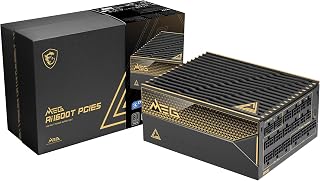
This 1600 watt Titanium unit pairs dual 12V-2x6 cables with server-grade capacitors, aimed at high-end gaming rigs demanding stable power under transient GPU spikes. ATX 3.1 and PCIe 5.1 readiness make it a fit for builders pairing flagship graphics cards with a need for top-tier efficiency.
Pros
- Triple-certified 80+ Titanium efficiency reduces power bills and heat
- Native dual 12V-2x6 connectors avoid adapter cables for flagship GPUs
- Japanese 105°C capacitors add thermal headroom and lifespan
- Comprehensive protection circuits guard against power anomalies
Cons
- 1600W exceeds the needs of most current systems
- 6.5 pound weight requires a case with sturdy PSU support
For builders chasing 80+ Titanium efficiency at the very top of the wattage scale, the MSI MEG Ai1600T PCIE5 delivers triple-certified efficiency without sacrificing the connector standards needed for flagship GPUs. Native dual 12V-2x6 cables mean no adapters between the PSU and a power-hungry graphics card, which matters when every efficiency gain from the Titanium rating is easier to appreciate without adapter losses or connector guesswork. Japanese 105°C capacitors give it thermal headroom that supports sustained high-efficiency operation rather than just a peak rating. ATX 3.1 and PCIe 5.1 readiness future-proof the investment for the next several GPU generations, and a full suite of protection circuits, OCP, OTP, OPP, SCP, OVP, UVP, SIP, NLO, backs that efficiency with component-level safety. For this list, it earns its spot as the choice for anyone whose efficiency needs come paired with genuinely high wattage demands, multi-GPU setups, or heavy content creation workloads.
Core Specs: Model: MSI MEG Ai1600T PCIE5, Output: 1600W, Form Factor: ATX, Connector: ATX, Cooling: Air-cooled
Dimensions and Weight: 11.5 x 9.5 x 5.4 inches, 6.5 pounds
Efficiency and Certification: 80+ Titanium, Cybenetics certified, PPLP certified, with Japanese 105°C server-grade capacitors
Connectivity: Dual-native 12V-2x6 connectors, fully modular design with braided cables
Safety Features: OCP (Over-current), OTP (Over-temperature), OPP (Over-power), SCP (Short-circuit), OVP (Over-voltage), UVP (Under-voltage), SIP (Soft-start), NLO (No-load operation)
Warranty: 12 years
Buy this if you're powering a flagship GPU or multi-GPU setup and want 80+ Titanium efficiency with native 12V-2x6 connectors and full protection circuitry. Fits high-end gaming and content creation builds planning several years of upgrades. Skip it if your system draws well under 1600W, since the headroom will go unused, or if the 6.5 pound weight and size don't suit your case.

Certified 80 Plus Titanium at 1600 watts, this ATX unit uses GaN MOSFETs and an OLED display to give enthusiasts real-time efficiency feedback. It suits builders running extreme multi-GPU or overclocked setups who want both maximum Titanium-tier efficiency and visibility into how the supply is performing.
Pros
- GaN MOSFET improves efficiency by up to 30% over standard designs
- Voltage stabilizer boosts GPU power delivery stability by up to 45%
- Double ball bearing fans rated for double the typical lifespan
- ATX 3.1 support and 10 year warranty for long-term efficiency gains
Cons
- Overkill wattage for systems that don't need 1600W of headroom
- Some reports of inconsistent international accessory fulfillment
When efficiency is the whole point of the search, the ROG Thor 1600W Titanium III earns its spot through more than a certification badge. GaN MOSFET technology pushes energy efficiency roughly 30% beyond conventional designs, cutting wasted heat and power draw in a way that compounds over years of use. The intelligent voltage stabilizer adds a second layer of value rarely seen in Titanium-class units, improving GPU voltage delivery by up to 45% for steadier performance under load. Double ball bearing fans rated for twice the lifespan of standard fans, aluminum housing, and full modular cabling round out a build meant to run efficiently for the long haul. ATX 3.1 support keeps it relevant as hardware demands grow. For anyone comparing Titanium units purely on how much efficiency and durability they deliver per watt, this one stacks features that go beyond the base certification, backed by a 10 year warranty that signals real confidence in long-term operation.
Power Output: 1600 watts
Certification: 80 Plus Titanium, Cybenetics Lambda A+
Form Factor: ATX, Full Modular
Connectors: 20+4 Pin ATX, PCI Express
Input Voltage: 100-264V AC
Cooling: Single 140mm double ball bearing fan with Turbo mode
Display: Magnetic OLED with real-time power monitoring
Dimensions: 7.87 x 5.91 x 3.39 inches
Weight: 2.8 kg
Warranty: 10 years
Best for builders running high-end gaming or content creation systems who want Titanium efficiency paired with extra voltage stability and monitoring features, not just the certification alone. Skip it if your system draws well under 1000W or if you're not interested in paying for GaN MOSFET and OLED extras. Those with simpler efficiency needs or tighter component budgets will get better value from a lower-wattage Titanium unit.
Buying Guide: What to Look for in an 80 Plus Titanium Power Supply
Efficiency Rating and Certification Tier
80 Plus Titanium is the highest standard in the mainstream PSU market, requiring at least 90% efficiency at 20% load and 94% at 50% load. Some units like the FSP Hydro Ti Pro 1000W Power Supply carry dual certification from both 80 Plus and Cybenetics, which offers more granular real-world efficiency data. If long-term power savings and minimal heat output matter to you, Titanium-rated units are the clear choice.
Not every unit in this guide is Titanium-rated. A couple carry Gold certification, which still delivers strong efficiency for most users. Knowing which tier you actually need depends on your load profile and how long you plan to run the system at high utilization.
Wattage and Headroom
PSUs operate most efficiently around 50% of their rated capacity. A 1000W unit powering a 500W system sits in its efficiency sweet spot. Going too close to maximum rated output under sustained load generates heat and can shorten the unit’s lifespan. Build in at least 20-30% headroom above your system’s peak draw.
For high-wattage builds pairing top-tier GPUs with powerful CPUs, options like the Seasonic Prime TX-1600 Noctua Edition and the MSI MEG Ai1600T PCIE5, Fully Modular Gaming 1600W offer 1600W of headroom with Titanium efficiency. Our dedicated guide to the best 1600W power supplies covers that segment in more depth.
ATX 3.1 and PCIe 5.1 Compatibility
Modern GPUs from NVIDIA’s latest generations use the 12V-2×6 connector standard, which replaces the older 12VHPWR adapter setup. A native 12V-2×6 connector means no adapter in the cable chain, which reduces the risk of connector damage or power delivery issues. Units like the MSI MPG Ai1300TS PCIE5, Fully Modular Gaming 1300W include dual native 12V-2×6 connectors, making them ready for multi-GPU workloads and next-gen single-GPU setups alike.
ATX 3.1 compliance also means the PSU can handle large transient power spikes, which the latest Intel and AMD platforms can produce under burst loads. If you are pairing this PSU with a current-generation GPU and CPU, ATX 3.1 support is worth prioritizing. Browse the full Power Supplies category for more options across different standards and wattage classes.
Form Factor and Physical Fit
Most power supplies use the standard ATX form factor, but SFF builders need to pay close attention. The ASUS ROG Loki SFX-L 1200W Titanium PSU is built in an SFX-L format, delivering 1200W of Titanium-rated power in a significantly smaller footprint. If you are working with a small form factor case, verifying compatibility before buying is essential.
For standard mid-tower and full-tower builds, the FSP Hydro Ti Pro actually ships in a shorter 150mm chassis compared to typical high-wattage units, which can simplify installation in tighter cases. Always cross-reference your case’s PSU clearance with the unit’s depth before ordering. For context on 850W power supply options specifically, that guide can help if your build falls in that wattage range.
Final Thoughts
For most high-performance builds, the MSI MPG Ai1300TS PCIE5, Fully Modular Gaming 1300W stands out with its server-grade SiC MOSFETs, dual native 12V-2×6 connectors, and a 12-year warranty that signals serious long-term confidence from the manufacturer. If your priority is the quietest possible operation and you are building a workstation-class system, the Seasonic Prime TX-1600 Noctua Edition pairs award-winning Titanium efficiency with a Noctua fan that runs at near-silent levels even under heavy loads.
Frequently Asked Questions
Is 80 Plus Titanium worth it over Gold for a gaming PC?
For most gaming builds running 6 to 10 hours a day, the efficiency difference between Gold and Titanium translates to measurable savings on your electricity bill over time. Titanium units also tend to run cooler and quieter under load, which benefits component longevity. If you run your PC heavily or care about minimizing heat inside your case, the upgrade is worth considering.
What PSU wattage do I need for an RTX 5090 or similar flagship GPU in 2026?
NVIDIA’s top-tier GPUs can draw over 450W by themselves under full load. Paired with a high-end CPU and storage, a 1000W to 1300W PSU is a reasonable starting point for a single-GPU flagship build. If you are running professional workloads or overclocking aggressively, 1600W units give you significantly more headroom. Check out the best 1000W power supply options if that wattage range fits your needs.
What is the difference between 80 Plus Titanium and Cybenetics Titanium?
80 Plus measures efficiency at a limited set of load points using a fixed 115V input. Cybenetics uses a broader methodology across more load conditions and also rates acoustic performance separately. Units like the FSP Hydro Ti Pro carry both certifications, which gives you a more complete picture of real-world behavior. Neither standard is strictly superior, but having both confirms consistency across varied usage scenarios.
How long should an 80 Plus Titanium power supply last?
Quality Titanium-rated PSUs typically carry warranties ranging from 10 to 12 years, which is a strong indicator of their expected operational lifespan. Units using Japanese capacitors rated at 105°C, like the MSI MEG Ai1600T, are built to handle sustained heat without degrading as quickly. Keeping the PSU well-ventilated and operating within its rated load range will help you get the most out of that warranty period.



Write Your Review
No reviews yet. Be the first to share your experience!