

When you are turning up a headset during a late match but still cannot separate footsteps from explosions, more volume is rarely the real answer. Built-in audio on a PC, controller, monitor, or handheld can add noise, lack useful controls, or simply fail to give your headphones the drive they need.
That is when the question, do you need a DAC for gaming, becomes practical rather than audiophile jargon. We focus this comparison on the situations where a USB dongle, console-ready external unit, or desktop DAC amp makes sense, and players who prefer cable-free gear can also compare our wireless earbuds for gaming.
Quick answer
This guide compares 9 picks, with Fosi Audio K7 DAC Headphone Amp: Premium Desktop Audio ranked first. Fosi Audio Q4 DAC Headphone Amp - USB/Optical/Coaxial has the most customer reviews.

Competitive and casual gamers juggling multiple sources will appreciate the wide interface spread, covering USB-C, optical, coaxial, Bluetooth with aptX HD LL, and a dedicated mic input, so PC, PS5, and Switch can share one amp without constant cable swapping. Support for stereo and surround sound output also helps positional cues come through clearly in fast-paced shooters.
Pros
- Powerful amplification suited to demanding headphones
- Wide connectivity: USB-C, Bluetooth, optical, coaxial, RCA, 4.4mm
- Durable aluminum chassis with intuitive controls
- High-resolution audio support up to 384kHz
Cons
- Volume knob has no detents, harder to gauge level
- 3dB volume steps can be too coarse for quiet environments
The question behind needing a DAC for gaming usually comes down to whether onboard audio is actually holding your setup back, and the Fosi Audio K7 is built to answer that directly. Its AK4493S DAC and TPA6120 amplifiers are designed to drive demanding headphones and planar drivers with enough power that the difference in positional audio and soundstage becomes noticeable rather than subtle. For gaming specifically, that translates into clearer separation between footsteps, gunfire, and dialogue instead of a flattened mix. Connectivity covers PC, PS5, and other consoles through USB-C, Bluetooth, coaxial, optical, and multiple output options including balanced 4.4mm, so it fits most gaming setups without extra adapters. The aluminum chassis and dual knob control layout make it easy to live beside a monitor. High-resolution support up to 384kHz means it's not a one-trick gaming device either, it carries over to music and movies. The main caveats are a volume knob without detents and coarse 3dB steps, both minor but worth knowing before you decide this is your long-term audio hub.
Audio Processing: AK4493S DAC, XMOS XU208 USB processor, TPA6120 headphone amplifiers. Maximum output power: 2100mW. Supports PCM up to 384kHz/32bit and DSD256.
Connectivity: USB-C, Bluetooth 5.0 with aptX HD and Low Latency, optical TOSLINK, coaxial S/PDIF, 3.5mm microphone input. Outputs: 4.4mm balanced, 3.5mm single-ended, RCA stereo.
Design: Aluminum alloy chassis with electromagnetic interference shielding. Dimensions compact for desktop use. Dual large control knobs, five shortcut buttons, high-resolution display.
Compatibility: PC (Windows with drivers, Mac and Linux without), PS5, Nintendo Switch, powered speakers, amplifiers, and any device with USB-C, Bluetooth, optical, coaxial, or 3.5mm input.
Package Contents: K7 unit, USB-A to USB-C cable, USB-C to USB-C cable, Y-splitter cable, Bluetooth antenna, 12V power supply. Includes 24-month manufacturer warranty.
Good for gamers who also care about music or movie listening and want one capable device instead of relying on a motherboard's audio chip. Especially useful if you use higher-impedance or planar headphones that need real power to perform. Skip it if you want simple click-stop volume control or need very fine volume adjustments in quiet rooms, since the increments here are coarser.
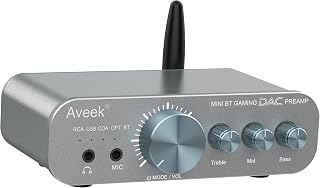
If you're splitting time between PS5 and PC and want quick tone adjustments between game audio and chat, the onboard 3-Band EQ gives you direct control without digging through console menus. Bluetooth and RCA outputs mean you can route sound to wireless headphones or a desktop speaker setup, making this a flexible pick for a mixed-console gaming station.
Pros
- Combines DAC, amp, and preamp in one unit
- Wide input options including Bluetooth, USB, optical, coaxial, RCA
- 3-band EQ for independent bass, mid, treble control
- Professional-grade specs: 24-bit/96kHz, 113dB SNR
Cons
- Very limited customer review history
- Compact size can complicate cable routing on crowded desks
If you're trying to figure out whether a DAC actually helps with gaming, the Aveek DAC-200 is a good test case because it answers a bigger question than audio quality alone: can one box replace your scattered desk setup? It combines a DAC, headphone amp, and preamp, so instead of asking whether a DAC adds value in isolation, you're asking whether consolidating PC, PS5, TV, and other sources into one hub is worth it. For gaming specifically, the 3-band EQ lets you push mids for clearer dialogue and footsteps without a generic preset guessing for you. With Bluetooth, USB, optical, coaxial, and RCA inputs, it also answers the practical gaming question of whether you can keep one device permanently wired to multiple consoles and a PC. The 24-bit/96kHz processing and 113dB signal-to-noise ratio mean the gaming benefit isn't just convenience, it's genuinely cleaner audio. The tradeoff is that it's a newer entrant, so you're relying on specs rather than a track record.
Good for gamers running multiple sources, like a PS5 and PC, who want one device with EQ control instead of juggling built-in audio across systems. Also fits anyone who wants a tidy desk with front-panel controls. Skip it if you want a device with a long review history to lean on, or if your desk space is tight, since cable routing around its compact frame takes some planning.
Audio Specs: 24-bit/96kHz processing, 113dB SNR, THD below 0.003%
Headphone Amplification: Supports 16-100 ohm headphones, including IEMs, gaming headsets, and full-size cans
Connectivity: Bluetooth, USB, Optical, Coaxial, RCA inputs; 3.5mm headphone and preamp outputs
Controls: 3-band EQ (bass, mid, treble), volume adjustment, input selection, all front-panel mounted
Inputs: Microphone input on front panel with monitoring output
Physical: Dimensions 4.65 x 2.6 x 1.18 inches, weight 7.1 ounces, metal chassis
Package Contents: DAC-200 unit, optical cable, USB-A/C to USB-C cable, 3.5mm headset splitter, user manual

Players chasing an edge in competitive shooters will care most about the footstep enhancement feature paired with 7.1 surround sound, since picking up subtle directional audio cues can mean reacting a split second faster to an enemy's position. Desktop volume control adds quick on-the-fly adjustment during matches without alt-tabbing out of the game.
Pros
- StepSense footstep enhancement built for competitive gaming
- 7.1 surround and HRTF for 360-degree positional audio
- Dual UAC mode for easy PS5, Switch, and PC compatibility
- Single USB-C connection keeps cable clutter minimal
Cons
- Feels lighter with more plastic than other Fosi models
- Browser-based EQ customization unavailable on Linux
For anyone asking if a DAC is worth it specifically for gaming, the Fosi Audio C3 makes one of the clearest cases, since it's built around gameplay advantage rather than general audio improvement. Its StepSense footstep radar actively enhances enemy footsteps while balancing louder sounds like gunfire, which is a direct answer to whether a DAC can meaningfully affect competitive performance. Combined with native 7.1 surround and HRTF processing, it creates positional audio through standard stereo headsets, so you don't need a specialty gaming headset to benefit. The CS43131 DAC supports 32-bit/384kHz PCM and drives headphones from 16 to 300 ohms, so power isn't a weak point even if footstep detection is the headline feature. Dual UAC mode switching means it works plug-and-play on PS5 and Switch while still offering full HiFi mode on PC and Mac, covering most gaming setups in one device. The single USB-C connection also keeps desk clutter minimal, which matters if your gaming station already has a console, PC, and peripherals competing for space.
The C3's gaming performance is its defining strength. StepSense footstep radar actively analyzes audio frequencies to amplify subtle movement cues while preventing louder sounds from drowning them out. Reviewers of competitive titles like CS:GO and PUBG report consistently hearing footsteps at greater distances and identifying enemy positions more accurately, enabling lower volume listening without sacrificing tactical awareness.
The 7.1 surround processing adds another dimension by creating precise directional mapping. When an enemy moves, the HRTF processing places that sound in specific spatial coordinates, helping you instinctively locate threats. This works with any stereo headset, eliminating the need for expensive gaming headphones. The combat audio prioritization system automatically balances frequencies during intense firefights, keeping critical sounds audible without overwhelming distortion.
UAC 1.0 mode ensures PS5 and Switch compatibility while maintaining gaming audio enhancements, so console players get identical benefits as PC users. UAC 2.0 mode unlocks full HiFi potential for PC gaming with demanding audio requirements.
The CS43131 DAC is flagship-level circuitry that supports 32-bit/384kHz PCM and DSD256 playback, far exceeding standard consumer audio requirements. It outputs 320mW per channel, sufficient to drive high-impedance headphones (up to 300 ohms) and low-impedance models (16 ohms and above) with equal effectiveness. The result is neutral, detailed sound with zero background hiss across gaming, music, and movie content.
The browser-based control interface provides real-time EQ adjustment through intuitive sliders and pre-tuned gaming, music, and streaming presets. Custom profiles let you save distinct settings for different use cases. The intelligent noise cancellation actively reduces keyboard clicks and ambient background noise during voice communication without affecting game audio.
Note: Linux users have full USB audio functionality but cannot access the browser-based equalizer interface. Windows and Mac users enjoy complete feature access.

Pros
- Genuine headphone amplifier boosts power delivery for demanding wired audio gear
- Silver-plated 8-core cable construction improves signal fidelity and durability
- Works instantly with zero driver installation required on all compatible devices
- Delivers measurable improvements in audio clarity, soundstage, and bass response
- Compact design reduces packaging waste while maintaining premium build quality
Cons
- No reviews available yet, so real-world user feedback is limited
- Compatibility limited to USB-C devices only, not suitable for Lightning-exclusive workflows
- May require USB-C phones or tablets to supply adequate power for optimal amplifier performance
The kbear USB-C to 3.5mm Audio Adapter is a dedicated HiFi solution for anyone tired of compromised audio on their smartphone or tablet. This adapter pairs a digital-to-analog converter with a built-in headphone amplifier, delivering measurable improvements in clarity, soundstage, and bass response. It's designed for discerning listeners who use quality wired headphones or IEMs and demand better sound than standard device outputs provide.
The standout feature is the integrated headphone amplifier, which provides additional power delivery to drive high-impedance headphones and IEMs with ease. Users can expect noticeably louder volumes, better dynamic range, and improved clarity without distortion compared to passive USB-C adapters. The 8-core silver-plated cable further enhances signal transmission, reducing interference and preserving audio fidelity across all frequencies.
Build quality reflects premium components throughout. The braided cable design resists fraying and damage from daily pocket use, while internal construction prioritizes audio performance over marketing claims. The manufacturer kept component quality high while reducing packaging size to lower costs, making this a genuinely accessible entry point to portable HiFi audio.
The main limitation is the lack of user reviews, which means you're buying on the product's specs and warranty rather than proven real-world performance. Additionally, optimal amplifier performance may depend on your device's USB power delivery. The adapter is USB-C only, so it won't work with older USB-A or Lightning devices.
For iPhone 15/16, Samsung Galaxy, iPad, and other USB-C users who want better sound from quality headphones, this adapter delivers measurable benefits at a fair price. The 3-year warranty suggests manufacturer confidence, and the design approach prioritizes genuine audio improvements over unnecessary features.
This adapter is ideal for: Audiophiles and music enthusiasts with quality wired headphones or IEMs seeking better portable sound, mobile gamers who demand responsive audio with clear detail, content creators and video editors working on smartphones or tablets, users with high-impedance headphones that struggle with standard phone outputs, and anyone switching to USB-C phones who misses the audio quality from their existing headphone collection.
Skip this product if: You use budget earbuds or casual headphones that don't benefit from amplification, you primarily use wireless audio, you need Lightning or USB-A compatibility, or you prefer a dedicated digital audio player over phone-based audio solutions.

Pros
- Solid build quality and reliable performance out of the box
- Remote control provides convenient volume management without accessing source device
- Removable Bluetooth antenna offers flexibility for different setups
- Transparent sound quality without artificial bass or treble enhancement
- Works seamlessly with both optical Toslink and coaxial inputs
Cons
- Included cables are lower quality and may need replacement for optimal durability
- Only supports stereo PCM/LPCM audio, not 5.1 or surround sound formats
- Setup requires removing protective rubber covers from cable connectors, which can confuse first-time users
The PROZOR DAC converter is a compact device designed to convert digital audio signals from modern entertainment sources into analog output that works with older amplifiers and speaker systems. It's perfect for anyone wanting to connect a streaming device or Blu-ray player to vintage equipment without investing in expensive replacements.
The standout feature is the combination of 192kHz DAC conversion and Bluetooth 5.0 connectivity. Owners report transparent sound quality that doesn't artificially boost highs or lows, making it suitable for both music enthusiasts and casual listeners. The remote control deserves special mention because it gives you volume adjustment at your fingertips, eliminating the need to fumble with your amplifier's controls every time you want to adjust levels.
Build quality is impressive for the price point. The aluminum alloy chassis provides effective anti-interference shielding, and the removable Bluetooth antenna adds flexibility. Setup is straightforward if you remember to remove the protective rubber covers from the cable connectors before plugging them in, a detail that confused some first-time users but not a major issue once known.
The main limitations are that it only handles stereo PCM audio, not surround sound formats like 5.1 Dolby Digital, and the included cables are basic quality. Most users recommend upgrading to better cables for long-term durability, though the included set works fine initially.
This is a smart buy for anyone with vintage audio equipment who wants modern connectivity options. It delivers reliable performance, good sound, and practical conveniences like remote control at a price that won't drain your wallet.
Before purchasing, confirm that your TV or source device supports PCM or LPCM audio output. Some devices default to compressed formats that this converter cannot handle. Check your device's audio settings menu to switch to PCM output for guaranteed compatibility.
Consider your cable needs carefully. While the converter includes optical and coaxial cables, you may want to upgrade these for better durability and shielding if you plan to use this converter long-term. Quality RCA and optical cables are inexpensive and will improve reliability.
If you have a vintage amplifier without remote volume control, this converter becomes even more valuable. You can set your amp to a fixed volume level and use the PROZOR remote to manage output, giving you modern convenience with older equipment. The 50-foot Bluetooth range works well for most living rooms and lets you stream music wirelessly from your phone without running cables.
This converter is not suitable for surround sound setups. If your system needs to handle 5.1 or 7.1 audio, you'll need a different solution. For stereo systems and basic home theater setups using PCM audio, the PROZOR performs reliably.
Pros
- Exceptional audio clarity and detail with professional-grade DAC chipset
- Powerful amplification handles demanding high-impedance headphones easily
- Zero configuration required, works instantly with any USB-C device
- Premium build quality with durable materials and excellent warranty coverage
- Excellent value for serious audiophiles and content creators
Cons
- Limited to 3.5mm output, not compatible with newer wireless or USB audio standards
- May be overkill for casual listeners who use standard earbuds
- No battery required but adds bulk compared to simple passive adapters
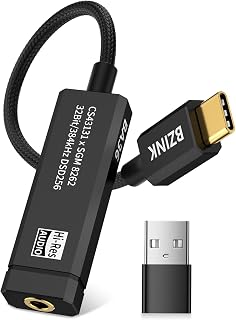
The BZINK BA36 is a premium USB-C to 3.5mm DAC adapter engineered for audiophiles, music producers, and anyone who demands authentic audio reproduction. It combines dual high-performance chipsets (CS43131 and SGM8262) to decode Hi-Res audio up to 32-bit/384kHz, making it ideal for professional monitoring, critical listening, and mobile music production.
The standout feature is its 227mW output power across the full 16 to 600 ohm impedance range. This means whether you're using delicate in-ear monitors or demanding 300-ohm studio headphones, the BA36 delivers clean, dynamic sound without audible noise or compression. The measured performance specs, 125dB SNR and -110dB THD+N, confirm the device operates with minimal background noise and distortion.
Build quality reflects its positioning in the premium segment. The aluminum alloy shell provides durability and electromagnetic shielding, while the silver-plated oxygen-free copper cable ensures signal integrity without oxidation over time. At just 37 grams, it remains portable enough for daily commuting, travel, or studio setups without adding meaningful weight to your bag.
The main limitation is its reliance on the 3.5mm jack in an era when many new devices have abandoned it. Additionally, casual listeners using standard Bluetooth earbuds or basic in-ear monitors may not hear meaningful improvement over simpler adapters, making this a specialist tool rather than a universal solution.
Verdict: The BZINK BA36 delivers genuine professional-grade audio in a compact, portable package. If you own quality wired headphones and demand the best possible sound from your USB-C device, this adapter justifies its investment. The generous warranty and responsive support add confidence to your purchase.
Musicians and producers working with mobile recording setups will appreciate the flat frequency response and low noise floor for critical mixing and monitoring. The adapter's powerful amplification handles professional studio headphones easily, making it ideal for on-location work or portable recording rigs.
Audiophiles with high-quality wired headphones in the 100-600 ohm range finally have a mobile solution that does justice to their equipment. The Hi-Res audio support unlocks the full potential of lossless music files and high-bitrate streaming services.
Content creators who edit audio or video on USB-C laptops or tablets can use the BA36 for accurate listening while working, ensuring their mix decisions translate well to consumer playback. Gamers using high-impedance gaming headsets will also benefit from the clean amplification and minimal latency.
Audio Performance: 32-bit/384kHz Hi-Res decoding, 227mW@32 ohm output, 125dB SNR, -110dB THD+N, 16-600 ohm impedance support
Connectivity: USB Type-C input, 3.5mm headphone output, includes USB-A adapter for legacy devices
Physical: Aluminum alloy shell, silver-plated oxygen-free copper cable, 37.65g, compact portable design
Compatibility: iPhone 15 series, Android USB-C devices, iPad, tablets, USB-C laptops. Plug-and-play, no drivers required
Warranty: 20-month limited warranty with 24-hour email support and 100% satisfaction guarantee

For a gaming setup built around a desktop speaker system rather than headphones, this unit's optical, coaxial, and USB inputs let it pull digital audio straight from a PC and convert it for powered speakers or a home stereo amp. That makes it a fit for players who want cleaner, console-free sound staging at their desk.
Pros
- Three input types cover PC and console sources
- Bass and treble knobs tune sound for different games
- 24-bit/192kHz support for detailed in-game audio
- Solid metal build with cables included
Cons
- No microphone input for chat or streaming
- 5V power limits headroom for high-impedance headphones
If you're asking whether a DAC actually helps gaming, the Q4 is a good test case. Your motherboard's onboard audio is sharing electrical space with every other noisy component on the board, and that's exactly what a DAC fixes by moving the conversion outside the PC entirely. The Q4 takes USB, Optical, or Coaxial from your PC or console and outputs through 3.5mm or RCA, so it slots into a gaming setup without forcing you to rebuild your audio chain. Bass and treble knobs let you tune footstep and gunfire clarity differently than you would for music, and the 24-bit/192kHz support means competitive titles with detailed sound design come through cleaner than stock audio typically allows. The all-metal chassis and included cables mean setup is quick, which matters if you just want better game audio without a project. It won't replace a gaming headset's mic function, but for the actual listening half of the equation, it's a legitimate upgrade over integrated sound.
Audio Specifications: 24-bit/192kHz maximum resolution, Stereo output, Supports headphones 16 to 200 ohms impedance, Low jitter conversion.
Connectivity: Digital Inputs: USB, Optical, Coaxial. Audio Outputs: 3.5mm headphone jack, RCA stereo connectors. Compatible with amplifiers, speakers, headphones, televisions.
Physical: Dimensions 3.9 inches L x 2.9 inches W, Weight 430 grams, Full metal construction, Tabletop mounting, Compact desktop-friendly design.
Power and Controls: 5V DC power supply, Adjustable bass and treble controls, Volume adjustment with premium metal knobs, Output protection circuit for safety.
Included Accessories: USB charging cable, Optical cable, PC-USB to Type-B cable, User guide. Warranty: 24-month manufacturer warranty.
Buy this if your gaming audio runs through onboard motherboard sound and you want cleaner separation between footsteps, voice chat, and effects. It suits PC and console gamers using headphones or desktop speakers. Skip it if you need a mic input for voice chat, since the Q4 has none, or if you run high-impedance studio headphones that need more power than a 5V supply provides.

Pros
- Noticeably improves sound clarity and volume compared to standard adapters
- Works seamlessly across multiple devices with included USB-A adapter
- Excellent build quality with premium materials and thoughtful design
- Compact size makes it genuinely portable for daily use
- Great value for audiophiles and casual listeners seeking better sound
Cons
- Not all phones immediately recognize the adapter, requiring troubleshooting on some devices
- Limited to 3.5mm headphones, not compatible with wireless audio
- May require volume adjustment on some sources due to enhanced amplification
The KBEAR DAC1 is a portable USB-C DAC and headphone amplifier designed to breathe new life into wired 3.5mm earbuds and IEMs. It's ideal for anyone frustrated by weak audio output from their modern devices, whether that's a smartphone, tablet, laptop, or music player.
The standout feature is the combination of the KT0231H DAC and HT97220 amplifier chip. The DAC handles high-resolution audio decoding up to 32-bit/384kHz, while the amplifier delivers up to 125mW of clean power at 32 ohms, enough to drive even demanding IEMs with fuller dynamics and tighter bass response. Real-world testing confirms reviewers hear a dramatic difference in clarity and presence compared to cheaper adapters.
Build quality is excellent for the price point. The 8-core OCC silver-plated cable reduces signal loss, and the transparent case window reveals quality internal construction. Despite its tiny form factor, it feels sturdy and designed to last. The included USB-A adapter adds genuine versatility, letting you use it on older computers and devices without native USB-C ports.
The main limitation is compatibility inconsistency. While it works with most phones and computers, some users report connection issues on certain devices. Additionally, it only supports 3.5mm wired audio, so if you've already switched to wireless earbuds, this won't help. The added amplification occasionally requires volume adjustments depending on your source device.
Overall, the KBEAR DAC1 represents solid engineering in a pocket-sized package. For $13, it delivers a tangible upgrade in audio quality for anyone still using wired earbuds or IEMs across multiple devices. It's worth buying if you value sound quality and want genuine improvements without overspending.
This adapter suits several audiences. Audiophiles and music enthusiasts using high-quality IEMs will appreciate the transparent sound and amplification capability. Mobile gamers benefit from the enhanced audio clarity and dynamic range during extended play sessions. Content creators and musicians need reliable, portable audio output for on-the-go work, and the USB-A adapter ensures compatibility across studio and personal devices.
It's also valuable for anyone with an older computer or music player lacking a headphone jack. The KBEAR DAC1 breathes new life into devices stuck on USB audio, delivering significantly better sound than built-in solutions. However, if you use primarily wireless earbuds or don't care about audio quality beyond basic listening, this adapter won't provide meaningful benefit.
Audio Processing: KT0231H DAC chip, PCM decoding up to 32-bit/384kHz, Hi-Res certified. Amplification: HT97220 independent amplifier, 125mW output at 32 ohms. Cable: 8-core OCC silver-plated with low-resistance design. Compatibility: USB-C and USB-A (with included adapter), works with iPhones with USB-C, iPads, MacBooks, Android phones, laptops, desktops, and car stereos. Output: 3.5mm standard headphone jack. Size: Compact pocket-friendly design. Warranty: 1 year manufacturer warranty. Features: Transparent chip window design, noise reduction, dual-interface support.

Pros
- Excellent compatibility across gaming consoles, PCs, and popular gaming headset brands
- Flexible audio configuration with 16 EQ presets and multiple sound modes for different scenarios
- High-quality audio processing at 192KHz/24bit resolution ensures detailed, crisp sound
- Dual output capability lets you connect headphones and speakers simultaneously
- Affordable entry point to virtual surround sound gaming audio
Cons
- Virtual 7.1 surround sound cannot match true hardware surround implementations for critical listening
- Limited customer reviews (20 total) means less user feedback on long-term reliability
- Setup and driver compatibility may vary depending on gaming platform or operating system version
The VENTION 7.1 Gaming DAC is an external USB sound card designed for gamers seeking enhanced audio on a budget. It targets PC players, console gamers on PS4/PS5 and Xbox, and anyone using gaming headsets who wants to elevate their audio experience without investing in high-end audio equipment.
The standout feature is its virtual 7.1 surround sound processing combined with 192KHz/24bit high-resolution audio. The 16-preset independent equalizer gives you granular control over frequencies, while gaming, cinema, and standard sound modes let you optimize audio for different activities. Dual output support means you can connect both headphones and external speakers simultaneously, providing flexibility for various setups.
Build quality appears solid for the price point. The USB-C connectivity and three 3.5mm jacks provide excellent connectivity options. The RGB lighting system adds a gaming aesthetic without compromising functionality. The compact form factor makes it portable for console gaming or travel.
The main limitation is that virtual surround sound, while effective for gaming immersion, cannot replicate true multi-speaker surround systems. Additionally, with only 20 customer reviews, there is limited feedback on durability and long-term performance. Driver compatibility may also depend on your specific platform or operating system.
The VENTION 7.1 Gaming DAC represents good value for mid-range gamers wanting improved directional audio cues and customizable sound profiles. It delivers noticeable improvements in gaming immersion and works seamlessly across major platforms, making it a practical choice for budget-conscious players upgrading from basic onboard audio.
Audio Performance: 7.1 virtual surround sound, 192KHz/24bit resolution, 120dB signal-to-noise ratio, professional DSP sound card chip
Connectivity: USB-C input, three 3.5mm jacks (microphone, headphones, auxiliary), supports TRS and TRRS microphones
Compatibility: PC, laptop, PS4, PS5, Xbox, Nintendo Switch, gaming headsets (Logitech G432, HyperX Cloud III, Razer BlackShark V2 X)
Features: 16 EQ presets, gaming/cinema/standard sound modes, dual audio output, independent volume control, one-click mute, RGB lighting system
Package Contents: Sound card, USB-C cable, instruction manual, 1-year warranty
Best For: Competitive gamers on PS4, PS5, Xbox, or PC seeking better directional audio for game awareness. Console players wanting surround sound without complex setup. Users with gaming headsets who want customizable audio profiles. Budget-conscious buyers looking to upgrade from basic onboard audio.
Not Ideal For: Audiophiles seeking true lossless surround sound or Hi-Fi audio quality. Users needing true hardware surround speaker systems. Those with minimal connectivity needs or no gaming focus.
Perfect Match If: You game competitively and want to hear enemy positions clearly, you use a compatible gaming headset, you switch between multiple devices and platforms, you value audio customization, and you want professional audio features at an affordable price.
Buying Guide
Start With the Weak Link in Your Audio Path
Begin with the connection you use now. Modern motherboards and USB headsets can sound clean, but controller jacks, front-panel ports, and budget monitor outputs are more likely to introduce faint hiss, weak volume, or interference when other hardware is active.
A dedicated DAC is most useful when a direct connection exposes noise, struggles at normal listening volume, or lacks the digital and analog connections your setup requires. If you are still choosing listening gear, browse the wider Headphones & Audio collection to match the DAC choice to the headphones you actually plan to use.
The Fosi Audio Q4 DAC Headphone Amp for PC makes sense for a simple desktop path with USB, optical, and coaxial inputs, plus headphone and RCA outputs. The PROZOR DAC Converter with Bluetooth 5.0 Remote is more focused on converting optical or coaxial TV and console audio to analog outputs, while adding Bluetooth playback and remote volume control.
Match Headphone Power and Noise Control
Headphone impedance is useful, but it is not the whole story because sensitivity also affects how hard headphones are to drive. Sensitive IEMs benefit most from a quiet output and smooth low-level volume control, while larger full-size headphones may need more voltage and current to sound dynamic without pushing a weak source to its limit.
The Fosi Audio K7 DAC Headphone Amp offers substantial listed output power for demanding headphones and includes both 4.4 mm balanced and 3.5 mm headphone connections. Its broader set of USB-C, optical, coaxial, Bluetooth, microphone, and RCA connections also suits a desk where gaming, music, and powered speakers share one audio hub.
For portable wired play, the BA36 USB C DAC with CS43131+SGM8262 HiFi Chip is designed for a wide impedance range, while the KBEAR DAC1 USB C to 3.5mm Audio Adapter targets efficient earphones with a compact amplified design. The goal is comfortable headroom and a low-noise floor, not maximum loudness, and our Cables & Adapters guides can help if connector choices are part of the decision.
Confirm Console, Chat, and Input Compatibility
Console support deserves its own check because USB audio behavior varies by platform. PS5 and Switch players should look for a clearly stated console mode or UAC 1.0 support, while optical input can be valuable when the TV is the center of the setup instead of the console itself.
The Fosi Audio C3 Gaming DAC Amp for PC includes UAC 1.0 and UAC 2.0 modes for console-oriented plug-and-play use and higher-resolution PC or Mac playback. Its microphone processing, browser-based EQ, and virtual surround features give it a focused gaming role, but you should still confirm that its available ports suit your exact chat and headset arrangement.
The Aveek Gaming DAC Headphone Amplifier, Bluetooth takes a different route with Bluetooth, USB, optical, coaxial, and RCA inputs, along with a front microphone input and three-band EQ. If Nintendo compatibility is your priority, pair that research with our Switch 2 headset guide, since the headset connection can matter as much as the DAC itself.
Prioritize Useful Positional Features, Not Marketing Alone
A DAC cannot invent positional detail that is absent from a game’s mix, but clear conversion, adequate power, and thoughtful EQ can make subtle directional cues easier to notice. Stereo headphones often work very well with a game’s built-in spatial settings, so enable one surround method at a time rather than stacking multiple processing layers.
The VENTION 7.1 Gaming DAC External USB Sound Card adds virtual 7.1 processing, selectable modes, preset EQ options, separate microphone and headphone ports, and dual-output capability for a headset and speakers. It is a practical fit if hands-on effects controls appeal to you, although its virtual surround presentation will depend on your headphones and preferences.
For FPS players, the Fosi Audio C3 Gaming DAC Amp for PC also includes StepSense footstep enhancement and HRTF-based 7.1 processing. Treat these as optional tools rather than automatic advantages: begin with a neutral profile, use the game’s headphone setting, then make restrained EQ changes so explosions and bass do not bury quieter movement cues.
Final Thoughts
A DAC is optional rather than mandatory for gaming, but it can be a rewarding answer to weak headphone drive, noisy outputs, missing inputs, or inconvenient volume control. Choose the Fosi Audio C3 Gaming DAC Amp for PC for a feature-rich desktop and console focus, or the KBEAR DAC1 USB C to 3.5mm Audio Adapter when a pocket-sized wired solution is all you need.
Frequently Asked Questions
Do you need a DAC for gaming with a USB headset?
Usually not, because a USB headset already contains its own DAC and amplifier. A separate unit helps only if you move to analog headphones, need different connection options, or want a physical volume control beyond what the headset provides.
In 2026, a quality USB headset can remain a straightforward solution for game audio and chat. If you are considering a switch to dedicated headphones, our Sennheiser headphones guide can help you compare models that may reveal more from a better source.
Does a DAC make footsteps easier to hear in FPS games?
It can, but the improvement comes from clean playback, sufficient headphone drive, and the game’s own spatial mix rather than a magic competitive setting. A DAC cannot add a footstep cue that the game audio does not include.
Start with a neutral EQ and confirm that the game’s dynamic-range and headphone options are set appropriately. Then make small changes to bass or upper mids, because excessive low end can mask details just as easily as a weak audio source can.
Can you use a DAC with PS5, Switch, and a microphone?
You can, provided the unit supports the console’s USB audio mode and offers the microphone arrangement you need. A model with a front mic input can simplify analog headset chat, while other units may handle game audio well but require a separate path for voice communication.
Check whether the device specifies UAC 1.0 support for your console and whether its headphone jack supports your headset plug type. For a more complete voice setup around streaming or multiplayer chat, see our Shure microphone picks for streaming and recording.
Is a USB-C DAC dongle enough for mobile and handheld gaming?
For IEMs and efficient wired headphones, a compact dongle is often enough and is far easier to carry than a desktop unit. The USB C to 3.5mm Audio Adapter with DAC for iPhone is built for plug-and-play use with compatible phones, tablets, laptops, and handheld devices.
Move to a larger DAC amp if your headphones need noticeably more power, you want optical or RCA connections, or you need a microphone input and physical EQ. Also confirm that your device’s USB-C port supports digital audio output before choosing any dongle.





Write Your Review
No reviews yet. Be the first to share your experience!