

You plug in your power bank before heading out, check it an hour later, and it is barely at 30 percent. Sound familiar? Slow charging is one of the most common frustrations with portable chargers, and the root cause is almost always one of a few fixable issues: the wrong cable, an underpowered wall adapter, or a power bank that simply lacks fast-charging support. Understanding the difference can save you a lot of waiting.
This guide breaks down exactly why your power bank charges slowly, what to look for in a faster replacement, and which models are worth considering in 2026. Whether you are topping up a phone on a commute or keeping a laptop alive through a long flight, there is a right tool for the job. If you are also planning for off-grid use, our roundup of the best power banks for camping covers rugged, high-capacity options worth bookmarking.
Quick answer
This guide compares 8 picks, with Miady 2-Pack 10000mAh Portable Charger with USB-C, Slim ranked first.

Miady 2-Pack 10000mAh Portable Charger with USB-C
Slow charging often traces back to a weak output stage, and this one pairs a 2.4A amperage with auto shut-off to stop wasting cycles once your device is full. The slim, lightweight build and dual-pack setup make it easy to keep a backup ready, so you're never stuck waiting on a single depleted unit.
Pros
- Four ports total let multiple devices charge at once without competing
- Bidirectional USB-C port simplifies input and output
- Two units included for a built-in spare
- LED indicators show remaining battery clearly
Cons
- No Lightning cable included for iPhone users
- 10,000mAh capacity generally covers only one full smartphone charge
A slow charge is often really a shared-port problem: one cable, one device, one line of people waiting. The Miady 2-Pack sidesteps this by giving each device its own dedicated line, with two USB-A ports and a bidirectional USB-C port supporting simultaneous charging at 2.4A output. That means your phone isn't competing with a tablet or earbuds for power, which is one of the most common reasons charging feels slower than expected. The bidirectional USB-C port also simplifies things, since it handles both recharging the bank and powering a device without needing separate cables. With two full 10,000mAh units included, you get a built-in backup plan too, since a nearly dead bank is as frustrating as a slow one. LED indicators let you check remaining charge before you head out, so you're not guessing whether the pack has enough juice left for a full top-up. It's a practical fix for charging frustration rooted in device competition rather than wattage limits.
Capacity and Power: 10000mAh battery capacity with 3.7V voltage and 2.4A output current. Lithium polymer battery cell type ensures reliability and longevity.
Ports and Connectivity: Four total ports: two USB-A and one bidirectional USB-C for input/output, plus one additional port. Supports simultaneous charging of three devices.
Physical Dimensions: Measuring 5.5 x 2.6 x 0.6 inches and weighing 7.68 ounces, the ultra-slim design prioritizes portability without sacrificing capacity.
Compatibility: Works with iPhone 18/17/16/15/14/13/12/11 series and older X/XS/XR/8/7/6/5 models, iPad Air/Pro, Galaxy S series, Pixel phones, Moto devices, and PS4/5 consoles.
Package Contents: Two 10000mAh chargers in black and white, two USB-C cables, and user manual. Includes 18-month limited warranty and 24/7 customer service support.
Buy this if slow charging in your household comes from multiple devices sharing one charger, or if you want a spare bank always ready to go. It suits students, commuters, and families. Skip it if you need Lightning cable included, since it's not in the box, or if you're after high-wattage fast charging, as this focuses on multi-device convenience rather than maximum output speed.

For readers chasing a real fix to slow charging, 45W PD fast charging and a 3A amperage rating put this well above standard 10W banks. The digital display lets you watch charge speed in real time, while overcharging protection keeps performance consistent instead of tapering off as the cells age.
Pros
- 45W PD fast charging significantly cuts charge time
- Three ports allow simultaneous fast charging of multiple devices
- 18-Layer SmartProtect helps sustain speed safely
- Broad compatibility across iPhone, Samsung, Pixel, iPad, and Apple Watch
Cons
- 10,000mAh capacity suits daily top-ups, not multi-day trips
- Lanyard design may wear compared to a permanently built-in cable
When a power bank feels slow, it's often underpowered or stuck trickle-charging multiple devices at once, and the INIU P55 is built to avoid both. Its 45W PD fast charging gets an iPhone to 65% or a Samsung device to 75% in just 30 minutes, which is a real answer to the 'why is this barely moving' problem. With three ports, two USB-C and one USB-A, it can fast-charge a phone, tablet, and earbuds at the same time without any one device slowing to a crawl. An 18-Layer SmartProtect system manages heat, current, and voltage, which helps sustain that speed reliably rather than throttling under load. Wide device compatibility across recent iPhones, Samsung, Google Pixel, iPads, and Apple Watches means the fast charging isn't limited to one ecosystem. At 10,000mAh it's not meant for marathon trips, but for daily use where the goal is getting a device charged quickly and moving on, it's built specifically around speed rather than raw capacity.
Core Specs: Capacity: 10000mAh / Battery Type: Lithium Polymer / Output: 45W / Ports: 2 USB-C + 1 USB-A / Dimensions: 4.4 x 2.7 x 0.7 inches / Weight: 6.5 oz (160g)
Additional Features: Digital display, integrated phone stand, built-in flashlight, detachable USB-C lanyard, over-charge protection, 18-Layer SmartProtect technology, airline-friendly
Warranty: 3 years / Colors: Black / Model: P55-E2
Pick this if your frustration is slow charging on day-to-day devices and you want multi-device fast charging in something slim enough for daily carry. Skip it if you need a single bank to cover several days without an outlet, since 10,000mAh is meant for top-ups rather than extended backup power.
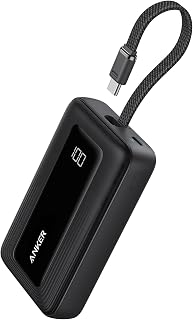
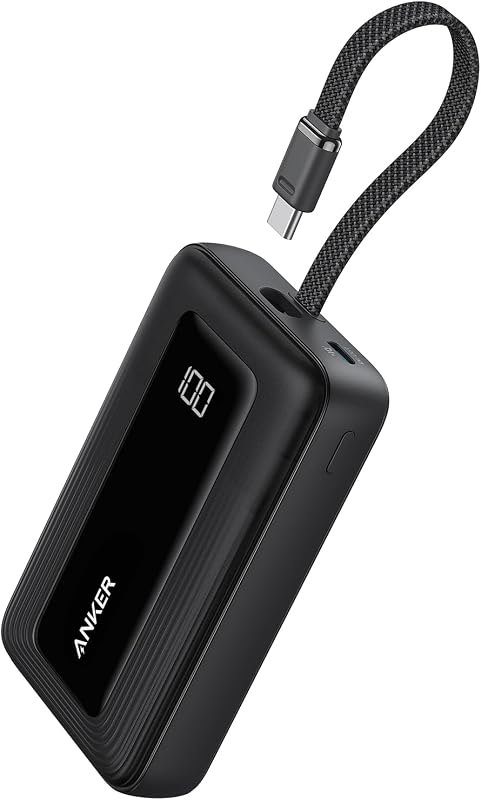
If sluggish charging comes from cable wear or loose connections, a built-in USB-C cable removes that variable entirely. Rated at 30W with a 10000mAh capacity, it delivers steadier output than basic bank, while the attached cable means you're not relying on an old, damaged cord that's quietly throttling your charge speed.
Pros
- 30W output cuts charging time nearly in half
- Built-in cable rated for 10,000+ bends avoids a common slow-charge culprit
- Bi-directional 20W charging speeds up the bank's own refill
- Compact 223g build fits easily in pockets or small bags
Cons
- 10,000mAh capacity is limiting for extended trips
- Lightning device users need a separate cable for fast charging
If slow charging is the problem, the fix often comes down to wattage and cable quality, and this Anker hits both. Its 30W output pulls a smartphone to 50% in just 27 minutes, nearly double the speed of a standard charger, which directly solves the frustration of watching a battery creep up too slowly. Part of the slowness people experience also comes from worn or underpowered cables, so Anker built the solution in: a permanently attached USB-C cable rated past 10,000 bends, removing a common weak link. Bi-directional 20W charging also means refilling the bank itself happens faster between uses, so you're not left waiting on that end either. At 223 grams and pocket-sized, it adds speed without adding bulk. For anyone whose complaint is specifically 'this takes too long,' the combination of high wattage, a durable built-in cable, and a secondary USB-A port for other gear makes this a practical, fast-charging-first pick rather than a capacity-first one.
Capacity and Power: 10000mAh battery with 30W output and 20W input charging.
Dimensions and Weight: 4.32 x 2.58 x 0.98 inches, weighing 223 grams (battery 212g).
Ports: Built-in USB-C cable (5.4 inches) plus one USB-A port for dual charging.
Charging Performance: Delivers 50% charge to iPhone 16 Pro Max in 27 minutes. Up to 2 full charges for iPhone 15, 1.94 for Samsung S24, 10 for AirPods Pro 2.
Compatibility: iPhone 15 series, MacBook, Galaxy, iPad, Nintendo Switch, Steam Deck, and USB-C devices. Lightning cable required separately for iPhone 14 and earlier.
Safety and Warranty: ANATEL certified, includes 18-month manufacturer warranty and customer support.

For readers whose devices take forever to top off, the 30W output and 3A amperage on this 20000mAh bank push more power through per minute than entry-level units. The built-in USB-C cable also eliminates a common slowdown culprit, a frayed or underspec'd cable bottlenecking the connection.
Pros
- 30W two-way fast charging speeds up both phone and bank
- Durable built-in cable rated for 10,000+ bends
- 20,000mAh capacity covers multiple full charges
- ActiveShield 2.0 monitors temperature during fast charging
Cons
- Bulkier and heavier than slim, pocket-focused power banks
- 5-hour recharge time requires planning ahead
Slow charging usually comes from two things: low wattage and poor cables, and the Anker Zolo addresses both while adding capacity to spare. Its 30W two-way fast charging gets a phone to roughly half charged in about 30 minutes, which is the kind of speed that actually solves the 'why is this taking forever' frustration. The built-in 5.98-inch USB-C cable, rated past 10,000 bends, also removes the degraded-cable issue that quietly slows down many charging sessions over time. Because the bank itself recharges at 20W, downtime between uses stays short too, so the whole cycle feels faster end to end. With 20,000mAh behind it, this isn't just a quick fix, it's enough to get through multiple full phone charges, so speed doesn't come at the cost of running out early. ActiveShield 2.0 keeps constant temperature checks running during those fast sessions, which matters since fast charging generates more heat. For anyone frustrated by slow top-ups on long days out, this covers both the speed and the stamina side.
Capacity and Power: 20,000mAh battery with 30W output and 20W input charging speed. Compatible with smartphones and other USB-C devices. Charges iPhone 15 from 0 to 57% in 30 minutes.
Ports and Connectivity: Built-in 5.98-inch USB-C cable plus two additional USB-C ports, totaling three charge points. Supports simultaneous multi-device charging up to 3 amperes per connection.
Physical Specs: Dimensions 4.72 x 2.89 x 1.24 inches, weighs 12.45 ounces. Compact and travel-friendly design. Lithium Polymer single battery included.
Safety and Reliability: ActiveShield 2.0 technology with 3 million temperature checks daily. 18-month manufacturer warranty included. Recharge time: approximately 5 hours.
Good for anyone who wants fast charging without sacrificing capacity, especially travelers or heavy phone users who charge multiple times a day and find slower banks frustrating. Less ideal if pocket portability matters most, since it's noticeably larger and heavier than slim banks, or if a 5-hour recharge time doesn't fit your routine.

When a laptop or multiple devices charge painfully slowly off a single bank, 140W total output and 5A amperage give this one the headroom to push full speed to each port. The smart display shows exactly how much power is flowing, so you can confirm it's not quietly underdelivering.
Pros
- 140W output charges laptops and phones at full speed
- Digital display shows real-time wattage to diagnose slow charging
- Recharges itself in about 52 minutes
- 3 ports allow simultaneous multi-device charging
Cons
- Requires a compatible 140W USB-C charger to hit top speeds
- Basic chargers and cables will bottleneck performance
Slow charging usually comes down to one of two things: a weak power source or a bank that can't push enough wattage to match your device's needs. The Anker 737 solves the second half of that equation. Its 140W Power Delivery 3.1 output and 24000mAh capacity mean it can feed power-hungry laptops and phones at full speed instead of trickling them along. The built-in smart display is especially useful here, since it shows real-time wattage draw, so you can actually see whether a device is charging at the rate it should be or being bottlenecked by a weak cable or charger. The bank itself recharges from empty in about 52 minutes when paired with a sufficiently powerful charger, which is dramatically faster than typical power banks that take several hours. If your current charging setup feels sluggish, this is built specifically to fix that, provided you pair it with the right accessories.
Capacity and Power: 24000mAh, 140W output, Power Delivery 3.1 technology
Ports: 3 ports (USB-A and USB-C configurations), supports simultaneous multi-device charging
Charging Speed: 52-minute recharge time with compatible charger and cable
Compatibility: MacBook Pro and Air, iPad Pro, iPhone 16/15/14/13 series, Samsung Galaxy S23/S22/S21/S20, Dell and other USB-C laptops
Dimensions and Weight: 6.13 x 2.14 x 1.95 inches, 1.4 pounds
Battery Type: Lithium Polymer, 5V/5A rated
Special Features: Digital display with real-time power monitoring, TSA carry-on approved
Warranty: 24-month stress-free warranty with Anker customer support
Buy this if you're charging laptops, phones, or tablets on the go and want visible proof your charging speed is actually fast, not just advertised as fast. Skip it if you only own basic USB chargers and cables, since you won't unlock the 140W speeds and will end up paying for performance you can't access. Also skip it if you just need a small backup charge for a phone.
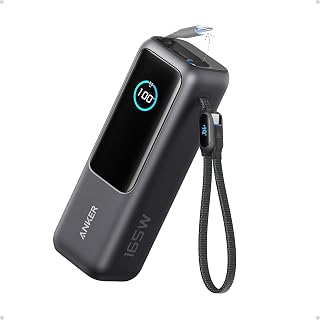
Laptops are usually the slowest things to charge from a power bank, and 165W total output paired with 5A amperage addresses that directly. The built-in cable also removes a frequent slowdown cause, a mismatched or damaged cord, so the full rated output actually reaches your device.
Pros
- 165W total output avoids slow charging under multi-device load
- Built-in USB-C cables remove cable mismatch issues
- Pass-through charging keeps devices powered while the bank recharges
- Digital display confirms real-time wattage output
Cons
- No charger included, so a separate 100W+ charger is needed for fast recharging
- Heavier and less flat than minimalist power banks
A common cause of slow power bank charging is mismatched hardware, where the bank supports fast charging but the charger or cable plugged into it doesn't. This Anker model removes a layer of that guesswork by including built-in USB-C cables, including an extendable one, so you're not relying on whatever cable happens to be on hand. With 165W total output across three 100W USB-C ports and one USB-A port, it's designed to charge laptops and multiple devices at full speed rather than slowing down under combined load. The digital display tracks battery percentage and real-time wattage, letting you confirm devices are actually pulling the power they should. Recharging the bank itself takes about 2 hours, but only when paired with a 100W or higher USB-C charger, since no charger ships in the box. Pass-through charging is another plus, letting you power devices while the bank recharges rather than waiting idle.
Capacity and Power Output: 25000mAh battery with 165W total output across four ports (3x 100W USB-C ports, 1x USB-A port). Recharge time approximately 2 hours with 100W+ charger.
Design and Portability: Dimensions 6.18 x 2.12 x 1.92 inches, weighs 300g. Airline carry-on approved at 100Wh. Black color with compact rectangular design featuring rounded corners for comfortable grip.
Built-In Cables: Two integrated USB-C cables, one extendable to 2.3 feet with 20000+ retractions, second cable at 0.98 feet functions as a durable carrying strap rated for 20000+ bends.
Compatibility and Features: Works with iPhone 13-16 series, Google Pixel 7-8, Samsung Galaxy S23-S24, MacBooks, and all USB-C devices. Supports PPS, PD, and Qualcomm Quick Charge technologies. Digital display shows battery percentage and wattage output. Pass-through charging supported. Lithium polymer battery with 18-month warranty included.
Good fit for anyone juggling a laptop plus phone or tablet who's tired of hunting for the right fast-charging cable. The built-in cables and 165W output solve both the speed and convenience problem at once. Skip it if you don't already own a 100W+ USB-C charger, since without one the 2-hour recharge claim won't apply, or if you want the lightest, flattest bank possible for packing.

Wireless charging is notoriously slow, so the 22.5W fast charging spec here matters for anyone frustrated by trickle-speed magnetic pads. The 3A amperage keeps wired input brisk too, and the ultra-slim magnetic design means it stays aligned on the back of an iPhone instead of slipping and interrupting the charge.
Pros
- 22.5W wired USB-C charging for genuinely fast top-ups
- Magnetic attachment for hands-free, cable-free convenience
- Slim, lightweight build at 0.5 inches thick
- 2-hour recharge time gets the bank itself back to full quickly
Cons
- Magnetic wireless mode is limited to 7.5W, slower than wired
- Non-MagSafe Android phones need an extra magnetic case or ring
Slow charging usually comes down to one of three culprits: a weak cable, an underpowered port, or a bank that simply can't push enough wattage. The TORRAS MiniMag addresses the last two directly. Its USB-C port delivers 22.5W wired output, well above the 5W trickle many basic banks top out at, so a depleted iPhone climbs back to usable levels much faster than magnetic-only competitors. If you're relying on the magnetic snap-on connection instead, know that wireless output caps at 7.5W, noticeably slower than plugging in, so treat that mode as convenience charging rather than a quick top-up. Pair the bank with its USB-C cable when speed is the goal. Beyond raw speed, the 10,000mAh capacity and 2-hour recharge time mean you're not left waiting around between uses. For iPhone 12 through 18 owners frustrated by sluggish charges, switching to the wired connection on this bank is a straightforward fix, while the magnetic attachment stays available for hands-free, lower-priority charging during calls or navigation.
Capacity: 10,000mAh (3.87V DC). Charging Speed: 22.5W USB-C wired output, 7.5W wireless for iPhones, 15W wireless for compatible devices. Recharge Time: 2 hours via USB-C. Ports: 1 USB-C input/output. Dimensions: 4.03 x 2.63 x 0.5 inches. Weight: 6.4 ounces. Battery Type: Lithium Ion (included).
Compatibility: MagSafe-compatible iPhones 12 through 18 series. Works with Samsung Galaxy, Google Pixel, and other phones via magnetic case or ring. Also compatible with iPads, AirPods, smartwatches, and other USB-C devices. Safety: FCC, UL, TUV, DOE, CEC, UN, and RoHS certified. Temperature control, overcharge protection, and heat-management design included.
Buy this if you're an iPhone 12-18 owner who wants a fast wired option plus the convenience of magnetic attachment when speed isn't critical. It suits commuters and travelers who want a slim, pocketable backup. Skip it if you mainly need fast wireless charging, since the magnetic mode is capped at 7.5W, or if you're on Android without a MagSafe-style case or ring.

Small magnetic power banks are often the slowest to charge, but 2.4A amperage here keeps output respectable for a compact 5000mAh unit. The foldable magnetic stand holds it steady against your phone, preventing the misalignment that causes wireless charging to drop speed or stop mid-session.
Pros
- Built-in kickstand doubles as a hands-free phone stand
- Strong magnetic alignment snaps on without fumbling
- Slim, under 5-ounce build that barely adds bulk
- 2-hour recharge time for the bank itself
Cons
- MagSafe wireless charging is less efficient than wired, so it's slower
- Battery tends to drain quickly when sitting idle
If your power bank feels slow, wireless charging is often the reason, since magnetic systems lose energy as heat compared to a direct cable connection. The Anker 622 is upfront about this tradeoff rather than hiding it. It relies on MagSafe wireless charging, which is convenient but inherently less efficient than wired charging, so expect it to fill an iPhone more gradually and deliver roughly one full charge from its 5,000mAh capacity rather than more. For anyone reading this article because their charging feels sluggish, this bank isn't the pick for raw speed. What it does offer is a dependable, low-fuss way to keep a phone topped up passively, especially with its built-in kickstand turning charging time into useful screen time for calls or navigation. The bank itself recharges in about 2 hours, so it's quick to get back in rotation. Think of it less as a fast-charging solution and more as a convenient backup that trades speed for portability and hands-free use.
Buy this if you want a slim, low-effort backup for iPhone 12 or newer and don't mind trading charging speed for MagSafe convenience and the kickstand. It works well as a secondary emergency bank. Skip it if slow charging is your main frustration, since wireless MagSafe charging is inherently less efficient than a wired connection, or if you need more than one full charge's worth of backup power.
What to Look for in a Fast-Charging Power Bank
Wattage Output: The Single Biggest Factor
The wattage a power bank can deliver determines how fast your device charges. A 5W output will trickle power into a modern smartphone, while 30W or 45W can bring a phone from empty to halfway in about 30 minutes. Always check the listed output wattage before buying.
The INIU Power Bank, Compact 10000mAh 45W PD delivers 45W over USB-C, enough to charge an iPhone 17 Pro to 65 percent in 30 minutes. The Anker Power Bank,10,000mAh 30W with USB-C Travel hits 30W bidirectional charging, meaning it both charges devices and recharges itself quickly using the same port.
Input Wattage: How Fast the Bank Itself Recharges
Most people focus only on output and forget about input. A power bank with a high-capacity battery but a weak input rate can take six or more hours to refill from a wall outlet. Look for at least 18W input on a 10,000mAh unit and 65W or higher for anything above 20,000mAh.
The Anker 737 Power Bank, 140W 24,000mAh 3-Port Laptop supports 140W two-way charging via Power Delivery 3.1, so its 24,000mAh battery refills far faster than comparable units. For heavy travelers, that recharge speed matters as much as the output. You can also explore more high-capacity options in our guide to the best 50000mAh power banks for travel and outages.
Cable and Port Compatibility
Even a 45W power bank will charge slowly if you are using an old USB-A cable that caps out at 10W. Fast charging protocols like USB Power Delivery require a USB-C to USB-C cable rated for the wattage you need. Using the cable that came with your phone is usually the safest starting point.
Some power banks solve this entirely with built-in cables. The Anker Zolo Power Bank,20,000mAh 30W includes a built-in 5.98-inch USB-C cable certified for over 10,000 bends, so you always have the right cable on hand. The Anker Laptop Power Bank, 25,000mAh Travel goes further with dual built-in cables plus a USB-A port, covering virtually every device you might carry.
Wireless vs. Wired Charging Speed
Wireless magnetic charging is genuinely convenient, but it is inherently slower than wired. Most magnetic power banks top out at 7.5W for iPhones over wireless, compared to 20W or more over USB-C. That said, the best magnetic models include a wired USB-C port so you can switch when speed matters.
The TORRAS MiniMag Power Bank,Ultra-Slim 10,000mAh pairs 7.5W wireless charging with a 22.5W USB-C output, giving you the snap-on convenience of MagSafe without sacrificing speed when you need a quick top-up. The Anker 622 Magnetic Power Bank is a slimmer option with a built-in kickstand, ideal for hands-free use during calls or streaming. For steam-powered gaming on the go, see our picks for the best power banks for Steam Deck.
Final Thoughts
Slow charging almost always comes down to mismatched hardware, and the fix is usually straightforward once you know what to look for. For most people who want a compact, genuinely fast everyday carry, the INIU Power Bank, Compact 10000mAh 45W PD is hard to beat at this size. If you need serious capacity for laptops and multi-device travel, the Anker 737 Power Bank, 140W 24,000mAh 3-Port Laptop delivers the raw power and smart display to keep everything running without guesswork.
Frequently Asked Questions
Why does my power bank charge my phone so slowly?
The most common reason is a mismatch between the power bank’s output wattage and what your phone needs for fast charging. If the power bank only outputs 5W over USB-A but your phone supports 25W fast charging, you will always get a slow charge. Switching to a USB-C power bank with Power Delivery support and using a compatible cable usually resolves this immediately.
Does the charging cable affect how fast a power bank charges my device?
Yes, significantly. Older USB-A cables often cannot carry more than 10 to 12 watts regardless of what the power bank can output. For fast charging in 2026, you need a USB-C cable rated for the wattage your power bank supports. Many newer power banks now ship with high-quality braided cables to eliminate this variable entirely.
Why does my power bank itself take so long to recharge?
This usually comes down to the wall adapter you are using to charge the bank, not the bank itself. A 5W phone charger plugged into a 20,000mAh power bank could take well over ten hours to fully recharge it. Use a wall adapter that matches or exceeds the power bank’s rated input wattage, and always use a USB-C port if one is available. Check out our guide to power banks with AC outlets if you need a unit that can also recharge from higher-wattage sources.
Is wireless charging from a power bank always slower than wired?
In most cases, yes. Magnetic wireless charging for iPhones typically maxes out around 7.5W, while a USB-C wired connection on the same power bank might deliver 20W or more. That said, wireless charging is still useful for casual top-ups when you do not need to be fully charged quickly. The best magnetic power banks include a USB-C port so you can choose based on how much time you have.
Common questions
Can a cable's rating limits actually slow down charging speed?
Yes, a cable rated for lower amperage or wattage than your charger caps the output no matter how fast the power bank can deliver. A basic USB cable often only supports around 2.4A, so even a 45W PD power bank like the INIU gets bottlenecked. Always match the cable to the port rating, and use the thicker cables bundled with fast charging power banks to get full speed.
What happens during the PD handshake when a device starts charging?
The PD handshake is the negotiation between the power bank and device to agree on voltage and current before power flows. If the handshake fails or defaults to a lower profile, charging slows down. Power banks with clear fast charging support, such as the INIU 45W PD model, are built to complete this negotiation reliably, while basic USB models without PD skip it entirely and charge at fixed lower speeds.
Does heat derating cause a power bank to charge more slowly?
Yes, heat derating happens when a power bank gets too warm and automatically reduces output to protect its battery and components. This is common during fast charging sessions or in hot environments. Slim, lightweight designs can be more prone to this since they have less room for heat dissipation, so letting the bank cool down or charging in a ventilated spot helps maintain consistent speed.



Write Your Review
No reviews yet. Be the first to share your experience!