

You are packing for a long flight or a multi-day camping trip and you want to know whether your 20000mAh power bank will actually cover your needs. The milliampere-hour rating tells you one part of the story, but watt hours are what really matter when you are comparing capacity across devices or checking airline carry-on rules.
A 20000mAh power bank operating at the standard 3.7V cell voltage holds about 74 watt hours (Wh) of raw energy. After accounting for conversion losses, expect around 50 to 60Wh of usable output, which translates to roughly three to four full charges for a modern smartphone. If you are shopping for a reliable portable charger, our roundup of the best Anker power bank picks for every traveler is a solid place to start.
Quick answer
This guide compares 8 picks, with Anker Zolo 20000mAh 45W Power Bank with Built-in USB-C ranked first. Anker 737 140W Power Bank 24000mAh Laptop Charger has the most customer reviews.

Built around a 20,000mAh cell with 45W output and a built-in USB-C cable, this is close to a reference model for the exact capacity the article discusses. Its 3 ports let readers think through how splitting output across devices affects the usable watt-hours versus the rated capacity.
Pros
- True 20000mAh capacity for direct comparison
- 45W fast charging for Samsung, 40W for iPhone
- Built-in USB-C cable rated for 10,000+ bends
- Real battery percentage display
Cons
- 5V rating limits it to phone/tablet-class charging, not laptops
- Heavier feel for ultralight travelers at this capacity
As another true 20000mAh bank, this is a helpful real-world anchor for the title's question: how many watt-hours does that capacity actually translate into, and what can you do with them. At 5 volts and with 45W fast charging, it illustrates the phone-focused end of the 20000mAh category, where the watt-hour total is spent on multiple full phone charges rather than laptop-class output. The 45W Samsung charging and 40W iPhone charging show how the same rated capacity gets allocated differently depending on the device, which is exactly the kind of nuance a watt-hour calculation needs to account for. The built-in USB-C cable, rated for over 10,000 bends, and the real battery percentage display add practical context for how much of that capacity you can actually monitor and use over time. It's less about laptops and more about showing what 20000mAh means for day to day phone and tablet charging.
Capacity and Power: 20,000mAh battery with 45W max output for Samsung devices and 40W for iPhone. Supports Samsung Fast Charging 2.0 and standard USB-C fast charging protocols.
Physical Dimensions: 4.72 inches long, 2.89 inches wide, 1.24 inches thick. Weight 12.48 ounces. Compact enough for standard travel bags, backpacks, and cargo pockets.
Cable and Connectivity: Built-in 5.98-inch (15.2 cm) USB-C cable with 3 total ports. Cable rated for 10,000+ bend cycles for extended durability. No additional cables or adapters needed for most devices.
Safety and Performance: ActiveShield 2.0 temperature monitoring checks conditions 3 million times per day. Lithium polymer battery cells for reliability. Recharge time 5 hours from empty using standard charger.
Warranty and Support: 18-month manufacturer's warranty included. Anker Innovations Limited customer service available globally. Model A1689.
A good fit for readers using this guide to plan phone, tablet, or multi-day travel charging rather than laptop charging, since output tops out at 45W. The built-in cable suits anyone who wants fewer accessories to carry. Skip it if your 20000mAh watt-hour question is really about powering a laptop, since this doesn't target that use case.

At 26,250mAh and 300W output with 5A amperage, this bank sits well above the 20000mAh class readers are comparing against, making it a useful benchmark for watt-hour math since higher capacity cells need more real-world charging power to back them up. The digital display also helps verify remaining capacity against the theoretical watt-hour figure as the pack drains.
Pros
- Digital display shows real-time power draw
- 300W total output across 3 ports
- TSA-compliant watt-hour rating for air travel
- Fast 80% recharge in 39 minutes
Cons
- Heavier and bulkier than a 20000mAh bank
- Needs a capable 5A cable for full speed
If you're trying to figure out the real watt-hour math behind a 20000mAh bank, the Anker Prime is useful context at the opposite end of the spectrum. At 26,250mAh and roughly 94 to 97Wh (using the 28V/5A-class rating, within TSA's 99.75Wh limit), it shows how capacity and voltage combine to produce usable energy, not just a mAh number on a box. For readers who land on this guide because their 20000mAh bank isn't cutting it, this is the step-up comparison: more watt-hours, a 300W total output split across three ports, and a digital display that shows real power draw instead of a vague percentage. The 140W max output and 250W dual USB-C input mean both discharge and recharge are fast, which matters when you're trying to understand efficiency and turnaround time, not just raw capacity. It's a good reference point for anyone trying to decide whether to size up from 20000mAh or stick with it.
Capacity and Power: 26,250mAh (99.75Wh) lithium polymer battery, 300W total output power, 140W maximum per port output.
Ports and Connectivity: Two USB-C ports, one USB-A port. 250W dual USB-C input supports simultaneous charging of the power bank and connected devices.
Charging Performance: MacBook Pro (M4) to 50% in 27 minutes, iPhone 16 Pro to 50% in 26 minutes, power bank 50% recharge in 13 minutes, 80% charge in 39 minutes.
Physical Specifications: Phantom Gray color, 6.3 x 2.5 x 1.5 inches, 600g weight (365g battery weight). Includes 3.3 ft USB-C to USB-C cable (240W rated), travel pouch, welcome guide, and 24-month warranty.
Compatibility: Compatible with MacBook Pro, MacBook Air, iPhones, iPads, Samsung devices, and other USB-C laptops. Model number A110A, UPC 194644239299.

This pack matches the 20,000mAh capacity in question but runs at 20V with 3A amperage and 30W output, giving a concrete data point for calculating watt-hours using the volts times amps formula readers need. The built-in cable also simplifies real-world testing of actual delivered energy.
Pros
- 20,000mAh capacity delivers roughly 4 full phone charges
- 30W two-way fast charging on both output and recharge
- Built-in cable rated for 10,000 bends plus two USB-C ports
- ActiveShield 2.0 temperature monitoring for safer high-output use
Cons
- Bulkier and heavier than ultra-slim 20,000mAh alternatives
- 5-hour recharge time requires planning ahead
A 20,000mAh capacity sits in a sweet spot for watt hour math, and the Zolo makes those numbers count. At roughly 74Wh (20,000mAh x 3.7V), it delivers enough energy to take an iPhone 15 through about four full charges or a Samsung S24 close to four, so you get real-world mileage that matches the on-paper capacity. The 30W two-way fast charging means you're not waiting around either: your phone can go from empty to half full in about 30 minutes, and the bank itself refills in 5 hours. Dual USB-C ports plus a built-in 5.98-inch cable rated for 10,000 bends mean you get three charging points without digging for a cord. ActiveShield 2.0 checks temperature 3 million times a day, which matters when you're pulling steady wattage from a battery this size. For anyone trying to figure out how far 20,000mAh actually stretches, the Zolo turns that spec into dependable, repeatable output.
Capacity and Power: 20,000mAh battery with 30W output and 20W input charging speed. Compatible with smartphones and other USB-C devices. Charges iPhone 15 from 0 to 57% in 30 minutes.
Ports and Connectivity: Built-in 5.98-inch USB-C cable plus two additional USB-C ports, totaling three charge points. Supports simultaneous multi-device charging up to 3 amperes per connection.
Physical Specs: Dimensions 4.72 x 2.89 x 1.24 inches, weighs 12.45 ounces. Compact and travel-friendly design. Lithium Polymer single battery included.
Safety and Reliability: ActiveShield 2.0 technology with 3 million temperature checks daily. 18-month manufacturer warranty included. Recharge time: approximately 5 hours.
Buy this if you want a 20,000mAh bank that converts its capacity into fast, practical charging without carrying extra cables. It suits travelers, festival-goers, and remote workers who charge phones heavily throughout the day. Skip it if you need to power a laptop, since this is built for smartphones, or if you want the slimmest possible 20,000mAh option, since the built-in cable and dual ports add some bulk and weight.

With a stated 5000mAh battery capacity but 100W PD output, this pack illustrates how the mAh number alone doesn't reveal total energy or usable watt-hours, especially once you factor in the 65W recharge spec and 20V operating voltage. Readers trying to understand the mAh-to-Wh conversion get a clear contrast case here.
Pros
- Same 20000mAh capacity as the article's reference point
- 100W output reaches laptop-charging speeds
- 65W self-recharge in 1.6 hours
- Includes a proper 100W USB-C to USB-C cable
Cons
- Full speed requires the included or an equivalent 100W cable
- Standard cables cause much slower laptop charging
This one is a near-exact match for the question in the title, since it's also a 20000mAh bank, which makes it a direct, real-world comparison point rather than a hypothetical. At 20V and up to 6A output, its watt-hour figure sits in a similar range to the capacity you're calculating here, but it demonstrates how voltage and output current (not just the mAh printed on the shell) determine how many real watt-hours you can pull for a laptop versus a phone. The 100W fast charging and three-port setup show how a 20000mAh bank can be engineered to hit laptop-class speeds, with 42% to a MacBook Pro 16 inch in 30 minutes. The 65W self-recharge, refilling in 1.6 hours instead of the usual 8 to 12, is a useful illustration of how recharge speed is a separate spec from capacity. If you're reading this guide to understand what a 20000mAh number actually gets you in practice, this is a concrete example at that exact capacity.
Capacity: 20000mAh, 5000mAh equivalent (actual energy content)
Output Power: 100W maximum
Recharge Speed: 65W input, full charge in 1.6 hours
Ports: 2x USB-C, 1x USB-A (22.5W)
Dimensions: 5.3 x 3.2 x 1.1 inches
Weight: 420 grams
Battery Type: Lithium Ion
Included: 100W USB-C to USB-C cable, carrying case
Warranty: 2 years manufacturer coverage
Color: Grey
Model: PB720 (Model Number 25188)
Suited to readers who want to see a 20000mAh power bank used at its full potential, especially for laptop charging, since it needs the included 100W-rated cable to hit those speeds. Business travelers and MacBook or iPad Pro users benefit most. Skip it if you only charge phones or earbuds, since you won't need 100W output and a simpler 20000mAh bank will do the job.

With 24,000mAh capacity and 140W output across 3 ports at 5A amperage, this pack sits just above the 20000mAh baseline, letting readers compare how a modest capacity bump changes the watt-hour total. The smart display is handy for tracking stored energy as it's consumed by laptop-level loads.
Pros
- 24,000mAh capacity, notably higher Wh than a 20,000mAh bank
- 140W output supports laptops, tablets, and phones at once
- Digital display shows real-time wattage and recharge estimates
- Fast 52-minute battery charge time with the right charger
Cons
- Full 140W speed requires a separate compatible USB-C charger
- Heavier and bulkier than a standard 20,000mAh smartphone bank
If you're comparing watt hour figures across power banks, the 737's 24,000mAh capacity puts it just above the 20,000mAh mark, roughly 89Wh versus the 20,000mAh bank's 74Wh, but the real differentiator is what it can push: 140W total output across 3 ports. That extra headroom means this isn't just a phone charger with more capacity, it's capable of running a MacBook Pro, Surface Pro, or iPhone simultaneously without throttling. The smart digital display shows real-time wattage draw and estimated recharge time, letting you see exactly how your watt hours are being spent. At 1.4 pounds it's heavier than a typical 20,000mAh smartphone bank, which makes sense given the laptop-grade output it supports. The tradeoff for anyone focused purely on mAh-per-dollar efficiency is that reaching 140W requires a compatible USB-C charger, and basic chargers won't unlock the full speed. For context on where 20,000mAh capacity tops out, the 737 shows what the next tier of capacity and output looks like.
Capacity and Power: 24000mAh, 140W output, Power Delivery 3.1 technology
Ports: 3 ports (USB-A and USB-C configurations), supports simultaneous multi-device charging
Charging Speed: 52-minute recharge time with compatible charger and cable
Compatibility: MacBook Pro and Air, iPad Pro, iPhone 16/15/14/13 series, Samsung Galaxy S23/S22/S21/S20, Dell and other USB-C laptops
Dimensions and Weight: 6.13 x 2.14 x 1.95 inches, 1.4 pounds
Battery Type: Lithium Polymer, 5V/5A rated
Special Features: Digital display with real-time power monitoring, TSA carry-on approved
Warranty: 24-month stress-free warranty with Anker customer support
Choose this if your watt hour needs go beyond phones into laptops and tablets, since 24,000mAh at 140W covers a wider device range than a 20,000mAh phone-focused bank. It fits remote workers and business travelers charging multiple devices daily. Skip it if you only need phone charging and want to stay closer to a standard 20,000mAh capacity and lighter weight, or if you don't own a 140W charger to unlock its full output.
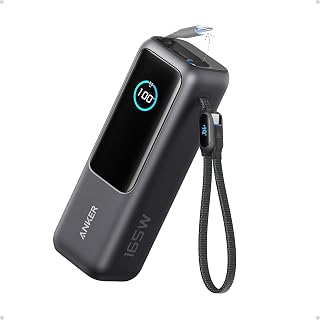
At 25,000mAh with 165W total output and 5A amperage, this model shows how capacity above the 20000mAh mark translates into meaningfully higher watt-hours, which matters for readers sizing a bank against laptop or multi-device power draw. The built-in cable keeps the setup simple when testing that output in practice.
Pros
- 25,000mAh capacity exceeds a standard 20,000mAh bank's energy storage
- 165W total output across 4 ports charges laptops and phones together
- Built-in dual USB-C cables including a 2.3-foot extendable option
- Digital display tracks battery percentage and real-time wattage
Cons
- No charger included, so a separate 100W+ charger is needed for fast recharge
- Heavier than a typical 20,000mAh bank, which may concern ultralight packers
Stepping up from 20,000mAh to 25,000mAh doesn't sound like a huge jump on paper, but paired with 165W total output it changes what the battery's watt hours can actually do. This bank can run a laptop, phone, tablet, and another USB device at the same time through its three 100W USB-C ports and one USB-A port, something a standard 20,000mAh phone bank isn't built for. Pass-through charging lets you power devices while the bank itself recharges, and the built-in dual USB-C cables, including a 2.3-foot extendable one, mean the stored capacity is always ready to use without hunting for a cord. A digital display tracks remaining battery percentage and real-time wattage, so you can watch exactly how those extra watt hours get spent compared to a smaller bank. At 300g and 6.18 by 2.12 by 1.92 inches, it's compact for the output it provides, though reaching the fast 2-hour recharge time needs a separate 100W-or-higher charger, which isn't included.
Capacity and Power Output: 25000mAh battery with 165W total output across four ports (3x 100W USB-C ports, 1x USB-A port). Recharge time approximately 2 hours with 100W+ charger.
Design and Portability: Dimensions 6.18 x 2.12 x 1.92 inches, weighs 300g. Airline carry-on approved at 100Wh. Black color with compact rectangular design featuring rounded corners for comfortable grip.
Built-In Cables: Two integrated USB-C cables, one extendable to 2.3 feet with 20000+ retractions, second cable at 0.98 feet functions as a durable carrying strap rated for 20000+ bends.
Compatibility and Features: Works with iPhone 13-16 series, Google Pixel 7-8, Samsung Galaxy S23-S24, MacBooks, and all USB-C devices. Supports PPS, PD, and Qualcomm Quick Charge technologies. Digital display shows battery percentage and wattage output. Pass-through charging supported. Lithium polymer battery with 18-month warranty included.
Pick this if you need meaningfully more capacity and output than a 20,000mAh bank provides, especially for charging a laptop alongside phones and tablets. It suits remote workers and travelers carrying multiple power-hungry devices. Skip it if a 20,000mAh phone-only bank already covers your needs, since the added capacity, ports, and 165W output bring extra weight and require a separate high-wattage charger for full speed.

At 20000mAh with 3A amperage and wireless charging support, this pack shows how added features like Apple Watch charging and a flashlight draw from the same finite watt-hour budget calculated from its rated capacity. The built-in cable and USB-A/USB-C mix also matter when comparing real output against the theoretical number.
Pros
- 20000mAh capacity directly matches the article's reference figure
- Delivers about 4 iPhone 15 charges or 37 Apple Watch charges in practice
- Wireless charging pad works for both phone and Apple Watch
- Hybrid solar and corded charging adds flexibility for travel
Cons
- 20W output is too low for laptop charging
- Solar charging needs 4+ hours of direct sunlight to add meaningful power
This BLAVOR pack is a direct 20000mAh match for the capacity this article is built around, making it a practical real-world example of what that watt hour figure translates to in actual charges. With a 20W output and 3A amperage, it delivers roughly 4 full iPhone 15 charges or about 37 Apple Watch charges, concrete numbers that help readers connect raw mAh and watt hour figures to everyday use. The solar and corded hybrid charging also shows how a 20000mAh capacity can stretch across both grid and off grid scenarios, which matters if you are evaluating this capacity class for travel or outdoor reliability rather than just desk charging. Wireless charging for phones and Apple Watch, a built-in cable, and a flashlight add utility beyond pure capacity. For anyone using this article to decide if 20000mAh is enough, the included accessories and dust resistant build suggest this capacity is well suited to portable, multi-day use rather than heavy laptop charging.
Capacity and Output: 20000mAh battery, 20W maximum wattage, 3A output current, 12V voltage. USB-C port supports 20W fast charging.
Charging Ports: 3 total USB ports including USB-C, USB-A, and iOS connector. Includes 4 built-in cables: 2 USB-C, 1 iOS, 1 USB-A.
Wireless Charging: Qi-compatible wireless charging area for iPhones and Apple Watches.
Power Sources: Corded electric charging via USB-C and integrated solar panel for off-grid charging.
Physical Specs: Weight 0.78kg, orange color, includes carabiner, power bank, cables, and user manual. Model PN-W39 by Shenzhen Pannizhe Technology Co., Ltd.
Accessories: LED flashlight with 3 modes, camping light with 3 adjustable levels, red indicator light, compass, thermometer, carabiner, and rope.
Good for readers who have settled on 20000mAh as their target capacity and want a versatile, travel-ready option with solar backup and wireless charging. Fits outdoor use, emergency kits, and phone-centric charging needs. Skip it if your watt hour research pointed you toward laptop charging, since the 20W output and lack of USB-C PD for larger devices make it unsuitable for that purpose.

With 25000mAh capacity, 28V operation, and 140W PD 3.1 output across 3 ports, this pack gives readers another high-capacity reference point for the volts-times-amps calculation behind watt-hours. The digital display also lets you track real remaining energy rather than relying on the raw mAh figure alone.
Pros
- 145W total output helps contextualize what higher watt hour capacity enables
- Digital display shows real-time remaining capacity
- Two-way fast charging lets you charge it and your devices at once
- 25000mAh capacity gives a clear benchmark above the 20000mAh class
Cons
- Requires your own 65W+ adapter to hit the 2 hour recharge time
- Larger and heavier than a typical 20000mAh pack
If you are trying to figure out how many watt hours a 20000mAh bank gives you, this 25000mAh UGREEN is a useful comparison point at the upper end of the category. At 28V and 25000mAh, its energy pool is noticeably larger than a 20000mAh unit, which is exactly why it can push 145W across three ports and still recharge a 16-inch MacBook Pro to 56% in 30 minutes. For readers deciding whether to size up from 20000mAh, the math here matters: this capacity recharges a smartphone about 5.2 times or a laptop 1.3 times, figures that scale down proportionally for a 20000mAh pack. The digital display also helps make watt hour math concrete, showing exactly how much stored energy remains rather than leaving you to guess. Two-way fast charging and a 2 hour recharge time (with a 65W+ adapter) round out a pack built for people who need to understand and maximize every watt hour they carry.
Capacity: 25000mAh (total energy storage)
Output Power: 145W maximum (USB-C1: 140W, USB-C2 and USB-A combined: 5W)
Charging Standards: PD3.1, QC3.0
Ports: 2x USB Type-C, 1x USB Type-A
Battery Chemistry: Lithium Ion
Recharge Time: 2 hours with 65W PD adapter, up to 6 hours with 20W adapter
Rapid Charging: 100% in 90 minutes under optimal conditions
Dimensions: 6.3 x 3.2 x 1.1 inches
Weight: 505 grams
Color: Space Gray
Model: PB205
Apple: iPhone 16, 16 Plus, 16 Pro, 16 Pro Max, 15 series, 14 series, 13 series, 12 series, 11 series, XS, XR, X, 8 series, SE models, iPad Pro, iPad Air, iPad Mini, MacBook Air, MacBook Pro, AirPods Pro, AirPods Max
Samsung: Galaxy S24, S24 Ultra, S23, S22, S21, S20, S10 series, Galaxy Note series, Galaxy Z Fold, Galaxy Z Flip
Google: Pixel 9, Pixel 9 Pro, Pixel 9 Pro XL, Pixel 9 Pro Fold, Pixel 8 Pro, Pixel 8a, Pixel 7, Pixel 6, Pixel 5, Pixel 4a, Pixel 3a
Laptops: MacBook Air M2, MacBook Pro 13 inch and 16 inch, Dell XPS series, HP Spectre, Chromebook, ThinkPad series, ASUS ROG Zephyrus
Gaming: Nintendo Switch, Steam Deck, ROG Ally
Other: DJI Mini 3 Pro, various Android phones, USB-C devices
What to Look for in a Power Bank
Watt Hours vs. Milliampere Hours
Milliampere hours measure charge at a fixed voltage, while watt hours measure actual energy. To convert, multiply the mAh rating by the cell voltage (3.7V) and divide by 1000. A 20000mAh bank gives you roughly 74Wh raw, or about 50 to 60Wh after efficiency losses.
This matters for two reasons: airline regulations cap carry-on power banks at 100Wh without prior approval, and knowing the Wh figure lets you estimate real-world charges more accurately than the mAh number alone. Most 20000mAh banks fall comfortably under the 100Wh limit, making them travel-friendly by default.
Charging Speed and Output Wattage
Capacity means little if the power bank trickles energy into your device. Look for USB-C Power Delivery support and an output of at least 30W for smartphones, or 60W and above if you plan to charge a laptop. The reasons a power bank charges slowly often come down to mismatched wattage between the bank and the device.
The Anker Zolo Power Bank, 20,000mAh 45W delivers 45W output with Samsung Fast Charging 2.0 support, while the UGREEN Nexode 100W 20000mAh Power Bank pushes up to 100W through its primary USB-C port, enough to meaningfully top up a MacBook Air. Choosing the right wattage for your specific devices saves a lot of waiting.
Number of Ports and Simultaneous Charging
If you carry multiple devices, a single-port bank becomes a bottleneck quickly. Multi-port designs let you charge a phone, tablet, and wireless earbuds at the same time without prioritizing one over another.
The BLAVOR Solar Power Bank 20000mAh takes this further with four built-in cables and three ports, supporting up to six devices simultaneously. For travelers who pack light but carry many gadgets, that kind of versatility is genuinely useful. You can find more multi-device options in our guide to the best power bank picks for camping.
Recharge Speed and Built-In Cables
A high-capacity bank that takes eight hours to refill is a liability on a busy travel day. Fast two-way charging, where the bank itself recharges quickly, is just as important as its output speed. The Anker Zolo Power Bank,20,000mAh 30W supports 20W input and recharges substantially faster than older generation banks.
Built-in cables are another practical consideration. Both Anker Zolo models include a 5.98-inch USB-C cable rated for over 10,000 bends, which eliminates the need to carry a separate cable for everyday charges. For higher-capacity needs and longer trips, the best 50000mAh power bank picks offer even more runway between recharges.
Final Thoughts
A 20000mAh power bank sits in a practical sweet spot: enough watt hours to keep your devices alive through a long travel day, light enough to carry without a second thought. For everyday smartphone and tablet charging, the Anker Zolo Power Bank, 20,000mAh 45W delivers fast output, a built-in cable, and solid temperature management in a compact form. If you need solar backup, rugged construction, and the ability to charge a crowd of devices at once, the BLAVOR Solar Power Bank 20000mAh covers those bases with a feature set that goes well beyond basic charging.
Frequently Asked Questions
How many watt hours is a 20000mAh power bank?
A 20000mAh power bank contains approximately 74 watt hours of raw energy based on a standard 3.7V lithium cell. After accounting for conversion inefficiency during discharge, the usable output is typically between 50 and 60Wh. That is enough to fully charge most flagship smartphones three to four times.
Can I bring a 20000mAh power bank on a plane in 2026?
Yes, in 2026 a standard 20000mAh power bank falls under the 100Wh airline carry-on limit, so it is approved for cabin baggage on most commercial flights. Power banks must be carried on rather than checked, and some airlines restrict quantities to two per passenger. Always confirm with your specific carrier before traveling.
How many times can a 20000mAh power bank charge my phone?
The number of charges depends on your phone’s battery size and the power bank’s efficiency. As a general benchmark, a 20000mAh bank can charge an iPhone 15 roughly four times or a Samsung Galaxy S24 roughly three to four times. Larger phones with bigger batteries will yield fewer cycles. Our INIU power bank guide covers more capacity comparisons across popular phone models.
What is the difference between a 20000mAh and a 25000mAh power bank?
A 25000mAh power bank holds roughly 92.5Wh of raw energy compared to about 74Wh in a 20000mAh model, a difference of about one to two additional smartphone charges. The trade-off is size and weight: higher-capacity banks like the Anker Prime Power Bank, 26,250mAh 300W or the UGREEN Nexode 25000mAh 145W 3-Port USB-C Power are noticeably heavier and better suited to laptop users or multi-day trips than to daily carry.
Common questions
What is the 100Wh carry-on limit for flying with power banks?
100Wh is the maximum battery capacity airlines allow in carry-on luggage without special approval under TSA and IATA rules. A 20000mAh power bank at 3.7V nominal cell voltage works out to around 74Wh, so it fits comfortably under the limit. Batteries between 100Wh and 160Wh usually need airline approval, and anything above that is banned from passenger flights entirely.
How do you convert mAh to Wh at 3.7V for a battery?
You convert by multiplying the mAh rating by the voltage, then dividing by 1000. At the standard 3.7V lithium-ion cell voltage, a 20000mAh power bank equals 20000 x 3.7 / 1000, or about 74Wh. This formula matters because mAh alone does not tell you real energy capacity, and airlines, retailers, and spec sheets rely on Wh for accurate comparisons.
What is the two spare batteries rule for air travel?
The two spare batteries rule refers to older airline guidance limiting passengers to two spare lithium batteries between 100Wh and 160Wh in carry-on bags. Batteries under 100Wh, like a standard 20000mAh power bank at roughly 74Wh, are not subject to this cap and can be carried in reasonable personal quantities without needing airline approval.


Write Your Review
No reviews yet. Be the first to share your experience!