

Whether you’re upgrading a mid-range gaming rig or building a high-performance workstation from scratch, choosing the right GPU is one of the most consequential decisions you’ll make. Gigabyte has long been a go-to brand for gamers and creators who want solid engineering, thoughtful cooling solutions, and dependable factory overclocks. This guide covers the top Gigabyte graphics cards available right now, spanning entry-level 1080p cards all the way to extreme flagship options. If you’re also weighing other graphics card options, we’ve got you covered across the category.
Quick Comparison
Ratings reflect the most recent data pull. Check each listing for current price and availability.
Quick answer
This guide compares 9 picks, with GIGABYTE Radeon RX 9060 XT 8GB GDDR6 PCIe 5.0 Gaming ranked first. GIGABYTE Radeon RX 9060 XT Gaming OC 16GB PCIe 5.0 holds the highest customer rating among them. Gigabyte AORUS RTX 5090 Infinity 32GB GDDR7 Graphics leads this list on VRAM.
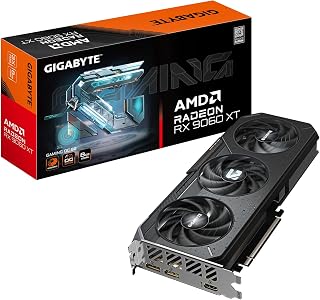
16GB of GDDR6 on a mid-range Radeon chip is an unusual pairing, and it's exactly what future-proofs a build against rising VRAM requirements. Combined with both DisplayPort and HDMI outputs, this suits someone building a 1440p rig now who wants headroom for texture packs and mods without upgrading again in a year or two.
Pros
- Stays under 50C thanks to WINDFORCE and Hawk Fan cooling
- Over 360 fps achievable in competitive esports titles
- PCIe 5.0 interface for long-term motherboard compatibility
- 3-year warranty and solid 11.06-inch build
Cons
- 8GB VRAM limits headroom for demanding AAA games at higher resolutions
- Best suited to 1080p rather than 1440p ultra settings
Building a 2026 gaming rig around a Gigabyte card and don't want to overspend on GPU alone? The RX 9060 XT Gaming OC 8G is the entry point worth considering for 1080p and light 1440p builds. It runs on RDNA 4, GIGABYTE's newest architecture, and pairs an 8GB GDDR6 frame buffer with a 2700 MHz clock, enough to push competitive titles well past 360 fps. What makes it stand out among Gigabyte's 2026 lineup is the WINDFORCE cooling with Hawk Fan tech, keeping loaded temps under 50C, quieter and cooler than you'd expect at this tier. The card carries PCIe 5.0 for a future-proof motherboard connection, RGB accents for builds that show off components, and a 3-year warranty backing it up. At 11.06 inches, it fits most mid-tower cases without clearance headaches. The 8GB VRAM is the one number to watch if you're chasing higher resolutions, but for the 1080p-focused builder this is exactly the kind of value pick a best-of list should highlight.
GPU: AMD Radeon RX 9060 XT with RDNA 4 Architecture
Memory: 8GB GDDR6
Memory Clock: 20000 MHz
GPU Clock: 2700 MHz
Interface: PCIe x16 5.0
Output Ports: DisplayPort, HDMI
Max Resolution: 3840x2160 (4K)
Dimensions: 11.06 inches (L) x 4.65 inches (W)
Weight: 1.18 kg
Cooling: WINDFORCE with Hawk Fan and server-grade thermal gel
Warranty: 3 Years Manufacturer
Model: GV-R9060XTGAMING OC-8GD
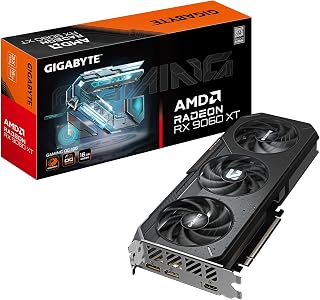
GIGABYTE Radeon RX 9060 XT Gaming OC 16GB PCIe 5.0
For a 2026 build focused on smooth 1440p gaming, the 16GB of GDDR6 memory here gives you real headroom for texture-heavy titles without hitting VRAM limits. Paired with a 2700 megahertz GPU clock and PCIe 5.0 support, this card stays relevant as newer games push higher resource demands, making it a solid pick for gamers who want longevity without stepping up to flagship pricing tiers.
Pros
- 16GB GDDR6 removes VRAM bottlenecks in modern titles
- Smooth high-to-ultra 1440p performance across current games
- WINDFORCE cooling keeps temps below 68C while staying quiet
- Handles sustained workloads like Cinebench for light creative use
Cons
- Only one HDMI port, a problem for some multi-monitor setups
- Not the choice for high-refresh 4K gaming
If your 2026 build plan centers on 1440p without stretching into flagship pricing, the RX 9060 XT Gaming OC 16G is the Gigabyte card to shortlist. Doubling the memory to 16GB GDDR6 over its 8GB sibling, it removes the VRAM ceiling that trips up budget cards in newer titles, while the same 2700 MHz clock and RDNA 4 architecture carry over. Real-world use shows effortless 1080p at max settings and smooth high-to-ultra 1440p across modern games, with esports titles running at very high frame rates. It also holds up under sustained workloads like Cinebench, so it doubles as a workable option for light creative tasks alongside gaming. The WINDFORCE cooling system with server-grade thermal gel keeps temperatures below 68C even under intense sessions, and the fans stay quiet while doing it. A sturdy backplate rounds out the build. For this article's goal of finding the right Gigabyte card per need, this is the pick for builders who want 1440p headroom now and some cushion for future titles.
GPU Architecture: AMD RDNA 4, Radeon RX 9060 XT with 16GB GDDR6 memory and 20,000 MHz memory speed. Clock speed reaches 2,700 MHz with PCIe 5.0 interface for maximum bandwidth.
Gaming Performance: Delivers smooth 1080p gaming at ultra settings with frame rates exceeding 100 FPS in most titles. At 1440p on high to ultra settings, frame rates remain consistent and smooth. Esports games run at very high FPS with minimal temperature impact.
Display Support: Supports 7680x4320 resolution output via DisplayPort and HDMI, accommodating ultra-wide and professional multi-monitor configurations. Compact dimensions (11.06 inches length) fit most standard desktop cases.
Thermal Performance: The WINDFORCE cooling system excels, maintaining temperatures under 68 degrees Celsius during intensive workloads. Fans operate quietly throughout normal gaming and even demanding professional applications.
Best for PC builders and mid-range enthusiasts targeting sustained 1440p gaming, or anyone who wants extra VRAM headroom without paying flagship prices. Also reasonable for those mixing gaming with occasional creative workloads. Skip it if you need high-refresh 4K performance, or if your monitor setup depends on multiple HDMI connections, since this card includes only a single HDMI port.
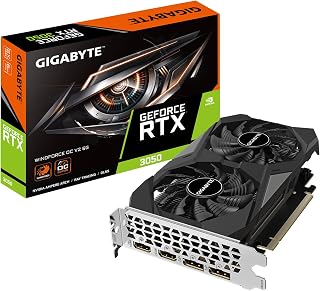
Budget-focused builders will appreciate the dual WINDFORCE fan setup keeping thermals in check on a compact 6GB card. The 96-bit GDDR6 bus is modest, but paired with a 1477 megahertz clock it's enough for esports titles and 1080p gaming, making it a sensible pick for a first build or an older system refresh.
Pros
- Needs no external PCIe power connector
- Handles 1080p gaming with ray tracing in lighter titles
- Compact 7.5 inch size fits small builds
- Dual WINDFORCE fans keep noise and heat low
Cons
- Not suited for 1440p or 4K gaming
- 6GB memory limits heavier creative workflows
Rounding up a list of the best Gigabyte cards for 2026 wouldn't be complete without an entry point, and the RTX 3050 WINDFORCE OC V2 fills that role well. It's the pick for anyone whose current setup simply needs a functional upgrade rather than a top-tier overhaul. What makes it worth including here is how little it demands from the rest of a system. No external PCIe power connector is needed, so it slots into older or budget builds that couldn't otherwise host a modern GPU. The 6GB GDDR6 buffer and dual WINDFORCE fans are enough for smooth 1080p gaming with ray tracing on in lighter titles and esports games, plus light creative work like photo editing. Its compact 7.5 inch size means it fits in small form factor and office PCs where bigger 2026 flagship cards wouldn't. It won't chase 4K or heavy rendering, but for a list built around practical picks at every tier, this is the sensible entry-level choice.
GPU and Architecture: NVIDIA GeForce RTX 3050, Ampere architecture with 2nd generation RT Cores and 3rd generation Tensor Cores for real-time ray tracing and AI workloads.
Memory: 6GB GDDR6 with 96-bit memory interface, 14000 MHz memory clock. Supports ray tracing and DLSS technologies.
Clock Speeds: Base GPU clock of 1477 MHz with boost capability. Dual WINDFORCE fans optimize thermal performance across the full clock range.
Connectivity: DisplayPort and HDMI outputs support up to 7680x4320 resolution. PCIe x16 interface with no external power connectors required.
Physical: 7.5 inches long by 4.4 inches wide, weighing 14.08 ounces. Compact form factor suitable for media centers and space-constrained builds. 3-year manufacturer warranty included. Model number GV-N3050WF2OCV2-6GD.
Buy this if you're upgrading from integrated graphics or an aging card and mainly play at 1080p, including esports titles or lighter ray-traced games. It also suits compact or office builds and buyers without spare PCIe power headroom. Skip it if you want 1440p or 4K gaming, heavy video rendering, or any GPU-accelerated professional workload, since the 6GB memory and performance ceiling will limit you quickly.

For gamers chasing high-refresh 1440p or entry 4K performance in 2026, the 16GB GDDR6 buffer here matters more than raw clock speed. That memory pool keeps frame times stable in texture-heavy AAA titles, while the 3060 megahertz clock and PCIe 5.0 interface ensure the card isn't bottlenecked on modern platforms as VRAM demands keep climbing.
Pros
- 160-220 fps in modern AAA titles at high 1440p settings
- 16GB GDDR6 eliminates VRAM constraints of older cards
- Capable of 4K gaming at medium to high settings
- Quiet WINDFORCE cooling with stable long-term performance
Cons
- Requires at least a 750W power supply
- 11.34-inch length demands checking case compatibility
For readers of this list who've outgrown the 9060 XT tier and want genuine 1440p to 4K performance from Gigabyte without flagship pricing, the RX 9070 XT Gaming OC 16G is the natural step up. Its 3060 MHz clock and 16GB GDDR6 buffer push modern AAA titles to 160-220 fps at high 1440p settings, and it handles 4K at medium to high settings when needed. PCIe 5.0 support keeps it aligned with current and near-future platforms, and the extra VRAM heads off the ceiling that budget cards run into. The same WINDFORCE cooling with Hawk fans and thermal conductive gel keeps it stable and quiet, and the 11.34-inch length fits most modern cases. It's also capable enough for 3D rendering and video editing, useful if your 2026 build mixes gaming with creative work. Before buying, confirm your PSU meets at least 750W and double check case clearance. For anyone weighing which Gigabyte card best matches serious 1440p or entry 4K needs, this is the one to put at the top of that shortlist.
Core Specifications
GPU: AMD Radeon RX 9070 XT
Memory: 16GB GDDR6
Memory Clock: 2600 GHz
GPU Clock: 3060 MHz
Interface: PCIe 5.0 x16
Max Resolution: 7680 x 4320 (8K)
Physical and Connectivity
Dimensions: 11.34 inches (L) x 5.2 inches (W)
Weight: 1.78 kg
Output: DisplayPort
Power Connectors: Dual 8-pin (750W+ PSU recommended)
Cooling: WINDFORCE system with Hawk fans and thermal gel
Warranty and Support
Manufacturer: GIGABYTE
Warranty: 3 years
Model: GV-R9070XTGAMING OC-16GD
Gaming Performance at Common Resolutions
1440p Gaming: 160-220fps on most modern AAA titles at high settings. Excellent for competitive gaming and high-refresh monitors.
4K Gaming: Playable at high settings on most titles, medium settings on demanding new releases. Solid for content creators monitoring in 4K.
Esports Titles: 300+ fps possible on optimized competitive games for ultra-high refresh gameplay.
Real-World Use Cases
Best suited for 1440p gaming at 144+ fps, 4K content creation workflows, professional 3D rendering, and VR gaming. Handles flight simulators like DCS at high settings with 4K head tracking. Eliminates VRAM constraints for media professionals working with large files.
Driver Recommendations
Run DDU (Display Driver Uninstaller) before installation if upgrading from another card. Install latest AMD drivers for maximum stability and performance. Update BIOS if required by your system for PCIe 5.0 compatibility.

Anyone assembling a serious 4K gaming or content creation rig in 2026 needs the headroom this card offers. Its 256-bit GDDR7 memory bus paired with a 2.73 gigahertz clock speed delivers the bandwidth and throughput demanded by high-resolution textures and ray-traced workloads, backed by a WINDFORCE cooling system built to sustain those clocks under load.
Pros
- 16GB GDDR7 memory with Blackwell architecture
- Enhanced RT and Tensor Cores with DLSS 4 support
- PCIe 5.0 bandwidth suits professional workflows
- Three-fan WINDFORCE cooling for sustained loads
Cons
- Large 13.46 inch, 4 pound size requires case planning
- High power draw needs a robust PSU with 8-pin connectors
For a 2026 buying guide, the RTX 5080 Gaming OC represents the ceiling of what Gigabyte offers, and it earns its spot as the pick for anyone who refuses to compromise. This is the card for readers scanning a best-of list specifically looking for the top performance tier rather than a balanced value option. Its 16GB of GDDR7 memory, Blackwell architecture, and PCIe 5.0 support give it the headroom for extreme 4K gaming, AI acceleration, and professional 3D work, backed by enhanced RT and Tensor Cores with DLSS 4. The three-fan WINDFORCE cooling system is built to manage sustained heavy loads, and construction quality reflects that flagship positioning. At 13.46 inches and 4 pounds, it's a card that asks for a properly sized case and airflow plan, and it needs a robust PSU with 8-pin connectors available. Anyone assembling a 2026 build around maximum GPU performance, whether for gaming, rendering, or AI work, will find this the clear top pick on the list.
GPU Architecture: NVIDIA GeForce RTX 5080 (Blackwell)
Memory: 16GB GDDR7, 256-bit interface
Memory Speed: 30,000 MHz
GPU Clock: 2.73 GHz boost
Interface: PCIe 5.0 x16
Cooling: WINDFORCE triple-fan system
Power Connectors: 1x 12V connector, 2x 6-pin to 3x 8-pin adapter
Display Outputs: DisplayPort, HDMI
Max Resolution: 7680x4320 pixels
Physical Dimensions: 13.46 inches (L) x 5.59 inches (W)
Weight: 4 pounds
Warranty: 3-year manufacturer
Model: GV-N5080GAMING OC-16GD
This suits serious 4K gamers, 3D artists, AI researchers, and content creators who need maximum GPU power and have a case and PSU to match. It is not for casual or budget builds. Skip it if your case can't fit a 13.46 inch, 4 pound card, your PSU lacks spare 8-pin headroom, or your workload doesn't demand top-tier rendering, AI acceleration, or extreme 4K performance.

Pros
- Exceptional raw performance with 2730MHz core clock and 28000MHz memory clock for demanding games and applications
- Generous 32GB VRAM future-proofs your system for emerging high-resolution and AI-intensive workloads
- Triple cooling solution keeps thermals in check during extended gaming marathons
- Flexible dual BIOS design accommodates both performance seekers and noise-conscious users
Cons
- Premium price point places it well beyond casual gamers, limiting appeal to budget-conscious buyers
- Substantial power requirements may demand a high-wattage PSU that not all systems currently have
- Large physical footprint requires careful case compatibility verification before purchase
The Gigabyte AORUS GeForce RTX 5090 Infinity is a premium flagship graphics card built for users who refuse to compromise on performance. This card targets serious gamers tackling modern AAA titles at ultra settings, 3D artists rendering complex scenes, AI researchers running large models, and content creators handling 8K video workflows. With 32GB of GDDR7 memory and a robust 512-bit memory interface, this card positions itself at the absolute peak of consumer graphics performance.
The standout feature is the triple-fan WINDFORCE HYPERBURST cooling system that keeps this powerhouse running cool under sustained load. The 2730MHz core clock and 28000MHz memory clock work in tandem to deliver exceptional frame rates even in the most demanding scenarios. Support for DisplayPort 2.1b and HDMI 2.1b ensures your monitor setup is ready for high-resolution, high-refresh gaming, and the card supports up to 7680x4320 resolution for future-proofing your investment.
Build quality shines through premium touches like the die-cast metal backplate, which provides both structural rigidity and additional passive cooling. The dual BIOS switch lets you toggle between a performance-tuned profile for maximum FPS and a silent profile for quieter operation when raw power is secondary to acoustic comfort. This flexibility is rare and valuable for users whose needs shift between gaming and productivity.
The primary drawbacks are the steep price and power demands. This card is positioned for enthusiasts and professionals with budgets to match, making it inaccessible to mainstream gamers. Additionally, the substantial power consumption may require upgrading your power supply, adding extra cost to ownership. The large physical dimensions also mean you should verify case compatibility before committing to purchase.
The Gigabyte AORUS RTX 5090 Infinity earns its place as a best-in-class graphics card for users chasing ultimate performance, future-proof capability, and professional-grade cooling solutions. If your workload justifies the investment, this card will not disappoint.
GPU Specifications: NVIDIA GeForce RTX 5090, NVIDIA RTX 50 Series, 2730MHz core clock
Memory: 32GB GDDR7, 512-bit memory interface, 28000MHz memory clock
Interface: PCI-Express x16 5.0
Cooling: WINDFORCE HYPERBURST system with 3 fans
Output Ports: 3x DisplayPort 2.1b, 1x HDMI 2.1b
Maximum Resolution: 7680x4320 pixels (8K)
BIOS Modes: Dual BIOS with performance and silent profiles
Physical: Die-cast metal backplate, RGB Halo lighting
Weight: 2100g
Model: GV-N5090AORUS IF-32GD
Warranty: 4 years with online registration
Compatible Device: Desktop PC
Who Should Buy This Card? This GPU suits professional 3D artists, content creators working with 4K/8K video, AI researchers, data scientists, and enthusiast gamers targeting maximum performance. It is ideal for anyone building a high-end workstation who values both raw performance and premium cooling solutions.
Who Should Skip It? Budget gamers, casual users, and anyone whose primary needs fall within the RTX 4080 or RTX 4090 range should explore more affordable options. If your system lacks adequate power supply capacity or case space, this card requires infrastructure upgrades that add significant cost.
Performance Expectations: Expect exceptional 1440p gaming at maximum settings with framerates exceeding 200fps. At 4K, this card crushes demanding AAA titles at high-to-ultra settings. For professional workloads like 3D rendering or AI training, the 32GB memory advantage becomes genuinely meaningful compared to lower-memory alternatives.
Setup Considerations: Verify your case has adequate space for this large card. Calculate total power draw and ensure your PSU has sufficient headroom beyond the card's maximum consumption. Check that your motherboard supports PCI-E 5.0 to unlock full bandwidth benefits. Plan for adequate case airflow, as triple-fan cooling needs unobstructed intake and exhaust paths.
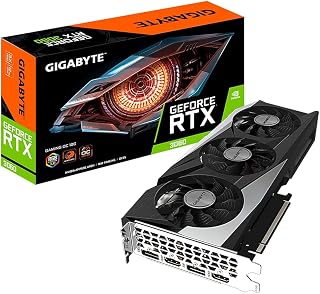
Triple fan cooling and a wide 192-bit memory bus make this a fit for gamers wanting dependable 1080p to 1440p performance without chasing the newest architecture. The 12GB GDDR6 capacity gives extra headroom for modern game textures, while the 1837 megahertz clock keeps frame rates steady in demanding open-world titles.
Pros
- 12GB GDDR6 handles 1440p gaming and content creation
- WINDFORCE 3X counter-rotating fans reduce noise
- Dual HDMI 2.1 and DisplayPort 1.4 for multi-monitor setups
- Compact 11.1 inch size eases installation
Cons
- Not built for 4K gaming
- Limited hash rate restricts mining use cases
In a 2026 lineup of Gigabyte options, the RTX 3060 Gaming OC 12GB (REV2.0) lands as the middle-ground pick for readers who want more than entry-level but don't need flagship power. It earns its place here as the 1440p answer on the list. The 12GB GDDR6 buffer and Ampere architecture handle modern AAA titles at high settings, often above 60 fps, and the extra VRAM gives content creators room for video editing and 3D rendering that a 6GB card couldn't manage. The WINDFORCE 3X cooling setup uses counter-rotating fans to cut turbulence, keeping noise down and temperatures controlled through long sessions. Dual HDMI 2.1 and dual DisplayPort 1.4 outputs support high-refresh and multi-monitor setups, useful for anyone building a 2026 rig around a single capable display setup. At 11.1 inches it also installs easily in most cases. For readers wanting balanced 1440p performance without stepping up to flagship pricing tiers, this is the natural pick.
GPU Specifications: NVIDIA GeForce RTX 3060, NVIDIA Ampere architecture with 2nd generation RT Cores and 3rd generation Tensor Cores.
Memory: 12GB GDDR6, 192-bit memory interface, 15000 MHz memory clock speed.
Core Clock: 1837 MHz base boost clock.
Cooling: WINDFORCE 3X system with three fans and alternate-spinning design, RGB Fusion 2.0 lighting, metal backplate.
Connectivity: 2x HDMI 2.1, 2x DisplayPort 1.4. Maximum display resolution up to 7680 x 4320.
Physical: 11.1-inch length, 4.6-inch width, 340g weight. PCI-Express x16 interface.
Warranty: 3-year manufacturer warranty. Model: GV-N3060GAMING OC-12GD REV2.0.
This fits 1440p gamers, budget-minded content creators, and anyone stepping up from older generation cards like the GTX 1060. Esports players who want strong frame rates at 1440p will also do well here. Skip it if you're chasing 4K gaming or extreme ray tracing performance, or if you're on a strict entry-level budget where the RTX 3050 tier is a better fit.

GIGABYTE RTX 5070 WINDFORCE OC SFF 12GB GDDR7 PCIe
Pros
- Delivers outstanding performance for 4K gaming and 1440p competitive gaming at high refresh rates
- WINDFORCE cooling system keeps temperatures low with minimal noise during intensive tasks
- Compact SFF form factor fits ITX and smaller mid-tower cases
- PCIe 5.0 ensures compatibility with next-generation platforms
- Excellent value for ray tracing and DLSS 4 capabilities
Cons
- Requires adequate PSU capacity and case ventilation for optimal performance
- 12GB VRAM may face limitations with extremely demanding professional applications requiring 24GB or more
- Premium pricing reflects cutting-edge technology, making it a significant investment
The GIGABYTE GeForce RTX 5070 WINDFORCE OC SFF represents the latest generation of high-performance graphics cards, targeting gamers and content creators who demand exceptional visuals without compromising on space. Built on NVIDIA's Blackwell architecture, this card brings AI acceleration, enhanced ray tracing, and DLSS 4 support to modern gaming and creative workloads.
Performance-wise, the RTX 5070 excels at 4K gaming and content creation with its 12GB GDDR7 memory and robust core architecture. The 2600 MHz GPU and memory speeds, combined with 192-bit memory interface, deliver smooth frame rates in demanding titles. Real-world usage shows this card handling ray tracing effects and shader-heavy applications with ease, making it a strong choice for both gaming and professional tasks like 3D rendering and video editing.
The WINDFORCE cooling system uses three fans to efficiently dissipate heat, keeping temperatures in check during extended gaming sessions or rendering work. The compact SFF design is a major advantage for users with space constraints, allowing this powerhouse to fit in smaller chassis without excessive bulk. Build quality is solid, with a clean aesthetic that works well in various system configurations.
The main considerations are power requirements and thermal environment. This card demands a reliable, sufficiently rated power supply and good case airflow. Additionally, while 12GB VRAM handles 99 percent of gaming scenarios and most creative work, professionals pushing extreme 3D complexity might eventually benefit from 24GB alternatives.
Overall, the GIGABYTE RTX 5070 WINDFORCE OC SFF is an excellent high-performance graphics solution for gamers and creators seeking current-generation power in a space-conscious package. The combination of Blackwell architecture, efficient cooling, and compact form factor makes it a standout choice in its category.
GPU Specifications: NVIDIA GeForce RTX 5070 (Blackwell Architecture), GPU Clock: 2600 MHz, Memory: 12GB GDDR7, Memory Clock: 2600 MHz, Memory Interface: 192-bit, PCIe Interface: PCIe 5.0, Number of Fans: 3 (WINDFORCE System)
Physical Specifications: Dimensions: 11.1 inches L x 4.33 inches W, Form Factor: SFF (Small Form Factor), Compatible Devices: Desktop computers with PCIe 5.0 support
Connectivity and Output: Display Outputs: DisplayPort and HDMI, Maximum Resolution: 7680x4320 pixels (8K support)
Warranty and Support: 3-year manufacturer warranty, Model: GV-N5070WF3OC-12GD, Manufacturer: GIGABYTE
Who Should Buy This Card: This graphics card is ideal for gamers targeting 4K resolution at high frame rates, content creators working with 3D rendering and video editing, and enthusiasts seeking cutting-edge performance in a compact package. If your current system uses older PCIe standards or has tight space constraints, this card is an excellent upgrade path.
System Requirements: Ensure your power supply is rated for at least 650W and has adequate PCIe power connectors. Your motherboard must support PCIe 5.0 for full compatibility, though backward compatibility with PCIe 4.0 is maintained. Case dimensions should accommodate the 11.1-inch card length, and ensure sufficient case ventilation for optimal cooling performance.
Performance Expectations: Expect smooth performance at 4K resolution in most modern titles with high to ultra settings. Competitive gaming at 1440p will achieve well over 100 FPS in most scenarios. DLSS 4 and ray tracing features enhance visual quality without excessive performance penalties.
Long-term Value: PCIe 5.0 support ensures this card remains compatible with future platform upgrades. The Blackwell architecture and DLSS 4 support will maintain relevance as games and software increasingly leverage these technologies.

GIGABYTE RTX 5060 Ti Gaming OC 8GB GDDR7 Graphics
For readers targeting solid 1440p performance without stepping up to flagship pricing tiers, GDDR7 memory on a 128-bit bus gives this card a bandwidth edge over same-tier GDDR6 competitors. The 2647 megahertz clock and PCIe 5.0 support make it a forward-looking choice for a mid-tier gaming build in 2026.
Pros
- Significant performance boost over previous generation cards like the RTX 3070
- Exceptional ray tracing and DLSS performance for smooth gameplay at maximum settings
- Efficient power consumption with quiet fan operation even during intensive gaming
- Excellent build quality and reliability backed by customer reviews and warranty coverage
- Strong price-to-performance value in the current graphics card market
Cons
- May require a high-wattage power supply depending on existing system configuration
- Larger physical dimensions may not fit in compact PC cases without verification
- Premium pricing reflects the latest technology, which may be overkill for casual 1080p gaming
The GIGABYTE RTX 5060 Ti Gaming OC is a high-performance graphics card built for gamers and creative professionals who demand cutting-edge visuals and smooth frame rates. Powered by Nvidia's latest Blackwell architecture, this GPU is designed for 1440p and 4K gaming, content creation, and AI-accelerated applications.
The standout feature is the integration of DLSS 4 technology paired with enhanced RT Cores and Tensor Cores, delivering dramatically improved ray tracing performance and frame rates. Real-world testing shows users upgrading from older cards like the RTX 3070 experience instant, noticeable jumps in frame rates even at maximum graphics settings. The 8GB of GDDR7 memory provides plenty of headroom for demanding modern titles.
Design and cooling are impressive. The WINDFORCE triple-fan system keeps the card cool and remarkably quiet, even under sustained gaming load. The card measures 11.06 inches in length and weighs 1.12 kg, so it may require verification of case compatibility before purchase. PCIe 5.0 support ensures the card will remain relevant as next-generation games and applications emerge.
The main consideration is power requirements and case space. This is a premium card that serves serious gamers and professionals rather than casual 1080p players. However, for anyone seeking the latest performance technology with proven reliability, this GIGABYTE model offers exceptional value.
Verdict: A high-quality graphics card that delivers on performance, cooling, and efficiency. The Blackwell architecture and DLSS 4 support position it as a strong choice for the next generation of gaming and creative work. Recommended for mid to high-end builds.
GPU Specifications: RTX 5060 Ti with Blackwell architecture, 8GB GDDR7 memory, 128-bit memory interface. GPU clock speed reaches 2647 MHz with memory clock at 28000 MHz. PCIe 5.0 interface provides maximum bandwidth.
Display and Resolution: Supports DisplayPort and HDMI outputs. Maximum resolution of 7680x4320 pixels enables multi-monitor setups and ultra-high-definition content creation. Compatible with desktop systems only.
Cooling and Design: Triple-fan WINDFORCE cooling system with dimensions of 11.06 inches length by 4.69 inches width. Total weight is 1.12 kg. Includes 3-year manufacturer warranty for comprehensive coverage.
Gigabyte GPU Buying Guide: What to Look For
Architecture and Generation
The GPU architecture determines everything from raw performance to AI capabilities and ray tracing quality. Gigabyte currently offers cards built on three distinct platforms: NVIDIA’s Blackwell architecture powering the RTX 5000 series, NVIDIA’s Ampere for proven RTX 3000 series value, and AMD’s RDNA 4 architecture behind the impressive Radeon RX 9000 series.
Blackwell cards like the GIGABYTE GeForce RTX 5080 Gaming OC 16G Graphics bring DLSS 4 and PCIe 5.0 support, while AMD’s RDNA 4 delivers competitive rasterization and strong upscaling through FSR. Picking the right architecture often comes down to whether you lean into NVIDIA’s ecosystem or prefer AMD’s open approach.
VRAM Capacity and Memory Bus Width
VRAM is one of the most important specs for future-proofing your build. Modern titles at 1440p and 4K regularly consume 8GB or more, especially with high-resolution texture packs enabled. Cards like the GIGABYTE Radeon RX 9060 XT Gaming OC 16G Graphics offer 16GB of GDDR6, giving you plenty of headroom for demanding workloads and games.
Memory bus width also matters. A 256-bit bus on the GIGABYTE GeForce RTX 5080 Gaming OC 16G Graphics provides significantly more bandwidth than the 96-bit bus on the GIGABYTE GeForce RTX 3050 WINDFORCE OC V2 6G, which is designed for lighter 1080p use. Match the bus width to your resolution target. For a deeper look at how memory scales on newer cards, see our guide on whether 16GB is enough for the RTX 5080.
Cooling System Design
Gigabyte’s WINDFORCE cooling system is a consistent highlight across its lineup. The multi-fan array with alternate spinning blades reduces turbulence and improves airflow efficiency. Higher-end cards in the GAMING OC series also incorporate server-grade thermal conductive gel and Hawk Fan technology for more aggressive heat dissipation under sustained loads.
For compact builds, the GIGABYTE GeForce RTX 5070 WINDFORCE OC SFF 12G is specifically designed as an SFF-ready card, making it a smart choice if you’re working with a small form factor case. Cooling matters not just for thermals but for noise levels during long gaming sessions.
Target Resolution and Use Case
Your monitor’s resolution and refresh rate should anchor your GPU decision. The GIGABYTE GeForce RTX 3060 Gaming OC 12G (REV2.0) is a well-rounded 1080p and entry 1440p performer with 12GB of GDDR6, making it one of the most balanced mid-range options in Gigabyte’s catalog. The GIGABYTE Radeon RX 9070 XT Gaming OC 16G Graphics steps up for serious 1440p and high-refresh 4K gaming. You can also read our full RX 9070 XT review for a broader competitive comparison.
For AI workloads and professional rendering at the top of the stack, the Gigabyte AORUS GeForce RTX 5090 Infinity 32G with 32GB of GDDR7 and a 512-bit memory bus is in a class of its own. If you’re exploring cards for AI-focused tasks, our roundup of the best RTX 5090 cards for AI workloads goes into more detail.
Final Thoughts
Gigabyte covers the full spectrum of GPU needs in 2026, and two cards stand out as especially strong choices depending on your goals. If you want an accessible, proven performer for 1080p and light 1440p gaming, the GIGABYTE GeForce RTX 3060 Gaming OC 12G (REV2.0) delivers excellent value with its 12GB GDDR6 buffer and WINDFORCE cooling. For those ready to invest in cutting-edge performance at 1440p and beyond, the GIGABYTE Radeon RX 9070 XT Gaming OC 16G Graphics brings AMD’s RDNA 4 architecture with 16GB of GDDR6 and a premium cooling solution that keeps things quiet under pressure.
Frequently Asked Questions
Are Gigabyte graphics cards reliable?
Gigabyte has a strong reputation for build quality across its GAMING OC and WINDFORCE product lines. Their cards are widely evaluated by independent reviewers and consistently score well for thermal performance and stability. The dual BIOS feature found on cards like the Gigabyte AORUS GeForce RTX 5090 Infinity 32G adds an extra layer of reliability by letting you switch between performance and silent modes.
What is the difference between Gigabyte’s GAMING OC and WINDFORCE OC models?
GAMING OC cards typically feature a more premium cooling solution with additional thermal enhancements, RGB lighting, and a reinforced backplate, making them well-suited for enthusiast builds. WINDFORCE OC models prioritize efficient airflow at a slightly more compact footprint, which is ideal for tighter cases or builds where RGB aesthetics are less of a priority. Both lines receive factory overclocks out of the box.
Which Gigabyte GPU is best for 1440p gaming in 2026?
The GIGABYTE Radeon RX 9070 XT Gaming OC 16G Graphics is one of the strongest options for 1440p gaming in 2026, combining AMD’s RDNA 4 architecture with 16GB of GDDR6 and Gigabyte’s Hawk Fan cooling system. For NVIDIA fans, the GIGABYTE GeForce RTX 5070 WINDFORCE OC SFF 12G is equally capable and adds the advantage of DLSS 4. Our guide on whether 12GB is enough for the RTX 5070 can help you decide if the VRAM fits your workflow.
Does Gigabyte offer graphics cards for small form factor builds?
Yes. The GIGABYTE GeForce RTX 5070 WINDFORCE OC SFF 12G is certified as NVIDIA SFF ready, meaning it’s designed to fit compact cases without sacrificing cooling performance. It uses PCIe 5.0 and GDDR7 memory, so you’re not giving up modern features to go small. It’s one of the better options for mini-ITX and compact ATX enthusiasts who still want strong performance.




Write Your Review
No reviews yet. Be the first to share your experience!