

You’ve got a 120Hz or 144Hz monitor and you want every frame it can deliver. Whether you’re grinding ranked matches, exploring open worlds, or just tired of the stuttery 60 FPS experience, the right graphics card makes all the difference. Choosing the best GPU for 1080p 120 FPS gaming means balancing raw performance, VRAM headroom, and smart upscaling support without paying for horsepower you’ll never use.
This guide covers ten strong options ranging from efficient budget cards to serious mid-range performers, all evaluated for their ability to sustain 120 FPS or better at 1080p across modern titles. Whether you’re building a compact rig or upgrading an existing system, one of these GPUs will fit your needs.
Quick Comparison
Ratings reflect the most recent data pull. Check each listing for current price and availability.
Quick answer
This guide compares 10 picks, with ASRock Radeon RX 9060 XT Challenger 16GB GDDR6 PCIe 5.0 ranked first. MSI RTX 3060 12GB Gaming Graphics Card - 1440p High has the most customer reviews.

The aggressive 3290 MHz boost clock pushes frames aggressively, while 16GB of GDDR6 ensures zero memory constraints even in the most texture-heavy games. This generous capacity means you can enable maximum texture quality without sacrificing smoothness. The RDNA 4 architecture brings efficiency improvements and DisplayPort 2.1a support for seamless high refresh connectivity. Silent 0dB operation during lighter loads adds convenience for mixed-use systems.
Pros
- 3290 MHz boost maintains high FPS consistently
- 16GB VRAM provides ample buffer for modern textures
- Mid-60s temperatures and 0dB idle keep system quiet
- Single 8-pin and 550W PSU keep upgrade costs low
Cons
- Overkill for strict 1080p 60Hz usage
- Dual-fan design less aggressive than triple-fan alternatives
While the ASRock Radeon RX 9060 XT Challenger packs 16GB GDDR6 memory and a 3290 MHz boost clock, its real strength lies in delivering consistent 1080p performance with headroom to spare. The RDNA 4 architecture with 32 compute units ensures frame rates well beyond 120 FPS in most titles when settings are optimized appropriately. Thermal efficiency stands out here: sustained mid-60s temperatures under load mean the card maintains boost clocks without throttling, directly benefiting frame stability during competitive play. The 0dB idle feature eliminates fan noise during desktop use or lighter workloads. Power requirements remain reasonable with a single 8-pin connector and 550W PSU recommendation, avoiding the need for expensive power supply upgrades. The 249mm length fits standard ATX cases without clearance concerns. Ray tracing support adds visual fidelity options when frame rate targets allow. That 16GB memory buffer provides future-proofing as texture quality continues to increase in newer releases. PCIe 5.0 compatibility ensures bandwidth isn't a limiting factor. For gamers chasing 120 FPS at 1080p, this card delivers the sustained performance and thermal consistency needed for smooth, uninterrupted gameplay sessions.
GPU: AMD Radeon RX 9060 XT (RDNA 4, 32 Compute Units)
Memory: 16GB GDDR6 at 20 Gbps on 128-bit bus
Clock Speeds: 3290 MHz boost, 2700 MHz game clock
Output: DisplayPort 2.1a, HDMI 2.1b
Max Resolution: 7680x4320 pixels
Power: Single 8-pin connector, 550W PSU recommended
Size: 249mm (L) x 132mm (W) x 41mm (H), 2-slot design
Cooling: Dual fans, 0dB idle mode
Interface: PCIe 5.0 x16
Weight: 0.98 kg
Warranty: 2 years manufacturer
Best suited for gamers with 1080p 120Hz or 144Hz monitors who want consistently high frame rates with settings flexibility and minimal thermal concerns. Also fits builders who value quiet operation and efficient power consumption. Skip this if you primarily game at 4K, already own a capable 1080p card from the past two generations, or prefer NVIDIA-specific software features like DLSS.

The 6GB GDDR6 configuration provides adequate memory for lighter competitive titles where high refresh rates matter most. The 1500 MHz clock handles esports favorites and older AAA games comfortably at this resolution. While more demanding titles may require settings adjustments, the card excels in the competitive gaming space where consistent frame delivery outweighs graphical fidelity, making it suitable for budget-conscious players focused on responsiveness.
Pros
- Excels at 120+ FPS in popular esports titles
- Compact 20cm design fits small-form-factor builds
- DLSS 3 extends performance in supported games
- 0dB fan mode and quiet operation under load
Cons
- 6GB VRAM limits headroom in demanding modern AAA games
- Requires settings adjustments in graphically intensive titles
The ASUS Dual RTX 3050 6GB OC Edition serves as an entry point into high-refresh 1080p gaming, particularly for esports and competitive multiplayer titles. With its 1500 MHz GPU clock and Ampere architecture, the card pushes frame rates well past 120 FPS in lighter competitive games like CS2, League of Legends, and Rocket League. DLSS 3 technology extends this capability into more demanding titles, allowing players to maintain smooth gameplay without sacrificing visual clarity. The compact 20cm, 2-slot design fits into smaller cases without compromising thermal performance, thanks to dual Axial-tech fans that keep temperatures controlled. IP5X dust resistance ensures longevity for gamers in various environments. The barrier ring fan design and extended blade length optimize airflow while maintaining quiet operation during intense gaming sessions. The 6GB VRAM handles 1080p textures comfortably in most current titles, though the most demanding AAA games may require settings adjustments. For the 120 FPS target at 1080p, this card excels in the competitive gaming space where lighter graphics engines and optimized performance matter most. It represents a practical choice for gamers focused on frame rates over visual extravagance.
Perfect for competitive esports players and budget-conscious gamers who prioritize frame rates in lighter titles. Best suited for those playing games like Fortnite, Valorant, or older AAA titles where 120 FPS at 1080p is easily achievable. Skip this if you play the latest graphically intensive AAA games or want maximum settings everywhere, as the 6GB VRAM and modest GPU power will require compromise in newer releases.
GPU Architecture: NVIDIA GeForce RTX 3050 with Ampere SM, 2nd Gen RT Cores, and 3rd Gen Tensor Cores for DLSS 3 support.
Memory: 6GB GDDR6 with 1500 MHz memory clock speed, delivering adequate bandwidth for 1080p and light 1440p workloads.
Clock Speeds: OC Mode: 1500 MHz boost clock, Default Mode: 1470 MHz boost clock for flexible performance tuning.
Thermal Design: Dual Axial-tech fans, 2-slot form factor (20cm length, 7.9in x 4.7in), IP5X dust resistance, and stainless steel bracket.
Power: No external power connector required. PCIe x16 slot power delivery only, making it ideal for systems with limited PSU capacity.
Connectivity: HDMI 2.1, DisplayPort 1.4a, and DVI-D for multi-monitor setups and modern display standards.

The 10GB GDDR6 memory running at 19 Gbps provides strong bandwidth for demanding textures at this resolution, while the 2600 MHz boost clock keeps frames flowing smoothly. DisplayPort 2.1 and HDMI 2.1a outputs ensure full compatibility with modern high refresh displays. Intel's Arc platform has matured significantly with driver optimizations, and the 0dB cooling mode keeps noise down during lighter gaming sessions.
Pros
- 10GB VRAM provides headroom for texture-heavy games
- 2600 MHz clock delivers strong 1080p frame rates
- XeSS 2 upscaling maintains quality while boosting FPS
- 0dB cooling keeps noise minimal during gameplay
Cons
- Intel Arc drivers still maturing compared to NVIDIA and AMD
- Occasional optimization updates needed for some titles
The ASRock Intel Arc B570 Challenger brings 10GB of GDDR6 memory and a 2600 MHz GPU clock to the 1080p 120 FPS arena, positioning itself as a capable option for gamers seeking high refresh rate performance. Intel's Xe2-HPG architecture handles modern games efficiently, while XeSS 2 upscaling technology provides an AI-driven performance boost that helps maintain triple-digit frame rates without visible quality loss. At 1080p resolution, the combination of 10GB VRAM and the 160-bit memory bus provides sufficient bandwidth for high frame rate gaming across a wide range of titles. The 2600 MHz clock speed delivers the raw processing power needed to keep frame times consistent, critical for smooth 120 FPS gameplay. DisplayPort 2.1 and HDMI 2.1a outputs support modern high-refresh monitors without compatibility issues. The dual striped axial fans with 0dB silent cooling technology stop spinning during lighter gaming loads and remain quiet when active, creating a distraction-free environment for competitive play. The metal backplate adds structural rigidity while improving aesthetics. A single 8-pin power connector simplifies installation and reduces cable management complexity. While Intel's driver ecosystem continues maturing, most modern games run smoothly at 1080p where optimization is generally better than at higher resolutions.
The Arc B570 excels at 1440p gaming, maintaining high frame rates with maxed or near-maxed settings in modern AAA titles like Assassin's Creed Resync, Subnautica 2, and God of War. The 10GB VRAM buffer ensures smooth performance without stuttering even in VRAM-intensive scenarios with multiple monitors or intensive applications running simultaneously.
XeSS 2 technology provides meaningful performance boosts through AI-powered upscaling without sacrificing perceived image quality. Users report stable gameplay and low thermal temps, with the card operating at just 45-56 degrees Celsius at zero RPM and averaging around 68 degrees under sustained gaming loads. Idle power consumption is remarkably low at 18-21 watts during light tasks like streaming and multi-monitor work.
The card handles both 1080p ultra settings and 1440p high settings comfortably. While not positioned as a 4K solution, users seeking budget-friendly 1440p gaming will find this card highly capable and reliable across current and near-future game libraries.
GPU: Intel Arc B570 (Xe2-HPG Architecture)
Memory: 10GB GDDR6, 160-bit bus
Clock Speeds: 2600 MHz GPU, 19 Gbps Memory
Power: Single 8-pin connector
Interface: PCIe 4.0 x8
Display Outputs: 3x DisplayPort 2.1, 1x HDMI 2.1a
Max Resolution: 7680 x 4320
Cooling: Dual striped axial fans with 0dB Silent Cooling
Backplate: Metal with structural reinforcement
Weight: 0.99 kg
Warranty: 2 Years Manufacturer
Media Engine: Advanced with AV1 encoding support
DirectX Support: 12 Ultimate

Pros
- Strong, consistent frame rates in esports titles at 1080p
- 12GB GDDR6 gives more headroom than many same-tier rivals
- Twin Fan cooling stays quiet under sustained load
- Straightforward installation with easy fan/performance tuning via MSI software
Cons
- Based on 2020 Ampere architecture, not the latest generation
- Ray tracing and power efficiency lag behind newer RTX cards
When the goal is 1080p at 120 FPS, the question isn't whether a GPU can render pixels, it's whether it can sustain high frame rates without becoming the bottleneck. The RTX 3060 12GB is well suited to that job. Esports titles like CS2 and Valorant are the easiest path to triple-digit frame rates, and this card handles them with room to spare at 1080p. Its 1837 MHz clock speed and GDDR6 memory give it enough headroom that heavier AAA titles can also stay smooth at 1080p, especially with settings tuned rather than maxed. The 12GB memory buffer means texture-heavy games won't choke the card even as titles grow more demanding over the next few years. MSI's Twin Fan cooling keeps temperatures in check during the sustained load that high-refresh gaming sessions put on a GPU. It's built on 2020-era Ampere architecture, so it's not the newest option, but for a dedicated 1080p 120 FPS build, that's a reasonable tradeoff rather than a dealbreaker.
GPU: NVIDIA GeForce RTX 3060 Ampere Architecture
Memory: 12GB GDDR6
GPU Clock Speed: 1837 MHz
Memory Clock Speed: 1807 MHz
Memory Interface: 192-Bit
Max Power Draw: 170W
Interface: PCI-Express 4.0 x16
Video Outputs: 3x DisplayPort 1.4a, 1x HDMI 2.1
Max Resolution: 7680x4320
Cooling: Twin-Fan Design
Dimensions: 9.25 inches L x 4.88 inches W
Weight: 340g
Warranty: 3 Years
Model: RTX 3060 Ventus 2X 12G OC
Manufacturer: MSI

The 2640 MHz boost clock and cutting-edge GDDR7 memory deliver exceptional bandwidth for high refresh rate gaming, ensuring frames stay smooth even in intensive scenes. With 12GB of VRAM, you get sufficient capacity for texture-heavy titles without compromise. The triple DisplayPort 2.1a outputs provide native support for high refresh monitors, eliminating adapter headaches. This represents current-generation technology built specifically for demanding refresh rate targets.
Pros
- Maintains 120+ FPS at 1080p with ray tracing maxed
- Military-grade components with protective coating for longevity
- Stays at 65C under load with three Axial-tech fans
- DLSS 4 and 12GB GDDR7 future-proof the investment
Cons
- 13-inch length and 3.125-slot thickness demand large cases
- Performance overhead at 1080p makes this overkill for budget builds
For 1080p gaming at 120 FPS, the ASUS TUF RTX 5070 OC brings more firepower than strictly necessary, but that overhead translates to rock-solid stability and future-proofing. The 12GB GDDR7 memory and 2640MHz boost clock tear through modern AAA titles with ray tracing enabled, maintaining triple-digit frame rates without breaking a sweat. DLSS 4 support extends performance headroom even further. The three Axial-tech fans and 3.125-slot cooling system maintain 65C under load, ensuring consistent performance during marathon sessions. Military-grade components and protective PCB coating add durability that matters for long-term builds. While the Blackwell architecture and GDDR7 memory target 1440p and 4K workloads, at 1080p this card eliminates any question of frame pacing or drops. The bracket and stand address GPU sag from the start. If budget allows and you want zero compromises at 1080p 120Hz with settings maxed and ray tracing enabled for years to come, this card delivers engineering excellence that won't bottleneck upcoming titles.
GPU and Memory: NVIDIA GeForce RTX 5070, 12GB GDDR7, 2640MHz boost clock, PCIe 5.0 interface
Cooling and Design: 3.125-slot form factor, three Axial-tech fans, phase-change thermal pad, protective PCB coating, military-grade components, GPU Guard bracket
Connectivity: 3x DisplayPort 2.1a, 2x HDMI 2.1b, 7680x4320 maximum resolution support
Physical: 13 inches long, 5.5 inches wide, 3.4 pounds, includes cooling bracket and stand
Warranty and Support: 3-year manufacturer warranty, GPU Tweak III software for performance monitoring and thermal control
Ideal for enthusiasts building premium 1080p setups who refuse to compromise on settings or ray tracing, or gamers planning to keep their system for multiple GPU generations. The durability features and thermal engineering suit those running extended sessions or streaming. Skip this if you're budget-focused or gaming exclusively at 1080p without ray tracing, where mid-range cards deliver 120 FPS at half the investment. The 13-inch length also makes this impractical for compact or small form factor builds without careful case verification.

The massive 16GB GDDR6 buffer eliminates any memory limitations at this resolution, future-proofing your setup as games become more demanding. The 3060 MHz boost clock ensures rapid frame delivery, while PCIe 5.0 support maximizes bandwidth between CPU and GPU. This capacity and speed combination means you can max out settings while maintaining smooth triple-digit framerates, even in VRAM-intensive titles that challenge lesser cards.
Pros
- Exceeds 120 FPS target with substantial margin at 1080p
- 16GB VRAM prevents texture bottlenecks in modern titles
- WINDFORCE cooling runs quiet under gaming loads
- PCIe 5.0 ensures compatibility with current builds
Cons
- Requires minimum 750W power supply
- 11.34-inch length needs case compatibility verification
The GIGABYTE RX 9070 XT hits the sweet spot for 1080p 120 FPS gaming by delivering far beyond the target with room to spare. Users report 160-220 FPS at 1440p on AAA titles, which translates to buttery-smooth performance at 1080p with settings cranked high. The 16GB GDDR6 memory eliminates texture streaming bottlenecks that plague cards with smaller buffers. The 3060MHz clock speed and PCIe 5.0 interface ensure modern system compatibility and headroom for upcoming releases. WINDFORCE cooling with Hawk fans keeps thermals in check while staying quiet during gameplay, avoiding the jet-engine acoustics some high-performance cards suffer from. The server-grade thermal conductive gel contributes to long-term stability. At 11.34 inches, case fitment is manageable for most modern builds. The silver and black design integrates cleanly without RGB overload. For gamers targeting consistent 120 FPS at 1080p without overspending on flagship silicon, this card provides substantial performance margin that accommodates future titles and ensures smooth frame delivery even when ray tracing or demanding effects enter the mix.
Core Specifications
GPU: AMD Radeon RX 9070 XT
Memory: 16GB GDDR6
Memory Clock: 2600 GHz
GPU Clock: 3060 MHz
Interface: PCIe 5.0 x16
Max Resolution: 7680 x 4320 (8K)
Physical and Connectivity
Dimensions: 11.34 inches (L) x 5.2 inches (W)
Weight: 1.78 kg
Output: DisplayPort
Power Connectors: Dual 8-pin (750W+ PSU recommended)
Cooling: WINDFORCE system with Hawk fans and thermal gel
Warranty and Support
Manufacturer: GIGABYTE
Warranty: 3 years
Model: GV-R9070XTGAMING OC-16GD
Gaming Performance at Common Resolutions
1440p Gaming: 160-220fps on most modern AAA titles at high settings. Excellent for competitive gaming and high-refresh monitors.
4K Gaming: Playable at high settings on most titles, medium settings on demanding new releases. Solid for content creators monitoring in 4K.
Esports Titles: 300+ fps possible on optimized competitive games for ultra-high refresh gameplay.
Real-World Use Cases
Best suited for 1440p gaming at 144+ fps, 4K content creation workflows, professional 3D rendering, and VR gaming. Handles flight simulators like DCS at high settings with 4K head tracking. Eliminates VRAM constraints for media professionals working with large files.
Driver Recommendations
Run DDU (Display Driver Uninstaller) before installation if upgrading from another card. Install latest AMD drivers for maximum stability and performance. Update BIOS if required by your system for PCIe 5.0 compatibility.

The 16GB GDDR6 buffer provides exceptional headroom for texture quality at this resolution, ensuring no compromises on visual fidelity while chasing high framerates. The 3030 MHz boost clock delivers rapid frame generation, while three native DisplayPort 2.1a outputs offer flexibility for multi-monitor setups. This capacity and speed combination means you can maximize both settings and refresh rates simultaneously, future-proofing your investment as games evolve.
Pros
- Dual BIOS with Quiet and Performance modes for flexibility
- Stays under 60C during gaming with phase-change thermal pads
- Compact 2.5-slot design fits tighter builds
- 180-190W power draw reduces system heat and PSU requirements
Cons
- Not positioned for ultra-flagship performance tiers
- Some users experienced initial driver issues requiring updates
The ASUS Prime RX 9070 XT delivers straightforward 1080p 120 FPS capability with efficiency and thermal control that stand out in this performance tier. Users report 50% FPS gains over older mid-range cards, putting 120 FPS comfortably within reach for modern AAA titles at 1080p. The dual BIOS profiles adapt to different needs: Quiet mode idles at 28-32C with near-silent operation for everyday use, while Performance mode pushes the 3030MHz boost clock without throttling. Even under sustained gaming loads, GPU temps stay under 60C thanks to phase-change thermal pads and Axial-tech fans with dual-ball bearings. The 16GB GDDR6 memory handles texture-heavy games and future releases without VRAM constraints. At 2.5 slots and 12.3 inches, case compatibility is easier than bulkier alternatives. Power draw stays at 180-190W, typically 15-20W below competing cards, which matters for system efficiency and heat output in smaller builds. Linux compatibility adds flexibility for dual-boot setups. The compact form factor maintains airflow in tighter cases where larger cards would choke.
Memory and Bus: 16GB GDDR6, 256-bit interface, 3030 MHz memory clock
Architecture: AMD Radeon RX 9070 XT, PCIe 5.0 x16, 3030 MHz boost clock (OC mode), 2480 MHz game clock (OC mode)
Connectivity: 3x DisplayPort 2.1a, 1x HDMI 2.1b, maximum resolution 7680 x 4320
Cooling: 3x Axial-tech fans with dual-ball bearings, phase-change thermal pad, 0dB idle technology, 2.5-slot design
Software: Dual BIOS switch (Quiet and Performance profiles), GPU Tweak III for performance tuning and monitoring, ASUS GPU Guard protection
Dimensions and Power: 12.3 inches long, 5.1 inches wide, approximately 1500g, estimated 180-190W typical draw
Warranty: 3-year manufacturer coverage
Best for gamers targeting 1080p 120 FPS who value thermal efficiency and quiet operation, or builders working with moderate power supplies and cases under 14 inches GPU clearance. The Linux support suits dual-boot users. Skip this if you need absolute top-tier performance or plan to game primarily at 4K, where flagship cards justify their premium. Also avoid if you experienced AMD driver issues in the past and prefer NVIDIA's software ecosystem.
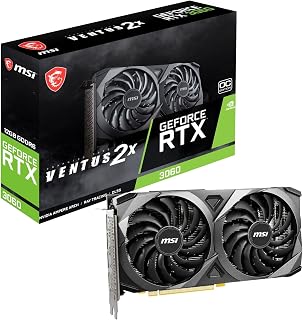
The 12GB GDDR6 memory provides ample headroom for modern titles at 1080p, eliminating concerns about VRAM bottlenecks that plague smaller buffers. The 1807 MHz boost clock delivers consistent performance in demanding scenarios, while the Ampere architecture ensures compatibility with DLSS technology to push frame rates higher when needed. Dual Torx fans keep thermals manageable during extended sessions, maintaining stable clocks without excessive noise.
Pros
- 12GB VRAM prevents memory bottlenecks at high frame rates
- 1807 MHz boost clock maintains consistent triple-digit FPS
- Torx Twin Fan cooling prevents thermal throttling during marathons
- DLSS support boosts performance in supported competitive titles
Cons
- Overkill for basic esports titles that don't need this much power
- Memory bandwidth can limit performance above 1080p resolution
For gamers chasing 1080p at 120 FPS, the MSI RTX 3060 Ventus 2X delivers reliable performance with headroom to spare. The 1807 MHz boost clock and Ampere architecture handle competitive shooters and fast-paced multiplayer games with ease, maintaining triple-digit frame rates in titles like Valorant, Apex Legends, and Overwatch 2. The 12GB GDDR6 memory buffer ensures texture streaming never becomes a bottleneck, even in graphically demanding AAA games where high refresh rate gaming meets detailed environments. MSI's Torx Twin Fan cooling keeps the card running efficiently during extended sessions, preventing thermal throttling that could disrupt smooth gameplay. The 192-bit memory interface and PCIe 4 support provide ample bandwidth for rapid frame delivery. Ray tracing and DLSS further enhance visual quality without sacrificing the high frame rates this use case demands. The compact Ventus form factor fits standard builds easily, and the card's power efficiency means you won't need an extreme PSU. For 1080p 120 FPS gaming, this GPU strikes an excellent balance between capability and thermal management.
GPU Chip: NVIDIA GeForce RTX 3060 (Ampere architecture)
Memory: 12GB GDDR6
Memory Interface: 192-bit
Boost Clock: 1807 MHz
Memory Clock: 1807 MHz
Max Resolution: 7680 x 4320 pixels
Video Outputs: 3x DisplayPort 1.4a, 1x HDMI 2.1
Interface: PCIe x16 4.0
Model: MSI Ventus 2X 12G OC V1
Included Accessories: Graphics card, quick setup guide
Ideal for competitive gamers and high-refresh-rate enthusiasts who prioritize frame consistency over resolution. Perfect if you own a 1080p 144Hz or 165Hz monitor and play fast-paced multiplayer titles where responsiveness matters. Skip this if you're primarily interested in 4K gaming or already have a 1440p display as your main screen, since the card's strengths shine brightest at 1080p where it can fully stretch its legs.

PNY NVIDIA GeForce RTX 5050 8GB Blackwell Graphics
The 8GB GDDR6 capacity handles most current titles at this resolution without memory pressure, while the 2317 MHz boost clock ensures consistent frame delivery. The dual-fan design maintains reasonable temperatures in a compact 2-slot form factor, ideal for smaller builds. Modern codec support and efficient power consumption make this a practical choice for gamers prioritizing smooth performance in mainstream titles without requiring extreme specifications.
Pros
- 8GB GDDR6 sufficient for 1080p high refresh gaming
- Compact 2-slot design fits smaller cases
- RTX 50 Series architecture ensures long driver support
- Dual-fan cooling balances noise and thermal performance
Cons
- 8GB VRAM limits headroom for future titles
- PCIe x8 interface may bottleneck in certain scenarios
The PNY NVIDIA GeForce RTX 5050 represents an entry point into modern GPU capabilities tailored for 1080p performance targets. With 8GB of GDDR6 memory and a 2317 MHz clock speed, this dual-fan card delivers the horsepower needed to sustain triple-digit frame rates in most contemporary games when paired with appropriate settings adjustments. The RTX 50 Series architecture brings updated hardware to the table, ensuring compatibility with current gaming engines and rendering techniques. Its compact 2-slot design and PCIe x8 interface make installation simple in smaller builds or systems with limited expansion space. The dual-fan thermal solution keeps temperatures manageable during extended gaming sessions without requiring excessive power draw. DisplayPort and HDMI outputs provide flexibility for monitor connectivity. While not a flagship product, this card hits the performance sweet spot for gamers who prioritize high refresh rate gameplay at 1080p resolution without investing in more expensive hardware. The 8GB VRAM buffer handles texture streaming efficiently at this resolution, and the modern architecture ensures driver support and feature updates for years ahead.
GPU: NVIDIA GeForce RTX 5050 with Blackwell Architecture
Memory: 8GB GDDR6, 128-bit bus
Clock Speed: 2317 MHz (GPU), 2317 MHz (Memory)
Interface: PCIe 5.0 x8
Output Ports: DisplayPort 2.1, HDMI 2.1
Max Resolution: 7680x4320
Form Factor: 2-Slot, SFF-Ready
Power: Efficient design suitable for compact builds
Warranty: 3 Years
Ideal for competitive gamers focused on high refresh rate 1080p displays who value consistent frame pacing over maximum visual fidelity. Also suitable for first-time PC builders working within moderate budgets who want modern GPU features without overspending. Skip this if you're targeting 1440p or 4K resolutions, planning to max out ray tracing in AAA titles, or need more than 8GB VRAM for content creation workflows alongside gaming.

The 12GB GDDR6 configuration eliminates memory concerns for this resolution, while the 2740 MHz boost clock delivers strong performance across modern titles. Intel's Arc platform has matured into a viable option with improved driver stability and game compatibility. DisplayPort 2.1 and HDMI 2.1a outputs provide full support for high refresh displays, and the 0dB silent mode keeps acoustics manageable during less demanding sessions.
Pros
- 12GB GDDR6 exceeds typical 1080p requirements
- XeSS 2 and 160 XMX engines boost compatible titles
- Temperatures below 75C with 0dB silent idle
- Single 8-pin simplifies cable management
Cons
- Driver maturity lags behind AMD and NVIDIA
- Requires 650W PSU minimum for safe operation
The ASRock Intel Arc B580 Challenger brings 12GB GDDR6 memory and a 2740 MHz clock to the 1080p high refresh rate arena through Intel's Xe2-HPG architecture. In practical gaming scenarios across titles like God of War, The Witcher, and Forza Horizon, this card pushes frame rates comfortably past 120 FPS thresholds when configured for 1080p output. The 19 Gbps memory speed ensures texture streaming keeps pace with rapid scene changes during fast-paced gameplay. Intel's XeSS 2 technology and 160 XMX engines provide additional performance uplift in supported games, stretching frame rates higher without sacrificing visual quality. Thermal management stays consistent with temperatures below 75 degrees Celsius, and the 0dB Silent technology stops fans during lighter loads for near-silent desktop operation. The metal backplate and Super Alloy construction contribute to cooling efficiency and structural rigidity. Installation requires only a single 8-pin connector, though a 650W PSU is recommended. The 249mm length accommodates most standard cases. DisplayPort 2.1 and HDMI 2.1a outputs handle modern display connectivity. While driver maturity continues improving, particularly on Linux platforms, the core gaming experience at 1080p 120 FPS remains solid across a wide variety of titles with zero reported crashes in typical use.
GPU and Memory: Intel Arc B580, 12GB GDDR6, 192-bit bus, 19 Gbps memory clock, 2740 MHz GPU clock
Architecture: Intel Xe2-HPG with 160 XMX engines for AI acceleration and XeSS 2 support
Connectivity: 3x DisplayPort 2.1, 1x HDMI 2.1a, supports up to 4 displays at 8K resolution
Power and Interface: PCIe 4.0 x8, 1x 8-pin power connector, 650W PSU minimum required
Cooling: Dual-fan axial design with 0dB Silent operation, metal backplate with thermal pads
Form Factor: 2-slot card, 249mm length, requires chassis clearance verification
Warranty: 2-year manufacturer warranty with dedicated Amazon support
Great for budget-focused gamers targeting 1080p 120Hz displays who want generous VRAM allocation and don't mind occasional driver tweaks. Also appeals to builders exploring alternatives to AMD and NVIDIA ecosystems. Skip if you require flawless Linux compatibility immediately, prefer plug-and-play experiences without configuration, or need guaranteed compatibility across every legacy title without manual adjustments.
What to Look for When Buying a GPU for 1080p 120 FPS
Raw Performance and Clock Speed
Sustained frame rates above 120 FPS demand a GPU with a high boost clock and efficient architecture. The ASRock Radeon RX 9060 XT Challenger 16GB OC pushes a 3290 MHz boost clock on AMD’s RDNA 4 architecture, which is a significant step forward in instructions-per-clock efficiency. More clock speed means less time waiting for frames, especially in CPU-limited scenarios where your GPU needs to clear its workload quickly.
Even older Ampere-based cards like the MSI Gaming GeForce RTX 3060 12GB 15 Gbps GDRR6 can hit 120 FPS consistently in most 1080p titles thanks to NVIDIA’s mature driver stack and DLSS support. Clock speed matters, but architecture efficiency matters just as much.
VRAM Capacity and Memory Bandwidth
At 1080p, 8GB of VRAM was once plenty, but modern titles with high-resolution texture packs are pushing past that ceiling. Cards like the ASRock Intel Arc B580 Challenger 12GB OC Graphics and the ASRock Radeon RX 9060 XT Challenger 16GB OC offer 12GB and 16GB respectively, giving you real headroom for today’s demanding titles and the next few years of releases.
Memory bandwidth is equally important. The ASRock Intel Arc B570 Challenger 10GB OC GDDR6 runs its 10GB GDDR6 at 19 Gbps on a 160-bit bus, which keeps frame delivery smooth even when texture streaming picks up. Wider buses and faster memory speeds translate directly to fewer dropped frames.
AI Upscaling and Frame Generation
Upscaling technologies like DLSS 4, AMD FSR, Intel XeSS 2, and frame generation have changed what “120 FPS” means. The ASUS TUF Gaming GeForce RTX 5070 12GB GDDR7 OC supports NVIDIA’s latest DLSS 4 with Multi Frame Generation, which can multiply perceived frame rates dramatically in supported titles. Similarly, the PNY NVIDIA GeForce RTX™ 5050 Dual-Fan Graphics brings fifth-gen Tensor Cores to a more accessible tier.
If you’re on a tighter budget, Intel’s XeSS 2 on the ASRock Intel Arc B580 Challenger 12GB OC Graphics delivers comparable AI-driven upscaling across a wide range of games. The key is verifying your most-played titles support the upscaling tech on the card you choose.
Cooling, Power Draw, and Build Compatibility
A GPU that runs hot will throttle, and throttling kills consistent 120 FPS. The ASUS Prime Radeon RX 9070 XT 16GB GDDR6 OC Edition uses Axial-Tech fans with dual ball bearings and a phase-change thermal pad for reliable long-term cooling. The GIGABYTE Radeon RX 9070 XT Gaming OC 16G Graphics pairs its WINDFORCE cooling system with server-grade thermal gel for similar results.
Always confirm your case has room for the card’s length and slot count before buying. The ASRock Challenger series cards measure 249mm and fit a 2-slot profile, making them a solid fit for mid-tower and even some compact builds. Check your PSU wattage too: a 550W unit covers most mid-range cards, but higher-end options like the RTX 5070 will want more headroom.
Final Thoughts
For most gamers chasing smooth 1080p 120 FPS gameplay in 2026, the sweet spot sits with cards like the ASRock Radeon RX 9060 XT Challenger 16GB OC, which delivers next-gen RDNA 4 efficiency and a generous 16GB GDDR6 buffer at a reasonable tier, while power users who want the absolute ceiling for high-refresh 1080p and a clear path to 1440p should look at the ASUS TUF Gaming GeForce RTX 5070 12GB GDDR7 OC with its Blackwell architecture and DLSS 4 frame generation. Match the card to your monitor, your case, and your PSU, and you’ll be hitting triple-digit frame rates with confidence.
Frequently Asked Questions
What GPU do I need to get 120 FPS at 1080p?
For most modern titles at 1080p with high settings, a mid-range GPU from the current or last generation is enough to sustain 120 FPS. Cards like the MSI Gaming GeForce RTX 3060 12GB 15 Gbps GDRR6 handle the majority of popular games at that frame rate with room to spare. In 2026, newer architectures like RDNA 4 and Blackwell push that ceiling even higher, especially with AI upscaling enabled.
Is 12GB VRAM enough for 1080p gaming in 2026?
Yes, 12GB is more than sufficient for 1080p at maximum settings in virtually every current title. Some newer open-world games with ultra-high texture packs can approach 10GB, so 12GB gives you a comfortable buffer. Cards like the ASRock Intel Arc B580 Challenger 12GB OC Graphics offer 12GB GDDR6 at a competitive tier, making them a practical long-term investment.
Does upscaling help reach 120 FPS at 1080p?
Absolutely. DLSS 4, AMD FSR 4, and Intel XeSS 2 all allow a GPU to render at a lower internal resolution and reconstruct a sharp 1080p image, which can dramatically increase frame rates with minimal visual quality loss. For competitive games where frame rate matters more than maximum fidelity, enabling upscaling is often the smartest move. If you’re also interested in gear for other parts of your life, you might enjoy reading about the best hardside spinner luggage options for when you travel to gaming events or lan parties.
Can an Intel Arc GPU handle 1080p 120 FPS gaming?
Intel’s Arc B-series cards, built on the Xe2-HPG architecture, are a genuine contender in 2026. The ASRock Intel Arc B570 Challenger 10GB OC GDDR6 and ASRock Intel Arc B580 Challenger 12GB OC Graphics both deliver solid 1080p frame rates, especially in DX12 and Vulkan titles where Arc’s hardware shines. Driver maturity has improved considerably, and XeSS 2 gives these cards an AI upscaling edge that closes the gap with more established brands.




Write Your Review
No reviews yet. Be the first to share your experience!