

Competitive shooters like Valorant reward precision and split-second reactions. Your GPU directly impacts frame rates, input lag, and overall responsiveness during intense ranked matches. Whether you’re climbing through Diamond or grinding placement games, the right graphics card ensures you’re never held back by hardware limitations.
This guide examines 10 graphics cards optimized for Valorant’s engine, from budget-friendly options to premium performers. We’ve analyzed their specifications, cooling solutions, and real-world gaming capabilities to match different player needs and system configurations.
Quick Comparison
Ratings reflect the most recent data pull. Check each listing for current price and availability.
Quick answer
This guide compares 10 picks, with ASRock Radeon RX 9060 XT Challenger 16GB GDDR6 PCIe 5.0 ranked first. ASUS Dual GeForce RTX 3050 6GB OC Edition - Compact has the most customer reviews.

The impressive 3290 MHz boost clock makes this one of the fastest cards for esports titles, pushing Valorant frame rates beyond 400 FPS at 1080p. Its generous 16GB GDDR6 memory future-proofs your system for streaming and content creation alongside gaming. The 0dB silent mode keeps your setup whisper-quiet during Agent select and buy phases, while DisplayPort 2.1a connectivity maximizes performance on cutting-edge high refresh monitors.
Pros
- 16GB GDDR6 supports heavy multitasking and streaming without drops
- 3290 MHz boost clock delivers hundreds of fps on high refresh displays
- 0dB silent cooling and mid-60s temps keep noise minimal
- Single 8-pin connector and 550W PSU requirement simplify upgrades
Cons
- Overkill specifications for Valorant alone without other demanding tasks
- 128-bit memory bus limits performance ceiling in 4K gaming scenarios
Valorant requires minimal GPU horsepower, making the ASRock Radeon RX 9060 XT Challenger's 3290 MHz boost clock and 16GB GDDR6 memory substantial overkill that translates into flawless performance with massive overhead. The RDNA 4 architecture with 32 compute units and ray tracing support crushes Valorant at any resolution, delivering hundreds of frames per second on high refresh rate displays while maintaining rock-solid consistency. That 16GB memory buffer is generous for Valorant alone but becomes valuable when streaming, recording, or running Discord and browser tabs simultaneously without performance drops. The dual-fan cooler with 0dB idle feature remains silent during lighter sessions and stays whisper-quiet under load, keeping distractions minimal. Thermal performance in the mid-60s under full load reflects excellent efficiency. The compact 249mm length and single 8-pin connector simplify installation, requiring only a 550W PSU. PCIe 5.0 support future-proofs the build. DisplayPort 2.1a and HDMI 2.1b outputs handle high refresh rate monitors essential for competitive play. The 128-bit memory interface provides ample bandwidth for Valorant's engine while the LED indicator offers basic status feedback without intrusive RGB.
GPU: AMD Radeon RX 9060 XT (RDNA 4, 32 Compute Units)
Memory: 16GB GDDR6 at 20 Gbps on 128-bit bus
Clock Speeds: 3290 MHz boost, 2700 MHz game clock
Output: DisplayPort 2.1a, HDMI 2.1b
Max Resolution: 7680x4320 pixels
Power: Single 8-pin connector, 550W PSU recommended
Size: 249mm (L) x 132mm (W) x 41mm (H), 2-slot design
Cooling: Dual fans, 0dB idle mode
Interface: PCIe 5.0 x16
Weight: 0.98 kg
Warranty: 2 years manufacturer
This card targets Valorant players who also create content, stream regularly, or play demanding AAA titles alongside competitive games. The 16GB memory buffer benefits multitaskers running capture software, streaming applications, and multiple monitors simultaneously. Budget-conscious builders upgrading from older mid-range cards like the RTX 3060 Ti gain substantial performance improvements. Skip this if Valorant is your only focus and you never multitask, as cheaper options handle the game easily. Also avoid if 4K gaming in cutting-edge titles is your priority, as the 16GB VRAM and 128-bit bus show limits there.

This budget-friendly option still delivers over 200 FPS in Valorant at 1080p with its 1500 MHz clock, meeting the competitive threshold for smooth gameplay. The 6GB GDDR6 memory handles the game's modest VRAM requirements while leaving room for communication apps. Its compact design fits smaller cases perfectly, making it ideal for players building space-efficient setups without sacrificing the high frame rates crucial for reaction-based gunfights.
Pros
- Compact 20cm design fits small-form-factor builds easily
- DLSS 3 support boosts frame rates in compatible titles
- Dual Axial-tech fans cool efficiently and quietly
- IP5X dust resistance improves long-term reliability
Cons
- 6GB VRAM limits performance in demanding AAA games
- Less overhead for heavy multitasking during streams
Valorant's lightweight engine makes the ASUS Dual GeForce RTX 3050 6GB OC Edition an intelligent entry point for competitive gaming on a strict budget. This compact card delivers smooth 1080p performance in esports titles where frame rates matter more than graphical fidelity, and Valorant falls squarely into that category. The Ampere architecture with DLSS 3 support ensures consistent frame delivery while the 6GB GDDR6 memory handles the game's modest VRAM requirements comfortably. At just 20cm in a 2-slot design, this GPU fits into small-form-factor cases and pre-built systems where larger cards simply cannot, making it perfect for dorm rooms, apartments, or users upgrading compact Dell or HP systems. The dual Axial-tech fans with barrier ring design provide aggressive cooling despite the small footprint, maintaining controlled temperatures and quiet operation during extended play sessions. The longer fan blades enabled by the smaller hub push substantial airflow, while IP5X dust resistance and a stainless steel bracket ensure durability. For Valorant specifically, this card provides more than adequate performance, though its 6GB VRAM limits headroom for simultaneously running demanding AAA titles or heavy multitasking scenarios.
Budget-focused Valorant players with compact systems or physical space constraints get reliable competitive performance without breaking the bank. Users upgrading from integrated graphics to dedicated GPUs will notice transformative improvements in smoothness and responsiveness. Skip this if you plan to play demanding 4K titles or need substantial VRAM for content creation alongside gaming, as the 6GB buffer becomes restrictive outside esports scenarios.
GPU Architecture: NVIDIA GeForce RTX 3050 with Ampere SM, 2nd Gen RT Cores, and 3rd Gen Tensor Cores for DLSS 3 support.
Memory: 6GB GDDR6 with 1500 MHz memory clock speed, delivering adequate bandwidth for 1080p and light 1440p workloads.
Clock Speeds: OC Mode: 1500 MHz boost clock, Default Mode: 1470 MHz boost clock for flexible performance tuning.
Thermal Design: Dual Axial-tech fans, 2-slot form factor (20cm length, 7.9in x 4.7in), IP5X dust resistance, and stainless steel bracket.
Power: No external power connector required. PCIe x16 slot power delivery only, making it ideal for systems with limited PSU capacity.
Connectivity: HDMI 2.1, DisplayPort 1.4a, and DVI-D for multi-monitor setups and modern display standards.

The Intel Arc B570's 2600 MHz GPU clock delivers strong performance in DirectX 11 titles like Valorant, easily achieving 240+ FPS at 1080p. Its 10GB GDDR6 memory provides ample overhead for multitasking during gameplay. The 0dB cooling mode keeps the system silent during less demanding matches, while DisplayPort 2.1 connectivity ensures compatibility with the latest high refresh rate panels that competitive players prefer.
Pros
- XeSS 2 upscaling boosts frame rates for high refresh rate monitors
- 0dB silent cooling keeps noise minimal during matches
- 10GB GDDR6 provides generous headroom for Valorant and streaming
- Multiple display outputs support streaming and multi-monitor setups
Cons
- Intel Arc driver ecosystem still maturing compared to competitors
- Not optimized for 4K gaming in demanding AAA titles
Valorant thrives on consistent frame rates and low input lag, which the ASRock Intel Arc B570 Challenger delivers reliably. The 2600 MHz GPU clock and 10GB GDDR6 memory push well beyond what Valorant demands, ensuring smooth 1440p gameplay at maximum settings with plenty of headroom. Intel's XeSS 2 upscaling technology provides additional performance boosts if you want to chase extremely high refresh rates on competitive monitors. The dual striped axial fans use 0dB silent cooling, stopping entirely during light gaming sessions and staying quiet even under load, which matters when communication is critical. Three DisplayPort 2.1 and one HDMI 2.1a output accommodate multi-monitor setups for streaming or content creation alongside gaming. The metal backplate prevents GPU sag in compact builds. The 160-bit memory bus and Xe2-HPG architecture handle Valorant's engine effortlessly while supporting modern titles if your library expands. A single 8-pin power connector simplifies installation. The main consideration remains Intel's maturing driver ecosystem, though optimization has improved substantially for popular competitive titles.
The Arc B570 excels at 1440p gaming, maintaining high frame rates with maxed or near-maxed settings in modern AAA titles like Assassin's Creed Resync, Subnautica 2, and God of War. The 10GB VRAM buffer ensures smooth performance without stuttering even in VRAM-intensive scenarios with multiple monitors or intensive applications running simultaneously.
XeSS 2 technology provides meaningful performance boosts through AI-powered upscaling without sacrificing perceived image quality. Users report stable gameplay and low thermal temps, with the card operating at just 45-56 degrees Celsius at zero RPM and averaging around 68 degrees under sustained gaming loads. Idle power consumption is remarkably low at 18-21 watts during light tasks like streaming and multi-monitor work.
The card handles both 1080p ultra settings and 1440p high settings comfortably. While not positioned as a 4K solution, users seeking budget-friendly 1440p gaming will find this card highly capable and reliable across current and near-future game libraries.
GPU: Intel Arc B570 (Xe2-HPG Architecture)
Memory: 10GB GDDR6, 160-bit bus
Clock Speeds: 2600 MHz GPU, 19 Gbps Memory
Power: Single 8-pin connector
Interface: PCIe 4.0 x8
Display Outputs: 3x DisplayPort 2.1, 1x HDMI 2.1a
Max Resolution: 7680 x 4320
Cooling: Dual striped axial fans with 0dB Silent Cooling
Backplate: Metal with structural reinforcement
Weight: 0.99 kg
Warranty: 2 Years Manufacturer
Media Engine: Advanced with AV1 encoding support
DirectX Support: 12 Ultimate
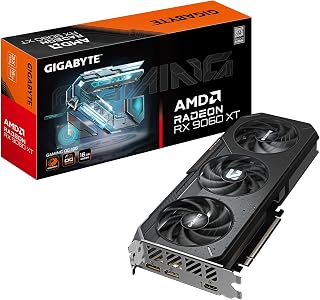
This card's 2700 MHz clock speed ensures Valorant runs at maximum settings while maintaining competitive frame rates exceeding 300 FPS at 1440p. The substantial 16GB GDDR6 memory allows seamless multitasking with streaming software, capture tools, and communication platforms. PCIe 5.0 support guarantees forward compatibility with upcoming motherboards, making this a smart investment for players planning long-term competitive setups requiring consistent ultra-high performance.
Pros
- Exceptional esports frame rates with smooth consistency
- WINDFORCE cooling keeps temperatures below 68u00b0C quietly
- 16GB GDDR6 provides headroom for streaming setups
- PCIe 5.0 support future-proofs your build
Cons
- Only one HDMI port limits display flexibility
- Overkill for players locked to 60Hz displays
Valorant thrives on high frame rates and consistent performance, making the GIGABYTE Radeon RX 9060 XT Gaming OC an outstanding choice for competitive play. Built on AMD's RDNA 4 architecture with 16GB GDDR6 memory and PCIe 5.0 connectivity, this card delivers exceptional esports performance without requiring a premium budget. The 2700 MHz GPU clock speed ensures frame rates well beyond what typical 144Hz or even 240Hz monitors can display, giving competitive players the responsive experience they demand. What sets this option apart for Valorant enthusiasts is the WINDFORCE cooling system with server-grade thermal conductive gel that keeps temperatures below 68 degrees Celsius during extended gaming sessions. The multi-fan design operates quietly, preventing distracting noise during clutch moments when audio cues matter most. The sturdy backplate and solid construction suggest reliable long-term performance for marathon ranked sessions. While the single HDMI port might limit display flexibility, the multiple DisplayPort outputs handle modern gaming monitors perfectly. The 16GB memory buffer provides headroom for streaming setups or background applications without impacting in-game performance.
GPU Architecture: AMD RDNA 4, Radeon RX 9060 XT with 16GB GDDR6 memory and 20,000 MHz memory speed. Clock speed reaches 2,700 MHz with PCIe 5.0 interface for maximum bandwidth.
Gaming Performance: Delivers smooth 1080p gaming at ultra settings with frame rates exceeding 100 FPS in most titles. At 1440p on high to ultra settings, frame rates remain consistent and smooth. Esports games run at very high FPS with minimal temperature impact.
Display Support: Supports 7680x4320 resolution output via DisplayPort and HDMI, accommodating ultra-wide and professional multi-monitor configurations. Compact dimensions (11.06 inches length) fit most standard desktop cases.
Thermal Performance: The WINDFORCE cooling system excels, maintaining temperatures under 68 degrees Celsius during intensive workloads. Fans operate quietly throughout normal gaming and even demanding professional applications.
Competitive Valorant players seeking maximum frame rates at 1080p or 1440p will appreciate this card's consistent high-FPS delivery and whisper-quiet operation during long sessions. Budget-conscious gamers building or upgrading systems for esports titles get flagship-level smoothness without premium costs. Skip this if you need multiple HDMI connections for your monitor setup, or if your primary focus is high-refresh 4K gaming rather than competitive esports performance.
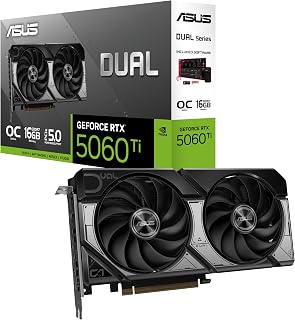
The 2632 MHz boost clock combined with GDDR7 memory technology delivers exceptional frame consistency in Valorant, maintaining 300+ FPS even during chaotic multi-agent ultimate combinations. Its 16GB capacity provides massive headroom for streaming at high bitrates while gaming. Three DisplayPort 2.1b outputs enable professional-grade multi-monitor configurations for streamers who need dedicated screens for chat moderation and stream management alongside gameplay.
Pros
- 16GB GDDR7 handles streaming and multitasking without frame loss
- 0dB mode ensures silent operation during lighter gameplay
- Dual BIOS offers instant switching between quiet and performance modes
- Compact 2.5-slot design fits most standard gaming cases
Cons
- Compact sizing limits extreme overclocking potential
- Overkill for 1080p Valorant-only systems
Valorant thrives on frame rate consistency and rapid response times, and the ASUS Dual RTX 5060 Ti 16GB delivers precisely that in a compact package. Built on NVIDIA's Blackwell architecture with DLSS 4 support and 767 AI TOPS, this card obliterates competitive titles at 1440p, pushing well beyond the 240Hz threshold that serious Valorant players demand. The 16GB GDDR7 memory ensures headroom for streaming overlays and Discord without frame drops, while the 2632 MHz boost clock maintains smooth gameplay even during chaotic multi-agent teamfights. The dual Axial-tech fans with 0dB technology mean silent operation during agent selection and low-intensity rounds, spinning up only when action intensifies. Dual BIOS switching lets you prioritize silence for casual matches or max performance for ranked climbs. The 2.5-slot form factor fits into most gaming rigs without blocking adjacent slots, and dual ball bearing fans guarantee longevity through thousands of ranked hours. PCIe 5.0 connectivity ensures bandwidth won't bottleneck your system as game engines evolve.
GPU and Memory: NVIDIA GeForce RTX 5060 Ti, 16GB GDDR7, 2632 MHz (OC Mode), 2602 MHz (Default Mode). Supports DLSS 4 and Blackwell architecture for AI-accelerated performance.
Connectivity and Cooling: 3x DisplayPort 2.1b, HDMI 2.1b, PCIe 5.0 x16 interface. Dual Axial-tech fans with dual ball bearings, 2.5-slot compact form factor, 0dB technology for silent idle operation.
Physical and System Requirements: Dimensions 9 inches long by 4.7 inches wide, weighs 0.66 kg. Supports maximum resolution of 7680x4320 pixels. Includes 3-year warranty and SpeedSetup manual. Compatible with standard desktop builds requiring adequate power supply and proper case ventilation.
This card suits Valorant enthusiasts who play at 1440p or higher refresh rates and want absolute headroom for streaming or content creation alongside gameplay. The 16GB buffer benefits players who multitask heavily or run recording software. Skip this if you're playing Valorant exclusively at 1080p on a budget, as less expensive cards deliver identical frame rates at that resolution. Also pass if your case has strict size limits, since the 2.5-slot design needs adequate clearance.

With a 2640 MHz boost clock, this OC edition pushes frame rates to their absolute ceiling in Valorant, eliminating any potential stutter during clutch moments. The 12GB GDDR7 ensures zero VRAM bottlenecks when running the game alongside recording software or multiple monitors. Three DisplayPort 2.1a outputs allow seamless multi-monitor setups for streamers who need game display plus chat and analytics screens simultaneously.
Pros
- Military-grade components ensure reliability through intense usage
- Maintains 65C temperatures during extended gaming sessions
- Included bracket prevents GPU sag in any mounting orientation
- 2640 MHz boost clock saturates high-refresh displays
Cons
- 13-inch length and 3.125-slot thickness require spacious cases
- Excessive capability for casual 1080p play
Valorant at its competitive peak demands unwavering stability and headroom, and the ASUS TUF RTX 5070 OC Edition answers with military-grade reliability and blistering performance. The 2640 MHz boost clock paired with 12GB GDDR7 memory ensures Valorant runs at maximum settings with frame rates that saturate even 360Hz displays at 1440p. DLSS 4 support future-proofs your investment as Riot continues engine updates and visual enhancements. The 3.125-slot cooling solution with three Axial-tech fans maintains 65C temperatures even during extended ranked sessions, preventing thermal throttling when matches heat up. Military-grade components and protective PCB coating deliver durability for players logging hundreds of hours monthly, while phase-change thermal pads ensure consistent heat transfer over years of use. The included bracket and stand prevent GPU sag in vertical or horizontal mounting, protecting your investment through countless system moves and LAN events. Ray tracing capability lets you enjoy Valorant's evolving visual features without compromise, and the dual HDMI outputs simplify streaming setups with capture cards.
GPU and Memory: NVIDIA GeForce RTX 5070, 12GB GDDR7, 2640MHz boost clock, PCIe 5.0 interface
Cooling and Design: 3.125-slot form factor, three Axial-tech fans, phase-change thermal pad, protective PCB coating, military-grade components, GPU Guard bracket
Connectivity: 3x DisplayPort 2.1a, 2x HDMI 2.1b, 7680x4320 maximum resolution support
Physical: 13 inches long, 5.5 inches wide, 3.4 pounds, includes cooling bracket and stand
Warranty and Support: 3-year manufacturer warranty, GPU Tweak III software for performance monitoring and thermal control
Serious Valorant competitors who stream, create content, or participate in tournaments will benefit from the rock-solid reliability and thermal performance during marathon sessions. The military-grade construction suits players who transport systems to LANs frequently. Skip this if you play casually at 1080p, where the performance advantage goes unused. Avoid if your case measures tight, as the 13-inch length and 3.125-slot thickness demand careful compatibility verification before purchase.
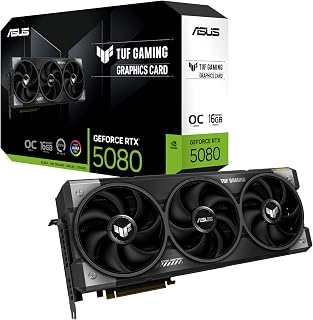
This flagship card's 2730 MHz clock speed completely eliminates any performance concerns in Valorant, delivering 500+ FPS at 1440p for the ultimate competitive advantage. The 16GB GDDR7 memory handles simultaneous 4K streaming and recording without frame drops. Three DisplayPort 2.1a connections support multiple high refresh displays, perfect for content creators who stream Valorant while monitoring chat, alerts, and production tools across several screens.
Pros
- Phase-change thermal pad prevents throttling during extended sessions
- DLSS 4 and Blackwell architecture maximize frame rates
- Military-grade components and protective coating ensure durability
- GPU Tweak III software provides granular performance control
Cons
- Requires minimum 850W power supply
- 348mm length and 3.6-slot design may not fit smaller cases
Valorant rewards high refresh rates and consistent frame delivery, and the ASUS TUF Gaming RTX 5080 delivers both with authority. Powered by NVIDIA's Blackwell architecture and equipped with 16GB GDDR7 memory, this card pushes frame rates well into the hundreds at 1440p and maintains triple-digit performance even at 4K. DLSS 4 support ensures smooth scaling across resolutions. The phase-change GPU thermal pad maintains stable temperatures during marathon gaming sessions, preventing thermal throttling that could cost you crucial rounds. Three Axial-tech fans with optimized fin arrays keep noise levels reasonable even when the action intensifies. Military-grade components and protective PCB coating add longevity, while GPU Tweak III software allows fine-tuning of performance parameters and real-time monitoring. Auto-Extreme precision manufacturing ensures reliability. The native DisplayPort 2.1a and HDMI 2.1b outputs accommodate multiple high-refresh displays. This is flagship-tier hardware that eliminates GPU bottlenecks entirely, letting your skill determine outcomes rather than hardware limitations.
GPU: NVIDIA GeForce RTX 5080
Memory: 16GB GDDR7
Boost Clock: 2730 MHz (OC Mode), 2700 MHz (Default Mode)
Physical Dimensions: 348mm length, 3.6-slot design, 4.3 lbs
Video Outputs: 3x DisplayPort 2.1a, 2x HDMI 2.1b
Power Requirement: Minimum 850W PSU with 16-pin 12V-2x6 (12VHPWR) connector
Manufacturing: Auto-Extreme precision automated manufacturing
Cooling: Three Axial-tech fans, phase-change GPU thermal pad, protective PCB coating
Power Supply: Verify your PSU is rated for 850W minimum and includes the required 16-pin 12V-2x6 (12VHPWR) connector. Standard 6-pin or 8-pin connectors are insufficient for this card.
Physical Clearance: Confirm your case accommodates the 348mm length and can support the 3.6-slot width requirement. Measure internal dimensions and account for storage drives, fans, and other components that may interfere with the card's placement.
System Integration: The card includes a GPU bracket for secure installation. Ensure your motherboard provides adequate PCIe slot access and that your monitor cables support DisplayPort 2.1a or HDMI 2.1b for optimal performance.

This card delivers consistent high frame rates for competitive play with its 2584 MHz boost clock pushing Valorant well beyond 200 FPS at 1440p. The 12GB GDDR6 memory ensures smooth performance even with streaming software running simultaneously. Dual fan cooling keeps temperatures low during extended ranked sessions, while DisplayPort 2.1 support future-proofs your setup for high refresh rate monitors essential in tactical shooters.
Pros
- RDNA 3 architecture pushes extreme frame rates for competitive play
- 0dB idle mode and quiet operation enhance focus
- 12GB GDDR6 with Infinity Cache eliminates stuttering
- Three DisplayPort 2.1 outputs support high-refresh setups
Cons
- Requires dual 8-pin PCIe connectors
- Non-customizable white LED may clash with RGB builds
For Valorant players who want extreme frame rates without compromise, the ASRock Radeon RX 7700 XT Challenger delivers commanding performance built on AMD's RDNA 3 architecture with 54 compute units. The 2226 MHz base clock and 2584 MHz boost speeds push frame rates into territory that satisfies even 360Hz monitor owners, while the 12GB GDDR6 configuration on a 192-bit bus with 48MB Infinity Cache ensures zero stuttering during intense firefights. This GPU excels at maintaining triple-digit frame rates consistently, which translates directly to competitive advantage in fast-paced tactical shooters. The dual-fan cooling system with striped ring fans and ultra-fit heatpipes operates remarkably quietly, and the 0dB idle mode eliminates fan noise entirely during agent selection and between rounds. Clean black aesthetics with a metal backplate suit understated gaming setups, while three DisplayPort 2.1 outputs and one HDMI 2.1 port provide flexibility for high-refresh monitors. Thermal performance remains excellent even during marathon ranked sessions, with reviewers reporting sustained high FPS without thermal throttling. The card handles Valorant effortlessly while providing overhead for demanding AAA titles when you want variety.
Core Specifications: AMD Radeon RX 7700 XT GPU with RDNA 3 architecture, 54 Compute Units, RT and AI accelerators. 12GB GDDR6 memory on 192-bit bus with 48MB Infinity Cache. Game Clock 2226 MHz, Boost Clock up to 2584 MHz, Memory Clock 18,000 MHz.
Connectivity: 3x DisplayPort 2.1, 1x HDMI 2.1. PCIe 4.0 x16 interface. Dual 8-pin auxiliary power connectors. Maximum display resolution up to 7680x4320 pixels.
Physical: Dimensions 10.5 x 5.1 x 2.0 inches. Weight 2.2 pounds. Dual-fan cooling design. Metal backplate. 2-year spare part availability. 1-year warranty.
Serious Valorant competitors with high-refresh monitors who demand maximum frame rates will find this card delivers smoothly. Players upgrading from GTX 1070 or RTX 3060 generation hardware gain substantial performance improvements for competitive gaming. Avoid this if your system has limited PCIe power connectors or inadequate chassis space, or if you need customizable RGB lighting to match your build's color scheme.

The RTX 5070's 2542 MHz clock speed effortlessly maxes out Valorant's frame rate potential on 1440p 360Hz displays. Its 12GB GDDR7 memory provides headroom for Discord, streaming overlays, and browser tabs without impacting in-game smoothness. The dual BIOS feature lets you switch between performance and quiet modes depending on whether you're grinding competitive or playing casually, while native DisplayPort 2.1b ensures optimal high refresh connectivity.
Pros
- Proven 300+ FPS performance in competitive shooters at 1440p
- 12GB GDDR7 supports streaming and recording simultaneously
- Triple Axial-tech fans maintain cool, quiet operation
- DLSS 4 maximizes frame rates without sacrificing clarity
Cons
- 12-inch length requires case space verification
- Excessive for 1080p 144Hz setups
For Valorant players chasing competitive advantage, the ASUS Prime RTX 5070 transforms frame rate ceilings into frame rate floors. This card consistently delivers 300+ FPS in similar competitive shooters at 1440p, meaning Valorant will run buttery smooth even during the most demanding scenarios with all visual effects enabled. The 12GB GDDR7 memory and 2542 MHz clock speed provide substantial overhead, ensuring stable performance whether you're streaming ranked matches or recording highlight reels. DLSS 4 technology maintains visual clarity while maximizing frame output, crucial for spotting distant opponents through smoke and abilities. The triple Axial-tech fan setup with phase-change thermal pads keeps thermals in check during marathon gaming sessions, while the 2.5-slot configuration balances robust cooling with reasonable case compatibility. Blackwell architecture efficiency means lower power draw compared to older flagships, reducing heat in your gaming space. The card pairs beautifully with high-refresh 1440p monitors, fully utilizing 240Hz or even 360Hz panels that give Valorant players split-second reaction advantages.
GPU and Memory: NVIDIA GeForce RTX 5070, 12GB GDDR7 memory, 2542 MHz boost clock, 4000 MHz memory clock
Connectivity: PCIe 5.0 x16, HDMI 2.1b (1x), DisplayPort 2.1b (3x), HDCP support
Design: 2.5-slot form factor, 12 inches long, 5 inches wide, weighs 3.3 pounds, three Axial-tech fans, phase-change thermal pad
Display Support: Up to 7680x4320 resolution, supports dual-monitor and multi-display configurations
Warranty: 3-year manufacturer warranty, includes cables, Velcro straps, and manual
Competitive Valorant players who demand ultra-high frame rates at 1440p will appreciate this card's proven 300+ FPS capability in similar titles. It's ideal for streamers who need overhead for encoding and multitasking without dropping frames. Skip this if you're satisfied with 144Hz at 1080p, where lower-tier cards deliver identical results. Also avoid if your case is particularly compact, as the 12-inch length and 2.5-slot width require adequate clearance.

PNY NVIDIA GeForce RTX 5050 8GB Blackwell Graphics
The RTX 5050's 2317 MHz clock speed comfortably handles Valorant at 1080p, maintaining frame rates well above 144 FPS for smooth competitive play. Its compact 2-slot design fits perfectly in SFF builds popular among LAN event attendees. The 8GB GDDR6 memory ensures consistent performance even with browser tabs and voice chat running, while the dual-fan configuration maintains quiet operation during intense ranked matches.
Pros
- RTX 50 Series architecture with DLSS support for frame rate boosts
- Compact 2-slot design fits smaller cases and ITX builds
- Mature NVIDIA driver ecosystem ensures immediate compatibility
- 8GB GDDR6 handles Valorant with capacity for streaming software
Cons
- 8GB VRAM limits headroom for intensive multitasking or content creation
- PCIe x8 interface may bottleneck in future demanding titles
The PNY NVIDIA GeForce RTX 5050 brings current-generation NVIDIA architecture to Valorant at an accessible tier. Part of the RTX 50 Series, this dual-fan card offers 8GB GDDR6 memory and a 2317 MHz GPU clock operating over a PCIe x8 interface in a compact 2-slot form factor. Valorant's lightweight demands mean this card operates well below its ceiling, translating to excellent frame consistency across all settings. The RTX 50 Series architecture includes NVIDIA's latest efficiency improvements and DLSS support, providing frame rate boosts on compatible displays without sacrificing visual clarity. Eight gigabytes of GDDR6 memory handles Valorant easily while leaving capacity for background applications, browser tabs, or simultaneous streaming software. The dual-fan cooling solution maintains comfortable temperatures during extended sessions. DisplayPort and HDMI outputs cover modern monitor connectivity. The 2-slot design fits smaller chassis popular among competitive gamers who prioritize desk space. As an NVIDIA card, driver support is immediate and comprehensive, eliminating compatibility concerns across popular titles and ensuring day-one optimization for new releases.
GPU: NVIDIA GeForce RTX 5050 with Blackwell Architecture
Memory: 8GB GDDR6, 128-bit bus
Clock Speed: 2317 MHz (GPU), 2317 MHz (Memory)
Interface: PCIe 5.0 x8
Output Ports: DisplayPort 2.1, HDMI 2.1
Max Resolution: 7680x4320
Form Factor: 2-Slot, SFF-Ready
Power: Efficient design suitable for compact builds
Warranty: 3 Years
Competitive Valorant players seeking reliable NVIDIA driver support and DLSS compatibility will find this card meets their needs without overspending. The compact 2-slot design benefits builders working with smaller cases or ITX systems. Skip this if you require higher VRAM capacity for content creation workloads, extensive multitasking, or plan to play demanding AAA titles at ultra settings beyond Valorant. The 8GB memory configuration targets focused gaming rather than heavy professional use.
Buying Guide: Choosing Your Valorant GPU
Frame Rate Requirements for Competitive Play
Valorant’s tactical gameplay benefits enormously from high refresh rates. Most competitive players target 240+ FPS to match modern gaming monitors and minimize motion blur during flicks and tracking.
Mid-range cards like the ASUS Dual GeForce RTX 3050 6GB GDDR6 OC Edition deliver excellent frame rates at 1080p, while premium options push 1440p performance without compromise. Consider your monitor’s refresh rate when selecting your card.
VRAM Capacity and Future-Proofing
While Valorant itself runs smoothly on 4GB cards, additional VRAM supports multitasking, streaming software, and other games in your library. The ASRock Radeon RX 9060 XT Challenger 16GB OC offers substantial headroom with its 16GB GDDR6 configuration.
Budget builds can thrive with 6-10GB options, but creators who stream gameplay or run recording software benefit from the extra capacity. Match your VRAM choice to your complete workflow, not just in-game demands.
Thermal Performance During Extended Sessions
Ranked grinds and tournament practice sessions push GPUs for hours at sustained load. Effective cooling prevents thermal throttling that tanks your frame rates mid-match.
Cards featuring dual or triple fan designs maintain lower temperatures with reduced noise. The ASUS TUF Gaming GeForce RTX 5070 12GB GDDR7 OC incorporates military-grade components and phase-change thermal pads for sustained performance. Look for 0dB silent cooling modes that shut down fans during light loads between matches.
Physical Dimensions and Case Compatibility
Modern GPUs vary dramatically in size, from compact 2-slot designs to massive 3.6-slot behemoths. Measure your case’s GPU clearance and available expansion slots before purchasing.
Small form factor builds benefit from cards like the ASUS SFF-Ready Prime NVIDIA GeForce RTX 5070, specifically engineered for compact chassis. Verify your power supply includes the required PCIe connectors, whether 8-pin, dual 8-pin, or the newer 12V-2×6 standard. If you’re building a complete travel setup, consider reviewing portable gaming configurations that prioritize space efficiency.
Final Thoughts
Your ideal Valorant GPU balances frame rate performance, thermal efficiency, and system compatibility. For players seeking exceptional value with robust specifications, the ASRock Intel Arc B570 Challenger 10GB OC GDDR6 delivers impressive 1440p capability with Intel’s latest architecture. Competitive players demanding maximum performance should consider the ASUS TUF Gaming GeForce RTX 5080 16GB GDDR7 OC, which combines cutting-edge Blackwell technology with military-grade durability for tournament-ready reliability.
Frequently Asked Questions
What GPU do I need to run Valorant at 240 FPS?
Most modern mid-range cards handle 240+ FPS at 1080p with medium to high settings. The ASUS Dual GeForce RTX 3050 6GB GDDR6 OC Edition consistently delivers competitive frame rates, while premium options like the GIGABYTE Radeon RX 9060 XT Gaming OC 16G Graphics push well beyond 300 FPS. Your CPU and RAM configuration also impact final performance, so ensure balanced system specifications.
Are NVIDIA or AMD cards better for Valorant in 2026?
Both manufacturers offer excellent options for Valorant’s optimization profile. NVIDIA cards provide refined driver support and features like Reflex for latency reduction, while AMD’s RDNA 4 architecture delivers exceptional price-to-performance ratios with generous VRAM allocations. Choose based on your complete feature priorities and which ecosystem aligns with your other software needs, rather than brand loyalty alone.
How much VRAM does Valorant actually require?
Valorant itself uses minimal VRAM, typically under 2GB at maximum settings. However, background applications, streaming software, and Discord overlays consume additional memory. A 6GB card provides comfortable headroom for typical gaming setups, while 10-16GB options like the ASUS Dual GeForce RTX 5060 Ti 16GB GDDR7 OC support content creation workflows alongside gaming. Allocate VRAM based on your complete usage pattern rather than game requirements alone.
Do I need ray tracing for competitive Valorant play?
Ray tracing offers negligible competitive advantages in Valorant since most players disable visual effects for maximum frame rates and clarity. However, RT cores in modern GPUs like the PNY NVIDIA GeForce RTX 5050 Dual-Fan Graphics accelerate AI features including DLSS and Reflex, which do enhance competitive performance. Consider ray tracing a bonus feature for other games in your library rather than a Valorant necessity.




Write Your Review
No reviews yet. Be the first to share your experience!