

You’ve saved up for a new GPU, and you’re working with a firm $300 budget. The good news: this price range offers excellent options for 1080p gaming, capable 1440p performance, and even entry-level ray tracing. The challenge lies in choosing between newer architecture with less VRAM, older cards with more memory, or brand-new budget options from Intel and AMD.
This guide examines nine graphics cards that maximize value under $300, from NVIDIA’s RTX 3050 series to Intel’s new Arc B570 and refurbished powerhouses like the GTX 1080 Ti. Whether you prioritize the latest features or raw performance, you’ll find a solid recommendation here.
Quick Comparison
Ratings reflect the most recent data pull. Check each listing for current price and availability.

MSI GeForce GTX 1660 Ti Gaming X 6GB GDDR6 Dual
Pros
- Outstanding noise performance, the intelligent cooling system keeps fans off during light use
- Easy installation with minimal power draw, perfect for systems with limited PSU capacity
- Compact form factor fits most PC cases without modification
- Excellent price-to-performance ratio for 1080p and 1440p gaming
- Consistent reliability and strong MSI brand reputation for support
Cons
- No ray tracing or DLSS support, limiting future-proofing for next-gen graphics features
- Mystic Light RGB software has known usability issues according to owner feedback
- Maxes out at 7680x4320 resolution output, though 1440p remains the optimal gaming resolution for this card
The MSI GeForce GTX 1660 Ti Gaming X is a practical mid-range graphics card designed for gamers who prioritize smooth performance at 1080p and 1440p without breaking the bank. This card is ideal for budget-conscious upgrades, Dell XPS owners with power constraints, and anyone skeptical about paying premium prices for ray tracing technology they won't regularly use.
Performance is rock-solid across modern titles. With 1536 CUDA cores, 6GB GDDR6 memory, and a 1875 MHz boost clock, this card handles demanding games at high settings with consistent frame rates at its target resolutions. The 192-bit memory bus and memory clock of 8000 MHz ensure smooth data flow for intensive gaming workloads. Most importantly, owners report measurable upgrades from older generations like the GTX 1070 or RX 480.
The standout feature is the dual-fan cooling system's intelligence. Unlike aggressive coolers that run constantly, these fans activate only when temperatures demand it, resulting in near-silent operation during everyday use and web browsing. The card measures 5 inches long and weighs just 1.8 pounds, fitting comfortably in most builds without space conflicts. Build quality from MSI is evident in the premium aesthetics and sturdy construction.
Drawbacks exist. This is purely raster architecture without ray tracing or DLSS support, meaning you won't access next-generation graphical features hitting newer AAA titles. The Mystic Light RGB software has documented usability issues that some users find frustrating. Additionally, the graphics card market's inflation means value propositions fluctuate seasonally.
Verdict: The MSI GTX 1660 Ti Gaming X is a sensible choice for 1080p and 1440p gamers wanting reliability, quiet operation, and compelling performance without premium pricing or power supply upgrades. It won't satisfy enthusiasts chasing ray tracing, but it excels at what it promises.
Core Architecture: 1536 CUDA Cores with 1750 MHz base clock and 1875 MHz boost clock for responsive performance scaling.
Memory Configuration: 6GB GDDR6 on a 192-bit memory bus running at 8000 MHz, delivering bandwidth for demanding gaming workloads at 1440p and below.
Connectivity: One HDMI 2.0b port and three DisplayPort 1.4 connectors support multi-monitor configurations and modern displays with high refresh rates.
Power and Interface: PCI Express 3.0 x16 interface with low power draw compatible with standard PSUs. Maximum display resolution output rated to 7680x4320, though optimal gaming performance targets 1440p.
Best For: 1080p gamers at high settings, 1440p gamers at medium to high settings, budget builders upgrading from GTX 970 or older, anyone with limited PSU capacity, users prioritizing silent operation during idle periods.
Consider This If: You need ray tracing performance, you game primarily at 4K resolution, you require the absolute fastest frame rates at any cost, you plan to upgrade soon and want maximum future-proofing.
Installation Tips: Requires a PCIe 6-pin power adapter (commonly available for under $10). Fits most modern cases. Drivers install seamlessly through NVIDIA GeForce Experience. Avoid Mystic Light software unless comfortable troubleshooting RGB issues, as this has been noted as the product's software weak point.
Warranty and Support: Backed by MSI's 3-year limited warranty with responsive support. MSI maintains strong community presence for driver questions and compatibility issues.

Pros
- Exceptional value for 1440p gaming without sacrificing performance or build quality
- Passive cooling at idle and nearly silent operation during gaming makes it ideal for quiet builds
- Abundant 10GB VRAM outpaces competing budget cards and handles demanding creative applications
- Clean power delivery with single 8-pin connector simplifies system integration
- Strong driver support from Intel continues to improve game compatibility and performance
Cons
- Intel Arc driver ecosystem is still maturing compared to NVIDIA and AMD, though improving rapidly
- Limited to 8x PCIe interface, which has minimal real-world impact but represents a budget constraint
- Best suited for 1080p and 1440p gaming, not a primary choice for demanding 4K workloads
The ASRock Intel Arc B570 Challenger is a budget-focused graphics card designed for gamers and content creators seeking solid 1440p performance without premium pricing. This card targets users upgrading from older GPUs like the GTX 1660 Super or those building their first capable gaming system on a tight budget.
The standout feature is its impressive performance-to-price ratio. With 10GB of GDDR6 memory on a 160-bit bus, the 2600 MHz GPU clock, and Intel's modern Xe2-HPG architecture with XeSS 2 upscaling technology, this card delivers smooth gaming experiences and handles content creation tasks admirably. Real-world testing shows it runs demanding modern titles at high settings while maintaining playable frame rates, and the AI-powered upscaling further boosts performance without noticeable image degradation.
Build quality exceeds expectations for the price. The dual striped axial fans incorporate 0dB silent cooling technology, meaning they stop entirely at idle and remain whisper-quiet under load. The metal backplate adds rigidity and prevents sag while lending a premium feel. Connectivity includes three DisplayPort 2.1 and one HDMI 2.1a output, covering virtually all modern display scenarios, plus a single 8-pin power connector that eliminates adapter complexity.
The main consideration is the Intel Arc driver ecosystem, which continues maturing but remains younger than NVIDIA and AMD alternatives. Driver support has improved significantly, and most modern games run smoothly, though early adopters should expect occasional optimization updates. Additionally, while excellent at 1440p, this card isn't positioned as a 4K powerhouse.
The Arc B570 Challenger represents genuinely smart value in the graphics card market. It delivers premium features, quiet operation, and reliable performance for 1440p gaming and creative work, making it an excellent choice for budget-conscious builders who want their hardware to actually feel premium.
The Arc B570 excels at 1440p gaming, maintaining high frame rates with maxed or near-maxed settings in modern AAA titles like Assassin's Creed Resync, Subnautica 2, and God of War. The 10GB VRAM buffer ensures smooth performance without stuttering even in VRAM-intensive scenarios with multiple monitors or intensive applications running simultaneously.
XeSS 2 technology provides meaningful performance boosts through AI-powered upscaling without sacrificing perceived image quality. Users report stable gameplay and low thermal temps, with the card operating at just 45-56 degrees Celsius at zero RPM and averaging around 68 degrees under sustained gaming loads. Idle power consumption is remarkably low at 18-21 watts during light tasks like streaming and multi-monitor work.
The card handles both 1080p ultra settings and 1440p high settings comfortably. While not positioned as a 4K solution, users seeking budget-friendly 1440p gaming will find this card highly capable and reliable across current and near-future game libraries.
GPU: Intel Arc B570 (Xe2-HPG Architecture)
Memory: 10GB GDDR6, 160-bit bus
Clock Speeds: 2600 MHz GPU, 19 Gbps Memory
Power: Single 8-pin connector
Interface: PCIe 4.0 x8
Display Outputs: 3x DisplayPort 2.1, 1x HDMI 2.1a
Max Resolution: 7680 x 4320
Cooling: Dual striped axial fans with 0dB Silent Cooling
Backplate: Metal with structural reinforcement
Weight: 0.99 kg
Warranty: 2 Years Manufacturer
Media Engine: Advanced with AV1 encoding support
DirectX Support: 12 Ultimate

Pros
- Exceptional power efficiency eliminates PSU upgrade requirement for many builds
- Strong real-world reliability with long-term user satisfaction
- Excellent value entry point for ray tracing and DLSS gaming
- Minimal thermal footprint with quiet dual-fan cooling
- Works flawlessly in Linux and distributed computing environments
Cons
- Generational age limits performance in demanding AAA titles at high settings
- 6GB VRAM may feel constrained for future game releases
- Limited to 1440p for comfortable framerates in newer demanding games
The MSI RTX 3050 Ventus 2X 6GB is a budget-friendly entry-level graphics card built on NVIDIA's proven Ampere architecture. It targets gamers upgrading from older GPUs, users with pre-built systems featuring proprietary power supplies, and those seeking an affordable stepping stone into ray-traced gaming and DLSS technology.
Performance and real-world usage reveal strong capabilities for 1080p gaming with ray tracing enabled. The card's standout feature is its 70-watt power consumption, drawing electricity directly from the PCIe slot without requiring external power connectors. This makes it ideal for OEM machines from HP, Dell, and similar manufacturers where PSU upgrades are impractical or impossible. Users report smooth, stable operation for both gaming and distributed computing workloads.
Build quality reflects MSI's manufacturing reputation. The dual-fan Ventus cooler maintains reasonable temperatures while staying quiet. Cards arrive factory-sealed and properly tested. The compact 7.4-inch length fits standard mid-tower cases without compatibility issues. Construction feels durable enough to justify the included 3-year warranty.
Realistic limitations include its generational age relative to current-generation cards and 6GB of VRAM that may tighten for demanding AAA titles beyond 1440p resolution. Performance in demanding newer games peaks around 1440p medium-to-high settings rather than maximum quality. This is fundamentally an entry-level card, not a content creation or ultra-high-setting gaming workhorse.
The RTX 3050 Ventus 2X represents smart value engineering for specific use cases. If you need to upgrade an OEM machine, require ultra-low power consumption, or want your first taste of ray-traced gaming at 1080p, this MSI card delivers proven reliability and excellent bang for the budget. It won't max out every new game, but it consistently outperforms expectations for the price tier.
GPU Specifications: NVIDIA GeForce RTX 3050 with Ampere architecture, 96-bit memory interface, 1492 MHz boost clock. Memory: 6GB GDDR6 running at 14 Gbps. Power consumption: 70W. Video outputs: 1x DisplayPort 1.4a, 2x HDMI 2.1a. Maximum supported resolution: 7680x4320.
Physical Design: Dimensions 7.4 inches (L) x 4.3 inches (W). Weight 0.58 kg. Dual-fan cooling design. PCIe x16 slot required. No external power connectors needed. Compatible with desktop systems. Includes quick setup guide and 3-year warranty.
Ideal Buyers: Users upgrading from GTX 1650 or AMD RX 6400 level GPUs. Gamers with pre-built systems using proprietary power supplies. Anyone building a budget 1080p gaming PC. Linux enthusiasts needing NVIDIA GPU support. Users running distributed computing or AI inference projects with power constraints.
Not Recommended For: 4K gaming aspirants. Content creators needing high VRAM. Competitive esports players demanding maximum frame rates in demanding titles. Users wanting to future-proof for games 2-3 years ahead.

Pros
- Excellent 1080p gaming performance with minimal power requirements
- Fanless 0dB operation under low load keeps your system completely silent during everyday tasks
- Efficient PCIe 4.0 x8 design compatible with older PSUs and motherboards
- Three-year warranty backing from ASRock with responsive customer support
Cons
- Limited performance ceiling, not suitable for 1440p high-refresh or 4K gaming
- Only PCIe 4.0 x8 connection instead of x16 may bottleneck in certain professional workloads
- No user reviews available yet to validate real-world performance and reliability claims
The ASRock Radeon RX 7600 Challenger is a budget-friendly discrete GPU designed for 1080p gaming and light professional work. It targets gamers upgrading from integrated graphics and content creators who need GPU acceleration without breaking the bank or demanding excessive case space.
The standout feature is the factory overclocked 2695MHz boost clock paired with efficient RDNA 3 architecture, delivering smooth frame rates in modern titles at 1080p with high detail settings. The 8GB GDDR6 memory at 18 Gbps provides ample bandwidth for textures and modern game engines. Ray tracing support via DirectX 12 Ultimate means you get realistic lighting effects even at this price tier.
Design and build quality impress for the segment. The dual-fan axial cooler with 0dB silent mode stops spinning during light loads, making this card genuinely quiet for office or creative work. The metal backplate and Super Alloy components add structural rigidity and long-term thermal stability. At just 269mm long and requiring a single 8-pin connector, it fits easily into compact systems and works with modest 550W power supplies.
The main limitation is performance ceiling. This card excels at 1080p but struggles with demanding 1440p high-refresh setups or 4K work. The PCIe 4.0 x8 interface is efficient but not ideal for GPU-compute tasks requiring full bandwidth. The lack of user reviews means real-world reliability remains unproven, though ASRock's three-year warranty provides solid peace of mind.
Verdict: A smart choice if you need reliable 1080p gaming or light GPU work without power supply upgrades. Not recommended for enthusiasts targeting high refresh rates or 1440p resolution.
GPU: AMD Radeon RX 7600 with 32 CUs and 2048 stream processors
Memory: 8GB GDDR6 at 18 Gbps on 128-bit bus
Clock Speeds: Boost 2695MHz, Game 2280MHz, Base 1770MHz
Interface: PCI Express 4.0 x8
Power: Single 8-pin connector, 550W PSU recommended
Cooling: Dual striped axial fans with ultra-fit heatpipe, 0dB silent mode
Outputs: 3x DisplayPort 1.4a with DSC, 1x HDMI 2.1 VRR, supports up to 4 displays at 8K
Dimensions: 269.2 x 131.8 x 40.3mm (2-slot card)
API Support: DirectX 12 Ultimate, OpenGL 4.6
Warranty: 3 years
Best For: 1080p gamers on a budget, office workstations needing GPU acceleration, small form factor PCs with limited power supplies, users upgrading from integrated graphics.
Not Ideal For: Competitive gamers targeting 1440p high refresh rates, 4K content creators, GPU compute workloads requiring maximum bandwidth, systems with tight case clearance for 2-slot cards.
Before You Buy: Verify your chassis accommodates a 269mm card with 40mm height. Confirm your motherboard has a PCIe slot available. Check that your PSU can supply the recommended 550W minimum. Review game benchmarks at 1080p ultra settings to confirm performance meets your expectations.
Value Consideration: At this price point, the RX 7600 offers the best balance of performance, efficiency, and cooling for budget 1080p gaming. The quiet operation and low power draw add real-world convenience that justifies the ASRock premium over reference designs.

Pros
- Excellent value for 4K gaming with consistent 60+ fps performance in modern titles
- Mature, well-supported architecture with extensive driver optimization and game compatibility
- Robust cooling solution with EVGA's iCX technology prevents thermal throttling
- Strong build quality and reliability demonstrated through positive customer feedback
Cons
- Runs warm and generates noticeable noise under full load, requiring good case ventilation
- No ray-tracing support, limiting future-proofing for next-generation ray-traced games
- Renewed condition means potential cosmetic wear, though performance is fully functional
The EVGA GTX 1080 Ti SC Black Edition remains one of the most capable graphics cards for serious PC gamers who prioritize performance over cutting-edge ray-tracing features. This renewed unit offers a smart entry point into high-end gaming for enthusiasts upgrading from mid-range systems or building value-focused 4K gaming rigs.
Performance is the standout feature here. With 11GB of GDDR5X memory and a real boost clock of 1670 MHz, this card consistently delivers 60+ fps in modern AAA titles at 4K resolution on high to ultra settings. Customer feedback confirms stability across demanding games with no stuttering or driver issues, making it a reliable workhorse for anyone serious about gaming at high resolutions.
The EVGA iCX cooling system excels at thermal management with its three-fan design and redesigned pin-fin heatsink. Heat dissipation is effective, though users note the card does run warm and produces considerable noise under full load. In well-ventilated cases with good exhaust setup, cooling performance becomes a non-issue and fans operate within acceptable noise ranges.
As a renewed product, cosmetic wear is possible but performance is guaranteed. The 90-day limited warranty and Amazon's return policy provide buyer protection. This card lacks ray-tracing support, but that absence translates directly to the significant price advantage over RTX generation alternatives.
Verdict: The GTX 1080 Ti SC Black Edition is an excellent choice for budget-conscious 4K gamers and a smart upgrade for systems running older mid-range cards. Performance justifies the investment, and the established driver support ensures long-term reliability.
Graphics Processor: NVIDIA GeForce GTX 1080 Ti
Memory: 11GB GDDR5X at 11000 MHz
Base Clock: 1556 MHz
Boost Clock: 1670 MHz
Power Consumption: 250W total
Power Requirements: 600W minimum PSU, one 6-pin and one 8-pin PCI-E connector
Cooling: Three-fan EVGA iCX with L-shaped contact fins
Output: HDMI
Max Resolution: 3840x2160 at 60Hz
Dimensions: 12.81 inches long x 9.5 inches wide
API Support: DirectX 12, Vulkan
Warranty: 90 days limited
Ideal For: PC gamers seeking maximum 4K performance without ray-tracing capability, users upgrading from GTX 1070 or lower, value-conscious builders prioritizing performance over latest features, and enthusiasts running systems that can accommodate a 250W power draw.
Not Ideal For: Gamers heavily invested in ray-traced games, users requiring the latest architecture with smaller power footprint, or those unable to properly cool a high-performance desktop card in their case setup.
Best Use Cases: 4K resolution gaming at 60+ fps, VR gaming with high fidelity, content creation requiring GPU acceleration, and gaming on existing high-end gaming PCs seeking maximum graphical performance.

Pros
- Strong price-to-performance ratio for both gaming and professional workloads like 3D graphics creation
- Sufficient VRAM for demanding creative software and large AI models without memory bottlenecks
- Effective thermal management with quiet operation during typical desktop use
- Robust Linux driver support and compatibility with modern compute frameworks like Ollama
- Ray tracing and XeSS technology deliver measurably better visuals than older AMD and Nvidia competitors in its price tier
Cons
- Driver stability issues reported by some users, requiring occasional Vulkan driver reloads during extended workloads
- No bundled software utilities beyond Intel Arc Control, unlike some competing GPUs with game optimization suites
- Requires 600W power supply minimum and adequate chassis clearance for the triple-fan design
The ASRock Intel Arc A770 Phantom Gaming is a 16GB dedicated graphics card built on Intel's Xe HPG architecture, targeting gamers and 3D professionals who want strong performance without the premium price of flagship models. It bridges the gap between budget entry-level cards and expensive high-end options, making it ideal for 1440p gaming at high settings, 4K gaming at moderate settings, and professional workloads like Unreal Engine 5 rendering and AI model inference.
Performance stands out through Intel's XeSS AI upscaling technology, which intelligently reconstructs frames to deliver higher frame rates with minimal visual quality loss in supported titles. The card supports full ray tracing, variable rate shading, mesh shading, and sampler feedback, ensuring compatibility with current and upcoming graphics standards. The 2200 MHz GPU clock paired with 17.5 Gbps memory speeds ensures responsive gameplay even in demanding new releases. Real-world testing by 3D artists confirms the 16GB VRAM handles complex scenes in Unreal Engine 5.3 and newer versions without stuttering or memory overflow.
Build quality is solid, featuring a stylish metal backplate that enhances rigidity and aids heat dissipation. The Phantom Gaming cooling system uses three striped axial fans with ultra-fit heatpipes that remain completely silent below load thresholds, a feature that matters during office work or light browsing. The card measures 12.01 inches in length and weighs 2.5 pounds, requiring verification of chassis space before purchase. DisplayPort 2.0 and HDMI 2.1 outputs support the latest high-refresh displays seamlessly.
Drawbacks exist: some users report occasional driver instability requiring manual Vulkan driver reloads under sustained workload, and Linux driver maturity lags behind Nvidia's ecosystem despite solid basic compatibility. The card also demands a 600W minimum power supply, which older systems may lack. These issues affect a minority of users and align with typical early-adoption challenges for newer GPU architectures.
The ASRock Intel Arc A770 Phantom Gaming represents exceptional value for gamers seeking ray-traced visuals and 4K capability without flagship pricing, and for 3D artists and AI practitioners needing ample VRAM and modern compute support. Its effective cooling, quiet operation, and strong real-world performance make it a smart choice for the mid-range segment.
GPU Architecture: Intel Xe HPG Microarchitecture, Intel Arc A770
Memory: 16GB GDDR6 on 256-bit bus with 17.5 Gbps clock speed
Clock Speed: 2200 MHz GPU core clock
Display Support: Maximum 7680x4320 pixels, 3x DisplayPort 2.0, 1x HDMI 2.1
Interface: PCI-Express x16 v4.0
Cooling: Triple striped axial fans with ultra-fit heatpipes, 0dB silent mode
Dimensions: 12.01 inches length, 5.16 inches width
Weight: 2.5 pounds
Power Requirements: 600W minimum power supply recommended
Warranty: 2 years manufacturer coverage
Model Number: A770 PG 16GO
Gamers: Players seeking 1440p ultra-settings or 4K high-settings gaming with ray tracing and AI-enhanced upscaling. Those upgrading from 5-7 year old cards like the AMD 5700 XT will notice meaningful improvements in visual quality and frame rates.
3D Content Creators: Artists using Unreal Engine 5, Blender, or similar tools who need at least 16GB VRAM and support for ray tracing and modern graphics APIs. The card excels at handling complex scenes and rendering without thermal throttling during extended work sessions.
AI and Machine Learning Practitioners: Developers training or running inference on models like Qwen 2.5 14B using frameworks like Ollama. The card's VRAM capacity and compute performance provide excellent value compared to enterprise-grade alternatives.
Budget-Conscious Upgrades: Users with older GPUs who want next-generation graphics technology without flagship pricing. The A770 delivers features once exclusive to expensive cards at a mid-range price point.
Not Ideal For: Enthusiasts seeking extreme 4K ultra settings in all titles, or those requiring absolute driver stability for mission-critical workloads. Those with limited power supplies under 600W or compact cases should verify compatibility before purchase.
Pros
- Certified refurbished units tested and validated for quality assurance
- Exceptional performance for 4K gaming, streaming, and professional workloads
- Superior cooling system with three fans and advanced heatsink contact
- RGB customization syncs across ASUS Aura Sync enabled devices
- Significant savings compared to new equivalent cards
Cons
- Quality inconsistency with some units arriving with non-functional components or poor condition
- RGB lighting issues reported on some refurbished units despite testing claims
- May arrive without original factory packaging or all included cables and accessories
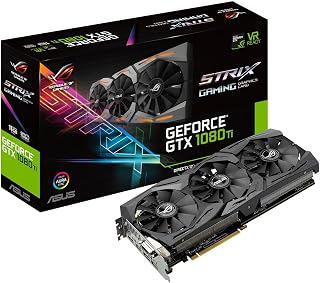
The ASUS ROG STRIX GTX 1080 Ti is a professional-grade graphics card designed for serious PC gamers and content creators tackling 4K gaming, VR applications, and compute-intensive workloads. This certified refurbished model delivers flagship performance at a fraction of the original cost, making it ideal for budget-conscious enthusiasts and those upgrading aging systems.
Performance-wise, the card's 3584 CUDA cores and 11GB GDDR5X memory deliver impressive frame rates at ultra settings across demanding titles. The 1632 MHz boost clock in OC mode ensures sustained high performance, while the card handles both modern AAA games and professional applications like video editing and 3D rendering with ease. Users report strong real-world gaming performance when they receive units in full working order.
The build quality reflects ASUS's premium positioning, featuring MaxContact Plus technology for enhanced heatsink contact, aerospace-grade Super Alloy Power II components, and a sophisticated three-fan cooling solution. The wing-blade 0dB fans deliver 105% more air pressure than reference designs, keeping temperatures manageable under load. The card's robust construction speaks to its longevity when properly maintained.
The main concern with this refurbished unit involves quality control consistency. While certified and tested, some customers received units with non-functional RGB lighting, fan issues, or condition problems not caught during refurbishment. The lack of original packaging on some units and missing accessories adds to the uncertainty, though the 90-day warranty provides recourse for defective products.
For buyers willing to accept the risks inherent in refurbished electronics, the ASUS ROG STRIX GTX 1080 Ti offers exceptional value and proven performance. It's best suited for gamers upgrading from older cards who can leverage the warranty for peace of mind. Approach the purchase with realistic expectations about refurbished quality, but the potential savings make it worth considering.
Core Specifications: Graphics Processor: NVIDIA GeForce GTX 1080 Ti, Memory: 11GB GDDR5X, Memory Interface: 352-bit, Memory Clock: 1632 MHz Boost (OC Mode), CUDA Cores: 3584
Physical Specifications: Dimensions: 11.73 inches (length) x 2.07 inches (width), Cooling: 3 axial wing-blade fans with FanConnect II, Connectivity: DVI, HDMI, DisplayPort
Performance Capabilities: Maximum Display Resolution: 7680x4320, VR Ready, Supports 5K HD gaming, Interface: PCI Express, Built-in Media Support: HDMI, DisplayPort, DVI cables included
Warranty and Support: 90-day limited warranty, Certified Refurbished status ensures functionality testing and inspection before shipment, Aura Sync RGB with dual 4-pin headers for ecosystem synchronization
Who Should Buy: This card suits PC gamers seeking high-end performance on a budget, content creators handling video and 3D work, and enthusiasts willing to accept refurbished condition in exchange for substantial savings. It's particularly attractive for those upgrading from GTX 970 era cards or looking to maximize performance per dollar.
What to Know About Refurbished: Certified refurbished means the unit has been tested and validated to work properly, but it may show cosmetic wear and could lack original packaging. The 90-day warranty covers defects, giving you recourse if the unit fails. Quality varies between units, so inspect your card immediately upon arrival and initiate returns if needed.
Performance Considerations: The GTX 1080 Ti handles 4K gaming at high to ultra settings with strong frame rates. It excels at VR and professional GPU-accelerated applications. While newer cards offer better efficiency, the 1080 Ti remains capable for demanding workloads and will serve for several years of high-quality gaming and content work.
Setup and Compatibility: Verify your system has adequate PSU capacity (recommended 600W+), sufficient PCIe slot space given the card's 11.73-inch length, and proper ventilation. Ensure your motherboard supports PCIe. The card ships with necessary cables, though some units reportedly lack original accessories. Have ASUS drivers ready before installation.

Pros
- Excellent 1440p and 4K gaming performance with ray tracing enabled
- Compact Twin Edge design fits well in most mid-tower cases
- Renewed pricing offers significant savings versus new RTX 3070 cards
- Strong driver support and VR-ready capabilities
- Comes with quick installation guide and driver CD
Cons
- Renewed condition means thermal paste and pads may be dried out, requiring reapplication before heavy use
- Requires adequate power supply (minimum 750W recommended) and proper system configuration
- 90-day limited warranty is shorter than typical new card coverage, and restocking fees apply to returns
The ZOTAC RTX 3070 Twin Edge OC is a mid-range gaming GPU built on NVIDIA's Ampere architecture, delivering strong performance for 1440p gaming and solid 4K capability with settings adjustments. This renewed unit targets budget-conscious gamers and content creators who need ray tracing and DLSS without paying full MSRP, though buyers should understand the refurbished nature comes with caveats.
Performance and features are where this card excels: the 8GB GDDR6 memory, 1755 MHz boost clock, and 14 Gbps memory speed handle modern AAA titles with ray tracing and tensor-accelerated features. Support for PCIe 4.0, 8K display readiness, and four simultaneous displays makes it future-proof for multi-monitor setups. The IceStorm 2.0 cooling system with FREEZE fan stop technology keeps temperatures in check during sustained loads.
Build quality is solid, with a metal backplate and compact Twin Edge design that fits most systems. However, multiple reviews reveal the critical issue: this renewed card often ships with dried thermal paste and pads, causing temperature spikes under load. Buyers report requiring thermal paste replacement to drop temperatures by 20-30 degrees Celsius, a task that should have been done during refurbishment.
Real-world concerns include occasional stability issues if your power supply is marginal and the need for proper driver installation. One reviewer experienced complete failure on multiple test systems, highlighting that not all renewed units are created equal. The 90-day warranty and Amazon Renewed restocking fees provide limited protection compared to a new card purchase.
Verdict: Buy this card if you can handle basic thermal maintenance and want genuine 1440p performance on a budget. Avoid if you prefer turnkey reliability or need the security of a full manufacturer warranty. Test immediately upon arrival and be prepared to reapply thermal paste before pushing it under load.
GPU: NVIDIA GeForce RTX 3070 Ampere architecture
Memory: 8GB GDDR6, 256-bit, 14 Gbps
Clock Speed: 1755 MHz boost
Interface: PCIe 4.0 x16
Cores: 2nd Gen ray tracing, 3rd Gen tensor cores
Display Outputs: 3x DisplayPort 1.4a, 1x HDMI 2.1
Max Resolution: 7680x4320 (8K)
Max Displays: 4 simultaneous
Cooling: IceStorm 2.0 with 2 fans, FREEZE fan stop, active fan control
Power Requirement: 220W TDP (750W PSU recommended)
API Support: DirectX 12 Ultimate, Vulkan RT, OpenGL 4.6
Features: HDCP 2.3, VR Ready, 4K Ready, 8K Ready
Warranty: 90 days limited
Included: Driver CD, quick installation guide
Who Should Buy: Gamers on a budget targeting 1440p high refresh rate or 4K 60fps gaming, content creators needing CUDA acceleration, and those comfortable with light hardware maintenance.
Who Should Avoid: Users requiring factory warranty peace of mind, those with marginal power supplies under 650W, and anyone uncomfortable with thermal paste replacement or troubleshooting.
Before Purchase: Verify your PSU can handle this card plus your CPU, ensure you have DisplayPort 1.4 or HDMI 2.1 compatible monitor, and confirm your case has adequate cooling airflow and space for the Twin Edge form factor.
Upon Arrival: Test the card immediately in your system with a stable driver version. Monitor temperatures under load using GPU-Z or similar tools. If thermals exceed 80 degrees Celsius during gaming, plan to replace thermal paste and pads before extended use. Run 3DMark or Heaven benchmark to verify stability across multiple test systems before committing to the purchase.

Pros
- Fanless PCIe power delivery eliminates need for 8-pin connectors and PSU upgrades
- Excellent thermal design keeps temperatures controlled with minimal noise under load
- Perfect for upgrading older pre-built systems without case or power supply modifications
- Solid 1080p gaming performance with room for DLSS support in demanding titles
- Compact footprint maximizes compatibility with SFF and budget system builds
Cons
- Not suitable for 4K gaming or the latest AAA titles at high settings due to 6GB VRAM limit
- Ray-tracing performance is secondary to traditional rasterization, limiting cutting-edge game experience
- Limited performance gains over high-end integrated graphics for non-gaming productivity tasks
The ASUS Dual RTX 3050 6GB OC Edition is a compact graphics card designed for budget-conscious gamers and productivity users upgrading from integrated graphics. Its 20cm form factor and 2-slot design make it exceptionally versatile, fitting easily into small-form-factor cases and pre-built systems where GPU upgrades are typically limited by physical and power constraints.
Performance excels at 1080p gaming, delivering smooth frame rates in esports titles and lighter AAA games at medium to high settings. DLSS 3 support provides meaningful performance boosts in supported games, while the card handles productivity workloads like 3D modeling and video editing efficiently. The Ampere architecture brings improved power efficiency and concurrent ray-tracing with shading, though ray-tracing remains a secondary strength compared to traditional rasterization.
Thermal design is a standout feature, with dual Axial-tech fans providing aggressive cooling in a compact footprint. The barrier ring design increases downward air pressure while the smaller fan hub allows longer blades, resulting in controlled temperatures and quiet operation even under sustained load. The stainless steel bracket resists corrosion while IP5X dust resistance protects internal components for long-term reliability.
The primary limitation is its 6GB VRAM, which restricts performance in demanding 4K gaming and the most intensive modern AAA titles. However, this constraint is intentional by design, as the card is positioned as an entry-level solution rather than a high-end powerhouse. For its target audience, this is a reasonable tradeoff that keeps pricing accessible.
Verdict: The ASUS Dual RTX 3050 6GB OC Edition is the ideal GPU for system builders and upgraders with physical or power budget constraints. It delivers genuine performance improvements for 1080p gaming and professional work, backed by thoughtful thermal engineering and compact design that respects the user's system limitations.
This card is perfect for users with older pre-built systems or small-form-factor builds where GPU upgrades are typically impossible. If your current system has a small 310W PSU or tight case dimensions, the RTX 3050 6GB bypasses these constraints entirely by drawing power from the PCIe slot alone.
Budget gamers targeting 1080p gaming will find solid performance in competitive shooters, MOBAs, and lighter AAA titles. Office workers, 3D modelers, and content creators upgrading from integrated graphics will see dramatic performance improvements for everyday work without thermal or noise concerns.
Skip this card if you need 4K gaming performance, plan to use demanding ray-traced titles at high settings, or have a newer system capable of supporting larger GPUs and dedicated power connections. High-end gamers should look at more powerful RTX 40-series or RTX 60-series options.
GPU Architecture: NVIDIA GeForce RTX 3050 with Ampere SM, 2nd Gen RT Cores, and 3rd Gen Tensor Cores for DLSS 3 support.
Memory: 6GB GDDR6 with 1500 MHz memory clock speed, delivering adequate bandwidth for 1080p and light 1440p workloads.
Clock Speeds: OC Mode: 1500 MHz boost clock, Default Mode: 1470 MHz boost clock for flexible performance tuning.
Thermal Design: Dual Axial-tech fans, 2-slot form factor (20cm length, 7.9in x 4.7in), IP5X dust resistance, and stainless steel bracket.
Power: No external power connector required. PCIe x16 slot power delivery only, making it ideal for systems with limited PSU capacity.
Connectivity: HDMI 2.1, DisplayPort 1.4a, and DVI-D for multi-monitor setups and modern display standards.
Buying Guide: What to Consider When Choosing a GPU Under $300
VRAM Capacity and Memory Bandwidth
VRAM determines how well your GPU handles high-resolution textures and future game requirements. Cards like the ASRock Intel Arc A770 Phantom Gaming offer 16GB, which provides headroom for demanding titles and content creation workflows. Meanwhile, 6GB models like the ASUS Dual GeForce RTX 3050 work well for 1080p gaming but may struggle with heavily modded games or ultra textures.
Memory bandwidth matters equally. A 192-bit or 256-bit bus moves data faster than a 96-bit interface, directly impacting frame rates in memory-intensive scenarios. The msi Gaming GeForce GTX 1660 Ti features a 192-bit interface that keeps pace with modern games despite being an older architecture.
Architecture and Ray Tracing Support
Newer architectures deliver better performance per watt and support modern features. NVIDIA’s Ampere cards bring dedicated RT cores for ray tracing and DLSS upscaling technology, which boosts frame rates significantly in supported games. Intel’s Xe2-HPG architecture in the ASRock Intel Arc B570 includes XeSS 2 for AI-enhanced performance and competitive ray tracing capability.
AMD’s RDNA 3 architecture in the ASRock Radeon RX 7600 offers hardware ray tracing and FSR upscaling. If you plan to play newer titles with ray tracing enabled, prioritize cards with dedicated RT hardware over older models that lack this feature entirely.
Cooling Solution and Physical Dimensions
Thermal performance directly affects boost clocks and noise levels. Dual-fan designs like the msi Gaming RTX 3050 Ventus 2X balance cooling and compact size, fitting most cases without clearance issues. Triple-fan models such as the ASRock Intel Arc A770 Phantom Gaming provide quieter operation and better sustained performance but require verification of case dimensions before purchase.
Many cards now include 0dB silent modes that stop fans during light loads, eliminating noise during desktop work or video playback. The ASRock Radeon RX 7600 Challenger implements this feature alongside striped axial fans for improved airflow efficiency when cooling is needed.
New Versus Refurbished Options
Refurbished GPUs like the EVGA GeForce GTX 1080 Ti SC Black Edition offer exceptional raw performance for the money. These cards outperform many newer budget options in rasterization workloads but lack modern features like DLSS, ray tracing, and updated encoder hardware for streaming. They come with limited warranties, typically 90 days, compared to the multi-year coverage on new cards.
New cards provide current driver support, energy efficiency, and warranty peace of mind. The choice depends on whether you prioritize maximum frame rates today or future-proofing with features that will matter in upcoming game releases. For creators who need AV1 encoding or AI acceleration, newer architectures deliver capabilities older cards simply cannot match.
Final Thoughts
The right GPU under $300 depends on your specific needs and priorities. For balanced 1080p performance with modern features, the ASUS Dual GeForce RTX 3050 6GB GDDR6 OC Edition delivers DLSS and ray tracing in a compact form factor. If you want maximum VRAM for content creation or future-proofing, the ASRock Intel Arc A770 Phantom Gaming 16GB OC provides exceptional memory capacity and competitive gaming performance. Both represent smart investments that maximize value within this budget range.
Frequently Asked Questions
What GPU should I buy for 1080p gaming in 2026?
For 1080p gaming, the msi Gaming GeForce GTX 1660 Ti, ASUS Dual GeForce RTX 3050, and ASRock Radeon RX 7600 all deliver smooth frame rates in modern titles. The RTX 3050 adds DLSS support which significantly boosts performance in compatible games, while the RX 7600 offers slightly better raw rasterization performance and 8GB of VRAM for texture-heavy games.
Is 6GB VRAM enough for gaming in 2026?
Six gigabytes works well for 1080p gaming at high settings in most current titles. However, some newer games recommend 8GB or more for ultra textures, and heavily modded games can exceed 6GB quickly. If you plan to keep your GPU for several years or play at 1440p, consider 8GB or higher options like the ASRock Radeon RX 7600 or Intel Arc B570 for better longevity.
Should I buy a refurbished GPU or a new budget card?
Refurbished high-end cards like the GTX 1080 Ti offer impressive raw performance but lack modern features such as DLSS, FSR 3, and hardware-accelerated ray tracing. New budget cards provide current driver support, energy efficiency, longer warranties, and features that become increasingly important as games evolve. Choose refurbished for maximum frame rates today, or new for better long-term value and feature support.
Can these GPUs handle ray tracing?
Several cards in this range support ray tracing, including the RTX 3050 models, Intel Arc B570, Intel Arc A770, and ASRock Radeon RX 7600. Performance varies significantly: the RTX 3050 handles ray tracing at 1080p with DLSS enabled, while the Arc A770 and RX 7600 offer competitive ray tracing capability. Older cards like the GTX 1660 Ti and GTX 1080 Ti lack dedicated RT cores entirely and cannot handle ray tracing effectively.




Write Your Review
No reviews yet. Be the first to share your experience!