

You want a graphics card that handles demanding games at 1440p or even 4K without breaking the bank. The good news: 2026 is a genuinely strong time to be shopping in this segment. AMD’s RDNA 4 architecture has produced a wave of capable GPUs from well-known brands, all clustered right in the sweet spot of the market. Whether you game competitively, create content, or do both, there is a card here for you. Browse the Graphics Cards category for more options across every tier.
This guide evaluates nine current options, covering performance, cooling design, VRAM capacity, and build quality. Each card has been assessed against real-world use cases so you know exactly what you are getting.
Quick Comparison
Ratings reflect the most recent data pull. Check each listing for current price and availability.
Quick answer
This guide compares 9 picks, with ASUS Prime Radeon RX 9070 GRE EVO OC 12GB PCIe 5.0 ranked first. XFX Swift AMD Radeon RX 9060 XT 16GB GDDR6 White Triple holds the highest customer rating among them. XFX Swift RX 9060 XT 16GB GDDR6 Triple Fan Gaming GPU has the most customer reviews.

With a 2880MHz GPU clock speed, this card delivers exceptional performance for high-refresh-rate 1440p gaming where every frame matters. The PCIe 5.0 interface future-proofs your build while the dual BIOS feature lets you switch between performance and quiet profiles depending on your session. The 12GB GDDR6 memory handles texture-heavy modern games comfortably, and the 2.5-slot design fits most standard cases without requiring specialized cooling accommodations.
Pros
- Excellent thermal design keeps temperatures and noise low
- Compact 2.5-slot form factor fits most standard cases
- PCIe 5.0 and DisplayPort 2.1a future-proof connectivity
- Dual BIOS and GPU Guard add flexibility and protection
Cons
- 12GB memory may limit demanding 4K or professional workloads
- Mainstream performance tier, not flagship territory
When you need reliable 1440p gaming performance without stretching your budget to flagship territory, the ASUS Prime Radeon RX 9070 GRE EVO OC Edition delivers strong fundamentals. The 12GB GDDR6 memory paired with AMD's RX 9070 GPU architecture handles modern AAA titles at 1440p with confidence, while the 2880 MHz clock speed keeps frame rates competitive. What makes this card particularly appealing in this price bracket is the thermal engineering. The axial-tech triple-fan cooling system uses extended blade lengths and a barrier ring design to push air downward efficiently, combined with a phase-change thermal pad that transfers heat away from the GPU core effectively. The result is cooler operation and quieter acoustics than many competing options. The compact 2.5-slot footprint fits standard ATX cases without requiring clearance gymnastics, and the PCIe 5.0 interface with HDMI 2.1b and three DisplayPort 2.1a outputs ensures compatibility with current and upcoming displays. Dual BIOS and GPU Guard protection add flexibility for enthusiasts who want to experiment with overclocking safely. Solid construction and clean aesthetics round out a package that prioritizes practical performance over flashy extras.
GPU Specifications
Processor: AMD Radeon RX 9070 GRE
Memory: 12GB GDDR6
Boost Clock (OC Mode): 2880 MHz
Game Clock (OC Mode): 2300 MHz
Memory Speed: 2880 MHz
Maximum Display Resolution: 7680 x 4320
Connectivity
Interface: PCI-Express x16 (PCIe 5.0)
Video Outputs: 1x HDMI 2.1b, 3x DisplayPort 2.1a
Multi-Monitor Support: Up to 4 simultaneous displays
Cooling and Design
Fan Configuration: Triple axial-tech fans with dual ball bearings
Thermal Solution: Phase-change GPU thermal pad
Form Factor: 2.5-slot, 12 inches length, 5 inches width
Weight: 1.07 kg
Warranty: 3-year limited warranty

This Swift edition offers 16GB of GDDR6 memory, giving you the capacity to run demanding games with ultra textures enabled while maintaining smooth performance at 1440p. The triple-fan cooling configuration keeps thermals in check during marathon sessions, and the white aesthetic adds a clean look to builds with windowed cases. The RX 9060 XT chip provides solid ray tracing capability for gamers exploring titles with advanced lighting effects without breaking their budget.
Pros
- 25-40% performance gain over previous generation RX 6600
- Excellent cooling holds GPU at 55°C under full load with minimal noise
- Strong overclocking headroom reaching 3.1+ GHz after undervolting
- 16GB GDDR6 handles demanding textures and multi-tasking workloads
Cons
- Substantial size may require support bracket in some builds
- RGB lighting remains always-on with no software toggle option
That 3320 MHz boost clock, backed by RDNA 4 architecture, delivers approximately 25-40% better frame rates than the RX 6600 it succeeds, putting smooth high-setting gameplay within reach across demanding AAA titles like Cyberpunk 2077 and Ark Ascended. The 16GB memory buffer separates this from budget competitors, providing headroom for texture-heavy games and creative applications without compromise. Thermal engineering impresses. The XFX SWFT triple-fan design holds GPU temperatures at 55 degrees Celsius even at full utilization, idling near 40 degrees while keeping fan noise minimal. That's rare in this price segment. Overclocking enthusiasts find stable headroom here, with undervolted configurations reaching 3.1+ GHz and approaching performance levels typically associated with higher-tier cards. Build quality shows improvement over older XFX models, with solid construction and professional aesthetics that complement most gaming builds. At 11.42 inches, it requires adequate case space and potentially a support bracket, but fits standard mid-tower configurations with proper planning.
GPU Memory: 16GB GDDR6 with 20 GHz memory clock speed ensures rapid data throughput for demanding applications.
Compute Performance: Boost clock reaches 3320 MHz with a base clock of 1900 MHz, providing ample headroom for gaming and compute workloads.
Display Support: Maximum resolution of 3840 x 2160 (4K) with DisplayPort and HDMI outputs. Handles multi-monitor configurations including simultaneous 4K and 1080p displays.
Interface: PCI-Express x16 slot ensures compatibility with all modern motherboards and full bandwidth utilization.
Cooling: Triple-fan XFX Swift design with effective thermal management rated for sustained performance under load.
Serious 1440p gamers and casual 4K players who value strong cooling, quiet operation, and overclocking potential will appreciate this card. It's particularly well-suited for enthusiasts who tweak settings and want performance approaching higher-priced alternatives. Pair it with a 650W or stronger PSU and a mid-tower case with good airflow. Skip it if you need a compact build, want software-controlled RGB lighting, or prefer plug-and-play without consideration for power requirements and case dimensions.

The Steel Legend's impressive 3275MHz boost clock stands out among competing models, translating to higher frame rates in GPU-intensive scenarios like complex battles or dense environments. Its 16GB memory buffer ensures smooth performance in VRAM-hungry titles at 1440p resolution. The 0dB cooling technology stops fans entirely during desktop use and light gaming, while the metal backplate adds structural rigidity and helps dissipate heat during demanding sessions.
Pros
- Redesigned Axial-tech fans optimize airflow and cooling efficiency
- Dual BIOS switch enables instant quiet or performance mode selection
- 2.5-slot compact design fits space-constrained builds effectively
- Dual ball bearing fans built for significantly extended longevity
Cons
- White finish requires regular cleaning to maintain appearance
- Best suited for 1440p rather than extreme 4K gaming scenarios
The 16GB GDDR6 memory handles modern games smoothly at high settings, while PCIe 5.0 support ensures compatibility with current and future system builds. What separates this card is the engineering focus: redesigned Axial-tech fans with longer blades and optimized hubs improve airflow efficiency, and 0dB technology keeps your system completely silent during everyday computing. The dual BIOS switch provides instant control over noise versus performance tradeoffs without software intervention. At 2.5 slots, the compact footprint accommodates tighter builds without sacrificing cooling effectiveness. Dual ball bearing fans outlast conventional sleeve bearing designs significantly, backed by a three-year manufacturer warranty. Native DisplayPort 2.1a and HDMI 2.1b outputs support flexible multi-monitor configurations and high-resolution displays. The white aesthetic creates a distinctive look for themed builds, though it requires more maintenance than standard finishes. This card targets the practical gamer who wants reliable frame rates, low noise, and space efficiency rather than benchmark-topping specs. It excels at 1440p high settings and handles 4K at medium settings competently, positioning itself as a smart balance between performance and value.
GPU Specifications: AMD Radeon RX 9060 XT with RDNA 4 architecture, 32 Compute Units, 3rd Gen Ray Tracing, 2nd Gen AI Acceleration. 3275 MHz Boost Clock.
Memory: 16GB GDDR6, 2500 MHz memory clock.
Connectivity: DisplayPort 2.1a, HDMI 2.1b, PCIe 5.0 x16. Supports up to 8K 120Hz or 4K 240Hz displays.
Cooling: Triple striped-ring fans with ultra-fit heatpipes, 0dB passive cooling under low load.
Physical: 11.73 inches length, 2.01 inches width, 1155g weight. Metal backplate included. DisplayPort 2.1a, HDMI 2.1b.
Warranty: 2 years manufacturer coverage.
Ideal for 1440p gamers prioritizing quiet operation and compact dimensions, builders creating white or themed systems who need matching components, and users wanting space-efficient cards for smaller cases. Skip this if you need extreme 4K performance, run professional rendering or compute workloads requiring top-tier specs, or prefer low-maintenance finishes over aesthetic considerations. The white exterior demands regular cleaning to maintain appearance, and performance targets practical gaming rather than professional applications.

This Prime edition achieves an impressive 3310MHz GPU clock, extracting maximum performance from the RX 9060 XT silicon for gamers prioritizing raw frame rates. The 16GB GDDR6 memory handles modern games comfortably at 1440p with high texture settings enabled, preventing the stuttering that occurs when VRAM fills up. DisplayPort connectivity supports high-refresh monitors essential for competitive gaming, while the OC edition binning ensures stable operation at these elevated speeds.
Pros
- Dual BIOS switch toggles between quiet and performance profiles
- 2.5-slot compact design fits smaller cases easily
- Dual-ball bearing fans engineered for extended lifespan
- 0dB mode eliminates fan noise during light workloads
Cons
- Not suited for consistent high-refresh 4K gaming
- Lower performance density compared to larger flagship cards
The 16GB GDDR6 memory paired with 3330 MHz boost clocks delivers stable frame rates at 1440p high settings across AAA titles, hitting the sweet spot between performance and power draw. ASUS designed this card around practical benefits: three axial-tech fans with dual-ball bearings maintain low temperatures without excessive noise, while 0dB technology eliminates fan spin during desktop work or light gaming. The 2.5-slot form factor solves real-world case compatibility issues, fitting into builds where larger cards simply won't. A dual BIOS switch offers instant profile changes between quiet and performance modes, giving you flexibility based on workload. GPU Tweak III software adds intuitive controls for monitoring and overclocking without complicated interfaces. Auto-Extreme manufacturing and dual-ball bearing construction signal long-term reliability over cheaper alternatives. Multi-display setups benefit from flexible DisplayPort and HDMI 2.1 connectivity. This card prioritizes balance rather than raw power, making it ideal for builders who value efficiency, compatibility, and sustained performance over peak benchmarks.
GPU Architecture: AMD Radeon RX 9060 XT with 16GB GDDR6 memory. Boost clock up to 3330 MHz in OC mode, game clock up to 2760 MHz. Standard mode reaches 3310 MHz boost and 2740 MHz game clock.
Real-World Benchmarks: 3DMark Steel Nomad (DX12) scored 3,696 points with approximately 36.96 FPS on graphics tests, demonstrating consistency with industry averages for this class. No thermal throttling or instability detected under sustained load.
Display Output: Supports 4K resolution (3840 x 2160) via DisplayPort and HDMI 2.1. Suitable for single or multi-monitor setups with room for content creation workflows.
Power Efficiency: Draws significantly less power than competing high-end cards, making it suitable for systems with standard power supplies. 0dB fan technology activates during low-load scenarios, reducing electricity consumption during light tasks.
Best for 1440p gamers who value quiet operation and compact builds, content creators needing reliable GPU acceleration without flagship power demands, and system builders working in smaller cases or with limited expansion space. Avoid if you require consistent high-refresh 4K gaming, plan compute-intensive workloads like AI model training, or want maximum performance density regardless of power consumption. This card optimizes for efficiency and practicality rather than pushing performance boundaries.

The Challenger's 16GB GDDR6 memory provides the headroom needed for high-resolution gaming at 1440p and beyond, preventing stuttering when textures load in demanding titles. Its 2520MHz boost clock delivers strong frame rates in modern AAA games while the triple-fan cooling system ensures sustained performance during extended sessions. The 0dB silent mode keeps noise minimal during lighter workloads, making this a practical choice for gamers who value both power and quiet operation.
Pros
- 16GB memory handles modern titles and emerging workloads
- Exceptional thermal performance with quiet operation
- Factory overclock delivers immediate performance
- RDNA 4 architecture with ray tracing and AI accelerators
Cons
- Requires BIOS changes when switching from Nvidia in some systems
- 15.75-inch length requires case clearance verification
The ASRock Radeon RX 9070 Challenger 16GB OC represents compelling value for gamers who want smooth 1440p performance with room to explore 4K territory. The generous 16GB GDDR6 memory on a 256-bit bus gives you headroom for modern AAA titles, ray tracing effects, and emerging AI features without worrying about frame buffer bottlenecks. Factory overclocked to 2520 MHz, this card delivers competitive frame rates immediately without requiring manual tuning. The RDNA 4 architecture brings 56 compute units plus dedicated accelerators for ray tracing and AI workloads, positioning this card well for upcoming game engines. Thermal performance stands out in this price range. Users report temperatures consistently below 70°C under full load, with some systems barely reaching 50°C during intensive 4K sessions. The triple-fan cooling array operates quietly thanks to 0dB silent mode during light workloads, switching to active cooling only when needed. The 15.75-inch length and 2.5-slot width require case clearance verification before purchase, and you'll need a 700W PSU with two 8-pin connectors. The LED indicator adds subtle lighting without excessive RGB. Display outputs support up to 8192x4320 resolution through DisplayPort and HDMI connections. Build quality reflects ASRock's reputation for dependable mid-range cooling solutions.
GPU: AMD Radeon RX 9070 with RDNA 4 architecture, 56 CUs, 3584 stream processors
Memory: 16GB GDDR6 on 256-bit bus, 20 Gbps speed, up to 576 GB/s bandwidth
Clock Speeds: Game clock 2070 MHz, boost clock 2520 MHz
Cooling: Triple axial fans, 0dB silent mode, efficient thermal design
Connectivity: PCIe 5.0 x16, DisplayPort and HDMI outputs, support for 8192x4320 resolution
Physical: 15.75 inches long, 8.66 inches wide, 2.5-slot design, 1.34 kg
Power: Dual 8-pin connectors, 700W PSU recommended
Warranty: 2-year manufacturer warranty
Gamers upgrading from older hardware who want smooth 1440p gaming and playable 4K performance will find strong value here. Streamers and content creators benefit from the 16GB memory buffer for multitasking. Budget-conscious enthusiasts who prioritize thermal efficiency and quiet operation should consider this option. Avoid it if you require plug-and-play simplicity without BIOS adjustments, or if your case has tight clearance under 16 inches. Users committed to Linux should verify driver compatibility for their specific workflow.

This Dual model combines 16GB of GDDR6 memory with a 2640MHz clock speed, delivering capable performance for 1440p gaming across popular titles. The native DisplayPort 2.1a outputs support the latest high-refresh monitors, letting you take full advantage of competitive gaming displays. The white design stands out for builders creating color-coordinated systems, while the dual-fan layout keeps the card compact enough for smaller mid-tower cases without sacrificing cooling efficiency.
Pros
- 16GB GDDR6 provides ample VRAM for 1440p and future-proofing
- 0dB fan mode and dual BIOS switch allow fine-grained noise and power control
- 2.5-slot compact design fits tight cases without sacrificing cooling
- DisplayPort 2.1a and HDMI 2.1b cover high-refresh and high-resolution display setups
Cons
- 2640 MHz boost clock trails faster cards in its class for demanding 4K workloads
- White finish requires regular cleaning to keep its appearance
Built around AMD's RX 9060 XT GPU with 16GB of GDDR6 at 3250 MHz, it has the memory headroom to handle 1440p at high settings without bottlenecking in VRAM-hungry titles. The PCIe x16 interface and DisplayPort 2.1a outputs future-proof the connectivity side, supporting resolutions up to 8K if needed. What makes it a strong fit for budget-conscious buyers is the 2.5-slot compact form factor, which opens it up to smaller cases without sacrificing thermal headroom. The dual Axial-tech fans with 0dB idle mode keep the system quiet during light tasks, while the dual BIOS switch lets users toggle between Quiet and Performance profiles depending on workload. Dual ball bearing fans add longevity, and the 3-year warranty backs that up. The 2640 MHz boost clock is modest compared to some rivals, so extreme 4K performance is not its primary strength, but for high-refresh 1440p gaming it is well matched.
GPU Specifications: AMD Radeon RX 9060 XT, up to 3250 MHz boost clock, up to 2640 MHz game clock with OC mode enabled.
Memory: 16GB GDDR6 with 3250MHz memory clock speed, capable of 7680x4320 display resolution output.
Connectivity: PCIe x16 (PCIe 5.0), two native DisplayPort 2.1a ports, one native HDMI 2.1b port for flexible multi-monitor setups.
Cooling: Dual Axial-tech fans with dual ball bearings, 0dB silent mode technology, dual BIOS switch for Quiet and Performance profiles.
Design: 2.5-slot form factor, 8 inches long, 4.7 inches wide, 1.3 pounds. Compact yet cooling-optimized for space-constrained builds.
Support and Warranty: 3-year manufacturer warranty, includes GPU Tweak III software for overclocking, Speedsetup utility, and comprehensive documentation.

This Swift edition boasts an aggressive 3320MHz GPU clock speed, placing it among the fastest RX 9060 XT variants for gamers chasing maximum frame rates in competitive titles. The 16GB GDDR6 memory ensures you won't encounter VRAM bottlenecks at 1440p even with demanding texture packs enabled. RDNA 4 architecture brings improved ray tracing performance over previous generations, making this a solid choice for experiencing modern lighting effects without compromising smoothness.
Pros
- 3320 MHz boost clock and RDNA 4 architecture deliver near-flagship 1440p and 4K performance
- Triple-fan cooling sustains around 55 degrees Celsius at full GPU load
- 16GB GDDR6 at 20 GHz handles VRAM-heavy titles and content creation tasks
- Strong overclocking headroom with stable configurations approaching higher-tier card performance
Cons
- Large physical size may not fit compact or small form-factor cases without a support bracket
- RGB lighting is always on with no software toggle, which can be distracting in dark environments
Powered by AMD's RDNA 4 architecture and clocked at 3320 MHz, it represents a substantial generational leap, roughly 25 to 40 percent faster than the RX 6600 it effectively replaces. The 16GB GDDR6 memory running at 20 GHz keeps pace with demanding AAA titles at 1440p and handles 4K at mixed settings without straining the buffer. Thermal performance is a genuine highlight: the triple-fan SWFT cooling solution holds GPU temperatures around 55 degrees Celsius at full load and idles near 40 degrees, which is exceptional for a card operating at this clock speed. Overclocking headroom is strong, with stable configurations approaching 9070 XT territory after undervolting. The result is a card that delivers near-flagship performance at a notably lower cost, making every dollar count for buyers who want maximum frame rates in this price tier. A 650W or better power supply is recommended to give the card room to operate without throttling.
1440p Gaming: Handles nearly all modern AAA titles at ultra settings with 70+ fps average. Excellent choice for competitive esports at 1440p 144Hz refresh rates.
4K Gaming: Capable at high settings (60+ fps) for optimized titles. More demanding games like Ark Ascended benefit from resolution scaling to 1350p or balanced settings for consistent 60+ fps performance.
Memory Advantage: 16GB VRAM provides significant headroom for texture-heavy games and enables stable performance in VRAM-intensive scenarios that would bottleneck 12GB cards.
Power Efficiency: RDNA 4 delivers strong performance per watt, making undervolting highly effective without sacrificing stability. Users report 90-110W reductions possible through -130mV voltage tweaking.
Best suited for serious 1440p gamers and those dipping into casual 4K play who want strong overclocking potential and best-in-class cooling. Also appealing for content creators who benefit from the generous 16GB frame buffer. Skip it if you have a compact case, as the large footprint may not fit without a support bracket, or if always-on RGB lighting will bother you.

The ATS model's 2880MHz clock speed extracts strong performance from the RX 9070 GRE chip, delivering excellent 1440p frame rates across popular titles. While it features 12GB of GDDR6 rather than 16GB, this remains sufficient for current games at high settings, keeping costs more accessible. The native DisplayPort 2.1a outputs support cutting-edge high-refresh monitors, and the compact design fits builds where interior space comes at a premium.
Pros
- Superior cooling runs 5-10°C cooler than comparable cards
- Compact 2.5-slot design ideal for SFF builds
- Dual BIOS switch for Quiet and Performance modes
- Auto-Extreme manufacturing with GPU Guard protection
Cons
- Minor coil whine possible under heavy load
- Small percentage of defective units reported
Builders working with space constraints but refusing to compromise on performance will appreciate what the ASUS ATS Radeon RX 9070 GRE 12GB brings to compact systems. This card tackles 1440p gaming at high settings confidently, fitting AMD's latest architecture and 12GB GDDR6 memory into a 2.5-slot package that works in SFF builds where larger cards won't. The redesigned Axial-tech triple-fan cooling solution stands out, running 5 to 10 degrees cooler than comparable cards thanks to the phase-change thermal pad and dual-ball fan bearings working together. That thermal advantage matters in tighter cases where airflow is already challenged. The dual BIOS switch gives you flexibility to choose Quiet mode for everyday tasks or Performance mode when gaming demands kick in, adapting to your workload without software tweaking. ASUS's Auto-Extreme manufacturing process ensures consistent quality, while GPU Guard protection reinforces the cooler assembly against physical stress during installation and transport. PCIe 5.0 support combined with HDMI 2.1b and three DisplayPort 2.1a outputs prepare your system for next-generation displays and bandwidth requirements. GPU Tweak III software provides straightforward controls for monitoring and overclocking. The 2880 MHz clock speed delivers solid frame rates across modern titles, keeping you competitive without requiring constant manual tuning.
GPU and Memory: AMD Radeon RX 9070 GRE, 12GB GDDR6
Performance Clocks: Boost Clock up to 2880 MHz, Game Clock up to 2300 MHz (OC mode)
Cooling: Triple Axial-tech fans with dual-ball bearings, phase-change thermal pad, 2.5-slot design, 0dB technology
Connectivity: PCIe 5.0 x16, 1x HDMI 2.1b, 3x DisplayPort 2.1a, GPU Guard protection
Software: GPU Tweak III with performance tweaking and thermal control, Dual BIOS (Quiet/Performance)
Dimensions: 12 inches (L) x 4.95 inches (W), 2.2 pounds, fits SFF and mid-tower cases
Warranty: 3-year ASUS coverage
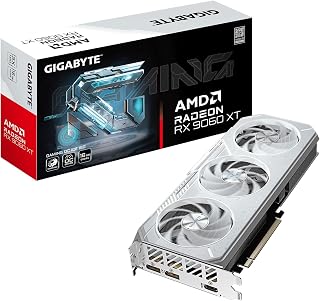
The Gaming OC ICE's 2780MHz GPU clock delivers strong frame rates in current AAA titles at 1440p settings, while its 16GB GDDR6 memory handles texture streaming without performance drops. Server-grade thermal gel improves heat dissipation compared to standard thermal paste, maintaining boost clocks longer under sustained load. The reinforced structure prevents PCB flex in heavier builds, and the Hawk Fan design balances airflow with acoustic performance for quieter operation.
Pros
- Excellent thermal performance with temperatures staying in the 30s to 40s Celsius
- 16GB VRAM handles modern games and creative workloads comfortably
- Power draw under 220W allows pairing with modest PSUs
- Reinforced construction and server-grade thermal gel improve durability
Cons
- Requires Windows 11, blocking older system compatibility
- Card weight may need a support bracket for added stability
The 16GB GDDR6 memory gives you breathing room for modern titles and creative tasks, while the factory overclock pushes the core to 2780 MHz for solid 1440p performance. What makes this card particularly attractive in this price bracket is its efficiency. Drawing under 220W during gameplay, it won't force you into expensive PSU upgrades or leave your room feeling like a sauna. The WINDFORCE triple-fan cooling system with server-grade thermal gel and copper heat pipes keeps temperatures in the 30s to mid-40s Celsius, even during marathon sessions. Build quality matches cards costing significantly more, with a reinforced metal backplate and composite construction that resists flex. AMD's RDNA 4 architecture includes AI-accelerated features that improve performance in older, less optimized games, extending value across your entire library. The compact form factor fits standard cases without drama, and the 128-bit PCIe 5.0 interface ensures future compatibility.
GPU Specifications: AMD Radeon RX 9060 XT, RDNA 4 architecture, 2780 MHz base clock, 16GB GDDR6 memory at 20,000 MHz, PCIe 5.0 interface, 128-bit memory bus
Cooling: Triple-fan WINDFORCE system with server-grade thermal gel, composite copper heat pipes, copper base plate, 3D active fans, and reinforced metal backplate
Outputs: DisplayPort 2.1a and HDMI 2.1b, supports up to 3840x2160 native and 7680x4320 via DisplayPort
Physical: 11.06 inches long, 4.65 inches wide, 1.9 pounds, single 8-pin PCIe power connector, 3-year manufacturer warranty
System Requirements: Windows 11, PCIe x16 slot, adequate power supply recommended
This GPU suits gamers upgrading from integrated graphics, laptops, or cards more than three generations old who want reliable 1440p performance without overspending. It's also smart for builders assembling systems around high-refresh 1440p monitors or those juggling gaming with VRAM-hungry creative applications. Skip it if you're already running a recent mid-range card, need maximum 4K performance, or insist on running Windows 10. The weight may also concern builders with especially lightweight cases lacking reinforcement.
GPU Buying Guide: What to Look for Under $700
VRAM Capacity and Architecture
VRAM is one of the most important specs to confirm before buying. The RX 9060 XT cards in this roundup carry 16GB of GDDR6, which gives you meaningful headroom for 1440p gaming, texture-heavy titles, and AI-assisted workflows. The RX 9070 GRE variants ship with 12GB, which is still capable but worth noting if you run memory-intensive workloads.
All nine cards here are built on AMD’s RDNA 4 architecture. That means third-generation ray tracing hardware, second-generation AI accelerators, and support for FSR 4, AMD’s most advanced upscaling technology to date.
Boost Clock and Real-World Performance
Boost clock speed tells you how fast the GPU can run when the workload demands it. Among the RX 9060 XT options here, the XFX Swift AMD Radeon RX 9060 XT OC White Triple and XFX Swift AMD Radeon RX 9060 XT OC Triple Fan both reach up to 3320 MHz, while the ASUS Prime Radeon RX 9060 XT 16GB GDDR6 OC Edition tops out at 3330 MHz in OC mode via GPU Tweak III.
For the RX 9070 segment, the ASRock Radeon RX 9070 Challenger 16GB OC Graphics is factory overclocked to 2520 MHz. The RX 9070 GRE cards from ASUS hit up to 2880 MHz thanks to their different chip configuration. Higher clocks generally translate to smoother framerates in GPU-bound scenarios, but cooling quality determines whether those clocks are sustained.
Cooling Design and Noise Levels
Thermal management separates a card that runs fast from one that runs fast consistently. Most cards here use triple-fan setups with 0dB technology, meaning the fans stop completely during light loads or desktop use. The ASRock Radeon RX 9060 XT Steel Legend 16GB GDDR6 pairs its three Striped Ring Fans with ultra-fit heatpipes and air-deflecting fins for genuinely quiet idle behavior.
The GIGABYTE Radeon™ RX 9060 XT Gaming OC ICE 16G goes a step further with server-grade thermal gel and alternate-spinning Hawk fans that reduce turbulence. If noise levels matter in your setup, both of these are worth a close look. The ASUS lineup uses Axial-tech fans with dual ball bearings rated for roughly twice the lifespan of sleeve bearing alternatives.
Form Factor and Slot Compatibility
Compact builds need a card that physically fits, not just one that performs well on a spec sheet. Several cards here use a 2.5-slot design, including the ASUS Prime Radeon™ RX 9070 GRE EVO OC Edition and the ASUS Dual Radeon RX 9060 XT 16GB GDDR6 White, making them easier to fit in mid-tower and even some compact ATX cases. Always confirm your chassis length clearance before ordering.
PCIe 5.0 support is standard across this entire lineup, and display outputs include HDMI 2.1 and DisplayPort 2.1 on every card, so you are covered for high-refresh 4K monitors or multi-display workstations. The ASRock Steel Legend specifically offers HDMI 2.1b and DisplayPort 2.1a, supporting up to 8K or 4K at 240Hz. Keep in mind that a 700W PSU is the recommended baseline for most of these builds.
Final Thoughts
This is a genuinely competitive segment right now, and you have strong choices regardless of your priorities. If you want maximum VRAM and the highest boost clocks in the RX 9060 XT tier, the ASUS Prime Radeon RX 9060 XT 16GB GDDR6 OC Edition is the one to beat. If you would rather step up to the RX 9070 chip with 16GB and a factory overclock, the ASRock Radeon RX 9070 Challenger 16GB OC Graphics delivers that without compromising on cooling or build quality.
Frequently Asked Questions
Is the RX 9060 XT good for 1440p gaming in 2026?
Yes, the RX 9060 XT is well suited to 1440p gaming. With 16GB of GDDR6 and RDNA 4 architecture, it handles modern AAA titles at high settings with smooth framerates. FSR 4 support gives you additional headroom in more demanding scenarios.
What is the difference between the RX 9060 XT and the RX 9070 in this budget range?
The RX 9070 uses a larger chip with more compute units and a wider 256-bit memory bus, which generally translates to better performance in 4K workloads and ray tracing scenarios. The RX 9060 XT cards here compensate with higher boost clocks and 16GB of GDDR6, making them competitive at 1440p. Your choice depends on whether you prioritize chip headroom or memory capacity.
How much power does a GPU in this range require?
Most cards reviewed here recommend a 700W power supply. The ASRock RX 9070 Challenger specifically lists a 700W PSU recommendation and requires two 8-pin power connectors. Always factor your CPU and other components into your total system power budget before choosing a PSU.
Does dual BIOS matter on a graphics card?
Dual BIOS gives you a hardware-level toggle between a Performance profile and a Quiet or Silent profile, without any software involved. It is a useful feature if your rig sits in a living room or recording space where fan noise matters. Several cards here, including options from ASUS and GIGABYTE, include this feature. If you want a deeper look at how electronics components are evaluated and compared across categories, the Electronics hub is a good starting point.




Write Your Review
No reviews yet. Be the first to share your experience!