

A winter storm, a scheduled utility interruption, or an unexpected blackout can quickly turn a normal evening into a scramble for cold food, phone charging, lighting, and internet access. The right portable power station gives you quiet, fuel-free electricity for the essentials without the fumes or storage demands of a conventional engine generator.
This guide compares the best portable generator for home needs across six battery-powered options, from compact device chargers to high-capacity refrigerator backups. Use it if you want practical outage coverage, an easy home-office safety net, or a flexible unit for camping as well, and explore our complete generator category for more power solutions.
Quick answer
This guide compares 6 picks, with Jackery Explorer 1000 v2 Portable Power Station ranked first. Jackery Explorer 300 Portable Power Station 292Wh has the most customer reviews.

With 1070Wh capacity and 1500W output, this station can run full-size refrigerators, sump pumps, or medical equipment during extended home outages. The dual solar and battery power sources give you flexible recharging options when grid power remains unavailable. Its 120V AC output matches household voltage standards, so you can plug in critical appliances directly without adapters or converters during an emergency.
Pros
- Seven device connection points
- One-hour emergency charging mode
- 23.8-pound portable design
- LFP battery rated for 4,000 cycles
Cons
- Solar panels are sold separately
- Only 42 minutes at a constant 1,500W load
During a blackout, the useful question is how many key items can stay connected without turning a portable station into a whole-home promise. The Explorer 1000 v2 supplies 1,070Wh of capacity, 1,500W of continuous AC power, and up to 3,000W of surge power for a focused backup setup. Its three AC outlets, two 100W PD USB-C ports, USB-A and DC car outlet create seven connection points, so household electronics and selected appliances need not compete for a single socket. This version is particularly practical for an emergency kit because it weighs 23.8 pounds and uses a foldable handle. It can recharge from a wall outlet in 1.7 hours with the battery-health-focused standard setting. If time is more important, its emergency charging mode can fill it in one hour, although that mode must be enabled in the app each time. LFP battery technology is designed to maintain more than 70% capacity after 4,000 charge cycles. Solar power is an option, but compatible Jackery panels are sold separately. With only 42 minutes of runtime at a constant 1,500W load, this is a smart choice for rotating or lower-draw essentials rather than sustaining maximum output.
Capacity and Power Output: 1070Wh battery capacity, 1500W continuous AC output, 3000W surge peak, 7 total power outlets
Charging: 1-hour emergency fast charge or 1.7-hour standard charge, 100W USB-C PD output, ChargeShield 2.0 technology
Battery Technology: LFP battery with 4000+ charge cycles, maintains 70%+ capacity after 4000 cycles, 10+ year lifespan
Ports and Connectivity: 2x USB-C (100W PD), 1x USB-A, 1x DC car port, 3x pure sine wave AC ports, LED lights, smart app control
Physical Specifications: Weight: 23.8 lbs, Dimensions: 12.87in (L) x 8.82in (W) x 9.72in (H), Foldable handle for portability
Additional Features: Smart app control with three charging modes, 30 dB quiet mode, energy efficiency mode, compatible with Jackery solar panels
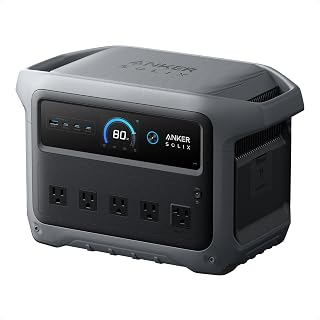
The 2000W output wattage handles high-draw home appliances like window air conditioners, space heaters, and power tools that smaller stations cannot support. Solar fuel compatibility means you can recharge off-grid during multi-day outages without relying on gasoline or propane. This makes it suitable for homes needing sustained backup power for more demanding loads beyond basic lighting and communication devices.
Pros
- 2,000W continuous output
- 49-minute wall recharge
- 10ms UPS switchover
- Up to 600W solar input
Cons
- 1,024Wh capacity limits extended backup
- Solar recharge timing requires optimal conditions
Power interruptions can be short, so a backup battery that restores quickly has an advantage. The Anker SOLIX C1000 Gen 2 combines 1,024Wh capacity with 2,000W continuous output and 3,000W maximum power, supplying more headroom than 1,500W models for a targeted home setup. Nine outlets support a mix of household devices, and its 10ms UPS switchover can be important for equipment that should not lose power during an outage. Its strongest home-backup feature is charging speed. HyperFlash technology accepts 1,600W from a wall outlet and can fully recharge the station in 49 minutes. That can be useful between outage events or when a battery has been drained. It also accepts up to 600W of solar input, with a stated 1.8-hour full solar recharge under optimal conditions. The LiFePO4 battery retains at least 80% capacity after 4,000 cycles. At 15.1 by 8.2 by 9.6 inches and 11.3 kg, it remains manageable to relocate between rooms, helped by handles on both sides. This is a strong portable alternative for selected loads, but its 1,024Wh capacity does not make it a replacement for a whole-home standby generator.
Buy it if your home backup priority is fast wall recharging, 2,000W output, and near-instant UPS switchover for devices that should avoid an interruption. It is also suitable for someone who wants solar-input flexibility and can carry an 11.3 kg station between rooms. Skip it if you need more than 1,024Wh for prolonged, wide-ranging household use, or if the 1.8-hour solar figure under optimal conditions does not match your charging expectations.
Capacity: 1,024Wh LiFePO4 battery
Output: 2,000W continuous, 3,000W peak
Ports: 10 total outputs
Wall Recharge: 1,600W input, 49 minutes to full
Solar Input: Up to 600W at 60V maximum, 1.8 hours to full
UPS Switchover: 10 milliseconds
Dimensions: 15.1L x 8.2W x 9.6H inches
Weight: 11.3 kg (24.9 lbs)
Battery Cycles: 4,000+ cycles with minimum 80% retention
Warranty: 5 years
Colors Available: Gray
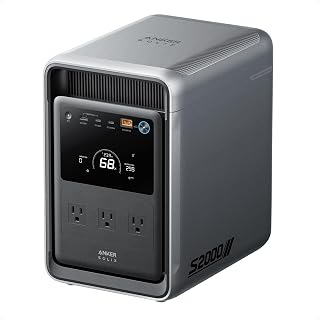
At 2,010Wh capacity with 1500W continuous output, this station powers refrigerators, medical devices, and home office equipment through extended outages. Its lightweight and compact design addresses the challenge of moving backup power between rooms or storing it in tight utility spaces. The product is explicitly rated for power outages and home backup, confirming it meets residential reliability requirements rather than just recreational camping use.
Pros
- 2,010Wh capacity with 1,500W continuous output
- Sub-10ms UPS switchover
- Eight front-and-rear outlets
- Six recharge methods, including 400W solar input
Cons
- No 12V DC port
- Runtime varies by appliance, usage, and ambient conditions
Home backup is where the Anker SOLIX S2000 makes its strongest case: it pairs a 2,010Wh battery with 1,500W of continuous output and 3,000W starting capacity for essential power during an outage. The stated household use includes refrigerators, freezers, medical equipment, and CPAP machines, while the low 6W idle draw is cited for up to 35 hours of refrigerator runtime. That combination puts the focus on sustaining selected basics rather than attempting to run every circuit in a house. Its compact, portable design is also meaningful for a home emergency setup. At 35.7 pounds and 8.2 by 11.1 by 12.7 inches, it is described as 30% smaller and 25% lighter than comparable 2kWh models. Eight outlets, placed on the front and rear, can keep a small backup station organized. Sub-10ms UPS switchover helps connected devices continue through a grid interruption. For recharging flexibility, it supports six methods, including AC, generator, car-outlet, and up to 400W solar input. The LFP battery is rated for 10,000 charge cycles and a 15-year lifespan.
Capacity and Output: 2,010Wh LiFePO4 battery, 1,500W continuous output, 3,000W peak output
Battery Technology: 314Ah LFP cells, 10,000 cycle lifespan, 15-year warranty
Dimensions: 8.19L x 11.1W x 12.7H inches
Weight: 35.7 pounds
Outlets: 8 total (front and rear configuration)
Charging Options: AC input, solar (up to 400W), generator, car outlet, alternator charger
UPS Switchover: Less than 10 milliseconds
Idle Power Draw: 6W
Color: Black
Model: AS220
Warranty: 5 years
Buy the S2000 if your home-outage plan centers on keeping selected essential appliances and sensitive devices supplied, and you value a compact 2kWh-class station with UPS capability and multiple recharge options. Its reported refrigerator runtime and long LFP cycle rating suit households preparing for repeated outages. Skip it if you need power for specialized 12V DC equipment, since it lacks a 12V DC port. It is also not the fit for shoppers seeking an entry-level backup station.

This compact 292Wh unit delivers 300 watts of continuous power, enough to keep essential devices like phones, routers, and small lamps running during short outages. The 4-hour recharge time means you can quickly restore backup capacity between disruptions. Its 10A output handles multiple USB and AC loads simultaneously, making it practical for maintaining connectivity and lighting when the grid fails without overwhelming a small living space.
Pros
- 292Wh capacity in a 7.5-pound package
- Six-device charging capability
- 100W USB-C PD port
- LiFePO4 battery rated for more than 4,000 cycles
Cons
- Not intended for refrigerators or air conditioners
- 300W maximum limits high-wattage devices
Rather than serving as a whole-home backup source, the Jackery Explorer 300 is a small emergency-power reserve for keeping personal electronics usable when an outage interrupts normal routines. Its 292Wh capacity and 300W maximum output are suited to phones, tablets, laptops, cameras, drones, and other lower-demand devices. The limitations matter for home backup: it is not intended to run refrigerators, air conditioners, or high-wattage tools. For a household that wants a unit easy to carry to the room where it is needed, its 7.5-pound compact form is the appeal. Connectivity is unusually broad for this size: two AC outlets, a 100W USB-C PD port, two USB-A ports, and a 120W car-charging port can support up to six devices at once. A display shows battery capacity. It can recharge in about three to four hours from the AC adapter, and compatible solar panels can bring it to 80% in 2.8 hours with a 100W panel. Its LiFePO4 battery is rated for more than 4,000 cycles before reaching 70% capacity, supporting regular preparedness use over time.
Buy the Explorer 300 if your outage kit is meant to preserve communications, remote work, and small electronics, and you want a compact unit that can be moved easily around the home. It is especially appropriate for charging several low-draw devices at once. Skip it if your home backup plan requires refrigerator power, air-conditioning support, high-wattage tools, or extended appliance runtime. Its 292Wh capacity and 300W output are built for a different level of demand.
Capacity: 292Wh (LiFePO4 battery)
Weight: 7.1-7.5 lbs
Dimensions: 15.43in D x 9.92in W x 11.89in H
AC Output: 2 outlets, 110V, 300W continuous (600W peak surge)
USB Ports: USB-C PD 100W, USB-A 2.4A (x2)
Car Port: 120W 12V output
Charging Time: Approximately 4 hours AC, 2.8 hours with 100W solar panel
Battery Cycles: 4,000+ before reaching 70% capacity
Warranty: 2 year manufacturer
Model: JE-300E
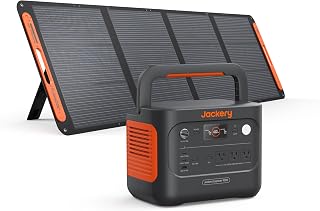
This bundled system pairs 1070Wh storage with a 200W solar panel, giving you immediate off-grid recharging capability when utility power stays down for days. The 1500W AC output runs essential home loads like refrigerators and sump pumps without modifications. Solar and battery integration removes dependence on fuel resupply during prolonged residential emergencies, making it practical for homes in storm-prone or remote areas.
Pros
- Includes a 200W solar panel
- 1,070Wh LFP battery
- 1,500W AC output with 3,000W surge
- One-hour emergency charging mode
Cons
- Emergency mode requires app activation
- Not suited to multiple high-draw appliances
Home backup works best when it is easy to move to the appliance that matters, rather than pretending to run an entire house. The Jackery Solar Generator 1000 v2 pairs a 1,070Wh LFP power station with a 200W solar panel, giving households a battery option that can recharge away from an outlet. Its 1,500W AC output and 3,000W surge capacity suit selected essentials, while three AC outlets allow several devices to be connected at once. It also includes two 100W PD USB-C ports, USB-A, a DC car outlet, and integrated LED lights, which can make a blackout setup more organized. For replenishing the battery, a wall outlet takes 1.7 hours in the standard mode, or one hour in emergency mode after activation in the app. In clear conditions, solar can reach 80% in six hours. At 23.8 pounds, the foldable ergonomic handle makes this a backup that one person can move around the house or take on the road. LFP chemistry is rated to retain over 70% capacity after 4,000 cycles, supporting long-term emergency readiness. The limitation is its 1,500W continuous ceiling: it is intended for carefully chosen loads, not multiple demanding appliances at once.
Buy this bundle if your home-backup plan centers on keeping a limited group of essential devices powered and you want the included 200W panel for solar replenishment. It also suits people who value a 23.8-pound unit with fast wall charging and USB-C charging alongside AC power. Skip it if your outage plan requires continuous operation of several high-draw appliances, since output tops out at 1,500W, or if storing both a power station and foldable panel would be inconvenient.
Battery: 1070Wh LFP (Lithium Iron Phosphate) with 4000+ cycle lifespan
AC Output: 1500W continuous, 3000W surge peak at 120V, 60Hz
Solar Input: 200W panel included, reaches 80% charge in 6 hours (clear conditions)
AC Charging: 1.7 hours standard, 1 hour emergency mode via app
Alternator Charging: 3 hours with 600W charger (sold separately)
Ports: 3x pure sine wave AC outlets, 2x USB-C (100W PD max), 1x USB-A, 1x DC car outlet, LED lights
Weight: 23.8 lbs with foldable handle
Dimensions: 12.87"L x 8.82"W x 9.72"H
Warranty: 2-year manufacturer coverage, 5-year coverage included with purchase
Model: JE-1000D (E1000v2+200W bundle)

Pros
- Eight output ports
- 3.2-pound, DSLR-size design
- Built-in three-mode LED flashlight
- Reaches 80% in two hours
Cons
- Larger appliances can trigger automatic shutoff
- Some reports cite diminished full-charge capacity after more than three years
An 88Wh station cannot take on the central jobs of home outage backup, but the MARBERO unit can fill a useful supporting role: keeping small electronics and emergency lighting available. Its 80W output and 120W surge capacity set a modest power limit, and high-wattage devices such as air compressors or larger appliances can trigger automatic shutoff. That makes this a better match for phones, tablets, a small fan, and its own built-in LED flashlight than for household appliances. Port selection is a notable strength for such a small unit. Eight ports include dual 110V AC outlets, USB-A fast charging, USB-C Power Delivery, and a 12V car port, allowing several small devices to be connected. The flashlight has three brightness modes, making the station more directly useful during a blackout. At 3.2 pounds and about the size of a DSLR camera, it is easy to keep within reach as part of an emergency setup. It reaches 80% from empty in two hours and supports solar, battery, and AC power sources. Short-circuit, overcharge, overload, and over-voltage protection are listed, alongside automatic shutdown.
Buy the MARBERO if your home outage preparation calls for an ultra-light backup for a phone, tablet, small fan, and emergency light, with a varied selection of ports. It is most suitable as a secondary power source that is easy to store and carry. Skip it if you need to support larger appliances, air compressors, or dependable long laptop runtime. Its 88Wh capacity and 80W output place it well below appliance-level home backup.
Buying Guide: How to Choose a Portable Generator for Home
Match output wattage to your essential appliances
Start with a list of what you must keep running: a refrigerator, modem, router, lamps, CPAP machine, laptop, or medical equipment. Add each device’s running watts, then leave room for startup surge, since compressor-based appliances can briefly demand much more power when their motors begin cycling.
The Jackery Explorer 1000 v2 Portable Power supplies 1,500W continuously, while the Anker SOLIX C1000 Gen 2 Portable Power Station raises that figure to 2,000W. The Jackery Explorer 300 Portable Power Station,292Wh and MARBERO Portable Power Station 88Wh, 120W Surge are better aligned with lights and electronics than refrigerator duty. Build a sensible load plan with our home power planning resources, especially if a desktop PC is part of your backup list.
Prioritize battery capacity for realistic runtime
Watt-hours tell you how much stored energy a station holds, much like the size of its fuel tank. A larger figure generally means longer runtime, but inverter losses, appliance cycling, room temperature, and the age of your refrigerator all affect the final result. Plan for your critical loads first instead of expecting one station to power an entire house.
For longer outage coverage, the Anker SOLIX S2000 Portable Power Station, 2,010Wh has the largest capacity in this group and is rated to support a refrigerator for up to 35 hours in favorable conditions. The 1,070Wh Jackery models and 1,024Wh Anker C1000 offer a middle ground for core appliances and electronics. If you are backing up a desktop, an 80 Plus Gold power supply guide can help you understand why a computer’s actual draw may differ from its power supply rating.
Consider wall charging and solar recovery
A station is far more useful when you can refill it quickly between outages or during a short period of grid access. The Anker SOLIX C1000 Gen 2 Portable Power Station supports a 49-minute full recharge at its high-speed setting through the app, while the Jackery Explorer 1000 v2 Portable Power can reach full charge in about one hour with its emergency charging mode enabled.
Solar input adds resilience, although panel output changes with weather, panel angle, and available daylight. The Jackery Solar Generator 1000 v2 and 200W Solar includes a matching panel, which removes one major compatibility question for new buyers. A charged station can also keep a modem and router online during a short blackout, while our WiFi extender guide for stable gaming can help you refine the rest of your home network setup.
Look at portability, outlets, battery life, and UPS support
Portability matters when you need to move power between rooms, carry it to a vehicle, or store it in a closet. At 7.5 pounds, the Jackery Explorer 300 Portable Power Station,292Wh is easy to grab for phones, lights, and a CPAP. The MARBERO Portable Power Station 88Wh, 120W Surge is lighter still, making it a practical small emergency kit rather than a home-appliance backup unit.
For more demanding daily use, LFP battery chemistry and long cycle ratings are valuable indicators of durability. The Anker SOLIX S2000 Portable Power Station, 2,010Wh is rated for 10,000 cycles, while the Jackery and Anker mid-size stations list 4,000-cycle ratings. The Anker C1000 and S2000 also offer under-10-millisecond UPS switchover for compatible computer setups, a useful feature if you rely on a large display from our 32-inch 4K monitor recommendations.
Final Thoughts
For a capable balance of output, rapid recharging, and home-office continuity, the Anker SOLIX C1000 Gen 2 Portable Power Station is a compelling all-around choice. If your priority is an easy-to-carry unit for lights, phones, and modest overnight essentials rather than appliance backup, the Jackery Explorer 300 Portable Power Station,292Wh is a dependable fit.
Frequently Asked Questions
How much capacity do I need for home backup?
Start by deciding whether you only need devices and lighting, or whether a refrigerator and work equipment are also essential. Compact stations below 300Wh work best for phones, lamps, cameras, and some CPAP setups, while units around 1,000Wh offer much more useful flexibility for short outages.
For refrigerator-focused backup, a 2,000Wh-class station provides more breathing room than a smaller model. Check the appliance label for running watts and startup demand, then avoid loading the power station close to its rated output for long periods. Adding solar can extend runtime, but it should complement, not replace, a realistic capacity plan.
Can a portable generator run a refrigerator during an outage?
Many battery power stations can run a modern refrigerator if their continuous output and surge capability are sufficient. The exact runtime varies substantially because refrigerators turn their compressors on and off, and they consume more energy in a hot room or when the door is opened frequently.
Use a station with enough wattage headroom, then connect only the refrigerator and other truly important loads. A high-capacity option such as the Anker SOLIX S2000 Portable Power Station, 2,010Wh is designed for this role, whereas compact units are more appropriate for communication devices and lighting.
Is solar charging practical for a home power station?
Solar charging is practical for extending power during multi-day interruptions, camping trips, and off-grid use. It works best when you have unobstructed sunlight, properly positioned panels, and enough panel wattage to match the station’s supported solar input.
Expect slower recovery in cloudy conditions, early morning, late afternoon, or when panels are not angled toward the sun. A bundle such as the Jackery Solar Generator 1000 v2 and 200W Solar is convenient because it includes a panel, while standalone stations require you to confirm connector and voltage compatibility before buying panels.
Can I use a portable power station as a UPS for a computer in 2026?
Yes, but choose a model that specifically lists UPS capability and a short switchover time. The Anker C1000 and S2000 list under-10-millisecond switchover, which can help keep compatible laptops, monitors, routers, and desktop equipment running through brief utility interruptions.
Confirm the combined wattage of your computer, display, networking gear, and accessories before connecting them. If you are building a lower-draw workstation for longer battery runtime, our budget 1440p monitor guide can help you compare display options that suit a practical desk setup.



Write Your Review
No reviews yet. Be the first to share your experience!