

A power outage hits, the fridge starts warming up, and you realize you have no idea whether the generator in your garage can actually keep the lights on. Choosing the right generator size for your home is not about buying the biggest unit you can find. It is about matching wattage to your real needs, whether that means keeping a few essentials running or powering your entire house through a multi-day storm. For more context on how portable units stack up overall, check out our guide to the best portable generators for home backup.
This guide is for homeowners, renters, and anyone who wants a clear answer before spending serious money. We cover everything from compact power stations to high-output dual fuel machines, so you can zero in on exactly what your household requires.
Quick answer
This guide compares 8 picks, with Jackery Explorer 1000 v2 Portable Power Station ranked first. Westinghouse WGen9500DF 12500W Dual Fuel Portable holds the highest customer rating among them. Jackery Explorer 300 Portable Power Station 292Wh has the most customer reviews.

With 1500 watts output and 1070Wh capacity, this station covers a fridge, CPAP, and lighting circuit simultaneously, useful for readers whose load calculation lands in the moderate range. Solar recharging also matters for anyone planning backup that doesn't depend on keeping gasoline stored at home.
Pros
- 1500W continuous output with 3000W surge covers key household circuits
- One-hour emergency fast charging when you need power back quickly
- Seven outlets reduce the need to swap devices in and out
- LFP battery holds over 70% capacity after 4000 cycles
Cons
- Only 42 minutes of runtime at full 1500W load
- Solar panels must be purchased separately for off-grid charging
If you're trying to figure out what size generator your house actually needs, the Jackery Explorer 1000 v2 is worth comparing before you commit to a fuel-powered unit. It won't replace a whole-home generator, but for the circuits that matter most during an outage, like a fridge, modem, medical device, or a few lights, it covers real ground. At 1070Wh with 1500W continuous output and 3000W surge, it sits between a basic power bank and a true backup generator, which makes it a useful reference point when sizing your overall setup. The one-hour emergency recharge means you're not stuck waiting hours between outages, and seven total outlets let you run multiple essentials without constant unplugging. Battery longevity is a real strength here too, with over 70% capacity retained after 4000 cycles, so this isn't a one-season purchase. For homeowners weighing a loud, fueled generator against something quieter and maintenance-free for partial backup, this unit gives a clear sense of what battery power can realistically handle versus what still needs a gas or standby generator.
Capacity and Power Output: 1070Wh battery capacity, 1500W continuous AC output, 3000W surge peak, 7 total power outlets
Charging: 1-hour emergency fast charge or 1.7-hour standard charge, 100W USB-C PD output, ChargeShield 2.0 technology
Battery Technology: LFP battery with 4000+ charge cycles, maintains 70%+ capacity after 4000 cycles, 10+ year lifespan
Ports and Connectivity: 2x USB-C (100W PD), 1x USB-A, 1x DC car port, 3x pure sine wave AC ports, LED lights, smart app control
Physical Specifications: Weight: 23.8 lbs, Dimensions: 12.87in (L) x 8.82in (W) x 9.72in (H), Foldable handle for portability
Additional Features: Smart app control with three charging modes, 30 dB quiet mode, energy efficiency mode, compatible with Jackery solar panels

Rated at 12500 starting watts with 9500 running watts, this generator fits households whose load math includes central AC, well pump, and multiple large appliances at once. Dual fuel flexibility between gas and propane also suits anyone sizing backup around fuel availability during extended outages.
Pros
- 9,500 running watts covers most whole-house essential circuits
- Transfer switch ready with 50A outlet for home integration
- Dual fuel flexibility between gasoline and propane
- Digital display tracks voltage, frequency, and run hours
Cons
- 210 pounds makes positioning and transport demanding
- Dual-fuel setup adds a learning curve for fuel management
Sizing a generator for a whole house means starting with your panel's demands, and the WGen9500DF gives you enough headroom to cover that math. With 9,500 running watts and 12,500 peak, it can carry a well pump, furnace blower, refrigerator, and lighting circuits at once, which is the real test of 'house-sized' power. The 457cc OHV engine with cast iron sleeve is built for the long, unpredictable stretches an outage can demand, and the 6.6-gallon tank stretches to roughly 12 hours before you're back out refueling. Because it is transfer switch ready with a 50A connector, it is designed to tie into your home's wiring rather than just running extension cords to individual appliances, which matters when you are trying to cover a full circuit panel instead of a few devices. Dual fuel capability also means that if gasoline is scarce after a storm, propane keeps your house running. The digital VFT display and automatic low oil shutdown help you manage a unit this large without guesswork. For anyone mapping out house-level wattage needs, this is sized to match that calculation directly.
The WGen9500DF delivers 9,500 running watts on gasoline and 8,500 on propane, with peak outputs of 12,500 and 11,200 watts respectively. This wattage tier handles most household essentials including refrigerators, sump pumps, air conditioning units, and entertainment systems simultaneously when using the transfer switch ready 50A outlet.
Runtime of up to 12 hours on a single fuel tank reduces refueling frequency during extended outages. The fuel gauge keeps you informed of consumption, and the automatic low oil shutdown prevents engine damage. A built-in hour meter tracks lifetime usage for maintenance planning, displayed on the digital VFT dashboard alongside real-time voltage and frequency readings.
The generator ships with remote start key fob, 12V battery charger, engine oil and funnel, comprehensive tool kit, propane hose, quick-start guide, and owner's manual. Minimal assembly is required out of the box, though careful fuel and oil setup is essential before first operation. All components support immediate deployment once prepared.

At 300 watts max output, this unit is sized for keeping phones, routers, and a laptop alive during a short outage, not for running house circuits. Homeowners calculating true whole-house wattage needs will see why a 292Wh battery belongs in the small-appliance backup category rather than as a primary generator.
Pros
- Six devices can charge or run simultaneously across its ports
- LiFePO4 battery rated for over 4,000 cycles
- Compact 7.5 lb design is easy to store or move around the house
- Charges in about 3 to 4 hours via standard AC adapter
Cons
- 300W rated output can't run refrigerators, AC units, or power tools
- Not a substitute for actual whole-home generator capacity
When you're sizing power options for a house, it helps to know where the floor is, and the Jackery Explorer 300 marks that floor clearly. This isn't a generator replacement for your home's circuits, but it's a useful benchmark for understanding what small-capacity battery power can and can't do compared to an actual generator. At 292Wh and 300W rated output with a 600W surge, it's built for charging phones, tablets, laptops, and small electronics, not for refrigerators, air conditioners, or power tools. Six devices can run at once across its two AC outlets, USB-C PD port, two USB-A ports, and car charging port, which makes it genuinely useful during a short outage for keeping communication devices alive. Charging takes about 3 to 4 hours via AC, faster with a compatible solar panel. The LiFePO4 battery is rated for over 4,000 cycles before dropping to 70% capacity, meaning it holds up over many years. If you're researching generator sizing for whole-home backup, this product helps illustrate why larger wattage generators exist, by showing exactly where small power stations hit their ceiling.
Makes sense for homeowners who want a lightweight backup option for phones, tablets, and small electronics during brief outages, or as a secondary unit alongside a real generator. Not a fit if you're trying to size backup for major appliances, since 300W rated output and a 600W surge can't handle anything close to refrigerator or AC loads. Skip it if your goal is whole-house coverage.
Capacity: 292Wh (LiFePO4 battery)
Weight: 7.1-7.5 lbs
Dimensions: 15.43in D x 9.92in W x 11.89in H
AC Output: 2 outlets, 110V, 300W continuous (600W peak surge)
USB Ports: USB-C PD 100W, USB-A 2.4A (x2)
Car Port: 120W 12V output
Charging Time: Approximately 4 hours AC, 2.8 hours with 100W solar panel
Battery Cycles: 4,000+ before reaching 70% capacity
Warranty: 2 year manufacturer
Model: JE-300E

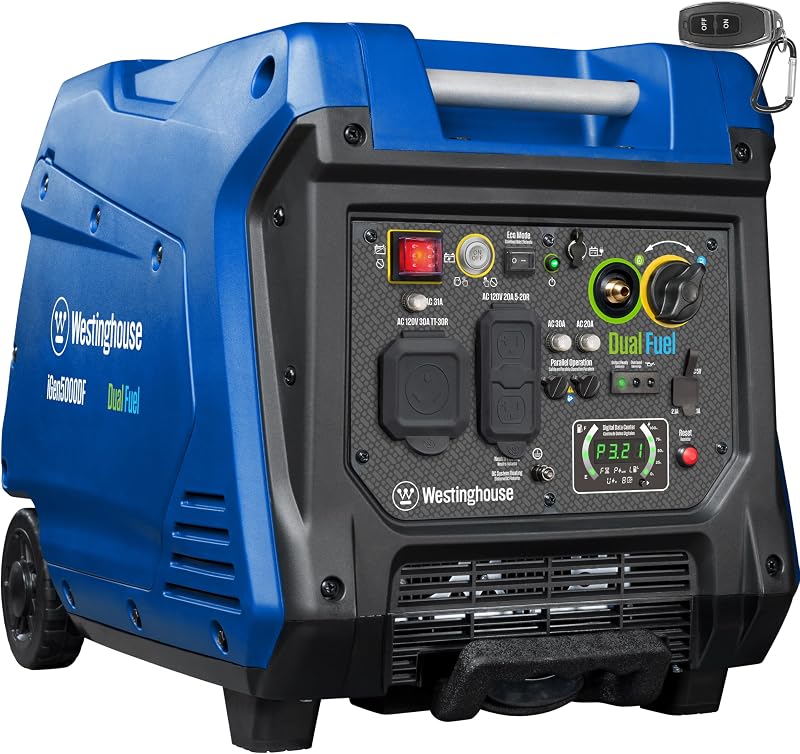
A 5000 peak watt rating puts this generator in range for a well pump, furnace blower, and refrigerator together, which is the bracket most mid-size home calculations land on. At 104.7 pounds with wheels, it stays movable for someone sizing a generator for partial rather than whole-house coverage.
Pros
- 3900 rated watts is genuine working power for essential devices
- 52 dB quiet operation suits residential neighborhoods
- 18-hour runtime covers overnight outages
- Clean inverter power protects sensitive electronics
Cons
- 104.7 pounds still takes effort to move despite wheels
- Not enough capacity for high-draw whole-house loads like central air
Not every house needs a whole-home solution, and figuring out the right generator size often means recognizing when a smaller, smarter unit covers what actually matters. The Westinghouse 5000W is sized for the essentials: refrigerator, some lighting, a sump pump, phone chargers, and similar circuits, without trying to run your entire panel. Its 3900 rated watts is real working power rather than an inflated peak number, which is useful when you're doing the math on what your house truly needs during an outage. At 52 dB in economy mode, it also solves a problem whole-home units can't: running quietly enough not to disturb neighbors or sleep through the night. The 18-hour runtime per tank means it can carry a partial home load overnight, which is often the actual requirement during a short outage. Clean inverter power under 3% THD protects electronics like modems and medical devices that a larger, cruder generator might put at risk. For households sizing power needs around a handful of critical circuits rather than full-panel coverage, this hits that mark without the excess weight or fuel complexity of larger units.
Power Output: 5000 peak watts, 3900 rated watts at less than 3% THD
Fuel Type: Gasoline
Runtime: Up to 18 hours at 50% load with 3.4-gallon tank (with economy mode)
Noise Level: 52 dB at 1/4 load with economy mode
Outlets: 5-20R 120V duplex household outlet, TT-30R 30-amp RV outlet, two USB outlets
Voltage: 120 volts
Weight: 104.7 pounds
Starting: Remote electric start with key fob, recoil start backup
Features: Fuel gauge, hour meter, rotating digital display, telescoping handle, wheels
Special Features: Economy mode for extended runtime, less than 3% THD for sensitive devices
Warranty: 3-year limited coverage on parts, labor, and service
Included: Battery charger, engine oil with funnel, key fob, owner's manual, quick-start guide

At 13000 watts, this generator sits at the top end of residential sizing charts, covering whole-house setups with central air, electric heat, and well pumps running together. Dual fuel capability and transfer switch readiness matter to readers whose wattage total pushes them into true whole-home territory.
Pros
- 10,500 running watts suited to near whole-house coverage
- Transfer switch ready 50-amp outlet for home integration
- Dual fuel switches between gasoline and propane quickly
- CO sensor and low oil shutdown add automatic safety protection
Cons
- 234 pounds requires real planning for transport and storage
- Dual fuel operation adds a learning curve for new users
When the sizing question for a house points toward needing to run nearly everything at once, the XP13000EH is built for that upper end of the range. At 13,000 watts with 10,500 running watts, it has the headroom to handle a furnace, refrigerator, well pump, and several circuits simultaneously, which is the scenario that pushes homeowners toward a larger unit in the first place. The transfer switch-ready 50-amp outlet means that sizing decision translates directly into a usable home setup rather than a tangle of cords. Dual fuel operation lets you switch between gasoline and propane in seconds, which matters if you're sizing for worst-case outages where fuel availability is uncertain. The all-metal frame, 100% copper windings, and no-flat wheels point to a unit meant to survive repeated heavy use rather than occasional backup duty. An hour meter, low oil shutdown, and CO sensor round out the safety and maintenance picture for a generator this size. If your wattage math lands near the top of the residential range, this is built to match that number rather than stretch to meet it.
Power Output: 13,000 watts peak, 10,500 watts continuous. Fuel Type: Dual fuel, gasoline or propane with quick-switch capability. Voltage: 240 volts. Weight: 234 pounds. Special Features: Electric start, CO sensor, low oil shutdown, hour meter, foldable handle, portable with no-flat wheels.
Outlets and Connectivity: Transfer switch-ready 50-amp outlet for whole-home backup systems, plus multiple standard outlets for RV, residential, and job site use. Engine: Robust DuroMax engine with 100% copper windings for superior heat conductivity and longevity. Construction: Heavy-duty all-metal frame and power panel with no plastic components.
Suited to homeowners whose load calculations point to near whole-house coverage, including furnace, well pump, and major appliances together. Also fits those who want dual fuel as insurance against gas shortages. Skip it if your actual need is a handful of circuits, since the 234-pound weight and added features are more than smaller households require.

Pros
- Exceptional battery capacity easily powers high-draw devices like mini-fridges, CPAP machines, and laptops simultaneously
- Fast USB-C charging delivers practical speeds for mobile devices during real-world use
- Versatile outlet selection including dual AC outlets, multiple USB ports, and wireless charging covers nearly every device type
- Reliable performance in power outages with customers reporting stable operation over extended use periods
- Lightweight and portable design with built-in handle makes transport and setup effortless
Cons
- Wall charger quality control issue: some units overheat dangerously within 15 minutes of use, requiring careful inspection upon arrival
- Cannot power high-inrush appliances like instant-brew coffee makers that draw power rapidly when activating
- Inconsistent initial charge state on arrival: some units ship at 48% battery while others arrive at 98%
The GRECELL EB1000 is a complete solar power solution designed for campers, RV travelers, and homeowners needing reliable backup power. This integrated kit pairs a 1000W pure sine wave power station with a 200W foldable solar panel, delivering everything needed for off-grid adventures or emergency home power. The 999Wh capacity proves substantial enough to power CPAP machines for multiple nights straight, with real users reporting approximately 100 hours of CPAP operation on a full charge.
Standout features include the pure sine wave output that safely runs sensitive equipment without damage, comprehensive outlet selection spanning dual AC outlets, 60W USB-C, multiple USB-A ports, wireless charging, and DC connections. The 60W USB-C port delivers impressive real-world performance, charging most smartphones from 8% to 60% during a typical 20-minute drive. The 23% energy conversion solar panel charges efficiently in sunlight and supports series or parallel connection for faster recharge cycles. Independent operation of LED lighting and SOS mode ensures emergency functionality even when main battery depletes.
Build quality reflects solid engineering with an intelligent cooling fan that activates under heavy load to extend lithium battery lifespan. The LCD display clearly shows remaining capacity and power flow, with auto-sleep after 20 seconds reducing standby drain. Multiple safety layers protect against overcharge, over-discharge, overload, and short circuits. The compact design at 7.9 x 7.9 x 11.6 inches with carrying handle makes transport practical for camping and travel.
Two legitimate concerns emerge from customer reports. The included wall charger occasionally runs dangerously hot within 15 minutes, requiring careful quality inspection upon arrival and potentially needing third-party replacement. Additionally, the station cannot power appliances with very high inrush current like instant-brew coffee makers, though standard appliances work reliably. Some units arrive with inconsistent initial charge levels.
For campers, road-trippers, and homeowners prioritizing versatile, reliable power without grid dependence, the GRECELL EB1000 delivers strong value. Real-world performance confirms the capacity claims, fast charging keeps mobile devices ready, and triple charging methods ensure you can recharge anywhere. Despite minor quality control inconsistencies, this kit represents a practical all-in-one solution for extended outdoor adventures and emergency backup power.
Choose this solar power station if you need to reliably power medical devices like CPAP machines during camping, want a portable backup system for home power outages, or plan frequent RV travel with multiple device charging needs. The 1000W output and 999Wh capacity handle most household appliances and outdoor electronics simultaneously.
Skip this model if you exclusively use instant-brew coffee makers or similar high-inrush-current appliances, or if you need portability for hiking and backpacking where weight matters significantly. The 7.9-inch compact design is travel-friendly but not ultralight for backcountry use.
Before purchase, verify the wall charger doesn't overheat during initial testing. Given some quality control variation, consider having a quality replacement charger on hand as backup insurance for your investment.

This 80 watt unit is far below what any home circuit calculation requires, making it relevant only as a footnote: readers comparing wattage tiers can see how small a true micro power station is next to actual appliance draw, useful for charging devices but not sizing home backup.
Pros
- Eight output ports cover phones, tablets, laptops, and a 12V car port
- Built-in LED flashlight with three brightness modes
- Charges from empty to 80% in about 2 hours
- UL certification and overload, overcharge, and short circuit protection
Cons
- 80W output is far too low for any household appliance or circuit
- Some users report reduced charge retention after a few years of use
Part of figuring out the right generator size for your house is understanding what smaller battery units can't do, and the MARBERO M82 is a clear example of that lower tier. At just 80 watts output and 3.2 pounds, this is built for charging phones and small devices or running a flashlight during an outage, not for powering anything resembling a household circuit. It's useful as a point of comparison when researching generator sizing, since it shows the gap between a pocket-sized backup and an actual generator capable of running a fridge or sump pump. Eight output ports, including dual AC outlets, USB-A, USB-C PD, and a 12V car port, let you charge several small devices at once, and the built-in LED flashlight with three brightness modes adds emergency utility. Charging from empty to 80% takes about 2 hours. Built-in protections against overcharge, short circuits, and overload, plus UL certification, add some safety assurance. For whole-house backup planning, this product is a reference point for the smallest end of the power spectrum, not a candidate for the job itself.
Fits people who want a small emergency light and phone charger to keep on hand, or who are comparing entry-level power options before deciding they need a real generator. Skip it entirely if you're sizing power for your house, since 80W output can't run any meaningful home circuit. Also worth noting for buyers planning long-term use, since some reports describe reduced charge retention after a few years.

Pros
- Affordable complete solar power solution at under $100
- Versatile charging options and multiple output ports cover most portable devices
- Eco-friendly solar energy reduces reliance on grid power for outdoor activities
- Compact and lightweight enough for backcountry camping and road trips
- Strong 4.1-star rating from over 9,000 verified buyers validates real-world reliability
Cons
- 80W running capacity limits simultaneous use of high-draw appliances
- 21W solar panel charges slowly in low-light conditions or cloudy weather
- 88Wh capacity provides limited runtime, requiring overnight solar recharging for extended off-grid use
The MARBERO M82SL21 is a compact solar generator kit designed for outdoor enthusiasts, emergency preparedness, and off-grid power needs. This bundle pairs an 88Wh portable power station with a 21W foldable solar panel, making it ideal for tent camping, road trips, RV living, and home backup power during outages.
The standout feature is its true portability combined with solar capability. At 2.3 pounds, it fits easily in a backpack, while the 21W panel folds for transport. The 120W surge output handles phones, laptops, mini-fridges, and small LED lighting. Multiple output ports (AC 110V, DC, USB) provide flexibility for different device types, and the system can charge via solar, wall outlet, or car adapter depending on your situation.
Build quality appears solid for the price point. The unit includes comprehensive protection systems: overcharge, overload, short circuit, and over-voltage protection. The ABS material housing feels durable, and the compact 6.5 x 3.2 x 4.6 inch footprint fits into most bags or vehicle storage compartments without taking up significant space.
Limitations exist. The 80W running capacity means you cannot run multiple high-draw devices simultaneously. The 21W solar panel charges slowly in overcast conditions or winter months, so real-world solar recharge times may stretch beyond the theoretical estimates. The 88Wh capacity provides roughly one full charge cycle per day for light use, requiring nightly solar recharging for extended trips.
Verdict: The MARBERO M82SL21 delivers solid value for budget-conscious buyers seeking their first solar generator or a secondary backup power option. It handles everyday camping and emergency scenarios well, backed by strong customer ratings and a 12-month warranty. Upgrade to larger capacity models only if you need extended off-grid runtime or higher power draw.
Power Capacity: 88Wh total energy storage, 80W running output, 120W surge capacity
Outputs: 1x 110V AC outlet, DC ports, USB ports (8 total power outlets), 60Hz frequency
Solar Panel: 21W foldable portable solar panel included
Charging Options: Solar panel input, AC wall adapter (included), 12V car cigarette lighter adapter (included)
Physical: 2.3 lbs total weight, 6.5L x 3.2W x 4.6H inches, compact and portable design
Protection Features: Automatic shutdown, short circuit protection, overcharge protection, overload protection, over-voltage protection
Warranty: 12 months warranty with 24/7 customer support
Ideal For: Campers and backpackers seeking lightweight solar power, road trippers needing device charging, RV owners wanting backup power, homeowners preparing for emergency outages, outdoor enthusiasts exploring off-grid living on a budget.
Consider Alternatives If: You need continuous power for high-draw appliances (TVs, heaters, power tools), plan month-long off-grid expeditions without external charging, live in consistently cloudy climates, or need to run multiple devices simultaneously.
Best Use Cases: Overnight camping trips, weekend road trips, emergency home backup for phones and lighting, outdoor events, boats and small RVs, outdoor office work requiring laptop and device charging.
How to Choose the Right Generator Size for Your Home
Calculate Your Wattage Requirements First
Start by listing every appliance you want to run during an outage. Refrigerators typically draw 600 to 800 running watts, a central air conditioner can demand 3,000 to 5,000 watts, and a sump pump often pulls 1,000 or more. Add those running watts together, then factor in the highest single starting surge in your lineup.
A unit like the DuroMax XP13000EH 13,000-Watt Dual Fuel is built for whole-home coverage and handles that kind of load comfortably. If you only need to keep the fridge, some lights, and a phone charger alive, something in the 3,000 to 5,000 watt range is usually enough.
Decide Between Portable Generators and Power Stations
Traditional gas-powered portable generators deliver high wattage output and long run times. The best dual fuel generators like the Westinghouse 12500 Watt Dual Fuel Home Backup add the flexibility of running on propane when gasoline is scarce after a major storm.
Battery-based power stations such as the Jackery Explorer 1000 v2 Portable Power are quieter, require zero fuel, and are safe to use indoors. They are a smart fit for apartments, short outages, or anyone who prioritizes convenience over raw wattage.
Match Run Time to Your Outage Reality
A generator that runs out of fuel or charge in four hours is not much use during a three-day outage. The Westinghouse 5000 Peak Watt Super Quiet delivers up to 18 hours on a single tank in economy mode, which covers most overnight situations without a refuel stop.
For solar-rechargeable options, the 1000W Portable Power Station & 200W Foldable Solar bundle from GRECELLPOWERSTATION can replenish itself during daylight hours, making it a genuinely sustainable option for extended grid-down scenarios. See how these kinds of units compare in our generator picks for power outages.
Consider Noise Level and Local Regulations
Inverter generators and battery stations run significantly quieter than conventional open-frame units. The Westinghouse 5000 Peak Watt Super Quiet operates at as low as 52 dBA, which is comparable to a normal conversation. That matters if you live in a neighborhood with noise ordinances or simply do not want to annoy everyone around you.
Compact battery units like the MARBERO Portable Power Station 88Wh, 120W Surge produce virtually no noise and emit no exhaust. They are not going to run a central AC unit, but for charging devices and running small appliances they are a low-drama solution. For campers and RV users who want quiet power on the road, our best quiet generator roundup has more targeted picks.
Final Thoughts
The right generator size for your house comes down to how much you need to power and for how long. If whole-home coverage during extended outages is the goal, the Westinghouse 12500 Watt Dual Fuel Home Backup delivers the wattage and run time to handle it, while the Jackery Explorer 1000 v2 Portable Power is the smarter choice for anyone who wants a quiet, fuel-free option for shorter outages and everyday backup use.
Frequently Asked Questions
What size generator do I need to run my whole house?
Most average-sized homes require between 10,000 and 13,000 watts to run central air conditioning, a refrigerator, lights, and other standard appliances simultaneously. A unit like the DuroMax XP13000EH, rated at 13,000 peak watts, is specifically designed for whole-home coverage. If you have a smaller home or only want to keep essentials running, a 5,000 to 8,000 watt unit is often sufficient.
Is a 3,000-watt generator enough for a house?
A 3,000-watt generator can power a refrigerator, several lights, a television, and phone chargers at the same time, but it will not handle a central air conditioner or electric water heater. It works well as an essentials-only backup for smaller homes or for keeping a few key circuits live. If your priority is running the AC, plan on at least 5,000 to 7,000 watts.
Can a portable power station replace a generator for home backup in 2026?
For shorter outages and lower-draw appliances, modern power stations have become a genuinely capable alternative to gas generators. Units like the Jackery Explorer 1000 v2 Portable Power deliver 1,500W of continuous output and can be recharged via solar panels, making them practical for multi-day situations. They cannot replace a high-wattage generator for whole-home use, but for apartments or for anyone who wants a quieter and cleaner solution, they are worth serious consideration. Our portable power stations category has a broader look at what is available.
Should I get a dual fuel generator for my home?
Dual fuel generators give you the option to switch between gasoline and propane, which is a real advantage when one fuel becomes hard to find after a major storm or regional emergency. Propane also stores indefinitely without degrading, unlike gasoline, so a full propane tank kept in your garage is always ready to go. For homeowners who experience frequent or prolonged outages, a dual fuel model like the Westinghouse 12500 Watt Dual Fuel Home Backup adds meaningful flexibility that a single-fuel unit simply cannot match.
Common questions
What is the difference between starting watts and running watts for generators?
Starting watts are the short burst of extra power needed to get a motor-driven appliance moving, while running watts are what it draws once operating steadily. A furnace blower, well pump, or refrigerator compressor can need two to three times its running wattage just to start. The Westinghouse 12500 Watt Dual Fuel generator is rated for 12500 starting watts and 9500 running watts, so sizing around the running figure alone can leave you short when appliances kick on.
Why are the furnace and well pump the biggest power draws in a house?
They have motors that spike in wattage the instant they start, unlike steady loads such as lights or electronics. A furnace blower and a well pump pulling startup power at the same time can push past a generator's capacity even if its running watt rating looks sufficient. This is why a home backup unit like the Westinghouse 12500 Watt Dual Fuel generator, with its higher surge rating, is built for these motor-driven appliances rather than small portable stations.
Should I use a transfer switch or extension cords for backup power?
A transfer switch is the safer and more practical choice because it connects the generator directly to your home's circuit panel, powering hardwired systems like a furnace or well pump without trailing cords through doors or windows. Extension cords only work for devices you can plug in directly, like a Jackery Explorer 300 Portable Power Station. The Westinghouse 12500 Watt Dual Fuel generator is listed as transfer switch ready, which simplifies a whole-home setup.



Write Your Review
No reviews yet. Be the first to share your experience!