

A dead campground hookup, a remote boondocking site, or an unexpected roadside stop can quickly turn basic RV comforts into a power-planning problem. Your generator needs enough running wattage for the appliances you genuinely use, plus the right outlet, manageable noise, and safety features that suit life on the road.
This guide to the best generator for rv use compares compact inverter models, flexible dual-fuel options, and high-output units for travel trailers and larger rigs. If your campsite also doubles as an office, pair reliable power with portable SSD options for a Mac-based RV workspace so your essential files travel securely.
Quick answer
This guide compares 10 picks, with Westinghouse iGen5000DF 5000W Dual Fuel Inverter ranked first. Westinghouse WGen9500DF 12500W Dual Fuel Portable holds the highest customer rating among them.
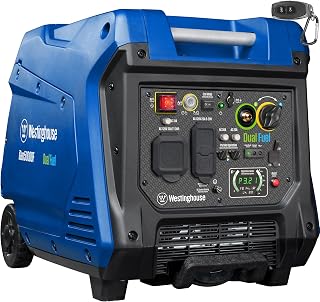
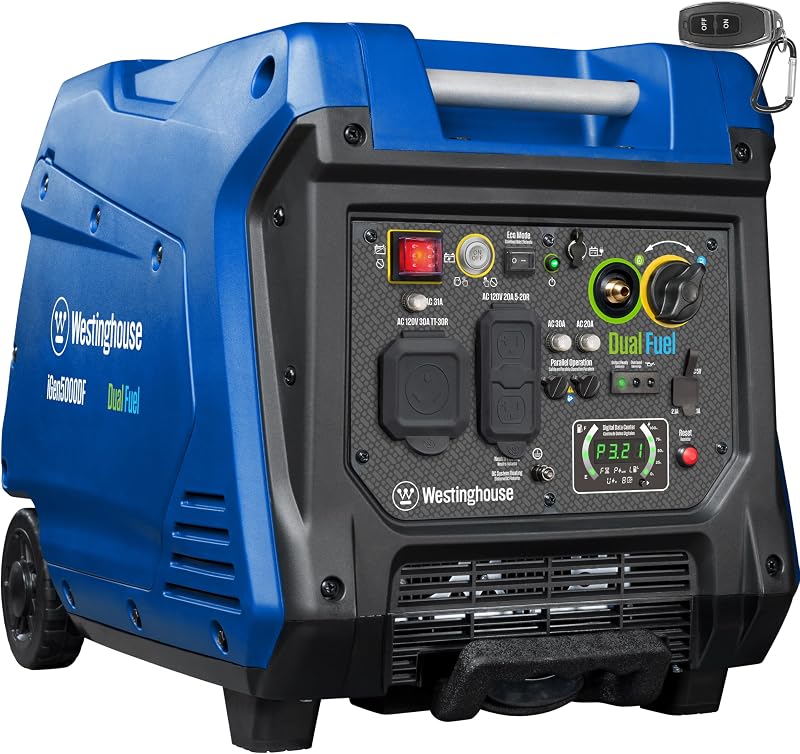
For travel-trailer owners who want flexible off-grid power, this inverter model's 3,900-watt output and 5,000-watt peak capacity provide useful headroom for RV appliances with high startup demands. Its RV-ready 30A outlet simplifies connecting a compatible trailer, while gasoline-or-propane operation lets campers choose the fuel available on their route. Remote electric start adds convenience from inside the RV.
Pros
- TT-30R 30A RV outlet
- Gasoline and propane capability
- 52 dBA operation
- Remote start and parallel capability
Cons
- 104-pound unit requires deliberate handling
- Performance is affected above 2,000 feet
For RV owners who want a direct trailer connection and room for everyday electronics, the Westinghouse iGen5000DF brings together key conveniences in one inverter unit. Its TT-30R 30A RV outlet supports a straightforward travel-trailer hookup, while 5,000 peak watts and 3,900 running watts provide substantially more capacity than a small camping generator. Gasoline and propane operation offers an alternative fuel choice on the road. It is also configured around campground usability. Westinghouse lists 52 dBA operation, and its inverter output is stated to remain below 3% THD, an important detail for laptops and plasma TVs. Variable engine speed adjusts to demand, and the 3.4-gallon gasoline tank can run for up to 18 hours. The LED data center shows fuel level, output, and remaining runtime. Remote electric start via the key fob lets the generator be started from the RV, with electric ignition, a fuel gauge, and an hour meter adding convenience. Wheels and a telescoping handle help, but the 104-pound weight still makes this a generator to position deliberately. It is parallel capable when more power is needed.
Power Output: 5000 peak watts, 3900 continuous watts at less than 3% THD
Fuel System: Dual fuel (gasoline and liquefied propane gas), 3.4-gallon tank capacity, up to 18 hours runtime on gasoline with economy mode
Engine: 4-stroke fuel-powered engine, 60 Hz frequency, 120V output
Start System: Electric start with remote key fob, recoil start backup
Outlets and Connectivity: TT-30R 30A RV outlet, 5-20R 120V duplex household outlet, two USB ports, 5 total power outlets
Portability: 104.7 pounds, 24.5L x 16.3W x 20H inches, telescoping handle and wheeled base
Noise Level: 52 dBA (extremely quiet for its class)
Warranty: 3-year limited coverage, nationwide service network, lifetime technical support
Choose this for a travel trailer with a 30A connection when you want an inverter generator with remote start, gasoline-or-propane flexibility, and capacity beyond basic device charging. It suits RV users who value long gasoline runtime, onboard operating information, and the option to add a parallel unit later. Skip it if lifting or moving a 104-pound generator is unrealistic, if you camp above 2,000 feet where performance is affected, or if a simpler single-fuel generator better fits your setup.

For owners of larger travel trailers or parked RV setups with high power needs, this unit’s 9,500-watt output and 12,500-watt peak rating provide ample capacity for broad RV electrical needs. Gasoline and propane capability can help with fuel planning on long stays, and remote electric start is convenient when the generator is positioned outside. Verify the trailer’s inlet and required connection equipment before choosing it.
Pros
- 9,500 running watts and 12,500 peak watts
- Gasoline and propane operation
- Up to 12 hours on its 6.6-gallon tank
- Remote start with VFT monitoring display
Cons
- 210-pound weight limits portability
- Dual-fuel operation requires added fuel management
The WGen9500DF is the high-output choice for an RV owner whose power needs go beyond a compact inverter generator. With 12,500 peak watts and 9,500 running watts, it has a much larger reserve for simultaneously supporting multiple appliances and equipment. The 50A connector and transfer-switch-ready outlets expand its connection options, although the product is primarily recommended for residential use. Fuel flexibility is a central advantage for longer stays. It runs on gasoline or propane, and the 6.6-gallon gasoline tank is rated for up to 12 hours of runtime. Remote electric start, operated with an included key fob, reduces the need to use the recoil starter, though a recoil backup is present. Automatic voltage regulation supports a steady 120-volt output, while the VFT display tracks voltage, frequency, and lifetime operating hours. A fuel gauge and hour meter also make routine monitoring easier. This is not a lightly portable RV generator. At 210 pounds, it requires planning to move and position even with heavy-duty wheels. Its dual-fuel setup also demands more fuel-management attention than a single-fuel model. For an RV setup that truly calls for its capacity, those tradeoffs may be acceptable.
The WGen9500DF delivers 9,500 running watts on gasoline and 8,500 on propane, with peak outputs of 12,500 and 11,200 watts respectively. This wattage tier handles most household essentials including refrigerators, sump pumps, air conditioning units, and entertainment systems simultaneously when using the transfer switch ready 50A outlet.
Runtime of up to 12 hours on a single fuel tank reduces refueling frequency during extended outages. The fuel gauge keeps you informed of consumption, and the automatic low oil shutdown prevents engine damage. A built-in hour meter tracks lifetime usage for maintenance planning, displayed on the digital VFT dashboard alongside real-time voltage and frequency readings.
The generator ships with remote start key fob, 12V battery charger, engine oil and funnel, comprehensive tool kit, propane hose, quick-start guide, and owner's manual. Minimal assembly is required out of the box, though careful fuel and oil setup is essential before first operation. All components support immediate deployment once prepared.

This tri-fuel inverter is a strong match for larger travel trailers or extended stays because its 6,600-watt output and 8,200-watt peak rating offer substantial capacity for several RV electrical demands. Gasoline, propane, and natural-gas compatibility gives travelers more refueling options, while low THD is specifically relevant to sensitive onboard electronics. The CO sensor and remote electric start add practical campsite safety and convenience.
Pros
- Tri-fuel gasoline, propane, and natural-gas operation
- Less than 3% THD inverter output
- Remote electric start with key fob
- RV-ready TT-30R 30A outlet
Cons
- 134.5-pound unit requires careful transport
- 60 dBA noise can stand out at quiet campsites
For RV travelers who carry laptops, phones, or televisions alongside high-demand trailer equipment, the iGen8200TFc puts clean power at the center of its design. Its inverter output has less than 3% THD, making it suitable for sensitive electronics, while 6,600 running watts and 8,200 peak watts provide considerable reserve for a travel trailer. The TT-30R 30A outlet is RV-ready, and the 14-50R 50A transfer-switch-ready outlet gives the unit a separate home-backup role. Fuel choice is unusually broad: gasoline, propane, or natural gas. The 3.9-gallon tank supports up to 17 hours at 25% load on gasoline. Remote electric start, including a key fob that works from over 100 feet away, can be helpful when the generator is placed at a distance from the trailer. A digital LED display shows voltage, frequency, and lifetime hours, while the enclosed housing, flat-free tires, fuel gauge, CO sensor, and overload protection support day-to-day operation. At 134.5 pounds, it needs a deliberate transport plan. Its 60 dBA noise level is reasonable for its output but will still be noticeable in quiet campgrounds.
Power Output: 8,200 peak watts (gasoline), 6,600 running watts. Propane: 7,380 peak / 5,940 running watts. Natural gas: 6,560 peak / 5,280 running watts.
Engine: 298cc Westinghouse 4-stroke OHV engine with cast iron sleeve. Electric start with remote key fob included. Automatic low oil shutdown and CO sensor for safety.
Fuel Tank: 3.9 imperial gallons with digital fuel gauge. Runtime up to 17 hours at 25% load on gasoline.
Outlets: One 120/240V 14-50R 50A outlet (transfer switch ready), one 120V TT-30R 30A RV outlet, one 120V GFCI 5-20R 20A duplex outlet.
Physical: 27L x 20.9W x 21.7H inches. Weight: 134.5 pounds. Fully enclosed with flat-free wheels and folding handle. Color: Blue.
Technology: Inverter technology with less than 3% THD. Copper windings. LED display shows voltage, frequency, and hour meter. Frequency: 60 Hz.
Warranty: 3-year limited warranty with lifetime technical support.
Buy this model for a 30A travel trailer when clean inverter power, large output capacity, and a choice of three fuels matter more than compactness. It particularly suits RV users who also want a transfer-switch-ready generator for residential backup and appreciate remote electric starting. Skip it for lightweight camping setups, frequent solo loading, or quiet sites where 60 dBA may be unwelcome. It is also excessive if your trailer only needs modest power and you do not need 6,600 running watts.
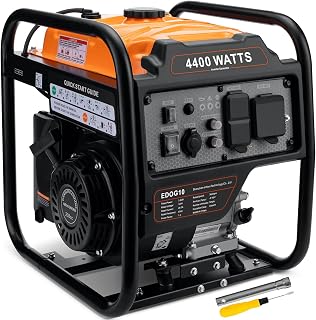
RV owners seeking a straightforward gasoline-only option can look to this 4,400-watt inverter unit for 120-volt trailer power. The built-in RV-ready 30A outlet avoids needing a separate adapter for compatible rigs, and its camping recommendation fits weekends at developed sites. It is especially relevant for travelers who prioritize a dedicated RV connection and substantial stated wattage over fuel versatility.
Pros
- 56-pound portable design
- RV-ready 30A outlet
- Inverter power for sensitive electronics
- ECO mode and 2-gallon tank
Cons
- Continuous output is closer to 3,400 watts
- Louder than quieter premium competitors
A modest travel trailer does not always require a 6,000-watt-class generator. The OXOG10 instead emphasizes a more portable 56-pound format, gasoline power, and an RV-ready 30A outlet. Its inverter design produces clean, stable electricity suited to sensitive electronics and essential appliances, and it provides dual 120V outlets for additional connections. The listed output is 4,400 watts, although continuous output is closer to 3,400 watts, so RV owners should size their appliance use around the lower figure rather than assume all high-draw equipment can run together. The 2-gallon tank, ECO mode, and stated 14-to-16-hour runtime depending on load favor longer stays away from hookups. Cold-start technology and electronic ignition address startup, while low-oil shutdown and overload protection add safeguards. The 4-stroke engine is factory-tested and arrives properly broken in. This is a gasoline-only, open-frame option, and noise exceeds quieter premium competitors. Those tradeoffs make it better for a practical trailer setup than for a campground where sound is the overriding concern. For RV use, its strongest appeal is the pairing of a 30A outlet with a weight that is far easier to manage than the heavier Westinghouse units.
Power Output: 4400 watts peak, 3400 watts running continuous
Engine: 4-stroke, electronic ignition, 4.4 kW maximum power
Fuel Capacity: 2-gallon tank with 14-hour runtime at 25% load
Outlets: Two 120V AC ports, one 30A RV outlet, one 12V DC port
Weight and Dimensions: 57 pounds, 19.4 inches length, 15.2 inches width, 19.2 inches height
Special Features: Cold start technology, ECO mode, automatic low oil shutdown, overload protection, inverter technology
Warranty: 1-year manufacturer coverage
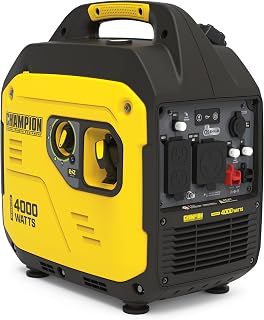
This inverter generator delivers 4000 watts of power, enough to run essential RV systems like air conditioning, refrigerators, and electronics without overloading your circuits. The 12-volt output allows direct battery charging while you're parked at campsites, and the inverter technology produces clean power safe for sensitive devices like laptops and smartphones that travel trailers rely on daily.
Pros
- Just under 49 pounds
- TT-30R RV outlet
- Clean power under 3% THD
- CO Shield automatic shutdown
Cons
- Recoil start only
- 1.54-gallon tank needs more frequent refueling
Not every travel trailer needs a large, wheel-equipped generator. The Champion 4000-Watt RV Ready Portable Inverter Generator is aimed at campers who want 4,000 watts of starting power in a compact package weighing just under 49 pounds. Its built-in carrying handle supports that portable focus, while the TT-30R RV outlet, household outlet, and 12V automotive outlet cover common trailer and campsite connections. It is especially appropriate when the RV includes electronics that benefit from clean output. The inverter power remains under 3% THD, and Economy Mode adjusts engine speed to the load, cutting fuel use and noise while allowing more than 10 hours of runtime at partial load. At 64 dB from 23 feet away, it is also positioned for campground and home settings where sound matters. Cold Start Technology helps with cold-weather starting, and CO Shield monitors carbon monoxide buildup before automatically shutting the engine down at dangerous levels. The 1.54-gallon tank and recoil-only start set its limits: continuous, high-demand use means more frequent refueling and more effort to start than an electric-start model. For regular trailer trips and essentials, that tradeoff favors portability.
Power Output: 4000 watts starting, 3000 watts running, 60Hz frequency
Engine: Champion 149cc 4-stroke gasoline engine with recoil start and Cold Start Technology
Fuel & Runtime: 1.54-gallon tank, up to 10 hours at 25% load, includes 0.5-quart oil capacity
Outlets: 120V 25A RV TT-30R, 120V 20A household duplex, 12V automotive-style, parallel-ready connectors
Noise & Power Quality: 64dB from 23 feet, clean sine wave output under 3% THD
Physical: 48.1 lbs, 17.9in L x 11.7in W x 19.7in H, yellow color with carrying handle
Warranty: 3-year limited warranty plus free lifetime technical support
Buy this Champion for a travel trailer where carrying weight, a TT-30R outlet, clean inverter power, and CO monitoring matter more than extended high-load runtime. It suits campground trips, modest overnight electrical use, and owners comfortable with a recoil starter. Skip it if you want electric start, need to run at high demand for long periods from a larger tank, or are planning whole-home backup. The 1.54-gallon tank requires more frequent refueling during continuous operation.

With 5000 peak watts, this unit handles high-demand appliances in larger travel trailers, including 15,000 BTU air conditioners and microwaves. The remote electric start with auto choke means you can fire it up from inside your RV without stepping outside in bad weather, and the included wheel and handle kit makes repositioning around your campsite effortless despite its 104.7-pound weight.
Pros
- 3,900 rated watts with 5,000 peak watts
- 52 dB in Economy Mode
- Up to 18-hour runtime per tank
- Remote electric start with key fob
Cons
- 104.7-pound unit
- Central air conditioning limits simultaneous loads
Travel trailers place a mixed set of demands on a generator: enough continuous output for onboard essentials, clean electricity for personal devices, and behavior that suits a campground. The Westinghouse delivers 3,900 rated watts and 5,000 peak watts, placing it among the more capable RV-ready inverter options for trailers with meaningful electrical needs. Its inverter-grade power stays below 3% THD, which is relevant for laptops, phones, and other sensitive electronics carried on a trip. This model also addresses the practical side of a multi-night stay. Economy mode lowers noise to 52 dB and can support up to 18 hours of runtime per tank, reducing the need for overnight refueling at lighter loads. Remote electric start, the supplied key fob, and auto choke make starting more convenient, while the fuel gauge and hour meter give useful operating information. Wheels and a handle help position it, but its 104.7-pound weight still makes it a substantial generator. It is best viewed as high-capacity RV power rather than a lightweight grab-and-go unit.
Power Output: 5000 peak watts, 3900 rated watts at less than 3% THD
Fuel Type: Gasoline
Runtime: Up to 18 hours at 50% load with 3.4-gallon tank (with economy mode)
Noise Level: 52 dB at 1/4 load with economy mode
Outlets: 5-20R 120V duplex household outlet, TT-30R 30-amp RV outlet, two USB outlets
Voltage: 120 volts
Weight: 104.7 pounds
Starting: Remote electric start with key fob, recoil start backup
Features: Fuel gauge, hour meter, rotating digital display, telescoping handle, wheels
Special Features: Economy mode for extended runtime, less than 3% THD for sensitive devices
Warranty: 3-year limited coverage on parts, labor, and service
Included: Battery charger, engine oil with funnel, key fob, owner's manual, quick-start guide

This gasoline inverter generator fits travel-trailer campers who want an RV-ready unit with an ECO mode for lighter-use operation. Its listing identifies a 30A RV-ready connection and 120-volt operation, which align with compatible trailer shore-power inputs. The specifications list 3,400 watts of wattage and 4,400 watts of output, so buyers should confirm their rig’s actual load requirements.
Pros
- 3,400 running watts and 4,400 peak watts
- Dedicated RV outlet
- Up to 14 hours at 25% load
- 56-pound open-frame design
Cons
- Exhaust may be loud under heavy load
- Less weather protection than enclosed models
An open-frame generator makes sense for RV owners who value a relatively light unit and straightforward access to its components. The 56-pound Oxseryn EDOG10 delivers 3,400 running watts and 4,400 peak watts, a combination intended for a travel trailer's appliances and other camping power needs. A dedicated RV outlet sits alongside 120V AC and 12V DC connections, so it offers connection flexibility without requiring an adapter in most situations. For overnight trailer use, the 2-gallon tank and ECO mode are the key story. At 25% load, it can run for up to 14 hours, allowing moderate-demand camping use to extend through the night on one tank. The fuel gauge, low-oil shutdown, overload protection, and Cold Start Technology add useful safeguards and operational convenience. The tradeoff is its open-frame design. It offers less weather protection than an enclosed generator, and its exhaust may be noticeable under heavier loads despite a rating below 72 dB at 23 feet. This is an RV-ready choice that puts output, runtime, and a manageable listed weight ahead of the quieter, more enclosed format.
Power Output: 4400 watts peak, 3400 watts running
Engine: 4-stroke, 208cc displacement with electronic ignition
Fuel Tank: 2 gallons with fuel gauge
Runtime: 14 hours at 25% load with ECO mode
Outlets: 2x 120V AC, 1x 12V DC, 1x RV port (4 total)
Noise Level: Under 72 dB at 23 feet
Weight: 56 pounds
Dimensions: 19 inches L x 15.6 inches W x 19.1 inches H
Frequency: 60 Hz
Special Features: Cold start technology, fuel efficient, low oil shutdown, overload protection
Warranty: 1 year manufacturer
Buy the Oxseryn if your RV setup benefits from 3,400 running watts, a dedicated RV outlet, and long ECO-mode runtime at a partial load, while keeping generator weight to 56 pounds. It fits campers who can place and protect an open-frame machine appropriately. Skip it if campground quiet is your overriding concern, if you want the greater weather protection of an enclosed design, or if you need the easiest possible transport. Its exhaust can be mildly loud during heavy use.
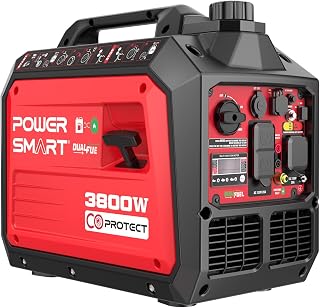
At 50.7 pounds, this 3,800-watt camping generator is a sensible choice for travel-trailer owners who need to move a unit between storage, a tow vehicle, and a campsite without handling a much larger machine. Its stated camping and residential uses make it versatile beyond the trailer, while gas-powered operation keeps the fuel setup straightforward for short RV trips.
Pros
- 30A twist-lock RV outlet
- Gasoline and propane operation
- 59 dB Eco Mode rating
- CO sensor and low-oil shutdown
Cons
- 3,200 running watts limits combined appliance loads
- Propane tank is not included
An RV generator does not always need extreme output; for many trailer trips, a 3,200-watt running rating paired with an RV-focused outlet layout is a more manageable fit. The PowerSmart 3800W supplies 3,800 peak watts and includes a 30A twist-lock outlet for RV use, along with household outlets, DC charging, and dual USB ports. That mix can cover trailer connections and smaller charging tasks without depending entirely on adapters. Its dual-fuel design lets the owner use gasoline or propane. At quarter load, PowerSmart lists up to eight hours on a gasoline tank or up to 24 hours on a standard propane tank. Eco Mode is rated at 59 dB, a feature relevant for campground use. Cold Start Technology is also included. Safety and expansion features strengthen its RV appeal: a CO sensor, low-oil shutdown, and parallel-ready capability are all listed. The 50.7-pound weight is relatively manageable compared with larger portable generators, although it is not weightless. Its 3,200-watt output places a firm ceiling on what can run together, so it is best used with a realistic plan for appliance loads.
The PowerSmart 3800W offers impressive flexibility in how you power it. On gasoline, expect 3300 running watts and approximately 8 hours of runtime at quarter load with the included 1.3-gallon tank. For extended use, a standard 20-pound propane tank delivers up to 24 hours at the same load, making propane the choice for emergencies or multi-day camping.
Propane offers several practical advantages: longer shelf life than gasoline, easier storage in dedicated tanks, and no fuel degradation concerns. Gasoline provides convenience at first use and lower initial cost, though you'll need fresh fuel management. The Eco Mode feature enhances both fuel types by reducing engine speed and noise while extending runtimes even further.
Power Output: 3800W starting watts, 3300W running watts on gasoline; 3500W starting watts, 3100W running watts on propane
Noise Level: 59 dB at 25% load in Eco Mode
Fuel Tank: 1.3 gallons (gasoline); compatible with standard 20-lb propane tanks
Runtime: 8 hours at 25% load on gasoline; up to 24 hours on propane at 25% load
Outlets: 120V 30A L5-30R twist-lock, 120V 20A duplex household outlet, 12V 8A DC port, dual 5V 2.1A USB ports
Weight: 50.7 pounds
Certifications: ANSI/PGMA G300, ANSI/UL2201, EPA compliant
Special Features: CO sensor, cold start technology, dual fuel capability, low oil shutdown, parallel ready

This dual-fuel model is tailored to travel trailers that use a 30A shore-power inlet, since it includes an RV-ready 30A outlet. Its 5,300-watt output, paired with a 6,600-watt peak rating, gives meaningful reserve for RV electrical loads, while gasoline or liquefied petroleum gas adds fueling flexibility. A built-in CO sensor is an important safety-oriented feature for campsite use.
Pros
- Dual-fuel gasoline and propane operation
- RV-ready TT-30R 30A outlet
- 5,300 running watts
- CO sensor and automatic voltage regulation
Cons
- 135.6-pound open-frame design
- Propane output is lower than gasoline output
The WGen5300DFcv is aimed at travel-trailer owners who want substantial 120-volt power and do not want to rely on just one fuel. It runs on gasoline or propane, with 5,300 running watts and up to 6,500 watts on gasoline. Output falls to 5,800 watts on propane, an important planning detail when several high-demand RV appliances may be operating. A dedicated TT-30R 30A outlet is RV-ready, while the L14-30R 30A transfer-switch-ready outlet broadens its role for home backup between trips. This is an open-frame, 4-stroke generator with a 4.7-gallon tank, automatic voltage regulation, overload protection, low-oil shutdown, an hour meter, and a CO sensor. Its 274cc engine has a cast-iron sleeve, and its hardened-steel frame and never-flat wheels help with relocation around a campsite or driveway. It can run up to 14.5 hours continuously. At 135.6 pounds, however, this is not a one-person lift, and the open construction calls for a weather canopy if it will remain outdoors for long periods.
Power Output: 6,500 peak watts (gasoline), 5,800 peak watts (propane); 5,300 running watts (gasoline), 4,800 running watts (propane)
Engine: 274cc 4-stroke OHV with cast iron sleeve; 60 Hz frequency
Fuel & Runtime: 4.7-gallon tank with fuel gauge; up to 14.5 hours per charge
Outlets: One 120V 5-20R household duplex receptacle, one RV-ready TT-30R 30A outlet, one Transfer Switch Ready L14-30R 30A outlet
Safety & Convenience: CO sensor with automatic shutdown, automatic low oil shutdown, hour meter, overload protection, automatic voltage regulation
Dimensions & Weight: 23.2L x 20.1W x 19.1H inches; 135.6 pounds
Warranty: 3-year limited warranty on parts and labor; lifetime technical support

Pros
- Dual fuel capability offers flexibility and extended range between refueling
- Compact 79-pound design with 20% weight reduction makes it easy to transport
- Clean power technology protects laptops, phones, and sensitive equipment
- Strong 4250 starting watts handles high-demand startup loads
- Backed by 3-year warranty and free lifetime technical support
Cons
- At 64 dB, it is noticeably louder than normal conversation and may disturb nearby campers or neighbors
- Propane runtime of 14 hours is shorter than gasoline, limiting off-grid duration
- Open frame design offers no weather protection during rainy conditions
The Champion 4250-Watt Dual Fuel Inverter Generator is a versatile power solution designed for RV owners, outdoor enthusiasts, and homeowners seeking reliable backup power. Its dual-fuel capability and inverter technology make it suitable for anyone who values flexibility and portability without sacrificing performance.
The standout features revolve around its advanced digital hybrid design. At 64 dB from 23 feet away, it operates significantly quieter than comparable generators, while producing clean power with less than 3% total harmonic distortion. This makes it safe for sensitive electronics. The dual-fuel system lets you switch between gasoline and propane instantly, giving you 22 hours of runtime on gas or 14 hours on propane at 25% load, depending on your needs and fuel availability.
Build quality reflects Champion's reputation for durability. The generator weighs only 79 pounds and measures under 28 inches long, making it one of the most portable options in its class. The Quick Touch Panel provides easy access to controls, while Economy Mode actively conserves fuel and extends engine life. Cold Start Technology ensures reliable ignition in cold weather, a practical feature for year-round use.
The main limitation is noise level for light sleepers or tight camping spaces. While quieter than traditional generators, 64 dB is still audible in quiet settings. The open frame provides no weather protection, so you will need a cover during rain. Additionally, propane runtime lags behind gasoline, which matters if you plan extended off-grid use without refueling.
The Champion 4250W is an excellent investment for RV owners and homeowners who prioritize quiet, clean power in a portable package. With strong warranty coverage and lifetime support, it represents solid value for occasional and regular use alike.
Power Output: 4250 starting watts, 3500 running watts on gasoline; 3825 starting watts, 3150 running watts on propane
Engine: 224cc Champion 4-stroke engine with compression ignition
Fuel Capacity: 4.0-gallon gasoline tank or 20-pound propane tank (requires hose)
Runtime: 22 hours at 25% load on gasoline, 14 hours at 25% load on propane
Outlets: 120V 30A RV (TT-30R), two 120V 20A household outlets (5-20R), 12V DC automotive outlet with dual USB adapter
Noise Level: 64 dB at 23 feet (approximately normal conversation volume)
Output Quality: Less than 3% total harmonic distortion (clean power)
Dimensions: 27.9 inches L x 23.4 inches W x 21.7 inches H, weighs 79 pounds
Oil Capacity: 0.6 quart with low oil shutoff sensor
Warranty: 3-year limited warranty with free lifetime technical support
Certifications: EPA certified and CARB compliant
Who Should Buy This Generator? This model suits RV owners, camping enthusiasts, tailgaters, and homeowners needing portable backup power. The quiet operation makes it suitable for campgrounds with noise restrictions, while the clean power output protects sensitive devices like computers and medical equipment.
Is Dual-Fuel Worth It? Yes, if you want flexibility. Propane stores longer without degrading, making it ideal for seasonal use. Gasoline offers longer runtime per fill-up. The ability to switch fuels provides insurance against fuel shortages and regional availability.
Consider These Factors: The 14-hour propane runtime requires planning if you need round-the-clock power. Propane hoses must be purchased separately. The open frame design needs weather protection via tarp or shelter. For extended backup power, consider adding the optional ParaLINK Parallel Kit to connect two generators and double output.
Maintenance and Support: Champion offers three years of warranty coverage and lifetime technical support. Routine maintenance includes checking oil levels, cleaning the air filter, and winterizing fuel systems before storage. The included oil and funnel simplify initial setup.
Alternatives to Consider: If you need quieter operation, explore Champion's higher-end models or Honda inverter generators. If you only need occasional power and don't need RV capacity, smaller 2000-3000 watt models cost less and weigh less.
How to Choose an RV Generator
Match Running Watts to Your Actual RV Load
Prioritize running watts over peak watts, since running watts determine what the generator can sustain after appliances start. A small trailer with lights, a refrigerator, device chargers, and a microwave has very different needs than a rig using one or two air conditioners.
The Westinghouse 5000 Peak Watt Super Quiet Dual Fuel supplies 3,900 rated watts, a practical middle ground for many travel trailers. For bigger loads and home-backup versatility, the Westinghouse 8200 Peak Watt Tri-Fuel delivers up to 6,600 running watts on gasoline and includes a 50A outlet.
List every device you expect to run at once, then account for the high starting demand of air conditioners, pumps, and compressors. A generator with useful headroom is easier to live with than one that runs constantly at its limit.
Choose the Right RV Outlet and Power Quality
Most travel trailers use a 30A TT-30R outlet, so a direct RV-ready connection simplifies setup. The Westinghouse 5000 Peak Watt Super Quiet, Champion 4000-Watt RV Ready Portable Inverter, and Oxseryn 4400-Watts Inverter Generator each provide an RV-oriented 30A outlet.
Inverter generators are especially appealing for laptops, TVs, chargers, and other sensitive electronics because they provide low-distortion power. Keep your digital life protected by maintaining copies on one of these external hard drive options for backup, rather than relying on a single device while traveling.
Do not assume that a 30A twist-lock outlet is identical to a TT-30R receptacle. The PowerSmart 3800 Watt Dual Fuel Inverter Generator has an L5-30R twist-lock outlet, so confirm your cord, adapter, and intended loads before making it your trailer’s primary power source.
Consider Fuel Flexibility, Runtime, and Refilling
Gasoline is widely available, but propane can be easier to store for longer periods and is often already part of an RV setup. Dual-fuel units let you choose based on availability, storage space, and how long you expect to stay off-grid.
The Westinghouse 5000 Peak Watt Super Quiet Dual Fuel and Champion 4250-Watt Dual Fuel Portable Open Frame give you gasoline and propane capability in RV-friendly inverter designs. The PowerSmart 3800 Watt Dual Fuel Inverter Generator also stands out for a claimed extended propane runtime on a standard 20-pound tank.
For fixed home use plus occasional RV duty, tri-fuel capability adds natural gas to the equation. The Westinghouse 8200 Peak Watt Tri-Fuel is the broadest fuel-flexibility choice here, though its higher output makes most sense when your power demands justify the larger machine.
Factor in Noise, Weight, and Campground Etiquette
A quiet generator makes early mornings and late evenings more pleasant for you and nearby campers. Enclosed inverter designs with economy modes are usually the stronger choice for campgrounds, while open-frame models can trade some refinement for more straightforward, high-output power.
The Westinghouse 5000 Peak Watt Super Quiet models are rated as low as 52 dBA, while the PowerSmart 3800 Watt Dual Fuel Inverter Generator is rated at 59 dBA at 25% load in Eco Mode. The Champion 4000-Watt RV Ready Portable Inverter is also notably easy to move at under 49 pounds.
Compact work gear helps keep your mobile setup practical, too. A set of tenkeyless keyboards for a compact workstation can free up desk space, while custom keyboard kits for a personalized setup may suit travelers who spend long hours writing or editing from the RV.
Which RV Generator Fits Different Travel Styles?
For many 30A travel trailer owners, the Westinghouse 5000 Peak Watt Super Quiet Dual Fuel offers one of the most complete feature sets: 3,900 rated watts, a TT-30R outlet, remote electric start, propane capability, and low-distortion inverter power. Its quiet rating and economy mode make it particularly well suited to campgrounds where noise matters.
The gasoline-only Westinghouse 5000 Peak Watt Super Quiet is a sensible alternative if you prefer the same 3,900-watt rated output, remote start, and RV-ready outlet without needing propane. Both models have a telescoping handle, useful when you need to reposition the generator away from the RV while following safe operating-distance guidance.
Choose the Champion 4000-Watt RV Ready Portable Inverter when lower carrying weight is a top priority. Its 3,000 running watts, clean power, CO Shield shutoff, and TT-30R outlet make it an appealing option for lighter trailers, weekend outings, and essential RV circuits rather than whole-home emergency demands.
The Champion 4250-Watt Dual Fuel Portable Open Frame is a strong compromise for travelers who want propane flexibility with 3,500 running watts on gasoline. Its digital hybrid design, parallel capability, and RV-ready outlet give it more versatility than a basic open-frame generator while retaining a rugged, portable format.
Both Oxseryn 4,400-watt inverter listings deliver 3,400 running watts, RV-ready connectivity, economy mode, and a manageable 56-pound weight. The Oxseryn 4400-Watts Inverter Generator and Oxseryn Power Equipment 4400 Watts Inverter are practical budget-conscious choices for modest RV loads, but verify the current included accessories and outlet layout before ordering.
If your RV trips overlap with gaming or creative work, calculate the combined draw of every device instead of counting only the main computer. A library stored on one of these external SSD picks for a mobile game library has minimal power needs, whereas a large display can add meaningful load, particularly high-refresh monitors for competitive gaming.
The Westinghouse 6500 Watt Dual Fuel Home Backup and Westinghouse 12500 Watt Dual Fuel Home Backup are better suited to owners who want a generator that can serve substantial home-backup duties in addition to RV use. They offer RV-ready receptacles and dual-fuel operation, but their larger conventional-generator format is more than many casual campers need.
Final Thoughts
For a quiet, flexible choice that fits the needs of many 30A travel trailers, the Westinghouse 5000 Peak Watt Super Quiet Dual Fuel is the most balanced option. If you need far more capacity, tri-fuel convenience, and low-distortion power for larger loads, the Westinghouse 8200 Peak Watt Tri-Fuel is the more capable long-term investment.
Frequently Asked Questions
What size generator do I need for a 30A RV?
A 30A RV can theoretically use up to 3,600 watts at 120V, but your real requirement depends on which appliances run together. A generator with roughly 3,000 to 4,000 running watts works well for many trailers, while air-conditioning startup demand may require additional capacity or careful load management.
Is a dual-fuel generator worth it for RV camping?
Dual-fuel capability is valuable when you want options during long stays or changing travel conditions. Propane can be convenient if your RV already carries a compatible tank, while gasoline may be easier to obtain on the road. Remember that output on propane is commonly lower than the gasoline rating.
Can I run an RV air conditioner with an inverter generator?
Yes, provided the generator has enough running and starting capacity for your particular air conditioner and the rest of your active loads. A soft-start device can reduce startup demand, but confirm appliance requirements before relying on it. Larger air conditioners or dual-AC rigs generally call for a higher-output generator.
Are quiet inverter generators better for campgrounds in 2026?
For most campers, yes. Inverter generators are typically quieter at partial load, more fuel-conscious in economy mode, and better suited to laptops and other electronics. Always operate outdoors well away from the RV, keep exhaust pointed away from people, and follow both campground rules and the generator manual.



Write Your Review
No reviews yet. Be the first to share your experience!