

Whether you are checking into a hotel with a single Ethernet port, connecting to sketchy airport Wi-Fi, or setting up a secure remote office in a coffee shop abroad, a reliable travel router changes everything. GL.iNet has built a loyal following by delivering compact, OpenWrt-powered routers with serious VPN performance at every price point. If you are looking for a capable VPN router that fits in your carry-on, you are in the right place.
This guide covers eight GL.iNet models, from the bare-essentials Mango to the cutting-edge Mudi 7 with 5G and eSIM. We evaluated each one on portability, wireless performance, VPN speed, and ease of setup so you can match the right router to your needs.
Quick answer
This guide compares 8 picks, with GL.iNet Flint 2 Wi-Fi 6 Gaming Router with Dual 2.5G ranked first. GL.iNet GL-MT300N-V2 Mango Portable Mini Travel VPN has the most customer reviews.
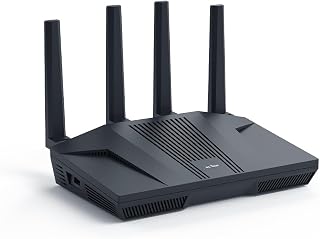
If your travels mean setting up a home base for gaming or heavy streaming, the dual 2.5G ports and Wi-Fi 6 radios here handle the load without choking. QoS keeps latency-sensitive gaming traffic prioritized over other devices sharing the connection, while Access Point Mode lets it slot into existing hotel or rental infrastructure instead of fighting it.
Pros
- Dual 2.5G ports for true multi-gig wired speeds
- Pre-installed OpenWrt with AdGuard Home and plugin support
- Strong VPN throughput on WireGuard and OpenVPN
- Reliable Wi-Fi 6 coverage without dead zones
Cons
- Not designed for portability or travel bags
- Mandatory firmware update adds setup time
Calling the Flint 2 a travel router is a stretch, and that is worth saying upfront. This is a desk and home base companion for travelers who need a powerful hub waiting for them rather than something to toss in a bag. If your trips involve setting up a short term office, a rental with fiber internet, or a home base you return to between trips, the dual 2.5G ports and 8 stream Wi-Fi 6 radio give you multi gigabit wired speed and strong wireless coverage without dead zones. OpenWrt firmware means you can run AdGuard Home for ad blocking and configure WireGuard or OpenVPN tunnels at speeds near 900 Mbps, useful if you want a consistent VPN exit point rather than relying on hotel networks. It is not pocketable and not meant to be, but for a traveling professional who wants one serious router at a fixed location, it earns its spot on this list as the high performance anchor rather than the grab and go option.
Buy this if you want a stationary, high performance router for a home base, rental, or office setup between trips, especially with fiber internet. It suits gamers, IT professionals, and anyone wanting OpenWrt flexibility and strong VPN throughput. Skip it if you need something compact for your carry on or hotel room hopping, since its utilitarian design and port setup are built for a fixed location, not portability.
Connectivity: Wi-Fi 6 (802.11ax), dual-band, 6 Gbps total throughput, 8-stream technology, 1148 Mbps on 2.4GHz, 4804 Mbps on 5GHz. Supports 802.11b, g, n, ac, and ax standards.
Ports: Dual 2.5G multi-gig ports, four 1G Gigabit ports, six ports total. Hybrid router with Multi-WAN support for redundancy and failover.
Hardware: MT6000 chipset, 1GB DDR4 RAM, 8GB eMMC storage, retractable antennas. Linux-based operating system with WPA3 security protocol.
VPN Performance: WireGuard up to 900Mbps, OpenVPN up to 880Mbps. Built-in ad-blocking with AdGuard Home support. Supports access point mode, guest networks, QoS, and internet security features.
Included: GL-MT6000 router, power adapter (US plug), Ethernet cable, user manual, and 2-year warranty. Connects 100+ devices simultaneously.

This one is built for the minimalist traveler who just needs a reliable pocket router with VPN support baked in. Wi-Fi 6 and a USB Type-C connection keep it modern and fast to power, while the compact, single-antenna design means it actually fits the use case of being pocket sized rather than just claiming to be.
Pros
- Just 245 grams with a pocket-friendly, compact design
- Pre-installed OpenVPN, WireGuard, and Cloudflare encryption
- Physical toggle switch for one-touch VPN or AdGuard Home
- Supports up to 120 simultaneous connections
Cons
- VPN speeds may feel limiting on gigabit broadband
- Toggle switch requires initial setup before use
This is the pick in the lineup built specifically around the traveler's core problem: trusting public Wi-Fi. At 245 grams with a compact footprint and fixed antennas, the Slate AX slides into a laptop bag without adding noticeable bulk, and the Type-C power input with included US adapter means one less cable to hunt for. Pre-installed OpenVPN and WireGuard, paired with Cloudflare encryption, turn any hotel or airport network into an encrypted connection, with real-world speeds around 500 to 550 Mbps, enough for video calls and streaming without feeling throttled. Wi-Fi 6 support for up to 120 simultaneous connections covers a small group or family sharing one connection. The physical toggle switch for VPN or AdGuard Home is a nice touch for travelers who want security without digging through menus, though it does need initial setup in the admin panel. For anyone whose travel router needs to prioritize size and built-in privacy over raw throughput, this is the most purpose-built option on this list.
Network Performance: Wi-Fi 6, 1800 Mbps combined speed, 600 Mbps on 2.4 GHz band, 1200 Mbps on 5 GHz band, supports up to 120 devices simultaneously.
Security & Connectivity: WPA3 security protocol, OpenVPN pre-installed (up to 500 Mbps), WireGuard pre-installed (up to 550 Mbps), IPv6 support, Cloudflare encryption, compatible with 30+ VPN providers.
Physical Design: Dimensions 4.92 x 3.23 x 1.42 inches, weight 245 grams, 2 fixed antennas, black color, 3 Ethernet ports at 1000 Mbps LAN bandwidth.
Software & Control: OpenWrt 21.02 (Kernel 4.4.60), mobile app control, guest mode, QoS management, OpenWrt customization support.
Ports & Power: 3 Ethernet ports, Type-C connectivity, 5V power input with included US plug adapter. Built-in NAS with SAMBA and WebDAV protocols for USB file sharing.
This suits digital nomads, business travelers, and remote workers who need a genuinely pocketable router with built-in VPN protection for hotel and public Wi-Fi. It is a good fit if security and portability matter more than top-end speed. Skip it if you have gigabit broadband and need maximum wired throughput, or if you want multi-gig ports, since this router is built for compact travel use rather than high-bandwidth home networking.
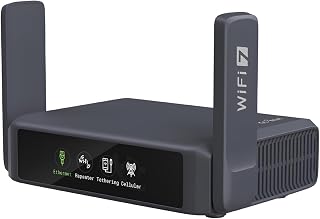
A built-in touchscreen sets this apart for travelers who don't want to dig into a web admin panel on a hotel Wi-Fi connection just to switch networks. Wi-Fi 7 support and a 2.5G port future-proof the connection, and Internet Security plus Guest Mode make it easy to isolate your devices from shared or public networks.
Pros
- Wi-Fi 7 speeds up to 2882 Mbps on 5GHz
- Touchscreen for QR Wi-Fi sharing and VPN toggling
- WireGuard and OpenVPN support with 30+ providers
- USB-C PD charging with international plug options
Cons
- Touchscreen has no physical lock, risking accidental presses
- OpenWrt depth may overwhelm less technical users
Ranking the best GL.iNet travel routers in 2026 almost has to start with the Slate 7, since it's the clearest answer to 'what's the newest, fastest option worth packing.' It runs Wi-Fi 7 across dual bands, topping out around 2882 Mbps on 5GHz, and backs that with dual 2.5G Ethernet ports for wired links in hotel rooms. The 1-inch touchscreen is the real differentiator for travel use: scan a QR code to hand out Wi-Fi to a roommate, flip VPN on before you touch hotel Wi-Fi, or switch modes without opening an app. OpenVPN and WireGuard support over 30 providers, with WireGuard capable of 540 Mbps, and VPN cascading lets the router act as client and server at once. OpenWrt 23.05 gives it room to grow. USB-C PD charging and swappable international plugs round it out as genuinely grab-and-go hardware, which is exactly the bar a top-8 list should hold travel routers to.
Connectivity: Wi-Fi 7 dual-band (2.4GHz + 5GHz), Dual 2.5G Ethernet ports (1 WAN + 1 LAN), USB 3.0, USB-C power input
Performance: 2.4GHz up to 688 Mbps, 5GHz up to 2882 Mbps, VPN speeds up to 100 Mbps (OpenVPN) and 540 Mbps (WireGuard), supports 120+ devices
Hardware: 2GB RAM, 512MB storage, OpenWrt 23.05 (Kernel 5.4.213), retractable antennas, 3.5in L x 1.3in W x 5.1in H, 0.3kg weight
Security: WPA3, DNS over HTTPS, DNS over TLS, IPv6 support, OpenVPN and WireGuard pre-installed, 30+ VPN service provider compatibility
Package: GL-BE3600 router, power adapter with international plugs, Ethernet cable, user manual, 2-year warranty
Buy this if you travel often and want Wi-Fi 7 speed plus a touchscreen that cuts down on app fumbling in airports and hotel lobbies. It suits professionals and remote workers who also want VPN flexibility and OpenWrt customization. Skip it if you don't need Wi-Fi 7 performance, prefer a locked-down simple interface, or travel with small children or in bags where an unlocked touchscreen could get bumped.

Travelers who need connectivity independent of hotel or airport Wi-Fi will get the most out of the built-in eSIM and 5G support here, which means a cellular fallback is always available. Tri-band Wi-Fi 7 and Parental Control also make it a practical choice for families traveling with kids who need both speed and content oversight.
Pros
- Built-in eSIM plus dual nano-SIM for easy carrier switching
- 5G modem rated up to 4.67 Gbps with tri-band Wi-Fi 7
- Quad-path multi-WAN failover for connection reliability
- 5380 mAh battery with fast 30W USB-C charging
Cons
- Higher capability than needed for single-country Wi-Fi-only trips
- More features and settings to manage than simpler travel routers
For a best-of list built around travel, the Mudi 7 earns its spot by solving the one problem a Wi-Fi only router can't: cellular connectivity across borders. It pairs a Qualcomm Dragonwing X72 modem rated up to 4.67 Gbps on 5G with tri-band Wi-Fi 7 reaching 5765 Mbps on 6GHz, and backs it with built-in eSIM plus dual nano-SIM dual standby so you can activate a regional data plan by QR code instead of hunting for a kiosk. Quad-path multi-WAN failover automatically shifts traffic between 5G, Ethernet, and Wi-Fi repeater if one connection drops, which matters for anyone relying on a single device across multiple countries. The 2.8-inch touchscreen handles VPN toggling, data monitoring, and Wi-Fi QR generation without the admin panel. A 5380 mAh battery gives up to 13.5 hours of use, and 30W USB-C charging gets it back to full in about 1.3 hours, making it a genuine standalone travel companion rather than an accessory tied to a hotel outlet.
Best for digital nomads, content creators, and business travelers who need cellular backup wherever Wi-Fi is unreliable or unavailable, and who cross borders often enough that eSIM switching saves real time. Skip it if your trips stay within one country with solid hotel or cafe Wi-Fi, since you'd be paying for 5G and tri-band capability you won't use.
Connectivity and Speed: Qualcomm Dragonwing MBB Gen 3 (X72) modem with up to 4.67 Gbps 5G download. Tri-band Wi-Fi 7: 688 Mbps (2.4 GHz), 2882 Mbps (5 GHz), 5765 Mbps (6 GHz). Supports up to 64 connected devices. 2.5G Ethernet and 10 Gbps USB-C ports for wired connectivity and external storage.
SIM and Mobile: Built-in eSIM plus two nano-SIM slots with dual standby support. No SIM lock. One-tap carrier switching via 2.8-inch touchscreen. QR-code eSIM activation and import for global and regional data plans.
Power and Battery: 5380 mAh battery delivering up to 13.5 hours of runtime. 30W USB-C Power Delivery with PPS support charges fully in approximately 1.3 hours.
Security and VPN: Pre-installed OpenVPN-DCO (up to 700 Mbps) and WireGuard (up to 600 Mbps). Compatible with 30+ VPN providers including NordVPN, ExpressVPN, Mullvad, and Surfshark. WPA3 security protocol. Advanced firewall.
Operating System and Control: OpenWrt 23.05.4 with Linux Kernel 5.15.170. 2 GB RAM. Controlled via 2.8-inch color LCD touchscreen, GL.iNet mobile app, or push button.
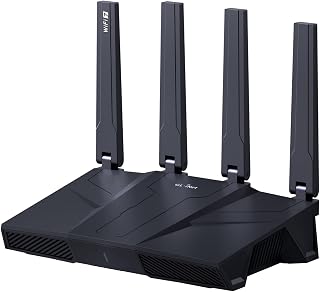
For travelers who need serious bandwidth across multiple devices, tri-band Wi-Fi 7 and five 2.5G ports give this one enough headroom for laptops, phones, and smart TVs at once. Remote Access means you can manage the router and check on a home network setup from the road, which matters if you're gone for extended stretches.
Pros
- 680 Mbps VPN throughput for fast encrypted connections
- Tri-band Wi-Fi 7 with up to 9 Gbps total bandwidth
- Five 2.5 Gbps ethernet ports for wired device capacity
- Built-in AdGuard Home and Bark parental controls
Cons
- Bulkier and less suited to quick, light travel
- Actual VPN speeds depend on ISP and VPN provider
Among the picks in this roundup, the Flint 3 is the one to consider if your travel setup doubles as a serious workstation rather than a simple connectivity fix. It is a tri-band Wi-Fi 7 router built for home office professionals, content creators, and privacy conscious users who need VPN protection without sacrificing speed, delivering up to 680 Mbps through encrypted tunnels. For travelers who set up a temporary office at a rental or long stay location, the five 2.5 Gbps ethernet ports and support for 100 plus connected devices mean it can handle a full household or team setup, not just a single laptop. MLO technology and enhanced OFDMA keep latency low even in crowded wireless environments, which matters in dense apartment buildings or shared accommodations. Built in AdGuard Home and Bark parental controls add value without subscriptions. It is a premium, bulkier option in this lineup, better suited to travelers who stay put for weeks at a time than to those packing light for quick trips.
Network and Connectivity: Wi-Fi 7 (802.11be) tri-band router with 2.4 GHz, 5 GHz, and 6 GHz bands. Maximum data transfer rate 12.5 gigabits per second. Five 2.5 Gbps ethernet ports plus one WAN port. Supports 802.11ac, 802.11ax, 802.11g, and 802.11n backward compatibility.
Processing and Storage: DDR4 1GB RAM, 8GB eMMC storage. Linux operating system. Supports 100+ simultaneous device connections with plugin installation capability.
Antennas and Coverage: Four retractable antennas with MLO, enhanced OFDMA, 4K QAM, and preamble puncturing technology. Coverage range extends to 2,000 square feet. Designed for home, gaming, and business environments.
Security and Control: WPA2-PSK, WPA3, WPA2-Enterprise, WPA-Enterprise, and WPS security protocols. High-level router firewall. Supports remote access. App control and push button functionality. Integrated AdGuard Home DNS filtering and Bark parental controls.
VPN Performance: OpenVPN and Wireguard protocols both achieve up to 680 Mbps throughput. Physical specifications: 0.85 kg weight, black color. Includes ethernet cable, power adapter, and user manual. 2-year manufacturer warranty.
This fits travelers who set up extended stays and need VPN speed, device capacity, and Wi-Fi 7 performance in one box, including remote professionals and content creators. It also suits privacy conscious households wanting enterprise grade security. Skip it if you want a lightweight, grab and go travel router, since its size, five port setup, and premium positioning are built for semi permanent setups rather than quick hotel stops.

Pros
- Exceptionally small and lightweight without sacrificing performance or features
- OpenWrt pre-installed eliminates setup friction and enables advanced networking capabilities
- Built-in OpenVPN and WireGuard support with multi-provider compatibility ensures privacy anywhere
- Flexible power delivery via USB allows operation from laptops, power banks, or wall adapters
- Dual Ethernet ports enable simultaneous wired and wireless network management
Cons
- Micro-USB charging connector is outdated compared to modern USB-C standards
- 300 Mbps throughput is modest for high-bandwidth tasks, suitable for browsing and streaming only
- Rare reliability issues reported in individual cases, though overall reviews indicate strong durability
The GL.iNet GL-AR300M16 is a professional-grade mini travel router designed for remote workers, journalists, frequent flyers, and security-conscious travelers who need reliable private networking on the go. At just 39 grams, it slips into any pocket while delivering enterprise-grade VPN capabilities unavailable in competing portable routers.
What sets this router apart is its pre-installed OpenWrt operating system combined with native OpenVPN and WireGuard support compatible with 30+ major VPN providers. Real-world users report flawless wireless performance and rock-solid stability, particularly praising the Qualcomm Atheros chipset for smooth operation without quirks. The dual Ethernet ports enable advanced configurations like connecting to wired hotel networks while broadcasting secure Wi-Fi to multiple devices simultaneously.
Power flexibility distinguishes this device from typical travel routers. Operating from micro-USB, standard 5V adapters, or power banks means you're never tethered to wall sockets. Users report all-day operation from standard 10,000mAh battery packs at under 1W power draw, making extended travel periods feasible without additional charging infrastructure.
Potential drawbacks include the dated micro-USB connector rather than modern USB-C, 300 Mbps throughput suitable for browsing and streaming but not large file transfers, and isolated reliability issues reported by a small percentage of users. The router's minimal industrial design prioritizes portability over cable management features.
For travel, privacy-focused professionals, and technical users needing customizable networking, the GL-AR300M16 delivers exceptional value through genuine open-source flexibility and proven security architecture. The two-year warranty and community forum support indicate strong manufacturer commitment to long-term product viability.
Core Specifications: Processor: Qualcomm Atheros, RAM: 128MB, Storage: 16MB NOR Flash, Wireless: 802.11n at 2.4GHz single-band, Speed: 300 Mbps maximum, Operating System: OpenWrt pre-installed.
Connectivity: Dual 10/100 Mbps Ethernet ports, USB 2.0 port with tethering support, Wi-Fi 4 standard, hybrid network type supporting both AP and client modes, WPS button for quick pairing.
Physical: Dimensions 2.28 x 2.28 x 0.98 inches, Weight 1.44 ounces, Color black, 2 internal antennas, GPIO and UART available for hardware modifications.
Power: Input 5 volts DC, compatible with USB power, power banks, and standard 5V/2A adapters, typical consumption under 1 watt, micro-USB charging connector.
Security: OpenVPN client and server pre-installed, WireGuard protocol support, 30+ VPN provider compatibility, advanced firewall, data encryption technology, no user data logging.
Ideal Users: Remote workers needing secure Wi-Fi at coffee shops and hotels, frequent international travelers requiring VPN access, journalists and activists in restricted environments, tech enthusiasts building custom networking projects, college students on restricted campus networks, digital nomads requiring reliable portable connectivity.
Not Recommended For: Users requiring multi-band Wi-Fi or higher than 300 Mbps speeds, those needing USB-C exclusively, users uncomfortable with Linux or command-line interfaces, individuals requiring 24/7 cloud connectivity without occasional stability concerns.
Best Use Cases: Converting untrusted hotel Wi-Fi to private networks, tethering mobile hotspots for multiple devices, testing network configurations, creating backup connectivity for work-critical situations, building IoT experimental setups with GPIO customization.

Built specifically around the hassle of hotel and public Wi-Fi login pages, this router's Access Point Mode handles the captive portal login once so every connected phone skips that step afterward. It's a straightforward pick for anyone whose main travel headache is re-authenticating on shared networks at every new location.
Pros
- VPN kill switch prevents unencrypted data leaks
- Compatible with 30+ VPN services via OpenVPN and WireGuard
- Compact at 429 grams, easy to pack
- OpenWrt 21.02 allows custom app installation
Cons
- OpenVPN speed capped at 28 Mbps
- Physical toggle button needs admin panel setup first
If this best-of list needs an entry for travelers who mainly want a reliable VPN gateway without extra complexity, the GL-A1300 Slate Plus fits that role. It's built around OpenVPN and WireGuard pre-installed and compatible with over 30 VPN services, so there's no hunting for drivers once you land. The VPN kill switch cuts internet access automatically if the VPN connection drops, which matters on untrusted hotel or airport networks. Dual-band AC Wi-Fi delivers up to 1.267 Gbps combined, running on a stable IPQ4018 processor. At 429 grams and 118 x 84 x 33mm, it's easy to slip into a laptop bag alongside the included power adapter and Ethernet cable. OpenWrt 21.02 gives advanced users room to install custom apps, while guest Wi-Fi separation and USB network storage add practical extras for shared trips. For a list focused on travel routers, its compact size and VPN-first design make it a straightforward, no-frills option.
Model: GL-A1300 (Slate Plus)
Processor: IPQ4018 @717MHz
Wireless Standard: 802.11a/b/g/n/ac
Frequency Bands: 2.4GHz (400 Mbps) and 5GHz (867 Mbps)
Total Wireless Speed: 1.267 Gbps combined
Operating System: OpenWrt 21.02
VPN Protocols: OpenVPN (28 Mbps max), WireGuard (170 Mbps max)
Supported VPN Providers: 30+
Storage Features: SAMBA and WebDAV support via USB
Security: VPN kill switch, encrypted DNS with Cloudflare, AdGuard Home
Connectivity: Ethernet, Wi-Fi
Antenna Type: Fixed
Dimensions: 118 x 84 x 33 mm
Weight: 429 grams
Power: Included US plug adapter
Warranty: 1-year limited warranty
Package Contents: Router, power adapter, Ethernet cable, user manual
Good for travelers who want straightforward VPN protection on hotel or public Wi-Fi without needing Wi-Fi 7 speed or cellular connectivity. Fine for solo travelers or small teams who value the kill switch and portability. Skip it if you need higher throughput for large file transfers, since OpenVPN tops out at 28 Mbps, or if you want 5G backup connectivity this model doesn't offer.

For travelers who just want a no-frills backup router, the dual Ethernet ports and USB 2.0 port give you wired options when Wi-Fi alone isn't enough, like tethering to a hotel's wired jack. OpenWrt support with OpenVPN and Wireguard baked in makes it a favorite for anyone who wants real control over their travel VPN setup.
Pros
- Extremely light at 39 grams, barely noticeable in a bag
- Repeater mode turns open public Wi-Fi into an encrypted private network
- Pre-installed OpenVPN and Wireguard support for 30+ providers
- OpenWrt based for users who want deeper customization
Cons
- Single 2.4GHz band with real-world speeds around 50-100Mbps
- Older hardware (128MB RAM) feels sluggish next to newer GL.iNet models
When the whole job is 'make hotel and airport Wi-Fi safe to use,' the Mango is about as small and cheap an answer as you'll find on this list. It weighs 39 grams, so it rides in a laptop sleeve or even a jacket pocket without you noticing. Its core trick is grabbing an open public hotspot and re-broadcasting it as your own encrypted network, with OpenVPN and Wireguard already on board and ready to connect to 30+ providers. Setup is app or web dashboard based, so you don't need networking chops to get protected in minutes. Where it falls short is horsepower: single-band 2.4GHz, 128MB RAM, and real-world throughput around 50-100Mbps mean it's fine for email, browsing, and streaming but not for anyone pushing large files or running multiple devices hard. It also runs OpenWrt, so tinkerers can go deeper if they want. For this list, it earns its spot as the lightest, most minimal-fuss option for travelers whose main worry is network security, not speed.
Connectivity: 802.11bgn Wi-Fi 4 at 2.4GHz only, 2 Gigabit Ethernet ports, USB 2.0
Performance: 300Mbps wireless, 100Mbps wired LAN, 128MB RAM, 16MB Flash storage
Security: WPA2-PSK encryption, OpenVPN client pre-installed, Wireguard support, OpenWrt open-source OS
Physical: 2.28 x 2.28 x 0.98 inches, 40 grams, available in Black, Grey, or Blue
Power: 5V USB or power bank compatible, also accepts 5V/2A DC adapter (sold separately)
Warranty: 2-year manufacturer coverage
Hotel and Airbnb Travel: Capture the hotel Wi-Fi once, then create your own secure network for all devices. One customer praised it for making hotel internet way more usable.
Business Travel Security: Journalists, consultants, and traveling executives protect sensitive work on public networks in airports and cafes without VPN subscription complications.
Home Network Extension: Use as a wireless bridge to extend existing Wi-Fi or connect wired devices in dead zones, like a garage security system pulling signal from upstairs.
OpenWrt Experimentation: Technical users leverage the pre-installed OpenWrt firmware for custom networking projects and hardware DIY through available GPIO and UART ports.
GL.iNet Travel Router Buying Guide
Wi-Fi Generation: 5, 6, or 7?
The Wi-Fi generation you choose has a real impact on throughput and device capacity. The GL.iNet GL-AXT1800 Slate AX Pocket-Sized Wi-Fi 6 offers a dual-band 1800 Mbps connection with MU-MIMO and OFDMA, which is more than enough for most road warriors. Step up to the GL.iNet GL-BE3600 Slate 7 Wi-Fi 7 Travel Router and you get Wi-Fi 7 with 2.5G Ethernet ports and a touchscreen interface for a noticeably smoother experience.
If you mostly stream video and handle video calls on a handful of devices, Wi-Fi 6 is the sweet spot. Power users or small teams who need maximum bandwidth should look at the Wi-Fi 7 options.
VPN Performance
VPN speed is a make-or-break spec for anyone routing all their traffic securely. The GL.iNet GL-MT6000 Flint 2 Wi-Fi 6 Gaming Router leads the pack with WireGuard speeds up to 900 Mbps and OpenVPN up to 880 Mbps. The GL.iNet GL-E5800 NA MUDI 7 5G Tri-Band Wi-Fi 7 follows closely with OpenVPN-DCO up to 700 Mbps and WireGuard up to 600 Mbps.
Budget models like the GL.iNet GL-MT300N-V2 (Mango) and the GL.iNet GL-AR300M16 Mini Travel Wi-Fi Router still support OpenVPN and WireGuard, but at lower throughput. They work well if your VPN use is light browsing and email rather than large file transfers. For a broader look at the category, our guide to the best VPN routers covers non-GL.iNet alternatives as well.
Portability and Power Options
Size and power source matter a lot when you are living out of a backpack. The GL.iNet GL-MT300N-V2 (Mango) and GL.iNet GL-AR300M16 Mini Travel Wi-Fi Router both weigh around 39 grams and run off any USB port or power bank, making them ideal for backpackers and minimalist travelers. The GL.iNet GL-A1300 Pocket VPN Travel Router is slightly larger but adds dual-band AC and a more powerful CPU for better all-round performance.
At the other end, the GL.iNet GL-E5800 NA MUDI 7 5G Tri-Band Wi-Fi 7 includes a built-in 5380 mAh battery that delivers up to 13.5 hours of untethered use, so you do not need an outlet at all. It is heavier and more expensive, but it is essentially a self-contained mobile office. If you need fast wired networking at your destination, also check out our top 2.5GbE network card picks for a complementary upgrade.
Cellular Connectivity and eSIM Support
If you travel internationally and want to avoid hunting for local SIM cards, the GL.iNet GL-E5800 NA MUDI 7 5G Tri-Band Wi-Fi 7 is in a class of its own. It combines a built-in eSIM, dual nano-SIM slots, and Qualcomm 5G delivering up to 4.67 Gbps download. You can switch carriers directly from the 2.8-inch touchscreen without opening the admin panel.
For most travelers, a Wi-Fi-only model connected via USB tethering from a phone hotspot covers cellular needs at a fraction of the complexity. The GL.iNet GL-AXT1800 Slate AX Pocket-Sized Wi-Fi 6 and the GL.iNet GL-A1300 Pocket VPN Travel Router both support USB tethering cleanly, which keeps things simple on the road.
Final Thoughts
GL.iNet covers a wide range of traveler needs better than almost any other brand in the space. For most people looking for a compact, capable all-rounder, the GL.iNet GL-AXT1800 Slate AX Pocket-Sized Wi-Fi 6 hits the best balance of portability, Wi-Fi 6 performance, and VPN speed. If you need the full package with 5G, eSIM, a long-lasting battery, and Wi-Fi 7 connectivity, the GL.iNet GL-E5800 NA MUDI 7 5G Tri-Band Wi-Fi 7 is worth every bit of the premium. Either way, you are getting an OpenWrt-based router that punches well above its size.
Frequently Asked Questions
Are GL.iNet routers good for travel?
Yes, GL.iNet routers are widely regarded as some of the best travel-specific routers available in 2026. They run OpenWrt, support WireGuard and OpenVPN out of the box, and are compact enough to fit in a jacket pocket. Most models also work as a repeater for hotel and public Wi-Fi, which adds an important layer of security for your connected devices.
What is the difference between GL.iNet Wi-Fi 6 and Wi-Fi 7 travel routers?
Wi-Fi 7 models like the GL-BE3600 Slate 7 and the GL-E5800 Mudi 7 offer higher peak throughput, lower latency, and advanced features like Multi-Link Operation and 2.5G Ethernet ports. Wi-Fi 6 models such as the GL-AXT1800 Slate AX are slightly more affordable and still deliver excellent real-world performance for streaming, video calls, and secure browsing. For most solo travelers or small groups, Wi-Fi 6 is completely sufficient.
Can I use a GL.iNet router with hotel Wi-Fi?
Absolutely. All GL.iNet routers reviewed here support repeater mode, which lets you connect to a hotel or public Wi-Fi network and share it privately across all your devices. They also handle captive portal login pages, which is the login screen most hotels require before granting internet access. Once connected, all your devices benefit from the router’s VPN and security features without individual setup. Our best router for streaming guide also covers home and hotel streaming setups in more detail.
Which GL.iNet travel router is best for remote work in 2026?
For remote workers who need reliable VPN performance and multi-device support, the GL-AXT1800 Slate AX is a strong choice, offering WireGuard speeds up to 550 Mbps in a pocket-sized form factor. If you frequently work from locations without stable broadband, the GL-E5800 Mudi 7 with its 5G modem, eSIM, and quad-path failover is a serious upgrade that keeps you connected even when the hotel Wi-Fi goes down. Both models run OpenWrt, so you can install additional tools and plugins to match your specific workflow.
Common questions
Should I use a VPN on a router instead of my phone?
Yes, for travel routers that run OpenVPN or WireGuard natively. Models like the GL-MT300N-V2 and GL-AXT1800 handle the VPN connection at the router level, so every device you connect, laptop, phone, or tablet, is covered automatically. That beats installing a separate VPN app on each device and avoids compatibility gaps on smart TVs or consoles that lack native VPN support.
How do I deal with the hotel wifi login screen while traveling?
Connect the travel router to the hotel network first, then let your other devices join the router's own Wi-Fi. The GL-A1300 is built for exactly this, letting you complete the hotel wifi login page once on the router's admin panel instead of on every device. The GL-MT300N-V2 works the same way, acting as a bridge between public Wi-Fi and your private network.
Are there any good battery powered travel router options available?
None of these GL.iNet models here ship with a built-in battery; they're designed to run off USB or AC power instead. The compact GL-MT300N-V2 and GL-A1300 are small and light enough to pair with a portable USB power bank for all-day use. If battery life matters most, check the listing specs directly, since this lineup focuses on plug-in portability rather than internal batteries.


Write Your Review
No reviews yet. Be the first to share your experience!