

When a storm interrupts power or a remote campsite leaves you beyond the reach of an outlet, a battery and panel combination can keep critical gear useful. The right solar generator kit can support phones, lights, routers, laptops, refrigeration needs, and select small appliances without the noise, fumes, or fuel handling of a conventional generator.
This guide compares practical choices for homeowners preparing for short outages, campers packing light, and RV travelers who need renewable charging. Before choosing, browse the site’s solar panel buying resources to better understand how panel size, sunlight, and battery capacity work together.
Quick answer
This guide compares 5 picks, with EcoFlow DELTA 2 Max 2048Wh Portable Power Station ranked first. ZeroKor 300W Portable Solar Generator with 60W Panel has the most customer reviews.

The 2048Wh capacity and 2400W continuous output make this station capable of running essential home appliances during outages while still being portable enough for weekend camping trips. Its LiFePO4 battery chemistry delivers thousands of charge cycles, meaning it will reliably serve as backup power year after year. The 3400W surge capacity handles the startup draw of refrigerators and power tools without hesitation.
Pros
- Exceptional charging speed eliminates long wait times for emergency power
- LiFePO4 chemistry ensures longer lifespan and better cost efficiency than standard lithium
- Expandable modular design scales with your needs without replacing the entire unit
- Exceptional outlet variety and high wattage capacity handle demanding appliances
- App-based management provides real-time monitoring and automation control
Cons
- Substantial 23kg weight makes solo portability challenging despite portable classification
- Expandable batteries sold separately, adding significant cost for full 6kWh capacity
The EcoFlow DELTA 2 Max is a premium portable power station that bridges the gap between camping gear and home backup systems. With 2048Wh capacity and expandable architecture, it serves homeowners preparing for outages, RV enthusiasts needing reliable power, and outdoor adventurers wanting dependable energy without gas generators.
Performance is where this unit shines. The 43-minute fast-charge to 80% capacity using combined solar and AC input is genuinely world-class. Its 10-year LiFePO4 battery endures 3000 cycles before dropping to 80% capacity, making it 6 cycles more durable than typical competitors. With 2400W continuous output and 3400W peak power via X-Boost mode, you can run nearly any household appliance.
Build quality reflects its premium positioning. The unit runs remarkably quiet at just 30dB, enabling overnight operation without sleep disruption. Fifteen outlets provide ample connectivity, and the app integration allows remote monitoring and automation. The 23kg weight is substantial but manageable for stationary use and occasional relocation.
The main drawbacks are cost and expandability expenses. At $1,029 base price, it targets serious users rather than casual campers. Achieving the full 6kWh expandable capacity requires purchasing additional battery modules separately, significantly increasing total investment. For some users, a smaller non-expandable model may deliver better value.
The DELTA 2 Max excels for users who want a single, reliable power solution combining home backup capability with off-grid flexibility. Its combination of fast charging, quiet operation, and proven battery chemistry makes it a smart investment for those willing to commit to quality power independence.
Capacity and Power: 2048Wh capacity, 2400W continuous output, 3400W peak output with X-Boost mode, 15 outlets total.
Battery Technology: LiFePO4 chemistry with 3000 charge cycles to 80% capacity, 10-year lifespan, 5-year extended warranty included.
Charging Options: AC charging (1.1 hours to 80%), solar input up to 1000W, vehicle charging support. Combined input enables 43-minute 80% charge.
Physical Specs: 2048 watt-hours, 23kg weight, dimensions 12.2in x 9.7in x 20in, black and grey color, 60Hz frequency.
Operation: Ultra-quiet 30dB operation, app-based management, advanced battery management system with real-time voltage, current, and temperature monitoring, no fumes or maintenance required.
Best For: Home emergency backup, RV and camping trips, off-grid applications, outdoor events, and users who want solar charging flexibility without expanding to six figures.
Consider This If: You need reliable power for essential appliances during outages, run sensitive electronics requiring clean power, want eco-friendly energy independence, or frequently use power tools and high-wattage devices remotely.
Skip This If: You only occasionally use portable power and can manage with smaller capacity units, need maximum portability over raw capacity, or want to avoid the premium price point of enterprise-grade systems.
Expansion Path: Purchase additional EcoFlow battery modules to scale capacity from 2kWh to 4kWh or 6kWh. This modular approach lets you start smaller and upgrade as your power needs grow.
Warranty and Support: Standard 5-year warranty covers manufacturing defects. EcoFlow provides app support for troubleshooting and firmware updates, plus 24/7 customer service access.

With 3072Wh of capacity and 3600W output, this unit can power an entire home circuit during extended blackouts or run high-draw camping gear like electric coolers and induction cooktops. The included XT60 solar cable simplifies field recharging, letting campers stay off-grid longer without hauling extra adapters. Three outlets provide enough ports for simultaneous device charging at a crowded campsite.
Pros
- Exceptional power capacity covers nearly all household appliances and tools without overload issues
- Lightning-fast UPS backup under 10ms ensures critical devices stay online during power failures
- Multiple charging pathways including solar compatibility offer unmatched flexibility for any situation
- Proven LiFePO4 chemistry delivers decade-long lifespan with reliability in extreme conditions
- User-friendly design with clear display, easy controls, and plug-and-play setup requires no technical expertise
Cons
- 72-pound weight requires some physical strength to move, though wheels and handle mitigate this concern
- No battery expansion slots on this model, unlike the Delta 3 Ultra Plus, limits future capacity upgrades
The EcoFlow Delta 3 Ultra is a high-capacity portable power station designed for homeowners, RV enthusiasts, and off-grid users seeking dependable emergency backup. With 3072Wh of capacity and 3600W continuous power output (7200W surge), it bridges the gap between ultra-portable units and stationary home systems.
The standout feature is its sub-10ms UPS functionality, which automatically switches to battery power faster than most uninterruptible power supplies. This means your PC, WiFi router, and medical equipment stay online during outages without interruption. Add the X-Quiet 3.0 technology delivering just 25dB of noise, and you have a power station that won't wake sleeping family members or disturb apartment neighbors.
Build quality impresses with LiFePO4 battery chemistry proven for 10 years of daily use. The EV-grade CTC structure and comprehensive thermal protection system handle extreme heat, cold, and heavy loads reliably. Four charging options including solar compatibility, wall outlets, car input, and generator support mean you're never stuck without a way to recharge.
The main tradeoff is weight at 72 pounds, though built-in wheels and a pull handle make it manageable. Unlike the Delta 3 Ultra Plus, this model has no battery expansion slots if you want to add capacity later. At this price point, you're investing in proven technology with a 5-year warranty backing the commitment.
This is the power station to choose if you prioritize reliability, silent operation, and real-world power over portability. It excels as a home backup system and performs equally well powering RV appliances or remote work setups for extended periods.
Capacity and Power: 3072Wh battery capacity with 3600W continuous output (7200W surge power)
Battery Technology: LiFePO4 with EV-grade CTC structure and 24/7 protection system, rated for 10 years of daily use
Charging Methods: Wall outlet (120V), solar panels via XT60 cable, 12V car input, or EcoFlow Smart Generator
Outlets and Ports: 4x 20A outlets, 1x 30A RV outlet, 4x USB ports (including high-power options)
Performance Features: Less than 10ms UPS switchover, 25dB noise level, X-Quiet 3.0 and X-Stream technologies
Physical Specs: 24.6 x 12.9 x 15.6 inches, 72.1 lbs with integrated wheels and pull handle
Warranty: 5-year manufacturer coverage
Best For: Home emergency backup, RV trips, off-grid cabins, and users who need to power multiple appliances simultaneously without noise concerns
Consider If: You need reliable backup that keeps sensitive electronics running, want to power high-draw devices like space heaters or microwaves, or prefer solar charging flexibility
Not Ideal If: You prioritize maximum portability above all else, plan to expand battery capacity in the future (choose Delta 3 Ultra Plus instead), or have a tight budget under $1000
Alternative Scenarios: For lighter travel, smaller units work better. For stationary home systems needing more than 3kWh, consider stackable options. For pure emergency backup without appliance powering, smaller capacity models suffice
Real-World Takeaway: Reviewers consistently praise this unit for handling extended power outages, RV living, and home office demands. The combination of silent operation, fast UPS switching, and true multi-appliance power makes it a legitimate competitor to portable generators, without the noise or fuel hassles
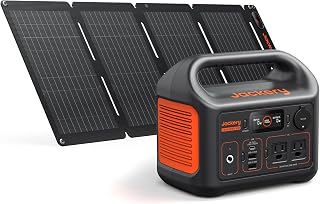
The 292Wh capacity and lightweight build make this kit ideal for solo camping or emergency phone and laptop charging during brief power interruptions. The bundled 40W panel recharges the station in a single sunny afternoon, perfect for weekend trips where you need lights, a fan, and device charging but not heavy appliances. At 300W output, it runs small electronics and camping essentials without the bulk of larger units.
Pros
- 7.5-pound station with integrated handle
- 292Wh capacity and 300W continuous AC
- Included 40W solar panel
- Multiple AC, USB, and car outputs
Cons
- 40W panel needs 7.5 hours to reach 80%
- 300W output and 292Wh require careful load management
For a backup-and-camping kit, the Jackery Solar Generator 300 prioritizes easy transport and basic device support rather than household-scale output. The 7.5-pound power station has an integrated handle, a 292Wh battery, and 300W of continuous AC power, with a 600W peak. That makes it appropriate for keeping phones, tablets, laptops, drones, lights, and a portable fridge supplied on a campsite or during a short interruption. The included 40W panel gives the kit an off-grid recharge path, while wall and car charging add options before or between trips. Its output selection includes two AC outlets, a 100W USB-C port, two USB-A ports, and a 120W car port, so a small group can charge several types of gear without relying on extra hubs. Pure sine wave AC power is intended for sensitive electronics, and the real-time display shows remaining capacity and power draw. For extended outages or remote stays, capacity management is essential. The supplied panel reaches 80% in 7.5 hours, so its recharge pace suits modest loads better than continuous heavy use. LiFePO4 chemistry is rated for more than 4,000 charge cycles before reaching 70% capacity.
Buy this kit if your backup plan centers on communications, lighting, laptops, and other low-draw essentials, and you also want something light enough to carry into a campsite. Campers, overlanders, and drivers who can recharge from a vehicle have several practical charging routes. Skip it if you need to run high-demand appliances, want long-duration home backup with little load planning, or expect the included 40W panel to restore capacity quickly during limited daylight. A larger solar panel or higher-capacity station will better suit those needs.
AC Wall Charging: Full charge via included AC adapter in approximately 6-8 hours
Car Charging: Via included car charger cable through 12V outlet, rate varies with vehicle charging capability
Solar Charging: 40W included panel reaches 80% capacity in 7.5 hours under optimal conditions; 100W panel (sold separately) reaches 80% in 2.8 hours
Battery Specs: 292Wh capacity, LiFePO4 chemistry, 4,000+ charge cycles to 70% capacity, supports 500+ full cycles yearly for 8+ years
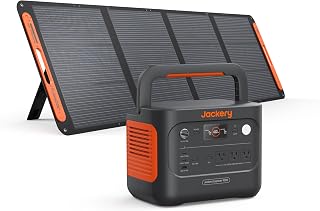
The 1070Wh capacity and bundled 200W solar panel create a self-sufficient setup for multi-day camping trips or short home outages. Its 1500W output handles microwaves, coffee makers, and CPAP machines without issue, while the compact design fits easily in a truck bed or RV storage compartment. Solar recharging in under seven hours means you can top up during the day and have full power by nightfall.
Pros
- 1,070Wh LFP battery
- 1,500W continuous AC with 3,000W surge
- Included 200W solar panel
- Wall charge in 1.7 hours or one-hour Emergency Charging
Cons
- 23.8-pound unit and 200W panel need storage space
- 1,500W continuous output limits combined high-draw loads
A solar kit for both outages and camping needs enough stored energy to cover more than phones, and the Jackery Solar Generator 1000 v2 brings a 1,070Wh LFP battery and 1,500W continuous AC output to that role. Its 3,000W surge peak broadens the loads it can accommodate, including motor-intensive appliances such as microwaves and power tools. At 23.8 pounds, it remains a single-person carry, though it is not a minimalist camp battery. The included 200W solar panel supports replenishment away from the grid, reaching 80% in six hours on a clear day. At home, wall charging can fill the unit in 1.7 hours, or one hour through Emergency Charging when that mode is activated in the app. The regular setting is designed to optimize battery health. Three AC outlets, two 100W PD USB-C ports, USB-A, a DC car outlet, and integrated LED lights make it practical for an outage kit as well as a road trip setup. LFP battery chemistry retains over 70% capacity after 4,000 charge cycles. The tradeoff is storage space: the station and 200W panel take more room than a compact camping kit, and the 1,500W continuous limit calls for restraint when several high-draw appliances are running.
Choose this kit for a home emergency supply that can also travel to a campground or road trip, especially if you need multiple AC outlets, fast USB-C charging, and substantially more capacity than a small electronics-only station. It suits users prepared to store a larger panel and manage a 1,500W continuous-output ceiling. Skip it for ultralight camping, tight RV storage, or a backup plan built around operating several high-draw household appliances simultaneously. Those situations call for less bulk or more continuous output.
Battery: 1070Wh LFP (Lithium Iron Phosphate) with 4000+ cycle lifespan
AC Output: 1500W continuous, 3000W surge peak at 120V, 60Hz
Solar Input: 200W panel included, reaches 80% charge in 6 hours (clear conditions)
AC Charging: 1.7 hours standard, 1 hour emergency mode via app
Alternator Charging: 3 hours with 600W charger (sold separately)
Ports: 3x pure sine wave AC outlets, 2x USB-C (100W PD max), 1x USB-A, 1x DC car outlet, LED lights
Weight: 23.8 lbs with foldable handle
Dimensions: 12.87"L x 8.82"W x 9.72"H
Warranty: 2-year manufacturer coverage, 5-year coverage included with purchase
Model: JE-1000D (E1000v2+200W bundle)

Pros
- 60W monocrystalline solar panel included
- 5.1-pound station with compact dimensions
- Two AC, USB-C, three USB, and DC outputs
- Built-in SOS flashlight and safety protections
Cons
- 300W maximum excludes high-draw appliances
- Solar panel junction box is not waterproof
The ZeroKor R200 makes sense as a compact solar generator kit for short camping stays and limited emergency power, because the 60W solar panel is included rather than an add-on. The 280Wh battery and 300W output are sized for personal electronics and small appliances, not for attempting to replace household power. At 5.1 pounds and 8.5 by 6.7 by 4.1 inches, the station is easy to reserve in a vehicle or bring to a campsite. Its connection mix serves the devices commonly used during an outage or overnight outdoors: two 110V AC outlets, USB-C with Quick Charge support, three USB ports, and a DC port. A built-in SOS flashlight with a reading mode can provide another useful camping or blackout feature. The monocrystalline panel has 20.5% conversion efficiency, while the power station includes overload, short-circuit, overvoltage, and overheating protection. An automatic cooling fan manages heat during operation. Plan around its boundaries. A 300W maximum rules out hair dryers, water pumps, and coffee makers, and the stated seven-hour runtime means longer off-grid trips need charging cycles or supplemental power. Protect the solar panel's junction box in wet weather, since it is not waterproof.
Battery and Power Output: 280Wh battery capacity, 300W continuous output, 110V AC outlets, 60-hertz frequency, pure sine wave output.
Charging Ports and Outlets: 2x 300W AC outlets, 1x DC port (9V-12.6V max, 10A), 3x USB-A ports (5V/3A max), 1x USB-C Quick Charge (5V/3A, 9V/2A, 15V/2A max), integrated SOS flashlight.
Charging Methods: Home AC adapter (15V), 12V car cigarette lighter adapter, 60W solar panel (13V-23V DC5521 connector, built-in MPPT controller).
Physical Specifications: Weight 5.1 pounds, dimensions 8.5"L x 6.7"W x 4.1"H, ABS material construction, available in Black and Orange, 7-hour runtime on full charge.
Safety and Warranty: Built-in BMS with overload, short circuit, overvoltage, overheating, and overcurrent protection. Automatic cooling fan system. 12-month manufacturer warranty from purchase date.
Buy this kit if you want an entry-level solar option for phones, a MacBook, a mini projector, lights, and similarly modest camping or blackout needs. Its low weight and included panel particularly favor vehicle storage, RV use, and people who value a simple secondary power source. Skip it if your backup plan must cover high-wattage appliances, if you will be off-grid beyond its seven-hour runtime without supplemental power, or if the solar panel may be exposed to wet conditions. The junction box needs weather protection.
Buying Guide
Match Battery Capacity to Your Real Load
Capacity is measured in watt-hours, and it is the first number to match with your actual needs. The EF ECOFLOW Portable Power Station DELTA 2 Max starts with 2,048Wh and can expand to 6kWh with extra batteries, while the EF ECOFLOW Delta 3 Ultra 3072Wh Power Station begins at 3,072Wh for households that need a more substantial reserve.
Start with a written list of the devices you want to support, their running wattage, and how long they need to operate. Stored energy is not identical to usable AC runtime because conversion losses and changing appliance demand matter, so leave a sensible buffer and explore broader portable power guidance before settling on a capacity.
Check Continuous Output and Surge Capability
Watt-hours tell you how long a station can run, but output watts determine what it can run at all. The EF ECOFLOW Delta 3 Ultra 3072Wh Power Station delivers 3,600W of continuous output with a 7,200W surge rating, while the EF ECOFLOW Portable Power Station DELTA 2 Max provides 2,400W output and supports higher-demand loads through its X-Boost mode.
Motors, compressors, heating elements, and kitchen appliances may require a brief surge that is much higher than their normal draw. For a computer-based setup, total the PC, networking equipment, speakers, and display together, and use our 4K 240Hz monitor guide as a reminder that performance displays can add meaningful demand to your backup plan.
Look Closely at Solar Input and Included Panels
A bundled panel makes a kit more useful immediately, but its wattage shapes how quickly you can restore the battery in favorable sunlight. The Jackery Solar Generator 1000 v2 and 200W Solar pairs a 1,070Wh station with a 200W panel, giving campers and road travelers a more capable solar starting point than a compact maintenance panel.
The Jackery Solar Generator 300 and 40W Solar prioritizes packability, while the Portable Solar Generator 300W Portable Power includes a 60W monocrystalline panel for small-device charging and modest off-grid use. Sun angle, shade, cloud cover, panel cleanliness, and heat all affect real-world collection, so regard listed solar times as favorable-condition estimates rather than a fixed daily promise.
Choose a Kit You Will Actually Carry and Use
Large power stations are compelling for emergency readiness, yet they are not the practical answer for every outing. The Jackery Solar Generator 300 and 40W Solar weighs 7.5 pounds and has a 292Wh battery with 300W AC output, making it a sensible fit for cameras, drones, laptops, lighting, and phone charging where low weight matters more than appliance-level power.
The Portable Solar Generator 300W Portable Power also targets lighter-duty travel with two AC outlets, multiple USB ports, an SOS light, and a stated 300W ceiling. Larger systems are better suited to extended home backup, whereas compact kits reward users who will carry the unit from the car to a tent, trailhead, or picnic table on a regular basis.
Final Thoughts
For a flexible home-backup foundation with expansion potential, the EF ECOFLOW Portable Power Station DELTA 2 Max is the stronger fit. If your priority is a remarkably portable panel-and-battery combination for personal electronics and simple camp comfort, the Jackery Solar Generator 300 and 40W Solar is easier to bring along and simpler to deploy.
Frequently Asked Questions
What can a solar generator kit run during a power outage?
It depends on both the battery capacity and the inverter’s continuous output. Compact 300W kits are best for phones, lights, cameras, laptops, and other small electronics, while higher-output stations can support items such as refrigerators, routers, microwave ovens, and some power tools when their wattage and startup draw fall within the unit’s limits. Always confirm the appliance label before connecting it.
How long does a solar generator take to recharge from panels?
Recharge time depends on the battery’s remaining capacity, panel wattage, weather, and how directly the panel faces the sun. A 200W panel generally collects energy faster than a 40W or 60W panel under comparable conditions, but partial shade can sharply reduce output. Plan for solar to be a renewable replenishment method, not an instant replacement for wall charging.
Is a solar generator kit strong enough for a gaming setup?
Yes, provided you add up the continuous draw of the console or PC, monitor, router, speakers, and accessories before selecting a power station. High-performance displays and peripherals can increase total demand, and travel rigs may include specialty gear such as the accessories covered in our sim racing handbrake recommendations. A higher-capacity, higher-output model is the safer route for longer sessions.
What is the best solar generator kit for 2026?
In 2026, the best solar generator kit is the one that aligns with your expected loads, mobility needs, and charging opportunities. Choose a larger LiFePO4 station with strong solar input for blackout preparation, or choose a lighter bundled kit for weekend trips and device charging. Reviewing the available solar panel options and power setups can help you build a system that remains useful after the first trip or outage.



Write Your Review
No reviews yet. Be the first to share your experience!