

Running out of VRAM mid-session is one of the most frustrating bottlenecks in modern gaming and creative work. Whether you are pushing high-resolution textures at 1440p, running local AI models, or juggling multiple creative applications, 16GB of VRAM gives you the headroom to work without compromise. The good news is that the cheapest GPU with 16GB VRAM has never been more accessible, with options ranging from next-gen RDNA 4 cards to budget-friendly renewed server hardware. Explore the full Graphics Cards category for more curated picks across every budget.
This guide covers ten cards evaluated across performance, cooling quality, build materials, and overall value. Whether you are building a new rig or upgrading an aging system, there is a 16GB option here that fits your use case without unnecessary compromise.
Quick Comparison
Ratings reflect the most recent data pull. Check each listing for current price and availability.
Quick answer
This guide compares 10 picks, with ASRock Radeon RX 9060 XT Challenger 16GB GDDR6 PCIe 5.0 ranked first. GIGABYTE Radeon RX 9060 XT Gaming OC 16GB PCIe 5.0 has the most customer reviews.

This Challenger variant features AMD's RDNA 4 architecture with 16GB GDDR6, ideal for machine learning inference and 3D rendering on a budget. The 3290 MHz boost clock delivers strong performance for video editing and AI image generation where VRAM capacity is critical. The 0dB silent mode keeps noise minimal during light tasks, while DisplayPort 2.1a ensures compatibility with cutting-edge displays for professional workflows.
Pros
- 16GB VRAM with strong 1440p and mixed 4K performance
- Excellent 55u00b0C load temps with quiet operation
- Overclocking headroom reaches 3.1+ GHz stable
- 20 GHz memory clock supports demanding textures
Cons
- Large dimensions require mid-tower and possible bracket
- RGB always-on with no software disable option
The XFX Swift RX 9060 XT combines 16GB GDDR6 capacity with a factory overclock to 3320 MHz, delivering 25-40% gains over prior-generation RX 6600 models. That boost clock sits atop RDNA 4 architecture optimized for 1440p and mixed 4K workloads, with users reporting smooth frame delivery in demanding AAA titles at high settings. The 16GB buffer handles texture-rich environments and content creation tasks that would choke 8GB alternatives. XFX's SWFT triple-fan thermal solution maintains 55 degrees Celsius at full utilization, with idle temperatures near 40 degrees and acoustic output remaining subdued even under sustained gaming loads. This thermal performance creates overclocking headroom: stable configurations beyond 3.1 GHz after undervolting bring the card closer to next-tier performance brackets. Memory runs at 20 GHz effective, feeding the GPU pipeline adequately for its performance class. DisplayPort and HDMI 2.1b outputs support high-refresh and 4K displays. Build quality reflects XFX's improved manufacturing compared to earlier generations. The substantial physical dimensions require mid-tower cases and potentially a support bracket to prevent PCB flex. RGB lighting remains permanently active without software toggle, which some users find intrusive. A 650W PSU minimum ensures stable operation under load and overclocking scenarios.
GPU: AMD Radeon RX 9060 XT (RDNA 4, 32 Compute Units)
Memory: 16GB GDDR6 at 20 Gbps on 128-bit bus
Clock Speeds: 3290 MHz boost, 2700 MHz game clock
Output: DisplayPort 2.1a, HDMI 2.1b
Max Resolution: 7680x4320 pixels
Power: Single 8-pin connector, 550W PSU recommended
Size: 249mm (L) x 132mm (W) x 41mm (H), 2-slot design
Cooling: Dual fans, 0dB idle mode
Interface: PCIe 5.0 x16
Weight: 0.98 kg
Warranty: 2 years manufacturer
Buy this card if you need 16GB for 1440p gaming with occasional 4K sessions, value excellent cooling and low noise, and want overclocking potential that stretches performance upward. The thermal solution suits long gaming sessions and the memory capacity provides headroom for demanding titles. Skip it if your case is compact or lacks support bracket options, if always-on RGB bothers you in dark environments, or if you're running a modest PSU below 650W. Also avoid if you prioritize pure value over cooling refinement.
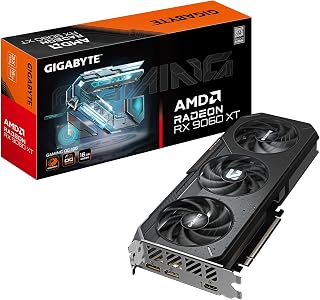
GIGABYTE's implementation offers 16GB GDDR6 on the RX 9060 XT platform, targeting users running LLMs locally or handling high-resolution texture work. The 2700 MHz clock speed balances power efficiency with performance for extended rendering sessions. PCIe 5.0 support future-proofs the card for next-generation systems, while the dual-slot design fits most workstation builds without compatibility concerns.
Pros
- 16GB GDDR6 delivers excellent value per dollar
- WINDFORCE cooling keeps temps under 68u00b0C quietly
- Handles 1440p smoothly and 1080p effortlessly
- Sturdy backplate and reliable build quality
Cons
- Only one HDMI port limits multi-monitor flexibility
- Not ideal for high-refresh 4K gaming
The GIGABYTE Radeon RX 9060 XT Gaming OC stands out as a practical path to 16GB VRAM without premium pricing. AMD's RDNA 4 architecture paired with 16GB GDDR6 handles 1080p maxed out and 1440p on high to ultra across current games, while PCIe 5.0 ensures compatibility with newer platforms. The WINDFORCE cooling system uses multiple fans and server-grade thermal gel to keep temperatures below 68 degrees Celsius during extended sessions, all while staying surprisingly quiet. That thermal efficiency translates to consistent frame rates in esports titles and stability under heavy workloads like Cinebench, making this card versatile beyond gaming. The sturdy backplate reinforces durability for long-term use. The single HDMI port could frustrate multi-monitor users who rely on HDMI exclusively, and those chasing high-refresh 4K will want more horsepower. But if your priority is securing 16GB memory capacity for 1440p gaming and creative applications without stretching your budget to flagship territory, the RX 9060 XT delivers dependable performance and excellent thermals in a well-built package that punches above its weight class.
GPU Architecture: AMD RDNA 4, Radeon RX 9060 XT with 16GB GDDR6 memory and 20,000 MHz memory speed. Clock speed reaches 2,700 MHz with PCIe 5.0 interface for maximum bandwidth.
Gaming Performance: Delivers smooth 1080p gaming at ultra settings with frame rates exceeding 100 FPS in most titles. At 1440p on high to ultra settings, frame rates remain consistent and smooth. Esports games run at very high FPS with minimal temperature impact.
Display Support: Supports 7680x4320 resolution output via DisplayPort and HDMI, accommodating ultra-wide and professional multi-monitor configurations. Compact dimensions (11.06 inches length) fit most standard desktop cases.
Thermal Performance: The WINDFORCE cooling system excels, maintaining temperatures under 68 degrees Celsius during intensive workloads. Fans operate quietly throughout normal gaming and even demanding professional applications.
Buy this if you're a budget-conscious builder who needs 16GB VRAM for 1440p gaming, creative work, or future-proofing without premium costs. It's perfect for users who value quiet cooling and solid thermals over flashy features. Skip it if you run multiple HDMI monitors simultaneously or if your primary goal is high-refresh 4K gaming, where higher-tier cards provide better returns.

The Steel Legend variant boasts a 3275 MHz boost clock with 16GB GDDR6, suitable for generative AI applications and video production requiring substantial memory overhead. Triple fan cooling with 0dB technology maintains quiet operation during idle periods while handling intensive compute loads. The metal backplate adds rigidity for heavy cooler designs, and DisplayPort 2.1a ensures seamless integration with professional-grade monitors.
Pros
- 16GB GDDR6 handles 1440p gaming comfortably
- Triple-fan 0dB cooling for silent light loads
- Metal backplate and military-grade components
- Well over 100 fps in modern titles at high settings
Cons
- ARGB cable not included in the box
- Some units need BIOS tweaks for PCIe detection
ASRock's Radeon RX 9060 XT Steel Legend offers 16GB GDDR6 as the foundation for 1440p gaming without flagship expenses. Built on RDNA 4 with 32 compute units and 3rd gen ray tracing, the card pushes well over 100 fps in modern titles at high settings, while AMD FidelityFX Super Resolution 4 adds headroom when you need it. The 3275 MHz boost clock extracts strong performance from the architecture. Users upgrading from 10-series or 3050-class hardware report dramatic frame rate jumps and improved visual quality. The triple-fan cooling system with 0dB technology stays completely silent during office tasks or light gaming, spinning up only when workloads demand it. Military-grade components and a reinforced metal backplate suggest this card will last. The black and white colorway integrates cleanly into modern builds, and RGB syncs directly with ASRock motherboards. Some buyers found the missing ARGB cable annoying for independent lighting control, and a few reported initial PCIe detection requiring BIOS adjustments. Build quality sits between budget and premium tiers rather than top-shelf. For the money, though, this is a balanced option that brings 16GB memory and strong 1440p performance without unnecessary extras inflating the cost.
GPU Specifications: AMD Radeon RX 9060 XT with RDNA 4 architecture, 32 Compute Units, 3rd Gen Ray Tracing, 2nd Gen AI Acceleration. 3275 MHz Boost Clock.
Memory: 16GB GDDR6, 2500 MHz memory clock.
Connectivity: DisplayPort 2.1a, HDMI 2.1b, PCIe 5.0 x16. Supports up to 8K 120Hz or 4K 240Hz displays.
Cooling: Triple striped-ring fans with ultra-fit heatpipes, 0dB passive cooling under low load.
Physical: 11.73 inches length, 2.01 inches width, 1155g weight. Metal backplate included. DisplayPort 2.1a, HDMI 2.1b.
Warranty: 2 years manufacturer coverage.
This card fits PC gamers targeting 1440p at 60+ fps who need 16GB VRAM for current and upcoming titles. It's smart for streamers, content creators, and anyone upgrading from older hardware seeking significant performance gains without overspending. Skip it if you want premium build quality with zero setup quirks, or if you need independent ARGB cable for complex lighting setups out of the box.

Pros
- 16GB GDDR6 with 20 GHz memory clock in a relatively compact 10.63-inch form factor
- RDNA 4 architecture supports 4K output up to 3840x2160
- Triple-fan cooling handles extended workloads without thermal throttling
- Dual DisplayPort and HDMI outputs enable flexible multi-monitor configurations
Cons
- Power supply requirements should be confirmed before purchase; marginal PSUs may cause instability
- Some older or less optimized titles may not fully leverage RDNA 4 efficiency gains
The white-colorway variant of XFX's Swift RX 9060 XT brings the same RDNA 4 architecture and 16GB GDDR6 specification as its black sibling, packaged in a 10.63-inch triple-fan design that fits more builds than many competing cards in this memory tier. The 20 GHz memory clock on that 16GB buffer is the core reason it belongs in a budget-focused 16GB roundup: most cards offering this capacity sit considerably higher in the market. Clock range spans from a 1900 MHz base up to the RDNA 4 boost ceiling, with the triple-fan cooler managing thermals across extended sessions. Dual DisplayPort and HDMI outputs support multi-monitor setups without adapters. The compact-relative length is a practical advantage for builders working with cases that struggle to accommodate longer boards. RDNA 4 efficiency also means the card handles modern AAA titles well, though a handful of older or poorly optimized titles may not fully exploit the architecture. A sufficiently robust power supply is a prerequisite worth confirming before purchase.
GPU: AMD Radeon RX 9060 XT (RDNA 4)
Memory: 16GB GDDR6 at 20 GHz
Clock Speeds: Base 1900 MHz, Boost 3320 MHz
Connectivity: 1x HDMI 2.1, 2x DisplayPort 2.1
Interface: PCI-Express x16
Cooling: Triple-fan design
Max Resolution: 4K (3840 x 2160)
Dimensions: 10.63"L x 4.88"W
Model: XFX Swift RX-96TSW16WQ
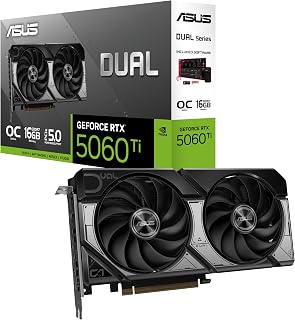
The RTX 5060 Ti stands out with 16GB of faster GDDR7 memory, accelerating AI inference and ray tracing workloads beyond what GDDR6 alternatives offer. NVIDIA's CUDA ecosystem provides mature tooling for machine learning frameworks like PyTorch and TensorFlow. The 2632 MHz clock combined with RTX architecture delivers hardware-accelerated encoding and tensor operations essential for modern content creation and model deployment.
Pros
- 16GB GDDR7 memory at a competitive entry point
- Compact 2.5-slot design fits nearly any build
- 0dB mode for silent operation during light loads
- Dual BIOS for instant Quiet/Performance switching
Cons
- Limited overclocking headroom versus larger cards
- Higher cost than entry-level 8GB alternatives
For buyers hunting affordable 16GB VRAM in 2026, the ASUS Dual RTX 5060 Ti delivers NVIDIA's Blackwell architecture and GDDR7 memory without the bloat of oversized three-fan designs. The 16GB buffer handles 1440p ultra settings and 4K high presets comfortably, while 767 AI TOPS ensures DLSS 4 runs efficiently across modern titles. The compact 2.5-slot footprint fits nearly any case, yet ASUS hasn't sacrificed cooling. Axial-tech fans with barrier rings push focused airflow onto the heatsink, and dual ball bearings extend lifespan well beyond sleeve alternatives. The 0dB mode stops fans entirely during desktop work or lighter games, keeping your build silent until you need performance mode's full 2632 MHz boost. Dual BIOS lets you toggle between Quiet and Performance profiles instantly. PCIe 5.0 connectivity and GDDR7 future-proof the investment. The tradeoff is overclocking headroom; compact sizing prioritizes compatibility over extreme tweaking. Still, if you need 16GB VRAM without spending flagship money or filling every inch of your chassis, this card balances capacity, efficiency, and real-world gaming power better than most alternatives.
GPU and Memory: NVIDIA GeForce RTX 5060 Ti, 16GB GDDR7, 2632 MHz (OC Mode), 2602 MHz (Default Mode). Supports DLSS 4 and Blackwell architecture for AI-accelerated performance.
Connectivity and Cooling: 3x DisplayPort 2.1b, HDMI 2.1b, PCIe 5.0 x16 interface. Dual Axial-tech fans with dual ball bearings, 2.5-slot compact form factor, 0dB technology for silent idle operation.
Physical and System Requirements: Dimensions 9 inches long by 4.7 inches wide, weighs 0.66 kg. Supports maximum resolution of 7680x4320 pixels. Includes 3-year warranty and SpeedSetup manual. Compatible with standard desktop builds requiring adequate power supply and proper case ventilation.
This card suits gamers building compact systems or small-form-factor rigs who need 16GB VRAM for 1440p and 4K gaming without chassis compromises. It's ideal if you value quiet operation during everyday use and want DLSS 4 support for future titles. Skip it if you demand extreme overclocking potential or if your case easily accommodates larger three-fan designs that might offer more cooling overhead for similar money.

The Tesla M60 targets server-based applications requiring 16GB VRAM for virtualized workstations or remote rendering farms. While GDDR5 and older architecture limit gaming performance, the card excels at parallel compute tasks and virtual desktop infrastructure. PCI-Express x16 compatibility fits standard server chassis, making it suitable for repurposed enterprise hardware running batch processing or simulation workloads at minimal investment.
Pros
- 16GB GDDR5 meets the memory threshold for serious AI inference and data analytics workloads
- Enterprise build quality engineered for continuous 24/7 operation
- PCI-Express x16 integrates into standard server motherboards
- Renewed unit provides professional inspection and testing assurance
Cons
- Not suited to gaming or consumer graphics workloads; Tesla architecture is compute-only
- Notably long physical dimensions require pre-purchase chassis and motherboard clearance verification
The HP NVIDIA Tesla M60 arrives at this list from a completely different direction than consumer gaming cards: it is a renewed enterprise GPU accelerator engineered for data centers. The 16GB GDDR5 specification hits the threshold this article targets, but the intended workload is sustained parallel compute, specifically AI inference, scientific computing, and data analytics, rather than gaming or desktop graphics. The Tesla architecture and 1 GHz memory clock reflect professional priorities: stable, continuous operation under demanding server conditions rather than peak frame rates. The PCI-Express x16 interface integrates into standard server motherboards, and HP's enterprise build quality is designed around 24/7 duty cycles. The renewed status indicates the unit has passed professional inspection and testing. One practical constraint demands attention before purchase: the card is notably long, and buyers must confirm chassis and motherboard clearance ahead of time. For anyone building or expanding machine learning infrastructure on a budget, this renewed unit offers professional GPU memory capacity at a fraction of new enterprise pricing.
Core Specifications: Graphics Processor: NVIDIA Tesla M60, Graphics Memory: 16GB GDDR5, Memory Clock: 1 GHz, Interface: PCI-Express x16, Compatible Devices: Desktop/Server.
Physical: Brand: HP (Manufacturer: Hewlett Packard Enterprise), Model: NVIDIA Tesla M60, HP Part Number: M3X68A-cr, UPC: 786513494061, Weight: 2 pounds.
Warranty and Support: 90-day limited warranty included. Amazon Renewed Guarantee covers replacement or refund if not satisfied. Product is professionally inspected and tested by Amazon-qualified suppliers.

XFX's Swift edition pushes the RX 9060 XT to 3320 MHz, providing extra headroom for deep learning training and batch rendering tasks that saturate VRAM. The 16GB GDDR6 buffer handles large datasets and complex scenes without swapping to system memory. Triple fan configuration ensures consistent thermal performance during prolonged compute sessions, while dual DisplayPort outputs support multi-monitor setups for productivity workflows.
Pros
- 16GB GDDR6 at 20 GHz memory clock keeps pace with memory-hungry modern titles
- RDNA 4 architecture with 3320 MHz boost offers strong generational performance uplift
- Triple-fan cooler holds ~55°C at full load with minimal fan noise
- Solid overclocking headroom reported above 3.1 GHz after undervolting
Cons
- Large physical footprint may not fit compact or smaller mid-tower cases
- RGB lighting has no software toggle and cannot be turned off
If your priority is getting 16GB of VRAM without paying flagship prices, the XFX Swift RX 9060 XT OC Triple Fan deserves serious consideration. Built on RDNA 4 architecture with a 3320 MHz boost clock, it delivers a meaningful generational leap over older mid-range cards, with roughly 25-40% better performance than the RX 6600 it succeeds. The 16GB GDDR6 buffer running at 20 GHz is the headline here: it comfortably handles AAA titles at 1440p high settings and holds its own in casual 4K scenarios where memory capacity is often the bottleneck. Thermal management is a genuine strength. The triple-fan SWFT cooler holds GPU temperature at around 55 degrees Celsius under full load while remaining notably quiet. Overclocking headroom is real, with stable configurations reported above 3.1 GHz, pushing performance closer to higher-tier cards. PCI-Express x16 and outputs covering HDMI plus two DisplayPort round out a well-specified package. The one hardware caveat: the card is physically large, so compact cases may struggle with fitment.
1440p Gaming: Handles nearly all modern AAA titles at ultra settings with 70+ fps average. Excellent choice for competitive esports at 1440p 144Hz refresh rates.
4K Gaming: Capable at high settings (60+ fps) for optimized titles. More demanding games like Ark Ascended benefit from resolution scaling to 1350p or balanced settings for consistent 60+ fps performance.
Memory Advantage: 16GB VRAM provides significant headroom for texture-heavy games and enables stable performance in VRAM-intensive scenarios that would bottleneck 12GB cards.
Power Efficiency: RDNA 4 delivers strong performance per watt, making undervolting highly effective without sacrificing stability. Users report 90-110W reductions possible through -130mV voltage tweaking.
Buyers chasing the lowest entry point into 16GB GDDR6 gaming performance will find this card well-matched to that goal, especially those playing demanding AAA titles at 1440p or experimenting with 4K. It also suits creators who run GPU-accelerated workloads alongside gaming. Skip it if your case is compact or SFF-sized, or if always-on RGB lighting in a dark room would be a constant annoyance.
Pros
- Pre-overclocked performance delivers strong 1440p frame rates straight out of the box without additional configuration
- Intelligent 0dB cooling keeps the card silent during light workloads, ideal for office and everyday use
- Solid RDNA 4 architecture brings modern ray tracing and AI acceleration for competitive visual quality at this price tier
- Generous 16GB GDDR6 memory future-proofs the card for demanding games and professional applications
- Three-fan design and nickel-plated copper baseplate maintain stable thermals under sustained load
Cons
- Card requires a 550W PSU and occupies 2.5 slots, so verify your chassis clearance and power supply capacity before purchase
- No reviews available yet, so real-world performance data and user reliability feedback are limited at launch
- Factory overclock voids some warranty provisions and may reduce card lifespan compared to reference clocks
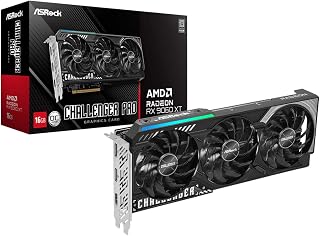
The ASRock RX 9060 XT Challenger Pro is a mid-range graphics card built for 1440p gaming and content creation, targeting PC enthusiasts and streamers who want modern performance without flagship pricing. It combines AMD's RDNA 4 architecture with 16GB of fast memory and a factory overclocked boost clock to deliver smooth, high-frame-rate gameplay out of the box.
Standout features include the 3290MHz factory overclock, which eliminates the need for manual tuning, and the 16GB GDDR6 memory at 20 Gbps, providing ample bandwidth for modern game engines and creative applications. The RDNA 4 architecture brings 3rd Gen Ray Tracing and 2nd Gen AI Accelerators, ensuring competitive visual fidelity in current and upcoming titles. PCIe 5.0 support future-proofs the investment for next-generation gaming technologies.
The triple-fan cooling system with striped axial fans and nickel-plated copper baseplate keeps thermals in check during gaming sessions, while the 0dB Silent mode cuts fan noise entirely at low loads. This makes the card equally at home in gaming rigs and quiet creative workstations. The metal backplate adds structural rigidity, and the customizable LED indicator lets you match your system aesthetic.
The main limitations are the 2.5-slot footprint and 550W minimum PSU requirement, which demand careful case planning. The card also launches with no user reviews, so long-term reliability data is not yet available. The factory overclock, while performance-boosting, may technically reduce card lifespan compared to reference speeds.
Overall, the RX 9060 XT Challenger Pro is a well-rounded 1440p performer that balances modern features, reliable cooling, and accessible pricing. It suits gamers stepping up from entry-level cards and content creators who value both performance and quiet operation.
GPU: AMD Radeon RX 9060 XT, RDNA 4 architecture, 32 Compute Units
Memory: 16GB GDDR6, 128-bit bus, 20 Gbps speed
Clock Speeds: Game Clock 2700 MHz, Boost Clock 3290 MHz
Interface: PCI-Express 5.0 x16
Display Outputs: 2x DisplayPort 2.1a, 1x HDMI 2.1b (up to 3 displays, 8K resolution)
Power: Single 8-pin connector, 550W PSU recommended
Cooling: Triple-fan axial design with 0dB Silent mode, nickel-plated copper baseplate, ultra-fit heatpipes
Physical Dimensions: 290 x 123 x 41mm, 2.5-slot card
Construction: SPS Dr.MOS, premium power chokes, 2oz copper PCB, metal backplate
Warranty: 3 years manufacturer warranty
Model Number: 90-GA6JZZ-00UANF
Who Should Buy: This card is ideal for 1440p gamers, content creators, and PC enthusiasts seeking a balance of performance, features, and thermals. The factory overclock and quiet cooling make it especially appealing to streamers and professionals who work in open offices.
What to Check Before Purchase: Verify your motherboard supports PCIe 5.0 (or at least PCIe 4.0) for full compatibility. Confirm your PSU delivers at least 550W and has available 8-pin connectors. Measure your chassis to ensure the 2.5-slot card fits without blocking other components.
Gaming Performance Expectations: Expect smooth, high-refresh gameplay at 1440p in most modern AAA titles at high or ultra settings. For competitive esports titles, you should see 100+ fps. Content creation tasks like video editing and rendering will benefit from the 16GB memory and AI accelerators.
Noise and Thermals: The 0dB Silent mode keeps the card silent at idle or light load, ideal for quiet environments. Under heavy gaming load, expect moderate fan noise typical of mid-range cards. Temperature management is solid thanks to the triple-fan design and premium copper baseplate.

Pros
- Substantial 16GB VRAM enables smooth performance at 1440p with high settings
- Comprehensive connectivity with DisplayPort 2.1 and HDMI 2.1a for modern monitors
- Efficient cooling design manages thermal output effectively during gaming workloads
- RDNA 3 architecture balances performance with power consumption relative to competitors
- Excellent value proposition for 1440p gaming at this price point
Cons
- 4K gaming performance is possible but may require settings adjustments for optimal frame rates
- 700W power supply requirement limits compatibility with older or budget-focused systems
- Limited brand presence in reviews may deter buyers seeking extensive user feedback
The Gigabyte Radeon RX 7600 XT is a mid-range graphics card built for gamers targeting 1440p gaming with modern features. With 16GB of GDDR6 memory and AMD's RDNA 3 architecture, this card is positioned for players who want solid performance without premium pricing. It serves gamers looking to upgrade older systems while maintaining flexibility for future titles.
The standout feature is the combination of substantial VRAM, advanced raytracing capabilities, and support for cutting-edge display standards. DisplayPort 2.1 and HDMI 2.1a connectivity future-proof the card for next-generation monitors, while AV1 encoding and AI accelerators add value for content creators. At 1440p with high settings, performance should be competitive and smooth. 4K is achievable but will require adjusting detail levels depending on the game.
The Windforce cooling system with triple 80mm fans and composite copper heat pipes ensures thermal management remains effective during extended gaming sessions. The design incorporates RGB Fusion lighting for customization, though the card's industrial appearance prioritizes function over flashy aesthetics. Build quality reflects Gigabyte's reputation for reliable components and thoughtful engineering.
The primary consideration is power delivery. The 700W recommended power supply requirement means older systems or compact builds may need upgrades. Additionally, being a newer or less reviewed model, buyer feedback remains limited compared to flagship alternatives. Performance at 4K will vary by title and requires reasonable settings compromise.
For 1440p gamers seeking modern features, substantial VRAM, and value-oriented pricing, the Gigabyte Radeon RX 7600 XT delivers a compelling option. The combination of RDNA 3 performance, robust cooling, and future-ready connectivity makes it a solid choice for the mid-range gaming segment.
GPU & Memory: AMD Radeon RX 7600 XT with 16GB GDDR6 memory, 128-bit memory interface, 18000 MHz memory clock, and 2810 MHz boost clock.
Architecture: RDNA 3 compute units with advanced raytracing, AI accelerator, and AV1 encoding support. Supports DirectX 12 Ultimate.
Connectivity: PCI-Express 4.0 x16, 2x DisplayPort 2.1, 2x HDMI 2.1a.
Cooling: Windforce system with 3x 80mm blade fans, 5 composite copper heat pipes, and direct GPU contact copper plate.
Physical: 11.06 inches length, 4.61 inches width, 1.2 kg weight. Requires 700W power supply.
Display Support: Up to 8K resolution (7680x4320).
Is this card right for you? Choose the RX 7600 XT if you're gaming primarily at 1440p and want strong performance with modern features like raytracing. It's ideal for upgrading from older generation cards and suitable for content creators needing AV1 encoding and AI acceleration.
Performance expectations: Expect smooth 1440p gaming at high to ultra settings in modern titles. 4K gaming is viable with moderate settings adjustments. Not designed for extreme enthusiast or professional workloads.
System requirements: Verify your power supply is 700W or higher and that your motherboard has a PCIe 4.0 x16 slot. Older systems may require upgrades before compatibility.
Comparison tip: Position this card against other mid-range options in the same generation. The 16GB VRAM differentiates it from lower VRAM alternatives when considering longevity and demanding applications.

ASRock Intel Arc A770 Phantom Gaming 16GB Graphics
The Intel Arc A770 delivers 16GB of GDDR6 memory at a competitive entry point, making it viable for AI workloads and content creation that demand high VRAM capacity. The 2200 MHz clock speed provides adequate performance for model training and rendering tasks where memory capacity matters more than raw compute. Triple fan cooling ensures thermal stability during extended sessions, while DisplayPort 2.0 supports modern high-resolution workflows without bottlenecks.
Pros
- Full 16GB VRAM at accessible entry pricing
- Silent triple-fan cooling below load threshold
- XeSS upscaling boosts supported game performance
- DisplayPort 2.0 and HDMI 2.1 future-proof connectivity
Cons
- Occasional driver instability requiring manual reloads
- Linux driver maturity trails competitors
When hunting for affordable 16GB VRAM in 2026, Intel's Arc A770 Phantom Gaming delivers that capacity at a fraction of what competing platforms charge. The full 16GB GDDR6 allocation sits on Intel's Xe HPG architecture, running at 2200 MHz with memory bandwidth reaching 17.5 Gbps. This specification matters for workflows that demand texture headroom: Unreal Engine 5.3 scene assembly, AI inference workloads, and modern titles designed around current-gen console memory targets. The triple-fan cooling array with ultra-fit heatpipes maintains complete silence during idle and light tasks, spinning up only under sustained load. ASRock backs the thermal solution with a metal backplate for structural integrity and passive dissipation. DisplayPort 2.0 and HDMI 2.1 outputs handle high-refresh monitors without compromise. XeSS upscaling extends performance further in supported games, using AI reconstruction to boost frame rates. Ray tracing, variable rate shading, and mesh shading support ensure the card remains relevant as engine features evolve. The physical footprint measures 12.01 inches, and the 2.5-pound weight requires case clearance verification before installation. Driver maturity has improved substantially since launch, though some users still encounter occasional Vulkan instability under extreme sustained loads.
GPU Architecture: Intel Xe HPG Microarchitecture, Intel Arc A770
Memory: 16GB GDDR6 on 256-bit bus with 17.5 Gbps clock speed
Clock Speed: 2200 MHz GPU core clock
Display Support: Maximum 7680x4320 pixels, 3x DisplayPort 2.0, 1x HDMI 2.1
Interface: PCI-Express x16 v4.0
Cooling: Triple striped axial fans with ultra-fit heatpipes, 0dB silent mode
Dimensions: 12.01 inches length, 5.16 inches width
Weight: 2.5 pounds
Power Requirements: 600W minimum power supply recommended
Warranty: 2 years manufacturer coverage
Model Number: A770 PG 16GO
Buy this card if you need genuine 16GB capacity for UE5 development, large texture mods, or AI experimentation without stretching your budget to AMD or NVIDIA's premium tier. The cooling system suits quiet office environments and the connectivity handles modern displays well. Skip it if your workflow depends on rock-solid Linux support or if you run sustained professional renders where occasional driver hiccups become productivity killers. Also avoid if your case cannot accommodate the 12-inch length or if you're committed to established AMD or NVIDIA ecosystems.
What to Look for When Buying a 16GB VRAM GPU
Architecture and Generation
Architecture determines far more than raw clock speed. Cards built on AMD’s RDNA 4 platform, like the ASRock Radeon RX 9060 XT Challenger 16GB OC and the GIGABYTE Radeon RX 9060 XT Gaming OC 16G Graphics, bring 3rd Gen Ray Tracing and 2nd Gen AI Accelerators that older architectures simply cannot match. Newer generations also benefit from better driver maturity and longer software support cycles.
If your workload leans heavily on AI inference or upscaling, NVIDIA’s Blackwell architecture found in the ASUS Dual GeForce RTX 5060 Ti 16GB GDDR7 OC delivers 767 AI TOPS, which is a significant lead in that specific area. Match the architecture to your primary workload rather than defaulting to whatever is newest.
Memory Type and Bus Width
Not all 16GB VRAM pools are created equal. GDDR7 memory, as seen on the ASUS RTX 5060 Ti, offers substantially higher bandwidth than GDDR6, which matters most at 4K or when loading extremely large assets. Most RDNA 4 cards in this roundup use GDDR6 on a 128-bit bus running at 20 Gbps, which is well-suited for 1440p gaming and general creative work.
The ASRock Intel Arc A770 Phantom Gaming 16GB OC stands out by pairing 16GB GDDR6 with a wider 256-bit bus, giving it significantly more memory bandwidth relative to its position in the lineup. For bandwidth-sensitive tasks like video encoding or high-resolution texture streaming, that wider bus makes a noticeable difference.
Cooling and Thermal Design
A good thermal solution keeps your GPU running at peak clock speeds consistently, which directly affects frame rate stability. Triple-fan designs like the ASRock Radeon RX 9060 XT Steel Legend 16GB GDDR6 and the XFX Swift AMD Radeon RX 9060 XT OC Triple Fan move significantly more air than dual-fan models, which matters in smaller or less ventilated cases. Zero-decibel fan modes on several of these cards also mean near-silent operation during light loads.
The XFX Swift AMD Radeon RX 9060 XT OC White offers a white colorway alongside solid thermal performance, which is a practical consideration if you are building a white-themed system. Aesthetic and thermal design can coexist when you choose the right card for your case layout.
Use Case: Gaming vs. Workstation vs. Legacy Compute
The HP NVIDIA Tesla M60 16GB Server GPU Accelerator is a renewed server card that is not designed for gaming at all. It lacks display outputs in a traditional sense and is intended for virtualized workstation environments and legacy compute tasks. If your goal is driving a monitor and playing games, this is not the card for you, but for specific server-side AI or virtual desktop infrastructure workloads, it represents an exceptionally low entry point for 16GB of VRAM.
The Gigabyte Radeon RX 7600 XT Gaming OC 16GB Graphics sits on the older RDNA 3 platform and is still a capable 1440p card. It is worth considering if you find it available at a strong discount, though the newer RDNA 4 options have largely surpassed it in performance-per-watt. Browse the broader Electronics section for complementary hardware guides.
Final Thoughts
If you want the most affordable entry into next-gen 16GB VRAM gaming, the GIGABYTE Radeon RX 9060 XT Gaming OC 16G Graphics offers a compelling blend of RDNA 4 architecture, WINDFORCE cooling, and strong community ratings. For buyers who need a rock-bottom price and can work within server hardware constraints, the HP NVIDIA Tesla M60 16GB Server GPU Accelerator remains the most accessible 16GB VRAM option on this list, provided the use case fits. Either way, 16GB of VRAM is now firmly within reach for a wide range of budgets and build types.
Frequently Asked Questions
Why does 16GB of VRAM matter for gaming in 2026?
Modern AAA titles at high texture settings can exceed 10GB of VRAM at 1440p, and that number keeps climbing. With 16GB, you avoid the stutter and frame drops that happen when a GPU exhausts its memory pool and starts borrowing from system RAM. It also gives you a meaningful buffer as games become more demanding over the next several years.
Is a renewed server GPU like the Tesla M60 usable for everyday tasks?
The Tesla M60 is a dual-GPU compute card designed for data center virtualization, not consumer gaming or desktop use. It does not have standard display outputs and requires a compatible server chassis or workstation platform. It can be useful for specific AI and machine learning inference tasks, but it is not a drop-in replacement for a consumer gaming GPU.
How does AMD RDNA 4 compare to older RDNA 3 for 16GB GPU buyers?
RDNA 4 delivers meaningful improvements in ray tracing performance, AI acceleration, and power efficiency compared to RDNA 3. Cards like the ASRock RX 9060 XT lineup boost as high as 3290 MHz, which is a significant clock speed advantage over the previous generation. If you are buying new in 2026, RDNA 4 is the stronger long-term investment for most gaming workloads.
What power supply do I need for a 16GB gaming GPU?
Most of the RDNA 4 cards in this guide recommend a 550W power supply with a single 8-pin connector, making them relatively easy to accommodate in existing builds. The Gigabyte Radeon RX 7600 XT Gaming OC 16GB Graphics recommends a higher 700W unit due to its power profile. Always verify your PSU rating and available connectors before purchasing. For broader hardware and electronics advice, the Electronics hub is a good starting point.




Write Your Review
No reviews yet. Be the first to share your experience!