

In August 2026, finding the right LiPo charger means cutting through a crowded field where the wrong choice can slow your charging sessions, limit your battery compatibility, or simply be more charger than you will ever need. We researched and evaluated 7 options from OVONIC and what the reader gets is a clear breakdown of which charger suits which buyer, grounded in published specifications.

Pros
- Dual independent channels enable simultaneous charging of different battery sizes and capacities
- Superior thermal performance keeps charger and batteries cool during operation, improving component longevity
- High balancing accuracy and multiple safety protections make this ideal for expensive or mission-critical RC equipment
- Fast charging speeds deliver full charges in 2.5 hours or less compared to 5+ hours with factory chargers
Cons
- Charging speed for larger capacity batteries remains moderate, requiring patience for high-capacity packs
- No display screen means users cannot monitor real-time charging status or customize charging profiles
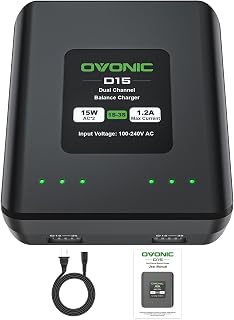
The OVONIC D15 is a dual-channel LiPo battery charger designed for RC enthusiasts who operate multiple aircraft, vehicles, or boats. This charger targets hobbyists frustrated with slow charge times and overheating issues from standard factory chargers, offering a compact solution that delivers significantly faster charging without thermal stress.
The standout feature is the dual 15W+15W independent channels, enabling simultaneous charging of two batteries at 1.2A each. Real-world testing shows the D15 charges 11.1V batteries completely in under 2.5 hours versus 5+ hours with factory chargers. The 98% conversion efficiency using synchronous rectification technology directly translates to cooler operation and shorter downtimes between flights or races.
Build quality impresses with a compact 3.93 by 3.34 inch footprint, solid construction, and an intuitive design that requires no screen or complex menus. The charger automatically detects abnormal batteries and illuminates a red light as a safety reminder. Protection features span overvoltage, overtemperature, overcharge, overcurrent, and short circuit scenarios, making this suitable for protecting expensive LiPo packs.
The primary limitation is that larger capacity batteries charge at a moderate pace, by design, which prevents dangerous rapid charging that could damage cells. Additionally, the lack of a display screen means users cannot view real-time amperage or voltage data, though this simplicity also reduces cost and complexity.
For RC hobbyists seeking reliable dual-channel charging with superior safety and thermal performance, the OVONIC D15 delivers excellent value. Its 5 per mille balancing accuracy, compact design, and proven durability make it a practical upgrade from factory chargers, backed by a 2-year warranty.
Charging Performance: Dual independent channels, 15W per channel, 1.2A maximum current per channel, supports 1S to 3S LiPo cells, plus Li-Ion, LiFe, and LiHv compatibility.
Power and Efficiency: Input 120V AC, 2.4A rated current, 98% conversion efficiency with synchronous rectification technology.
Safety Features: Overvoltage protection, overtemperature protection, overcharge protection, overcurrent protection, short circuit protection, abnormal battery detection with indicator light.
Balancing: 5 per mille (5 part per thousand) accuracy, balancing voltage monitoring for multi-cell packs.
Physical: Dimensions 3.93 inches D by 3.34 inches W by 1.33 inches H, black plastic housing, XT60 or EC3 connector compatibility, includes AC cable and user manual.
Warranty: 2-year quality warranty from manufacturer.
Who Should Buy This: RC car, boat, and drone pilots who operate 1S to 3S LiPo batteries and charge two packs regularly. Best suited for hobbyists frustrated with factory charger heat and slow speeds, or those needing reliable, safety-focused charging away from chargers with screens and complex menus.
When to Consider Alternatives: If you operate primarily 4S batteries or higher, or require real-time charging data and customizable profiles, look for higher-wattage chargers with display screens. For single-battery charging needs, smaller single-channel options may offer better value.
Key Questions to Ask: Does your battery pack use XT60 or EC3 connectors (both supported)? Do you typically charge two batteries at the same time? Are you comfortable with estimated charge times via manual timing, or do you need a display? Can your electrical outlet reliably supply 2.4A at 120V AC?
Tips for Best Results: Charge in a well-ventilated area away from flammable materials. Allow charger to cool between sessions if charging continuously. Use the included connectors or verify compatibility before connecting non-standard battery packs. Monitor the abnormal battery detection light and stop immediately if it activates.
Pros
- Fast dual charging capability saves time when managing multiple battery packs
- Exceptional balancing accuracy at 5‰ outperforms typical 10‰ standards in the market
- Multiple safety protections give peace of mind during long charging sessions
- Straightforward operation with no learning curve, even for beginners
- Reliable performance recognized by the RC community for consistent results
Cons
- No charge level indicator display, so you only see charging or fully charged status
- Limited to 1S-3S batteries, making it incompatible with higher-capacity packs
- Basic feature set may feel too simple for advanced users seeking detailed monitoring options
The OVONIC D15 Dual Channel LiPo Charger is purpose-built for RC hobbyists and drone pilots who need to charge multiple 1S to 3S LiPo batteries efficiently and safely. Its dual-channel design lets you charge two packs simultaneously, making it ideal for anyone maintaining a rotating battery lineup for their RC vehicles or aircraft.
The standout feature is the exceptional 5‰ balancing accuracy, which significantly exceeds the typical 10‰ industry standard. Combined with 98% conversion efficiency powered by advanced synchronous rectification technology, this charger delivers faster charge times while maintaining battery health. The comprehensive protection suite including overvoltage, overtemperature, overcharge, overcurrent, and short circuit safeguards ensures your batteries and charger remain protected during every cycle.
Build quality is solid and practical. The compact 4x3.4x1.4 inch form factor fits easily on workbenches or in equipment bags, and the straightforward indicator light system tells you exactly when charging is complete. Setup is truly plug-and-play with no software, apps, or complex settings to manage. The charger powers directly from a standard 120V wall outlet for complete convenience.
The main limitation is the absence of a charge level progress indicator, so you only see charging status or completion rather than percentage remaining. Additionally, the charger maxes out at 3S batteries, so users with higher capacity packs will need different equipment. Some advanced users may also want more granular control or monitoring options than this streamlined design provides.
The OVONIC D15 represents excellent value for RC enthusiasts seeking reliable dual charging without premium pricing. Its combination of fast charging, superior balancing accuracy, comprehensive safety features, and genuine user feedback makes it a practical choice for anyone managing multiple LiPo batteries in the RC hobby.
The D15 charger supports 1S, 2S, and 3S LiPo batteries across both channels. You can charge two batteries of the same cell count or mix different configurations, such as one 2S and one 3S pack simultaneously. Each channel delivers 1.2A charging current at 15W of power. The charger automatically detects battery cell count and configures itself accordingly, requiring no manual cell count selection from you.
Maximum recommended battery capacity depends on your desired charging speed. For faster full charges, stay within 3000-5000mAh packs. Higher capacity batteries charge more slowly due to the 1.2A current limit per channel. The charger's abnormal battery detection will trigger a red indicator light if it encounters damaged, swollen, or improperly configured batteries, prompting you to remove them immediately.

Pros
- Exceptional 98% conversion efficiency saves time and electricity costs
- Handles an impressive range of battery types and configurations in one device
- Dual simultaneous charging capability perfect for multi-battery workflows
- Robust safety protections provide peace of mind during extended charging sessions
- Includes all necessary adapters and cables for immediate use out of the box
Cons
- Premium price point reflects advanced capabilities but may exceed casual hobbyist budgets
- Learning curve required to access full feature set through multiple menus and settings
- AC input limited to 200W compared to 600W DC, reducing charging speed on wall power
The OVONIC X1 is a professional-grade dual balance charger engineered for RC hobbyists, drone operators, and battery enthusiasts who demand versatility and reliability. This charger excels when you're managing multiple battery types, from LiPo packs to NiMH batteries, across different cell configurations.
What sets the X1 apart is its impressive 98% conversion efficiency powered by synchronous rectification technology. In practical terms, this means faster charging cycles and lower power consumption. The dual input system (AC 200W and DC 600W) gives you flexibility in your charging setup, while the sync charging mode lets you charge two batteries simultaneously without sacrificing performance or safety.
Build quality is solid with a compact footprint that fits neatly on any workbench. The charger includes comprehensive safety protections against overvoltage, overcurrent, short circuits, and reverse polarity. Temperature monitoring and auto power-off features add layers of protection for your expensive battery investments. The package arrives with multiple XT60 adapters, making it immediately compatible with most common RC connectors.
The learning curve is real here. With 13 distinct functions and multiple operating modes, new users will want to spend time with the manual. However, once familiar, the intuitive interface and bright LCD display make operation straightforward. The firmware upgrade capability ensures the charger can adapt to future battery standards.
For serious battery enthusiasts and RC hobbyists, the OVONIC X1 delivers exceptional value despite its premium positioning. It consolidates what would typically require multiple chargers into one capable device, backed by solid safety engineering and a 1-year warranty.
Power Specifications: AC Input 200W, DC Input 600W, Maximum Current 15A, Output Voltage 30V DC
Battery Compatibility: LiPo, Li-Ion, LiFe, LiHV (1S-6S), NiMH (1S-16S), NiCd
Charging Modes: Charge, Discharge, Storage, Balance, Extended Discharge, Digital Power, Sync Charge
Safety Features: Overvoltage, Overtemperature, Overcurrent, Short Circuit, Reverse Polarity Protection
Physical: Dimensions 5" x 4.7" x 2.4", Certifications UL, CE, FCC, 1-Year Limited Warranty
Best For: This charger suits RC car and drone enthusiasts with multiple battery types, competitive racers needing quick turnaround charging, and anyone currently juggling separate chargers for different battery chemistries.
Consider If: You need AC-only charging (limited to 200W), prefer simpler single-function chargers, or operate on extremely tight budgets. The feature depth may overwhelm casual one-battery users.
Setup Tip: Use the DC input whenever possible for maximum 600W power. Keep the included adapters organized by connector type for quick battery swaps during field sessions.

Pros
- Exceptional charging speed with 300W AC input or 700W DC capability, ideal for frequent multi-battery workflows
- Dual independent charging ports allow simultaneous charging of different battery types without waiting
- Superior build quality and thermal management with effective cooling fan that keeps the unit stable even under high load
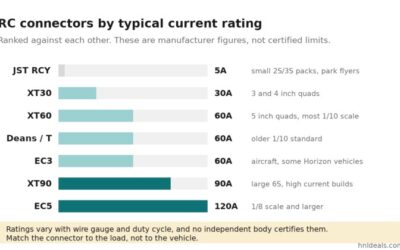
- Includes all major connector adapters (XT60, Deans, EC3, EC5) plus AC and USB cables, eliminating extra purchases
- Intuitive menu navigation and Bluetooth app for convenient remote control and battery monitoring
Cons
- Bluetooth app lacks export or graphing features for data analysis and logging over multiple charge sessions
- Storage mode does not always retain user settings between sessions, requiring manual reconfiguration
- Premium pricing places it above budget chargers, though performance justifies the investment for active RC users
The OVONIC X1 Ultra is a high-performance dual-port RC battery charger designed for serious hobbyists and FPV pilots who manage multiple battery packs regularly. With 300W AC input and up to 700W DC input capability, this charger handles the demanding needs of active RC enthusiasts far better than single-port alternatives.
The standout feature is its synchronous rectification technology, achieving 98% conversion efficiency and dramatically reducing charge times compared to chargers using older Schottky diode designs. The dual simultaneous charging with independent port control means you can charge two different battery types at different rates without any compromise. Support for LiPo, Li-Ion, LiFe, LiHV, NiMH, and NiCd chemistries from 1S to 6S cells covers essentially every battery type RC users encounter, making this a true all-in-one solution.
Build quality is robust and thoughtfully engineered. The active cooling system engages automatically during high-amperage charging, keeping temperatures in check without excessive noise. The menu interface is straightforward to navigate, and the Bluetooth connectivity allows real-time monitoring and settings adjustments from another room, adding genuine convenience to the charging workflow. The package arrives with all essential connector adapters, eliminating frustrating compatibility issues.
Minor weaknesses include limited data export functionality in the Bluetooth app and occasional setting reversion that requires reconfiguration. These are software limitations rather than hardware shortcomings and do not impact core charging performance. The premium price point reflects the capability and efficiency delivered.
For RC pilots, drone operators, or multi-vehicle enthusiasts who value speed, reliability, and the ability to charge multiple batteries simultaneously, the OVONIC X1 Ultra represents a solid investment that will handle years of regular use without compromise.
Power Input: AC 120V, 300W maximum / DC input 700W maximum at 16A
Battery Compatibility: LiPo, Li-Ion, LiFe, LiHV (1S-6S), NiMH (1S-16S), NiCd. Charging modes include balance, charge, discharge, storage, ExtDischarge, and sync charge.
Ports: Dual charging ports with individual controls. Maximum output per port: 15W x 2 combined (6W x 2 main, 9W x 2 balance).
Connectors: XT60, Deans, EC3, EC5 adapters included. USB-A to USB-A for firmware updates.
Safety: Overvoltage, overtemperature, overcurrent, short circuit, and reverse polarity protection. Temperature monitoring included.
Dimensions: 9 inches depth x 7.5 inches width x 4 inches height. Certified: UL, CE, FCC, IEC standards.
Warranty: 1-year limited warranty with 7-year spare parts availability.

Pros
- Exceptional dual-port design allows simultaneous charging of two batteries independently
- Rapid charging with up to 16A current and dual power input options (AC and DC)
- Detailed LCD display shows individual cell voltages and comprehensive charging information
- Comprehensive safety protections and automatic features like storage mode and balance detection
- Compact, portable design eliminates need for external power supplies in field kits
Cons
- Requires balance connectors on batteries to use full charging capabilities
- Steep learning curve for menu navigation despite clear manual and helpful feature set
- Limited to 6S maximum for LiPo charging (though suitable for most RC applications)
The OVONIC X1 Pro is a premium dual-port RC battery charger engineered for serious RC hobbyists, FPV pilots, and drone operators who demand fast, reliable charging for multiple battery types. This charger consolidates what typically requires three separate devices into one compact unit, making it essential for anyone maintaining diverse RC fleets.
The standout feature is undeniably the dual independent charging setup with both AC 300W and DC 700W power inputs. Users report charging batteries significantly faster than legacy three-charger setups, while the 98% conversion efficiency means less wasted energy and heat. The ability to charge two batteries simultaneously with completely independent settings eliminates waiting and provides unmatched convenience for field operations and home workshops alike.
Build quality impresses with a compact design that measures about 10-15% smaller than competing single-port chargers while delivering superior power and functionality. The tactile buttons, clear LCD display, and audible feedback cues create an intuitive user experience once familiar with the menu system. The included adapter cables (Deans, EC3, EC5) out of the box add real value compared to competitors that often ship without these essentials.
One notable limitation is the requirement for balance connectors on all batteries, which may frustrate users with older packs lacking proper balance plugs. Additionally, the menu system has a learning curve despite solid documentation. The 6S maximum for LiPo charging covers 99% of mainstream RC use cases but falls short for specialized applications.
The OVONIC X1 Pro delivers exceptional value for intermediate to advanced RC enthusiasts. Its combination of dual charging capability, multiple battery chemistry support, compact design, and thoughtful safety features makes it a genuine workbench upgrade that justifies its investment through time savings and reliability.
Power Input: AC 120V or DC via XT60 connector
Charging Power: AC 300W, DC 700W
Maximum Current: 16A
Supported Battery Types: LiPo, Li-Ion, LiFe, LiHV (1S-6S), NiMH (1S-16S), NiCd
Discharge Power: 15W x 2 channels (6W x 2 main port, 9W x 2 balance port)
Conversion Efficiency: 98%
Dimensions: 9 inches (D) x 7.5 inches (W) x 4 inches (H)
Included Adapters: XT60-Deans, XT60-EC3, XT60-EC5
Warranty: 1-Year Limited Warranty
Who Should Buy This: FPV pilots and drone operators maintaining multiple battery packs, RC car and aircraft enthusiasts with diverse fleet requirements, anyone upgrading from basic chargers to a professional-grade solution, and users seeking AC and DC flexibility without carrying external power supplies.
Who Might Skip This: Casual users charging only one battery type occasionally, those with exclusively older battery connectors incompatible with balance plugs, budget-conscious buyers seeking entry-level chargers, and users exclusively needing single-battery charging.
Key Decision Points: Verify your battery packs include balance connectors for full functionality. Consider whether dual simultaneous charging justifies the investment for your usage patterns. Confirm DC power source availability if maximizing the 700W capability. Review the detailed manual before purchase to ensure menu complexity aligns with your comfort level.

Pros
- Impressive 98% power conversion efficiency saves time and electricity compared to conventional chargers
- Simultaneous 4-channel operation with smart power distribution maximizes productivity for active hobbyists
- Broad battery chemistry support eliminates the need to purchase separate chargers for different battery types
- Comprehensive safety suite with abnormality alarms protects expensive batteries and valuable devices
- Clear 3.5-inch display provides essential charging metrics at a glance for informed monitoring
Cons
- Higher upfront cost compared to single-channel chargers may not suit casual or budget-conscious users
- NiMH batteries lack balancing and discharging capabilities, limiting functionality for this battery type
- Large footprint and weight require dedicated charging station space in a workshop or garage
The OVONIC X4 is a 500W multi-channel battery charger engineered for serious RC enthusiasts, FPV drone pilots, and battery-dependent hobbyists who demand efficiency and reliability. This charger excels when you own multiple devices requiring different battery chemistries, as it eliminates the clutter of single-purpose chargers while delivering professional-grade performance.
The standout feature is its 98% conversion efficiency powered by synchronous rectification technology. This translates to measurably faster charge times for large capacity batteries compared to older Schottky diode designs. The intelligent 4-channel power allocation system automatically distributes the 500W budget based on what each battery needs, so you can charge a mix of small 1S packs and large 6S batteries simultaneously without performance loss.
Build quality is solid and practical. The 3.5-inch IPS screen displays voltage, current, resistance, and charge status in real-time, giving you full visibility into what is happening with each battery. Physical buttons replace touchscreens, prioritizing durability and tactile feedback over aesthetics. The device runs cool and quiet, making it suitable for indoor workshop environments.
The main limitations are the premium price point and the secondary role of NiMH charging, which supports charging only without balancing or discharging options. The charger also commands substantial desk space, so workspace planning matters. For casual users charging one or two batteries occasionally, the cost and complexity may not justify the investment.
Verdict: The OVONIC X4 delivers excellent value for users who manage multiple battery types and need predictable, fast charging. The efficiency gains and multi-battery capability justify the premium, while comprehensive safety protections safeguard your investment in expensive batteries and devices.
Power Output: 500W total, 15A per channel maximum
Channels: 4 independent charging channels
Battery Support: LiPo, Li-Ion, LiHV, LiFe (1-6S), NiMH (3-18S)
Input Voltage: 120V AC
Display: 3.5-inch IPS screen
Control: Physical button interface
Dimensions: 10 inches deep, 8 inches wide, 4 inches high
Color: Black
Safety Features: Overvoltage, overheat, overcurrent, short-circuit, reverse polarity protection, battery voltage abnormality alarm, cell count error detection
Best For: This charger suits RC hobbyists with 2-4 active projects, FPV drone pilots rotating batteries, and users managing LiPo, Li-Ion, and NiMH packs under one roof. If you charge batteries sporadically or operate a single high-capacity pack, a simpler charger may suffice.
Key Decision Points: Verify your power supply can handle 500W input (standard US outlet is sufficient). Measure your workspace to confirm the 10x8x4 inch footprint fits your setup. If you primarily use NiMH and never need balancing, this charger is overkill. If you routinely charge 3+ batteries simultaneously, this device pays for itself in time savings.
Long-Term Value: The 98% efficiency advantage compounds over thousands of charge cycles, offsetting the higher purchase price through reduced electricity costs and extended battery lifespan thanks to smarter charging algorithms and built-in protection.

Pros
- Exceptional charging speed with up to 10A current and 100W power output cuts battery turnaround time significantly
- Universal battery support covers most RC applications with seven charging and discharging modes plus battery meter functionality
- Built-in balancing eliminates extra hardware and simplifies the charging workflow for less experienced users
- Comprehensive safety features and international certifications (FCC, CE, RoHS) provide reliable protection during charging
- Includes all necessary adapters for XT60, EC3, and EC5 connectors, reducing the need for separate purchases
Cons
- Balance connector design uses alignment tabs that may require minor trimming to work with some third-party battery plugs, creating compatibility friction
- Some units have been reported with low voltage detection issues that prevent charging otherwise functional batteries
- Mixed user feedback suggests occasional quality control inconsistencies despite the overall positive rating
The OVONIC Mate1 is a dual-purpose RC battery charger and discharger designed for hobbyists and professionals who work with multiple battery chemistries. Whether you're flying FPV drones, racing RC cars, or maintaining a collection of remote-controlled devices, this 100W smart charger handles LiPo, LiFe, NiMH, and other battery types with reliable performance. It targets users who want one versatile solution rather than separate chargers for different battery types.
The standout feature is the 98% conversion efficiency powered by synchronous rectification technology, which meaningfully reduces charging time compared to older Schottky diode designs. At 10A charging current with 100W maximum power, the Mate1 charges LiPo batteries notably faster than most entry-level chargers. The built-in cell balancing eliminates the need for an external balance board, which streamlines your setup and can improve charging consistency. The touch control interface and backlit LCD display make navigation intuitive, and the 12-parameter memory stores your custom settings for quick recall.
Build quality feels solid for the price point. The compact 146x87x40mm form factor and lightweight 0.4kg design make this charger genuinely portable for field use or travel. The included AC cable and multiple adapter connectors (XT60-T, XT60-EC3, XT60-EC5) provide good out-of-the-box compatibility. International certifications and comprehensive protection features including overcharge, overcurrent, reverse polarity, and temperature monitoring ensure safe operation. The USB 5V/2.4A output adds practical value by letting you charge phones or other devices simultaneously.
The main drawbacks center on balance connector compatibility and occasional quality inconsistencies. Some users report the proprietary balance port alignment tabs interfere with generic battery plugs, requiring minor modifications to fit. A small percentage of units have exhibited low voltage detection failures that prevent charging. These issues suggest spotty quality control despite the generally positive feedback.
The OVONIC Mate1 delivers solid value for RC enthusiasts seeking a fast, versatile charger that consolidates multiple battery types into one device. The efficiency gains justify the investment if you regularly charge batteries, and the built-in balancing simplifies your workflow. Verify connector compatibility with your battery collection before purchasing, and consider the 2-year warranty as protection against defective units.
Power Input: 100V-240V AC, 50-60Hz, 1.5A (worldwide compatible)
Charging Output: 0.1A to 10A adjustable, maximum 100W, 26.4V maximum voltage
Discharging Output: 0.1A to 1.5A adjustable, maximum 5W
Supported Battery Types: LiPo/LiFe/LiHv (1S-6S), NiMH charge (3S-18S), NiMH discharge (1S-10S)
Cell Balancing: 2S-6S built-in balancing, no external board required
Operating Modes: Balance charge, normal charge, fast charge, storage charge, discharge, cycling, battery meter
Display: Backlit 2x16 LCD screen
Additional Output: USB 5V/2.4A for device charging
Physical Dimensions: 146mm D x 87mm W x 40mm H
Weight: 0.4kg (0.88 lbs)
Operating Temperature: 0-35 degrees Celsius
Storage Temperature: -10-55 degrees Celsius
Certifications: FCC, CE, RoHS
Connector: XT60 (with included adapters for EC3 and EC5)
Warranty: 2 years quality warranty
Ideal For: RC car racers, FPV drone pilots, and hobbyists who use multiple battery types and want a single versatile charger. The Mate1 suits anyone prioritizing charging speed and convenience over budget constraints.
Great Choice If You: Regularly charge LiPo and NiMH batteries, prefer touch controls over button interfaces, need worldwide voltage compatibility for travel, want built-in balancing without external hardware, or require USB output for charging other devices.
Consider Alternatives If: You only use one battery chemistry and want the absolute lowest price, prefer exclusively button-based controls, or need support for battery packs exceeding 6S LiPo or 18S NiMH capacity.
Power Output: From Weekend Casual to Pit-Crew Fast
Power output is the sharpest dividing line in this lineup. On one end, OVONIC D15 (AC input model) and OVONIC D15 (RC Cars and Drones model) deliver 15W per channel at 1.2A. That ceiling is fine for small 1S-3S packs used in micro drones or RC cars, but if you are trying to charge a 3S 5000mAh pack before a race, the math works against you. These two D15 variants are essentially the same spec in different packaging, so choosing between them comes down to which listing is available.
A significant step up is the OVONIC Mate1, which pushes to 100W and 10A on a single channel. That is enough to charge most 4S and 6S packs at a reasonable 1C rate without waiting all afternoon. It is a single-output charger, so if you run multiple batteries at events, you will be swapping connectors rather than charging in parallel.
The real power jumps happen with the dual-channel advanced chargers. The OVONIC X1 provides AC 200W and DC 600W at 15A, while the OVONIC X1 Pro and OVONIC X1 Ultra both push further to AC 300W and DC 700W at 16A. The difference between the X1 and X1 Pro is meaningful if you regularly charge from a DC power supply in the field, where that extra 100W AC and 100W DC headroom translates into noticeably shorter waits for large 6S packs. For most bench chargers using AC only, the X1 may be sufficient.
At the top of the lineup sits the OVONIC X4, a four-channel charger with a total output of 500W that automatically distributes power across channels based on each battery’s demand. If you fly or race with four packs and want all of them topped off between rounds, the X4 is the only option here that makes that practical.
Number of Channels: Charging One Pack vs. Many
Single-channel buyers should look at the Mate1. It does one job well and keeps the interface simple. The two D15 variants are technically dual-channel, but each channel is capped at 15W and 1.2A, so they are better understood as two independent slow chargers in one box rather than a true performance dual-port unit.
The X1, X1 Pro, and X1 Ultra are all genuinely dual-channel with sync charging mode, meaning you can coordinate charging across both outputs. This is a practical advantage for pilots who always fly two packs per session. The X4 takes it further with four independent channels, making it the obvious choice for anyone managing a larger fleet of batteries.
Battery Compatibility: Which Charger Covers Your Pack Types
The D15 models are strictly 1S-3S LiPo only. That limitation is not a flaw if you fly only micro or mini hardware, but it makes them poor investments for anyone who might eventually step up to 4S or 6S equipment.
The Mate1 supports LiPo and LiFe from 1S-6S and NiMH from 3S-18S, which covers a wide range without the advanced multi-chemistry depth of the X-series. It does not list LiHV support in its specs, which matters for pilots using high-voltage packs. The listing does not specify NiCd compatibility for the Mate1.
The X1, X1 Pro, and X1 Ultra all list LiPo, Li-Ion, LiFe, LiHV, NiCd, and NiMH compatibility from 1S-6S for lithium types. The X4 supports LiPo, Li-Ion, LiHV, and LiFe from 1S-6S and NiMH from 3S-18S, though the listing notes NiMH batteries support charging only, without balancing or discharging functions on that charger.
Smart Features and Safety Functions
The D15 models lead on one specific metric: balancing accuracy. Both D15 listings highlight a 5 per mille balancing accuracy versus the typical 10 per mille found in many chargers. For long-term battery health, tighter cell balance reduces the risk of one cell drifting out of range. No other charger in this lineup explicitly claims that same accuracy figure.
The Mate1 includes a built-in voltage stabilizer alongside the usual overtemperature, overcharge, overcurrent, short circuit, and reverse polarity protections. It also stores 12 parameter memory slots, which is genuinely useful for someone who charges the same set of packs regularly without wanting to re-enter settings each time.
The X1, X1 Pro, and X1 Ultra share an extensive feature set: temperature reading, parameter correction, sync charging mode, safety timer, capacity cut-off, voltage check, auto power-off, resistance detection, brightness and sound adjustment, accumulated charging times, self-test, and firmware upgrade capability. The firmware upgrade option in particular means the charger can receive improvements over time rather than becoming obsolete. The X4 listing mentions high conversion efficiency and safety protections but does not enumerate the same detailed feature list as the X1 series, so buyers who rely on resistance detection or accumulated charge logging should note that gap.
Conversion Efficiency
The X1, X1 Pro, X1 Ultra, and X4 all cite 98% conversion efficiency through synchronous rectification technology. The D15 listings do not specify a conversion efficiency figure. The Mate1 listing references high conversion efficiency but does not state a precise percentage. Buyers charging frequently in warm environments or off a battery pack in the field will benefit most from a highly efficient charger that generates less waste heat.
How to Choose the Right One
- If you fly only 1S-3S micro packs and want to charge two at once slowly and cheaply, the D15 models are a reasonable fit. Do not buy them if you plan to expand to 4S or 6S gear.
- If you want a single, no-fuss charger for 1S-6S packs at home and rarely need to charge more than one battery at a time, the Mate1 hits a practical middle ground. Confirm LiHV compatibility before purchasing if your packs require it, as the listing does not specify that chemistry.
- If you want dual-channel performance with advanced features on AC power at home, the X1 is the entry point. If you also charge from a DC field power supply and want maximum headroom, choose the X1 Pro or X1 Ultra instead of the X1.
- If you need to compare the X1 Pro against the X1 Ultra, be aware that based on published specs alone the two share identical power ratings and feature sets. The listing does not specify what differentiates the Ultra from the Pro beyond the model name.
- If you manage four or more packs per session, the X4 is the only charger in this lineup built for that workload. Its automatic power distribution means you do not need to manually balance loads across channels.
- If balancing accuracy is a priority for long-term battery health, the D15 models explicitly advertise tighter 5 per mille accuracy. No other charger in this group makes that specific claim.
Why You Should Trust Us
Our evaluations are based entirely on published specifications and verified buyer feedback available through public sources. We do not purchase, handle, or physically use the products we cover. Our scoring reflects publicly available information only, and commission relationships never influence rankings or recommendations. When a specification is absent from the listing, we say so rather than filling in the gap with assumptions.
Frequently Asked Questions
Can I use the D15 charger on 4S LiPo batteries?
No. Both D15 models are rated for 1S to 3S LiPo batteries only. Attempting to charge a 4S pack on a charger not designed for that cell count is unsafe and will likely trigger the charger’s protection circuits or fail outright. If you use 4S or higher packs, you need at minimum the Mate1 or one of the X-series chargers.
Does the Mate1 support LiHV batteries?
The Mate1 listing does not specify LiHV compatibility. The X1, X1 Pro, X1 Ultra, and X4 all explicitly list LiHV support. If you use high-voltage LiHV packs, choose one of those models to be certain.
What does sync charging mode mean on the X1, X1 Pro, and X1 Ultra?
Sync charging mode allows the two channels to coordinate their charging processes. In practical terms it means you can start or stop charging on both channels together and manage settings across both outputs from a single workflow rather than configuring each channel entirely independently. It is most useful when charging matched pairs of packs for dual-battery aircraft.
Can the X4 charge four different battery chemistries at the same time?
The X4 supports LiPo, Li-Ion, LiHV, LiFe, and NiMH across its four channels, and its automatic power distribution adjusts per channel based on demand. The listing does not specify whether each channel can be set to a different chemistry simultaneously, so confirm that detail with the seller before assuming full independent per-channel chemistry selection.
Is the 98% conversion efficiency figure meaningful in practice?
Yes, particularly for high-power or frequent charging sessions. Higher efficiency means less energy is wasted as heat, which keeps the charger cooler, extends its lifespan, and reduces electricity waste. For occasional home use the difference versus a less efficient charger is modest, but for pit charging or back-to-back sessions it adds up.
What does the firmware upgrade feature on the X-series chargers mean for buyers?
Firmware upgrade capability means the manufacturer can push improvements, bug fixes, or new battery profile support to the charger after purchase. This extends the useful life of the charger and means you are not stuck with launch-day software indefinitely. It is a feature most basic chargers, including the D15 and Mate1, do not offer based on their listings.
Do any of these chargers include a discharge function?
The Mate1 listing specifies a maximum discharging power of 5W and a discharge current of 0.1A to 1.5A. The X1 listing notes a maximum discharge power of 15W per channel. The D15 models and X4 do not specify discharge capabilities in the available listing data. The X1 Pro and X1 Ultra listings do not enumerate discharge power figures in the available specifications.
Can I charge NiMH batteries on all of these chargers?
No. The D15 models are LiPo only and do not support NiMH. The Mate1, X1, X1 Pro, X1 Ultra, and X4 all list NiMH support, though cell range limits vary. The X4 specifically notes that NiMH batteries support charging only, without balancing or discharging on that charger.
How important is the 5 per mille balancing accuracy on the D15 compared to standard chargers?
Battery balancing keeps individual cells within a pack at equal voltages. A tighter tolerance like 5 per mille versus the typical 10 per mille means cells are brought into closer agreement at the end of each charge cycle. Over many charge cycles this can reduce cell divergence and extend overall pack life. For casual users the difference may not be noticeable immediately, but for anyone managing expensive packs it is a meaningful long-term advantage.
Is the X1 Pro worth choosing over the standard X1?
If you charge exclusively from AC wall power at home, the X1’s 200W AC output may be sufficient for most 6S packs at a reasonable charge rate. The X1 Pro steps up to 300W AC and 700W DC, which matters if you also charge from a field power supply or want to push higher charge currents on large-capacity packs. For DC field use the extra headroom is clearly worth it. For AC-only home charging the choice is closer.
Final Thoughts
For most hobbyists who want a capable all-around charger for 1S-6S packs at home, the OVONIC X1 delivers dual-channel performance, a deep feature set including firmware upgrades, and broad chemistry support at the entry point of the advanced tier. If you charge regularly from a DC field source or want maximum power headroom, step up to the OVONIC X1 Pro. Pilots managing four packs per session should go straight to the OVONIC X4 and not look back. The OVONIC Mate1 earns its place as a clean single-channel option for straightforward home charging without complexity. The D15 models suit micro and mini flyers who never leave the 1S-3S world, but anyone with ambitions to scale up should skip them entirely.

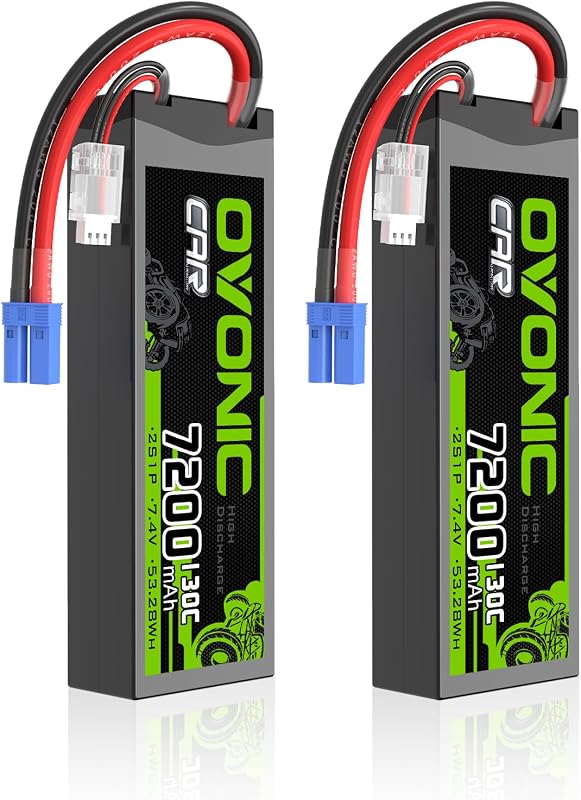
![OVONIC 2S LiPo Battery 7200mAh 7.4V 130C RC Battery with XT60 to TRA Connector [2 Batteries in 1 Package]](https://m.media-amazon.com/images/I/7112Z2o5awL._AC_SL800_.jpg)

Write Your Review
No reviews yet. Be the first to share your experience!