

You have selected a graphics card, a capable processor, and the rest of your PC parts, but the power supply choice is still unclear. A 750W unit may be plenty for a focused single-GPU build, while 850W can provide useful capacity for demanding hardware, brief power spikes, and future upgrades.
This 750w vs 850w power supply guide explains how to match capacity to the way you actually use your computer. It is designed for gamers, creators, and first-time builders who want dependable power without buying capacity they cannot use, especially if a game-specific GPU choice such as those in our GPU guide for Helldivers 2 is shaping the rest of the build.
Quick Comparison
Ratings reflect the most recent data pull. Check each listing for current price and availability.
Quick answer
This guide compares 10 picks, with CORSAIR RM850e 2025 850W Fully Modular ATX 3.1 PCIe 5.1 ranked first. MSI MAG A850GL PCIe 5 850W 80+ Gold Fully Modular has the most customer reviews.
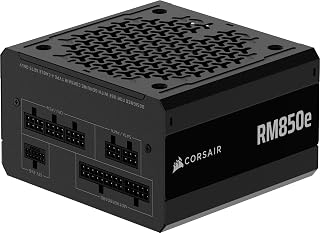
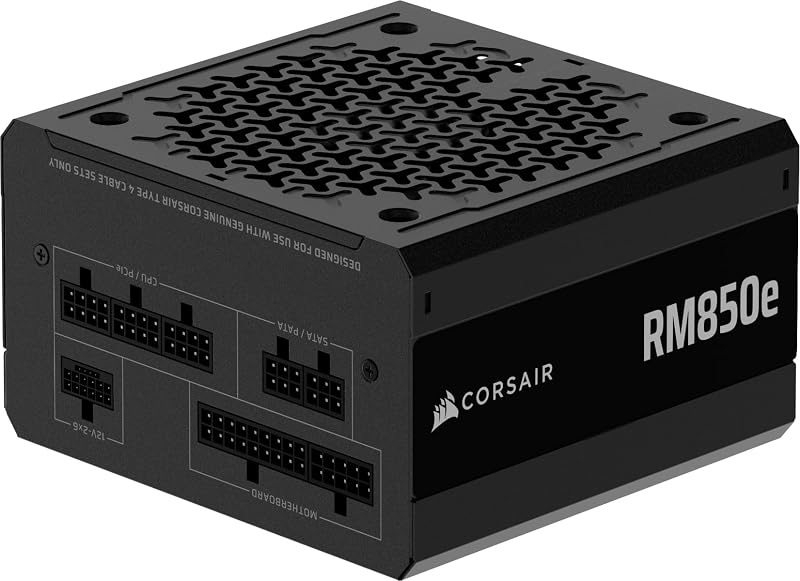
Readers deciding between 750W and 850W often land here because 850 watts gives headroom for a high-end GPU plus overclocked CPU without constantly running near max load. Built to ATX 3.1 spec with PCIe 5.1 readiness, it handles the latest graphics cards' transient power spikes cleanly, making it a safe pick for anyone sizing a build meant to last several GPU upgrade cycles.
Pros
- 850W gives real headroom over 750W for high-draw GPU and CPU pairings
- Native 12V-2x6 connector, no adapters needed
- Quiet 120mm fan in normal use
- Compact 140mm size fits most cases
Cons
- More capacity than mid-range or budget builds need
- Minor coil whine possible under extreme full-load conditions
Choosing between 750W and 850W usually comes down to one question: how much headroom do you want above your system's peak draw. The RM850e answers that with 850W of fully modular, ATX 3.1 and PCIe 5.1 ready power, built around a native 12V-2x6 connector so you are not relying on adapters for a modern GPU. That extra 100W over a 750W unit gives you margin for power spikes from high-end CPU and GPU combinations without pushing the supply near its ceiling during normal use. The 120mm rifle bearing fan stays quiet through typical gaming and productivity sessions, so the jump in capacity does not come with a jump in noise. Build quality backs up the capacity decision too, with flat black cables, a compact 140mm chassis that fits mid-tower and full-tower cases, and included mounting hardware. If your build includes a current flagship GPU or you plan to upgrade within this PSU's lifespan, the 850W figure is the more future-proof pick over 750W.
Power Output: 850 watts
Form Factor: ATX, fully modular
Connectors: 24-pin ATX, 8-pin EPS12V, native 12V-2x6 connector, multiple PCIe 8-pin connectors, 6x SATA, 2x PATA
Cooling: 120mm rifle bearing fan
Input Voltage: 100-240V AC
Dimensions: 5.91 x 5.51 x 3.35 inches
Weight: 3.4 pounds
Efficiency Rating: Cybenetics Gold
Capacitors: Industrial-grade 105C-rated
Warranty: 7 years manufacturer
Model: CP-9020296-NA
Good fit for builders pairing a high-end CPU with a current flagship GPU, or anyone who wants headroom for a future GPU upgrade without replacing the PSU. Also suits those who want full modularity and ATX 3.1 readiness at a mid-tier price. Skip it if your system draws well under 750W already, since you would be paying for capacity you will not use and 750W would cover the same build.

For builders weighing capacity against noise, this one adds full modularity and Cybenetics Gold efficiency on top of the 850 watt output, so cable clutter and heat waste are both minimized. The native 12V-2x6 connector means a modern GPU plugs in directly, which matters to anyone choosing the higher wattage tier specifically to future-proof against power-hungry cards.
Pros
- 91% Cybenetics Gold efficiency reduces waste at higher wattage
- Native 12V-2x6 connector for current GPUs
- Three PCIe 8-pin connectors avoid daisy-chaining
- Japanese 105C capacitors for long-term durability
Cons
- Fan noise increases under sustained heavy load
- 850W exceeds what most typical builds actually need
When deciding between 750W and 850W, the real question is whether your components' combined peak draw leaves enough safety margin at 750W, or whether you'd rather build in more room. The RM850x makes the case for 850W by pairing that extra capacity with 91% Cybenetics Gold efficiency, so the higher wattage does not mean higher waste or heat. It is fully modular with native 12V-2x6 support, which matters if you are running a current flagship GPU that a 750W unit might run closer to its limit under. Three included PCIe 8-pin connectors mean demanding graphics cards get power without daisy-chaining, something tighter-capacity units can struggle with. Reviewers note systems running noticeably quieter and more stable after moving up to this PSU, with fewer crashes tied to power delivery. The 100% Japanese 105C capacitors and embossed low-profile cables point to a build meant to last. For anyone whose GPU and CPU combination sits near the edge of what 750W comfortably handles, the extra 100W here is the deciding factor.
Power Output: 850W
Efficiency Rating: Cybenetics Gold, up to 91%
Form Factor: ATX
Modular Design: Fully Modular
Cooling: 140mm FDB fan with manual and auto modes
Input Voltage: 100-240V AC
Connectors: Native 12V-2x6, (3) PCIe 8-pin, ATX standard
Capacitors: 100% Japanese 105C rated
Warranty: 10 years manufacturer
Dimensions: 2.3 x 3.39 x 5.91 inches
Weight: 3.9 pounds
Model: RM850x (CP-9020270-NA/AM)
Best for builders with flagship GPUs and processors where 750W leaves little margin, and for anyone prioritizing quiet, stable power over the long term. The 10-year warranty suits those planning to keep the PSU across multiple builds. Skip it if your current and future components will reliably stay well under 750W, where the extra capacity and modularity here go largely unused.

If the capacity decision in this comparison lands on 750W, this model backs that choice with 80 Plus Gold certification and a 120mm low-noise fan, keeping a mid-tier build quiet under typical gaming loads. The native 12V-2x6 connector also means no adapter cables are needed for current-generation GPUs.
Pros
- Exceptional value for money with 80+ Gold certification at budget pricing
- Native PCIe 5.1 and 12V-2x6 support makes it ready for next-gen components without adapters
- Reliable performance with strong customer reviews praising build quality and cable quality
- Quiet operation thanks to optimized 120mm cooling fan design
- 3-year warranty provides solid peace of mind for budget builders
Cons
- Non-modular cable design takes up more case space and reduces cable management flexibility
- Some users report missing sensor pins on 12V high power cables, raising durability concerns
- Limited to 750W output, which may require upgrades for high-end multi-GPU or workstation systems
The ASRock PRO 750G is a practical 750W power supply designed for budget-conscious PC builders and gamers who need reliable, efficient power delivery without premium pricing. Its 80+ Gold certification makes it a smart choice for those seeking lower electricity bills and reduced heat output over the product's lifetime.
The standout feature is its native 12V-2x6 connector with up to 450W power delivery for modern graphics cards, combined with ATX 3.1 and PCIe 5.1 compliance. This means you won't need adapters for newer components, and the power supply is ready for next-generation hardware. Users consistently praise the build quality, noting well-made construction and quality cables that inspire confidence in long-term reliability.
The 120mm cooling fan is engineered for quiet operation, making it suitable for both gaming rigs and workstation builds where noise matters. The non-modular design is a trade-off, taking up more space in the case compared to modular alternatives, though some builders actually prefer this approach for simplicity and lower cost.
A minor concern mentioned in user feedback involves some units shipping with missing sensor pins on the 12V high power cable, which could indicate quality control inconsistencies. This appears to be an isolated issue rather than a widespread problem, given the strong 4.6-star rating and positive reviews mentioning the product's reliability.
The ASRock PRO 750G delivers excellent bang for buck, offering proven performance for mid-range systems at a price point that won't strain your budget. With a 3-year warranty backing your purchase, it represents a low-risk investment for builders prioritizing value and reliability over premium features.
This power supply is ideal for budget-conscious PC builders assembling mid-range gaming systems or workstations with power requirements between 500W and 700W. If you're building a system for someone else and want reliable performance with a non-modular, no-frills approach, this delivers strong value.
The PRO 750G makes sense if you appreciate energy efficiency and want to reduce operating costs over time. It's also a solid choice for builders who value the peace of mind that comes with 80+ Gold certification and PCIe 5.1 readiness without paying premium prices. However, if you need more than 750W or prioritize compact cable management through a modular design, consider alternatives.
Power Output: 750W continuous power delivery
Efficiency Rating: 80+ Gold certified, up to 90% efficiency
Connectors: Native 12V-2x6 (up to 450W), ATX, PCIe Express compliant
Form Factor: Standard ATX, compatible with most PC cases
Cooling: Single optimized 120mm fan for low-noise operation
Design: Non-modular fixed cable configuration
Input Voltage: 100-120V AC, 50/60Hz
Dimensions: 5.51 x 5.91 x 3.39 inches
Weight: 4.8 pounds
Warranty: 3-year manufacturer coverage
Model: PRO-750G (90-UXR075-GNUAA2)

Readers who want 850 watts along with cooler-running components will note the 105℃ Japanese capacitors here, which support longevity under sustained high loads. The 140mm low-noise fan and full modularity round it out for anyone treating the extra 100 watts over a 750W unit as insurance for future GPU upgrades.
Pros
- Outstanding value for an 850W fully modular 80+ Gold PSU at this price
- Future-proof design with ATX 3.1 and PCIe 5.1 compliance for next-gen components
- Premium build quality using Japanese capacitors and advanced circuit topology for reliability
- Exceptionally quiet operation with intelligent 140mm fan control that minimizes noise at idle
- Fully modular cables and excellent efficiency make this ideal for cable management and thermal performance
Cons
- Limited brand recognition compared to established PSU manufacturers like Corsair or EVGA may concern some buyers
- Single 140mm fan design limits cooling headroom compared to dual-fan competitors in extreme overclocking scenarios
- Product listing shows conflicting warranty info (10-year vs 2-year), which may create confusion during purchase
The SKYLZOR 850W is a fully modular power supply designed for gamers and PC builders seeking next-generation platform support without breaking the bank. It's particularly suited for high-end gaming builds with RTX 40-series GPUs, content creation workstations, and enthusiasts who want future-proofing with ATX 3.1 and PCIe 5.1 compliance.
The standout feature is the combination of 92% efficiency, full modularity, and intelligent cooling in one affordable package. The dual 16-pin PCIe 5.1 connectors with orange identification make secure connections foolproof, while the DC-DC and resonant topology delivers stable power rails under heavy load. Japanese 105°C capacitors ensure this PSU will handle years of continuous operation without degradation.
Build quality is evident throughout. The 140mm FDB fan with smart control operates nearly silently during everyday use and ramps up smoothly under load, while fully modular cables eliminate the cable management headaches common with semi-modular alternatives. The compact 6 x 6 x 3.7 inch form factor fits most modern cases without issue.
The main limitation is brand recognition compared to tier-one manufacturers, which may give some buyers pause. Additionally, a single 140mm fan won't match the cooling performance of dual-fan designs if you're planning extreme overclocking scenarios. The conflicting warranty information in the listing should be clarified before purchase.
Verdict: This is a genuinely solid power supply that punches well above its price point. The 80+ Gold efficiency, full modularity, and next-gen platform readiness make it an intelligent choice for modern builds. If you value cable management, efficiency, and future compatibility, this deserves serious consideration.
The SKYLZOR 850W is ideal for PC builders upgrading to RTX 40-series or Radeon 7000-series GPUs who want full modularity and next-gen support. It's perfect for those building high-end gaming rigs or workstations where efficiency directly impacts electricity costs and case temperatures.
Budget-conscious enthusiasts will appreciate the value proposition compared to name-brand competitors at similar wattages. Anyone planning their build around ATX 3.1 and PCIe 5.1 standards will benefit from having the proper connectors ready from day one.
Power Output: 850W continuous / 12V rail architecture with dual-channel support
Efficiency Rating: 80+ Gold (92% efficiency at typical loads)
Form Factor: ATX standard
Cables: Fully modular with soft dragon-pattern connectors and dual 16-pin PCIe 5.1 cables
Cooling: Single 140mm FDB fan with intelligent load-based control
Capacitors: 100% Japanese rated for 105°C operation
Platform Support: ATX 3.1 and PCIe 5.1 compliant
Dimensions: 6 x 6 x 3.7 inches
Warranty: 2-year manufacturer warranty with 10-year EU spare parts availability
Input Voltage: 240V AC

Pros
- Full ATX 3.1 compliance with native PCIe Gen 5.1 support handles current and future hardware
- Excellent 90% efficiency rating lowers energy costs and operating temperatures
- Quiet operation thanks to Smart Zero Fan technology and quality 120mm hydraulic bearing fan
- Fully modular cables reduce clutter and improve airflow inside your case
- Solid 4.6-star rating reflects real-world reliability and user satisfaction
Cons
- 750W capacity may be limiting for extreme multi-GPU or high-end workstation configurations
- Premium positioning means higher cost than non-modular or lower-efficiency alternatives
- Single 12+4 pin connector limits support for multiple high-power GPUs simultaneously
The Thermaltake Toughpower GT 750W is a fully modular power supply engineered for builders who demand modern standards without compromise. Built to support ATX 3.1 specifications and featuring a native PCIe Gen 5.1 12+4 pin connector, this unit is ready for current flagship GPUs and future generations. It's ideal for enthusiasts assembling high-end gaming rigs, content creators running workstation builds, and anyone prioritizing efficiency and reliability.
Where this unit truly shines is in its combination of power delivery and efficiency. The 80 Plus Gold certification guarantees up to 90% efficiency, meaning less wasted energy and lower electricity bills over time. The Smart Zero Fan technology is a practical addition, automatically dialing back the 120mm hydraulic bearing fan during light workloads to keep noise levels nearly imperceptible. The high-amperage single +12V rail provides the stable power that demanding components require, whether you're gaming at high frame rates or running compute-intensive applications.
Build quality is evident in the fully modular design with low-profile flat black cables that simplify cable management and reduce airflow obstruction inside your case. The compact form factor (150mm x 86mm x 140mm) fits comfortably in most modern cases without taking up excessive space. The unit passes rigorous safety certifications including CE, FCC, and cTUVus, giving confidence in long-term reliability.
The main limitation is the 750W capacity, which sits in a sweet spot for single-GPU setups but may require upgrading if you pair multiple high-end cards or pursue extreme overclocking. The single PCIe 12+4 pin connector similarly limits simultaneous multi-GPU configurations. These aren't flaws for the target audience, but they're worth considering if your needs extend beyond mainstream gaming and workstation use cases.
The Thermaltake Toughpower GT 750W is a strong choice for builders seeking a future-proof, efficient power supply backed by warranty confidence. Its combination of ATX 3.1 compliance, Gold efficiency, quiet operation, and modular design makes it one of the better options in the 750W segment. Recommended for anyone building or upgrading a modern system who values both performance and power efficiency.
Power Output: 750W maximum capacity with single +12V rail design
Efficiency: 80 Plus Gold (up to 90% efficiency at 115V input)
Form Factor: ATX, fully modular design
Cooling: Single 120mm hydraulic bearing fan with Smart Zero Fan technology
Connectors: 1x PCIe 12+4 pin (350W), 4x PCIe 6+2 pin, multiple SATA and Molex connectors
Input Voltage: 100-240V AC, 50-60Hz
Operating Temperature: 0C to 40C
Dimensions: 150mm (W) x 86mm (H) x 140mm (D)
Weight: 5.3 pounds
Warranty: 5 years manufacturer coverage
Safety Approvals: CE, FCC, cTUVus, UKCA, TUV, LVD, RCM, CB, BSMI, CCC, BIS, S-MARK
MTBF Rating: 100,000 hours
Ideal For: PC gamers building or upgrading systems with modern GPUs, content creators needing reliable power for workstation builds, anyone prioritizing energy efficiency and quiet operation, enthusiasts wanting future-proof ATX 3.1 and PCIe 5.1 support.
Not Ideal For: Budget builders seeking the lowest possible price, users planning extreme multi-GPU configurations, those needing power supplies above 750W for high-end server or workstation applications.
Best Use Cases: High-end single-GPU gaming builds, 4K video editing workstations, 3D rendering machines, streaming setups, general productivity builds where power efficiency reduces electricity costs over time.

For builds where 750 watts is plenty, this compact gaming unit offers full modularity and 80+ Gold efficiency without the bulk of a higher-capacity model. It's a sensible match for readers who've determined their GPU and CPU combo doesn't justify stepping up to 850 watts.
Pros
- Exceptional 750W capacity handles even demanding RTX 40-series and RX 7000-series systems
- Modular design allows cable management customization for cleaner builds and better thermals
- 80+ Gold certification balances performance with efficiency for lower operating costs
- Compact dimensions make it compatible with micro-ATX and smaller gaming builds
- Industry-leading 10-year warranty demonstrates manufacturer confidence in durability
Cons
- Limited real-world reviews available at launch, though #1 bestseller status suggests strong early adoption
- Compact size may require careful cable routing in standard full-tower cases with tight spaces
- Dual 12V-2x6 connector requires compatible modern graphics cards, not backward compatible with older GPU designs
The MSI MAG A750GL PCIE5 is a premium 750W power supply engineered for gamers and PC enthusiasts building high-performance systems with next-generation components. This unit bridges the gap between current gaming demands and future-ready architecture, making it an excellent choice for anyone investing in a system that will remain relevant for years to come.
What sets this PSU apart is its forward-thinking feature set. ATX 3.1 and PCIe 5.1 support mean your system is ready for the latest high-power graphics cards without requiring a power supply upgrade. The native dual-color 12V-2x6 connector eliminates adapter cables, reducing potential points of failure while delivering cleaner aesthetics. The fully modular design gives you complete control over cable management, which translates to better airflow and easier maintenance.
Build quality reflects MSI's gaming heritage. The compact 12x9x5 inch form factor packs serious power without the bulk, making it ideal for micro-ATX and smaller tower builds where space is precious. The 80+ Gold certification ensures efficient power delivery while keeping your electricity bills reasonable even during extended gaming sessions. The included 10-year limited warranty backs MSI's confidence in long-term reliability.
The main consideration is that this is an emerging product with limited customer reviews so far. However, its position as the number-one bestseller in computer power supplies suggests strong market confidence. The compact dimensions, while excellent for smaller cases, may require careful cable management in oversized tower cases.
The MSI MAG A750GL PCIE5 is a smart investment for gamers who want current performance with future-ready capabilities, all backed by a decade of manufacturer support. For 750W modular power at this price point with PCIe 5 readiness, it represents excellent value.
Power Output: 750W continuous rated power
Efficiency: 80+ Gold Certified
Form Factor: ATX 3.1 and PCIe 5.1 compatible
Design: Fully Modular
Dimensions: 12 x 9 x 5 inches (compact design)
Cooling: 12cm fan with intelligent temperature control
Input Voltage: 100-240V AC, 50/60Hz
Connectors: Native dual-color 12V-2x6 PCIe cable
Warranty: 10-year limited manufacturer warranty
Spare Parts Availability: 10 years EU support
Who Should Buy This PSU? The MSI MAG A750GL PCIE5 is perfect for gamers building or upgrading high-end gaming systems with current or next-generation GPUs. It's ideal if you're planning to use RTX 40-series, RTX 50-series, or AMD Radeon RX 7000-series and beyond, or if you want a future-proof foundation for your system.
Is 750W Enough? Yes. 750W provides ample headroom for most single-GPU gaming systems, including high-end graphics cards with modern CPUs. If you're running dual GPUs or professional workloads, consider higher wattage options.
Why Modular Matters: Fully modular means you only connect the cables you need, improving airflow, simplifying builds, and making maintenance easier. This is especially valuable in compact cases where cable clutter becomes a thermal liability.
Compact Form Factor Considerations: The smaller size is an advantage in micro-ATX and mini-ITX builds, but verify your case can accommodate the 12x9x5 inch dimensions before purchasing. Most standard ATX towers accept it without issue.

For readers concluding that 750W covers their build, this delivers the same ATX 3.1 and PCIe 5.1 readiness as its 850W siblings, just scaled to a lower output. It suits a single mid-range GPU setup where the extra 100 watts of the larger option would mostly sit unused.
Pros
- 750W fits mid-to-high-end builds without excess
- ATX 3.1 and PCIe 5.1 ready, no adapters
- Zero RPM mode for silent light loads
- 105C-rated capacitors for steady performance
Cons
- Little headroom for extreme overclocking
- Not suited to dual-GPU configurations
When weighing 750W against 850W, the RM750e represents the case for staying at 750W: most gaming and workstation builds simply don't need more. This unit is built for the mid-range to high-end GPU range where 750W is the sweet spot rather than a compromise. ATX 3.1 and PCIe 5.1 certification with native 12V-2x6 connectors mean you're not sacrificing future-readiness by choosing the lower capacity. Cybenetics Gold efficiency keeps power draw and heat in check, and the 120mm rifle bearing fan runs quietly, with Zero RPM mode silencing it completely under light loads. Industrial-grade 105C capacitors and reinforced cables back up the capacity choice with build quality that should last. The compact 140mm form factor fits nearly any case, which matters if you're trying to decide capacity based on physical space as well as wattage. For builders without extreme overclocking or dual-GPU plans, this makes a strong argument that 750W covers the need without paying for unused capacity.
Power Output: 750W
Form Factor: ATX, Full Modular
Cooling: 1x 120mm Rifle Bearing Fan
Efficiency: Cybenetics Gold
Input Voltage: 100-240V AC
Dimensions: 5.91 x 5.51 x 3.35 inches
Weight: 3.3 pounds
Certifications: ATX 3.1, PCIe 5.1
Connectors: 1x 24-pin ATX, 2x 8-pin EPS/CPU, Multiple PCIe connectors including native 12V-2x6, SATA and PATA support
Warranty: 7 years
Model: RM750e (CP-9020295-NA/AM)
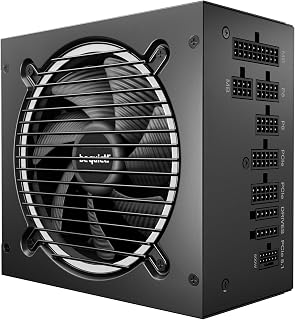
Someone settling on 850 watts for a mid to high-end build will appreciate that this unit is fully modular, letting them route only the ATX cables they actually need. Paired with 80+ Gold efficiency, it fits the common decision point in this comparison: enough capacity for a strong GPU without over-provisioning into the next wattage class.
Pros
- 850W headroom for power-spiking GPUs
- 94.4% efficiency limits heat and waste
- Semi-passive fan stays off at light loads
- Native 12V-2x6 connectors, no adapters needed
Cons
- More capacity than mid-range systems need
- Compact form factor needs careful cable routing in small cases
Choosing between 750W and 850W usually comes down to headroom, and the be quiet! Pure Power 13 M makes the case for going higher. If your build includes a power-hungry GPU that spikes under load, or you want a buffer against future upgrades without buying a new PSU, this 850W unit gives you that margin while staying fully modular. The single 12V rail with LLC topology handles load spikes cleanly, and the 94.4% 80+ Gold efficiency means the extra capacity doesn't translate into wasted heat or noise. Semi-passive cooling keeps the 120mm fan off entirely during lighter tasks, so you're not paying a noise penalty for the added wattage. Native 12V-2x6 connectors mean the step up to 850W also comes with PCIe 5.1 readiness built in, no adapters required. For anyone comparing capacities and wondering if 850W is overkill, the answer depends on your GPU and upgrade plans. This unit makes 850W worthwhile specifically because the extra headroom doesn't cost you efficiency or quiet operation.
Power Output: 850W continuous, handles transients up to 1700W (2x rated power)
Efficiency: 80+ Gold certified, up to 94.4% efficiency rating
Form Factor: ATX, fully modular design
Cooling: Semi-passive 120mm fan with zero-RPM mode under light load
Connectors: Native 12V-2x6 for PCIe 5.1, plus 4 PCIe 6+2-pin for current-gen GPUs
Rail Configuration: Single 12V rail with LLC topology
Input Voltage: 100-120 VAC
Warranty: 10 years
Dimensions: 6.3 x 5.91 x 3.39 inches
Buy this if you're deciding between 750W and 850W and lean toward extra headroom for a high-end GPU or future upgrades without sacrificing quiet operation. Good for enthusiast and content creation builds where power spikes need margin. Skip it if your system comfortably fits within 750W, since you'd be paying for capacity you won't use. Also skip it if you prefer multi-fan cooling designs over a single-fan approach.

Choosing 850W often comes down to wanting quiet operation under everyday loads, and the Smart Zero Fan mode here keeps the fan off until load demands it. With 80 Plus Gold efficiency and a native 450W PCIe 5.1 connector, it suits readers building a high-wattage system that still idles and browses silently.
Pros
- Native 450W PCIe 5.1 connector, no adapters for current GPUs
- 80 PLUS Gold efficiency up to 90%
- Smart Zero Fan keeps idle and light loads silent
- Broad connector support across ATX, PCIe, Molex, SATA
Cons
- 850W capacity underused by mid-range or budget builds
- Long-term durability data more limited than established models
The 750W vs 850W decision often hinges on connector compatibility as much as raw wattage, and the Toughpower GT 850W addresses that directly with a native 450W PCIe 5.1 connector built for ATX 3.1, meaning no adapters for current high-wattage GPUs. That is a meaningful advantage over stepping down to a 750W unit that may lack native support for the latest connector standard. The 80 PLUS Gold certification pushes efficiency up to 90%, so the extra 100W of headroom does not translate into a proportional jump in heat or power waste. Smart Zero Fan technology keeps the 120mm hydraulic bearing fan silent during lighter loads and only ramps up as demand increases, which matters if you are running the PSU below its ceiling most of the time. Full modularity and flat black cables across ATX, PCIe, Molex, and SATA keep cable management simple. Real-world reports cite stable performance under 4K gaming and Unreal Engine 5 workloads with high-end hardware. For builds centered on a current flagship GPU, this is a case where 850W and native connector support work together rather than one compensating for the other.
Power Output and Standards: 850W capacity, ATX 3.1 compliant, PCIe 5.1 support with native 450W 12+4 pin connector. Single high-amperage 12V rail for stable delivery.
Efficiency and Certification: 80 PLUS Gold rated, achieving up to 90% efficiency at 115Vac input. Safety approvals include CE, UKCA, ICES, TUV, LVD, RCM, CB, FCC, cTUVus, BSMI, CCC, BIS, and S-MARK.
Cooling and Design: 120mm hydraulic bearing fan with Smart Zero Fan technology. Fully modular design with four 6+2 pin PCIe connectors plus one 12+4 pin native PCIe Gen 5.1 connector. Dimensions: 150mm W x 86mm H x 140mm D.
Environmental Specs: Operating temperature range 0°C to 40°C, humidity 5% to 85%. Storage temperature minus 40°C to 70°C. Input voltage 100-240V, 50-60Hz, max 10A input current. Hold-up time 17ms at 80% load. Power Good Signal 100-250ms. MTBF 100,000 hours. 5-year warranty.
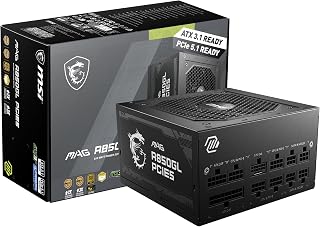
This fits readers who want 850 watts in a compact case, since it's built as a space-saving gaming unit while still offering full modularity and 80+ Gold efficiency. The native dual-color 12V-2x6 cable also makes GPU identification easier, a small but useful detail when matching capacity to a tight build.
Pros
- 850W capacity with dual 120mm fan cooling
- Native dual-color 12V-2x6 connector included
- Compact form factor fits most ATX cases
- 10-year warranty backs the extra capacity
Cons
- Possible coil whine with some high-end CPUs under peak load
- More wattage than many mid-range builds require
If the choice between 750W and 850W hinges on which GPU you're pairing it with, the MSI MAG A850GL leans into the 850W side with a dual-fan cooling approach that's different from single-fan 850W alternatives. The extra capacity suits enthusiast gamers and content creators running high-end systems where PCIe 5.1 support and the native dual-color 12V-2x6 connector matter for modern GPUs. The dual 120mm fans split the cooling load, which can mean quieter operation under sustained workloads compared to relying on one larger fan. The fully modular cable system and included cable pouch keep the extra wattage from turning into cable clutter, and the compact form factor still fits most ATX cases despite the added capacity. Backed by a 10-year warranty, this is a case for choosing 850W when you want the dual-fan cooling style and are building around current high-end hardware rather than staying conservative with 750W.
Power Output: 850W with 80+ Gold efficiency rating
Form Factor: Compact ATX, dimensions 12 x 8.75 x 4.92 inches
Connectors: 20-pin ATX motherboard, multiple PCIe 6+2 pin connectors, 4x 4+4 pin CPU connectors, 20 total connectors for comprehensive device support
Cooling: Dual 120mm fans with intelligent thermal management
Standards: ATX 3.1 and PCIe 5.1 ready, fully modular cable design
Warranty: 10-year limited manufacturer warranty with 10-year EU spare parts availability
Input Voltage: 100-240V AC
Buy this if you're leaning toward 850W for a high-end GPU and want dual-fan cooling plus a long warranty backing the extra capacity. Good for gamers and streamers building future-ready systems with PCIe 5.1 GPUs. Skip it if you're pairing with an extremely high-end CPU sensitive to coil whine, or if your build doesn't need more than 750W in the first place.
How to Choose Between a 750W and 850W Power Supply
Start with your GPU and CPU power demands
Your graphics card and processor determine most of the power requirement. Add their stated power needs, then allow for the motherboard, memory, storage drives, case fans, USB devices, and liquid cooling pump if you use one. A sensible margin helps the supply handle momentary demand changes without operating at its limit all the time.
For many gaming systems with one graphics card, a 750W model such as the MSI MAG A750GL PCIE5, CORSAIR RM750e, or Thermaltake Toughpower GT 750W is a practical fit. If your parts list resembles a higher-tier configuration from our GPU guide for Baldur’s Gate 3, calculate its recommended PSU capacity before deciding that 750W is enough.
Leave useful headroom for power spikes and upgrades
An 850W supply does not make your PC consume 850W continuously. Your components draw what they need, while the higher-rated unit gives you more room for short GPU demand spikes, a power-hungry CPU, additional drives, or a later graphics card upgrade.
That cushion is especially appealing for a high-performance gaming or creation machine. The CORSAIR RM850e, CORSAIR RM850x, MSI MAG A850GL PCIE5, be quiet! Pure Power 13 M 850W, Thermaltake Toughpower GT 850W, and SKYLZOR 850W each pair 850W capacity with modern ATX 3.1 support, but connector layout, cooling behavior, warranty coverage, and component quality still deserve equal attention.
Prioritize ATX 3.1 and the right native GPU connector
ATX 3.1 matters because it addresses the power behavior of modern components, particularly graphics cards that can have sharp demand changes. A native 12V-2×6 cable creates a direct PSU-to-GPU connection and can be tidier than an adapter, provided its rated output matches your graphics card requirements and the cable has adequate clearance at the side panel.
The ASRock PRO 750G includes a dual-color 12V-2×6 connector rated for up to 450W, while the Toughpower GT series provides a native 300W connector on its 750W model and a native 450W connector on its 850W model. If you are moving an NVMe drive to the new build, one of these M.2-to-USB adapters for portable SSD access can simplify copying files beforehand. Always use only the modular cables included with your chosen PSU, since cables from another model may not share the same pinout.
Compare cooling, efficiency, cables, and warranty support
Gold-level efficiency is a strong starting point, but acoustics depend on the fan and its control profile. Thermaltake uses Smart Zero Fan technology in its Toughpower GT models, be quiet! uses semi-passive zero-RPM operation in the Pure Power 13 M 850W, and the SKYLZOR 850W has a 140mm FDB fan with smart control. These details can matter more than the wattage label in a quiet room.
Fully modular cabling is another meaningful convenience because you connect only the cables your build needs, reducing clutter around the motherboard tray. Long warranty coverage can offer added confidence, as seen with the MSI MAG A750GL PCIE5 and MAG A850GL PCIE5, while the ASRock PRO 750G is backed by shorter coverage. Review the form factor, included connectors, and warranty terms before committing.
Final Thoughts
A quality 750W unit is a smart match for many balanced gaming PCs, while 850W is the calmer choice when your build has a demanding GPU, a high-draw processor, or an upgrade path in mind. Choose the CORSAIR RM850x ATX 3.1 PCIe 5.1 Ready Fully Modular 850W Power Supply for polished cabling and extra capacity, or the Thermaltake Toughpower GT 750W ATX 3.1 Standard Power Supply for a streamlined modern build that does not require as much headroom.
Frequently Asked Questions
Is a 750W power supply enough for a modern gaming PC in 2026?
Yes, 750W is enough for many modern gaming PCs, including numerous single-GPU systems with a mainstream or upper-tier graphics card. Confirm the GPU maker’s recommended PSU capacity, account for your processor and accessories, and choose a reputable ATX 3.1 model with the required connectors. Step up to 850W when the calculated load is close to 750W or you expect a major GPU upgrade.
Is an 850W power supply safer than a 750W model?
Neither wattage is inherently safer by itself. Build quality, protections, efficiency, cable compatibility, and correct installation matter more than a larger number on the label. An 850W model can provide more operational margin for powerful components, but a well-made 750W supply is fully appropriate when it meets your system’s calculated needs.
Do I need an ATX 3.1 power supply for a new PC?
ATX 3.1 is a worthwhile choice for a new build because it is designed around modern power-delivery expectations and commonly includes a native 12V-2×6 GPU cable. It is particularly useful if you plan to use a graphics card that calls for that connection. Before swapping components, protect important files with a backup, and consider these hard drive dock picks for backups and drive access if you have spare SATA drives.
Does an external monitor add to my desktop power supply requirement?
Usually no, because an external monitor has its own AC power connection and does not draw from your desktop PSU. The graphics card may work harder at higher resolutions or refresh rates, so account for the GPU rather than the display itself. If your workspace also serves a notebook, our monitor picks for MacBook Pro can help you compare compatible desk-display options.



Write Your Review
No reviews yet. Be the first to share your experience!