

Choosing the best ASUS graphics card becomes complicated when the model you want exceeds your case clearance, needs a different power connector, or carries memory that does not match your workload. This guide compares ten ASUS options for gaming, creative tasks, and AI-assisted work, with practical fit advice from our Graphics Cards buying hub.
ASUS separates its lineup into compact Dual cards, versatile Prime models, reinforced TUF Gaming designs, and premium ROG Strix hardware. We focus on the factors that affect your ownership experience, so you can choose a card that suits your display, chassis, power supply, and preferred games rather than chasing a one-size-fits-all winner.
Quick Comparison
Ratings reflect the most recent data pull. Check each listing for current price and availability.
Quick answer
This guide compares 10 picks, with ASUS Prime Radeon RX 9070 GRE EVO OC 12GB PCIe 5.0 ranked first. ASUS TUF Gaming RTX 5070 Ti 16GB GDDR7 OC Graphics Card holds the highest customer rating among them.

The Prime Radeon RX 9070 GRE EVO pairs a 2880 MHz boost clock with 12GB of GDDR6, delivering strong rasterization performance and competitive AI acceleration on AMD's latest architecture. Dual BIOS switching lets you toggle between performance and efficiency profiles depending on workload, while native HDMI 2.1b and DisplayPort 2.1a support high-bandwidth displays. The axial-tech cooling keeps thermals in check during extended sessions.
Pros
- Axial-tech fans with phase-change thermal pad deliver exceptional cooling
- Compact 2.5-slot design fits standard ATX cases easily
- PCIe 5.0 and DisplayPort 2.1a future-proof connectivity
- Dual BIOS and GPU Guard protection for overclockers
Cons
- 12GB memory may constrain demanding 4K or AI workloads
- Mainstream performance tier limits ultra-high refresh 4K gaming
The ASUS Prime Radeon RX 9070 GRE EVO balances 1440p gaming performance with thermal efficiency for 2026 builds. AMD's RX 9070 GPU architecture paired with 12GB of GDDR6 memory targets mainstream users who need reliable everyday computing for gaming and creative work without flagship-tier specs. The thermal design stands out with new axial-tech fans using longer blades and a barrier ring to maximize downward air pressure, combined with a phase-change GPU thermal pad for optimal heat transfer. This delivers cooler temperatures and lower acoustic output compared to competing models while maintaining robust performance under sustained workloads. The compact 2.5-slot design fits standard ATX cases without clearance issues, and solid construction provides clean aesthetics. Next-gen connectivity through PCIe 5.0, HDMI 2.1b, and triple DisplayPort 2.1a connections future-proof your system for upcoming displays and bandwidth-heavy workflows. Dual BIOS and GPU Guard protection add security for overclockers and power users. The 12GB memory allocation suffices for 1440p gaming and most creative tasks but may constrain users tackling demanding 4K gaming, intensive 3D rendering, or AI workloads. This card targets mainstream performance rather than ultra-high refresh 4K gaming territory.
GPU Specifications
Processor: AMD Radeon RX 9070 GRE
Memory: 12GB GDDR6
Boost Clock (OC Mode): 2880 MHz
Game Clock (OC Mode): 2300 MHz
Memory Speed: 2880 MHz
Maximum Display Resolution: 7680 x 4320
Connectivity
Interface: PCI-Express x16 (PCIe 5.0)
Video Outputs: 1x HDMI 2.1b, 3x DisplayPort 2.1a
Multi-Monitor Support: Up to 4 simultaneous displays
Cooling and Design
Fan Configuration: Triple axial-tech fans with dual ball bearings
Thermal Solution: Phase-change GPU thermal pad
Form Factor: 2.5-slot, 12 inches length, 5 inches width
Weight: 1.07 kg
Warranty: 3-year limited warranty

ASUS TUF Gaming RTX 5070 Ti 16GB GDDR7 OC Graphics
The TUF Gaming RTX 5070 Ti delivers 16GB of GDDR7 and a 2610 MHz factory overclock, striking a balance between gaming performance and AI workload capacity. Five video outputs and native DisplayPort 2.1a make it ideal for multi-monitor productivity alongside gaming, while the reinforced frame and advanced cooling handle extended compute tasks. PCIe 5.0 ensures maximum bandwidth for data-intensive operations.
Pros
- 16GB GDDR7 handles 4K gaming and AI workloads effectively
- Factory overclock to 2610MHz delivers immediate performance gains
- Triple Axial-tech fans maintain stable temperatures with quiet operation
- Military-grade components with protective PCB coating ensure durability
Cons
- Requires 850W PSU with native 16-pin 12VHPWR cables
- 3.125-slot design demands substantial case clearance
The ASUS TUF Gaming RTX 5070 Ti OC delivers exceptional capability for both high-refresh gaming and AI workflows in 2026. Built on NVIDIA's Blackwell architecture with 16GB of GDDR7 memory, this card handles 4K gaming and demanding creative tasks like 3D rendering and video editing without throttling. The factory overclock to 2610MHz offers immediate performance gains without manual tuning, while the triple Axial-tech fans and phase-change thermal pad keep temperatures stable under sustained full-load conditions. Users report smooth competitive FPS gaming at 3440x1440p on 240Hz displays and maxed-out settings in modern AAA titles with consistently quiet operation. The 3.125-slot design with massive fin array optimizes airflow, and military-grade components with auto-extreme precision manufacturing ensure long-term reliability. The protective PCB coating guards against moisture and debris. Minimal RGB lighting and a metallic gray-silver finish provide understated elegance. One critical requirement: an 850W minimum power supply with native 16-pin 12VHPWR cables is essential, and the included adapter should not be used permanently.
The RTX 5070 Ti OC leverages NVIDIA Blackwell architecture to deliver next-generation gaming performance. With 16GB of GDDR7 memory, a 2610MHz boost clock, and support for DLSS 4, this card handles extreme gaming scenarios: 4K at high refresh rates, ultrawide gaming at ultra settings, and 1440p competitive gaming with maximum frame rates and no bottlenecks.
Specifications include native DisplayPort 2.1a (3x) and HDMI 2.1b (2x) outputs for multi-monitor setups and high-refresh displays. The PCIe 5.0 interface ensures maximum bandwidth utilization. Maximum display resolution reaches 7680x4320 pixels, supporting dual 4K displays or single ultrawide configurations. Power delivery is robust with proper PSU support, enabling sustained high-performance operation.
Thermal specifications benefit from advanced engineering. The phase-change thermal pad outlasts traditional thermal paste during extended heavy loads, and the Axial-tech fan design provides superior cooling efficiency compared to traditional blower designs. GPU Tweak III software enables real-time performance monitoring, temperature control, and safe overclocking adjustments for users seeking additional performance margins.
This card suits gamers targeting ultrawide high-refresh displays or 4K resolution alongside content creators running video editing and 3D rendering workloads. Enthusiasts who want factory overclocked performance without manual tweaking will appreciate the immediate speed gains. Those building premium systems with adequate power delivery and case clearance for a 3.125-slot design should consider this option. Skip it if your power supply lacks native 16-pin 12VHPWR support or if you need a more compact form factor for small-form-factor builds.

The Dual Radeon RX 9060 XT pairs 16GB of GDDR6 with a 3250 MHz boost clock, providing ample memory for AI workloads and high-resolution gaming. AMD's RDNA architecture delivers strong compute performance alongside competitive rasterization, while native DisplayPort 2.1a and HDMI 2.1b support modern display standards. The generous VRAM capacity suits both creative workflows and gaming at maximum texture quality.
Pros
- 16GB GDDR6 handles AI workloads and high-res gaming textures
- Compact 2.5-slot design fits smaller cases
- Dual BIOS toggle between silent and performance modes
- DisplayPort 2.1a and HDMI 2.1b for latest displays
Cons
- Requires adequate PSU and case airflow
- Not an entry-level option for casual gaming
For 2026 gaming and AI workloads, the ASUS Dual Radeon RX 9060 XT delivers serious capability in a form factor that fits tighter builds. The 16GB of GDDR6 memory gives you headroom for high-resolution gaming while simultaneously handling AI inference tasks or content creation tools that lean on GPU acceleration. AMD's latest Radeon architecture runs at 3250 MHz under load, and the dual BIOS switch lets you choose between silent operation for lighter workloads and full performance when training models or pushing frame rates. The Axial-tech fan design with barrier rings moves air efficiently through the 2.5-slot body, keeping thermals controlled without dominating your case. DisplayPort 2.1a and HDMI 2.1b outputs ensure compatibility with modern high-refresh panels. Dual ball bearing fans are rated for extended lifespan, a practical consideration if you're running compute jobs overnight or long gaming sessions. This card threads the needle between compact dimensions and the memory capacity AI tools increasingly demand, making it suitable for hybrid gaming and productivity setups where space matters.
GPU and Memory: AMD Radeon RX 9060 XT with 16GB GDDR6 memory running at 3250 MHz
Clock Speeds: OC Mode: up to 3250 MHz boost, 2640 MHz game clock. Default Mode: up to 3230 MHz boost, 2620 MHz game clock
Connectivity: PCIe 5.0, 2x DisplayPort 2.1a, 1x HDMI 2.1b
Physical Design: 2.5-slot form factor, 8 inches long, 4.7 inches wide, 1.3 pounds, dual Axial-tech fans with ball bearings
Maximum Display Resolution: 7680 x 4320 at 60Hz
Warranty: 3 years manufacturer warranty
This card suits builders who need AI-ready memory capacity and strong gaming performance in a mid-tower or smaller case. It's ideal if you're experimenting with local AI models, running creative software with GPU acceleration, or gaming at 1440p and above. Skip it if you have a truly minimal power supply, poor case ventilation, or only play lightweight titles that don't justify the performance tier. Budget-conscious buyers focused purely on gaming may find better value in lower-tier options.
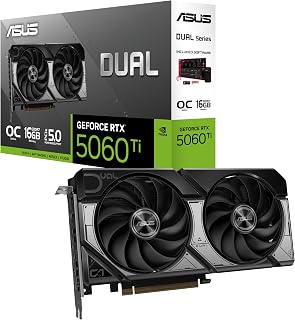
The Dual RTX 5060 Ti stands out with 16GB of GDDR7 memory, offering generous capacity for AI model inference and high-resolution texture streaming in modern games. Its 2632 MHz boost clock and GDDR7 bandwidth handle mixed workloads efficiently, while the compact dual-fan layout suits mid-tower builds. DisplayPort 2.1b connectivity future-proofs the card for next-generation displays.
Pros
- 767 AI TOPS with DLSS 4 for gaming and AI workloads
- 16GB GDDR7 memory future-proofs for demanding titles
- Compact 2.5-slot design fits small-form-factor cases
- 0dB mode with dual BIOS for quiet or performance profiles
Cons
- Compact sizing limits extreme overclocking headroom
- Entry-level alternatives available for budget-focused builds
The ASUS Dual RTX 5060 Ti 16GB delivers NVIDIA's Blackwell architecture and DLSS 4 support in a compact form factor that excels at both gaming and AI workloads. With 767 AI TOPS of computational power, it handles modern games at 1440p ultra settings and scales to 4K high settings without compromise. The 16GB of GDDR7 memory provides headroom for texture-heavy titles and AI inference tasks, while PCIe 5.0 connectivity ensures compatibility with current and future platforms. The Axial-tech fan design with 0dB technology keeps acoustics minimal during light loads and delivers full cooling capacity when pushed to its 2632 MHz boost clock. Dual ball bearing fans outlast sleeve bearings by a factor of two, and the dual BIOS switch lets you toggle between Quiet and Performance profiles instantly. At 2.5 slots, it fits into smaller cases where flagship cards cannot, making it ideal for compact gaming builds or SFF workstations that need serious GPU power. The barrier ring design channels airflow directly onto the heatsink for efficient thermal management despite the reduced footprint.
GPU and Memory: NVIDIA GeForce RTX 5060 Ti, 16GB GDDR7, 2632 MHz (OC Mode), 2602 MHz (Default Mode). Supports DLSS 4 and Blackwell architecture for AI-accelerated performance.
Connectivity and Cooling: 3x DisplayPort 2.1b, HDMI 2.1b, PCIe 5.0 x16 interface. Dual Axial-tech fans with dual ball bearings, 2.5-slot compact form factor, 0dB technology for silent idle operation.
Physical and System Requirements: Dimensions 9 inches long by 4.7 inches wide, weighs 0.66 kg. Supports maximum resolution of 7680x4320 pixels. Includes 3-year warranty and SpeedSetup manual. Compatible with standard desktop builds requiring adequate power supply and proper case ventilation.
Buy this card if you're building a compact gaming rig or small-form-factor AI workstation where space is limited but performance cannot be compromised. It suits gamers targeting 1440p ultra or 4K high settings, and creators working with AI image generation or lighter machine learning models. Skip it if you have room for a larger card with more overclocking headroom, or if you're on a strict budget and can accept entry-level performance. Extreme overclockers should look elsewhere, as the compact design prioritizes compatibility over maximum tuning potential.

The Dual RTX 5070 OC Edition combines 12GB of GDDR7 with DLSS 4 support, enabling both ray-traced gaming at high settings and efficient AI acceleration. Its compact dual-fan design and 0dB idle mode suit quiet workstation builds, while native HDMI 2.1b and DisplayPort 2.1b provide flexible display connectivity. The 2542 MHz boost clock handles demanding frame rates and compute tasks alike.
Pros
- 1000 TOPS AI capability for machine learning tasks
- Compact dual-fan design fits smaller cases
- DLSS 4 and 12GB GDDR7 for 4K gaming
- 0dB silent operation during light workloads
Cons
- Requires careful case selection for proper ventilation
- Premium positioning reflects cutting-edge technology
Built on NVIDIA's Blackwell architecture, the ASUS Dual RTX 5070 targets gamers and AI users seeking high performance in space-constrained builds. The 12GB GDDR7 memory configuration provides ample headroom for 4K gaming while supporting AI workloads with up to 1000 TOPS of computational capability. DLSS 4 integration ensures frame rate optimization in modern titles, and the 2572MHz boost clock in OC mode delivers substantial performance gains over previous generation cards. The compact dual-fan design uses Axial-tech engineering with extended blades and barrier ring technology to maximize cooling efficiency without consuming excessive case space. Real-world testing confirms smooth 4K gaming across contemporary titles, while the AI capability makes this card relevant for machine learning experimentation and GPU-accelerated productivity tasks. The 0dB technology keeps the card silent during lighter gaming sessions or desktop work, only spinning up fans when thermal loads demand active cooling. This makes the card suitable for mixed-use systems handling both entertainment and computational work. The slim profile simplifies installation in smaller cases, though adequate ventilation remains essential for sustained performance.
Memory and Architecture: 12GB GDDR7 memory, NVIDIA Blackwell architecture, PCIe 5.0 interface
Performance: GPU clock speed 2542MHz default, 2572MHz OC mode, 1000 TOPS AI performance, DLSS 4 support
Cooling: Dual Axial-tech fans, 0dB technology, compact form factor 9.8 inches length x 4.96 inches width
Connectivity: HDMI 2.1b, DisplayPort 2.1b, supports up to 7680x4320 resolution
Package Contents: 1x ASUS Dual RTX 5070, Model DUAL-RTX5070-O12G, Weight 2 pounds
Ideal for gamers building compact high-performance systems who need 4K capability without oversized hardware. Content creators working with AI-accelerated tools and GPU rendering will benefit from the 1000 TOPS AI performance and 12GB VRAM buffer. This card suits enthusiasts upgrading from older GPUs who want modern architecture and DLSS 4 support. Skip this if you're building a large tower with room for bigger cards or if your workload demands more than 12GB VRAM. Budget-conscious builders should consider whether the performance justifies the premium positioning.

The TUF Gaming RTX 5070 OC Edition pushes its boost clock to 2640 MHz out of the box, giving you extra performance in both gaming and accelerated AI inference tasks. With 12GB of GDDR7 and five total video outputs, it handles multi-monitor setups and demanding workloads simultaneously. The reinforced build and triple-fan cooling are designed for sustained heavy use.
Pros
- 2640 MHz boost with DLSS 4 for 1440p/4K gaming and AI
- Military-grade components with protective PCB coating
- 65C sustained temps with 3.125-slot cooling design
- Bracket and stand included to prevent GPU sag
Cons
- 13-inch length and 2+ inch thickness require large cases
- 12GB VRAM may limit next-generation AI and texture workloads
The ASUS TUF RTX 5070 OC combines NVIDIA's Blackwell architecture with military-grade components and a 3.125-slot cooling design for gamers and creators who prioritize reliability and sustained performance. Clocked at 2640 MHz with 12GB of GDDR7 memory, it handles 1440p ray tracing at high settings, scales to 4K gaming, and excels in video editing, rendering, and AI workloads like image generation and lighter video synthesis. DLSS 4 support ensures visual quality and frame rates that justify the enthusiast positioning. The cooling solution with three Axial-tech fans maintains 65C under sustained load, while phase-change thermal pads improve heat transfer across the PCB. Protective coating and military-grade components enhance durability for extended rendering sessions and continuous AI inference tasks. The included bracket and stand eliminate GPU sag, a practical touch for heavy cards. DisplayPort 2.1a and dual HDMI 2.1b outputs accommodate multi-monitor setups for productivity and gaming. At 13 inches long and over 2 inches thick, it requires careful case compatibility verification. The 12GB VRAM handles current AI models and games but may face headroom constraints with next-generation titles demanding larger datasets.
GPU and Memory: NVIDIA GeForce RTX 5070, 12GB GDDR7, 2640MHz boost clock, PCIe 5.0 interface
Cooling and Design: 3.125-slot form factor, three Axial-tech fans, phase-change thermal pad, protective PCB coating, military-grade components, GPU Guard bracket
Connectivity: 3x DisplayPort 2.1a, 2x HDMI 2.1b, 7680x4320 maximum resolution support
Physical: 13 inches long, 5.5 inches wide, 3.4 pounds, includes cooling bracket and stand
Warranty and Support: 3-year manufacturer warranty, GPU Tweak III software for performance monitoring and thermal control
Buy this if you're building a high-performance rig for 1440p/4K gaming, video production, or AI image generation and you value durability and thermal performance. It suits enthusiasts running continuous rendering workloads or training lighter models who need consistent thermals and long-term reliability. The included bracket is ideal for heavy builds. Skip it if your case cannot accommodate 13 inches of GPU length or over 2 inches of thickness, or if you need more than 12GB VRAM for large-scale AI training or next-gen texture workloads.

The Dual RTX 3050 offers an accessible entry point for 1080p gaming and lighter AI experimentation with 6GB of GDDR6 memory. Its compact dual-fan design keeps noise low and fits budget-oriented builds, while NVIDIA's latest driver support ensures compatibility with current game engines and machine learning frameworks. The OC edition adds a modest clock speed bump for better frame pacing.
Pros
- Compact 20cm form factor fits small-form-factor cases easily
- DLSS 3 support extends performance in compatible games
- Dual Axial-tech fans deliver controlled temperatures with quiet operation
- IP5X dust resistance and corrosion-resistant bracket ensure durability
Cons
- 6GB VRAM restricts performance in demanding 4K gaming
- Ray-tracing capability secondary to traditional rasterization
For budget-conscious gamers entering RTX territory in 2026, the ASUS Dual RTX 3050 6GB OC Edition provides essential modern GPU features in a compact package. The 20cm form factor and 2-slot design fit easily into small-form-factor cases and pre-built systems where physical and power constraints typically limit upgrade options. At 1080p, this card delivers smooth frame rates in esports titles and lighter AAA games at medium to high settings. DLSS 3 support offers meaningful performance boosts in compatible games, extending the card's capability beyond raw rasterization. The Ampere architecture brings improved power efficiency and concurrent ray-tracing with shading, though traditional rasterization remains the primary strength. Dual Axial-tech fans with barrier ring design increase downward air pressure while smaller fan hubs allow longer blades, resulting in controlled temperatures and quiet operation under sustained load. The stainless steel bracket resists corrosion and IP5X dust resistance protects internal components for long-term reliability. The 6GB VRAM limits performance in demanding 4K scenarios and the most intensive modern AAA titles, but for 1080p gaming and productivity tasks like 3D modeling and video editing, this constraint is reasonable given the entry-level positioning.
System builders and upgraders working with physical or power budget constraints will find this card ideal. Those gaming primarily at 1080p in esports titles or lighter AAA games, or users upgrading from integrated graphics for productivity workloads like 3D modeling and video editing, should consider this option. Skip it if you need 4K gaming capability, plan to run the most demanding modern AAA titles at high settings, or require more than 6GB VRAM for intensive creative or AI workloads.
GPU Architecture: NVIDIA GeForce RTX 3050 with Ampere SM, 2nd Gen RT Cores, and 3rd Gen Tensor Cores for DLSS 3 support.
Memory: 6GB GDDR6 with 1500 MHz memory clock speed, delivering adequate bandwidth for 1080p and light 1440p workloads.
Clock Speeds: OC Mode: 1500 MHz boost clock, Default Mode: 1470 MHz boost clock for flexible performance tuning.
Thermal Design: Dual Axial-tech fans, 2-slot form factor (20cm length, 7.9in x 4.7in), IP5X dust resistance, and stainless steel bracket.
Power: No external power connector required. PCIe x16 slot power delivery only, making it ideal for systems with limited PSU capacity.
Connectivity: HDMI 2.1, DisplayPort 1.4a, and DVI-D for multi-monitor setups and modern display standards.

The Prime RTX 5080 brings 16GB of GDDR7 and a 2685 MHz boost clock, positioning it for high-refresh 4K gaming and serious AI model training or inference. Its PCIe 5.0 interface maximizes throughput for large dataset transfers, while the robust cooling solution maintains performance during hours-long compute sessions. The OC edition offers extra headroom without manual tuning.
Pros
- Flagship performance in a compact 12-inch form factor
- 16GB GDDR7 handles 4K gaming and AI workloads
- Excellent cooling with vapor chamber and 0dB silent mode
- Dual BIOS for Performance and Quiet mode flexibility
Cons
- Requires 850W PSU with specific 16-pin connector
- Some users report extended refund timelines
The ASUS Prime GeForce RTX 5080 delivers flagship-class performance for both gaming and AI workloads in 2026, built on NVIDIA's Blackwell architecture with 16GB of GDDR7 memory. The card handles path-traced 1440p gaming at 243fps and excels at 4K resolution gaming, while DLSS 4 support ensures optimized frame generation for the latest titles. AI applications benefit from the substantial computational horsepower and generous VRAM buffer, making this suitable for local machine learning tasks alongside gaming. The triple Axial-tech fan cooling system combines with a vapor chamber and phase-change thermal pad to maintain low temperatures under heavy gaming or AI inference loads, while 0dB technology silences fans during lighter tasks. The dual BIOS switch offers flexibility between Quiet and Performance modes depending on workload demands. At 12 inches long and 2.5 slots wide, this card fits compact builds that larger flagship GPUs cannot accommodate. The 2685MHz boost clock and modern memory architecture provide headroom for both current and upcoming gaming titles. Installation requires an 850W PSU with the 16-pin 12V-2x6 connector, so verify compatibility before purchasing.
GPU Specs: NVIDIA GeForce RTX 5080 Blackwell, 16GB GDDR7 memory, 2685MHz boost clock (OC mode), 2655MHz default boost clock, PCIe 5.0 interface.
Connectivity: 2x HDMI 2.1b, 2x DisplayPort 2.1, 12VHPWR 16-pin connector, requires 850W minimum PSU.
Cooling: 3x Axial-tech fans with dual-ball bearings, vapor chamber, phase-change thermal pad, 0dB technology, dual BIOS profiles.
Physical: 2.5-slot design, 12 inches long, 5 inches wide, 2.9 pounds, SFF-ready. Includes adapter cable, Velcro straps, manual, and thank you card.
Support: 3-year warranty, GPU Tweak III software for overclocking and monitoring.
This card suits gamers building small-form-factor or ITX systems who refuse to sacrifice flagship performance for space savings. It's ideal for enthusiasts running 4K gaming rigs or demanding VR setups, and for users experimenting with AI workloads who need substantial VRAM. Content creators working with GPU-accelerated tools will appreciate the memory capacity. Skip this if you're on a tight power budget or lack an 850W PSU with the required 16-pin connector. Users upgrading from RTX 4080 or newer should carefully evaluate whether the performance jump justifies the investment.

The ROG Strix RTX 4060 OC Edition offers 8GB of GDDR6 and a 2700 MHz boost clock, suitable for 1080p gaming and entry-level AI tasks like stable diffusion or small model inference. DLSS 3 frame generation extends performance in supported titles, while the axial-tech fans and 0dB technology keep the card silent during lighter workloads. Aura Sync adds RGB customization for gaming-focused builds.
Pros
- DLSS 3 delivers up to 4x rendering performance boost
- Triple Axial-tech fans keep temps below 52°C
- Ada Lovelace architecture improves power efficiency
- 3-year warranty with responsive ASUS support
Cons
- 8GB VRAM limits 4K and AI workload headroom
- Top-mounted power connector complicates cable routing
The ASUS ROG Strix RTX 4060 OC provides reliable 1440p gaming performance with support for modern visual technologies including DLSS 3 and hardware-accelerated ray tracing. Built on Ada Lovelace architecture, the card features 8GB of GDDR6 memory and a 2700MHz boost clock that handles demanding titles smoothly. Users report strong frame rates in games like Cyberpunk and Halo, particularly when paired with modern CPUs. DLSS 3 delivers up to 4x faster rendering compared to traditional methods, extending the performance envelope for ray-traced workloads. The triple Axial-tech fan design increases cooling capacity by 21% over previous models, with real-world temperatures staying below 52 degrees Celsius during extended sessions. The 3.1-slot cooling solution houses a substantial fin array optimized for airflow, ensuring consistent performance under load. While AI capability is limited compared to RTX 50 series cards, the 3rd generation RT Cores handle ray tracing workloads efficiently for gaming purposes. Aura Sync RGB lighting integrates with compatible ASUS components for coordinated aesthetics. The 3-year warranty and ASUS customer support add confidence. The 8GB VRAM suits 1440p gaming but may constrain performance in 4K scenarios or heavier AI experimentation.
GPU Specifications: NVIDIA GeForce RTX 4060 with Ada Lovelace architecture, 4th generation Tensor Cores, and 3rd generation RT Cores. Base GPU clock runs at 2700 MHz with GDDR6 memory clocked at 4000 MHz.
Memory Configuration: 8GB GDDR6 memory provides ample bandwidth for 1440p gaming and light creative workloads. Memory interface supports advanced caching for efficient data movement.
Connectivity and Outputs: PCIe 4.0 x16 interface connects to desktop systems. Video outputs include HDMI 2.1a and DisplayPort 1.4a for multi-monitor gaming setups or high-refresh displays.
Thermal and Power Design: Triple Axial-tech fans deliver 21% more airflow than previous generations. Vented backplate with digital power control maintains optimal temperatures. Dimensions measure 12.26 inches long by 5.26 inches wide, fitting most mid-tower and full-tower cases.
This card suits gamers focused on 1440p performance who want DLSS 3 and ray tracing support without paying flagship prices. It's ideal for users upgrading from GTX 2070 or RTX 3060 hardware seeking modern features and improved efficiency. Builders prioritizing premium cooling and RGB integration will appreciate the triple-fan design and Aura Sync. Skip this if you're targeting 4K gaming or need more than 8GB VRAM for content creation or AI workloads. The top-mounted power connector may complicate builds with tight cable management constraints.

The Prime RTX 5070 delivers 12GB of GDDR7 memory and PCIe 5.0 bandwidth, providing the headroom modern AI workloads and ray-traced gaming demand. Its compact 2.5-slot design fits small form factor builds without sacrificing thermal performance, while the dual BIOS offers flexibility for tuning between quiet operation and maximum throughput. Native DisplayPort 2.1b ensures compatibility with high-refresh 4K displays.
Pros
- 300+ FPS in competitive titles, 180+ FPS in AAA games at 1440p
- 12GB GDDR7 with DLSS 4 for smooth frame pacing
- 2.5-slot design balances cooling and case compatibility
- Runs cooler and quieter than previous-generation alternatives
Cons
- 12-inch length requires adequate case clearance
- Tight SFF and ITX cases may struggle with fit
Built on NVIDIA's Blackwell architecture, the ASUS Prime RTX 5070 targets gamers and creators who need strong 1440p performance without the bulk of flagship models. The 12GB of GDDR7 memory running at 4000 MHz paired with a 2542 MHz clock speed handles competitive titles at 300+ FPS and demanding AAA games above 180 FPS at high settings. DLSS 4 technology ensures smooth frame pacing and visual fidelity across modern engines. The 2.5-slot configuration strikes a balance between cooling capacity and case compatibility, fitting more builds than three-slot designs while still accommodating three Axial-tech fans for strong downward airflow. Phase-change thermal pads ensure exceptional heat transfer, keeping thermals lower than previous-generation AMD alternatives and acoustics quieter than blower-style coolers. The card pairs well with mid-to-high-end CPUs like the Ryzen 7 7800X3D for responsive gameplay. Native DisplayPort 2.1b and HDMI 2.1b outputs support high-refresh 1440p and 4K displays. At 12 inches long, it requires adequate case clearance, so measuring before purchase is essential for SFF builds.
GPU and Memory: NVIDIA GeForce RTX 5070, 12GB GDDR7 memory, 2542 MHz boost clock, 4000 MHz memory clock
Connectivity: PCIe 5.0 x16, HDMI 2.1b (1x), DisplayPort 2.1b (3x), HDCP support
Design: 2.5-slot form factor, 12 inches long, 5 inches wide, weighs 3.3 pounds, three Axial-tech fans, phase-change thermal pad
Display Support: Up to 7680x4320 resolution, supports dual-monitor and multi-display configurations
Warranty: 3-year manufacturer warranty, includes cables, Velcro straps, and manual
Buy this if you're building a 1440p gaming rig or content creation workstation that balances performance with practical form factor. It suits competitive gamers chasing high refresh rates and creators working with video editing or lighter AI tasks. Pairs well with Ryzen 7 or Intel Core i7/i9 processors. Skip it if you're building in a compact ITX case under 13 inches of GPU clearance, or if you need flagship 4K performance for ray-traced AAA titles at maximum settings. Measure your case carefully before committing.
How to Choose an ASUS Graphics Card
Start with your resolution and game settings
Your monitor establishes the right performance tier. The compact ASUS Dual GeForce RTX 3050 6GB GDDR6 OC Edition makes sense for modest 1080p builds with limited space, while the ROG Strix GeForce RTX 4060 OC Edition adds DLSS 3, stronger cooling hardware, and a larger three-fan layout for players who want more visual headroom.
For demanding 1440p gaming, the ASUS Dual GeForce RTX 5060 Ti 16GB GDDR7 OC and ASUS Dual GeForce RTX 5070 12GB GDDR7 OC Edition combine compact 2.5-slot profiles with NVIDIA Blackwell features and DLSS 4. If your goal is high-refresh 4K gaming or substantial GPU-accelerated creative work, the ASUS Prime GeForce RTX 5080 16GB GDDR7 OC Edition is the clear higher-tier choice in this group.
Choose VRAM for the games and projects you actually run
Memory capacity matters most when you use high-resolution textures, demanding ray tracing, multi-monitor setups, or large creative assets. The Prime RTX 5070 and both ASUS RTX 5070 Dual and TUF variants carry 12GB, which can be a sensible fit for many 1440p-focused systems, but you should understand the tradeoffs before committing.
Our 12GB RTX 5070 memory guide explains where that capacity can become a consideration. Buyers who prefer additional memory headroom can look at the 16GB RTX 5060 Ti, the TUF Gaming RTX 5070 Ti, the Prime RTX 5080, or the ASUS Dual Radeon RX 9060 XT 16GB GDDR6, whose larger allocation may better suit memory-heavy workflows.
Measure your case and confirm power requirements
Do not select a card based on its GPU alone. The SFF-Ready ASUS Prime NVIDIA GeForce RTX 5070 uses a 2.5-slot design intended for small-form-factor builds, and the Dual RTX 5060 Ti and Dual Radeon RX 9060 XT also use compact 2.5-slot layouts. The RTX 3050 is especially space-conscious with its 20 cm, 2-slot format.
In contrast, the TUF Gaming RTX 5070 and RTX 5070 Ti use a wider 3.125-slot cooler with a substantial fin array. The TUF RTX 5070 Ti and Prime RTX 5080 specify a minimum 850W PSU and a 16-pin 12V-2×6 connector, so verify your available clearance, cable routing, and power delivery with our 80 Plus Gold power supply picks before installation.
Prioritize cooling behavior and construction features
ASUS gives every family a distinct approach to thermals. Prime models pair triple Axial-tech fans with phase-change GPU thermal pads, and the Prime RTX 5080 adds a vapor chamber for efficient heat transfer. The Prime Radeon RX 9070 GRE EVO OC Edition also uses triple fans, a phase-change pad, Dual BIOS, and a 2.5-slot body that is easier to accommodate than many large performance cards.
TUF Gaming cards emphasize reinforcement, with military-grade components, protective PCB coating, and GPU Guard support on the RTX 5070. For quieter everyday behavior, several Dual models provide 0dB technology, dual-ball fan bearings, and Quiet or Performance BIOS profiles. If you are weighing the 16GB Blackwell option specifically, our RTX 5060 Ti 16GB comparison offers additional context for gaming and AI-oriented use.
Final Thoughts
Choose the ASUS Prime GeForce RTX 5080 16GB GDDR7 OC Edition if your build needs a high-end card with 16GB memory, strong cooling, and 4K-oriented capability. For a compact system where generous memory and quiet dual-fan operation matter more, the ASUS Dual Radeon RX 9060 XT 16GB GDDR6 is a balanced, approachable alternative.
Frequently Asked Questions
Which ASUS graphics card is right for 1440p gaming in 2026?
The ASUS Dual GeForce RTX 5060 Ti 16GB GDDR7 OC is a strong candidate when you value 16GB memory, a compact chassis fit, and DLSS 4 support. The ASUS Prime Radeon RX 9070 GRE EVO OC Edition is another appealing 1440p option with 12GB GDDR6, triple-fan cooling, and modern PCIe 5.0 connectivity. Step up to an RTX 5070 model if you want a more capable Blackwell option for demanding settings and NVIDIA features.
Is 12GB of VRAM enough on an ASUS RTX 5070?
For many 1440p gaming builds, 12GB can be a practical amount, especially when you tune texture settings according to each game. It provides less room for exceptionally demanding texture packs, high-resolution creative assets, and certain AI workloads than a 16GB card. For perspective on the next performance tier, see our guide asking whether 16GB is enough for the RTX 5080.
Will an ASUS TUF Gaming graphics card fit in a smaller PC case?
You need to check both length and thickness, plus room for the power cable to bend safely. The ASUS TUF Gaming RTX 5070 and RTX 5070 Ti use 3.125-slot designs, which can restrict compatibility in narrow cases despite their excellent cooling capacity. A 2.5-slot Prime or Dual model is often the more straightforward route when case space is limited.
Do I need a 4K high-refresh monitor for an RTX 5080?
No, an RTX 5080 can also deliver excellent results at 1440p, particularly when you prioritize high frame rates and advanced visual settings. A 4K high-refresh panel simply gives the GPU more room to show its capability in compatible games. Review our best 4k 240hz monitor if you are building around a premium display upgrade.




Write Your Review
No reviews yet. Be the first to share your experience!