

Your NAS enclosure is only as good as the drives inside it. Whether you’re running a home media server, a small business file share, or a multi-bay RAID array, picking the wrong drive can mean sluggish transfer speeds, premature failure, or compatibility headaches you didn’t see coming. Standard desktop drives simply aren’t built for the constant vibration, heat, and 24/7 workloads that a NAS environment demands.
This guide covers the top NAS hard drives available right now, from budget-friendly 4TB options to enterprise-grade 26TB workhorses. If you’re also hunting for deals on related storage gear, our roundup of Black Friday external hard drive deals is worth a look alongside this list. Whatever your setup, there’s a drive here that fits.
Quick answer
This guide compares 10 picks, with Seagate Exos ST6000NM0115 6TB Enterprise SATA Hard ranked first. Seagate BarraCuda 8TB Internal Hard Drive - 190MB/s holds the highest customer rating among them.

Pros
- Proven enterprise reliability with components designed for non-stop operation
- Large 6TB capacity ideal for backups, media libraries, and data-intensive applications
- Fast 7200 RPM performance with substantial 256MB cache for smooth data transfers
- Excellent compatibility across multiple platforms and storage configurations
- Strong 5-star customer rating reflects real-world reliability and performance
Cons
- Renewed product status means it comes with a limited 90-day warranty rather than full manufacturer coverage
- Enterprise drives consume more power than consumer-grade alternatives, impacting operating costs
- Higher upfront cost compared to consumer-level hard drives limits appeal for budget-conscious buyers
The Seagate Exos ST6000NM0115 is an enterprise-class internal hard drive designed for organizations and power users who demand reliability and performance in storage-intensive environments. This 6TB SATA drive is purpose-built for data centers, NAS systems, RAID arrays, surveillance infrastructure, and backup servers where uptime and data integrity are non-negotiable.
The drive's standout technical specifications reflect its enterprise pedigree. The 7200 RPM spindle speed combined with a substantial 256MB cache ensures responsive performance for database operations, virtualization, and media streaming. The SATA 6Gb/s interface provides consistent high-speed connectivity while maintaining broad hardware compatibility across servers, workstations, and storage appliances. Built with enhanced vibration tolerance, it excels in multi-drive environments where noise and mechanical stress can compromise performance.
Build quality reflects enterprise engineering standards. The 3.5-inch form factor houses robust internal components rated for continuous 24/7 operation, making it fundamentally different from consumer-grade alternatives designed for intermittent use. The aluminum and ceramic construction provides thermal stability and mechanical durability needed for demanding workloads. At 16 ounces, the substantial weight signals quality components and superior construction.
The main consideration is the renewed status, which provides a 90-day limited warranty instead of extended manufacturer coverage. However, the perfect 5-star customer rating from verified buyers suggests this drive delivers on its reliability promise. Enterprise drives also draw more power than consumer models, which may impact long-term operating expenses in large deployments.
This drive is the right choice for businesses deploying RAID systems, NAS administrators managing large media collections, and power users backing up critical data. If you need proven enterprise reliability and 6TB of capacity in a single drive, the Seagate Exos ST6000NM0115 delivers exceptional value for mission-critical storage.
Storage Capacity: 6TB (6000 GB)
Form Factor: 3.5-inch
Interface: SATA 6Gb/s
Rotational Speed: 7200 RPM
Cache: 256MB
Data Transfer Rate: 6 gigabits per second
Media Speed: 5400 MB/s
Dimensions: 5.8 inches (L) x 4 inches (W) x 1 inch (H)
Weight: 16 ounces
Warranty: 90 days limited warranty
Model: ST6000NM0115
Installation Type: Internal Hard Drive
Who Should Buy This Drive
Data center managers deploying enterprise storage infrastructure, NAS administrators managing large file libraries, system integrators building RAID arrays, and backup professionals needing high-capacity reliable storage. Also suitable for power users running continuous recording systems or media servers.
Compatibility
The SATA interface ensures compatibility with virtually any desktop, workstation, server, or NAS device manufactured in the last decade. Verify your system has available SATA power and data connectors before purchase. Check NAS documentation to confirm the drive is on your device's approved compatibility list.
Installation and Setup
Installation follows standard SATA hard drive procedures. Secure the drive in a 3.5-inch drive bay, connect SATA data and power cables, and initialize the drive in your operating system or NAS interface. For RAID configurations, follow your RAID controller documentation for optimal configuration.
Performance Expectations
Expect sustained sequential performance near the 6 Gb/s interface limit. Real-world transfer speeds depend on file size, system configuration, and workload patterns. In RAID arrays, performance scales with array configuration and controller optimization.
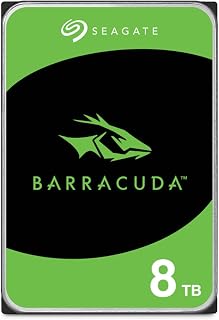
This BarraCuda model is built as a desktop drive, not one meant to run continuously in a multi-bay enclosure, so it's a poor match for round-the-clock NAS duty. It lacks vibration tolerance and rotational vibration sensors that RAID arrays need, and its SATA 6 Gb/s interface alone doesn't compensate for the missing NAS-grade firmware. Better suited as internal desktop storage than a home server drive.
Pros
- 8TB of bulk storage
- SATA 6 Gb/s interface
- 190MB/s sustained transfer rate cited
- Includes data recovery service
Cons
- Not positioned as a NAS-specific drive
- Slower random access than SSDs
An 8TB drive can be appealing when the priority is simply adding a large pool of storage, but the BarraCuda is positioned for desktops and gaming consoles rather than as a dedicated NAS model. That makes it a selective choice for a NAS-focused list. Its 3.5-inch internal mechanical design and SATA connection are familiar fits for a standard PC tower, while the 8TB capacity gives media libraries, game collections, and large project files substantial room to grow. The existing information cites sustained transfer performance of 190MB/s, reinforcing this drive’s strength with big, sequential file operations instead of speed-sensitive random access. A listed data recovery service is another useful inclusion. For readers looking for storage that actually holds a large volume of files without needing SSD-like responsiveness, capacity is the BarraCuda’s central appeal. The trade-off is clear: mechanical drives are slower than SSDs for booting, application launches, and intensive random-access work. They also produce modest heat and noise while operating. Since its listed compatible devices are desktops and gaming consoles, this drive is best viewed as bulk storage for those systems rather than a purpose-built choice for an always-on NAS enclosure.
Storage Capacity: 8 TB
Interface: SATA 6 Gb/s
Form Factor: 3.5 inches
Drive Type: Mechanical Hard Disk
Sustained Transfer Rate: 190 MB/s
Compatible Devices: Desktop, Gaming Console
Installation: Internal Hard Drive
Included Services: Data Recovery Service
Packaging: Frustration Free (anti-static bag)
Buy the BarraCuda 8TB if the immediate need is spacious internal storage for a desktop PC, gaming setup, media library, or large creative files. It makes the most sense for workloads centered on capacity and sequential transfers, where its mechanical design is not a drawback. Skip it if the storage will face demanding, constant random-access work or if fast startup and application performance are the main goals. It is also not the natural fit for shoppers specifically seeking a NAS-oriented drive, since its listed compatibility emphasizes desktops and gaming consoles.

Pros
- Class-leading 24TB capacity reduces the number of drives needed, lowering TCO and power consumption
- Exceptional 2.5 million hour MTBF rating provides confidence for critical infrastructure deployments
- Proven CMR technology delivers consistent performance without the complexity of newer recording methods
- Hot-swap design minimizes maintenance windows and operational disruption
- 3-year seller warranty provides solid protection for renewed enterprise hardware
Cons
- Renewed condition means cosmetic wear or prior use, which may concern buyers needing pristine hardware
- SATA interface limits performance compared to newer SAS or NVMe alternatives for ultra-high-speed applications
- 24TB capacity drives are best suited for large-scale deployments and may be overkill for smaller storage needs
The Western Digital Ultrastar DC HC580 24TB is an enterprise storage workhorse designed for hyperscale data centers, cloud service providers, and organizations managing massive volumes of data. This drive targets infrastructure teams prioritizing raw capacity, cost efficiency, and proven reliability over cutting-edge performance metrics.
Performance and storage capacity are the headline features here. The 24TB capacity cuts the number of physical drives needed by half compared to 12TB alternatives, reducing chassis footprint, power draw, and hardware management overhead. The 7200 RPM spindle speed combined with a 512MB cache and SATA 6Gb/s interface ensures predictable, responsive access for server workloads. The exceptional 2.5 million hour MTBF (Mean Time Between Failures) rating reflects WD's enterprise engineering and inspires confidence in deployments running continuous operations.
Build and design reflect data center realities. CMR technology delivers consistent performance across the diverse workload patterns typical in RAID arrays and cloud environments. Hot-swap capability minimizes downtime during maintenance or drive replacement. The drive is built for 24/7 operation without compromise, making it suitable for mission-critical applications where uptime directly impacts revenue.
The renewed condition is the primary consideration. This drive has previous service history but has been tested and certified to meet OEM specifications. For data center operators comfortable with refurbished hardware and prioritizing cost savings, it represents exceptional value. New deployments or environments requiring pristine components may prefer unused alternatives.
The Ultrastar DC HC580 is the right choice for large-scale storage environments where capacity, reliability, and total cost of ownership matter more than incremental speed gains. If you are building out a data center, expanding a cloud storage platform, or managing big data infrastructure, this 24TB drive delivers the performance and dependability your systems need.
Core Specifications: 24TB capacity, 3.5-inch form factor, 7200 RPM, SATA 6Gb/s interface, 512MB cache, CMR technology, 600 MB/s data transfer rate.
Reliability: 2.5 million hour MTBF rating, designed for 24/7 continuous operation, enterprise-class durability standards.
Physical and Connectivity: Hot-swap capable, internal hard drive installation, compatible with data center servers and RAID systems.
Warranty: 3-year seller warranty included with renewed purchase.
Who Should Buy: Data center operators, cloud infrastructure providers, system integrators deploying large-scale storage, and organizations managing big data or archival workloads prioritizing capacity and cost efficiency over maximum speed.
Who Should Avoid: Users needing brand-new hardware with full OEM warranties, small office environments where 24TB capacity exceeds requirements, applications demanding the absolute lowest latency, or deployments where used equipment creates compliance concerns.
Key Considerations: Verify your servers support SATA 3.5-inch drives in the required quantity. Confirm your infrastructure team is comfortable with renewed/refurbished components. Plan for appropriate RAID configuration and redundancy strategies to maximize the drive's reliability benefits. Consider power and cooling requirements at scale when deploying multiple units.

Pros
- Purpose-built NAS design reduces wear and extends drive lifespan in continuous-duty environments
- Fast 180MB/s transfer speeds and 64MB cache minimize bottlenecks for team file access
- Exceptional reliability with 1M hour MTBF and comprehensive 3-year warranty coverage
- Health monitoring tools enable proactive drive maintenance and early failure detection
- Quiet operation with minimal vibration suits office and home network installations
Cons
- 5400 RPM speed is slower than high-performance desktop drives, better for shared access than speed-critical tasks
- 4TB capacity may require multiple drives for larger enterprise-scale storage needs
- CMR technology offers less advanced features than newer SMR alternatives for sequential workloads
The Seagate IronWolf 4TB is a NAS-specific internal hard drive designed for small to medium business networks and prosumer home storage setups. Built for multi-user environments requiring reliable 24/7 operation, this drive targets teams that prioritize uptime and data accessibility over raw speed.
Performance and reliability are where this drive shines. With 180MB/s read speeds, a 64MB cache, and an exceptional 1 million hour MTBF rating, the IronWolf handles continuous file sharing across network teams without the hiccups or downtime that plague consumer-grade drives. The integrated IronWolf Health Management system actively monitors drive condition, allowing administrators to catch potential issues before failures occur.
Physically, the 3.5-inch aluminum enclosure is engineered for noise and vibration reduction, making this drive suitable for office environments where quiet operation matters. Power consumption is optimized for 24/7 duty cycles, reducing heat and electricity costs compared to standard desktop drives. The drive fits seamlessly into NAS enclosures supporting up to 8 bays.
The main limitation is rotational speed. At 5400 RPM, this drive prioritizes reliability and efficiency over raw performance. Heavy sequential workloads or applications requiring maximum throughput may benefit from higher-speed alternatives. Additionally, 4TB is entry-level for serious network storage; teams with substantial data needs will require multiple drives or larger capacity options.
The Seagate IronWolf 4TB is an excellent choice for small business networks, collaborative teams, and enthusiasts building reliable NAS systems. With a 3-year warranty and included Rescue Data Recovery services, you get both protection and peace of mind. This is a solid workhorse drive built to last.
NAS drives like the IronWolf differ fundamentally from consumer desktop drives in several key ways. NAS drives are engineered for 24/7 continuous operation with optimized firmware for multi-user access patterns, while desktop drives are designed for periodic use and single-user workloads. This distinction matters because NAS drives manage vibration and thermal stress differently, resulting in longer lifespans in shared environments.
The IronWolf's 1M hour MTBF rating reflects this engineering focus. Desktop drives typically promise shorter MTBF values because they are not stress-tested for always-on scenarios. Additionally, NAS drives include health monitoring and error recovery features tailored for network storage, allowing administrators to proactively manage drive health across multiple units.
The IronWolf 4TB suits several specific use cases. Small businesses building departmental file servers, creative teams sharing large media files, and home users running Plex, Nextcloud, or other network storage applications all benefit from this drive's reliability and performance balance. RAID enthusiasts assembling 4, 6, or 8-bay systems will appreciate the vibration control and 24/7 duty rating.
However, if you need maximum raw speed for workstations, streaming servers, or heavy database operations, consider higher RPM alternatives. If your storage needs exceed 4TB, the IronWolf family offers capacities up to 16TB, allowing you to scale without changing drives later. Evaluate your expected file access patterns, bay count, and total capacity needs before purchasing a single drive.

Pros
- Built and tested specifically for NAS systems, not consumer-grade drives repurposed for network use
- CMR technology maintains stable performance throughout the drive's lifespan without performance degradation issues
- Generous 180 TB/year workload rating handles concurrent access in small business and SOHO setups
- NASware firmware reduces vibration and compatibility issues common in multi-drive environments
- 3-year warranty reflects manufacturer confidence in durability for 24/7 operation
Cons
- 5400 RPM speed is slower than desktop drives, making it unsuitable for high-performance computing tasks
- Entry-level 4TB capacity may require additional drives for expanding storage as business needs grow
- Requires 8-bay NAS system compatibility for optimal performance, not suitable for external USB enclosures or single-drive setups
The WD Red Plus 4TB is a specialized NAS hard drive engineered for small to medium-sized business environments and serious SOHO users who need reliable network storage. Unlike consumer drives repurposed for NAS duties, this drive is built from the ground up with NASware firmware and CMR technology specifically for 24/7 continuous operation in multi-bay systems.
What sets this drive apart is its proven track record in demanding environments. With support for up to 8-bay systems and a 180 TB/year workload rating, it handles concurrent file access, RAID array rebuilding, and continuous data transfers that would strain consumer-grade hardware. The 64MB cache and 5400 RPM speed provide the right balance between performance and thermal efficiency for network environments where reliability outweighs raw speed.
Build quality is solid with aluminum enclosure and compact 3.5-inch form factor that fits standard NAS enclosures without modification. The drive runs quietly and generates minimal heat, important factors when multiple drives operate in proximity. SATA 6 Gb/s connectivity ensures no bottlenecks in data transfer, even with simultaneous access patterns common in small offices.
The main limitation is speed. At 5400 RPM, this drive is not designed for gaming, video editing, or intensive single-user applications. Additionally, the 4TB capacity is modest by today's standards, so growing storage needs may require purchasing multiple units. The 3-year warranty is standard for the category but shorter than some enterprise alternatives.
For NAS users, this is the right choice. The WD Red Plus delivers dependable performance in network storage systems, backed by purpose-built firmware and a warranty that reflects manufacturer confidence in durability. Recommended for small businesses, creative professionals with shared storage needs, and anyone serious about protecting their digital assets in a networked environment.
The WD Red Plus 4TB is designed for specific use cases. You should consider this drive if you operate a NAS system with 2 to 8 bays and need dependable storage for file archiving, backup, or RAID configurations. It excels in SOHO environments where uptime matters and multiple users access shared storage.
Skip this drive if you need high-speed storage for gaming, video editing, or database servers. Consumer-grade drives or enterprise SSDs are better for those applications. Also avoid if your NAS system is single-drive or external USB only, as you need a proper NAS enclosure to leverage this drive's strengths.
Capacity planning matters. The 4TB model is entry-level for NAS. Calculate your actual storage needs accounting for RAID overhead (typically 25 to 50 percent of raw capacity lost to redundancy) and growth over the next 2 to 3 years. Many users find larger capacities more cost-effective long-term. This drive is available up to 14TB if your budget and system support it.

Built specifically for NAS enclosures, this IronWolf drive uses RAID-optimized firmware designed to handle multi-bay vibration and continuous read/write cycles that desktop drives can't tolerate. At 8 TB with a SATA 6 Gb/s interface, it gives home server builders enough capacity for media libraries or backups while the 3.5 inch form factor fits standard NAS bays. A sound pick for anyone assembling redundant storage.
Pros
- Built specifically for NAS use
- Up to 210MB/s read speed
- 7200 RPM with 256MB cache
- IronWolf Health Management included
Cons
- Mechanical random access trails SSDs
- Limited to NAS systems with eight bays or fewer
Shared storage only works when the drive behind it can keep pace with several people accessing files, and the IronWolf 8TB is built around that NAS requirement. This 3.5-inch SATA hard drive combines 8TB of capacity with a 7200 RPM rotational speed, 256MB cache, and read speeds up to 210MB/s. The source information also cites sustained performance of 180MB/s, making it well suited to the large-file transfers and media streaming that define many home, business, and creative-team NAS setups. Its NAS focus goes beyond headline transfer speeds. Vibration-reducing technology and optimized thermal management are intended for operation in enclosures with multiple drives, while IronWolf Health Management monitors drive health and can flag potential issues. The stated 1 million-hour MTBF rating further supports its role in long-term, demanding storage environments. It is described as appropriate for NAS systems with up to eight bays and includes a three-year warranty plus Rescue Data Recovery service. For storage that actually remains useful when more than one user needs access, the IronWolf offers the right balance of capacity, sustained performance, and NAS-specific management. As a mechanical drive, it still cannot match an SSD’s random-access responsiveness.
Storage Capacity: 8 TB
Interface: SATA 6 Gb/s
Form Factor: 3.5 inches
Spindle Speed: 7200 RPM
Cache Memory: 256 MB
Data Transfer Rate: 6 Gb/s
Read Speed: 210 MB/s
Sustained Performance: 180 MB/s
MTBF: 1 million hours
Dimensions: 5.79 inches L x 4.01 inches W x 1.03 inches Thickness
Weight: 1.6 pounds
Warranty: 3 years limited
Data Recovery Service: 3 years included
Model Number: ST8000VNZ04
Supported NAS Bays: Up to 8 bays
Buy the IronWolf 8TB if you run an eight-bay-or-smaller NAS for shared files, media streaming, business storage, or a creative team. It is especially appropriate when several users may access data at once and you want 8TB per drive, 7200 RPM performance, health monitoring, and features designed for multi-drive enclosures. Skip it if your workload depends on extremely fast random access or SSD-like responsiveness. It is also unnecessary for someone who only needs basic internal storage in a desktop or gaming console.

Pros
- Massive 12TB capacity maximizes storage density and reduces the number of drives needed
- Specifically engineered for NAS environments with optimized firmware and vibration tolerance
- Robust reliability features including health monitoring, enterprise warranty, and data recovery service
- Excellent 180MB/s speed balances performance with power efficiency for continuous operation
- SATA 6Gb/s interface ensures broad compatibility with existing NAS enclosures and systems
Cons
- Higher upfront cost compared to standard desktop drives, though justified for professional use
- Mechanical design generates some operational noise in very quiet office environments
- 12TB capacity may exceed storage needs for smaller organizations or personal users
The Seagate IronWolf 12TB is a specialized internal hard drive engineered specifically for network-attached storage environments where reliability and performance matter. It is designed for businesses, creative teams, and power users who need dependable multi-bay storage systems running 24/7 without interruption.
What sets this drive apart is its purpose-built NAS architecture. With 180MB/s read speeds and a 256MB cache, it delivers responsive performance for file sharing and backup workflows. The IronWolf Health Management system actively monitors drive health, alerting users to potential issues before failures occur. Coupled with a robust 1M hours MTBF rating, this drive is built to last in demanding environments.
Design and build quality are excellent. The drive operates quietly with minimal vibration, a critical advantage in office settings where multiple units run simultaneously. Its optimized firmware reduces wear on mechanical components during the constant read/write cycles typical of NAS usage. Power consumption is kept low without sacrificing speed, making it cost-effective for long-term deployment.
The main drawback is cost. At this capacity and performance tier, expect a premium price that makes sense only for serious storage needs. Additionally, the mechanical design does generate some audible operation, though far less than consumer drives. The 12TB capacity may be excessive for users with modest storage requirements.
Verdict: The Seagate IronWolf 12TB is an excellent choice for organizations and enthusiasts building reliable, high-capacity NAS systems. Its engineering, warranty coverage, and health management tools deliver professional-grade dependability that justifies the investment for mission-critical storage applications.
Capacity and Performance: 12TB capacity with 256MB cache, 180MB/s read speed, 240MB/s write speed, 7200 RPM spindle speed
Interface and Compatibility: SATA 6.0Gb/s (6Gbps data transfer rate), 3.5-inch form factor, compatible with standard NAS enclosures supporting up to 8 bays
Reliability: 1M hours MTBF (Mean Time Between Failures), operating temperature maximum 65 degrees Celsius, built-in IronWolf Health Management system
Warranty and Support: 3-year limited warranty, 3-year Rescue Data Recovery Service included, model number ST12000VNZ008
Physical: 1.4 pounds weight, dimensions 5.79 inches L x 4.01 inches W x 1.03 inches thickness, metal enclosure
Who Should Buy: The IronWolf 12TB is ideal for small-to-medium businesses running network storage, creative professionals needing collaborative file access, system administrators building redundant backup solutions, and enthusiasts with demanding multi-user storage needs. It is not cost-effective for casual personal use or single-user systems.
Capacity Considerations: At 12TB, this drive suits organizations storing large media files, databases, or comprehensive backups. For smaller teams or personal archival, consider lower-capacity IronWolf models starting at 2TB.
RAID and Redundancy: This drive is optimized for RAID configurations, which provide fault tolerance. Plan your RAID level (RAID 1, 5, 6, etc.) based on performance and protection needs. The drive supports RAID-ready environments up to 8 bays.
Installation and Setup: Ensure your NAS enclosure supports 3.5-inch SATA drives and confirm power supply capacity. The IronWolf Health Management system integrates with most modern NAS operating systems for proactive monitoring.

Pros
- Exceptional 26TB storage capacity reduces the number of drives needed in large deployments
- Helium-sealed construction minimizes power draw and heat generation in data center environments
- Enterprise workload rating and high MTBF make it dependable for continuous backup and archival tasks
- Hot-plug capability allows maintenance and upgrades without taking systems offline
- Renewed pricing provides significant savings compared to new enterprise-grade alternatives
Cons
- As a renewed product, it may show cosmetic wear and comes with a shorter warranty than new OEM units
- 7200 RPM is slower than SSDs, making it unsuitable for applications requiring high-speed random access
- Enterprise drives typically carry higher failure rates in consumer environments with inconsistent cooling and power management
The Seagate Exos 26TB ST26000NM000C is a purpose-built enterprise storage solution designed for hyperscale data centers, cloud infrastructure providers, and organizations managing petabyte-scale deployments. This renewed unit delivers the same industrial-grade reliability as new OEM inventory at a significantly lower price point, making it ideal for IT departments managing large-scale infrastructure projects or businesses seeking cost-effective backup and archival solutions.
The standout feature is its helium-sealed architecture paired with 26TB capacity. The helium design reduces mechanical friction inside the drive, allowing sustained operation at 7200 RPM while minimizing power consumption and heat output. This efficiency matters in data centers where thousands of drives run simultaneously. The SATA 6Gb/s interface ensures compatibility with existing enterprise systems without requiring specialized controllers, and hot-plug support means technicians can swap failed drives during operation.
Build quality reflects enterprise standards. The drive is rated for 2.5 million hours MTBF, translating to decades of expected service life under normal conditions. The 512MB cache handles typical enterprise workloads effectively. However, this is fundamentally a mechanical hard drive, so performance is measured in throughput and reliability rather than speed. It excels at sequential data operations like backup streams and video archival but will feel slow compared to solid-state alternatives for random-access workloads.
The renewed condition is the primary consideration. This unit has been returned, tested, and repackaged by Amazon, which means it may show cosmetic wear and includes a 2-year seller warranty instead of the manufacturer's standard coverage. For environments where new OEM units are cost-prohibitive, the renewed option represents excellent value, though risk-averse buyers should budget for new drives in production systems.
The Seagate Exos 26TB is recommended for data center operators, cloud service providers, and enterprises building large-scale storage infrastructure where capacity and reliability matter more than speed. It represents the practical balance between enterprise reliability and cost efficiency. For consumer NAS systems or personal backup, a lower-capacity desktop drive or cloud service may be more appropriate.
Core Specifications: Capacity: 26TB, Interface: SATA 6Gb/s, Form Factor: 3.5-inch, Spindle Speed: 7200 RPM, Cache: 512MB, Data Transfer Rate: 6Gb/s
Reliability and Features: MTBF: 2.5M hours, Design: Helium-sealed, Hot-plug support, Workload rating: Enterprise 24/7 operation, Warranty: 2-year seller warranty (renewed)
Physical and Connectivity: Model: ST26000NM000C, Manufacturer: Seagate, UPC: 728434330875, Compatible with desktop, laptop, and server environments
Ideal For: Data center operators, cloud infrastructure teams, enterprise IT departments managing large backup systems, archival storage facilities, and organizations running hyperscale deployments requiring massive capacity with proven reliability.
Not Recommended For: Consumer NAS users on tight budgets, gamers, content creators needing fast random access, or buyers requiring brand-new condition warranties and support.

Pros
- Excellent reliability record with extensive user base validation across NAS environments
- Quiet operation and low power consumption ideal for always-on systems
- Fast data transfer rates and responsive performance for business workloads
- Industry-leading customer support with quick response times for warranty claims
- Compatible with virtually all mid-range NAS systems and RAID configurations
Cons
- Recent production batches ship with PUIS (Power-Up In Standby) enabled, causing compatibility issues with some NAS enclosures until firmware is manually adjusted
- Pricing has increased significantly due to market demand, making it a premium choice versus consumer-grade alternatives
- Occasional DOA (Dead on Arrival) units reported, though rare relative to overall sales volume
The WD Red Plus 4TB is a specialized NAS hard drive engineered for small to medium business environments and tech-savvy users who demand continuous, reliable storage. Unlike standard desktop drives, this unit is specifically tuned for RAID-optimized systems and can operate across multiple-bay NAS enclosures without performance degradation. It serves businesses, personal storage enthusiasts, and anyone who needs mission-critical data availability.
Performance and reliability shine with this drive's 180 MB/s transfer speeds, 128 MB cache, and NASware technology that intelligently manages workloads across RAID arrays. The 5400 RPM spindle speed, contrary to some confusion in customer reviews, was intentionally designed to balance responsiveness with power efficiency and thermal management. Rotation Vibration sensors further enhance stability by compensating for vibration interference common in multi-drive NAS systems. Real-world users consistently report smooth operation and fast file transfers across diverse NAS platforms including Synology, QNAP, and Ubiquiti systems.
Build quality reflects Western Digital's enterprise heritage, with this drive housed in a robust 3.5-inch form factor weighing 1.2 pounds. The drive runs remarkably quiet for its class and operates at low temperatures, making it suitable for environments where noise and heat matter. The included 3-year limited warranty provides substantial protection, and Western Digital's support team has earned praise for responsive, helpful service when issues arise.
One significant drawback emerged with recent production batches: some units ship with PUIS (Power-Up In Standby) firmware enabled, causing certain NAS systems to misidentify the drive as failed until manually reconfigured. This affects a minority of units but can be frustrating for end users. Additionally, market pricing for this drive has climbed substantially, positioning it as a premium option compared to standard consumer-grade alternatives.
The WD Red Plus 4TB remains an excellent investment for anyone building or maintaining a reliable NAS system. Its proven track record, dedicated NAS engineering, and strong warranty support justify the premium cost for business users and serious enthusiasts who cannot afford downtime. For casual users seeking basic network storage, budget alternatives may suffice, but for RAID-based data protection and continuous operation, this drive delivers confidence and performance.
Storage and Performance: 4TB capacity, 5400 RPM spindle speed, 180 MB/s read speed, 5.6ms average latency, 128 MB cache memory
Interface and Connectivity: SATA 6 Gb/s (Serial ATA-600), 3.5-inch form factor, CMR (Conventional Magnetic Recording) technology
Physical Specifications: Dimensions 8 inches (L) x 3 inches (W) x 5.99 inches (Thickness), Weight 1.2 pounds, Red color housing
Features and Protection: NASware technology for RAID optimization, Rotation Vibration sensors, designed for NAS systems up to 8 bays, 3-year limited warranty, supports continuous 24/7 operation
Compatibility: Works with desktop NAS systems, compatible with Synology, QNAP, Ubiquiti, and other RAID-capable enclosures (with possible PUIS firmware adjustment on recent batches)
What is NASware Technology? WD Red Plus drives feature NASware firmware that optimizes performance specifically for Network Attached Storage systems. This includes intelligent load balancing across multiple drives in RAID arrays, vibration compensation for multi-bay environments, and enhanced power management for continuous operation.
Important Firmware Note: Some recent WD Red Plus 4TB units ship with PUIS (Power-Up In Standby) enabled. If your NAS reports the drive as failed or shows blank model/serial information after installation, contact your NAS manufacturer or WD support for PUIS adjustment instructions. Older stock and individual retailer units may have different firmware versions, so purchasing from reputable vendors is recommended.
Supported NAS Systems: This drive has been verified to work with Synology DiskStation series, QNAP TS series, Ubiquiti UNAS systems, and most other mid-range RAID-capable NAS enclosures. When installing in QNAP systems, contact QNAP directly for the correct mounting screws, as standard hardware may not fit the drive tray properly.

Pros
- Massive 14TB capacity maximizes storage efficiency in limited rack space
- Consistent 200MB/s read speed supports demanding multi-user NAS environments
- Purpose-built for network storage with optimized firmware and thermal management
- Renewed pricing offers significant savings versus new comparable drives
- Proven reliability rating of 1M hour MTBF for mission-critical storage
Cons
- Renewed condition means drive has been previously used, requiring format on first installation
- Bare drive only without mounting hardware, screws, or cables included
- Limited compatibility information in reviews may require tech support verification for some legacy systems
The MDD 14TB NAS hard drive is a purpose-built storage solution designed for network administrators, small business owners, and data center operators who need reliable, high-capacity storage in a compact 3.5-inch form factor. This renewed drive combines enterprise-grade specifications with budget-friendly pricing, making it an accessible option for those upgrading or expanding existing NAS infrastructure.
Performance-wise, the drive delivers impressive specifications with 7200 RPM spindle speed, a generous 256MB cache, and consistent 200MB/s data transfer rates via SATA 6.0 Gb/s interface. These figures translate to responsive file access and smooth multi-user operations, whether you are managing shared network folders, running RAID arrays, or monitoring surveillance systems. The NAS-optimized firmware minimizes vibration and noise, enabling reliable continuous operation in environments where uptime matters.
Build quality reflects MaxDigitalData's focus on reliability, with a rated MTBF of 1 million hours indicating solid engineering and component selection. The 3.5-inch form factor fits standard NAS enclosures and server bays efficiently, while the polycarbonate enclosure provides adequate protection during installation. The renewed status means this unit passed Amazon's quality checks, though it arrives as a bare drive requiring formatting before use.
One consideration is that this renewed drive does not include mounting screws, cables, or accessories, so ensure you have compatible SATA cables and hardware on hand. Additionally, as a renewed product, it carries the typical expectations of pre-owned electronics, though the 5-year warranty from the reseller provides meaningful protection and peace of mind.
Overall, this 14TB MDD NAS drive represents solid value for those building reliable network storage systems on a budget. With strong performance metrics, proven reliability ratings, and extended warranty coverage, it serves as a practical choice for RAID configurations, NAS enclosures, and backup solutions where capacity and dependability matter more than cutting-edge speed.
Storage Capacity: 14 TB
Form Factor: 3.5 inches
Interface: SATA 6.0 Gb/s (Serial ATA-600)
Spindle Speed: 7200 RPM
Cache Memory: 256 MB
Data Transfer Rate: 6 gigabits per second
Read Speed: 200 MB/s
MTBF: 1 million hours
Weight: 1.5 pounds
Model: MD14TSATA25672NAS/5YR
Warranty: 5 years from reseller
Unit Type: Bare drive only, no accessories included
Who Should Buy This Drive: This drive suits NAS administrators, small business owners building RAID systems, surveillance operators maintaining large video archives, and enthusiasts expanding storage capacity on limited budgets. It works well in any application requiring reliable 24/7 operation at capacity, from home media servers to modest enterprise deployments.
Who Should Consider Alternatives: If you need the latest performance for high-speed gaming or professional video editing, newer consumer SSDs or high-RPM drives may serve you better. If you require brand-new warranty coverage or prefer avoiding renewed products, standard new drives from major manufacturers offer that peace of mind despite higher costs.
Installation Considerations: Ensure your NAS enclosure or server supports standard 3.5-inch SATA drives. Have SATA cables and mounting hardware available, as this bare drive includes neither. Format the drive on your system before use to ensure proper detection. Check compatibility with your specific NAS model or RAID controller before purchasing if using legacy systems.
NAS Hard Drive Buying Guide
NAS-Optimized Firmware vs. General-Purpose Drives
Not every hard drive belongs in a NAS enclosure. Drives like the Seagate 8TB IronWolf Internal NAS Hard Drive and the Western Digital 4TB WD Red Plus NAS Internal Hard ship with NAS-specific firmware that handles multi-drive vibration compensation and error recovery tuning. These features prevent a single drive’s recovery cycle from stalling an entire RAID array.
General desktop drives like the Seagate 8TB BarraCuda Internal Hard Drive can work in lighter NAS workloads, but they’re not optimized for continuous multi-user access. For anything beyond casual personal use, purpose-built NAS drives are the smarter long-term investment.
Capacity and Workload Rating
Think realistically about how much data you’re managing now and where you’ll be in two or three years. Drives like the MDD (MD14TSATA25672NAS) 14TB 7200 RPM 256MB Cache hit a sweet spot for growing media libraries and business backups, while the Western Digital Ultrastar DC HC580 WUH722424ALE604 at 24TB suits data centers or hyperscale environments where consolidating drives matters.
Workload rating is equally important. A drive rated for 180TB per year will handle a small home server comfortably, but a busy team sharing files around the clock needs something with a higher sustained rating. Always match the drive’s workload spec to your actual usage pattern, not just the capacity number on the label.
CMR vs. SMR Technology
Conventional Magnetic Recording (CMR) and Shingled Magnetic Recording (SMR) behave very differently inside a RAID or ZFS array. CMR drives, including the Seagate IronWolf 4TB NAS Internal Hard Drive CMR and the Western Digital 4TB WD Red Plus NAS Internal Hard, write data in non-overlapping tracks, which means faster, more predictable write performance during RAID rebuilds.
SMR drives can struggle under the sustained write loads that RAID rebuilds demand, sometimes causing timeouts that drop the drive from the array entirely. If your NAS runs any form of redundancy, confirm the drive uses CMR before you buy. The WD Red Plus line explicitly labels its CMR models to help you avoid any confusion during this period of product transition.
Spindle Speed, Cache, and Bay Count
Most NAS drives spin at 5400 RPM, which keeps heat and noise low in multi-bay enclosures. But if your workflow involves constant large-file transfers or surveillance-grade recording, a 7200 RPM drive like the ST6000NM0115 3.5″-Inch HDD 6TB 7200 RPM 512e SATA or the Seagate IronWolf 12TB, Interne Harde Schijf delivers noticeably faster throughput. Pair that with a 256MB or 512MB cache and you get much smoother performance under heavy random I/O.
Also confirm that your chosen drive supports the number of bays in your enclosure. Most NAS-rated drives in this list support up to 8-bay systems, which covers the vast majority of home and small-business setups. Larger enterprise arrays may require drives with extended vibration management, like the Seagate Exos 26TB Internal Hard Drive HDD, rated for data center-class continuous operation. For tech shoppers building out a full home network, our guide to gifts for tech lovers covers complementary gear worth pairing with a new NAS setup.
Final Thoughts
For most home users and small teams, the Seagate 8TB IronWolf Internal NAS Hard Drive offers the best combination of NAS-tuned performance, health monitoring, and long-term reliability. If you’re running a larger setup or need room to grow without swapping drives, the MDD (MD14TSATA25672NAS) 14TB 7200 RPM 256MB Cache delivers serious capacity with a generous warranty that justifies the investment.
Frequently Asked Questions
What is the difference between a NAS hard drive and a regular desktop hard drive?
NAS drives are engineered specifically for always-on, multi-user environments. They include vibration compensation, tuned error recovery settings, and firmware optimized for RAID arrays, features you won’t find on a standard desktop drive. Running a desktop drive in a NAS enclosure under heavy workloads significantly shortens its lifespan and can cause RAID instability.
How many bays do I need for a home NAS in 2026?
A two-bay NAS is enough for most home users who want basic redundancy through RAID 1. If you’re storing 4K video libraries, running a Plex server, or sharing files with multiple users simultaneously, a four-bay setup gives you more flexibility for capacity expansion and better RAID options. All the drives reviewed here support up to 8-bay systems, so you have room to grow either way.
Is CMR or SMR better for NAS storage?
CMR is the stronger choice for NAS environments, particularly when your enclosure uses RAID 5, RAID 6, or ZFS. SMR drives write data in overlapping tracks, which causes significant slowdowns during the sustained writes that accompany RAID rebuilds. For reliable, consistent performance in any redundant array, stick with confirmed CMR drives like the IronWolf CMR or WD Red Plus lines. If you’re curious about building out a full tech setup, check out our guide to the best Black Friday router deals to pair with your NAS on the network side.
How long do NAS hard drives typically last?
Enterprise and NAS-class drives are rated by MTBF (Mean Time Between Failures), often listed at 1 million hours or more for consumer NAS drives and up to 2.5 million hours for enterprise models like the Seagate Exos lineup. In real-world use, well-maintained NAS drives commonly last five years or longer. Keeping your enclosure ventilated, monitoring drive health with built-in tools like IronWolf Health Management, and replacing aging drives proactively are the best ways to protect your data in 2026 and beyond.




Write Your Review
No reviews yet. Be the first to share your experience!