

Whether you’re fine-tuning a large language model, running generative AI pipelines, or accelerating deep learning inference, your GPU is the most critical variable in your setup. The wrong card leaves you bottlenecked on memory bandwidth or VRAM capacity, while the right one can cut training times dramatically and let you work with larger datasets locally.
This guide covers ten of the strongest NVIDIA options on the market right now, ranging from space-efficient workstation cards to flagship professional accelerators. If you’re browsing the broader Graphics Cards category, this list focuses specifically on AI-oriented performance criteria so you can zero in on what actually matters for your use case.
Quick Comparison
Ratings reflect the most recent data pull. Check each listing for current price and availability.
Quick answer
This guide compares 10 picks, with NVIDIA RTX A1000 8GB Professional Graphics Card - Ray ranked first. ASUS ProArt RTX 5080 16GB GDDR7 Graphics Card holds the highest customer rating among them. ASUS TUF Gaming RTX 5080 16GB GDDR7 OC Graphics Card has the most customer reviews. NVIDIA Tesla L40S 48GB AI Graphics Accelerator leads this list on VRAM.

The 8GB GDDR6 memory provides entry-level capacity for inference deployment where models have already been trained and compressed. Its compact form factor and lower power requirements suit edge deployment scenarios or development workstations where initial prototyping happens before scaling to larger infrastructure. The RTX A1000's professional drivers ensure compatibility with CUDA-dependent libraries and frameworks. This tier works for researchers experimenting with smaller datasets or running pre-trained models for transfer learning without investing in flagship hardware.
Pros
- 3.6x higher AI performance over T1000, driven by 72 third-generation Tensor cores
- Low-profile form factor fits tight workstation and small-form-factor chassis
- 8GB GDDR6 handles moderate AI inference and generation workloads
- Ampere architecture balances AI compute efficiency with reasonable thermal output
Cons
- 8GB memory ceiling limits larger AI model training and bigger dataset workflows
- PCI-Express x8 interface and GDDR6 bandwidth lag behind newer-generation professional cards
For AI workloads that need to run on compact or space-constrained hardware, the NVIDIA RTX A1000 punches well above its physical size. Built on the Ampere architecture, it carries 2,304 CUDA cores, 8GB of GDDR6 memory, 72 third-generation Tensor cores, and 18 second-generation RT cores into a low-profile form factor measuring just 6.42 by 2.72 inches. Those Tensor cores are the headline for AI practitioners: compared to the T1000 predecessor, this card delivers 3x faster AI image and video generation and 3.6x higher overall AI performance. Workflows involving neural upscaling, inference pipelines, or AI-assisted asset generation benefit directly from that Tensor core throughput. The PCI-Express x8 interface and GDDR6 memory at 1200 MHz keep data moving efficiently without demanding a full-length slot. For professionals running AI workloads in small-form-factor workstations or dense multi-system setups, the RTX A1000 offers a credible on-ramp to accelerated compute without requiring a chassis rebuild.
GPU Architecture: NVIDIA Ampere
CUDA Cores: 2,304
Tensor Cores: 72 (3rd generation)
RT Cores: 18 (2nd generation)
Memory: 8GB GDDR6
Memory Clock: 1200 MHz
Video Interface: 4x Mini DisplayPort
Maximum Resolution: 7680 x 4320 (8K)
Form Factor: Low-profile
PCIe Interface: x8
Physical Dimensions: 6.42 inches L x 2.72 inches W
Weight: 453 grams
Compatibility: Desktop systems with PCIe x8 slot
Model Number: 900-5G172-2580-000
Best suited for AI practitioners, engineers, and designers who work in compact or low-profile desktop workstations where a full-size card is not an option. Also a strong fit for those running inference, neural upscaling, or AI-assisted creative pipelines at a professional level. Users who need heavy large-model training at scale should skip it, as 8GB of GDDR6 will become a bottleneck before the compute does.

The 24GB GDDR7 ECC memory corrects bit errors during multi-day training runs, preventing corrupted gradients that would otherwise ruin model convergence. ECC protection matters when training large models where a single flipped bit can cascade into unusable weights. The RTX PRO 4000's professional driver stack offers better compatibility with frameworks like TensorFlow and PyTorch. Its compact form factor fits workstations where space is constrained but demanding inference workloads require dedicated acceleration beyond consumer cards.
Pros
- 24GB GDDR7 memory with ECC error correction supports large models and ensures data integrity
- Low-profile dual-slot design enables AI workloads in space-constrained and rackmount systems
- PCIe 5.0 x8 interface delivers high CPU-to-GPU bandwidth for data-intensive pipelines
- Blackwell architecture includes dedicated AI and ray tracing acceleration cores
Cons
- 577 MHz base clock speed is lower than consumer alternatives, limiting raw peak compute throughput
- Requires a PCIe 5.0 compatible motherboard to fully realize bandwidth advantages
The NVIDIA RTX PRO 4000 SFF Blackwell is engineered specifically for AI development and scientific computing workloads, and its hardware choices reflect that focus directly. The 24GB of GDDR7 memory with ECC error correction is the headline advantage for AI work: larger models fit in memory without spilling to system RAM, and ECC prevents silent data corruption during long training runs or inference pipelines where a single bit error can invalidate results. The Blackwell architecture brings ray tracing and AI acceleration that maps well to simulation and generative model workflows. What makes this card distinctive for AI workloads is the combination of capacity, reliability, and physical footprint. At 6.6 inches long in a low-profile dual-slot form factor, it installs into workstations and rackmount servers where full-length cards simply will not fit. PCIe 5.0 x8 connectivity provides the bandwidth needed for data-intensive AI applications. For research institutions and studios running AI workloads in space-constrained environments, this card fills a gap that few others address.
Memory and Architecture: 24GB GDDR7 with ECC support, 1125 MHz memory clock, Blackwell architecture
Performance: 577 MHz GPU clock, PCIe 5.0 x8 interface, ray tracing acceleration, up to 7680x4320 resolution support
Physical Design: 6.6 inches length, 2.7 inches width, low-profile dual-slot format, single cooling fan, 5 pounds weight
Connectivity: 4x Mini DisplayPort 2.1b outputs for multi-monitor setups and professional displays
Warranty and Support: 3-year manufacturer warranty, manufactured by PNY, model RTX PRO 4000 SFF Blackwell
Designed for AI researchers, data scientists, and machine learning engineers working in compact workstations, small form factor desktops, or rackmount deployments where space is limited but VRAM capacity and data integrity cannot be compromised. Also a strong fit for creative studios handling AI-assisted rendering. Skip it if you need maximum clock speeds for raw throughput or if your system lacks PCIe 5.0 support to fully utilize its bandwidth.
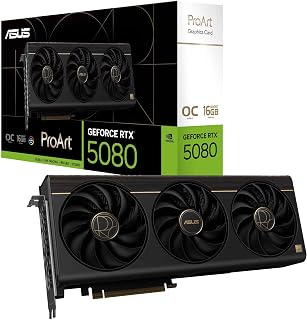
The 16GB GDDR7 memory provides sufficient capacity for training medium-scale neural networks and running inference on large language models without constant data transfers. Its 2730 MHz clock speed accelerates matrix operations central to transformer architectures and convolutional networks. The ProArt line's stability-focused design ensures uninterrupted training sessions that can run for days, while GDDR7's bandwidth handles the memory-intensive data pipelines typical in computer vision and natural language processing tasks.
Pros
- 1858 AI TOPS with 2730 MHz OC clock delivers strong sustained AI compute throughput
- Vapor chamber plus phase-change thermal pad maintains stable temperatures under continuous workloads
- 2.5-slot compact chassis fits workstations with limited expansion space
- Auto-Extreme manufacturing and MaxContact heatsink support long-term reliability in production environments
Cons
- 15-20% performance uplift over the previous ProArt 4080 generation may not justify upgrading an existing capable setup
- PCIe Gen 4 systems require motherboard BIOS adjustments before the card operates correctly
The ASUS ProArt RTX 5080 brings 1858 AI TOPS and a 2730 MHz boost clock to AI workloads inside a thermally disciplined 2.5-slot package. That combination matters for researchers and engineers who need sustained inference or training runs without thermal throttling derailing long jobs. The vapor chamber, three Axial-tech fans, and phase-change GPU thermal pad work together to hold temperatures steady under continuous compute loads, which is where gaming-oriented coolers often fall short. GDDR7 memory running at speed over a PCIe x16 interface feeds Blackwell Tensor Cores consistently, keeping data-hungry model operations from stalling. Auto-Extreme manufacturing and the MaxContact heatsink design speak directly to reliability over months of heavy utilization. The integrated USB Type-C port adds flexibility for data transfer in lab or studio environments. For AI professionals who also handle 4K rendering or live inference pipelines alongside model training, the ProArt variant offers thermal headroom and build quality that justify its flagship position in a professional workstation.
GPU: NVIDIA GeForce RTX 5080, Blackwell Architecture
Memory: 16GB GDDR7
Clock Speed: 2700 MHz (Default), 2730 MHz (OC Mode)
AI Performance: 1858 AI TOPS
Interface: PCIe 5.0 x16
Video Outputs: 1x HDMI 2.1b, 1x USB Type-C, 2x DisplayPort 2.1b
Max Resolution: 7680x4320 pixels
Cooling: 3x Axial-tech Fans, Vapor Chamber, Phase-Change GPU Thermal Pad
Form Factor: 2.5-slot, 12" Length x 5" Width
Weight: 3.1 pounds
Power Connectors: PCIe 5.0 compliant
Warranty: 3 Years
Software: GPU Tweak III for performance monitoring and overclocking
Best suited for AI researchers, machine learning engineers, and technical content creators who run sustained CUDA workloads and need rock-solid thermal performance over long sessions. Also a strong fit for anyone combining AI model work with 4K video rendering in a single workstation. Skip it if your workloads are light or occasional, if you are already on a well-performing RTX 4080 ProArt setup, or if PCIe Gen 4 BIOS adjustments on your motherboard are not something you want to manage.
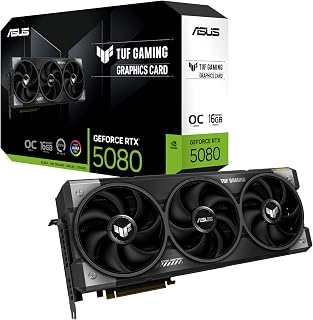
With 16GB GDDR7 memory, this card handles batch sizes large enough to stabilize gradient descent during training without excessive iteration overhead. The 2730 MHz boost clock reduces time per epoch when training convolutional networks for image classification or object detection. Three DisplayPort 2.1a outputs let you monitor training metrics, dataset visualizations, and system resources simultaneously. The TUF cooling system maintains consistent performance during extended training sessions where thermal throttling would otherwise degrade throughput and prolong experimentation cycles.
Pros
- Blackwell Tensor Cores with DLSS 4 support accelerate AI inference and compute pipelines effectively
- Phase-change thermal pad maintains consistent thermal contact without degradation over long AI training sessions
- Military-grade components and PCB coating suit continuous, always-on workstation operation
- GPU Tweak III enables real-time monitoring and power tuning for sustained compute jobs
Cons
- Mandatory 850W PSU minimum and 348mm card length require careful system compatibility verification before purchase
- 3.6-slot design limits available expansion slots in compact or densely configured workstations
Built on NVIDIA's Blackwell architecture, the ASUS TUF Gaming RTX 5080 brings serious AI acceleration credentials to a chassis engineered for sustained heavy loads. The Blackwell Tensor Cores paired with DLSS 4 support translate directly into faster inference and GPU-accelerated compute pipelines. What sets this card apart for AI workloads is thermal endurance: the phase-change GPU thermal pad delivers consistent heat transfer that does not degrade over long training runs the way traditional thermal paste can, and three Axial-tech fans with an optimized fin array keep temperatures controlled session after session. Military-grade components and a protective PCB coating guard against the environmental stress that comes with always-on workstation use. GPU Tweak III provides real-time monitoring and granular tuning, useful for dialing in power and clock behavior during extended model training. The 16GB GDDR7 frame buffer handles large model batches comfortably. The tradeoff is the 3.6-slot footprint and a hard 850W PSU minimum, both of which require deliberate system planning before committing to this card.
GPU: NVIDIA GeForce RTX 5080
Memory: 16GB GDDR7
Boost Clock: 2730 MHz (OC Mode), 2700 MHz (Default Mode)
Physical Dimensions: 348mm length, 3.6-slot design, 4.3 lbs
Video Outputs: 3x DisplayPort 2.1a, 2x HDMI 2.1b
Power Requirement: Minimum 850W PSU with 16-pin 12V-2x6 (12VHPWR) connector
Manufacturing: Auto-Extreme precision automated manufacturing
Cooling: Three Axial-tech fans, phase-change GPU thermal pad, protective PCB coating
Power Supply: Verify your PSU is rated for 850W minimum and includes the required 16-pin 12V-2x6 (12VHPWR) connector. Standard 6-pin or 8-pin connectors are insufficient for this card.
Physical Clearance: Confirm your case accommodates the 348mm length and can support the 3.6-slot width requirement. Measure internal dimensions and account for storage drives, fans, and other components that may interfere with the card's placement.
System Integration: The card includes a GPU bracket for secure installation. Ensure your motherboard provides adequate PCIe slot access and that your monitor cables support DisplayPort 2.1a or HDMI 2.1b for optimal performance.

The 256-bit memory interface paired with 16GB GDDR7 delivers bandwidth essential for feeding data to tensor cores during model training and inference. WINDFORCE cooling prevents thermal throttling that would slow down gradient computations across lengthy training epochs. The 2.73 GHz clock speed accelerates forward and backward passes through deep networks, shortening iteration times when experimenting with hyperparameters. Its GeForce RTX 5080 tensor cores provide hardware acceleration specifically designed for the mixed-precision operations common in modern frameworks.
Pros
- 16GB GDDR7 at 30000 MHz effective speed over PCIe 5.0 x16 delivers high bandwidth for large AI model batches
- Enhanced Blackwell Tensor Cores with DLSS 4 support accelerate both training and inference workloads
- 2.73 GHz boost clock sustains strong compute throughput across extended AI jobs
- WINDFORCE three-fan system manages thermals during continuous heavy compute loads
Cons
- 13.46-inch length and 4-pound weight demand thorough case compatibility checks before installation
- Substantial power draw and heat output require a robust PSU and good chassis airflow to maintain stable performance
The GIGABYTE RTX 5080 Gaming OC delivers the Blackwell architecture's enhanced Tensor Cores and RT Cores to AI workloads through a straightforward, high-throughput package. With 16GB of GDDR7 running at 30000 MHz effective clock speed over a PCIe 5.0 x16 interface, the card feeds compute-hungry AI operations with bandwidth that avoids the memory bottlenecks that can hamper larger model batches. The 2.73 GHz boost clock keeps Tensor Core throughput high across sustained runs. DLSS 4 support extends the card's utility to AI-assisted rendering and upscaling pipelines alongside pure model training or inference tasks. The WINDFORCE three-fan cooling system manages thermals during extended compute sessions, though the 13.46-inch length and 4-pound weight mean case selection matters. PCIe 5.0 support ensures the card is not constrained by interconnect bandwidth, which is relevant as data pipeline demands grow. A VGA holder and adapter are included to simplify physical installation. For AI researchers or engineers who want top-tier Blackwell compute performance without the premium of a purpose-built professional variant, this card covers the core requirements competently.
GPU Architecture: NVIDIA GeForce RTX 5080 (Blackwell)
Memory: 16GB GDDR7, 256-bit interface
Memory Speed: 30,000 MHz
GPU Clock: 2.73 GHz boost
Interface: PCIe 5.0 x16
Cooling: WINDFORCE triple-fan system
Power Connectors: 1x 12V connector, 2x 6-pin to 3x 8-pin adapter
Display Outputs: DisplayPort, HDMI
Max Resolution: 7680x4320 pixels
Physical Dimensions: 13.46 inches (L) x 5.59 inches (W)
Weight: 4 pounds
Warranty: 3-year manufacturer
Model: GV-N5080GAMING OC-16GD
Well suited for AI researchers, data scientists, and technical users who need maximum Blackwell Tensor Core throughput and wide GDDR7 bandwidth for model training, inference, or GPU-accelerated data processing. Also practical for those combining AI development with demanding 3D or rendering workloads. Skip it if your case cannot fit a 13.46-inch card, if your PSU and airflow setup cannot handle the substantial power draw and heat output, or if workloads are intermittent rather than sustained.

Pros
- Blackwell Tensor Cores with DLSS 4 and neural rendering accelerate AI inference workloads
- 16GB GDDR7 memory delivers high bandwidth for fast data throughput
- 2806 MHz clock speed handles compute-intensive bursts efficiently
- Stable thermals under sustained load without needing extra cooling support
Cons
- 16GB VRAM ceiling limits large model training and memory-intensive AI datasets
- No ECC memory support makes it unsuitable for mission-critical or error-sensitive AI applications
The NVIDIA GeForce RTX 5080 Founders Edition is built on the Blackwell architecture and brings meaningful AI acceleration to the consumer tier through its Tensor Cores, DLSS 4 support, and neural rendering capabilities. For AI workloads that do not require enterprise-grade error correction, the 16GB of GDDR7 memory provides fast bandwidth that keeps inference and lighter training tasks moving efficiently. The GPU clock speed of 2806 MHz ensures the card responds well to compute-intensive bursts common in model inference and real-time AI-assisted content generation. PCI Express 4.0 connectivity handles the CPU-to-GPU data transfers required for typical AI development workflows. The Founders Edition cooling design keeps thermals stable under sustained load, which matters for extended training runs. This is a card that sits at the intersection of high-end gaming hardware and accessible AI compute, making it attractive for developers who also use their workstation for gaming or creative work and want a single card that handles both without compromise.
GPU Architecture: NVIDIA Blackwell
Memory: 16GB GDDR7
GPU Clock: 2806 MHz
Display Outputs: HDMI, DisplayPort
Interface: PCI Express 4.0
Max Resolution: 3840x2160 (4K)
Weight: 2 pounds
Model: 900-1G144-2545-000
Format: Founders Edition Desktop Graphics Card
Best suited for AI developers, machine learning hobbyists, and content creators who need capable Tensor Core acceleration for inference, DLSS-enhanced workflows, and neural rendering without committing to a professional workstation GPU. Also fits researchers running smaller models locally. Skip it if your workloads require ECC memory for data integrity, demand more than 16GB of VRAM for large model training, or if your chassis cannot accommodate a large desktop card.

Pros
- Compact half-height design works in tight workstation builds and mini PCs
- Error-corrected GDDR6 memory provides stability for professional and scientific work
- Efficient thermal design with single active fan keeps noise and power low
- Trusted NVIDIA Quadro architecture for professional-grade reliability
- Strong customer feedback for real-world performance and ease of installation
Cons
- Mini DisplayPort connections may require adapters for legacy single-link displays
- Lower power budget limits performance compared to higher-tier professional cards
- Integrated GPU may require BIOS adjustment to disable in some mini PC systems
The NVIDIA RTX 2000 Ada is a professional-grade graphics accelerator built for creative professionals, AI researchers, and scientific computing applications where space and power efficiency matter. This compact card brings GPU acceleration to compact workstations, small-form-factor builds, and multi-GPU environments where larger cards won't fit.
Performance standouts include real-time rendering for 3D design workflows, AI-powered creative tools, and proven capabilities in quantum simulation and scientific computing. The 16GB of ECC-protected GDDR6 memory ensures data integrity for mission-critical work, while the half-height, dual-slot form factor squeezes into spaces where full-height cards cannot. Customers report flawless performance as a secondary GPU in workstations and reliable operation in space-constrained systems.
Build quality reflects NVIDIA's professional heritage. The blower-style active cooler is engineered for efficiency rather than silence, prioritizing sustained thermal performance in demanding workloads. The card's modest physical footprint (6.61L x 6.61W inches) and lightweight design make installation straightforward, and the Mini DisplayPort outputs support modern multi-monitor configurations.
One consideration: systems with integrated graphics may require BIOS adjustments to disable the iGPU when this card is installed, particularly in mini PCs. Additionally, the Mini DisplayPort standard may require passive adapters for older single-link display equipment. Power efficiency is a feature rather than a limitation, making this card ideal for deployments where thermal headroom and electricity costs are concerns.
The RTX 2000 Ada earns its place in professional and research environments where reliability, compact form factors, and GPU acceleration converge. It delivers proven performance, easy installation, and the backing of NVIDIA's professional driver support and 3-year parts availability.
3D designers and visual effects professionals building compact workstations or adding a secondary GPU to existing systems. The real-time rendering and AI tool acceleration deliver immediate workflow benefits without requiring case modifications.
Scientific researchers and quantum computing enthusiasts looking to run NVIDIA cuQuantum and similar GPU-accelerated applications on space-constrained hardware. The low power draw and 16GB memory support efficient multi-node research clusters.
Systems integrators and IT professionals deploying GPU acceleration in small-form-factor or thermally constrained environments. The half-height design and efficient thermal profile simplify system design and reduce cooling requirements.
Memory: 16GB GDDR6 with ECC error correction
Architecture: NVIDIA Ada (Quadro generation)
Memory Speed: 1250 MHz
Interface: PCI Express
Form Factor: Half-height, dual-slot, 6.61L x 6.61W inches
Cooling: Single blower-style active fan
Outputs: Mini DisplayPort
Max Display Resolution: 4K (3840x2160)
Weight: 0.08 kg
Model Number: 900-5G192-2541-000
Warranty: 3-year EU spare parts availability
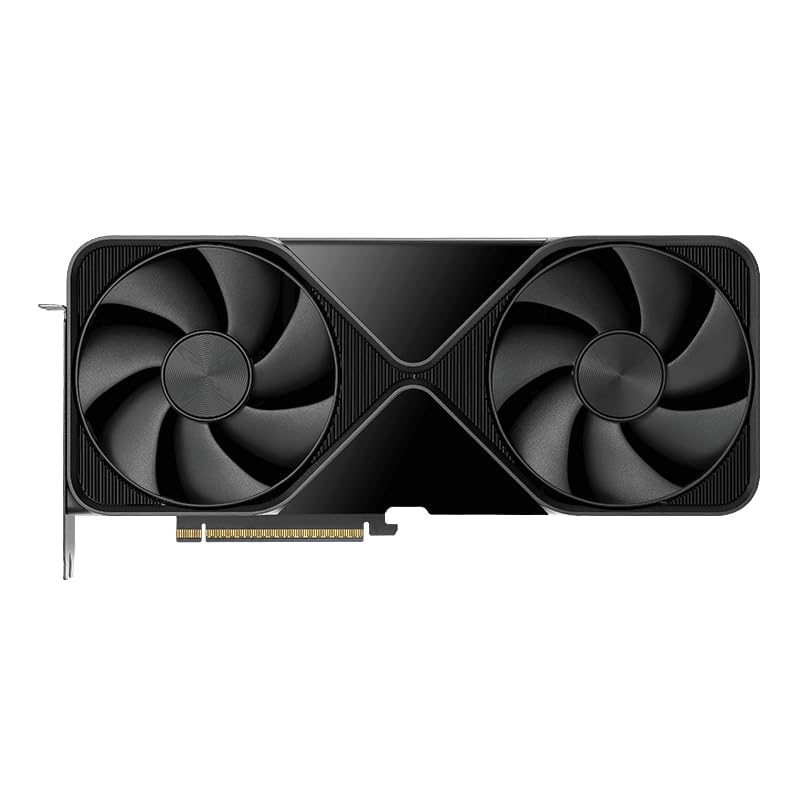
The massive 96GB GDDR7 ECC memory enables training and fine-tuning of exceptionally large language models that would require multi-GPU setups with smaller cards. ECC protection prevents silent data corruption during weeks-long training runs on billion-parameter architectures. Fifth-generation tensor cores deliver superior throughput for the FP8 and INT8 operations increasingly used in efficient inference serving. This capacity supports holding entire model weights in VRAM, eliminating host memory transfers that create bottlenecks when deploying production inference endpoints for real-time applications.
Pros
- 96GB GDDR7 ECC memory accommodates large language models and massive datasets in a single GPU
- 5th-gen Tensor Cores with FP4 precision deliver up to 3x AI throughput over the previous generation
- PCIe Gen 5 doubles bandwidth over Gen 4, reducing CPU-to-GPU transfer bottlenecks
- Two-slot form factor integrates into standard tower workstations despite flagship-class compute
Cons
- Side-mounted exhaust directs heat into the case interior, requiring careful airflow planning and supplemental fans
- OEM packaging has raised seller verification concerns, requiring careful inspection before purchase
The RTX PRO 6000 Blackwell Workstation Edition is purpose-built for the most demanding AI workloads available in 2026. Its 96GB of GDDR7 ECC memory is the defining capability: running large language models, training generative AI systems, and managing massive datasets that exhaust consumer and mid-tier professional cards all become feasible in a single-GPU workstation configuration. The 5th-generation Tensor Cores deliver up to three times the throughput of the previous generation and add FP4 precision support, which reduces memory footprint while accelerating AI inference and training simultaneously. PCIe Gen 5 connectivity doubles the bandwidth of Gen 4, directly addressing the CPU-to-GPU transfer bottleneck that limits throughput in data-intensive pipelines. The 4th-generation ray tracing cores also support AI-driven simulation and synthetic data generation for robotics and computational design. At 600W and a two-slot form factor, it integrates into tower workstations without demanding exotic infrastructure. This is the card for professionals where VRAM capacity and Tensor Core throughput are the primary constraints.
Memory and Compute: 96GB GDDR7 ECC memory with 1.8TB per-second bandwidth. 5th-generation Tensor cores with FP4 precision support. 4th-generation ray tracing cores with double the ray-triangle intersection rate.
Connectivity: PCIe Gen 5 interface. DisplayPort 2.1 with support for 8K at 240 Hz or 16K at 60 Hz. Single HDMI output. Universal MIG for workload partitioning and isolation.
Thermal and Power: 600W power consumption. Double-flow-through cooling design. Two-slot form factor. Dimensions 17x10x5 inches, 4 pounds.
Warranty and Support: 3-year manufacturer warranty. OEM packaging. Compatible with Windows operating systems on desktop tower systems.
Artificial Intelligence and Machine Learning: Run and fine-tune large language models locally without relying on cloud services. The 96GB memory and high-bandwidth Tensor cores enable fast training and inference for generative AI applications.
3D Design and Visualization: Build photorealistic renderings with complex geometry, HDR color depth, and multi-monitor precision layouts. Perfect for architectural visualization, visual effects, and product design workflows.
Data Science and Simulation: Process massive datasets and run computationally intensive simulations. The PCIe Gen 5 bandwidth and memory capacity handle data-intensive tasks that would bottleneck lesser GPUs.
Multi-Tenant Workloads: Universal MIG partitioning enables running multiple isolated workloads concurrently, ideal for shared workstations and enterprise environments requiring secure resource separation.

The 24GB GDDR7 ECC memory with 1230 MHz clock provides substantial capacity for fine-tuning large pre-trained models on domain-specific datasets while protecting against memory errors that corrupt gradient calculations. PCIe 5.0 x16 connectivity doubles bandwidth compared to previous generations, accelerating dataset loading from NVMe storage during training. The single-slot design allows dense multi-GPU configurations for distributed training across parallel model replicas. Professional-grade drivers ensure stability with frameworks like PyTorch and JAX throughout iterative experimentation cycles.
Pros
- 24GB GDDR7 with ECC handles large AI models and protects result integrity
- PCIe 5.0 x16 delivers maximum CPU-to-GPU bandwidth for data-intensive training pipelines
- Single-slot design preserves adjacent slots in multi-card or accessory-dense workstations
- 3-year manufacturer warranty supports production and research environments
Cons
- Single-fan thermal design requires adequate case airflow to sustain performance under sustained AI workloads
- Optimized for professional AI and rendering pipelines; lighter or consumer-oriented tasks will not justify the investment
The NVIDIA RTX PRO 4000 Blackwell is built around the specifications that matter most for serious AI workloads in 2026: memory capacity, memory integrity, and interconnect bandwidth. The 24GB of GDDR7 with ECC protection addresses two persistent pain points in AI work simultaneously. Large language models, diffusion pipelines, and complex training runs that frequently exceed 16GB of VRAM find room to operate, while ECC catches and corrects single-bit errors that would otherwise silently corrupt model weights or intermediate results. The PCIe 5.0 x16 interface doubles the bandwidth of the previous generation, reducing the CPU-to-GPU data transfer bottleneck that hampers data-heavy training loops. Memory clock speed sits at 1750 MHz, and the GPU core runs at 1230 MHz. The single-slot full-height design integrates into standard tower workstations without consuming the neighboring slot, which matters in multi-GPU or high-card-density builds. A 3-year manufacturer warranty reinforces the reliability expectations of production AI environments where downtime carries real cost.
GPU Architecture: Blackwell
Memory: 24GB GDDR7 with ECC
GPU Clock Speed: 1230 MHz
Memory Clock Speed: 1750 MHz
Interface: PCIe 5.0 x16
Display Outputs: 4x DisplayPort 2.1b
Max Resolution: 7680 x 4320 pixels
Power Configuration: Single-slot, full-height
Cooling: Single fan
Weight: 0.84 kg (1.85 lbs)
Dimensions: 9.5 inches L x 4.4 inches W
Warranty: 3 years manufacturer
Model Number: VCNRTXPRO4000B-PB

Pros
- Massive 48GB memory capacity handles large-scale AI models and datasets without bottlenecks
- Purpose-built for professional AI and HPC applications with verified enterprise reliability
- High memory bandwidth via 384-bit interface maximizes data throughput for compute-intensive tasks
- Dual-slot cooling design maintains optimal thermal performance under sustained workloads
- Broad compatibility with existing server and workstation infrastructures
Cons
- High power consumption at 300W requires robust PSU and cooling infrastructure planning
- Premium pricing limits adoption for small teams or budget-constrained projects
- Steep learning curve for teams unfamiliar with professional GPU computing and CUDA optimization
The NVIDIA Tesla L40S is a professional graphics accelerator purpose-built for data centers, research institutions, and enterprises tackling AI, machine learning, and high-performance computing. This GPU targets organizations requiring reliable, enterprise-grade acceleration rather than gaming or consumer applications, making it ideal for production environments where performance and stability are non-negotiable.
Built on NVIDIA's advanced AD102 architecture with 5nm process technology, the L40S delivers exceptional compute density with 18,176 CUDA cores, 568 specialized Tensor Cores for AI workloads, and 142 RT Cores for ray tracing. The 48GB of GDDR6 memory paired with a 384-bit interface ensures minimal memory bottlenecks, allowing researchers and engineers to work with massive datasets and complex models without constant data shuffling. Boost clocks reaching 2520MHz provide consistent performance across sustained workloads.
The dual-slot design accommodates a robust cooling solution necessary for continuous operation in server environments, while the card's compact 267mm length makes it compatible with most standard rack configurations. Multiple display outputs (HDMI 2.1 and three DisplayPort 1.4a connections) enable sophisticated multi-monitor visualization setups for data analysis and simulation work, supporting resolutions up to 16K for detailed rendering tasks.
The primary drawback is power consumption at 300W peak, requiring careful infrastructure planning with adequate power supplies and thermal management in data center deployments. Additionally, the premium enterprise pricing reflects the specialized market positioning, making it a significant capital investment that demands strong ROI justification for smaller organizations.
The Tesla L40S is the right choice for organizations operating at scale with serious AI, machine learning, or visualization requirements. Its enterprise architecture, exceptional memory capacity, and proven reliability make it a solid investment for production workloads where performance cannot compromise.
GPU Architecture: NVIDIA AD102, 5nm process technology, 609mm2 die area with 76.3 billion transistors
Compute Units: 18,176 CUDA Cores, 568 Tensor Cores, 142 RT Cores, 568 Texture Mapping Units, 192 ROPs
Memory: 48GB GDDR6, 384-bit memory interface, 2250MHz memory clock (18 Gbps effective)
Performance: Base 1110MHz, Boost up to 2520MHz GPU clock
Power and Cooling: 300W TDP, 1x 16-pin power connector, dual-slot active cooling solution
Connectivity: PCI-Express 4.0 x16, 1x HDMI 2.1, 3x DisplayPort 1.4a
Physical Dimensions: 267mm length, 111mm width (10.51L x 4.37W inches)
Supported Environments: Servers, workstations, DirectX 12 Ultimate compliant
What to Look for When Buying an NVIDIA GPU for AI
VRAM Capacity and Memory Bandwidth
For AI workloads, VRAM is often the first constraint you’ll hit. Loading large models, running batch inference, or fine-tuning locally all demand substantial GPU memory. A card like the NVD RTX PRO 6000 Blackwell offers 96GB of GDDR7 with 1.8TB/s bandwidth, which puts it in a class suited for enterprise-scale AI tasks.
For more accessible use cases, the NVIDIA RTX PRO 4000 SFF Blackwell 24GB GDDR7 ECC and NVIDIA RTX PRO 4000 Blackwell Graphics Card both offer 24GB GDDR7 with ECC, which is a solid middle ground for local model development. ECC memory is particularly valuable in AI workloads since it catches and corrects memory errors that could silently corrupt training runs.
Tensor Core Generation
Tensor Cores are the hardware engine behind matrix multiplication, which is the core operation in virtually every neural network layer. Newer generations support lower-precision formats like FP4 and FP8, which dramatically reduce memory usage and speed up throughput without meaningful accuracy loss in most inference scenarios.
The Blackwell-based cards on this list, including the NVIDIA GeForce RTX 5080 Founders Edition and the ASUS ProArt GeForce RTX 5080 16GB GDDR7 OC Edition, feature 5th-generation Tensor Cores with FP4 support. The Nvidia RTX A1000 uses 3rd-generation Tensor Cores, delivering solid AI acceleration in a low-profile form factor at a much lower entry point.
Form Factor and System Compatibility
Not every AI workstation has room for a three-slot, 350mm graphics card. If you’re working in a small form factor build or a rack-mounted server, form factor matters as much as raw performance. The NVIDIA RTX PRO 4000 SFF Blackwell 24GB GDDR7 ECC is explicitly designed for compact chassis, while the Nvidia RTX 2000 ADA 16GB Graphics Card fits a half-height dual-slot profile ideal for workstations with tight clearance.
On the other end, the ASUS TUF Gaming GeForce RTX™ 5080 16GB GDDR7 OC spans 3.6 slots at 348mm, so you’ll want to confirm case clearance and power supply headroom before committing. Always cross-reference the card’s length and slot width against your chassis specifications.
PCIe Generation and Data Throughput
For data-intensive AI pipelines, the interface between your CPU and GPU matters more than people often expect. PCIe 5.0 doubles the bandwidth of PCIe 4.0, which directly benefits tasks like streaming large datasets from system RAM into GPU memory. Cards like the NVIDIA RTX PRO 4000 Blackwell Graphics Card and the Tesla L40S 48GB AI HPC Graphics Accelerator are built for workloads where that throughput ceiling is a real bottleneck.
The GIGABYTE GeForce RTX 5080 Gaming OC 16G Graphics also runs on PCIe 5.0, making it a strong choice if you want consumer-tier pricing with a modern interface. Just confirm your motherboard supports PCIe 5.0 before purchasing, since not all current platforms do. You can explore more about power and connectivity choices in the Electronics hub for broader context.
Final Thoughts
For most developers and researchers running AI workloads locally, the sweet spot sits between accessible workstation cards and mid-tier professional GPUs. If you need a compact, budget-conscious entry point with genuine AI acceleration, the Nvidia RTX A1000 is a well-rounded performer that fits spaces where larger cards simply cannot go. If your work demands maximum VRAM and professional-grade reliability for large model fine-tuning or multi-workload deployments, the NVD RTX PRO 6000 Blackwell sits at the top of the stack with 96GB of ECC-protected GDDR7 and the bandwidth to match.
Frequently Asked Questions
What makes an NVIDIA GPU good for AI compared to gaming?
AI workloads prioritize Tensor Core throughput, VRAM capacity, ECC memory support, and sustained compute performance under long-running jobs. Gaming GPUs are optimized for high frame rates and rasterization, while professional and workstation-grade cards are tuned for the precision and reliability that training and inference pipelines require. That said, Blackwell-based consumer cards like the RTX 5080 series do deliver meaningful AI performance for developers who don’t need the full professional stack.
How much VRAM do I need for AI work in 2026?
It depends heavily on the models you’re running. Smaller fine-tuning jobs and inference tasks can fit comfortably in 16GB, but working with larger language models locally typically requires 24GB or more. For enterprise-scale tasks or running multiple workloads in parallel, 48GB to 96GB cards like the Tesla L40S 48GB AI HPC Graphics Accelerator or the NVD RTX PRO 6000 Blackwell become the practical choice in 2026.
Is ECC memory important for AI GPU workloads?
ECC, or Error-Correcting Code memory, detects and corrects single-bit memory errors automatically. For long training runs, this can mean the difference between a reliable result and a silently corrupted model checkpoint. Professional cards like the NVIDIA RTX PRO 4000 SFF Blackwell 24GB GDDR7 ECC include ECC as a standard feature, while most consumer gaming cards do not. If you’re running production or research-grade workloads, ECC support is worth prioritizing.
Can I use a low-profile GPU for AI development?
Yes, and it’s a practical option for workstations with limited slot clearance or small form factor builds. The Nvidia RTX A1000 is a strong example, offering 8GB of memory, 3rd-generation Tensor Cores, and a low-profile dual-slot design that fits chassis where full-size cards won’t. For lighter AI development tasks, prototyping, or running inference on mid-sized models, a well-specified low-profile card can handle the workload without requiring a tower-sized build.




Write Your Review
No reviews yet. Be the first to share your experience!