

AMD’s RX 9070 represents a significant leap in 1440p and 4K gaming capability, but pairing it with mismatched components wastes its potential. You need a processor that won’t throttle frame rates, memory fast enough for modern game engines, and cooling that handles sustained loads without thermal throttling.
This guide walks through eight carefully selected components that form a cohesive, high-performance system around the RX 9070. Each part addresses a specific performance requirement, from PCIe 5.0 bandwidth to DDR5 memory compatibility.

The 8-core, 16-thread design with 96MB of 3D V-Cache eliminates CPU bottlenecks in modern games that benefit from large cache pools. Socket AM5 ensures compatibility with DDR5 and PCIe 5.0, matching the capabilities of the RX 9070. The 4.2GHz base clock provides strong single-threaded performance for esports titles while the extra cache boosts frame rates in open-world games.
Pros
- 96MB L3 cache reduces frame time stuttering
- 8 cores prevent GPU bottlenecks in modern titles
- Efficient 5nm design reduces cooling requirements
- Socket AM5 provides future upgrade flexibility
Cons
- Requires Socket AM5 motherboard investment
- Integrated graphics insufficient for gaming workloads
Pairing the RX 9070 with a capable processor prevents CPU bottlenecks from undermining GPU investment, and the Ryzen 7 7800X3D delivers exactly that foundation. Eight cores and sixteen threads handle background tasks, streaming software, and system overhead while gaming, ensuring the GPU receives consistent frame pacing. The 96MB L3 cache dramatically reduces memory latency, which translates directly to higher minimum frame rates in CPU-sensitive titles. Clock speeds reaching 4.2 GHz provide snappy responsiveness across single-threaded workloads, while the 5nm architecture keeps power draw and heat generation reasonable. Maximum operating temperatures of 89°C mean modest cooling solutions suffice, avoiding expensive thermal hardware that inflates build costs. The Socket AM5 platform ensures upgrade paths remain open as AMD releases future processors. Integrated Radeon graphics provide troubleshooting capability if GPU issues arise, though discrete graphics remain essential for gaming. This processor balances gaming performance with productivity capability, making it suitable for builders who occasionally edit video or render 3D content alongside their gaming sessions.
Processor Specifications: The Ryzen 7 7800X3D features 8 CPU cores with 16 threads for efficient parallel processing. Clock speed reaches 4.2 GHz, with a maximum operating temperature of 89 degrees Celsius. The processor uses Socket AM5 for motherboard compatibility and employs a 5nm manufacturing process for superior efficiency.
Cache and Memory: This processor includes 8 MB of L2 cache and an impressive 96 MB of L3 cache, totaling 104 MB of high-speed memory. This substantial cache configuration significantly reduces memory latency and improves data throughput for demanding applications.
Graphics: Integrated AMD Radeon Graphics with a graphics frequency of 2200 MHz provides baseline graphics capability for general computing and light multimedia tasks without requiring a dedicated graphics card.
Ideal for gamers building a balanced RX 9070 system who value high frame rates and smooth multitasking, plus content creators occasionally rendering video or handling moderately threaded workloads. Skip this if your motherboard lacks Socket AM5 compatibility, you need maximum multicore performance for professional rendering, or you prefer Intel platforms.

DDR5-6000 with CL30 timing hits the sweet spot for Ryzen 7000 series performance, maximizing Infinity Fabric efficiency. AMD EXPO profiles enable one-click overclocking without manual tuning. The 32GB capacity (2x16GB) handles memory-intensive games and multitasking with Chrome or Discord open while maintaining dual-channel bandwidth for optimal frame pacing.
Pros
- 6000MT/s speed prevents CPU bottlenecks with high-end GPUs
- AMD EXPO enables one-click activation in BIOS
- Aluminum heatspreader manages heat during long sessions
- RGB lighting integrates without overwhelming case aesthetics
Cons
- Requires BIOS adjustment to reach advertised speed
- Premium DDR5 pricing targets higher budgets
Pairing an RX 9070 with fast, stable memory is essential for eliminating CPU bottlenecks and maximizing frame rates in 2026 titles. This 32GB dual-channel kit runs at 6000MT/s with CL30 timings, delivering the bandwidth modern AMD platforms need to keep pace with high-end graphics cards. AMD EXPO profiles remove configuration complexity, letting builders activate full speed with one BIOS toggle instead of manual tuning. The brushed aluminum heatspreader handles thermal loads effectively during extended sessions, while RGB lighting integrates cleanly into gaming builds without overpowering other components. Six heat pipes work with the aluminum fin array to maintain consistent temperatures under load. Compatibility spans current AMD platforms, and users report reliable stability across demanding gaming and multitasking scenarios. The matte black finish photographs well and suits most build aesthetics. While JEDEC fallback speeds work without adjustment, extracting peak performance requires brief BIOS interaction that EXPO simplifies significantly.
This memory kit is optimized for AMD Ryzen 7000 and 9000 series processors paired with AM5 socket motherboards. Supported chipsets include X870, X870-E, X870E-E, X670, X670-E, B850, B840, B650, B650-E, and A620. G.SKILL maintains a comprehensive QVL (Qualified Vendor List) and RAM Configurator tool on their website for verified motherboard compatibility.
For best results, use a single kit of matched memory. Do not mix this kit with other memory modules, as this can cause instability or system failure. The 32GB capacity (2x16GB configuration) provides ample headroom for current and near-future applications. If you need more capacity, purchase a second identical kit rather than mixing brands or specifications.
Memory will boot at safe JEDEC default speeds with compatible hardware and default BIOS settings. To achieve the 6000MT/s rating, enable the AMD EXPO profile in BIOS. Some older motherboard BIOS versions may require updates for full EXPO support, check your motherboard manufacturer's website for latest BIOS releases.

Six heat pipes with AGHP technology dissipate up to 265W, easily handling the Ryzen 7 7800X3D under sustained gaming loads. Dual 120mm PWM fans maintain 25.6dB noise levels, staying quiet during intense sessions. The dual-tower design maximizes surface area for heat dissipation without requiring a liquid cooling setup that adds complexity and maintenance.
Pros
- Six copper heat pipes maintain CPUs between 40-80°C depending on load
- Dual fans stay under 25.6dB during gaming sessions
- Universal mounting covers Intel and AMD platforms through 2026
- Clearance accommodates most standard RAM modules
Cons
- Physical dimensions require adequate case space
- Mounting hardware needs firm pressure for proper seating
An RX 9070 gaming rig generates significant heat under load, making CPU cooling a critical component choice. This tower cooler uses six copper heat pipes with AGHP technology to transfer thermal energy through an aluminum fin stack, maintaining processors in the 40-60°C range during typical gaming and 70-80°C under sustained workloads. Dual 120mm PWM fans spin at 1550RPM, moving 66.17 CFM while staying under 25.6dB, keeping noise levels manageable during intense sessions. Universal socket support covers both Intel LGA 1700/1851 and AMD AM4/AM5 platforms, fitting current and near-future upgrade paths. The electroplated fin design and reflow-welded construction provide durability that matches the expected lifespan of a mid-range gaming build. Generous RAM clearance means most standard memory modules install without interference, though final installation requires firm pressure to seat mounting hardware properly. The pure copper base ensures solid thermal contact with CPUs commonly paired with the RX 9070.
Cooler Dimensions: 4.92 inches L x 5.31 inches W x 6.1 inches H (125mm x 135mm x 155mm)
Material: Aluminum fins with pure copper heat pipes and base
Heat Pipes: 6 pure copper pipes with AGHP technology
Socket Compatibility: Intel LGA 1700, 1200, 115X platforms and AMD AM4, AM5 sockets
Fan Specifications: Dual 120mm PWM fans
Fan Speed: 1550 RPM (plus or minus 10%)
Air Flow: 66.17 CFM maximum
Noise Level: 25.6dB or lower
Power Connection: 4-pin connector, 12V
Weight: 907 grams
Choose this if you're assembling an RX 9070 system and need effective cooling for mid-range to upper-midrange CPUs without investing in liquid solutions. The balance of thermal capacity, low noise, and broad compatibility suits gamers focused on stable performance. Avoid this if your case has limited vertical clearance or if you're running extremely tall RAM with oversized heatspreaders. Builders upgrading from stock coolers will notice immediate thermal improvements, while those moving from premium air or AIO setups may find the performance incremental.
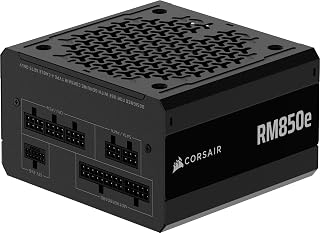
An 850W output handles the RX 9070 and a high-end CPU with headroom for peak power draws during gaming loads. ATX 3.1 and PCIe 5.1 compatibility means native support for the 12VHPWR connector without adapters. The 80 PLUS Gold certification delivers efficient power delivery, reducing heat and electrical costs during marathon gaming sessions.
Pros
- 850W headroom accommodates GPU and CPU upgrades
- ATX 3.1 and PCIe 5.1 certification ensures modern compatibility
- Full modularity improves airflow and cable management
- Quiet 120mm fan maintains acoustic comfort
Cons
- Minor coil whine possible under extreme loads
- Premium positioning exceeds budget-focused alternatives
An RX 9070 gaming build demands stable power delivery that accommodates both current hardware and future upgrades, and the CORSAIR RM850e provides exactly that capacity with modern certification standards. The 850W output supplies comfortable headroom for the RX 9070 alongside high-core-count processors, preventing power-related instability during sustained gaming sessions. Full modularity eliminates cable clutter that obstructs airflow around the GPU, while the included 12V-2x6 connector cable ensures PCIe 5.1 compatibility as graphics cards evolve. ATX 3.1 certification means transient power spikes from the GPU won't trigger shutdowns or crashes during intensive scenes. The 120mm rifle bearing fan remains nearly silent during typical gaming loads, maintaining acoustic comfort without sacrificing thermal performance. Compact 140mm dimensions fit standard mid-tower cases without blocking GPU installation or cable routing paths. Flat black cables simplify cable management behind motherboard trays, creating cleaner builds that improve both aesthetics and cooling efficiency. The combination of forward-thinking standards and practical headroom makes this supply suitable for builders planning multi-year system longevity rather than budget-focused short-term builds.
Power Output: 850 watts
Form Factor: ATX, fully modular
Connectors: 24-pin ATX, 8-pin EPS12V, native 12V-2x6 connector, multiple PCIe 8-pin connectors, 6x SATA, 2x PATA
Cooling: 120mm rifle bearing fan
Input Voltage: 100-240V AC
Dimensions: 5.91 x 5.51 x 3.35 inches
Weight: 3.4 pounds
Efficiency Rating: Cybenetics Gold
Capacitors: Industrial-grade 105C-rated
Warranty: 7 years manufacturer
Model: CP-9020296-NA
Perfect for builders assembling RX 9070 systems with upgrade plans, enthusiasts valuing quiet operation and clean cable management, and anyone prioritizing ATX 3.1 and PCIe 5.1 compliance for future hardware. Skip this if you need budget-tier pricing, require silent operation under extreme sustained loads, or prefer non-modular simplicity.
Pros
- Distinctive design that stands out with real wood panels and premium finishes
- Excellent component compatibility with support for large GPUs and multiple storage drives
- Thoughtful interior layout with intuitive cable management and component placement
- Includes quality 140mm fans reducing initial upgrade costs
- Strong thermal performance with open-front ventilation and flexible cooling options
Cons
- Premium price point may not appeal to budget-conscious builders
- Natural wood finish requires occasional maintenance to preserve appearance
- Limited to 2 included fans, additional cooling may be needed for high-end systems
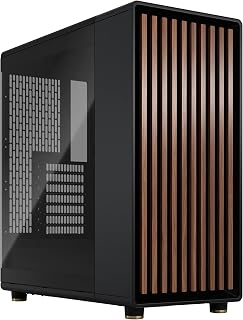
The Fractal Design North is a mid-tower PC case designed for builders who refuse to compromise on aesthetics. It caters to those wanting a gaming PC that complements modern living spaces rather than dominating them. With real walnut or oak front panels, brass accents, and a tempered glass side panel, this case proves that high-performance gaming builds don't need to look industrial.
The standout feature is undoubtedly the design philosophy. The open-front mesh ventilation isn't just functional, it's intentional, creating airflow while maintaining the minimalist aesthetic. Performance-wise, the case handles large graphics cards up to 355mm and supports full ATX motherboards. Two included 140mm PWM fans provide adequate base cooling, and the design accommodates 360mm front radiators for more demanding builds. The seven expansion slots offer extensive customization potential.
Build quality is premium throughout. The metal construction feels solid, the tempered glass side panel resists scratches while showing off your components, and the integrated tabs for removing panels prove that functionality was considered alongside form. Interior layout is intuitive with designated drive mounts and a cable management approach that doesn't feel cramped. Disassembly is tool-free, which is a practical touch.
The main drawback is cost. At this price point, you're paying a premium for design and materials. Natural wood also requires light maintenance to preserve its appearance over time. Additionally, while the two included fans are quality units, high-end builds may need supplemental cooling depending on your components and ambient conditions.
The Fractal Design North is an excellent choice if aesthetics matter as much as performance in your build. It's best suited for mid to high-end gaming systems where you want components that justify premium case design, and for builders with the budget to prioritize form factor alongside function.
This case supports a wide range of modern motherboards: ATX, mATX, and ITX form factors all fit comfortably. Graphics cards up to 355mm work without modification, though this reduces to 300mm if you're planning a 360mm front-mounted radiator, which is important to verify before purchasing.
Storage flexibility is solid with two combined 3.5-inch/2.5-inch drive mounts and two dedicated 2.5-inch slots. This gives you options for traditional drives, SSDs, or a hybrid setup. The seven bridgeless expansion slots support modern networking and expansion cards without limitations.

Pros
- Exceptional sequential and random read/write speeds reach 7,450/6,900 MB/s and 1,400K/1,550K IOPS respectively
- Superior power efficiency delivers more performance per watt than competing drives
- Excellent thermal management prevents thermal throttling during sustained workloads
- Strong compatibility with PS5, high-end gaming PCs, and modern laptops
- Highly rated by users with 4.7 out of 5 stars from thousands of verified purchases
Cons
- Requires PCIe 4.0 capable motherboard to achieve advertised speeds, limiting compatibility with older systems
- Premium pricing reflects high performance tier, making it less economical for casual users or basic storage needs
- Performance requires specific system configurations and may vary based on hardware and firmware versions
The Samsung 990 PRO 1TB is a flagship NVMe SSD engineered for users who demand peak performance. This drive targets serious gamers running PS5 or DirectStorage-enabled PC titles, content creators handling large video files, and professionals requiring rapid data access for productivity workflows. It represents Samsung's latest advancement in PCIe 4.0 technology.
Performance is the 990 PRO's strongest asset. Sequential read speeds reach 7,450 MB/s, nearly maxing out PCIe 4.0 theoretical limits. Random read and write speeds improve 40-55% over the previous 980 PRO generation, translating to snappier application loading and faster file operations. The drive achieves 1,400K and 1,550K IOPS for random reads and writes respectively, exceptional figures for intensive workloads.
Design and thermal management shine through Samsung's proprietary controller and nickel coating. The slim M.2 2280 form factor fits standard slots on virtually all modern motherboards, while the smart thermal control system maintains performance without requiring additional heatsinks in most cases. The drive weighs just 9 grams and measures less than 3 inches long, making it ideal for compact builds.
One limitation is the requirement for a PCIe 4.0 capable system. Older motherboards with PCIe 3.0 support will see significantly reduced speeds. Additionally, the premium positioning means this drive costs more than SATA alternatives, though the performance justifies the investment for intended use cases.
The Samsung 990 PRO earns recommendation for gamers, creators, and power users ready to invest in cutting-edge storage. The 5-year warranty and included Samsung Magician software add genuine value. For basic file storage or budget-conscious buyers, entry-level SSDs may suffice, but for maximum performance, this drive delivers.
Storage Capacity: 1TB
Interface: PCIe 4.0 NVMe M.2 2280
Sequential Read Speed: Up to 7,450 MB/s
Sequential Write Speed: Up to 6,900 MB/s
Random Read IOPS: Up to 1,400K
Random Write IOPS: Up to 1,550K
Form Factor: M.2 2280
Dimensions: 3.16 inches L x 0.87 inches W x 0.09 inches thick
Weight: 9.07 grams
Security: AES 256-bit Encryption
Warranty: 5 Years Manufacturer
Color: Black
Model Number: MZ-V9P1T0B/AM
Who Should Buy This? The 990 PRO suits gamers with PS5 or high-end gaming PCs, video editors and creative professionals, software developers, and anyone needing maximum storage performance. It also works for Mac users with compatible Thunderbolt 3 adapters and high-performance laptop upgrades.
System Requirements: Your motherboard or external enclosure must support PCIe 4.0 to unlock full speeds. Check your system documentation before purchasing. Windows 10 Pro and later, macOS, and Linux systems all support this drive. PS5 requires the drive in a compatible enclosure.
Installation Tip: Install Samsung Magician software after setup to monitor drive health, enable Intelligent Turbo Write for peak performance, and receive firmware updates. Most modern laptops and desktops have straightforward installation procedures, though consult your device manual when uncertain.

The 16GB GDDR6 memory and 2520MHz boost clock provide the raw performance needed for 1440p and 4K gaming in 2026. Triple fans with 0dB silent mode keep thermals in check during extended sessions while eliminating idle noise. PCIe 5.0 support ensures full bandwidth on modern motherboards, preventing bottlenecks that could limit frame rates in demanding titles.
Pros
- Factory overclock delivers immediate performance gains
- Excellent thermal management with quiet triple-fan cooling
- 16GB VRAM handles modern textures and ray tracing
- RDNA 4 architecture provides future-ready AI acceleration
Cons
- Requires 15.75-inch clearance and 2.5-slot spacing
- AMD driver maturity trails Nvidia on some platforms
Building around the RX 9070 requires a GPU that delivers both performance headroom and thermal efficiency, and the ASRock Challenger variant achieves this balance without compromise. The 16GB GDDR6 frame buffer ensures textures and assets load smoothly at 1440p and 4K, while the factory overclock to 2520 MHz provides competitive frame rates straight out of the box. RDNA 4 architecture with 56 compute units and dedicated ray tracing accelerators means this card won't struggle with lighting effects or AI-driven features in upcoming titles. The triple-fan cooling solution keeps temperatures below 70°C under sustained gaming loads, with the 0dB silent mode eliminating noise during lighter tasks. The 2.5-slot design and 15.75-inch length fit most modern cases, though clearance verification is essential. Two 8-pin connectors and a 700W PSU requirement keep power demands reasonable for a mid-range build. The LED indicator adds functional feedback without excessive RGB distraction, maintaining focus on gaming performance rather than aesthetics.
GPU: AMD Radeon RX 9070 with RDNA 4 architecture, 56 CUs, 3584 stream processors
Memory: 16GB GDDR6 on 256-bit bus, 20 Gbps speed, up to 576 GB/s bandwidth
Clock Speeds: Game clock 2070 MHz, boost clock 2520 MHz
Cooling: Triple axial fans, 0dB silent mode, efficient thermal design
Connectivity: PCIe 5.0 x16, DisplayPort and HDMI outputs, support for 8192x4320 resolution
Physical: 15.75 inches long, 8.66 inches wide, 2.5-slot design, 1.34 kg
Power: Dual 8-pin connectors, 700W PSU recommended
Warranty: 2-year manufacturer warranty
This card suits builders prioritizing 1440p gaming performance with room to grow into 4K, streamers running simultaneous encoding workloads, and content creators handling video editing or AI tasks. Skip this if you're migrating from Nvidia without checking BIOS compatibility, require guaranteed plug-and-play Linux support, or need a compact form factor under 15 inches.

Socket AM5 and DDR5 support provide the foundation for pairing the Ryzen 7 7800X3D with high-speed memory. PCIe 5.0 M.2 slots ensure maximum bandwidth for Gen5 SSDs while the primary PCIe slot delivers full lanes to the RX 9070. WiFi 6 and 2.5Gb Ethernet handle online gaming with low latency, and 14 power stages provide stable voltage delivery during extended sessions.
Pros
- Exceptional value for AM5 platform with premium B650 features at mid-range pricing
- Military-spec components and rigorous testing ensure reliability for 24/7 usage
- Next-gen connectivity with PCIe 5.0 and USB4 prepares you for future upgrades
- Excellent power delivery handles high-end Ryzen processors with thermal headroom
- Two-way AI noise cancellation improves streaming and communication clarity
Cons
- Limited to 4 memory slots caps maximum DDR5 capacity at 128 GB versus some higher-end boards
- Single Ethernet port and no WiFi 6E limits connectivity options for ultra-high-speed networks
- Requires BIOS updates for full compatibility with newest Ryzen 9000 series processors
The ASUS TUF Gaming B650-PLUS WiFi is a mid-range AM5 motherboard engineered for gamers and content creators who need reliable performance with modern connectivity. It supports AMD Ryzen 7000, 8000, and 9000 series processors and combines essential features like DDR5 support, PCIe 5.0 storage, and WiFi 6 networking at an accessible price point.
The standout feature is the robust 14-stage power delivery system paired with military-grade TUF components. Real-world performance remains stable under sustained gaming sessions and content creation workflows. The PCIe 5.0 M.2 slot future-proofs your storage expansion, while USB4 support future-proofs peripheral connectivity. Comprehensive cooling with enlarged VRM and M.2 heatsinks plus Fan Xpert 2 utility gives you granular thermal control.
Build quality reflects ASUS TUF durability standards with alloy chokes, durable capacitors, and rigid PCB construction. The board feels premium despite its mid-range positioning. Edge lighting design and Aura Sync RGB integration appeal to enthusiast builders without compromising functionality. At 454 grams, it's solidly constructed without unnecessary bulk.
The primary limitations are practical rather than technical. Four memory slots max out at 128 GB DDR5 capacity, limiting some workstation scenarios. Single 2.5 Gb Ethernet port and lack of WiFi 6E may disappoint users in ultra-high-speed networking environments. Ryzen 9000 series support requires BIOS updates on newer retail units.
Verdict: The TUF Gaming B650-PLUS WiFi delivers exceptional value for builders seeking stability, next-gen connectivity, and durability. It's the smart choice for gaming rigs and creative workstations where reliability matters more than cutting-edge extras. Recommended for mid-range to high-end AM5 builds.
Socket and Compatibility: Socket AM5 compatible with AMD Ryzen 7000, 8000, and 9000 series processors. Supports DDR5 memory up to 6400 MHz across 4 slots for maximum 128 GB capacity.
Power and Cooling: 14-stage power delivery (12+2 configuration), 8+4 ProCool sockets, alloy chokes, and durable capacitors. Enlarged VRM and PCH heatsinks with M.2 heatsinks and hybrid fan headers managed by Fan Xpert 2 plus utility.
Storage and Expansion: PCIe 5.0 M.2 slot, 4 total PCIe ports, 4 SATA ports, and USB4 support. Supports SATA 600 standard for legacy drives.
Networking and Audio: Single 2.5 Gb Ethernet port with TUF LANGuard protection, WiFi 6, and two-way AI noise cancellation. Optical S/PDIF connector for audio outputs.
Connectivity: USB 3.2 Gen 2x2 Type-C, front USB 3.2 Gen 1 Type-C, 8 total USB ports, 2 USB 2.0 headers, and 1 HDMI output port.
Best For: Gamers building mid-range to high-end AM5 systems, content creators needing multi-core processing, and enthusiasts who value durability and next-gen connectivity over premium extras.
Processor Pairing: Pairs excellently with Ryzen 5 7600X through Ryzen 9 7950X and newer 8000/9000 series chips. The 14-stage power delivery handles high-end CPUs with thermal headroom.
Memory Compatibility: Supports DDR5 memory. Capacity limited to 128 GB maximum. Verify BIOS compatibility before purchasing Ryzen 9000 series CPUs as updates may be required.
When to Consider Alternatives: If you need more than 2 M.2 slots, premium WiFi 6E, or dual 10G Ethernet, consider higher-end B850 boards. If budget is primary concern, base-model B650 options exist at lower price points.
Buying Guide: Matching Components to RX 9070 Performance
CPU Selection for GPU Bottleneck Elimination
The RX 9070’s 3584 stream processors and second-generation AI accelerators demand a processor that delivers consistent frame pacing. Eight cores with 3D V-Cache technology provide the L3 capacity modern game engines require, reducing memory latency that creates stuttering during complex scenes.
Clock speeds above 4.0 GHz on all cores ensure the CPU can feed frame data to the GPU without introducing wait states. For builders prioritizing gaming over productivity workloads, prioritize cache size and single-thread performance over raw core count, as proper cooling solutions become essential when pushing these frequencies.
Memory Speed and Capacity Requirements
DDR5 memory running at 6000 MT/s or higher eliminates bandwidth constraints between system memory and GPU transfers. The RX 9070’s 16GB GDDR6 VRAM handles textures and geometry, but system RAM still feeds asset streaming, physics calculations, and background processes that compete for bandwidth.
Dual-channel configurations with 32GB total capacity prevent memory pressure during demanding titles that cache large open worlds. CL30 timings at 6000 MT/s represent the optimal balance between frequency and latency for AM5 platforms, particularly when paired with budget-conscious DDR5 options that maintain performance.
Storage Performance for Asset Streaming
PCIe 4.0 NVMe drives with read speeds exceeding 7000 MB/s eliminate loading screen delays and texture pop-in during rapid camera movement. Modern game engines stream assets dynamically, making sustained sequential read performance more important than burst speeds or synthetic benchmarks.
1TB minimum capacity accommodates operating system overhead, essential applications, and three to five AAA titles with high-resolution texture packs. Drives using TLC NAND maintain write performance during game installations and updates without the endurance concerns of QLC alternatives, especially important for users who frequently install and remove games based on external storage needs.
Power Supply Headroom and Efficiency
The RX 9070’s transient power spikes require ATX 3.1 compliance with native 12V-2×6 connectors that handle instantaneous load changes without voltage droops. An 850W unit provides sufficient overhead for the GPU’s peak consumption plus CPU boost states, while maintaining 50-60% load during typical gaming for optimal efficiency curves.
Gold-rated efficiency reduces heat output inside the case, which directly impacts GPU temperatures in compact builds. Modern standby compatibility ensures rapid wake times without sacrificing component longevity, addressing the reality that gaming systems spend more time idle than under load, similar to considerations when selecting peripheral power requirements.
Airflow Architecture and Thermal Management
Unrestricted front intake paired with exhaust ventilation creates positive pressure that prevents dust accumulation while feeding cool air directly to GPU fans. Cases supporting triple 140mm fans move higher volumes at lower RPMs compared to 120mm alternatives, reducing acoustic signatures during sustained loads.
GPU clearance up to 355mm accommodates the RX 9070’s triple-fan cooler without compromising airflow pathways. Removable dust filters and tool-free side panels simplify maintenance, critical for preserving thermal performance as systems accumulate operating hours. Builders should verify motherboard standoff compatibility and cable routing channels before committing to a specific chassis configuration.
Final Thoughts
Building around the RX 9070 requires balancing bandwidth, thermal output, and future upgrade paths without overspending on unnecessary premium features. The AMD Ryzen 7 7800X3D 8-Core eliminates CPU bottlenecks at 1440p and 4K resolutions, while the G.SKILL Trident Z5 Neo RGB Series DDR5 RAM delivers the memory bandwidth modern game engines demand. Focus on confirmed compatibility with AM5 platforms, verify case dimensions against GPU length, and prioritize ATX 3.1 power supplies to handle transient loads without voltage instability.
Frequently Asked Questions
Does the RX 9070 require a PCIe 5.0 motherboard?
The RX 9070 functions fully on PCIe 4.0 slots without performance loss, as current games don’t saturate PCIe 4.0 x16 bandwidth. PCIe 5.0 compatibility future-proofs your build for upcoming DirectStorage implementations but isn’t mandatory for 2026 gaming performance.
What minimum RAM speed should I target for RX 9070 builds?
DDR5-6000 with CL30 timings represents the sweet spot for AM5 platforms paired with the RX 9070. Faster speeds like DDR5-6400 offer diminishing returns unless you’re running memory-intensive workloads beyond gaming. Avoid DDR5-4800 JEDEC speeds, as they introduce unnecessary memory latency that impacts frame pacing, especially in configurations similar to budget DDR5 builds.
How much PSU wattage does an RX 9070 system actually need?
An 850W power supply handles the RX 9070’s transient spikes plus CPU boost states with comfortable headroom. The GPU’s instantaneous power excursions can momentarily double listed TDP, so 750W represents the absolute minimum with no upgrade room. Choose ATX 3.1 certified units with native 12V-2×6 connectors rather than adapter cables.
Can I use an air cooler with high-end Ryzen processors in RX 9070 builds?
Dual-tower air coolers with six heat pipes adequately cool processors like the 7800X3D during gaming loads, often matching 240mm AIO performance while eliminating pump failure risks. Verify cooler height against your case specifications and ensure RAM clearance with tall heat spreaders. Air cooling reduces system complexity and maintenance requirements compared to liquid solutions, similar to choosing between AIO aesthetics versus air cooler reliability.


Write Your Review
No reviews yet. Be the first to share your experience!