

Building a high-end gaming or creator rig demands a GPU that can handle 4K ray tracing, AI workloads, and next-gen rendering without compromise. The RTX 5090 represents NVIDIA’s most powerful consumer graphics architecture yet, combining massive VRAM capacity with specialized AI accelerators that transform how you work and play.
This guide evaluates 10 premium RTX 5090 cards across thermal performance, overclocking headroom, and build compatibility. Whether you’re running local LLM inference, creating AI-enhanced content, or pushing frame rates in demanding titles, you’ll find the specific features that matter for your workflow. Check out our complementary PC case recommendations for RTX 5090 builds to complete your setup.
Quick Comparison
Ratings reflect the most recent data pull. Check each listing for current price and availability.
Quick answer
This guide compares 10 picks, with ASUS ROG Astral RTX 5090 OC 32GB GDDR7 AI Creator GPU ranked first. ASUS TUF Gaming RTX 5090 32GB GDDR7 OC Edition, PCIe holds the highest customer rating among them.
Pros
- 32GB GDDR7 with 512-bit interface for large AI models and datasets
- 3352 AI TOPS handles generative tools and LLM inference locally
- Quad-fan vapor chamber maintains stability during sustained workloads
- Includes GPU holder and three-year warranty for professional use
Cons
- Requires 1200W+ PSU and robust case ventilation
- Premium cost targets professionals over casual users
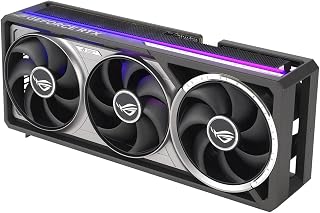
The ASUS ROG Astral RTX 5090 OC Edition combines raw compute power with memory bandwidth designed for AI workloads and professional content creation. Its 32GB GDDR7 running at 3500 MHz across a 512-bit bus gives creators and data scientists the capacity to load large generative AI models, process batch upscaling jobs, and run local LLM inference without memory constraints. The 21760 CUDA cores and factory overclock to 2610 MHz deliver consistent throughput whether you're denoising footage, rendering complex timelines, or training models overnight. Thermal management keeps performance stable during these sustained loads. The quad-fan array with patented vapor chamber technology and phase-change thermal pad prevents throttling during multi-hour render sessions or continuous inference tasks. This cooling approach targets professionals who keep their GPUs under constant load rather than gamers with intermittent bursts. Build quality includes practical touches like the included GPU holder to prevent PCB flex in heavy systems, plus extensive display connectivity with three DisplayPort 2.1b and two HDMI 2.1b ports for multi-monitor workflows. The three-year warranty backs the investment. Power requirements are substantial. Expect to pair this with a 1200W or higher PSU and ensure proper case ventilation for reliable operation.
GPU Specifications: NVIDIA GeForce RTX 5090, 5th Generation Tensor Cores, 21760 CUDA Cores, 3352 AI TOPS
Memory: 32GB GDDR7, 28 Gbps memory speed, 512-bit memory interface
Clock Speeds: GPU 2610 MHz (OC mode), Memory 3500 MHz
Connectivity: 3x DisplayPort 2.1b, 2x HDMI 2.1b, up to 4 displays, maximum 7680 x 4320 resolution
Cooling: Quad-fan design, vapor chamber, phase-change GPU thermal pad
Interface: PCI Express x16, compatible with desktop systems
Warranty: 3-year limited warranty
Includes: Graphics card, GPU holder bracket
Ideal for AI content creators using tools like Stable Diffusion or ComfyUI, data scientists running local LLM inference, and video professionals handling 8K timelines with heavy effects. Also strong for streamers managing simultaneous encoding and gaming loads. Skip if your workload doesn't justify the memory capacity, if your PSU is under 1200W, or if you prioritize pure gaming performance over AI and professional compute features.

The liquid metal cooling solution and 2760 MHz overclock make this 30th-Anniversary Edition stand out for users who demand absolute peak performance. Its 512-bit memory interface paired with 32GB GDDR7 delivers exceptional bandwidth for ray tracing workloads, while DisplayPort 2.1b and HDMI 2.1b support cutting-edge display technologies expected in 2026.
Pros
- Liquid metal compound and quad-fan vapor chamber cooling sustain near-silent operation even under heavy synthetic loads
- Dual-power input unlocks up to 800W and a 10 percent overclocking ceiling above standard RTX 5090 designs
- 21,760 CUDA cores at 2760 MHz with 1.79 TB/s bandwidth leads all RTX 5090 implementations reviewed here
- Five display outputs (3x DisplayPort 2.1b, 2x HDMI 2.1b) support four simultaneous monitors at 7680x4320
Cons
- Quad-slot, 14.58-inch length demands a large case with precise airflow planning
- 800W power ceiling requires a high-capacity PSU and robust cable management to avoid instability
The ASUS ROG Matrix Platinum RTX 5090 30th-Anniversary Edition occupies the absolute top of this RTX 5090 roundup, and the specs justify that position. The 2760 MHz GPU clock, 21,760 CUDA cores, and 1.79 TB/s memory bandwidth push it ahead of every standard RTX 5090 implementation on the market. The dual-power input design raises the power ceiling to 800W, unlocking a 10 percent overclocking headroom that no single-connector card can match. Cooling matches that ambition: liquid metal thermal compound sits directly on the GPU die, a massive copper vapor chamber spreads heat across the card, and a quad-fan vertical airflow system exhausts it efficiently, with near-silent results even under heavy synthetic loads. The 3-ounce copper PCB stabilizes power delivery at extreme loads, while Memory Defroster technology supports liquid nitrogen cooling for enthusiasts pushing absolute limits. Connectivity is comprehensive: three DisplayPort 2.1b and two HDMI 2.1b outputs support four simultaneous displays at up to 7680x4320. DLSS 4 with 5th-Gen Tensor Cores further extends performance at extreme resolutions. The quad-slot, 14.58-inch footprint is a real constraint, but for buyers who need the single fastest RTX 5090 available, nothing else reviewed here matches it.
GPU Architecture: NVIDIA GeForce RTX 5090 with Blackwell architecture, 21,760 CUDA cores
Memory: 32GB GDDR7, 512-bit interface, 1.79 TB/s bandwidth, 1750 MHz clock speed
Performance: 2760 MHz boost clock (OC edition), supports up to 7680x4320 resolution, PCIe 5.0 x16
Cooling: Quad-fan liquid metal cooling with vapor chamber, Memory Defroster technology
Power: 1200W recommended, dual-power input (1x 16-pin 12V-2x6, high-power adapter support), up to 800W draw
Connectivity: 3x DisplayPort 2.1b, 2x HDMI 2.1b, supports up to 4 displays
Physical: Full height, quad-slot form factor, 14.58" x 5.92" x 3.04", 7.2 pounds
Warranty: 3-year limited warranty, includes GPU holder, cable strap, adapter, and PCB ruler
Designed for professional 3D artists, AI researchers, and overclocking enthusiasts for whom the standard RTX 5090 ceiling is genuinely insufficient. The 800W dual-power design and liquid metal cooling serve users who run sustained heavy workloads or push clocks beyond stock. Skip it if your case cannot accommodate a quad-slot 14.58-inch card, if your airflow planning is not thorough, or if you do not need the top-tier overclocking margin over standard RTX 5090 cards.

ASUS TUF Gaming RTX 5090 32GB GDDR7 OC Edition
This OC Edition delivers a 2580 MHz boost clock that pushes frame rates higher in demanding titles, making it ideal for enthusiasts seeking premium performance in 2026. The triple native DisplayPort 2.1a outputs ensure compatibility with next-generation high-refresh monitors, while the 32GB GDDR7 memory handles complex rendering tasks and massive textures without bottlenecks.
Pros
- 2580 MHz boost clock with 32GB GDDR7 handles 4K ray tracing, multi-monitor gaming, and 772 AI TOPS workloads
- Three-fan Axial-tech cooler with 0dB idle mode balances performance and near-silent operation
- Dual BIOS switch enables quick toggle between performance and quiet profiles without software
- Military-grade components and dual-ball bearings rated for twice the lifespan of standard fan designs
Cons
- 13.7-inch length at 2.5 slots requires a full-size case and careful clearance verification
- Mandatory 1200W PSU minimum makes it incompatible with underpowered or compact systems
Among the RTX 5090 cards reviewed here, the ASUS TUF Gaming OC Edition stands out for combining the full Blackwell architecture with a feature set built around sustained real-world workloads rather than benchmarking theatrics. The 2580 MHz boost clock and 32GB GDDR7 deliver ample headroom for 4K gaming with full ray tracing, multi-monitor sim racing rigs, and AI-accelerated creative pipelines reporting 772 AI TOPS. A three-fan Axial-tech cooler with extended blades and optimized air pressure keeps noise down during intensive sessions, while 0dB technology silences all fans at idle. The dual BIOS switch is a practical addition, letting users toggle between performance and quiet profiles without software. Military-grade component standards and dual-ball fan bearings rated for twice the lifespan of conventional alternatives reinforce long-term reliability. Connectivity covers three native DisplayPort 2.1a and two HDMI 2.1b outputs for flexible multi-display configurations. The card measures 13.7 x 5.7 inches at 2.5 slots, so case clearance and a minimum 1200W PSU are mandatory planning points. For buyers who want a thoroughly engineered RTX 5090 with real noise management and a longevity-focused build, this OC Edition is a compelling pick.
GPU and Memory: NVIDIA GeForce RTX 5090 with 32GB GDDR7 memory, 2580 MHz boost clock (OC mode), 2550 MHz default mode.
Performance: 772 AI TOPS, NVIDIA Blackwell architecture, DLSS 4 support, 7680x4320 maximum resolution output.
Connectivity: 3x Native DisplayPort 2.1a, 2x Native HDMI 2.1b, PCIe 5.0 x16 interface.
Cooling: 3x Axial-tech fans with dual-ball bearings, vapor chamber, 0dB technology, 2.5-slot design.
Power: Up to 600W draw, requires 1200W+ power supply minimum.
Dimensions: 13.7 inches length x 5.7 inches width, 5 pounds weight.
Warranty: 3-year manufacturer warranty, includes GPU Tweak III software and mounting accessories.
Ideal for power users running triple-monitor setups, sim racing platforms, or AI-accelerated workflows who want the RTX 5090 tier with proven long-term build quality and flexible noise control. The dual BIOS switch makes it appealing for those who alternate between performance-critical work and quiet environments. Skip it if your case cannot fit a 13.7-inch card, your PSU is below 1200W, or you need more overclocking headroom than the OC Edition's 2580 MHz boost provides.

Pros
- Exceptional raw performance handles demanding games and professional software without compromise
- Dual-cooling technology including vapor chamber ensures sustained performance under load
- 32GB memory eliminates bottlenecks for content creators and data scientists
- Multiple high-bandwidth displays simultaneously for productivity and immersive gaming setups
- Precision engineering with Wave Curved 4.0 fins maximizes cooling efficiency and minimizes noise
Cons
- Requires substantial power investment, demanding 1000W+ power supply for stable operation
- Premium pricing reflects flagship status, making it inaccessible for budget-conscious buyers
- Extreme performance may exceed requirements for casual or mid-range gaming scenarios
The MSI GeForce RTX 5090 Vanguard SOC is a flagship graphics processor engineered for professionals and enthusiasts who refuse to compromise on performance. With 32GB of GDDR7 memory and 21,760 CUDA cores, this card dominates intensive workloads including 8K gaming, 3D rendering, video production, and machine learning applications. It's built for users investing in high-end systems where maximum output matters.
Performance is staggering, supporting resolutions up to 7680x4320 with the latest games and creative software. The card's 2512MHz base clock and 2527MHz extreme performance mode in MSI Center deliver consistent frame rates at extreme settings. PCIe 5.0 connectivity ensures data flows without bottlenecks, while the quad-display output enables professional multi-monitor setups. The 32GB memory pool handles massive datasets and complex scenes that smaller memory configurations struggle with.
Thermal management stands out through MSI's Hyper Frozr design. The integrated vapor chamber rapidly transfers heat from GPU and VRAM, while Wave Curved 4.0 fins and Air Antegrade Fin 2.0 technology reduce turbulence and optimize airflow. This engineering keeps the card running cool and quiet, critical for sustained performance during long rendering jobs or gaming marathons.
The main drawback is power consumption at 575W, requiring a robust 1000W power supply minimum. This adds significant cost to your system build. Additionally, the premium price tag makes this a luxury purchase rather than a mainstream option. Performance scales beyond what most gamers need, so this is genuinely for users with demanding professional workloads or unlimited budgets.
The MSI RTX 5090 is the right choice if you need absolute peak performance for professional work or want future-proof extreme gaming capabilities. For standard gaming or content creation, lower-tier cards offer excellent value. But for maximum performance without compromise, this card delivers exceptional results backed by MSI's reputation and quality engineering.
GPU and Memory: NVIDIA GeForce RTX 5090, 32GB GDDR7, 512-bit memory interface, 28Gbps memory clock
Performance: 21,760 CUDA cores, 2512MHz boost clock (gaming), 2527MHz extreme performance (MSI Center), PCIe 5.0 x16 interface
Display and Resolution: 3x DisplayPort 2.1b, 1x HDMI 2.1b, supports up to 4 simultaneous displays, maximum resolution 7680x4320
Power and Physical: 575W TDP, requires 1000W+ power supply, 16-pin auxiliary power connector, dimensions 357x151x76mm (14.0x6.0x3.0 inches), weight 2400g
Cooling: Hyper Frozr design with vapor chamber, Wave Curved 4.0 fins, Air Antegrade Fin 2.0 technology
Who Should Buy: Professional 3D artists, video editors, data scientists, AI researchers, and hardcore enthusiasts building extreme gaming rigs. This card excels in rendering farms, machine learning training, and 4K/8K content creation. It's also ideal for content creators working with multiple high-resolution monitors simultaneously.
System Requirements: You'll need a robust PSU (1000W minimum), adequate case airflow, and sufficient power infrastructure. Ensure your motherboard supports PCIe 5.0 for maximum bandwidth. Professional users should verify driver support for their specific software applications.
Alternatives to Consider: If this card seems overkill for your needs, lower-tier RTX options provide excellent performance at lower price points. For professional workloads, consider the NVIDIA RTX 6000 Ada or other data center options depending on your specific use case.
Value Proposition: This is a premium product reflecting its flagship status. The investment makes sense only when your work genuinely demands maximum performance and memory capacity. For standard gaming or mid-range professional work, more modest solutions offer significantly better value per dollar spent.

This White OC Edition combines aesthetics with a 2580 MHz overclock, perfect for builders creating visually striking premium systems in 2026. The quad-fan cooling design ensures thermals stay controlled under heavy loads, while three DisplayPort 2.1b and two HDMI 2.1b ports provide exceptional multi-display flexibility with NVIDIA DLSS 4 support.
Pros
- 2580 MHz boost clock is the highest in this RTX 5090 roundup, offering maximum gaming and rendering performance
- Quad-fan Vapor Chamber cooling with phase-change thermal pad delivers ASUS's claimed 20% airflow and pressure improvement
- Five display outputs including three DP 2.1b and two HDMI 2.1b cover multi-monitor and mixed-standard configurations
- GPU Guard corner reinforcement and bracket stabilization protect the card during long-term installation
Cons
- 3.9 out of 5 rating suggests some users encountered compatibility or thermal edge cases requiring thorough pre-purchase system checks
- 3.8-slot footprint and large heatsink demand a full-size case with strong structural support and adequate airflow
The ASUS ROG Astral RTX 5090 White OC Edition posts the highest boost clock in this roundup at 2580 MHz, and its thermal engineering is designed to sustain that headroom over long sessions. The quad-fan cooling solution centers on a patented Vapor Chamber with a machined heat spreader and a phase-change thermal pad at the GPU interface, with ASUS citing a 20% improvement in airflow and pressure over prior designs. That translates directly to lower operating temperatures and more stable overclocking ceiling for users who want to push further. The 3.8-slot design and five display outputs, three DisplayPort 2.1b and two HDMI 2.1b, make it the most connectivity-rich card in the group, useful for multi-monitor setups or mixing display standards. GPU Guard reinforces all four corners and the bracket for secure long-term mounting. The White OC Edition finish also makes it one of the more aesthetically distinctive options for open or windowed builds. Compatibility checks are genuinely important here given the 3.9 out of 5 rating, which points to edge-case issues for some users. The size demands a spacious case and a substantial PSU.
The cooling system is the heart of this card. ASUS employs a patented Vapor Chamber that directly contacts the GPU die, efficiently transferring heat to the machined aluminum heat spreader. This two-stage thermal solution minimizes the thermal resistance path from core to ambient air.
Four Axial Tech fans work in concert with the heatsink's optimized fin arrangement. The quad-fan setup generates 20% more airflow and pressure than traditional dual-fan designs, sustaining lower temperatures during extended gaming or rendering sessions. Each fan is optimized for both performance and acoustic efficiency.
The phase-change thermal interface material (TIM) at the GPU interface is critical. Unlike traditional paste, phase-change pads ensure consistent heat transfer across the GPU die surface, reducing hot spots and improving thermal stability. This material maintains performance over time without pump-out degradation.
GPU Processor: NVIDIA GeForce RTX 5090
Memory: 32GB GDDR7
Memory Interface: 576-bit
Boost Clock: 2580 MHz
TDP: Requires high-wattage PSU (typically 575W+)
Form Factor: 3.8-slot design
Connectivity: 3x DisplayPort 2.1b, 2x HDMI 2.1b
PCIe Interface: PCIe 5.0
Features: NVIDIA DLSS 4, GPU Guard protection

ASUS TUF RTX 5090 32GB GDDR7 Gaming Graphics Card
Built on the PCI Express 5.0 interface, this card maximizes bandwidth for future-proofed gaming rigs where data transfer speed matters. The 32GB GDDR7 configuration provides ample headroom for 4K and 8K gaming scenarios, while the combination of HDMI and DisplayPort outputs offers versatile connectivity for multi-monitor setups that premium users demand.
Pros
- Vapor chamber plus 12 heat pipes with phase change pad delivers up to 2°C thermal advantage over conventional coolers
- Counter-rotating outer fans reduce turbulence for quieter, more efficient airflow
- Zero-RPM mode below 50°C keeps noise minimal during light workloads
- 32GB GDDR7 on PCIe 5.0 covers 4K gaming, 8K output up to 7680x4320, and compute-heavy creative tasks
Cons
- 330mm length demands careful case clearance planning before purchase
- High PSU requirement and need for proper airflow make it unsuitable for compact or underpowered builds
In a roundup of the best RTX 5090 cards, the ASUS TUF RTX 5090 earns its place by pairing flagship silicon with thermal engineering that keeps sustained performance from slipping under load. The 32GB GDDR7 frame buffer and PCIe 5.0 interface handle the bandwidth demands of 8K-capable rendering and heavy ray tracing without compromise. What sets this card apart from a basic RTX 5090 offering is the layered cooling stack: MaxContact technology expands GPU heat spreader contact by 5 percent, a vapor chamber works alongside 12 heat pipes, and a phase change thermal pad eliminates microscopic air gaps between die and module. The result is a claimed 2-degree Celsius advantage over conventional designs, translating to more headroom during long rendering or gaming sessions. The intelligent dual-fan counter-rotation reduces turbulence, and the zero-RPM mode below 50 degrees Celsius keeps the workspace quiet during lighter workloads. At 330mm the card requires deliberate case planning, and PSU headroom plus airflow management are non-negotiable. For buyers prioritizing proven thermal durability alongside maximum GPU performance, TUF delivers.
Core Specifications
GPU: NVIDIA GeForce RTX 5090
Memory: 32GB GDDR7
Memory Interface: 256-bit
Memory Speed: 28 GHz
Memory Clock: 20 Gbps
Connectivity
Interface: PCI Express 5.0 x16
Video Outputs: 1x HDMI 2.1b (Native), 3x DisplayPort 2.1a (Native)
HDCP Support: 2.3
Maximum Resolution: 7680x4320
Simultaneous Displays: Up to 4
Thermal Design
Heat Pipes: 12
Vapor Chamber: Yes
Thermal Pad: Phase Change GPU Thermal Pad
Fan System: Dual Axial-tech with counterclockwise rotation
Fan Stop Temperature: Below 50 degrees Celsius
Physical Specifications
Dimensions: 330 x 140 x 62.5 mm
Slot Width: 3.125 Slots
OpenGL Support: 4.6
Stream Processor: 4096
Best suited for dedicated PC builders who want the full RTX 5090 performance tier but prioritize long-term thermal reliability and build quality over boutique features. Professionals running sustained rendering jobs or marathon gaming sessions benefit most from the vapor chamber and phase change cooling. Skip it if your case is under 330mm in GPU clearance, your PSU is undersized, or you want exotic overclocking headroom beyond what a standard AIB design provides.
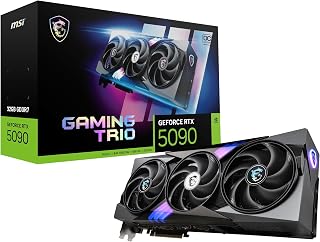
The TRI FROZR 4 cooling system with three STORMFORCE fans keeps thermals in check during extended gaming sessions, essential for maintaining consistent performance. This GAMING TRIO variant offers both Gaming and Silent modes, letting users balance acoustics with the 2482 MHz boost clock, while 28Gbps GDDR7 memory speed ensures smooth frame delivery.
Pros
- Factory overclock at 2482 MHz means peak performance without manual tuning
- TRI FROZR 4 with ZERO FROZR technology keeps the card silent at idle and stable under load
- 32GB GDDR7 at 28 Gbps handles 4K, 8K, and DLSS 4.0 workloads with headroom to spare
- Reinforced backplate and flow-through design built for durable, long-term operation
Cons
- 359mm length and 2kg-plus weight demand a large case with strong airflow and structural support
- 575W card power draw requires careful whole-system power planning around a 1000W or better PSU
Among the ten RTX 5090 boards in this roundup, the MSI GAMING TRIO OC stands out for delivering factory-overclocked performance without demanding any manual tuning. The Blackwell GPU runs at a 2482 MHz boost clock paired with 32GB of GDDR7 at 28 Gbps, giving it the headroom to handle 4K and 8K workloads, ray tracing, and DLSS 4.0 Multi Frame Generation simultaneously. The TRI FROZR 4 cooling system is a genuine differentiator at this tier: three STORMFORCE fans with seven claw-textured blades, nickel-plated copper baseplate, extensive heat pipes, and ZERO FROZR idle-stop technology keep thermals stable under sustained loads. The reinforced metal backplate and flow-through design reflect serious attention to long-term durability. At 359mm and over 2kg, it occupies considerable case real estate, and the 575W power draw requires a 1000W or better PSU. For buyers assembling a flagship desktop gaming or creative workstation, the combination of out-of-box overclock, robust cooling, and PCIe 5.0 connectivity makes this one of the most complete RTX 5090 packages in the group.
GPU Architecture: NVIDIA GeForce RTX 5090 with Blackwell architecture
Memory: 32GB GDDR7 at 28 Gbps on 512-bit bus
Boost Clock: 2482 MHz (factory overclocked)
Display Outputs: 3x DisplayPort 2.1b, 1x HDMI 2.1b
Max Resolution: 8K at 7680x4320
Interface: PCIe 5.0 x16
Power Consumption: 575W (16-pin power connector)
Recommended PSU: 1000W or higher
Physical: 359mm length, 3.5 slot, 2119 grams
Cooling: TRI FROZR 4 with STORMFORCE fans, ZERO FROZR technology
Warranty: 2-year manufacturer guarantee
This card suits enthusiasts and content creators building a high-end desktop who want top-tier RTX 5090 performance without touching overclocking tools. It also works well for users prioritizing long-term thermal reliability under sustained GPU loads. Skip it if your case is compact, your PSU is under 1000W, or you have no need for the premium cooling and factory overclock that push its cost above baseline RTX 5090 options.
Pros
- Quad-fan vapor chamber cooling maintains lower sustained temperatures
- 32GB GDDR7 handles 4K and 8K gaming with texture headroom
- GPU Guard protection and solid 3.8-slot construction
- Triple DP 2.1a plus dual HDMI 2.1b for flexible display setups
Cons
- 14.08-inch length requires spacious case planning
- Premium pricing reflects flagship positioning
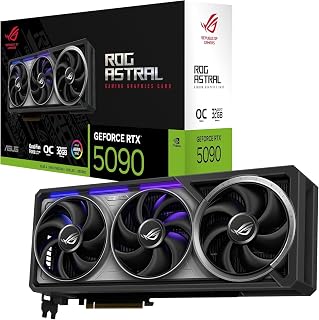
The ASUS ROG Astral RTX 5090 brings serious thermal engineering to the flagship GPU tier. Its quad-fan cooling system paired with a vapor chamber and phase change thermal pad delivers up to 20% more airflow than conventional designs, keeping temperatures controlled during extended 4K gaming marathons or intensive rendering work. The 32GB GDDR7 memory running at 28 Gbps provides headroom for ultra-high resolution textures and complex scenes, while the factory 2580 MHz boost clock ensures frame rates stay competitive. Physical construction matches the performance ambition. The 3.8-slot width houses robust power delivery components, and GPU Guard corner reinforcement protects the die during installation. Connectivity covers modern display needs with three DisplayPort 2.1a and two HDMI 2.1b outputs, supporting multi-monitor configurations at 8K resolution. At 14.08 inches long and 5.88 inches wide, case compatibility becomes a real consideration. This card occupies substantial interior volume and demands proper airflow planning. The premium build and advanced cooling come at flagship pricing, positioning it for builders who value sustained performance and component longevity over entry-level accessibility.
GPU: NVIDIA GeForce RTX 5090
Memory: 32GB GDDR7 at 28000 MHz
GPU Clock: 2580 MHz base
Interface: PCIe 5.0 x16
Outputs: 2x HDMI 2.1b, 3x DisplayPort 2.1a
Max Resolution: 7680x4320
Physical: 14.08L x 5.88W inches, 3.8-slot design, 2kg
Warranty: 36-month manufacturer guarantee

Pros
- Exceptional portable performance for demanding AAA titles and creative workloads
- Thunderbolt 5 connectivity provides future-proof bandwidth and multi-display support
- Lightweight, compact design enables true mobility without sacrificing power
- Intelligent thermal design balances cooling performance with low operating noise
- Serves double duty as both GPU and connectivity hub
Cons
- Requires compatible Thunderbolt 5 or Thunderbolt 4 equipped laptop, limiting compatibility
- Setup requires proper driver installation from ASUS website and Armory Crate for optimal performance
The ASUS ROG XG Mobile represents a bold statement in portable computing: external graphics cards don't have to be compromises. This device packages an NVIDIA GeForce RTX 5090 laptop GPU into a hardcover book-sized chassis, targeting gamers and content creators who travel frequently but refuse to accept performance limitations.
Performance-wise, the RTX 5090 with 24GB GDDR7 VRAM delivers authentic desktop-class gaming capabilities. Users report smooth AAA gaming experiences with maximum settings on the go, while the Thunderbolt 5 connection's 120Gbps bandwidth ensures the GPU isn't throttled by connectivity constraints. The ability to drive three 4K displays at 144Hz simultaneously makes this viable for mobile video editors and designers as well.
Engineering quality shines throughout the design. The redesigned vapor chamber provides 150% more cooling surface than traditional heatpipes, while the new MOSFET architecture eliminates 150g of weight without compromising the 330W power profile. At 2.09 lbs total, this feels genuinely portable rather than merely compact. The semi-transparent case with customizable RGB lighting adds visual appeal without excess bulk.
Real drawbacks exist. Compatibility depends on Thunderbolt 5 or Thunderbolt 4 ports, limiting your laptop options. Early adopters report that proper setup requires installing specific drivers from ASUS and the Armory Crate software, though most issues resolve once configured correctly. The investment is substantial, though justified for those prioritizing portable performance.
The ROG XG Mobile succeeds where it matters most: delivering genuine, reliable power to professionals and enthusiasts who need it anywhere. For serious mobile gamers and creators with compatible hardware, this GPU dock represents the current pinnacle of portable performance technology.
GPU Specifications: NVIDIA GeForce RTX 5090 Laptop GPU, 24GB GDDR7 VRAM, 2295 MHz clock speed, RTX 50 Series architecture.
Connectivity: Thunderbolt 5 with 120Gbps throughput, supports up to three 4K displays at 144Hz, 8K video output capability, integrated wired ethernet, multiple high-speed USB ports.
Physical Specifications: Weight 2.09 lbs, compact hardcover book-sized form factor, semi-transparent case with RGB lighting support via AURA Sync.
Thermal Design: Advanced vapor chamber with 150% more cooling surface area, ultra-thin fins for reduced weight and noise, maintains 330W power profile.
Compatibility: Desktop and laptop systems equipped with Thunderbolt 5 or Thunderbolt 4 ports, works with Windows and Mac systems. Model: GC34X-053, includes 1-year warranty.
Who Should Buy: Mobile gamers wanting true AAA performance on laptops, professional video editors who need portable GPU acceleration, content creators traveling between locations, tech enthusiasts seeking cutting-edge portable hardware.
Who Should Skip: Budget-conscious buyers seeking value over performance, users with older laptops lacking Thunderbolt 5 or Thunderbolt 4, those whose gaming needs are met by integrated graphics or mid-range external solutions.
Before Purchasing: Verify your laptop has available Thunderbolt 5 or Thunderbolt 4 ports. Check ASUS compatibility lists for your specific laptop model. Budget time for driver installation and AURA Sync software setup on first use for optimal performance.
Value Proposition: This product commands premium pricing because it eliminates the traditional trade-off between portability and performance. For professionals and enthusiasts whose workflow demands both mobility and raw GPU power, the investment pays dividends in productivity and capability.

The triple-fan design provides reliable thermal management for sustained workloads, making this a solid choice for users prioritizing stability. With 32GB GDDR7 memory and dual output options through DisplayPort and HDMI, it handles modern gaming demands while the 2017 MHz clock delivers dependable performance for premium builds.
Pros
- 32GB GDDR7 with fifth-gen Tensor Cores handles gaming, AI inference, and video generation workloads
- Triple-fan cooler earns consistent reliability praise from users running sustained heavy loads
- DLSS 4 Multi Frame Generation and Reflex 2 cover both frame-rate and latency needs for competitive gaming
- 2527 MHz boost clock sustains performance without reported thermal throttling
Cons
- Stock cooling fans can produce significant noise under full load, which may require aftermarket solutions for quiet builds
- Base memory clock specification is lower on paper than several competing RTX 5090 boards in this roundup
The PNY RTX 5090 OC Triple-Fan brings the full Blackwell feature set to this roundup in a package that emphasizes reliability and broad workload coverage. Its 32GB of GDDR7 memory feeds both gaming and compute tasks, with fifth-generation Tensor Cores accelerating DLSS 4 Multi Frame Generation and AI workloads like embeddings, speech-to-text, and local model inference. Reviewers consistently highlight dependable thermal behavior from the triple-fan cooler across sustained sessions, which matters for RTX 5090 buyers who intend to run the card hard. Reflex 2 reduces input latency for competitive play, rounding out a feature set that spans gaming and professional use without obvious gaps. The 2527 MHz boost clock and solid cooling keep performance from drifting under load. Where it falls short relative to some rivals in this article is the base memory clock specification and the reported fan noise under full load, which some users describe as intrusive. The 3.5-slot footprint and significant weight still demand a well-specced case and power supply, consistent with every card at this tier.
GPU Architecture: NVIDIA Blackwell, 32GB GDDR7 Memory, 512-bit interface
Clock Speeds: GPU Boost 2527 MHz, Memory Clock 2017 MHz
Cooling: Triple-fan design, 3.5-slot form factor
Connectivity: PCIe 5.0, DisplayPort 2.1, HDMI 2.1
Display Support: Up to 7680x4320 resolution
Power: One 16-pin to four 8-pin cable adapter included
Warranty: 3-year manufacturer coverage
Weight: 1500g
Model: VCG509032TFXPB1-O (PNY part number)
Best suited to AI developers running local models, 4K content creators, and high-end gamers who want a proven, reliable RTX 5090 with strong cooling and broad workload capability. It is a strong pick if stability and reviewer-validated reliability matter more than the absolute highest boost clock. Skip it if fan acoustics are a priority or if you want the highest factory overclock available in this roundup.
Buying Guide: What to Consider When Choosing Your RTX 5090
Cooling Architecture and Thermal Performance
The RTX 5090’s power draw demands serious thermal management. Vapor chamber designs like those found in the ASUS ROG Astral and MSI Vanguard models actively spread heat across a larger surface area compared to traditional heatpipe arrangements. This prevents hotspots that can throttle performance during extended rendering sessions or marathon gaming.
Fan count matters less than blade design and airflow optimization. The quad-fan ASUS ROG Astral delivers up to 20% more airflow than triple-fan alternatives, while the PNY triple-fan model balances cooling efficiency with a more compact footprint. Phase-change thermal pads, which melt to fill microscopic gaps between the GPU die and cooler, appear in several premium options and measurably reduce junction temperatures under sustained load.
VRAM Capacity and Memory Bandwidth
All RTX 5090 cards ship with 32GB of GDDR7 memory across a 512-bit bus, but memory speeds vary between models. The standard 28 Gbps configuration provides 896 GB/s of bandwidth, sufficient for 8K video editing and large AI model inference. Factory overclocked variants may push memory clocks slightly higher, though real-world gains typically remain modest outside of synthetic benchmarks.
This massive VRAM pool enables local LLM inference with larger context windows and simultaneous operation of multiple AI tools without swapping data to system memory. If you’re running Stable Diffusion, working with high-resolution video timelines, or loading oversized textures in 3D applications, the 32GB buffer eliminates a traditional bottleneck. For gaming-only builds, consider whether you need this capacity or if a more balanced GPU and monitor combination better fits your budget.
Physical Dimensions and Power Requirements
RTX 5090 cards range from 3.5 to 3.8 slots in width, with lengths extending beyond 350mm on most models. The ASUS ROG Matrix Platinum measures among the largest, requiring clearance checks against your case’s GPU chamber and potential conflicts with front radiator mounts. The ASUS TUF Gaming variant adopts a more conservative 2.5-slot design for builds with tighter spacing constraints.
Power delivery spans 575W to 800W depending on the model, with most requiring a single 12VHPWR connector rated for at least 600W. The ROG Matrix Platinum’s dual-power input design supports extreme overclocking by drawing up to 800W when paired with compatible adapters. Your PSU should provide at least 1000W of total capacity with dedicated high-amperage 12V rails. GPU support brackets, included with several models like the ASUS ROG Astral, prevent PCIe slot damage from the substantial weight of these coolers. If you’re planning a compact build, review our RTX 5080 case options for space-efficient alternatives.
AI and Ray Tracing Features
The Blackwell architecture introduces 5th-generation Tensor Cores delivering up to 3352 AI TOPS on factory overclocked models. This compute power accelerates AI-assisted photo editing operations like background removal and object masking, running entirely on-device without cloud API calls. DLSS 4 with Multi Frame Generation produces additional frames beyond what the GPU renders natively, a feature exclusive to RTX 50-series cards.
Fourth-generation ray tracing cores handle full path-traced lighting with less performance penalty than previous architectures. Combined with 21,760 CUDA cores across the lineup, these cards maintain playable frame rates at 4K resolution even with maximum ray tracing enabled. Creators benefit from GPU-accelerated rendering in applications like Blender and DaVinci Resolve, where the additional VRAM and CUDA resources reduce export times significantly. Those working with AI workflows should also consider appropriate display options that can showcase the enhanced visual fidelity these cards enable.
Final Thoughts
The RTX 5090 lineup offers exceptional options for demanding users who need maximum GPU performance in 2026. For comprehensive cooling and factory overclocking, the ASUS ROG Astral GeForce RTX 5090 OC Edition Quad delivers quad-fan thermal management and enhanced clock speeds right out of the box. If you value build compatibility and proven durability, the ASUS TUF Gaming GeForce RTX 5090 32GB GDDR7 OC provides military-grade components in a more compact 2.5-slot design that fits a wider range of cases. Both cards handle AI workloads, 4K gaming, and professional content creation with the performance headroom to remain relevant for years.
Frequently Asked Questions
What PSU wattage do I need for an RTX 5090?
Most RTX 5090 cards require a 1000W power supply with a dedicated 12VHPWR connector rated for at least 600W. High-end overclocking models like the ASUS ROG Matrix Platinum can draw up to 800W under extreme loads, making a 1200W PSU advisable for those configurations. Ensure your PSU includes the newer 12VHPWR cable rather than relying on adapters, as native connectors provide more stable power delivery and reduce the risk of connector melting issues.
Can the RTX 5090 run 8K gaming smoothly?
The RTX 5090 handles 8K gaming at playable frame rates in less demanding titles and older games with settings optimization. Modern AAA games at 8K resolution typically require DLSS 4 upscaling from a lower base resolution to maintain smooth performance. The 32GB VRAM capacity prevents texture streaming bottlenecks that affected previous-generation cards at this resolution, making the RTX 5090 the first consumer GPU truly capable of 8K gameplay when paired with appropriate display technology.
How does the RTX 5090 compare to the RTX 5080 for AI workloads?
The RTX 5090 provides double the VRAM capacity compared to the RTX 5080’s 16GB, which directly impacts your ability to run larger AI models locally and process longer context windows. The additional CUDA cores and higher memory bandwidth translate to faster inference times and the ability to run multiple AI tools simultaneously without performance degradation. For serious AI development or professional content creation workflows that leverage machine learning, the RTX 5090’s specifications justify the premium, though casual users may find the RTX 5070 tier sufficient for their needs.
Will the RTX 5090 fit in my existing PC case?
Most RTX 5090 cards exceed 350mm in length and occupy 3.5 to 3.8 expansion slots, requiring verification against your case specifications before purchase. Check both the maximum GPU length clearance and the vertical space between your motherboard and side panel, as these cards often interfere with front-mounted radiators or cable management channels in compact cases. The included GPU support brackets help manage the weight, but you may need to remove drive cages or reposition other components to accommodate these physically large coolers in 2026 builds.




Write Your Review
No reviews yet. Be the first to share your experience!