

Your mix may sound balanced in headphones, yet turn muddy when a bedroom, office, or apartment forces speakers close to walls and across a crowded desk. In limited spaces, early reflections, short listening distances, and oversized bass output can hide vocal detail and lead you toward unhelpful EQ choices.
This guide covers the best studio monitors for small room setups for musicians, podcasters, video editors, and hybrid game-and-create desks. We compared stated driver layouts, cabinet designs, input flexibility, and room-tuning controls, then considered which options make sense at close range. If the same desk supports play sessions, our competitive FPS display guide can also help you plan a less cramped workstation.
Quick answer
This guide compares 10 picks, with PreSonus Eris E7 XT 6.5-Inch 2-Way Active Studio ranked first. Yamaha HS4 Powered Studio Monitors, 4.5-Inch Woofer has the most customer reviews.

Pros
- Wide, controlled sweet spot supports collaboration and group listening.
- Detailed two-way sound with strong bass extension and smooth high frequencies.
- Acoustic tuning controls help compensate for room placement and listening environments.
- Flexible RCA, TRS, and XLR connectivity works with computers, interfaces, and other audio equipment.
- High 130-watt maximum output provides substantial headroom for studio monitoring.
Cons
- This listing includes one monitor, so a stereo setup requires a second unit.
- The larger cabinet may need more desk or stand space than compact entry-level monitors.
- The monitor is wired and does not provide waterproofing or portable use.
The PreSonus Eris E7 XT is a two-way active studio monitor designed for home recording spaces, project studios, producers, and content creators. This listing includes one monitor, making it suitable as a replacement or as part of a stereo pair.
Its 6.5-inch woven composite driver delivers extended low-end response from the ported enclosure, while the 1.25-inch silk-dome tweeter keeps vocals, instruments, and high-frequency detail clear. The EBM waveguide creates a wide, controlled sweet spot that is useful when more than one person is listening.
The monitor provides RCA, TRS, and XLR connectivity for flexible integration with computers, audio interfaces, mixers, and other equipment. Level, high-pass filter, LF Trim, HF Trim, and Acoustic Space controls help tailor the response to desk placement and room acoustics.
The cabinet is larger than compact desktop monitors, so users should allow adequate space on a desk or use suitable stands. Since the package contains a single monitor, buyers building a stereo system must purchase a second unit, and the wired design is intended for indoor studio use.
Overall, the Eris E7 XT combines useful room-tuning controls, broad listening coverage, and professional input options in a capable nearfield monitor. It is a practical choice for creators who want detailed, controlled monitoring and the flexibility to adapt the sound to their workspace.

Pros
- Three DSP voicing modes provide the flexibility of multiple monitoring profiles in one speaker.
- Extensive EQ tuning options help adapt the monitor to different desktop and studio environments.
- Balanced XLR and 1/4-inch TRS combo input supports a wide range of audio interfaces and studio equipment.
- The compact 5-inch format is well suited to home studios, editing desks, and nearfield listening.
Cons
- The listing is for one monitor, so a stereo setup requires a second speaker.
- The 5-inch woofer offers less low-end headroom than larger 7-inch or 8-inch studio monitors in bigger rooms.
- The DSP modes and 25 EQ combinations provide useful flexibility, but initial setup may take more time than a basic plug-and-play monitor.
The KRK ROKIT 5 Generation Five is a compact powered studio monitor designed for producers, mixers, musicians, and content creators working in home or professional studios. Its 5-inch format makes it a practical nearfield option for desktop setups and smaller listening spaces.
Its standout feature is the integrated DSP system, which offers Mix, Create, and Focus Modes for different listening tasks. Twenty-five boundary and tuning EQ combinations, supported by the KRK App, give users more control when room placement or acoustics affect the monitoring environment.
The woven Kevlar woofer, redesigned silk dome tweeter, and low-diffraction baffle are built to support controlled response, smooth high frequencies, and clearer stereo imaging. Biamplified Class D power amplifiers and included foam isolation pads further support efficient operation and reduced cabinet resonance during longer sessions.
There are a few practical limitations to consider. This listing includes one monitor, so stereo monitoring requires a second unit, and the 5-inch woofer may not provide the low-frequency authority needed for large rooms or bass-heavy work without additional monitoring support.
Overall, the KRK ROKIT 5 Generation Five is a versatile choice for anyone who wants adaptable studio monitoring in a compact enclosure. Its multiple voicing modes, extensive EQ options, and professional connections make it especially appealing for home studios and creators who need one monitor to handle several listening roles.

Pros
- Detailed, crisp high-frequency reproduction from the U-ART tweeter.
- Wide sweet spot makes monitoring less dependent on a fixed listening position.
- Compact design suits home studios and small control rooms.
- DSP room filters and multiple analog inputs improve placement flexibility.
- Strong real-world feedback for sound quality, home studio use and instrument monitoring.
Cons
- The 5-inch woofer may not deliver the deepest low bass for bass-heavy production without a subwoofer.
- The cabinet can take more desktop space than some buyers expect.
- The rear-firing port requires thoughtful placement near walls or in tight workspaces.
The ADAM Audio T5V is a two-way nearfield studio monitor designed for home studios, project rooms and compact control rooms. It is well suited to music production, mixing, podcast editing, guitar tracking and other work that benefits from revealing, consistent monitoring.
Its U-ART tweeter reaches up to 25 kHz and works with the precision HPS waveguide to produce detailed highs and a broad sweet spot. The 5-inch woofer extends down to 45 Hz, delivering useful low-end information while leaving room for the optional T10S subwoofer when deeper bass is required.
A rear-firing bass reflex port and beveled cabinet make the T5V practical for smaller spaces, while DSP-controlled high- and low-shelf filters help compensate for difficult room acoustics. XLR, 1/4-inch TRS and RCA inputs also make it easy to connect professional interfaces and home audio devices.
The main limitation is the compact 5-inch woofer, which cannot reproduce the lowest bass with the authority of a larger monitor or dedicated subwoofer. Buyers should also allow enough space around the rear port and note that the cabinet may feel larger on a crowded desktop than expected.
Overall, the T5V offers a detailed, spacious presentation and useful placement controls in a studio-friendly format. It is a compelling option for creators who want dependable nearfield monitoring for a home studio without moving to a larger, more demanding speaker.
Pros
- Clear and balanced presentation praised by reviewers for both monitoring and general music listening.
- Compact design delivers useful volume for bedrooms, desks, and small creative spaces.
- Flexible input selection works with professional interfaces as well as consumer audio devices.
- Room and high-frequency controls make placement adjustments easier.
- Solid Yamaha build quality with practical accessories included.
Cons
- The compact 4.5-inch woofers do not deliver the deep, full low-end or room-filling scale of larger monitors.
- A subwoofer may be desirable for bass-heavy production or listeners who want extended low frequencies.
- The monitors use corded power and are not designed for waterproof or outdoor use.
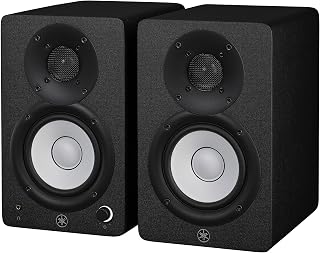
The Yamaha HS4 is a compact pair of powered studio monitors designed for music production, video editing, and everyday desktop listening. Its small footprint makes it especially suitable for creators working in bedrooms, home offices, and other spaces where larger speakers would be inconvenient.
A two-way bass-reflex design combines a 4.5-inch cone woofer with a 1-inch dome tweeter, producing a clear and revealing stereo presentation. The 60 Hz to 22 kHz frequency response is well suited to nearfield work, while the Room Control and High Trim Response settings help compensate for placement and room characteristics.
Connectivity is flexible for a compact monitor system, with XLR/TRS combo, RCA, and stereo mini inputs available. The included speaker cable, stereo mini to RCA cable, and anti-slip pads make it easier to connect the pair to an audio interface, computer, tablet, or other compatible source.
Reviewers consistently highlight the accurate, balanced sound and the ability to play comfortably loud in smaller rooms. The main limitation is the compact woofer size, which means the HS4 cannot match larger monitors for deep bass extension or broad room-filling impact, so bass-focused users may want to add a subwoofer.
Overall, the Yamaha HS4 is a practical choice for home producers, editors, musicians, and listeners who value honest sound in a compact format. It delivers dependable Yamaha monitoring performance, useful tuning controls, and broad analog connectivity without demanding much desk space.
Pros
- Excellent stereo imaging and a broad listening sweet spot
- Clear, natural mids with detailed highs that support mixing and dialogue editing
- Controlled bass response for a compact 5-inch monitor
- Room-tuning controls and flexible balanced analog inputs
- Durable construction with strong real-world feedback from home-studio users
Cons
- The 5-inch woofer may need a separate subwoofer for very deep bass or larger rooms
- These monitors require an audio interface, mixer, or other suitable line-level source
- There is no listed USB or wireless audio connectivity
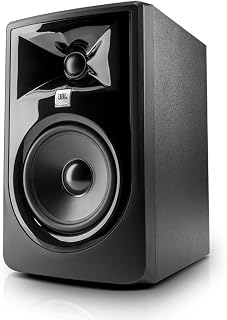
The JBL 305P MkII is a pair of 5-inch, 2-way powered studio monitors designed for music production, podcasting, voice-over work, and video editing. Their nearfield format makes them especially suitable for desktop setups and compact home studios.
JBL's Image Control Waveguide provides precise stereo imaging and a wide sweet spot, so the mix remains easier to judge when you move slightly away from the center position. Real-world feedback highlights the controlled bass, clear mids, detailed highs, and focused stereo image.
Dual 41-watt Class-D amplifiers drive the woofer and tweeter with enough headroom for demanding monitoring, while the Slip Stream port helps deliver tight low-frequency response. Boundary EQ and HF Trim let you compensate for room placement, and balanced XLR and 1/4-inch TRS inputs work well with studio interfaces.
The MDF enclosure and ABS baffle give the monitors a solid, practical build, while JBL's 100-hour full-power reliability test adds confidence for regular production use. As with many compact 5-inch monitors, they cannot match larger speakers for the deepest bass, and they need a suitable interface or line-level source rather than connecting directly to most digital devices.
The JBL 305P MkII is a strong choice for creators who want accurate imaging, clear dialogue, and dependable nearfield performance in a manageable pair of speakers. Add a subwoofer if your work demands extended low bass, but for most home studios and editing desks, this pair offers a capable and well-rounded monitoring solution.

Pros
- Highly compact design with strong output for its size
- Accurate sound suitable for recording, editing, mixing, and mastering
- Useful DSP controls for desktop and free-field placement
- Bluetooth plus RCA and 1/8-inch wired inputs
- Portable build that suits home studios and mobile creators
Cons
- The 3-inch woofers cannot replace a dedicated subwoofer for very deep bass.
- The speakers require corded power, so Bluetooth does not make the system fully battery portable.
- Connectivity is limited compared with larger professional monitors because balanced inputs are not listed.
The IK Multimedia iLoud Micro Monitor is a compact stereo reference system designed for producers, musicians, editors, DJs, and creators working in small or temporary spaces. Its combination of accurate monitoring, portable dimensions, and wireless playback makes it especially useful for home studios and mobile setups.
Sound quality is the main attraction, with 50W RMS Class D amplification, a 3-inch composite woofer, and a silk dome tweeter. The system delivers clear high frequencies, focused midrange detail, and controlled bass that reaches down to 55Hz at -3dB, helping mixes translate more reliably to everyday listening devices.
Built-in DSP adds practical EQ and position compensation settings, allowing the monitors to adapt to desktop or free-field placement. Bluetooth is convenient for casual listening, while stereo RCA and 1/8-inch aux inputs support wired sources such as computers, turntables, and older music players.
The compact enclosure is easy to fit on a crowded desk and light enough to move between locations. However, the corded power design means the speakers are portable rather than battery-powered, and their small woofers cannot deliver the deepest sub-bass without a separate subwoofer.
Overall, the iLoud Micro Monitor is a capable choice for accurate nearfield monitoring when space is limited. It offers an appealing balance of sound quality, placement flexibility, connectivity, and portability for home producers, editors, DJs, and traveling creators.

Pros
- Highly detailed and honest sound for mixing and mastering
- Precise stereo image with clear vocals and instruments
- Strong build quality and straightforward setup
- Balanced XLR and TRS connectivity
- Compact nearfield design works well in home studios
Cons
- The honest voicing can sound unforgiving with poorly recorded or unfinished material
- 5-inch drivers offer less low-end extension than larger monitors or a dedicated subwoofer
- The pair may cost more than some entry-level competing monitor options
The Yamaha HS5 is a pair of powered 5-inch nearfield studio monitors built for music production, mixing, mastering, and studio monitoring. They are a strong fit for home-studio musicians, producers, vocalists, and engineers who prioritize accuracy over an enhanced consumer-speaker sound.
Each monitor combines a 5-inch cone woofer with a 1-inch dome tweeter in a bi-amplified 70-watt design. The 54 Hz to 30 kHz response, clear midrange, and focused stereo image help reveal background noise, vocal details, and mix imperfections that less accurate speakers can hide.
Connectivity is practical for a modern studio, with XLR and TRS phone jack inputs that accept balanced or unbalanced signals. The monitors have a clean, compact appearance, while their MDF, polypropylene, and silk construction gives them a solid, professional feel.
The HS5 does not deliver the deepest bass available from larger monitors, so producers working heavily with sub-bass may want a larger system or a compatible subwoofer. Its revealing tuning can also feel less flattering for casual listening, especially when a recording or mix has noticeable flaws.
Overall, the Yamaha HS5 pair is a dependable choice for anyone building a serious nearfield monitoring setup. Its accurate presentation, detailed playback, reliable connectivity, and proven studio-focused design make it especially valuable for listeners who need clear feedback during production and mixing.

Pros
- Versatile connectivity supports Bluetooth 5.3, USB, RCA, AUX, and balanced TRS sources.
- 24-bit DAC and professional tuning support clear, balanced audio for monitoring and content creation.
- Compact powered design is practical for desks, bedrooms, small studios, and gaming setups.
- Carbon fiber woofer and silk dome tweeter provide detailed highs and defined mid-low frequencies.
- Front headphone output makes it easy to switch between speakers and private monitoring.
Cons
- The compact 3.5-inch woofer may not deliver the deep bass of larger monitors or a dedicated subwoofer.
- The speakers require a wired power connection, so they are not fully portable despite Bluetooth playback.
- The listed frequency response specification is limited, making it difficult to judge the full low-frequency extension.
The Ortizan C7 is a pair of powered studio monitor speakers designed for home recording, desktop audio, gaming, television, and everyday music playback. Its compact footprint makes it suitable for listeners who want more flexibility than basic computer speakers without building a large studio system.
Connectivity is a major strength, with Bluetooth 5.3 for wireless playback plus USB, RCA, AUX, and 6.35 mm TRS inputs for wired sources. The built-in 24-bit DAC supports cleaner digital audio, while the balanced TRS input is useful for mixers, instruments, and other compatible professional equipment.
Sound comes from a 3.5-inch carbon fiber woofer and 0.75-inch silk dome tweeter, supported by an electronic two-way crossover. Professional tuning is intended to keep the presentation balanced and accurate, making the C7 useful for monitoring content as well as enjoying music, movies, and games.
The black enclosure combines ABS, metal, and wood materials in a compact powered pair weighing 7.1 pounds. A front headphone output adds practical convenience, although the small woofer may not produce the deep bass available from larger monitors or a separate subwoofer.
Overall, the Ortizan C7 offers unusually broad connectivity and useful monitoring features for a compact speaker pair. It is a sensible choice for home creators, gamers, and desktop listeners who value clear, versatile audio more than room-filling low-end performance.
Pros
- Clear, detailed sound with impressive stereo separation for compact 3.5-inch monitors.
- Tone control provides convenient sound customization directly from the speaker.
- Flexible connectivity and included cables simplify setup with multiple sources.
- Compact design and location switch make them well suited to desktop or bookshelf placement.
- Strong value for gaming, multimedia, casual listening, and entry-level studio use.
Cons
- The small woofers cannot deliver deep, room-filling bass like larger monitors or a subwoofer-equipped system.
- Some listeners may find the sound somewhat colored for critical professional mixing.
- The included speaker wire and compact enclosure may feel less substantial than higher-end studio monitor systems.
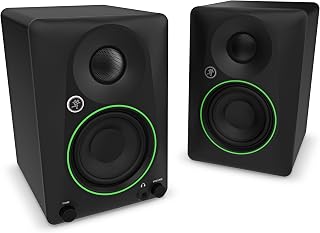
The Mackie CR3.5 is a compact pair of powered studio monitors designed for desktop listening, home studios, gaming, streaming, and everyday multimedia use. They offer a practical step up from standard computer speakers while remaining small enough for limited workspaces.
The standout feature is the tone knob, which lets you adjust the voicing from a more transparent reference sound to a warmer, more energetic presentation. Reviews praise the clear highs, balanced mids, strong stereo separation, and bigger-than-expected sound, while the location switch helps manage bass near walls or on open shelves.
RCA and TRS inputs support a range of computers, audio interfaces, televisions, and mobile devices, and the included cables and foam isolation pads make setup straightforward. The black vinyl finish gives the pair a clean, professional appearance, while the compact 3.5-inch woofers preserve valuable desk space.
These monitors have natural limits: their small drivers cannot reproduce the deepest bass without a subwoofer, and some users may find the voicing too colored for demanding professional mixing. They are best suited to entry-level production, content creation, gaming, and casual listening rather than replacing larger high-end reference monitors.
Overall, the Mackie CR3.5 delivers versatile, detailed desktop sound in a convenient package. It is a particularly good fit for buyers who want flexible tone control, simple connectivity, and a noticeable upgrade over ordinary computer speakers.

Pros
- Clear, balanced highs with a silk-dome tweeter designed to reduce harshness.
- Strong output and useful headroom for home studios and nearfield listening.
- Flexible acoustic controls help compensate for different room and desk environments.
- Multiple professional and consumer input options support a wide range of setups.
- Compact tabletop design fits smaller workspaces while still delivering substantial sound.
Cons
- Some users report audible amplifier hiss when no signal is playing.
- Bass can sound boomy or excessive on desks or in untreated rooms without careful placement and tuning.
- The package contents list one monitor, so a stereo setup may require purchasing a second unit.
The PreSonus Eris E5 is a compact 2-way nearfield studio monitor designed for home producers, musicians, podcasters, and content creators. Its 5.25-inch woofer and 1-inch tweeter provide a practical balance of detail, output, and desk-friendly size.
In everyday use, the woven composite woofer delivers solid low-end presence while the silk-dome tweeter keeps vocals, instruments, and high-frequency details clear. The 80-watt Class AB amplification provides plenty of volume for nearfield work, and the acoustic tuning controls help adapt the response to different rooms.
The cabinet includes a front-firing acoustic port, which can make placement more flexible than some rear-ported alternatives. Balanced XLR and 1/4-inch inputs, along with RCA connectivity, make it easy to connect an interface, mixer, computer, or other playback source.
Room acoustics and placement have a noticeable effect on the bass, and some users report a low level of amplifier hiss during quiet passages. Desk placement may also produce a boomy response, so stands, isolation, and careful tuning can improve results.
Overall, the Eris E5 is a capable and versatile monitor for compact studios and multimedia setups. It offers useful room controls, strong connectivity, protective circuitry, and clear sound, making it a sensible choice for buyers who want an affordable step up from basic computer speakers.
Buying Guide: Choosing Studio Monitors for a Small Room
Match the Woofer Size to Your Listening Distance
Driver diameter is the fastest way to narrow your choices. At a typical desk distance, 3-inch and 4.5-inch models can provide focused mids without overwhelming the room, while 5-inch to 5.25-inch monitors offer more low-end reach if you can give them a little breathing room. A larger 6.5-inch woofer can work, but it demands more careful placement and level control.
The Yamaha HS4 Powered Studio Monitor in Black and Mackie CR3.5 Studio Monitors are sensible for very tight desktop layouts. The IK Multimedia iLoud Micro Monitor 50 watt adds impressive extension from a compact 3-inch format, while the PreSonus Eris E5, JBL 305P MkII, Yamaha HS5, ADAM Audio T5V, and KRK ROKIT 5 give you a fuller nearfield experience when the desk and room allow it.
Plan for Walls, Corners, and Port Placement
Even a revealing monitor can sound boomy when a rear port sits almost against a wall. Begin with a symmetrical left-right layout, place the tweeters near ear height, and form an equilateral triangle between your head and the two speakers. Isolation pads or stands can also reduce vibration transferred into a desk, helping you hear cleaner bass definition.
Front-ported options such as the PreSonus Eris E5 are especially convenient where wall clearance is scarce. The ADAM Audio T5V uses a rear-firing port, so it benefits from extra space behind the cabinet, while the JBL 305P MkII offers Boundary EQ and the Yamaha HS4 includes Room Control. If a large screen is already taking up desk depth, our 32-inch 4K monitor roundup can help you account for the full footprint before positioning your speakers.
Prioritize Room Controls and Useful Connections
Small rooms change the bass and treble balance you hear, so onboard adjustment is more than a bonus. Look for high-frequency trim, low-frequency trim, room-control, or desktop compensation settings that help you reduce excess bass or soften bright reflections. These controls cannot replace good placement, but they give you a practical way to fine-tune a difficult room.
The PreSonus Eris E7 XT provides broad acoustic tuning controls, and its EBM waveguide is designed for a wide, stable listening area. The iLoud Micro Monitor includes DSP modes for desktop and free-field placement, while the Ortizan C7 provides balanced TRS alongside USB, RCA, AUX, Bluetooth, and a headphone output. For creators who also record gameplay or edit video, pairing your audio desk with external SSD options for gaming and media capture can keep project storage just as organized as your signal routing.
Choose a Sound Character That Supports Your Work
Studio monitors are meant to reveal problems rather than flatter every recording, but their presentation still differs. Yamaha HS models are known for a direct, uncolored approach, while the ADAM Audio T5V combines a U-ART tweeter and waveguide for detailed high frequencies. The JBL 305P MkII focuses on broad imaging, and the KRK ROKIT 5 Generation Five uses a low-diffraction baffle to support precise stereo placement.
Think about your main work before choosing. For careful mixing, prioritize balanced inputs, predictable mids, and acoustic adjustment over extra features. For a compact creative desk that also handles films, games, and casual playback, the Mackie CR3.5 tone control or the iLoud Micro Monitor Bluetooth connection may be more appealing. If a high-refresh display is part of that setup, use our 500Hz gaming display guide to avoid letting a large screen crowd your speaker triangle.
Final Thoughts
A small room benefits most from controlled nearfield monitoring, not maximum cabinet volume. Choose the Yamaha HS4 Powered Studio Monitor in Black for a traditional wired desktop with physical room controls, or the IK Multimedia iLoud Micro Monitor 50 watt when portability, compact placement, and Bluetooth matter most.
Frequently Asked Questions
What monitor size works best in a small room?
For most desks and compact home studios, a 3-inch to 5.25-inch woofer is the most manageable range. Smaller models are easier to position and often create fewer bass issues, while 5-inch models can provide more low-end information for music production. Move to a 6.5-inch design only when you have enough distance from walls and can listen from a proper nearfield position.
Do I need acoustic treatment before buying studio monitors?
You can begin without a fully treated room, but basic acoustic changes make a meaningful difference. Start by placing monitors symmetrically, keeping them away from corners, and using isolation pads or stands. Thick curtains, a rug, and a few well-placed absorption panels can further reduce harsh reflections and make your monitoring decisions more dependable.
How should studio monitors be positioned on a desk?
Place the monitors so their tweeters point toward your ears and form an equilateral triangle with your listening position. Angle each speaker inward, avoid placing one speaker in a corner, and keep both sides of the setup as similar as possible. When a gaming screen shares the desk, plan speaker spacing around it rather than squeezing the speakers behind it, especially when comparing a budget 1440p monitor for a compact gaming desk.
Are studio monitors good for gaming and everyday listening in 2026?
Yes, studio monitors can be excellent for games, movies, and everyday music because their stereo imaging and midrange clarity make details easier to follow. Models with Bluetooth, front headphone outputs, or a tone control are particularly convenient for mixed-use desks. For critical music work, use a wired balanced connection from your audio interface whenever possible, then reserve Bluetooth for relaxed listening.






Write Your Review
No reviews yet. Be the first to share your experience!