

Cyber Monday is one of the few times a year when serious GPU upgrades become genuinely accessible. Whether you are building a new rig from scratch or finally replacing a card that is holding back your frame rates, the range of options available this season covers every tier from entry-level 1080p performers to high-end flagship cards built for demanding workloads. Pairing a new GPU with the right supporting hardware matters too, so it is worth checking out the best PCIe 5.0 SSD to keep your storage from becoming the bottleneck.
This guide covers ten graphics cards we evaluated closely, spanning AMD RDNA 2, RDNA 3, and RDNA 4 architectures alongside NVIDIA Ampere and Blackwell offerings. There is something here for the budget-conscious gamer, the small-form-factor builder, and the enthusiast who wants maximum performance.
Quick answer
This guide compares 10 picks, with GIGABYTE RTX 5060 WINDFORCE OC 8GB Graphics Card - PCIe ranked first. ASUS Dual GeForce RTX 3050 6GB OC Edition - Compact holds the highest customer rating among them.

Compact PC builders after efficient cooling will notice the WINDFORCE dual-fan system keeping the 8GB GDDR7 card running cool despite its small footprint. A 2512MHz clock and PCIe 5.0 interface make it a practical 1080p pick for anyone prioritizing airflow-friendly cooling over sheer size.
Pros
- Newer RTX 50 series architecture with GDDR7 memory
- Dual-fan WINDFORCE cooling for efficient thermals
- PCIe 5.0 support for future motherboard compatibility
- Compact footprint suited to smaller builds
Cons
- 8GB VRAM limits higher resolutions and heavier workloads
- 128-bit memory bus caps bandwidth compared to higher-tier cards
If your Cyber Monday shopping list is about landing a fresh RTX 50 series card without stretching into flagship territory, the RTX 5060 WINDFORCE OC deserves a look. It runs NVIDIA's newest architecture with GDDR7 memory, a jump that keeps this card relevant well past this year's sale season. The 8GB buffer paired with 128-bit bandwidth is built for 1080p and entry 1440p gaming rather than 4K ambitions, which fits the profile of shoppers refreshing a mid-range rig rather than chasing benchmarks. A 2512 megahertz clock speed and 28000 MHz effective memory speed give it enough headroom for current titles at sensible settings. The dual-fan WINDFORCE cooler is designed to keep thermals in check without demanding a case full of extra airflow, and PCIe 5.0 support means the card is ready for newer motherboards. For a holiday deal that prioritizes modern features and efficiency over raw horsepower, this card checks the right boxes without overreaching on what an 8GB card should be asked to do.
GPU: NVIDIA GeForce RTX 5060 (Blackwell architecture)
Memory: 8GB GDDR7, 128-bit interface
Memory Clock: 28,000 MHz
GPU Clock: 2,512 MHz
Interface: PCIe 5.0 x16
Cooling: Dual-fan WINDFORCE system
Outputs: DisplayPort, HDMI
Max Resolution: 7680 x 4320 pixels
Dimensions: 7.83 inches L x 4.57 inches W
Power Profile: Dedicated graphics
Warranty: 3-year manufacturer coverage
Good for shoppers using Cyber Monday to upgrade a 1080p or light 1440p system to current-generation NVIDIA tech without chasing flagship pricing. Also fits small or efficiency-focused builds thanks to the compact WINDFORCE cooler. Skip it if the plan is 4K gaming or heavy VRAM workloads like large creative projects, since 8GB will become a limiting factor sooner than higher-capacity cards in this same sale.

Gamers wanting fresh architecture with generous memory will note the 16GB GDDR6 capacity and a high 3250MHz clock speed, among the fastest listed here, suited to 1440p gaming with room to spare. Native DisplayPort 2.1a and HDMI 2.1b outputs also support high refresh rate displays.
Pros
- 16GB GDDR6 memory, double many budget competitors
- High 3250MHz clock speed
- Modern DisplayPort 2.1a and HDMI 2.1b outputs
- Full PCIe x16 interface avoids bandwidth cuts
Cons
- No published real-world benchmark or thermal data
- Cooling design details beyond dual fans unspecified
For shoppers using Cyber Monday to jump up a performance tier, the ASUS Dual Radeon RX 9060 XT stands out mainly on paper specs relevant to this year's upgrade decisions: a 16GB GDDR6 buffer, a 3250MHz clock, and modern display outputs including DisplayPort 2.1a and HDMI 2.1b. The larger memory pool compared to typical budget cards in this price class is the headline factor worth weighing if you're deciding between an 8GB budget card and a 16GB step-up during this sales window, since more VRAM tends to age better against newer game releases. It supports resolutions up to 7680x4320 over its outputs, giving it headroom for high-resolution monitor setups. The dual-fan cooler is a straightforward two-fan design rather than anything exotic, and it uses the full PCIe x16 interface rather than a cut-down lane count, which matters for anyone concerned about bandwidth bottlenecks. Beyond the spec sheet, there isn't published detail here on real-world thermals, noise levels, or in-game benchmarks, so treat this as a spec-driven pick until more hands-on information becomes available.
GPU and Memory: AMD Radeon RX 9060 XT with 16GB GDDR6 memory running at 3250 MHz
Clock Speeds: OC Mode: up to 3250 MHz boost, 2640 MHz game clock. Default Mode: up to 3230 MHz boost, 2620 MHz game clock
Connectivity: PCIe 5.0, 2x DisplayPort 2.1a, 1x HDMI 2.1b
Physical Design: 2.5-slot form factor, 8 inches long, 4.7 inches wide, 1.3 pounds, dual Axial-tech fans with ball bearings
Maximum Display Resolution: 7680 x 4320 at 60Hz
Warranty: 3 years manufacturer warranty
Consider this if you specifically want more VRAM headroom than typical 8GB budget cards offer and plan to drive higher resolution displays. Skip it if you need confirmed real-world benchmarks or thermal performance data before buying, since detailed hands-on results aren't available yet, or if 8GB is already enough for your resolution and settings.
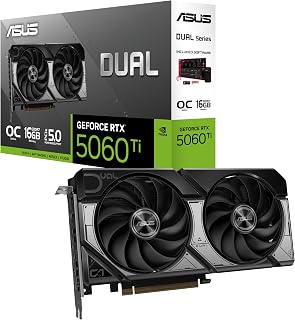
Gamers wanting extra memory headroom for modern texture packs will like the 16GB GDDR7 pool, unusually generous for this tier, paired with a 2632MHz clock for solid 1440p performance. Triple DisplayPort 2.1b outputs also suit those running multiple high-refresh monitors off one card.
Pros
- 16GB GDDR7 memory with PCIe 5.0 for long-term headroom
- Compact 2.5-slot, dual-fan design fits tighter cases
- 0dB silent mode during light workloads
- Dual BIOS toggle between Quiet and Performance profiles
Cons
- Compact cooler leaves little room for aggressive overclocking
- Two fans instead of three may run warmer under sustained heavy loads than larger designs
If you are scanning Cyber Monday listings for a card that actually fits your case, the ASUS Dual RTX 5060 Ti 16GB deserves a spot on your shortlist. It is built around a compact 2.5-slot cooler with just two fans, so it slots into small and mid-size builds where flagship cards would never fit. Under the hood you get NVIDIA's Blackwell architecture with DLSS 4, 16GB of GDDR7 memory, and a 2632 MHz clock that covers 1440p ultra and 4K high settings comfortably. The Axial-tech fans use a smaller hub with longer blades for stronger airflow, and they shut off entirely during light loads for silent running. A dual BIOS switch lets you flip between Quiet and Performance profiles on demand. For a Cyber Monday buyer weighing sale-priced cards against each other, this one stands out for pairing genuine 16GB headroom and PCIe 5.0 connectivity with a footprint that does not force a case upgrade alongside the GPU upgrade.
GPU and Memory: NVIDIA GeForce RTX 5060 Ti, 16GB GDDR7, 2632 MHz (OC Mode), 2602 MHz (Default Mode). Supports DLSS 4 and Blackwell architecture for AI-accelerated performance.
Connectivity and Cooling: 3x DisplayPort 2.1b, HDMI 2.1b, PCIe 5.0 x16 interface. Dual Axial-tech fans with dual ball bearings, 2.5-slot compact form factor, 0dB technology for silent idle operation.
Physical and System Requirements: Dimensions 9 inches long by 4.7 inches wide, weighs 0.66 kg. Supports maximum resolution of 7680x4320 pixels. Includes 3-year warranty and SpeedSetup manual. Compatible with standard desktop builds requiring adequate power supply and proper case ventilation.
Buy this if your case has limited clearance and you still want RTX 50-series performance with generous VRAM for 1440p or 4K gaming. It also suits anyone who wants near-silent idle operation. Skip it if you are chasing maximum overclocking headroom, since the compact cooler favors compatibility over extreme tuning, or if you already have ample case space and want a beefier stock cooler for the same GPU tier.

Shoppers wanting sustained performance headroom will notice the 2640MHz factory overclock, higher than the reference clock, paired with 12GB of GDDR7 for smooth 1440p gaming. TUF's reinforced build targets buyers who want durability alongside speed, and the five combined DisplayPort and HDMI outputs suit multi-monitor gaming rigs.
Pros
- Military-grade components and protective PCB coating for durability
- Consistent 65C temperatures under sustained load
- Includes anti-sag bracket and stand
- Backed by a 3-year warranty
Cons
- Large size at 13 inches long and over 2 inches thick
- 12GB VRAM may limit headroom for next-generation titles
For readers comparing Cyber Monday GPU deals who want a card built to last well beyond the sale itself, the ASUS TUF Gaming RTX 5070 OC is worth a close look. It combines NVIDIA's Blackwell architecture, 12GB GDDR7 memory, and a 2640 MHz boost clock with DLSS 4 support, giving it enough muscle for 1440p with ray tracing enabled, solid 4K work, and AI or creative tasks like image generation. What sets it apart in a deals roundup is durability. Military-grade components, a protective PCB coating, and phase-change thermal pads are paired with a 3.125-slot cooler using three Axial-tech fans, and owners report steady 65C temperatures under sustained load. A bundled bracket and stand address sag concerns, and the card is backed by a 3-year warranty. The tradeoff is size: at 13 inches long and over 2 inches thick, it demands a spacious case, so this fits shoppers prioritizing longevity and performance over compact form factor.
GPU and Memory: NVIDIA GeForce RTX 5070, 12GB GDDR7, 2640MHz boost clock, PCIe 5.0 interface
Cooling and Design: 3.125-slot form factor, three Axial-tech fans, phase-change thermal pad, protective PCB coating, military-grade components, GPU Guard bracket
Connectivity: 3x DisplayPort 2.1a, 2x HDMI 2.1b, 7680x4320 maximum resolution support
Physical: 13 inches long, 5.5 inches wide, 3.4 pounds, includes cooling bracket and stand
Warranty and Support: 3-year manufacturer warranty, GPU Tweak III software for performance monitoring and thermal control
Best for gamers and creators who want a durable, well-cooled 1440p to 4K card and plan to keep it for years, backed by a 3-year warranty. It suits builds with ample case space. Skip it if you need a compact card for a small-form-factor build, or if 12GB VRAM is a concern for demanding future titles, since the card's size advantage is durability and cooling rather than a small footprint.

Buyers curious about Intel's Xe HPG architecture as an alternative to NVIDIA and AMD will find 8GB of GDDR6 enough for 1080p gaming, backed by 0dB silent cooling for quiet operation. DisplayPort 2.0 support also appeals to those wanting higher-bandwidth output for newer monitors.
Pros
- Factory overclocked 2000MHz clock with 8GB GDDR6
- 0dB Silent Cooling stops fans under light load
- DisplayPort 2.0 supports up to 4 displays at 8K
- XeSS upscaling boosts framerates in supported games
Cons
- Requires BIOS Resizable BAR setup for best performance
- May need manual fan curve tuning via Arc software
If this year's Cyber Monday GPU search is about getting the most resolution and display flexibility for the money, the ASRock Intel Arc A580 Challenger deserves a look. It's one of the few budget-tier cards in any Cyber Monday roundup offering DisplayPort 2.0 and support for up to four displays at resolutions as high as 7680x4320, which matters if this purchase is also about upgrading a multi-monitor workstation alongside a gaming rig. The 8GB GDDR6 memory on a wide interface handles 1080p and 1440p comfortably, and Intel's XeSS upscaling helps stretch performance further in supported titles. The 0dB Silent Cooling feature shuts the fans off entirely under light load, so it won't add noise during everyday desktop use. For shoppers weighing Intel's newer GPU generation against AMD and Nvidia deals this Cyber Monday, the A580 is the value argument: strong 1080p to 1440p performance and display headroom, at the cost of some setup effort. Expect to spend time in BIOS enabling Resizable BAR and tuning fan curves in Intel's Arc software to get the most out of it.
Core Specifications
GPU: Intel Arc A580 with Xe HPG architecture and 384 XMX engines
Memory: 8GB GDDR6 on 256-bit interface at 16 Gbps
Engine Clock: 2000 MHz (factory overclocked)
Memory Clock: 2000 MHz
Interface: PCIe 4.0 x16
Power Connectors: 2x 8-pin PCIe power
Recommended PSU: 650W minimum
Connectivity
Display Outputs: 3x DisplayPort 2.0 (UHBR 10), 1x HDMI 2.0b
Maximum Displays: 4 simultaneous
Maximum Resolution: 7680x4320 pixels
Cooling and Design
Fans: Dual-fan design with striped axial fans
Cooling Features: Ultra-fit heatpipe, 0dB Silent Cooling at low load
Dimensions: 271 x 132 x 48 mm (10.67" x 5.2" x 1.89")
Design: 2.4-slot with metal backplate and Super Alloy components
Weight: 790 grams
Compatibility
Supported APIs: DirectX 12 Ultimate, OpenGL 4.6
Features: Intel Xe Super Sampling (XeSS), AI acceleration
Best For: Desktop systems with adequate airflow and PCIe 4.0 support
Warranty: 2 years manufacturer, 90 days refurbished

Budget-focused builders assembling an entry-level or 1080p rig will appreciate the 6GB GDDR6 frame buffer paired with ASUS's dual-fan OC cooling, enough for esports titles and older AAA games. It's a sensible choice for anyone upgrading from integrated graphics without needing 1440p-class horsepower.
Pros
- Compact two-slot design fits small-form-factor cases
- Dual Axial-tech fans keep cooling effective in a small footprint
- Efficient architecture suited to 1080p gaming and productivity
- Good entry point for upgrading from integrated graphics
Cons
- 6GB VRAM limits 4K and the most demanding modern titles
- Not built for high-end gaming or heavy creative workloads
Not every Cyber Monday shopper is chasing the biggest card in the lineup, and that is where the ASUS Dual RTX 3050 6GB OC Edition earns its spot on this list. It is the entry point for buyers who want a genuine upgrade from integrated graphics without the size, power, or cost demands of the higher-tier cards featured alongside it. Running on NVIDIA's RTX 30 series with 6GB of GDDR6 memory, it is built for 1080p gaming and everyday productivity rather than competing with newer 4K-ready options in this roundup. Its compact two-slot design is a practical advantage for small-form-factor builds or pre-built systems where larger cards simply will not fit, a common scenario for holiday shoppers upgrading an existing machine rather than building fresh. Dual fans handle cooling in that smaller footprint, keeping the card viable for sustained use. For anyone using this sale to make a first meaningful GPU upgrade rather than chase flagship specs, this card offers a sensible, size-conscious way in.
Suited to shoppers upgrading from integrated graphics or older entry-level cards in small or pre-built systems where space and power are limited. It fits 1080p gaming and general productivity use well. Skip it if this Cyber Monday purchase is meant to handle 4K gaming or demanding modern AAA titles, since the other cards in this list offer far more headroom for that kind of performance.
GPU Architecture: NVIDIA GeForce RTX 3050 with Ampere SM, 2nd Gen RT Cores, and 3rd Gen Tensor Cores for DLSS 3 support.
Memory: 6GB GDDR6 with 1500 MHz memory clock speed, delivering adequate bandwidth for 1080p and light 1440p workloads.
Clock Speeds: OC Mode: 1500 MHz boost clock, Default Mode: 1470 MHz boost clock for flexible performance tuning.
Thermal Design: Dual Axial-tech fans, 2-slot form factor (20cm length, 7.9in x 4.7in), IP5X dust resistance, and stainless steel bracket.
Power: No external power connector required. PCIe x16 slot power delivery only, making it ideal for systems with limited PSU capacity.
Connectivity: HDMI 2.1, DisplayPort 1.4a, and DVI-D for multi-monitor setups and modern display standards.

Quiet-room gamers will value the 0dB silent fan stop feature combined with 8GB of GDDR6, letting the card idle fanless during light desktop use. The 2695MHz boost clock and RDNA 3 architecture give it enough punch for 1080p and light 1440p gaming without excess noise.
Pros
- Factory overclocked 2695MHz boost clock
- 0dB silent mode for quiet operation
- Works with modest 550W power supplies
- Compact 269mm length fits small cases
Cons
- Limited to 1080p, struggles at 1440p and up
- PCIe 4.0 x8 interface caps compute bandwidth
Hunting for a Cyber Monday GPU deal that won't force a power supply upgrade too? The ASRock RX 7600 Challenger is built for exactly that scenario. Its RDNA 3 core hits a factory-tuned 2695MHz boost, and 8GB of GDDR6 gives it enough headroom for 1080p titles at high settings without stutter. For anyone comparing this year's graphics card deals, the appeal here is efficiency: a single 8-pin connector and 550W PSU compatibility mean this card slots into existing budget builds instead of triggering a full system upgrade, which is a common hidden cost people forget to factor into Cyber Monday GPU shopping. The dual-fan cooler with 0dB silent mode also makes it a sensible pick for anyone running a small form factor case where noise and airflow both matter. It supports DirectX 12 Ultimate ray tracing, so you get some future-facing features even at this tier. Just temper expectations at 1440p or 4K. This is a 1080p card through and through, and that's fine given what it's priced to compete against this shopping season.
GPU: AMD Radeon RX 7600 with 32 CUs and 2048 stream processors
Memory: 8GB GDDR6 at 18 Gbps on 128-bit bus
Clock Speeds: Boost 2695MHz, Game 2280MHz, Base 1770MHz
Interface: PCI Express 4.0 x8
Power: Single 8-pin connector, 550W PSU recommended
Cooling: Dual striped axial fans with ultra-fit heatpipe, 0dB silent mode
Outputs: 3x DisplayPort 1.4a with DSC, 1x HDMI 2.1 VRR, supports up to 4 displays at 8K
Dimensions: 269.2 x 131.8 x 40.3mm (2-slot card)
API Support: DirectX 12 Ultimate, OpenGL 4.6
Warranty: 3 years
Buy this if you're a 1080p gamer or light creator upgrading from integrated graphics and want to avoid a PSU upgrade this Cyber Monday. It also suits quiet home office builds. Skip it if you game at 1440p or higher, do GPU compute work needing full PCIe bandwidth, or already own a card in this performance class. Enthusiasts chasing high refresh rates should look higher in the lineup.

Anyone chasing high frame rates at 1440p or 4K should note the 16GB GDDR6 buffer and a fast 3060MHz clock, giving headroom for texture-heavy games. PCIe 5.0 support keeps the card ready for newer motherboards, making it a strong pick for builders prioritizing raw throughput over brand loyalty.
Pros
- 16GB GDDR6 avoids VRAM bottlenecks for years to come
- PCIe 5.0 and support up to 8K resolution
- Quiet, effective WINDFORCE-style cooling with Hawk fans
- Strong fit for both gaming and content creation workloads
Cons
- 11.34 inch length requires checking case clearance
- Needs a robust power supply to run reliably
For a Cyber Monday buyer weighing which card gives the most capability per dollar spent this season, the RX 9070 XT Gaming OC stands out as the higher-performance pick in a GPU lineup roundup. Its 16GB of GDDR6 memory removes the VRAM ceiling that limits cheaper cards on this list, making it the option to grab if the holiday deal is meant to last several GPU generations rather than bridge a gap. A 3060 megahertz clock speed and PCIe 5.0 interface keep it aligned with current platform standards, while support up to 7680x4320 resolution signals real 4K headroom rather than a checkbox spec. The WINDFORCE-style cooling with Hawk fans and server-grade thermal gel is built to manage heat quietly, an important factor if this purchase is going into a shared living space during a big shopping weekend. At 11.34 inches, it needs a case check before buying, but that is a minor step compared to the performance ceiling it unlocks. This is the card for shoppers using Cyber Monday to buy once and skip the next two upgrade cycles.
Core Specifications
GPU: AMD Radeon RX 9070 XT
Memory: 16GB GDDR6
Memory Clock: 2600 GHz
GPU Clock: 3060 MHz
Interface: PCIe 5.0 x16
Max Resolution: 7680 x 4320 (8K)
Physical and Connectivity
Dimensions: 11.34 inches (L) x 5.2 inches (W)
Weight: 1.78 kg
Output: DisplayPort
Power Connectors: Dual 8-pin (750W+ PSU recommended)
Cooling: WINDFORCE system with Hawk fans and thermal gel
Warranty and Support
Manufacturer: GIGABYTE
Warranty: 3 years
Model: GV-R9070XTGAMING OC-16GD
Gaming Performance at Common Resolutions
1440p Gaming: 160-220fps on most modern AAA titles at high settings. Excellent for competitive gaming and high-refresh monitors.
4K Gaming: Playable at high settings on most titles, medium settings on demanding new releases. Solid for content creators monitoring in 4K.
Esports Titles: 300+ fps possible on optimized competitive games for ultra-high refresh gameplay.
Real-World Use Cases
Best suited for 1440p gaming at 144+ fps, 4K content creation workflows, professional 3D rendering, and VR gaming. Handles flight simulators like DCS at high settings with 4K head tracking. Eliminates VRAM constraints for media professionals working with large files.
Driver Recommendations
Run DDU (Display Driver Uninstaller) before installation if upgrading from another card. Install latest AMD drivers for maximum stability and performance. Update BIOS if required by your system for PCIe 5.0 compatibility.

Value seekers upgrading an older rig will appreciate the 8GB GDDR6 buffer and 128-bit memory bus supporting resolutions up to 7680x4320, useful for media and light gaming setups. The dual-fan 0dB silent cooling design keeps things quiet during everyday desktop tasks and casual play sessions.
Pros
- Excellent value for 1080p gaming with strong thermal management and quiet operation
- Multiple high-bandwidth display outputs enable versatile connectivity for creators and multi-monitor gamers
- PCIe 4.0 support provides future-proofing and high data transfer rates for demanding applications
- Low power consumption and efficient RDNA 2 architecture reduce electricity costs over time
- Strong user satisfaction with 4.7/5 rating reflects proven reliability and performance
Cons
- Limited to 1080p and 1440p gaming, not suitable for demanding 4K gaming workloads
- PCIe x8 configuration may have minor performance impact compared to full x16 bandwidth
- Compatibility varies with some pre-built systems due to power supply and form factor requirements
The ASRock Radeon RX 6600 Challenger D is a mid-range graphics card built for budget-conscious gamers and content creators who prioritize value and efficiency. Based on AMD's proven RDNA 2 architecture, this card delivers smooth performance at 1080p resolution with high settings enabled, making it ideal for competitive gaming and everyday creative tasks without requiring a premium investment.
Performance and capability stand out as the main strengths. The 8GB GDDR6 memory provides ample bandwidth for smooth multitasking, while AMD FidelityFX Super Resolution technology enhances frame rates and image quality in supported games. PCIe 4.0 support ensures high-speed data transfer, and the card includes versatile display outputs with 3x DisplayPort 1.4 and 1x HDMI 2.1, enabling flexible multi-monitor configurations for productivity workflows and gaming setups.
Design and thermal management reflect ASRock's commitment to quiet, reliable operation. The dual-fan Challenger D cooling system effectively dissipates heat while maintaining minimal noise levels, a significant advantage for users sensitive to GPU fan noise during extended gaming sessions. The card's compact form factor and durable construction signal long-term reliability for both gaming and professional applications.
Potential limitations merit consideration. This card is optimized for 1080p and 1440p gaming rather than demanding 4K workloads, and compatibility varies with pre-built systems due to power supply and form factor constraints. Additionally, the PCIe x8 configuration may result in minor performance differences compared to full x16 bandwidth on some systems.
The ASRock Radeon RX 6600 Challenger D represents solid value for 1080p and 1440p gaming with efficient performance, quiet operation, and proven reliability. The high user rating confirms its capability as a dependable mid-range GPU for gaming enthusiasts and creative professionals seeking performance without premium pricing.
GPU: AMD Radeon RX 6600 (RDNA 2 Architecture)
Memory: 8GB GDDR6
GPU Clock Speed: 2491 MHz
Display Outputs: 3x DisplayPort 1.4, 1x HDMI 2.1
PCIe Interface: PCIe 4.0 x8
Power Connector: 1x 8-pin
Dimensions: 10.59 x 5.20 x 1.61 inches
Key Features: Dual-fan cooling, AMD FidelityFX Super Resolution support, 0dB silent mode
Best For: This card suits 1080p gaming at high settings, 1440p gaming at medium to high settings, content creation including video editing and 3D rendering, and general productivity. The efficient power consumption and quiet operation make it ideal for office environments and streaming setups.
Consider This If: You want reliable mid-range performance without premium pricing, prioritize quiet operation during gaming, need versatile multi-monitor connectivity for productivity, or are building a balanced gaming PC with reasonable power requirements.
Not Recommended For: Demanding 4K gaming, running the latest AAA titles at maximum settings, or systems with limited PCIe bandwidth. Also check power supply capacity before purchase, as pre-built systems may have insufficient PSU capacity.

For a small form factor build, the 2.5-slot design and compact Prime cooler make this a fit for compact cases without sacrificing the 12GB of GDDR7 needed for modern titles at 1440p. Dual BIOS lets you switch fan curves for quiet operation or max airflow, and triple DisplayPort 2.1b outputs future-proof for high refresh monitors.
Pros
- Strong 1440p performance, over 300 FPS in competitive titles
- 12GB GDDR7 memory with 4000 MHz effective speed
- 2.5-slot design fits more cases than flagship-size cards
- Three Axial-tech fans run cooler and quieter than older blower designs
Cons
- 12 inches long, so tight ITX cases need careful measuring
- 12GB VRAM may feel limiting for future high-end titles
Shoppers hunting for Cyber Monday GPU deals often want one card that can anchor a build without demanding a case rebuild to match. The ASUS Prime RTX 5070 targets exactly that middle ground. It runs NVIDIA's Blackwell architecture with DLSS 4 and 12GB of GDDR7 memory, and its 2542 MHz clock with 4000 MHz effective memory speed is enough to push competitive titles well past 300 FPS at 1440p while keeping AAA games above 180 FPS at high settings. Three Axial-tech fans and a phase-change thermal pad keep temperatures in check, and the 2.5-slot form factor is narrower than flagship three-slot coolers, which helps it clear more case layouts. It is a sensible pick for anyone comparing sale listings who wants strong 1440p performance without stepping up to bulkier, pricier flagship coolers. Just confirm your case has room, since at 12 inches long it is not built for the tightest ITX enclosures.
GPU and Memory: NVIDIA GeForce RTX 5070, 12GB GDDR7 memory, 2542 MHz boost clock, 4000 MHz memory clock
Connectivity: PCIe 5.0 x16, HDMI 2.1b (1x), DisplayPort 2.1b (3x), HDCP support
Design: 2.5-slot form factor, 12 inches long, 5 inches wide, weighs 3.3 pounds, three Axial-tech fans, phase-change thermal pad
Display Support: Up to 7680x4320 resolution, supports dual-monitor and multi-display configurations
Warranty: 3-year manufacturer warranty, includes cables, Velcro straps, and manual
Good for 1440p gamers and creators who want dependable performance and better-than-flagship space efficiency, especially those pairing it with a strong CPU. It also works for buyers comparing multiple deals who want the safer, better-reviewed middle option. Skip it if you have a genuinely tiny ITX case, since 12 inches and 2.5 slots can still be tight, or if you need more than 12GB VRAM for heavier workloads.
GPU Buying Guide: What to Consider Before You Buy
Resolution and Gaming Target
Your target resolution is the single biggest factor in choosing a GPU. Cards like the ASRock AMD Radeon RX 6600 Challenger D 8GB GDDR6 are purpose-built for 1080p and deliver smooth, efficient performance at that resolution without excess. If you are aiming at 1440p or 4K, you will want to look at more capable options like the ASUS SFF-Ready Prime NVIDIA GeForce RTX 5070 or the GIGABYTE Radeon RX 9070 XT Gaming OC 16G Graphics.
Matching the GPU to your monitor’s resolution prevents you from overspending on horsepower you cannot actually use, or underspending and leaving performance gains on the table.
VRAM and Memory Bandwidth
VRAM capacity shapes how well a card handles high-resolution textures and modern game assets. The ASUS Dual GeForce RTX 5060 Ti 16GB GDDR7 OC offers a generous 16GB of GDDR7, which gives it strong headroom for future titles. The ASUS Dual Radeon RX 9060 XT 16GB GDDR6 also brings 16GB, making both cards well-positioned for demanding workloads.
For most 1080p and entry-level 1440p gaming, 8GB remains sufficient today. Just keep in mind that some newer titles are beginning to push past that threshold. If you plan to hold onto the card for several years, erring toward more VRAM is a sound strategy. You might also want to pair your new GPU with the right RAM kit for high-resolution gaming to keep your system balanced.
Form Factor and Chassis Compatibility
Not every GPU fits every case. The ASUS SFF-Ready Prime NVIDIA GeForce RTX 5070 is explicitly designed for small-form-factor builds with its 2.5-slot profile. Similarly, the ASUS Dual GeForce RTX 3050 6GB GDDR6 OC Edition uses a compact 2-slot, 20cm design that slides into tighter enclosures. Before buying, confirm your case has enough clearance for the card’s length, slot width, and power connector orientation.
If your build is inside a compact chassis, it is also worth reviewing affordable PC cases that balance airflow with a smaller footprint. Good case ventilation directly supports GPU thermals.
Architecture and AI Feature Support
GPU architecture determines which AI upscaling and frame-generation technologies are available to you. Cards built on NVIDIA’s Blackwell architecture, including the ASUS TUF Gaming GeForce RTX 5070 12GB GDDR7 OC and the GIGABYTE GeForce RTX 5060 WINDFORCE OC 8G Graphics, support DLSS 4, which provides significant frame rate uplift in compatible titles. AMD’s RDNA 3 and RDNA 4 cards support FidelityFX Super Resolution and, on newer SKUs, AMD’s fluid motion frames technology.
The ASRock Intel Arc A580 Challenger 8GB OC Graphics brings Intel’s Xe Super Sampling (XeSS) to the table, which is a competitive upscaling option at the budget end. Each ecosystem has its strengths, so factor in which games you primarily play and which upscaling solutions those titles support. You may also want to consider a quiet CPU cooler to keep overall system noise in check once your GPU is running at full load.
Final Thoughts
Cyber Monday GPU deals give you a real window to upgrade without compromise, and the ten cards in this guide span enough ground to suit almost any gaming setup. If you want an efficient, no-fuss 1080p card that has proven itself over time, the ASRock AMD Radeon RX 6600 Challenger D 8GB GDDR6 is a dependable choice. For those ready to step into next-generation performance with DLSS 4 and a build that scales into future titles, the ASUS TUF Gaming GeForce RTX 5070 12GB GDDR7 OC delivers that headroom with military-grade durability to match.
Frequently Asked Questions
Are Cyber Monday GPU deals actually worth it in 2026?
Yes, Cyber Monday consistently delivers genuine discounts on graphics cards, particularly on last-generation and mid-range SKUs. In 2026, with new NVIDIA Blackwell and AMD RDNA 4 cards entering the market, older-generation cards often see their sharpest discounts of the year during this window. It is one of the best opportunities to pick up a card that was previously out of reach.
What GPU is best for 1080p gaming on a budget?
For 1080p gaming on a tighter budget, the ASRock AMD Radeon RX 6600 Challenger D 8GB GDDR6 is a strong option, built on RDNA 2 architecture with solid efficiency. The ASUS Dual GeForce RTX 3050 6GB GDDR6 OC Edition is another compact choice if you want ray tracing support at a lower entry point. Both have been well-reviewed by thousands of verified buyers and hold up across a wide range of modern titles.
Do I need a new PSU when upgrading to a next-gen GPU?
It depends on the card and your current power supply rating. High-performance cards like the ASUS TUF Gaming GeForce RTX 5070 12GB GDDR7 OC and the GIGABYTE Radeon RX 9070 XT Gaming OC 16G Graphics draw significantly more power than entry-level options. Always check the manufacturer’s recommended PSU wattage before installing. The ASRock Radeon RX 7600 Challenger 8GB OC, for example, only needs a single 8-pin connector and a 550W supply, making it a friendlier upgrade for existing builds.
What other components should I upgrade alongside a new GPU?
A new GPU performs best when the rest of your system can keep up with it. Fast storage reduces load times and asset streaming hitches, so pairing your upgrade with one of the best PCIe 4.0 SSDs is a practical next step. Sufficient RAM speed and capacity also matter, especially at higher resolutions where the CPU and GPU need to communicate quickly and consistently.


Write Your Review
No reviews yet. Be the first to share your experience!