

C rating is the number printed largest on almost every LiPo pack, and it is the least reliable number on the label. This is what it actually means, why the figure you are reading is probably optimistic, and what to look at instead.
The arithmetic
C is a multiplier against capacity. Multiply the C rating by the capacity in amp hours and you get the claimed maximum continuous discharge current in amps.
| Pack | Capacity in Ah | C rating | Claimed continuous current |
|---|---|---|---|
| 1300mAh 100C | 1.3 | 100 | 130A |
| 2200mAh 50C | 2.2 | 50 | 110A |
| 5200mAh 120C | 5.2 | 120 | 624A |
| 9000mAh 130C | 9.0 | 130 | 1170A |
Look at that last row. The claim is that a battery you can hold in one hand will deliver over a thousand amps continuously. For scale, a domestic electrical service to a whole house is typically rated at 100 to 200A. Nothing in a 1/8 scale RC car will draw anywhere near 1170A, and the pack could not sustain it if it did.
The number is not a lie exactly. It is a claim about a pulse under laboratory conditions that nobody discloses, dressed up as a continuous rating.
Why the number drifted
There is no standards body enforcing how C rating is measured in the hobby market. No test protocol is mandated, no independent verification is required, and no penalty exists for a generous figure. Every manufacturer knows their competitors are inflating, so nobody can afford to publish a conservative number.
The result is predictable. Ratings that sat around 20C to 30C a decade ago are now routinely printed as 100C or higher on cells that are not fundamentally different. This applies across the market, not to any one brand.
Continuous versus burst
Some packs list two numbers, for example 100C with a 200C burst. Continuous is meant to describe sustained draw. Burst is a short peak, usually quoted for ten seconds or less, though the duration is often not stated.
When only one number appears, assume it is the more flattering one. When two appear, the continuous figure is the one worth any attention, and even that deserves a discount.
What to look at instead
Internal resistance
Internal resistance, usually shown in milliohms per cell, is the closest thing to an honest measure of how hard a pack can work. Low resistance means less energy wasted as heat and less voltage sag under load. Most decent chargers display it after a charge.
It is also the best aging indicator you have. Record the figure when a pack is new and watch it climb. Rising internal resistance is what a pack does before it starts puffing.
Voltage under load
A pack that holds voltage while working is a good pack, whatever the label says. Sag is the practical symptom of everything C rating is supposed to describe, and unlike C rating you can observe it yourself with a telemetry capable ESC or a logging receiver.
Weight
This one is underrated. Delivering high current genuinely requires thicker foils, heavier tabs, and more copper. Two packs of the same capacity where one is significantly lighter usually tells you which claim is more grounded. A pack that is both very light and rated very high is claiming to have solved physics.
What C rating you actually need
Work backwards from your motor and ESC rather than upward from marketing. Take the maximum continuous current your ESC is rated for, divide by your pack capacity in amp hours, and you have the C rating you need. Round up for headroom and stop there.
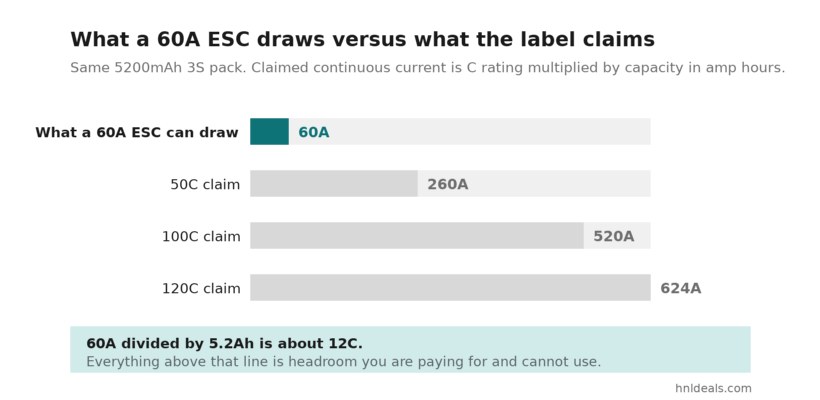
For a 60A ESC on a 5200mAh pack, that is 60 divided by 5.2, which is about 12C. Even discounting the manufacturer’s claim heavily, a 50C pack has enormous margin. Paying for 130C in that setup buys nothing but a larger number.
- Bashing and general 1/10 running: 50C to 80C is comfortable
- 1/8 scale and heavier vehicles: 80C to 100C
- Racing: follow the class norms, because at that level you already know why
- Small FPV quads: C rating matters more here relative to capacity, since a 1300mAh pack feeding a 6S freestyle build is working much harder proportionally than a car pack
The cost of chasing the number
High C packs cost more per unit of capacity. In the current Ovonic 3S line for RC cars, price per 1000mAh ranges from about $4.13 to $11.67, and the two most expensive by that measure are both high C singles. That is roughly a factor of 2.8 within one brand and one voltage, driven substantially by discharge class.
Spend the difference on a second pack instead. Two 80C packs will do more for your afternoon than one 130C pack will.
Questions readers ask
Does a higher C rating charge faster?
No. C rating describes discharge. Charge rate is a separate specification, usually printed on the label as something like 1C or 2C max, and exceeding it shortens pack life regardless of the discharge number.
Will a higher C pack make my car faster?
Only if the previous pack was sagging under load. If it was not, the extra headroom does nothing. What people often notice as extra punch is actually a new pack behaving like a new pack.
Is a lower C rating safer?
Not inherently. Safety comes from charging correctly, storing at the right voltage, and retiring damaged packs. See how to charge and store LiPo safely.
Bottom line
Treat C rating as a rough class indicator, not a specification. Calculate what your ESC actually needs, add margin, and buy the cheapest pack that clears it from a seller you can return to. Then watch internal resistance over time, because that is the number that tells you the truth.
For how this plays out in a real buying decision, see our comparison of 3S LiPo packs for RC cars.

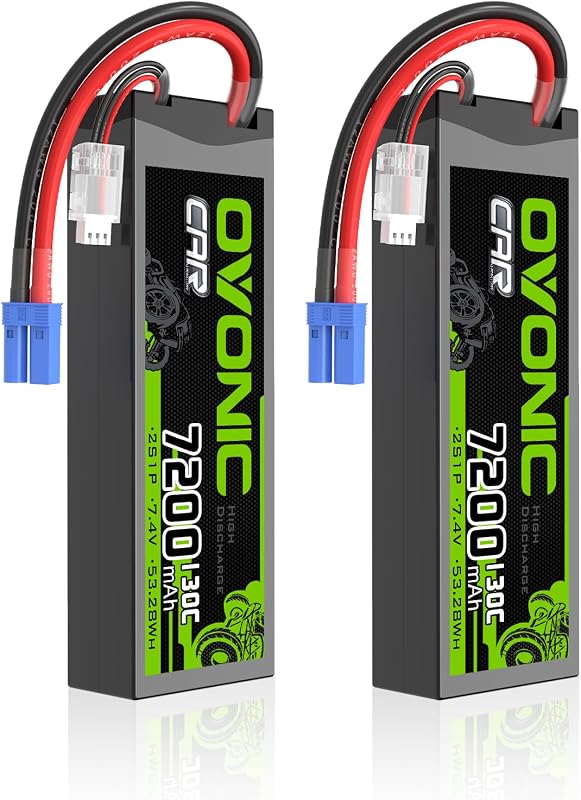
![OVONIC 2S LiPo Battery 7200mAh 7.4V 130C RC Battery with XT60 to TRA Connector [2 Batteries in 1 Package]](https://m.media-amazon.com/images/I/7112Z2o5awL._AC_SL800_.jpg)


Write Your Review
No reviews yet. Be the first to share your experience!