

Safety notice. Lithium polymer batteries can catch fire if they are damaged, over-charged, over-discharged, punctured or physically compressed. Nothing on this page replaces the safety information supplied with your battery, your charger and your vehicle. Read all three and follow them where they differ from us. We describe what these products are and what their makers claim; we cannot inspect your particular pack, and any decision to keep using a battery is yours.
A LiPo pack that is charged, stored, and retired correctly will give you hundreds of cycles and never cause you a problem. A pack that is left on a charger overnight, stored full for a month, or kept in service after it swells is a fire waiting for a quiet moment. The difference is not luck. It comes down to five numbers and a few habits, and this guide covers both.
The five numbers that matter
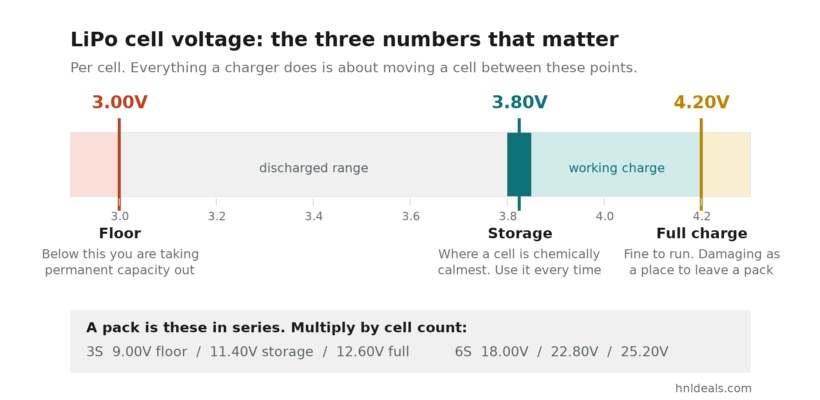
Almost everything about LiPo safety comes back to voltage per cell. Learn these and most decisions make themselves.
| Number | What it is | Why it matters |
|---|---|---|
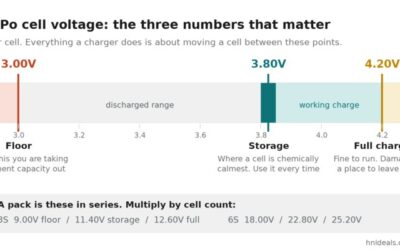
| 4.20V per cell | Fully charged | Going above this damages the cell and is the most common cause of a pack venting |
| 3.80V per cell | Storage voltage | Where a pack sits happiest when it is not being used. Roughly 50 percent charge |
| 3.00V per cell | Absolute floor | Below this the cell starts taking permanent damage. Most people set a cutoff higher |
| 1C | Standard charge rate | Charge current in amps equals capacity in amp hours. A 5000mAh pack charges at 5A |
| 0.03V | Acceptable cell spread | Difference between the highest and lowest cell after a charge. Wider than this means the pack is aging or the charger is not balancing |
Multiply by cell count to get pack voltage. A 3S pack is fully charged at 12.6V, stored at 11.4V, and should never be run below 9.0V. A 6S pack is 25.2V, 22.8V, and 18.0V.
How to charge a LiPo pack
Always balance charge
A LiPo pack is several cells wired in series, and they do not age at the same rate. Balance charging connects the small white plug as well as the main power leads so the charger can see each cell individually and bring them up together. Charging through the main leads alone lets one weak cell get pushed past 4.2V while the pack as a whole still reads normal. That is how packs fail without warning.
Plug in both connectors, select LiPo mode, confirm the cell count the charger detected matches the pack, and only then start. If the charger reports a different cell count than the label says, stop and find out why before continuing.
Pick a sane charge rate
1C is the rate that suits every pack. Some manufacturers rate packs for 2C, 3C, or higher, and it is usually printed on the label or in the product listing. Faster charging is convenient and it shortens pack life. If you are not in a hurry at the field, 1C costs you nothing. Note that charge rate and the discharge C rating on the label are different specifications, a distinction we untangle in what C rating really means.
- 1300mAh pack at 1C: 1.3A
- 2200mAh pack at 1C: 2.2A
- 5200mAh pack at 1C: 5.2A
Never leave it unattended
This is the rule people break most often and it is the one that turns a small fault into a house fire. A LiPo failure gives you seconds of warning, not minutes. Charge when you are in the room and awake. Not overnight, not while you run errands, not in the garage while you are inside.
Do not charge a cold or a hot pack
Charging below freezing causes lithium plating on the anode, which permanently reduces capacity and creates an internal short risk. Let a cold pack come up to room temperature first. At the other end, a pack that just came out of a hard run is hot. Let it cool to where you can hold it comfortably before it goes on the charger.
Where to charge
Charge on a surface that cannot catch fire and inside something that will contain a failure. In order of how much protection they give you:
- Steel ammo can with the seal removed. The best cheap option. Removing the rubber gasket matters, because a sealed can builds pressure. Leave the lid resting closed, not latched.
- LiPo safe bag. Better than nothing and easy to travel with. It contains sparks and slows a fire down. It does not stop a serious event, and the bag is consumable once it has been through one.
- Ceramic tile, concrete floor, or a metal baking tray. A bare non-flammable surface, away from anything that burns.
Wherever you settle on, keep it away from curtains, carpet, paper, and fuel, and have a way out of the room. A working smoke alarm in the charging area is worth more than any bag.
Storage, the part most people get wrong
A LiPo left at full charge degrades quickly. The chemistry that makes a full cell willing to deliver current also makes it reactive, and sitting at 4.2V accelerates the internal breakdown that eventually shows up as puffing and lost capacity. A pack left full for a month can lose a noticeable chunk of its life.
Every decent charger has a storage mode. It brings each cell to roughly 3.80V, charging cells that are low and discharging cells that are high. Use it any time a pack will sit for more than about three days. We go deeper on this in LiPo storage voltage and why it matters.
- Store at 3.80V per cell, cool and dry, ideally between 40 and 70 degrees Fahrenheit
- Store in the ammo can or LiPo bag, not loose in a drawer with metal objects
- Check voltage every couple of months. A pack that keeps drifting down is telling you something
- Do not store in a car. Summer interiors get far hotter than a LiPo should ever see
Flying with LiPo packs
Lithium batteries are regulated as dangerous goods. The rules below come from the FAA and the IATA dangerous goods regulations, and airlines apply them at the gate. Check your specific airline before you travel, because some are stricter.
- Spare packs go in carry-on only. Loose lithium batteries are not permitted in checked baggage.
- Under 100Wh: generally fine, no airline approval needed.
- 100Wh to 160Wh: airline approval required, and usually a limit of two spares.
- Over 160Wh: not permitted on passenger aircraft.
- Terminals must be protected against short circuit. Tape the leads or bag each pack individually.
Watt hours are volts multiplied by amp hours. A 6S 1300mAh pack is 22.2V times 1.3Ah, which is about 28.9Wh, well inside the limit. A 6S 5000mAh pack is 111Wh, which puts it in the approval bracket. Work it out before you get to the airport, not at the counter.
Packs also have to hold UN 38.3 transport certification before they can be shipped legally. That is the manufacturer’s obligation rather than yours, but it is a reasonable thing to ask a seller about, and it is one of the differences between an established brand and an anonymous listing.
When to retire a pack
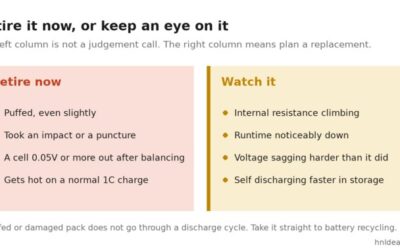
Retire it immediately, no exceptions, if any of these are true:
- It is puffed. Swelling is gas from decomposition inside the cell. It does not go back down and the pack does not recover.
- It took a hard impact or a puncture. Damage can start a slow internal short that shows up hours later. Put it somewhere safe outdoors and watch it for a day before disposal.
- A cell dropped below 3.0V and will not come back in balance.
- Cell spread after a balance charge is wide and getting wider.
- It gets noticeably hot on a normal charge or the run time has collapsed compared to when it was new.
A pack that is merely old and slightly down on capacity is not dangerous. A pack that is puffed, damaged, or unbalanced is, and it is not worth the money you would save by running it one more time. The gradual warning signs are covered in when to retire a LiPo battery.
If a pack catches fire
Get people away from it first. A LiPo fire produces hydrogen fluoride and other irritants, and the smoke is more likely to hurt you than the flame.
- Do not pick it up or try to move it once it is venting
- Get out, close the door, ventilate afterwards, and call the fire service if it is anything more than a small pack in a container
- Large amounts of water cool the surrounding area and stop the fire spreading. A LiPo is a lithium ion chemistry, not lithium metal, so water is not the hazard people often assume, but it will not stop a cell that is already in thermal runaway
- Sand or a fire blanket works to smother and contain
- Expect other cells in the pack to go one after another
The realistic goal is containment, not extinguishing. That is exactly why the charging container and the location matter more than any technique you can apply once it has started.
Disposal
Do not put LiPo packs in household trash or curbside recycling. Discharge the pack to a low voltage using your charger’s discharge function, tape the leads, and take it to a battery recycling drop off. Many hardware and electronics retailers in the United States accept lithium batteries through the Call2Recycle network, and most municipalities run a household hazardous waste day.
The salt water bucket method circulates widely online. It discharges unevenly, corrodes the leads, and can release chlorine gas depending on what is in the water. A recycling drop off is easier and it is what battery manufacturers actually recommend.
Questions readers ask
Can I leave a pack fully charged overnight if I am flying tomorrow?
One night at full charge will not ruin a pack. The habit will. If plans change and the pack sits full for a week, put it back to storage voltage rather than leaving it.
My charger says the pack is 3S but the label says 4S. What now?
Stop. Either a cell has collapsed to near zero volts or the balance lead is damaged. Do not charge it. Check the balance plug for a bent or corroded pin, then measure the pack with a cell checker. A genuinely dead cell means the pack is finished.
Is a slightly puffed pack still usable at low power?
No. Puffing means gas has already formed inside a sealed cell. Reducing the current you draw does not reverse it and does not make the pack safe to charge.
How many cycles should I expect?
It depends far more on how you treat the pack than on what you paid. Charging at 1C, avoiding deep discharges, storing at 3.8V, and letting packs cool between runs is what separates a pack that lasts years from one that puffs in a season.
Bottom line
Balance charge at 1C, in a container, in the room. Put packs to 3.80V per cell whenever they will sit. Retire anything that is puffed or damaged without arguing with yourself about it. Those three habits cover almost every LiPo incident that ever gets written up, and none of them cost anything except a little patience.
The one piece of equipment worth spending on is the charger, because storage mode, accurate balancing, and a clear per cell readout are what make the rest of this easy to follow. We compare the options in our charger roundup, and if you are shopping for packs at the same time, start with 3S LiPo batteries for RC cars.

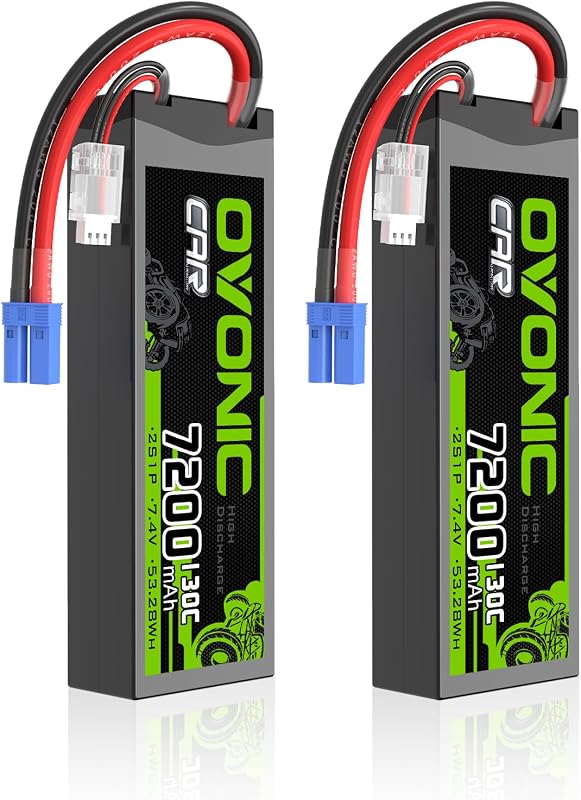
![OVONIC 2S LiPo Battery 7200mAh 7.4V 130C RC Battery with XT60 to TRA Connector [2 Batteries in 1 Package]](https://m.media-amazon.com/images/I/7112Z2o5awL._AC_SL800_.jpg)

Write Your Review
No reviews yet. Be the first to share your experience!