

Safety notice. Lithium polymer batteries can catch fire if they are damaged, over-charged, over-discharged, punctured or physically compressed. Nothing on this page replaces the safety information supplied with your battery, your charger and your vehicle. Read all three and follow them where they differ from us. We describe what these products are and what their makers claim; we cannot inspect your particular pack, and any decision to keep using a battery is yours.
Most people keep LiPo packs several runs longer than they should. The pack is still working, more or less, and nobody wants to throw away something they paid for. This is how to tell the difference between a pack that is merely old and a pack that has become a hazard.
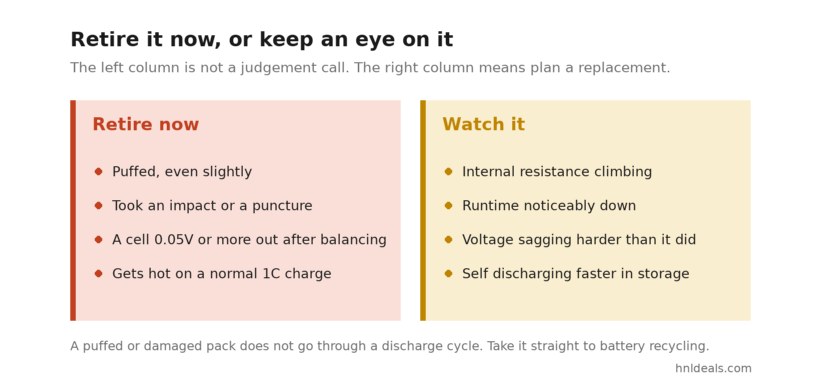
Retire immediately, no discussion
It is puffed
Swelling means gas has formed inside a sealed pouch through electrolyte decomposition. It does not reabsorb. It does not go back down if you leave it. The pack is finished, and the process that produced the gas is the same process that leads to thermal runaway.
A pack that is barely convex on one face is still puffed. There is no such thing as slightly puffed and still fine.
It took an impact or a puncture
Physical damage can start a slow internal short that produces nothing visible for hours. A crash hard enough to deform a pack, or anything that has pierced the pouch, means the pack is done even if it reads normal on a checker.
Put it somewhere non flammable outdoors, away from anything that matters, and leave it for a day before you handle it further. That is the window in which a damaged pack usually declares itself.
A cell will not come back into balance
After a full balance charge, cells should finish within roughly 0.01V to 0.03V of each other. A pack where one cell consistently sits 0.05V or more away from the others after balancing has a cell that is failing, and the charger is working harder each cycle to hide it.
It gets hot on a normal charge
A pack charging at 1C should get slightly warm at most. Noticeably hot means internal resistance has risen far enough that the pack is dissipating meaningful energy as heat, and heat accelerates everything that is already going wrong.
The gradual signs
These do not mean stop today. They mean the pack is on its way out and you should plan a replacement rather than being surprised.
| Sign | What it means | What to do |
|---|---|---|
| Internal resistance climbing | The clearest aging measure available to you | Track it every few charges. A large rise from new is the signal |
| Runtime falling | Capacity loss. Normal with age | Once you are noticeably down on when it was new, treat it as a lower duty pack |
| Voltage sagging harder | The pack cannot hold up under load like it used to | Move it to a gentler vehicle or retire it |
| Faster self discharge in storage | Something inside is drawing current | Watch closely. A cell that keeps drifting down is failing |
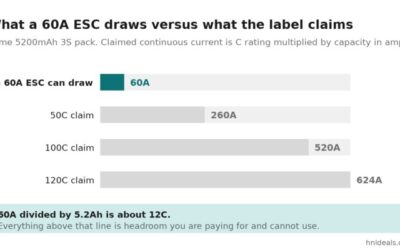
Internal resistance is the one worth building a habit around, because it moves before anything else does. Most balance chargers display it. Write the numbers down when a pack is new and you will have a baseline that tells you something real later. This is also why we discuss it instead of C rating in what C rating really means.
What shortens pack life fastest
Worth knowing, because most of it is avoidable:
- Storing at full charge. The most common and most avoidable. See LiPo storage voltage
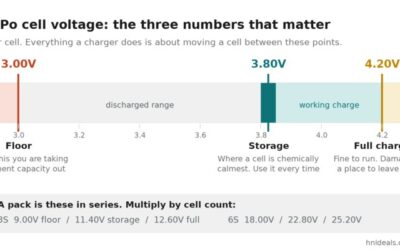
- Running packs flat. Below 3.0V per cell you are taking permanent capacity out
- Charging fast because you can. 2C and above shortens life for convenience
- Charging a hot pack. Let it cool to where you can hold it comfortably
- Heat in storage. A hot garage does damage while the pack sits doing nothing
Disposal
LiPo packs do not go in household trash or curbside recycling. Discharge the pack using your charger’s discharge function, tape the leads so nothing can short, and take it to a battery recycling drop off. In the United States many hardware and electronics retailers accept lithium batteries through the Call2Recycle network, and most municipalities run household hazardous waste collection.
The salt water bucket method circulates widely in hobby forums. It discharges unevenly, corrodes the terminals, and can release chlorine gas depending on water chemistry. A recycling drop off is easier and it is what manufacturers actually recommend.
A puffed or damaged pack should not be discharged through a charger. Put it somewhere safe and non flammable and take it straight to disposal.
Questions readers ask
How many cycles should a LiPo last?
There is no honest single number, because it depends far more on how the pack is treated than on what it cost. Charging at 1C, storing at 3.8V, and avoiding deep discharges is what separates packs that last years from packs that puff in a season.
Can I fly a slightly puffed pack at low throttle?
No. Reducing current does not reverse the chemistry and does not make the pack safe to charge, and charging is where most failures happen.
One cell reads 0.0V. Can it be recovered?
Techniques for reviving deeply discharged cells circulate online. They involve charging a cell that may have internal damage, outside the protections your charger provides. The pack is worth a fraction of what a fire costs. Retire it.
Is an old pack safe to keep as a spare?
An old pack that still balances well and is not puffed is fine at reduced duty. A pack retired for any of the immediate reasons above should be disposed of, not stored. Storing a failing pack is the worst option, because nobody is watching it.
Bottom line
Puffed, damaged, unbalanced, or hot on charge means the pack is done. Track internal resistance so aging is something you see coming rather than something you discover. And when a pack reaches the end, take it to recycling rather than improvising, because the last thing a LiPo does badly is sit in a bin.

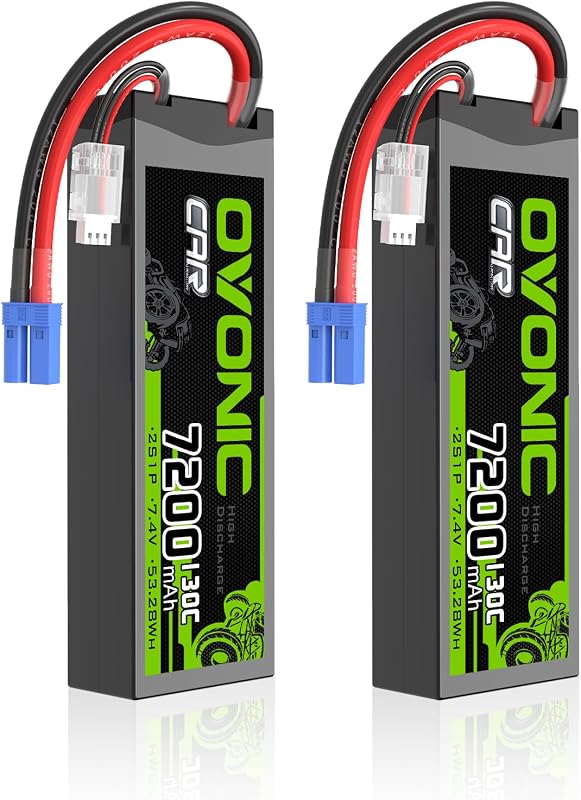
![OVONIC 2S LiPo Battery 7200mAh 7.4V 130C RC Battery with XT60 to TRA Connector [2 Batteries in 1 Package]](https://m.media-amazon.com/images/I/7112Z2o5awL._AC_SL800_.jpg)


Write Your Review
No reviews yet. Be the first to share your experience!