

Storage voltage is the single cheapest thing you can do for LiPo pack life, and it is the habit most people skip. It costs nothing, takes one button press, and it is the difference between packs that last years and packs that puff in a season.
The number
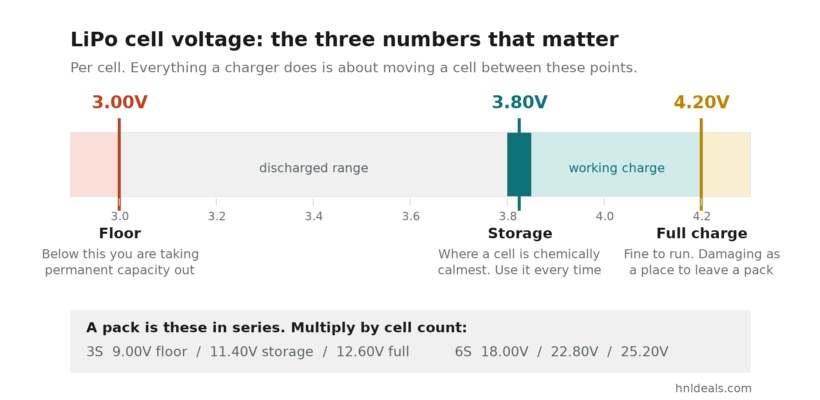
3.80V to 3.85V per cell. That is roughly 50 percent state of charge, and it is where a LiPo cell is chemically calmest.
| Pack | Full charge | Storage | Do not go below |
|---|---|---|---|
| 1S | 4.20V | 3.80V | 3.00V |
| 2S | 8.40V | 7.60V | 6.00V |
| 3S | 12.60V | 11.40V | 9.00V |
| 4S | 16.80V | 15.20V | 12.00V |
| 6S | 25.20V | 22.80V | 18.00V |
Why full charge damages a pack
A lithium cell at 4.2V has its cathode in a highly oxidised state. That is exactly what makes it willing to deliver current, and it is also what makes it reactive toward the electrolyte sitting against it. The reaction is slow, continuous, and irreversible. It consumes electrolyte, thickens the passivation layer on the electrodes, and produces gas.
You see the results as three symptoms, usually in this order: internal resistance creeps up, capacity falls, and eventually the pack swells because the gas has nowhere to go inside a sealed pouch.
Dropping to around 3.8V slows all of it down substantially. The cell is less reactive, the reaction rate falls, and the pack ages far more slowly while it waits for you.
Temperature makes it worse or better
Degradation is a chemical reaction, so heat accelerates it. A pack stored full in a hot garage in August is in the worst combination of conditions available. The same pack at storage voltage in a cool room is in the best.
- Aim for roughly 40 to 70 degrees Fahrenheit
- Never store packs in a car. Summer interiors go far beyond anything a LiPo should see
- Cold storage is not harmful, but let a cold pack warm up before charging, because charging below freezing causes lithium plating
- Keep packs in a steel ammo can with the gasket removed, or a LiPo bag, not loose in a drawer with metal objects
How to actually do it
Every competent balance charger has a storage mode. It is not the same as charging, and it is not the same as discharging. It looks at each cell and moves it toward the storage target, charging cells that are below it and discharging cells that are above it, then balances them.
- Connect both the main leads and the balance plug
- Select LiPo, then storage mode
- Confirm the cell count the charger detected matches the pack
- Start, and leave it where you can see it, as with any LiPo operation
Discharging to storage is slower than charging to it, sometimes much slower, because most chargers dissipate that energy as heat and are limited on discharge power. A charger with a 5W discharge ceiling will take a long time to bring a large pack down from full. That specification is worth checking before you buy, and it is one reason we weight it in our charger comparison.
When to bother
The practical rule most people converge on is three days. If a pack will sit longer than that, put it to storage voltage. If you are flying tomorrow, leave it charged.
The awkward case is the pack you charged for a session that got rained out. That is exactly the pack that ends up sitting full for three weeks, and it is where most avoidable damage happens. Make putting packs to storage part of packing up rather than part of planning ahead.
Storing a pack that has been run flat
A pack that came off the vehicle low should be brought up to storage voltage, not left where it is. Sitting at 3.2V or 3.3V per cell is its own problem, because self discharge over weeks can take a cell below 3.0V, and cells that go very low do not always come back.
Storage mode handles this automatically. It is the same button either way.
Questions readers ask
Is 3.8V or 3.85V better?
The difference is not worth worrying about. Manufacturers specify various points in that range and chargers use different defaults. Anywhere from 3.80V to 3.85V per cell is doing the job.
My pack drifted down over two months. Is it faulty?
All cells self discharge slowly. A small drop over months is normal. A pack that loses a lot, or where one cell falls much faster than the others, is telling you it has a problem. Check it against the signs in when to retire a LiPo battery.
Can I just discharge it in the car instead?
You can run a pack down, but you cannot hit storage voltage accurately that way, and it is easy to overshoot into damaging territory. Use the charger. It is the tool for it.
Does storage voltage matter for NiMH too?
No. NiMH chemistry has different care requirements and is far more tolerant of sitting. We cover the differences in LiPo versus NiMH for RC.
Bottom line
3.80V per cell, cool, in a container, any time a pack will sit more than three days. It is one button and it does more for pack life than any amount of money spent on higher specifications. The rest of the routine is in how to charge and store LiPo batteries safely.

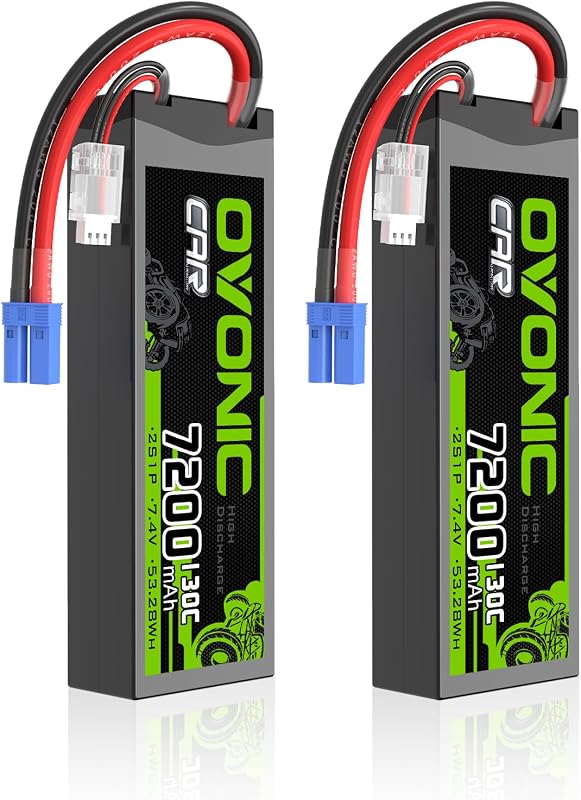
![OVONIC 2S LiPo Battery 7200mAh 7.4V 130C RC Battery with XT60 to TRA Connector [2 Batteries in 1 Package]](https://m.media-amazon.com/images/I/7112Z2o5awL._AC_SL800_.jpg)


Write Your Review
No reviews yet. Be the first to share your experience!