

NiMH is not obsolete, and LiPo is not automatically the upgrade. The two chemistries suit different owners, and the honest answer to which you should run depends more on how you use the vehicle than on which is technically superior.
The differences that matter
| LiPo | NiMH | |
|---|---|---|
| Nominal cell voltage | 3.7V | 1.2V |
| Energy for a given weight | Much higher | Lower |
| Voltage under load | Holds up, then falls off sharply | Declines gradually throughout the run |
| Charging | Balance charging required | Simple, more tolerant |
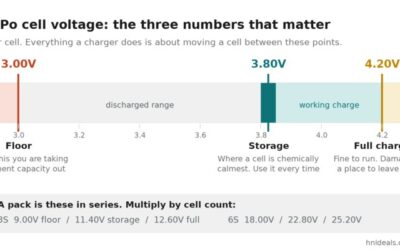
| Storage care | Must be stored at about 3.8V per cell | Store as you like, top up before use |
| Failure behaviour | Can enter thermal runaway | Can vent and get hot, far less dramatic |
| Tolerance of neglect | Low | High |
Why LiPo took over
Weight, mostly. A LiPo pack delivers substantially more energy for the same mass, which in a vehicle means either longer runs or less mass to accelerate, and in anything that flies it is the difference between viable and not.
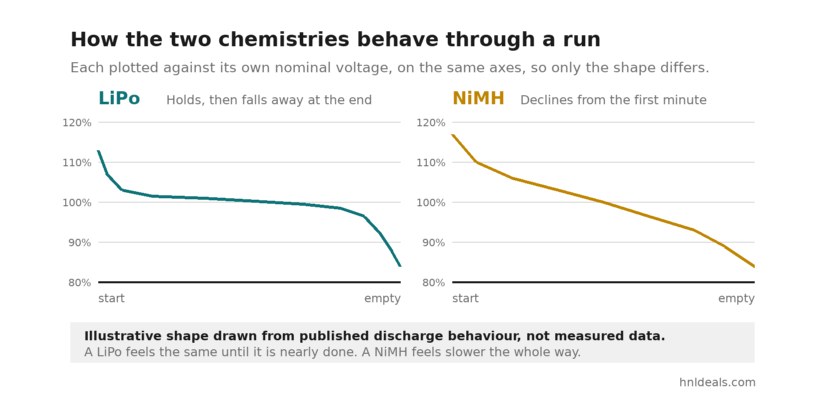
The second reason is how the voltage behaves. A LiPo holds its voltage through most of the discharge and then drops away at the end. A NiMH declines steadily from the start, so the vehicle feels progressively slower through a run. If you like consistent performance, LiPo delivers it.
Why NiMH is still the right answer sometimes
It tolerates being ignored
You can leave a NiMH pack in a drawer at whatever charge it happened to be at, come back in three months, top it up, and go. Do that with a LiPo and you have damaged it. For an occasional user, that difference outweighs everything in the specification table.
It fails less dramatically
NiMH cells can vent and get hot when abused. They do not typically produce the self sustaining fire that a LiPo in thermal runaway does. In a household with children, in a vehicle that gets handed to guests, or anywhere the charging routine will not be followed carefully, that matters more than performance.
Some vehicles are specified for it
Ready to run vehicles are frequently supplied with NiMH and an ESC specified accordingly. Fitting a LiPo raises voltage, and the ESC and motor were chosen around a different figure. Check the manual before assuming an upgrade is available to you.
The voltage trap when switching
A 6 cell NiMH pack is 7.2V nominal. People often replace it with a 2S LiPo at 7.4V nominal and assume equivalence. The nominal figures are close, but the peak is not. A freshly charged 2S LiPo is 8.4V, and a fully charged 6 cell NiMH sits above its nominal too. The real difference is that the LiPo holds the higher voltage rather than falling away from it.
Where this bites is 3S. Moving from a 7.2V NiMH to an 11.1V LiPo is a large step, and it is the point at which ESCs and motors that were fine on 2S start failing. Confirm the rating in the manual, not in a forum post from someone who got away with it.
You also need a low voltage cutoff configured. NiMH tolerates being run down. LiPo does not, and below 3.0V per cell you are taking permanent capacity out of the pack.
What switching actually costs
The pack is not the whole expense. Moving to LiPo properly means:
- A balance charger with a storage mode, which is the real purchase. See our charger comparison
- Somewhere fire safe to charge, such as a steel ammo can with the gasket removed
- A habit of putting packs to storage voltage when they will sit, covered in LiPo storage voltage
- Possibly a connector change, since NiMH packs often use different plugs. See connectors compared
If you are not going to do the charging and storage part, do not make the switch. A LiPo run on NiMH habits is a worse outcome than a NiMH pack.
Which should you run
Choose LiPo if you run regularly, you want consistent performance through a run, weight matters, and you are willing to keep a charging and storage routine.
Stay with NiMH if the vehicle comes out a few times a year, it is used by or around children, it is stored somewhere you would rather not have a lithium fire, or the manufacturer specified NiMH and you do not want to replace electronics to change that.
Questions readers ask
Can I charge NiMH on a LiPo charger?
Most hobby balance chargers handle both, usually with a wide NiMH cell range. Select the correct chemistry every time. Charging NiMH on a LiPo profile is a genuine hazard, and it is a one button mistake.
Is LiHV the same as LiPo?
Closely related. LiHV charges to a higher voltage per cell, typically 4.35V rather than 4.20V, for slightly more energy. It needs a charger set to LiHV specifically. Charging LiHV on a LiPo profile undercharges it, and charging LiPo on a LiHV profile overcharges it, which is the dangerous direction.
Does NiMH still have a memory effect?
Modern NiMH is far less affected than the NiCd packs the idea came from. Voltage depression from repeated partial cycles exists but is minor for hobby use, and it is not a reason to run packs flat.
Bottom line
LiPo is better on every performance measure and demands a routine in exchange. NiMH asks nothing of you and gives less back. Pick based on whether you will actually keep the routine, and check what your ESC is rated for before you change anything.
If you are going LiPo, start with how to charge and store LiPo batteries safely.

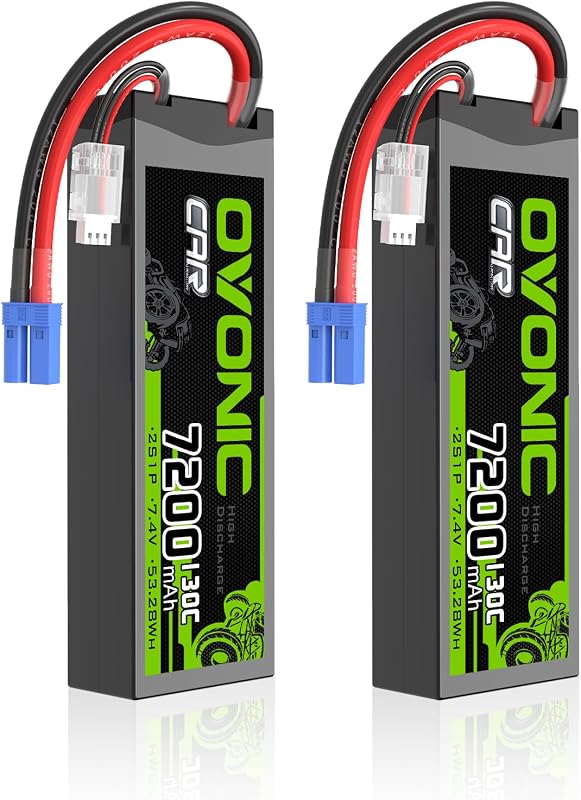
![OVONIC 2S LiPo Battery 7200mAh 7.4V 130C RC Battery with XT60 to TRA Connector [2 Batteries in 1 Package]](https://m.media-amazon.com/images/I/7112Z2o5awL._AC_SL800_.jpg)


Write Your Review
No reviews yet. Be the first to share your experience!