

Buying a pack with the wrong connector is the most common avoidable mistake in RC, and product titles rarely make it obvious. This is what each connector is, roughly what it handles, and how to decide whether to adapt or resolder.
The connectors you will meet
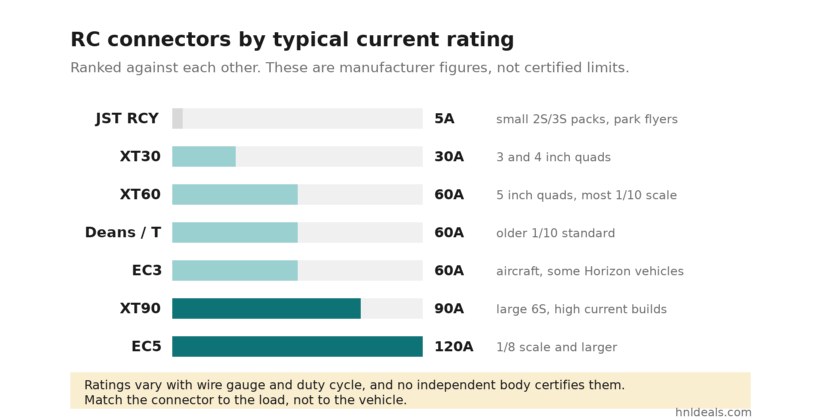
Current figures below are the values commonly quoted by manufacturers and retailers. They are nominal, they vary with wire gauge and duty cycle, and no independent body certifies them. Use them to rank connectors against each other, not as absolute limits.
| Connector | Typical rating | Where you find it |
|---|---|---|
| JST-PH 2.0 | a few amps | 1S whoop and micro packs |
| JST RCY (red) | around 5A | Small 2S and 3S packs, park flyers |
| XT30 | around 30A | Small and mid quads, 3 inch and 4 inch builds |
| XT60 | around 60A | The default for 5 inch quads and most 1/10 scale |
| Deans, also called T plug | around 60A | Older 1/10 standard, still very common |
| EC3 | around 60A | Aircraft, some Horizon Hobby vehicles |
| EC5 | around 120A | 1/8 scale and larger, Arrma and similar |
| XT90 | around 90A | Large 6S vehicles, high current builds |
| Traxxas high current | high, brand specific | Traxxas vehicles and packs |
The one that catches everyone
EC5 and Deans are not interchangeable, and neither is compatible with XT60. A large proportion of 1/8 scale packs ship with EC5, while a large proportion of 1/10 electronics use Deans or XT60. Buy a 1/8 oriented pack for a 1/10 truck and you will find this out after it arrives.
Traxxas connectors are a separate problem. Traxxas vehicles ship with their own high current connector, and while packs with that plug are widely available, mixing a Traxxas plug pack with a non Traxxas ESC means an adapter or a soldering iron.
Adapter or resolder
Adapters work. They are also two extra connections in the highest current path in the vehicle, and every connection adds resistance, heat, and a place to fail. A short adapter used occasionally is fine. An adapter that lives in the car permanently is a compromise you are choosing to keep.
- Adapt when you are borrowing a pack, checking a fit, or bridging one vehicle occasionally
- Resolder the ESC when you own several packs on one standard and one vehicle that disagrees. Change the one, not the many
- Never cut both battery leads at once. Do one wire at a time. Shorting a LiPo across a pair of snips is a memorable way to learn this
Standardise on one
The single best thing you can do is pick one connector for your whole fleet and convert everything to it. It removes the adapter drawer, it means any pack fits any vehicle, and it makes buying decisions simple.
- XT60 if most of what you own is 1/10 scale or 5 inch quads. It is the most widely stocked connector in the hobby
- EC5 or XT90 if you are mostly 1/8 and larger, where the current genuinely warrants it
- XT30 for small quads, where an XT60 is unnecessary weight
Do not standardise upward for its own sake. An XT90 on a 3 inch quad is dead weight, and weight is the enemy in small aircraft.
Balance connectors are a separate thing
The small white plug is JST-XH on almost every hobby pack, and it is effectively standard across brands. That is why chargers only need one balance board. The pin count changes with cell count: a 3S pack has four wires, a 6S pack has seven, always one more than the cell count.
Handle it gently. Bent or corroded balance pins are a common cause of a charger reporting the wrong cell count, which is a scenario worth understanding before it happens. See how to charge and store LiPo safely.
Soldering, briefly
Power connectors need real heat. A 25W iron will not do it and will leave you with a cold joint that heats up under load. Use an iron with enough thermal mass, tin both sides first, and keep the contact time short so you do not melt the plastic housing out of alignment.
Heat shrink every joint. Exposed copper in a battery lead is not a cosmetic issue.
Questions readers ask
Is XT60 better than Deans?
For most people, yes, though not because of current capacity, which is similar. XT60 is polarised, easier to grip, far easier to solder, and less prone to the partial contact that Deans can develop as it wears.
Do adapters lose noticeable power?
A good adapter with short, thick wire costs you very little. A long thin one on a high current setup is a different matter, and the way you notice is heat at the connector after a run. If a connector is hot enough to be uncomfortable, something in that path is undersized.
Can I use an XT30 pack on an XT60 vehicle with an adapter?
Physically yes. Whether you should depends on the current. The XT30 is the weakest link and it does not care that the rest of the system is bigger. Match the connector to the load, not to the vehicle.
Bottom line
Check the connector before you check the price. Standardise your fleet on one plug sized for your largest current draw, keep a couple of short adapters for borrowed packs, and resolder the vehicle rather than the batteries when something does not match.
Connector fitment is one of the three things we weight in our 3S pack comparison, alongside physical dimensions and case type.

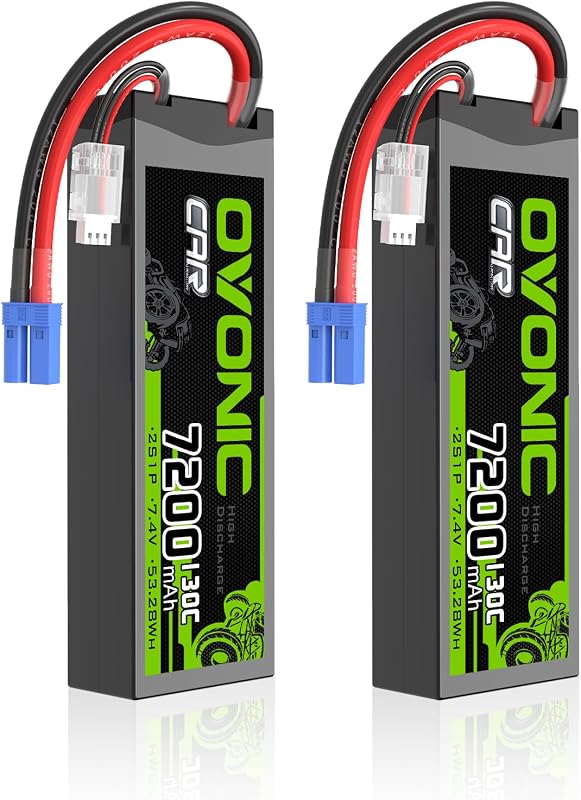
![OVONIC 2S LiPo Battery 7200mAh 7.4V 130C RC Battery with XT60 to TRA Connector [2 Batteries in 1 Package]](https://m.media-amazon.com/images/I/7112Z2o5awL._AC_SL800_.jpg)


Write Your Review
No reviews yet. Be the first to share your experience!