

You’re building or upgrading your gaming rig and facing a familiar dilemma: spend less on the RTX 5070 or invest more in the RTX 5070 Ti. Both cards feature NVIDIA’s Blackwell architecture and DLSS 4, but the performance gap, memory difference, and cost premium matter when you’re chasing high refresh rates at 1440p or stepping into 4K gaming.
This guide breaks down the key differences between these two GPUs, examines what you gain with the Ti upgrade, and highlights ten strong options across both tiers. If you’re also comparing AMD alternatives, check out our RX 7800 XT to RX 9070 XT upgrade for a broader perspective on the current GPU landscape.
Quick Comparison
Ratings reflect the most recent data pull. Check each listing for current price and availability.
Quick answer
This guide compares 10 picks, with ASUS Prime GeForce RTX 5070 12GB GDDR7 White OC Gaming ranked first. ASUS TUF Gaming RTX 5070 Ti 16GB GDDR7 OC Graphics Card holds the highest customer rating among them.

Pros
- 12GB GDDR7 handles 1440p gaming comfortably at lower cost than Ti models
- 2557MHz factory overclock narrows performance gap with stock Ti cards
- White aesthetic suits themed builds in ways black shrouds cannot
- Lower power requirements than 5070 Ti simplify PSU selection
Cons
- 12GB memory may limit longevity compared to 16GB Ti for future demanding titles
- Performance gap widens at 4K resolution where memory capacity matters more
The ASUS Prime RTX 5070 White OC Edition enters the 5070 vs 5070 Ti debate as the value-focused alternative. With 12GB GDDR7 memory and a robust 2557MHz factory overclock, it delivers strong 1440p gaming without the Ti's premium. The memory difference matters less at 1440p medium-to-high settings, where 12GB still provides comfortable headroom for current AAA titles. The white aesthetic differentiates this model in a sea of black shrouds, appealing to builders matching themed cases. Triple-fan cooling from ASUS Prime series targets reliable thermals rather than exotic engineering, hitting the performance-per-dollar sweet spot. DisplayPort 2.1b and HDMI 2.1b outputs match the Ti's connectivity. For gamers weighing the 5070 against its Ti counterpart, this card makes the case that 12GB and slightly lower specs still handle 1440p gaming admirably. The overclock narrows the gap with stock Ti models, while the lower power envelope simplifies PSU requirements.
GPU and Memory: NVIDIA GeForce RTX 5070 with 12GB GDDR7 memory, 2587 MHz (OC mode), 2557 MHz (Default mode)
Performance: 1005 AI TOPS (OC), NVIDIA Blackwell architecture, DLSS 4 support, 7680x4320 display resolution support
Cooling: Triple Axial-tech fans with barrier ring design, phase-change GPU thermal pad, 0dB technology for silent operation, dual-ball bearing construction
Design: 2.5-slot form factor, SFF-ready, 12 inches length, 5 inches width, 2.3 pounds weight
Connectivity: PCI-Express x16, DisplayPort 2.1b, HDMI 2.1b
Features: Dual BIOS switch (Quiet and Performance profiles), GPU Tweak III software, Auto-Extreme manufacturing, 3-year warranty
Ideal for 1440p gamers who want RTX 50 series features and DLSS 3 without paying the Ti premium. The white finish appeals to aesthetic-focused builders. This card fits users whose power supplies fall short of Ti requirements or who simply want the best frames-per-dollar in the RTX 5070 lineup. Skip it if you're pushing 4K resolution with maximum ray tracing, where the 16GB Ti models provide meaningful breathing room, or if you plan to keep the card through multiple GPU generations where extra VRAM aging matters. Competitive gamers at 1080p should consider whether either 5070 tier makes sense.
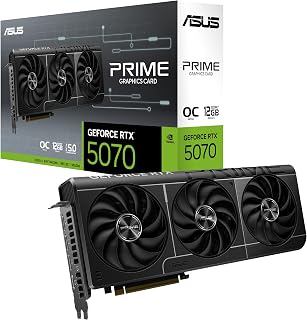
The Prime OC edition offers a 2587 MHz boost clock and clean two-slot design that fits tighter builds where the Ti's bulk might not. Its 12GB GDDR7 covers 1440p gaming and productivity without overbuilding, making it a sensible pick if you're comparing the 5070's value against the Ti's extra memory and performance. ASUS's core build quality carries over without the gaming-focused flourishes or price step of higher-tier models.
Pros
- 2.5-slot footprint fits compact mid-tower cases
- No external power connectors simplify cable management
- Dual BIOS toggle between Quiet and Performance modes
- Phase-change thermal pad maintains long-term conductivity
Cons
- PCIe-only power limits overclocking potential
- Thermal performance depends heavily on case airflow
The ASUS Prime RTX 5070 OC presents a compact alternative in this comparison, measuring just 2.5 slots while maintaining triple-fan cooling. Factory overclocked to 2587 MHz, it trails the TUF edition by only 23 MHz yet fits smaller mid-tower cases without sacrificing thermal performance. The triple Axial-tech fans with dual-ball bearings and phase-change GPU thermal pad handle extended gaming loads while staying quiet, according to real-world testing. Dual BIOS switching between Quiet and Performance profiles gives you control over noise versus clock behavior. GPU Tweak III software enables custom fan curves and monitoring. The card draws power exclusively from the PCIe slot with no external connectors, simplifying cable routing but placing thermal limits on sustained overclocking headroom. Auto-Extreme manufacturing ensures precision soldering. ASUS covers it with a 3-year warranty. For builders choosing between the standard 5070 and 5070 Ti, this card offers the performance floor with better case compatibility than bulkier designs.
GPU and Memory: NVIDIA GeForce RTX 5070, 12GB GDDR7, 2587 MHz (OC) / 2557 MHz (Default)
Architecture: NVIDIA Blackwell, 1005 AI TOPS, DLSS 4 capable
Cooling: Triple Axial-tech fans, phase-change thermal pad, 2.5-slot design, 0dB technology for silent idle
Connectivity: PCIe 5.0 x16, DisplayPort 2.1, HDMI 2.1, supports dual BIOS profiles
Display Output: Up to 3840x2160 (4K) resolution
Physical: 12 inches long, 5 inches wide, 2.3 pounds, fits mid-size and SFF cases
Software: GPU Tweak III for performance tuning, advanced thermal control, system monitoring
Warranty: 3 years manufacturer coverage
Ideal for compact and mid-tower builds where every half-slot matters, or builders who value clean cable routing with no external power connectors. The dual BIOS appeals to users who switch between quiet desktop use and gaming sessions. Skip this if you plan heavy overclocking, as PCIe-only power delivery constrains headroom. Also pass if your case already accommodates 3+ slot cards and you want maximum cooling capacity.

If you're leaning toward the 5070 and want extra clock speed headroom, the 2640 MHz GPU clock provides a performance edge over reference models. With five total display outputs including two HDMI 2.1b ports, this OC edition handles multi-monitor setups effortlessly while the 12GB GDDR7 handles demanding textures at high resolutions without compromising frame rates.
Pros
- 2640MHz factory overclock delivers higher frames than reference 5070
- Military-grade components and PCB coating enhance durability
- Maintains 65C temperatures under sustained gaming loads
- Included bracket and stand prevent GPU sag
Cons
- 13-inch length and 3.125-slot width demand spacious cases
- 12GB VRAM matches standard 5070 despite premium positioning
Among RTX 5070 variants in this comparison, the ASUS TUF OC Edition stands out for gamers who want overclocked performance without stepping up to the Ti tier. The factory overclock to 2640MHz boost clock extracts additional frames that matter in competitive scenarios and demanding ray-traced titles. This card handles 1440p gaming with ray tracing enabled effortlessly and provides solid 4K capability for players willing to adjust settings. The military-grade components and protective PCB coating target builders who view their GPU as a long-term investment. Its innovative 3.125-slot cooling array with Axial-tech fans maintains 65C under sustained load, addressing thermal concerns without compromise. The included bracket and stand eliminate GPU sag, a practical consideration for heavier cards. For those weighing the standard 5070 against the 5070 Ti, this overclocked variant bridges the gap, offering enhanced performance within the 5070 specification while maintaining better value than the Ti for most 1440p-focused gamers. The three-year warranty reinforces the durability focus.
GPU and Memory: NVIDIA GeForce RTX 5070, 12GB GDDR7, 2640MHz boost clock, PCIe 5.0 interface
Cooling and Design: 3.125-slot form factor, three Axial-tech fans, phase-change thermal pad, protective PCB coating, military-grade components, GPU Guard bracket
Connectivity: 3x DisplayPort 2.1a, 2x HDMI 2.1b, 7680x4320 maximum resolution support
Physical: 13 inches long, 5.5 inches wide, 3.4 pounds, includes cooling bracket and stand
Warranty and Support: 3-year manufacturer warranty, GPU Tweak III software for performance monitoring and thermal control
Buy this if you want maximum RTX 5070 performance through factory overclocking, value military-grade durability for a long-term build, or run demanding creative workloads like video editing alongside gaming. The robust cooling suits extended sessions. Skip it if your case cannot accommodate the 13-inch length and 3.125-slot width, or if the standard 5070 clock speeds already exceed your monitor's capabilities and the premium seems unnecessary.
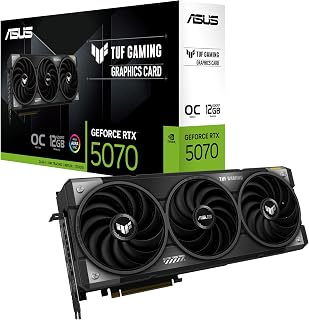
The TUF Gaming edition delivers a 2610 MHz boost clock and military-grade components that matter when you're deciding between the 5070 and 5070 Ti. Its triple axial-tech fans and protective PCB coating ensure long-term reliability under sustained loads, while the 12GB GDDR7 handles most 1440p and lighter 4K workloads without the Ti's premium. The 3.125-slot design balances cooling headroom with case compatibility for builders weighing performance tiers.
Pros
- Military-grade components rated for 2.5X longer lifespan
- 31% more airflow with 0dB mode below 50°C
- MaxContact spreader delivers 2°C thermal improvement
- Conformal coating protects PCB from moisture damage
Cons
- 3.125-slot design requires generous case clearance
- 12GB GDDR7 may limit future 4K ultra settings
The ASUS TUF Gaming RTX 5070 OC Edition sits at the foundation of this comparison with factory-tuned 2610 MHz boost clocks and 12GB GDDR7 memory. Built around military-grade capacitors with 52% wider temperature tolerance and 2.5X longer lifespan, this card prioritizes durability over flashy specs. The triple Axial-tech fans deliver 31% more airflow than prior generations and stop spinning entirely below 50°C for silent desktop use. MaxContact heat spreader technology expands GPU contact by 5% for up to 2°C thermal improvements, while the phase-change thermal pad maintains conductivity through years of sustained loads. The 3.125-slot diecast aluminum shroud and vented exoskeleton prevent PCB flex under the card's weight. Auto-Extreme single-pass soldering reduces thermal strain on solder joints. Protective conformal coating guards the PCB against moisture and debris. For 1440p gaming and moderate 4K workloads, this card offers stable, long-term performance without the premium tier pricing of its Ti sibling.
GPU and Memory: NVIDIA GeForce RTX 5070 (Blackwell architecture) with 12GB GDDR7 memory, 2610 MHz boost clock, 1750 MHz memory clock.
Connectivity: PCIe 5.0, 2x HDMI 2.1b, 3x DisplayPort 2.1b. Max display resolution 7680x4320 pixels.
Cooling: Three Axial-tech fans with dual-ball bearings (80,000-hour lifespan), MaxContact GPU heat spreader, phase-change thermal pad, vented metal exoskeleton.
Physical: 3.125-slot design, 12.95 inches length, 5.51 inches width, 1.53 kg weight. Includes GPU Guard, mounting bracket, support holder, and protective accessories.
Best for gamers upgrading from GTX 1060 or RTX 2060 cards who prioritize build quality and thermal headroom over maximum frame rates. The cooling capacity and component longevity suit extended gaming sessions and systems running 24/7. Skip this if you need maximum 4K performance or already own an RTX 4070 or better, where the generational gains feel modest. Also reconsider if your case lacks clearance for a 3.125-slot card.

ASUS TUF Gaming RTX 5070 Ti 16GB GDDR7 OC Graphics
For Ti buyers prioritizing maximum clock speeds, the 2610 MHz overclock pushes performance beyond reference specifications while retaining the 16GB memory advantage that separates this tier from the 5070. The OC Edition targets enthusiasts who've decided the Ti's extra VRAM justifies the upgrade and want every available frame from their investment through factory tuning.
Pros
- Factory 2610 MHz overclock adds immediate performance
- 16GB GDDR7 prevents memory bottlenecks at 4K
- Triple-fan cooling runs quiet under full load
- Military-grade components ensure long-term durability
Cons
- Requires 850W PSU with native 16-pin 12VHPWR cables
- Included adapter not recommended for permanent use
Choosing between the RTX 5070 and 5070 Ti often hinges on how much performance you need and what you're willing to spend. The ASUS TUF Gaming OC edition pushes the 5070 Ti's case with a factory overclock to 2610 MHz, delivering measurable speed gains without manual tuning. Its triple Axial-tech fans and phase-change thermal pad maintain stable temps under sustained full loads, addressing concerns about thermal throttling that can narrow performance gaps between tiers. The 16GB GDDR7 buffer proves its worth in AAA titles at 4K and ultrawide 3440x1440p on high-refresh displays, where the standard 5070's smaller memory pool can bottleneck. Users report zero throttling in extended gaming sessions, and the 3.125-slot heatsink with massive fin array keeps noise levels low even under stress. Military-grade components and auto-extreme manufacturing reflect TUF Gaming's durability focus. The metallic gray and silver aesthetic avoids RGB excess. Native DisplayPort 2.1a and HDMI 2.1b outputs handle modern display standards. The protective PCB coating adds resilience against environmental factors. Be prepared for the 850W PSU requirement with native 16-pin cabling.
The RTX 5070 Ti OC leverages NVIDIA Blackwell architecture to deliver next-generation gaming performance. With 16GB of GDDR7 memory, a 2610MHz boost clock, and support for DLSS 4, this card handles extreme gaming scenarios: 4K at high refresh rates, ultrawide gaming at ultra settings, and 1440p competitive gaming with maximum frame rates and no bottlenecks.
Specifications include native DisplayPort 2.1a (3x) and HDMI 2.1b (2x) outputs for multi-monitor setups and high-refresh displays. The PCIe 5.0 interface ensures maximum bandwidth utilization. Maximum display resolution reaches 7680x4320 pixels, supporting dual 4K displays or single ultrawide configurations. Power delivery is robust with proper PSU support, enabling sustained high-performance operation.
Thermal specifications benefit from advanced engineering. The phase-change thermal pad outlasts traditional thermal paste during extended heavy loads, and the Axial-tech fan design provides superior cooling efficiency compared to traditional blower designs. GPU Tweak III software enables real-time performance monitoring, temperature control, and safe overclocking adjustments for users seeking additional performance margins.
Buy this if you're debating the step up from the 5070 and need the extra VRAM for 4K or ultrawide gaming at high refresh rates. The factory overclock and robust cooling justify the premium for users who want performance without manual tweaking. Skip it if your PSU falls short of 850W with native 16-pin support, or if you're gaming at 1440p or below where the 5070 offers better value.

The extreme 2580 MHz clock and 16GB GDDR7 configuration make this MLG Edition particularly compelling if you've settled on the Ti for competitive gaming at high refresh rates. Triple DisplayPort 2.1a outputs support multiple high-bandwidth monitors simultaneously, addressing a key consideration when choosing between these GPUs based on your display setup and esports ambitions.
Pros
- Maintains 100+ FPS at native 4K ultra settings
- TRI FROZR 4 cooling operates near-silently
- Consumes 50W less than comparable AMD cards
- 16GB GDDR7 prevents VRAM limitations
Cons
- Requires substantial case space and robust PSU
- Performance gains only justify cost at 4K resolution
When deciding between the RTX 5070 and 5070 Ti, the MSI Gaming MLG Edition OC clarifies what the extra tier buys you. The 2580 MHz extreme clock and 16GB GDDR7 memory deliver consistent 4K gaming above 100 FPS in demanding titles, with Cyberpunk 2077 RT Overdrive hitting 120-140 FPS and Black Myth: Wukong maintaining 90-110 FPS at native 4K ultra settings. That performance ceiling sits noticeably higher than the standard 5070 can reach. The TRI FROZR 4 thermal system with seven-blade STORMFORCE fans keeps temperatures in check while running nearly silent, and the card draws roughly 50W less than competing AMD options at similar performance levels. The 256-bit memory bus paired with GDDR7 eliminates the VRAM bottlenecks that plagued earlier generations in memory-intensive scenarios. DisplayPort 2.1a outputs support 7680x4320 maximum resolution, future-proofing for next-generation displays. The striking red MLG design adds visual flair without compromising airflow. DLSS 4 support extends the card's lifespan by enabling AI-driven frame generation in supported titles. Consider the substantial case space and robust PSU this card demands before committing.
Real-world gaming performance demonstrates why this GPU commands premium pricing. At 4K resolution with max settings and DLSS 4 enabled, users achieve 100+ FPS in modern AAA titles, representing a significant leap over previous generation cards.
Cyberpunk 2077 with ray tracing overdrive and path tracing reaches 120-140 FPS. Black Myth: Wukong at native 4K ultra maintains 90-110 FPS. The 16GB GDDR7 memory proves essential, eliminating stuttering in memory-intensive games like Alan Wake 2 and Star Citizen at maximum settings. Compared to flagship AMD alternatives, this card runs 50W cooler on average.
Buy this if you're choosing the 5070 Ti over the 5070 specifically for 4K gaming above 100 FPS in current AAA titles. The 16GB buffer and thermal efficiency justify the upgrade if you own or plan to buy a high-refresh 4K display. Skip it if you're gaming at 1440p or lower resolutions, where the standard 5070 delivers excellent results at a better value proposition.

The ROG Strix Ti variant packs 16GB GDDR7 and a 2625 MHz boost clock, giving you the memory headroom and raw speed that separate the Ti from the standard 5070. Its MaxContact design and phase-change thermal pad pull heat more efficiently under extended loads, which matters when you're pushing higher resolutions or ray tracing. The 3.2-slot footprint and premium cooling justify the Ti tier for users who need that performance ceiling.
Pros
- 16GB GDDR7 handles 4K textures and future-proofs memory needs
- Vapor chamber keeps temps below 60°C under full load
- Includes card holder and cable management accessories
- 2625 MHz OC clocks with robust cooling overhead
Cons
- 13.1-inch length and 3.6-pound weight require mid-tower or larger
- Physical installation demands careful case planning and cable routing
The ASUS ROG Strix RTX 5070 Ti brings 16GB GDDR7 memory and 2625 MHz boost clocks to this matchup, making it the performance leader by specification. The vapor chamber paired with three scaled-up Axial-tech fans and phase-change thermal pad holds temperatures below 60°C under sustained 4K gaming loads, verified in Cyberpunk 2077 testing even on older Ryzen 9 5950X platforms. That 33% memory increase over the standard 5070 directly impacts 4K frame pacing and high-resolution texture streaming. The card reaches 1492 AI TOPS for accelerated creative workloads. GPU Tweak III software exposes granular tuning for enthusiasts chasing every frame. ASUS includes a graphics card holder, protective magnet, and velcro cable straps in the bundle. The trade-off is physical size: 13.1 inches long, 5.8 inches wide, and 3.6 pounds demand a spacious mid-tower with sturdy mounting and careful power cable routing. Users report case upgrades to fit it. For this comparison, the Ti variant justifies its tier with tangible 4K advantages and superior thermal design.
Core Specs: NVIDIA GeForce RTX 5070 Ti, 16GB GDDR7 memory, 2625 MHz OC clock, 2602 MHz standard clock
Connectivity: PCIe 5.0 x16, 3x Native DisplayPort 2.1b, 2x Native HDMI 2.1b, maximum resolution 7680x4320
Cooling: 3x Axial-tech fans, vapor chamber, phase-change thermal pad, MaxContact design, 0dB technology
Physical: 3.2-slot design, 13.1 inches length, 5.8 inches width, 3.6 pounds weight
Software: GPU Tweak III, Aura Sync RGB customization
Warranty: 3-year limited warranty, includes card holder, magnet, velcro strips
Best for 1440p high refresh and 4K gamers who want headroom for ultra settings without stepping up to flagship pricing. Content creators handling 4K video or 3D rendering benefit from the 16GB buffer. Skip this if you game primarily at 1080p or 1440p medium settings, where a standard 5070 delivers equivalent experience. Also reconsider if your case measures under 14 inches GPU clearance or lacks reinforced PCIe mounting.

Pros
- 16GB GDDR7 memory provides headroom over 12GB models for demanding textures and ray tracing
- Triple TORX Fan 5.0 cooling maintains high 60s Celsius temperatures in compact cases
- Factory overclock to 2482MHz delivers extra performance without manual tuning
- DisplayPort 2.1b and HDMI 2.1b support for current and future display technology
Cons
- Requires 750W power supply minimum, raising total system cost
- Overkill performance for 1080p gaming makes it poor value at lower resolutions
When comparing the 5070 Ti against its non-Ti sibling, the MSI Ventus 3X OC makes a compelling case for the higher tier. The 16GB GDDR7 memory pool at 28Gbps provides a meaningful buffer over the 5070's 12GB, particularly valuable as games push texture quality and ray tracing workloads harder. The factory overclock to 2482MHz squeezes additional frames without manual tuning. Thermal engineering proves thoughtful: triple TORX Fan 5.0 cooling paired with nickel-plated copper and square-design core pipes keeps temperatures in the high 60s Celsius, even in constrained builds. This matters when sustained performance separates the tiers during long sessions. DisplayPort 2.1b and HDMI 2.1b future-proof display connectivity, while the compact Ventus 3X footprint fits cases where larger Ti models wouldn't. For 1440p and 4K gaming with ray tracing enabled, the combination of memory capacity, bandwidth, and cooling headroom positions this card as the performance option without requiring oversized chassis or excessive power draw beyond a 750W supply.
GPU and Memory: NVIDIA GeForce RTX 5070 Ti, 16GB GDDR7 memory, 256-bit memory bus, 28Gbps memory speed, 1750 MHz base memory clock, 2482 MHz GPU clock speed
Connectivity and Display: PCIe 5.0 interface, DisplayPort 2.1b, HDMI 2.1b, maximum 8K resolution support (7680x4320)
Thermal Design: Triple TORX Fan 5.0, nickel-plated copper baseplate, square-design core pipes, compact Ventus 3X form factor
Requirements and Compatibility: Minimum 750W power supply, compatible with desktop PCs, 2-year spare part availability in EU, 1 kg weight

This ROG Strix variant pushes the Ti to 2625 MHz, the highest clock among these options, maximizing the performance gap over standard 5070 models for those seeking ultimate frame rates. The premium DisplayPort 2.1b implementation alongside 16GB GDDR7 ensures you extract every advantage the Ti tier offers, justifying the upgrade for performance-focused builds in 2026.
Pros
- Highest boost clock among these 5070 Ti cards at 2625MHz with no thermal throttling
- Five native outputs (three DisplayPort 2.1b, two HDMI 2.1b) for flexible multi-monitor builds
- 0dB silent mode reduces fan noise during light gaming and desktop use
- Protective PCB coating and 15K capacitors add durability and overclocking stability
Cons
- 3.2-slot thickness rules out compact, mini-ITX, and tightly packed mid-tower builds
- Ships without factory overclocking enabled, requiring GPU Tweak III to unlock full headroom
The ROG Strix RTX 5070 Ti is the card to consider when you are stepping up from an RTX 5070 and want every last drop of 5070 Ti performance locked in reliably. Its 2625MHz boost clock is the highest of the three 5070 Ti cards here, and the thermal system backing that clock is extensive: three scaled-up Axial-tech fans, a full vapor chamber, phase-change thermal pad, and 15K capacitors on the power delivery side. That combination means the boost clock does not drift under sustained 4K gaming or rendering loads. The 0dB silent mode is a practical differentiator for anyone who games casually and only needs peak cooling under full load. Five display outputs, including three DisplayPort 2.1b and two HDMI 2.1b, give this card the widest multi-monitor flexibility of the group. The included graphics card holder and ROG Velcro mounting system reflect thoughtful packaging for enthusiast builders. The trade-off against the RTX 5070 is straightforward: more memory bandwidth, higher boost clock, and more robust cooling, at the cost of a 3.2-slot footprint that rules out compact cases.
GPU Specs: NVIDIA GeForce RTX 5070 Ti, 16GB GDDR7 memory, 2625MHz boost clock, 2625MHz memory clock, 1492 AI TOPS in OC mode
Connectivity: 2x HDMI 2.1b, 3x DisplayPort 2.1b, PCIe x16 5.0 interface, supports up to 7680x4320 resolution
Cooling: Three Axial-tech fans, vapor chamber, MaxContact design, phase-change GPU thermal pad, 0dB technology
Design: 3.2-slot form factor, 13.1 inches long, 5.8 inches wide, weighs 3.7 pounds
Power and Features: 15K capacitors for power delivery, Aura Sync RGB lighting, GPU Tweak III software, protective PCB coating
Warranty: 3 year limited warranty, includes graphics card holder, magnetic mount, and Velcro hooks
The right pick for full-tower or large mid-tower builders who game at 4K, run multi-monitor setups, or want overclocking headroom beyond the 5070. The five-output configuration is a clear advantage over competitors for triple-display rigs. Skip it if your case cannot accommodate a 3.2-slot card or if you have no plans to use more than two monitors, where the ProArt 5070 Ti offers similar thermal quality in a smaller footprint.
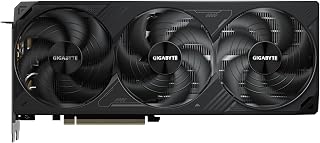
Choosing the Ti variant means gaining 16GB GDDR7 memory, a substantial advantage over the 5070's 12GB for texture-heavy games and future-proofing your investment. This small form factor model maintains that memory benefit while fitting compact chassis, making it ideal if you need Ti-level performance without sacrificing desk space or case compatibility in your 2026 build.
Pros
- 16GB GDDR7 provides substantial headroom over 12GB 5070 variants
- Maximum 60C temperatures under sustained load with quiet fans
- 11.97-inch length fits more cases than competing high-end cards
- PCIe 5.0 and 28000MHz memory eliminate bandwidth limitations
Cons
- Flagship positioning commands premium over standard 5070
- Performance exceeds needs for 1080p and casual 1440p gaming
The GIGABYTE RTX 5070 Ti SFF represents the performance ceiling in this matchup, delivering capabilities that justify the step up from the standard 5070 for specific users. The 16GB GDDR7 memory is the critical differentiator, providing headroom for 4K gaming, high-resolution texture packs, and creative workloads that saturate smaller framebuffers. Where the 5070 excels at 1440p, this card targets ultra settings at both 1440p and 4K, with DLSS 4 and path tracing remaining playable in titles that crush lesser hardware. The WINDFORCE triple-fan cooling keeps maximum temperatures at 60C under sustained loads while maintaining quiet operation that users specifically highlight. At 11.97 inches, it actually measures shorter than some premium 5070 variants despite superior performance. The 28000MHz memory clock and PCIe 5.0 interface eliminate bandwidth bottlenecks entirely. For buyers deciding between these cards, the Ti makes sense when 4K gaming is the priority, when you work with demanding creative applications, or when the extra VRAM justifies the cost for future-proofing beyond 2026.
GPU and Memory: NVIDIA GeForce RTX 5070 Ti, Blackwell architecture, 16GB GDDR7, 256-bit memory interface, 28000 MHz memory clock, 2452 MHz base GPU clock
Connectivity and Power: PCIe 5.0 x16, DisplayPort and HDMI outputs, 16-pin PCIe power cable included, supports 7680 x 4320 resolution
Cooling and Physical: WINDFORCE triple-fan cooling system, 11.97 inches long x 4.96 inches wide, 1.2 pounds, includes VGA holder bracket
Compatibility and Warranty: Desktop PC compatible, NVIDIA SFF ready, 3-year manufacturer warranty included
Buy this if you game at 4K, run creative workloads that benefit from 16GB VRAM like video editing or AI image generation, or want maximum ray tracing performance with path tracing enabled. It suits builders investing in a system meant to handle demanding titles through 2027 and beyond. Skip it if you primarily play at 1080p or 1440p where the standard 5070 already delivers excellent results, making the premium harder to justify.
Buying Guide
Memory Capacity and Bandwidth
The RTX 5070 ships with 12GB of GDDR7 memory, while the RTX 5070 Ti offers 16GB on the same 256-bit bus. That extra 4GB matters most at 4K resolution or when you layer on ray tracing and maximum texture quality in demanding titles. If you primarily game at 1440p with high settings, 12GB remains plenty for the foreseeable future.
Both cards use cutting-edge GDDR7 memory running at 28Gbps, delivering exceptional bandwidth that keeps frame times smooth even during intensive scenes. For creators working with large 3D assets or high-resolution video, the Ti’s extra capacity provides more headroom when juggling multiple applications.
Core Count and Boost Clocks
The RTX 5070 Ti features a wider GPU die with more CUDA cores and tensor cores, translating to higher raw compute throughput. You’ll see this advantage reflected in AI performance ratings: the Ti models typically deliver around 1492 AI TOPS compared to 1005 AI TOPS on the standard 5070. If you use AI-driven tools for upscaling, frame generation, or creative workflows, that gap becomes tangible.
Boost clocks vary by AIB partner and cooling design. Cards like the ASUS TUF Gaming GeForce RTX 5070 12GB GDDR7 OC push the 5070 to 2640MHz in OC mode, while the ASUS TUF Gaming GeForce RTX 5070 Ti 16GB GDDR7 OC reaches 2610MHz. Higher clocks help, but the Ti’s architectural advantage still delivers 10 to 15 percent more performance in rasterized workloads and wider margins when ray tracing is enabled.
Cooling and Slot Width
Thermal design directly impacts sustained performance and noise levels. Most RTX 5070 cards occupy 2.5 to 3 slots, making them compatible with compact builds and SFF cases. The ASUS Prime GeForce RTX 5070 12GB GDDR7 OC Edition and ASUS Prime GeForce RTX 5070 12GB GDDR7 White OC both use a 2.5-slot design with triple Axial-tech fans and phase-change thermal pads, delivering excellent temperatures without sacrificing motherboard expansion slots.
RTX 5070 Ti cards run hotter due to higher power draw, so many AIB partners opt for beefier 3.125 to 3.2-slot coolers. The ASUS ROG Strix NVIDIA GeForce RTX 5070 Ti 16GB combines a vapor chamber, MaxContact base plate, and oversized fin array to keep temperatures in check even during extended gaming sessions. If you value near-silent operation, look for models with 0dB idle modes that stop fans completely under light loads. When comparing current and previous generation cards, our RTX 5060 vs RTX 4060 offers insight into how cooling solutions have evolved across NVIDIA’s lineup.
Power Requirements and SFF Compatibility
The RTX 5070 typically requires a 750W power supply with a single 16-pin 12V-2×6 connector, while the RTX 5070 Ti demands at least 850W. If you’re working within a smaller case or a tighter power budget, the 5070 offers a meaningful advantage. SFF-ready models like the GIGABYTE NVIDIA GeForce RTX 5070 Ti SFF 16G are specifically engineered for compact builds, though you’ll still need to verify clearance and PSU capacity.
Check your case dimensions carefully. Cards like the ASUS TUF Gaming GeForce RTX 5070 12GB GDDR7 OC stretch over 300mm in length and consume three full slots, which can interfere with front-panel connectors or bottom-mounted PSUs in mid-tower enclosures. For builders planning extreme cooling setups, our guide to the best full tower PC cases covers chassis options that accommodate the largest GPUs with room to spare.
Final Thoughts
The RTX 5070 delivers exceptional 1440p performance and fits tighter budgets, while the RTX 5070 Ti’s extra memory and compute power make it the better pick for 4K gaming and demanding creative workloads. If you prioritize value and plan to stay at 1440p, the ASUS Prime GeForce RTX 5070 12GB GDDR7 OC Edition offers a compelling mix of cooling and clock speed. For those chasing maximum frame rates at 4K or leveraging AI-driven tools, the ASUS ROG Strix NVIDIA GeForce RTX 5070 Ti 16GB brings premium cooling and the horsepower to match. Both cards represent strong entries in NVIDIA’s Blackwell lineup, and your choice ultimately hinges on resolution, workload, and how much headroom you want for future titles.
Frequently Asked Questions
Is the RTX 5070 Ti worth the upgrade over the RTX 5070?
The upgrade makes sense if you game at 4K or use GPU-accelerated creative applications. The Ti’s 16GB of GDDR7 memory and higher core count deliver 10 to 15 percent better rasterized performance and wider margins when ray tracing is enabled. For 1440p gaming, the standard RTX 5070 offers excellent value and remains highly capable through 2026 and beyond.
Can the RTX 5070 handle 4K gaming?
Yes, the RTX 5070 can drive 4K gaming with DLSS 4 frame generation and upscaling enabled. You’ll achieve smooth frame rates in most titles at high settings, though the 12GB memory buffer may become a limiting factor in texture-heavy games or when combining maximum quality presets with ray tracing. If 4K is your primary target, the Ti’s extra memory provides more longevity.
What power supply do I need for the RTX 5070 Ti?
NVIDIA recommends a minimum 850W power supply with a 16-pin 12V-2×6 connector for the RTX 5070 Ti. Verify that your PSU includes the appropriate cable and has sufficient wattage headroom for your CPU, storage, and cooling components. High-end processors and extensive RGB setups can push total system draw closer to that 850W threshold, so consider a 1000W unit if you plan to overclock or add more drives.
Do I need to upgrade my RTX 4070 Ti to the RTX 5070 Ti in 2026?
The generational improvement from the RTX 4070 Ti to the RTX 5070 Ti is modest in raw rasterized performance, but DLSS 4 with multi-frame generation and improved ray tracing efficiency make the Blackwell architecture compelling for those chasing maximum fidelity. If your RTX 4070 Ti meets your current needs, waiting another generation may offer a more substantial leap. For broader context on GPU pricing trends, explore our RTX 5070 ti price guide to see how different models stack up across retailers.




Write Your Review
No reviews yet. Be the first to share your experience!