

Shopping for a mainstream graphics card in 2026 means choosing between NVIDIA’s established RTX 4060 and the newer RTX 5060. Both cards target 1080p gaming, but they deliver different experiences through distinct architectures, memory technologies, and feature sets. Whether you’re upgrading from older hardware or building your first gaming rig, understanding what each card offers will help you make the right choice.
This guide compares the RTX 5060 and RTX 4060 across performance metrics, cooling solutions, and practical features. We’ve evaluated seven cards from leading manufacturers to show you exactly what separates these two GPU generations. For context on budget GPU shopping, see our breakdown of the best budget GPUs for gaming.
Quick Comparison
| Model | Link | Rating | Graphics Ram Size | Graphics Ram Type | GPU Clock Speed |
|---|---|---|---|---|---|
| 1 MSI RTX 4060 8GB GDDR6 Gaming Graphics Card - 1440p...Highest ratedMost reviewed | Check price | 4.8 of 51,173 ratings | 8 GB | GDDR6 | 2505 megahertz |
| 2 GIGABYTE GeForce RTX 5060 WINDFORCE OC 8G Graphics Card,... | Check price | 4.7 of 5417 ratings | 8 GB | GDDR7 | 2512 megahertz |
| 3 MSI RTX 5060 8G Ventus 2X OC White - Blackwell... | Check price | 4.6 of 5150 ratings | 8 GB | GDDR7 | 2527 megahertz |
| 4 ASUS ROG Strix RTX 4060 OC 8GB Gaming GPU - DLSS 3, Ray...Unavailable | Check price | 4.8 of 5347 ratings | 8 GB | GDDR6 | 2700 megahertz |
| 5 Gigabyte RTX 4060 Gaming OC 8GB Graphics Card - High...Unavailable | Check price | 4.7 of 5662 ratings | 8 GB | GDDR6 | n/a |
| 6 ASUS Prime RTX 5060 8GB GDDR7 OC Gaming Graphics Card...Unavailable | Check price | 4.6 of 5152 ratings | 8 GB | GDDR7 | 2565 megahertz |
| 7 Gigabyte RTX 5060 OC 8GB GDDR7 Low Profile Gaming...Unavailable | Check price | 4.4 of 566 ratings | 8 GB | GDDR7 | n/a |
Ratings reflect the most recent data pull. Check each listing for current price and availability.

MSI RTX 4060 8GB GDDR6 Gaming Graphics Card
The Ventus 2X Black represents the 4060's established position with proven Ada Lovelace architecture and a competitive 2505 MHz boost clock. Its GDDR6 memory delivers consistent performance in DirectX 12 titles where memory bandwidth is less critical. For those evaluating value between generations, this card demonstrates last-gen capabilities with mature driver support and widespread game optimization across current AAA releases.
Pros
- Delivers smooth performance at 1440p on high settings in most modern games
- Excellent thermal efficiency with quiet dual-fan cooling design
- Compact form factor accommodates space-limited builds and upgrades
- Strong ray tracing and DLSS 3 performance for visually demanding titles
- Outstanding value compared to higher-tier cards for the performance delivered
Cons
- Performance plateaus at 4K or ultra-high refresh rates (240fps+) on demanding games
- 8GB VRAM may become limiting for next-generation AAA titles at ultra settings
- Single HDMI port limits multi-display setups compared to cards with dual HDMI outputs
The MSI RTX 4060 Ventus 2X is a mid-range graphics card built for 1440p gaming and content creation. It targets budget-conscious builders and upgraders seeking a capable card that doesn't demand a high-end power supply or cost a premium. This card strikes an excellent balance between performance, efficiency, and affordability.
Real-world performance is impressive for the price point. Users report smooth gameplay at 1440p on high settings in AAA titles like Cyberpunk 2077 and Call of Duty: Modern Warfare 2. Ray tracing and DLSS 3 work beautifully to boost frame rates without sacrificing visual quality. At 1080p, you'll easily achieve 120+ fps in most games. The 8GB GDDR6 memory provides ample headroom for modern workloads and handles creative tasks like photo and video editing without struggle.
Build quality is solid throughout. The dual TORX Fan 4.0 cooling system runs quiet and keeps temperatures well-controlled even during extended gaming sessions. The compact 2-slot form factor deserves special mention, as it fits in cases where larger cards won't, making it ideal for upgrading older systems or space-limited builds. The industrial design feels premium for the price tier.
Limitations exist mainly at the extremes. Demanding gamers chasing 240+ fps at 1440p or those planning 4K gaming will hit performance walls. The single HDMI 2.1 port may frustrate those needing multiple monitors, though three DisplayPort outputs provide an alternative. Casual gamers and upgraders should barely notice these constraints.
Verdict: The MSI RTX 4060 Ventus 2X is an excellent value graphics card that delivers smooth 1440p performance, runs cool and quiet, and fits virtually any build. It's the smart choice for anyone upgrading from older hardware or building a mid-range gaming PC without stretching the budget.
GPU: NVIDIA GeForce RTX 4060 (Ada Lovelace Architecture)
Memory: 8GB GDDR6 on 128-bit interface
Clock Speed: 2505 MHz base / 2505 MHz memory
Display Outputs: 3x DisplayPort 1.4a, 1x HDMI 2.1
Max Resolution: 7680 x 4320
Cooling: Dual TORX Fan 4.0 system
Power: Efficient 140W TDP
Physical: 7.83 inches long, 4.72 inches wide, 1kg weight
Interface: PCI Express
Warranty: 3 Years
Best for: Budget gamers targeting 1440p, content creators on a budget, PC upgraders, systems with space or power constraints, users seeking reliable mid-range performance.
Consider if: You primarily game at 1440p or lower resolutions, you value efficiency and quiet cooling, you need ray tracing and DLSS support, your case can't fit larger dual or triple-slot cards, you want a card that won't require a power supply upgrade.
Not ideal if: You need consistent 4K gaming at high frame rates, you're a competitive esports player demanding 300+ fps, you plan to keep this card for 5+ years and want maximum future-proofing, you need extensive multi-display connectivity with dual HDMI ports.

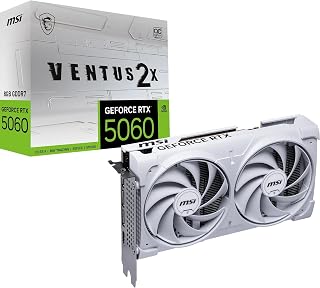
The Ventus 2X White balances 5060 performance with thermal efficiency through its dual TORX Fan 5.0 design. Its 2527 MHz boost clock sits comfortably above reference specs, delivering measurable gains in frame generation scenarios where the new architecture shines. The 28Gbps GDDR7 memory speed represents a substantial bandwidth increase over 4060's GDDR6, directly benefiting memory-intensive workloads and higher resolution textures.
Pros
- GDDR7 memory provides major bandwidth upgrade over RTX 4060
- DLSS 4.0 multi-frame generation doubles supported game performance
- Zero Frozr eliminates idle fan noise entirely
- Compact 197mm length suits smaller builds
Cons
- 8GB VRAM limits ultra settings in newest AAA titles
- PCIe 5.0 x8 bandwidth leaves performance on table
MSI's RTX 5060 Ventus 2X OC White brings the Blackwell versus Ada Lovelace comparison into sharp focus with measurable upgrades over the RTX 4060 generation. The GDDR7 memory running at 28Gbps significantly outpaces the 4060's 17Gbps GDDR6, reducing bottlenecks in texture-heavy games and creative applications. DLSS 4.0 inclusion gives this card multi-frame generation capabilities the 4060 lacks, effectively doubling frame rates in supported titles. The 2527 MHz factory overclock sits comfortably above reference speeds, delivering consistent performance gains without requiring manual tuning. MSI's TORX Fan 5.0 coolers with paired blade design improve static pressure and reduce turbulence compared to conventional fans. Zero Frozr mode stops fans entirely during light loads, eliminating idle noise that plagued earlier budget cards. The compact 197mm length and two-slot design fit more cases than bulkier 5060 models, while the flow-through backplate aids ventilation. DisplayPort 2.1b and HDMI 2.1b outputs handle 4K 144Hz displays and VRR without compromise. At 145W TDP, the card requires only a 550W PSU, lowering total system cost.
GPU: NVIDIA GeForce RTX 5060 (Blackwell Architecture)
Memory: 8GB GDDR7, 28Gbps, 128-bit bus
Clock Speed: 2527 MHz (OC)
Power: 145W, 8-pin connector, 550W PSU recommended
Interface: PCIe 5.0 x8
Cooling: Dual TORX Fan 5.0, Zero Frozr, heat pipes, large heatsink
Dimensions: 197mm length, 2-slot design
Weight: 511 grams
Outputs: 3x DisplayPort 2.1b, 1x HDMI 2.1b
Max Resolution: 7680x4320
Best suited for 1080p gamers upgrading from GTX 1660 or RTX 3060 cards who want current-generation ray tracing and DLSS 4 without premium pricing. The white aesthetic appeals to themed builds. Skip if you already run an RTX 4060 Super or better, need more than 8GB VRAM for professional work, or game primarily at 4K ultra settings. Compact case builders benefit most from the 197mm length and efficient cooling.

Pros
- Exceptional thermal performance keeps the card running cool even during extended gaming sessions
- DLSS 3 and ray tracing support enable high-fidelity visuals without sacrificing frame rates
- Customizable RGB lighting integrates seamlessly with other ASUS Aura Sync components
- Easy installation with intuitive design and included guides
- Strong value proposition for gamers upgrading from older generation cards
Cons
- Power connector placement on top edge can make cable routing difficult in cable-managed builds
- Requires PCIe x16 slot and adequate PSU, limiting compatibility with older systems
- Entry-level VRAM capacity means reduced performance in 4K gaming compared to higher-tier models
The ASUS ROG Strix RTX 4060 OC is a purpose-built gaming graphics card for players who want excellent 1440p performance with cutting-edge visual technologies. This card targets gamers upgrading from GTX 2070 or RTX 3060 generation hardware, as well as builders looking for premium cooling in a compact footprint.
Performance standouts include NVIDIA's latest DLSS 3 technology, which delivers up to 4x faster rendering than traditional methods, and 3rd generation RT Cores that accelerate real-world ray tracing. Users report smooth frame rates even in demanding titles like Cyberpunk and Halo, with noticeable performance improvements when paired with modern CPUs. The Ada Lovelace architecture provides both raw speed and improved power efficiency compared to older chips.
Build quality impresses with its triple Axial-tech fan design that scales up cooling capacity by 21% over previous models. The 3.1-slot design houses a massive fin array optimized for airflow, and real-world testing shows thermal performance stays below 52 degrees Celsius during extended gaming sessions. Aura Sync RGB lighting integrates with compatible ASUS peripherals and memory modules for a unified aesthetic.
One design consideration involves the top-mounted power connector, which can complicate cable routing in cases with tight cable management. The 8GB VRAM is sufficient for 1440p gaming but may limit performance in demanding 4K scenarios or content creation workflows.
Overall, the ASUS ROG Strix RTX 4060 OC represents a compelling choice for gamers seeking reliable performance, premium cooling, and modern gaming technologies at a mainstream price point. The 3-year warranty and responsive ASUS customer support add confidence to your purchase.
GPU Specifications: NVIDIA GeForce RTX 4060 with Ada Lovelace architecture, 4th generation Tensor Cores, and 3rd generation RT Cores. Base GPU clock runs at 2700 MHz with GDDR6 memory clocked at 4000 MHz.
Memory Configuration: 8GB GDDR6 memory provides ample bandwidth for 1440p gaming and light creative workloads. Memory interface supports advanced caching for efficient data movement.
Connectivity and Outputs: PCIe 4.0 x16 interface connects to desktop systems. Video outputs include HDMI 2.1a and DisplayPort 1.4a for multi-monitor gaming setups or high-refresh displays.
Thermal and Power Design: Triple Axial-tech fans deliver 21% more airflow than previous generations. Vented backplate with digital power control maintains optimal temperatures. Dimensions measure 12.26 inches long by 5.26 inches wide, fitting most mid-tower and full-tower cases.
Who Should Buy: This card excels for 1440p gaming enthusiasts, esports players seeking high frame rates, and anyone upgrading from GTX 10-series or RTX 20-series hardware. Streamers and content creators on moderate budgets will appreciate the Aura Sync integration and reliable performance.
System Requirements: Requires a PCIe x16 compatible motherboard and a PSU rated for your complete system. ASUS recommends a 550W+ power supply for stability. Ensure your case accommodates the 3.1-slot depth of approximately 5.26 inches.
Installation Tips: Remove protective rubber pieces from the front and back of the card before installation. Insert gently into the PCIe slot until the retention clip snaps into place automatically. Connect the power cable from your PSU to the top-mounted connector.
Optimization: Download the latest NVIDIA drivers and ASUS Aura software to unlock DLSS 3 features and synchronize RGB lighting. Enable DLSS 3 in your games to maximize frame rates without sacrificing visual quality.

Gigabyte's Gaming OC offers triple WINDFORCE cooling on the 4060 platform, maintaining lower temps during sustained loads compared to dual-fan alternatives. The GDDR6 memory configuration handles 1080p gaming efficiently, and established driver maturity means fewer compatibility concerns. When comparing 4060 to 5060 options, this model shows what proven architecture delivers without adopting first-generation GDDR7 implementation.
Pros
- Exceptional thermal performance with idle temps around 33°C and max around 56°C under gaming loads
- Noticeably better performance than RTX 3060 despite fewer CUDA cores, showing architectural efficiency gains
- Quiet operation even at full load with optimized three-fan cooling solution
- Simple installation and compatibility with existing systems
- Handles modern titles at 1080p ultra settings and 1440p at high settings reliably
Cons
- 8GB VRAM may be limiting for future AAA titles or high-end creative workflows requiring larger memory pools
- Overclock ceiling depends on silicon lottery, though reviewers report solid 200MHz gains with reference tuning
- Limited to 128-bit memory interface, which is entry-level by current standards
The Gigabyte RTX 4060 Gaming OC is a mid-range dedicated graphics card powered by NVIDIA's latest Ada Lovelace architecture. It's designed for gamers upgrading from older generation cards and creative professionals who need reliable performance without flagship pricing. With 8GB of GDDR6 memory and NVIDIA's cutting-edge DLSS 3 technology, this card bridges the gap between budget and premium tiers effectively.
Real-world performance shines in actual gameplay. Users report smooth frame rates in modern titles at 1080p ultra settings, with solid 1440p performance at high settings. The 4th generation Tensor Cores deliver up to 4x performance with DLSS 3 enabled, while 3rd generation RT cores provide impressive ray tracing capabilities. The Ada architecture's efficiency means you get more performance per watt compared to previous generations, making it an intelligent upgrade for users switching from RTX 3000 series cards.
Thermal design and cooling are highlights of this card. The triple WINDFORCE fan system keeps idle temperatures around 33°C and maintains maximum loads at just 56°C during extended gaming sessions. This efficient cooling allows the card to run quietly, even under stress, making it suitable for noise-sensitive setups. The metal back plate adds structural rigidity and heat dissipation while protecting components.
The main consideration is the 8GB VRAM capacity. While sufficient for current gaming and professional work, some users upgrading from older cards may find the modest memory increase underwhelming. The 128-bit memory interface is also entry-level by current standards, though paired with GDDR6 speeds and the efficient architecture, real-world impact is minimal for the target audience.
The Gigabyte RTX 4060 Gaming OC delivers solid mid-range performance with excellent value. It's an ideal choice for gamers seeking smooth 1440p gameplay, users upgrading from previous generations, and professionals needing reliable GPU acceleration without stretching budgets. The proven thermal management and architectural efficiency make it a smart, dependable graphics solution.
GPU: NVIDIA GeForce RTX 4060
Memory: 8GB GDDR6
Memory Interface: 128-bit
Memory Speed: 17000 MHz
Cooling: Triple WINDFORCE Fans
Outputs: DisplayPort, HDMI
Power Interface: PCIe
Max Resolution: 7680 x 4320
Dimensions: 11.06 inches L x 4.49 inches W
Weight: 1 kg
Features: Dual BIOS, RGB Fusion, Metal Back Plate
Ideal For: Gamers upgrading from RTX 3060 or older cards looking for smooth 1440p gaming performance. Content creators needing reliable GPU acceleration without premium investment. Budget-conscious PC builders seeking modern ray tracing and DLSS 3 support. Users prioritizing thermal efficiency and quiet operation.
Not Ideal For: Professionals requiring large VRAM pools for 4K video editing or complex 3D rendering. Enthusiasts pursuing maximum 4K gaming performance. Users needing more than 8GB memory for AI or machine learning workloads.
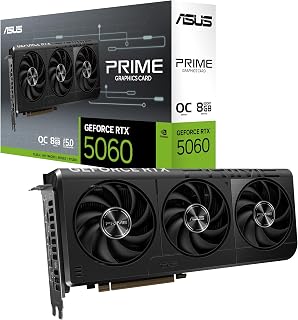
This ASUS Prime model pushes the 5060 architecture further with a 2565 MHz factory overclock, offering the highest out-of-box clocks for users evaluating performance differences against last-generation cards. The GDDR7 memory bandwidth advantage becomes tangible in GPU-bound scenarios at 1080p and 1440p. Three DisplayPort 2.1b outputs accommodate multi-monitor setups without sacrificing refresh rates, a consideration for productivity-focused comparisons.
Pros
- 2565 MHz boost among highest stock RTX 5060 clocks
- Dual BIOS and 0dB mode for flexibility and silence
- Three DisplayPort 2.1b outputs for multi-monitor setups
- Compact 2.5-slot design with strong thermal performance
Cons
- 8GB VRAM insufficient for demanding 4K workloads
- New release lacks long-term reliability data
The ASUS Prime RTX 5060 OC positions itself as the refined choice in the 5060 lineup when compared against the 4060 generation. Blackwell architecture brings meaningful efficiency gains and enhanced AI processing with 623 AI TOPS, a substantial jump over the 4060's capabilities. The 2565 MHz factory overclock ranks among the highest stock speeds in this tier, translating to tangible frame rate improvements in GPU-bound scenarios. DLSS 4 support gives this card a decisive advantage over the 4060's DLSS 3, especially in titles leveraging multi-frame generation. The dual BIOS system lets you toggle between Quiet and Performance modes, a feature absent on most competing 5060 models. ASUS's 0dB fan technology keeps the card silent during desktop use and light gaming, addressing noise complaints common with always-on cooler designs. The 2.5-slot form factor balances thermal performance with case compatibility better than thicker three-slot alternatives. Three DisplayPort 2.1b outputs and HDMI 2.1b connectivity exceed the 4060's I/O, supporting higher refresh rates and future display standards.
GPU Architecture: NVIDIA Blackwell (GeForce RTX 5060)
Memory: 8GB GDDR7 at 2565 MHz
Core Clock: 2535 MHz (Standard), 2565 MHz (OC Mode)
AI Performance: 623 AI TOPS
Outputs: 3x DisplayPort 2.1b, 1x HDMI 2.1b
Form Factor: 2.5-Slot, 10.55in x 4.72in x 4.3in (approx)
Cooling: Triple Axial-Tech Fans, 0dB Technology
Interface: PCIe 5.0
Max Resolution: 7680 x 4320 pixels
Weight: 0.7 kg
BIOS: Dual BIOS (Quiet and Performance profiles)
Ideal for gamers stepping up from the RTX 4060 who value quieter operation and premium build quality over raw budget pricing. The dual BIOS and 0dB modes suit streamers and content creators sharing workspaces. Skip if you need 4K gaming capability, already own a 4060 Ti or higher, or prioritize absolute lowest cost over features. Small-form-factor builders benefit most from the compact 10.55-inch length and improved thermal design.

This low-profile variant solves the compact build dilemma when weighing 5060 against 4060 options. Despite its reduced form factor, it maintains 8GB GDDR7 memory and the full 2512 MHz core frequency, proving that newer architecture efficiency allows performance without sacrificing space. The design suits SFF cases where previous-generation cards required compromises. Three DisplayPort outputs retain multi-display flexibility.
Pros
- Low-profile design fits compact ITX and SFF cases at 182mm length
- GDDR7 memory and PCI-E 5.0 provide bandwidth advantage over RTX 4060
- Three-fan cooling with graphene coating maintains stable temperatures
- DLSS 4 support and Blackwell architecture improve efficiency
Cons
- 8GB VRAM may limit longevity as game requirements grow
- Performance ceiling restricts 4K gaming and ultra settings in demanding titles
The Gigabyte RTX 5060 OC represents the entry point into NVIDIA's 50-series lineup, bringing Blackwell architecture and DLSS 4 support to the mainstream. Against the RTX 4060, it offers a meaningful generational step forward with faster GDDR7 memory running at 28000 MHz and native PCI-E 5.0 bandwidth. The low-profile design is unusually capable for its size, packing three fans with graphene-coated bearings and nano lubricant to maintain thermal stability under load. At 182mm, it fits SFF and ITX chassis that reject standard-length cards. The 8GB framebuffer handles 1440p workloads comfortably today, and the newer architecture extracts better performance per watt than its predecessor. For 2026 gaming at high settings, this card delivers smooth frame rates in most current titles. The combination of compact dimensions, solid cooling, and modern feature set makes it a practical upgrade path for anyone moving from older GTX or RTX 20-series hardware into a space-constrained system.
GPU Architecture: NVIDIA GeForce RTX 5060 (Blackwell)
Memory: 8GB GDDR7, 128-bit interface
Memory Speed: 28000 MHz
Core Frequency: 2512 MHz
Outputs: 3x DisplayPort, 1x HDMI (supports up to 4 displays)
Max Resolution: 7680x4320 pixels
Interface: PCI Express 5.0
Form Factor: Low Profile, 182mm length, 330g weight
Cooling: 3-fan design with thermal gel and graphene lubricant
Warranty: 3 years
This card suits builders prioritizing small form factor compatibility without sacrificing modern GPU features. It fits gamers targeting 1440p performance in ITX cases or those upgrading from GTX 16-series or RTX 20-series cards where space is limited. Skip it if you need 4K capability, plan to max out ultra settings in demanding AAA games, or can accommodate a full-size card with more VRAM and higher performance headroom for future-proofing.
Buying Guide: RTX 5060 vs RTX 4060
Architecture and Memory Technology
The RTX 5060 runs on NVIDIA’s Blackwell architecture with 8GB of GDDR7 memory at 28 Gbps, while the RTX 4060 uses Ada Lovelace architecture with 8GB of GDDR6. GDDR7 delivers higher bandwidth for memory-intensive workloads, particularly benefiting ray tracing and high-resolution texture streaming. Blackwell also introduces architectural improvements that enhance power efficiency and AI performance.
Both cards use a 128-bit memory interface, which keeps bandwidth modest compared to higher-tier GPUs. The RTX 5060’s GDDR7 partially compensates for this limitation through faster memory speeds. For builds focused on value, check our guide to GPUs under $250 for additional context.
DLSS 4 vs DLSS 3
NVIDIA’s RTX 5060 supports DLSS 4, which includes multi-frame generation and improved image quality over DLSS 3. The RTX 4060 remains limited to DLSS 3, which still offers substantial performance gains through frame generation and AI upscaling. DLSS 4’s multi-frame generation can theoretically double or triple frame rates in supported games, making the RTX 5060 more future-proof as developers adopt the newer technology.
In practice, DLSS 3 already delivers excellent 1080p performance with most modern titles. The advantage of DLSS 4 becomes more apparent at higher resolutions or with demanding ray tracing effects enabled. If you’re building around a budget-conscious system, our budget motherboard recommendations can help balance your build costs.
Cooling and Form Factor
Cooling design varies significantly across manufacturers. The ASUS ROG Strix GeForce RTX 4060 OC Edition uses a 3.1-slot design with three Axial-tech fans that deliver 21% more airflow than previous generations. The GIGABYTE GeForce RTX 5060 WINDFORCE OC 8G Graphics employs a more compact dual-fan WINDFORCE system optimized for smaller cases.
Low-profile options like the Gigabyte GeForce RTX 5060 OC Low Profile 8G measure just 182mm in length, fitting small form factor builds that standard-height cards cannot accommodate. For tight builds, our guide to PC cases shows compatible chassis options.
PCIe Interface and Power Requirements
The RTX 5060 supports PCIe 5.0, though most cards run at x8 bandwidth rather than full x16. The RTX 4060 uses PCIe 4.0 x8. In real-world scenarios, the bandwidth difference has minimal impact on gaming performance at 1080p. Both generations typically require a single 8-pin PCIe power connector with recommended PSU wattages around 550W.
Power consumption remains similar between generations, with the RTX 5060 drawing approximately 145W and the RTX 4060 consuming a comparable amount. This efficiency makes both cards suitable for compact systems and pre-built PCs with modest power supplies. For PSU selection guidance, visit our power supply category.
Display Outputs and Connectivity
RTX 5060 cards feature DisplayPort 2.1b and HDMI 2.1b, supporting higher refresh rates and resolutions than the RTX 4060’s DisplayPort 1.4a and HDMI 2.1. This matters if you’re driving a high-refresh 1440p monitor or planning to upgrade your display in the near future. The ASUS Prime GeForce RTX 5060 8GB GDDR7 OC Edition includes three DisplayPort 2.1b outputs plus one HDMI 2.1b port.
Both generations support up to four simultaneous displays, adequate for productivity setups or multi-monitor gaming configurations. The newer DisplayPort standard on RTX 5060 cards provides headroom for future display technologies, though current monitors rarely push the limits of DisplayPort 1.4a.
Final Thoughts
The RTX 5060 delivers forward-looking features through Blackwell architecture and DLSS 4, while the RTX 4060 offers proven performance with established driver support. For compact builds requiring maximum compatibility, the Gigabyte GeForce RTX 4060 Gaming OC 8G balances cooling efficiency with triple-fan design. If you prioritize future-proofing with newer memory technology and display standards, the GIGABYTE GeForce RTX 5060 WINDFORCE OC 8G provides those advantages at a competitive position in the mainstream market.
Frequently Asked Questions
Is the RTX 5060 worth upgrading to from an RTX 4060?
The performance gap between RTX 5060 and RTX 4060 remains modest for pure rasterization gaming at 1080p. DLSS 4 and GDDR7 memory offer advantages in ray-traced titles and future games, but the RTX 4060 still handles current AAA games effectively. Upgrade if you’re building new or if DLSS 4 features align with your specific game library. Otherwise, the RTX 4060 continues delivering solid value in 2026.
What power supply do I need for RTX 5060 or RTX 4060?
Both cards run efficiently on a quality 550W power supply with a single 8-pin PCIe connector. Actual power draw sits around 145W under gaming loads. Ensure your PSU has adequate 12V rail capacity and modern efficiency ratings. For broader PSU selection criteria, see our power supply recommendations.
Can RTX 5060 and RTX 4060 handle 1440p gaming?
Both cards manage 1440p in lighter titles and esports games with acceptable frame rates. For demanding AAA games at 1440p, you’ll need to enable DLSS and reduce some settings to maintain smooth performance. The 128-bit memory interface and 8GB VRAM become limiting factors at higher resolutions. These GPUs excel at 1080p high settings rather than 1440p ultra configurations.
Which RTX 5060 or RTX 4060 model has the best cooling?
The ASUS ROG Strix GeForce RTX 4060 OC Edition offers premium cooling with its 3.1-slot design and three Axial-tech fans, delivering excellent thermal performance and low noise levels. For compact cases, the MSI GeForce RTX 5060 8G Ventus 2X OC White provides effective dual-fan cooling in a smaller footprint. Choose based on your case dimensions and noise tolerance.
Common questions
Is the 4060 to 5060 upgrade worth it?
The upgrade delivers moderate gains but may not justify the cost if you already own a 4060. The RTX 5060 brings faster GDDR7 memory (28000 MHz vs 17000 MHz), improved ray tracing, and better efficiency, but both cards share the same 8GB capacity and 128-bit bus. Unless you need the latest features or can sell your 4060 at a strong price, waiting for a bigger generational leap often makes more financial sense.
Is the 5060 worth it over the 4060?
Yes, if you're buying new and the price difference is reasonable. The RTX 5060 launched at $299 MSRP and offers newer architecture, GDDR7 memory, and longer driver support than the older 4060. However, check current pricing on each card's listing, as discounts on remaining 4060 inventory during sales events like Prime Big Deal Days or Black Friday in November could narrow the value gap significantly.




Write Your Review
No reviews yet. Be the first to share your experience!