

You’re staring at your current GPU struggling to maintain 60 FPS in anything released after 2022, and the thought of spending a thousand dollars on a graphics card feels absurd. The reality is that capable gaming GPUs exist at reasonable budgets, you just need to know where the real value lies and which features actually matter for your gaming habits.
This guide evaluates six graphics cards that balance performance with affordability, covering everything from entry-level 1080p gaming to capable 1440p experiences. Whether you’re building your first PC or upgrading from aging hardware, these options represent the current sweet spot for budget-conscious gamers in 2026.
Quick Comparison
| Model | Link | Rating | Graphics Ram Size | Graphics Ram Type | GPU Clock Speed |
|---|---|---|---|---|---|
| 1 ASRock Intel Arc B570 Challenger 10GB GDDR6 Graphics... | Check price | 4.6 of 5113 ratings | 10 GB | GDDR6 | 2600 megahertz |
| 2 ASUS TUF Gaming RTX 5070 12GB GDDR7 OC - Blackwell...Highest ratedMost reviewed | Check price | 4.7 of 5516 ratings | 12 GB | GDDR7 | 2640 megahertz |
| 3 MSI RTX 3050 Ventus 2X 6GB OC Gaming Graphics Card -... | Check price | 4.6 of 5296 ratings | 6 GB | GDDR6 | 1492 megahertz |
| 4 GIGABYTE Radeon RX 9070 XT Gaming OC 16GB GDDR6 PCIe 5.0...Most VRAM | Check price | 4.6 of 5514 ratings | 16 GB | GDDR6 | 3060 megahertz |
| 5 MSI RTX 3050 LP 6GB Low Profile Gaming Graphics Card,... | Check price | 4.5 of 5371 ratings | 6 GB | GDDR6 | 1492 gigahertz |
| 6 ASUS Dual GeForce RTX 3050 6GB OC Edition - Compact...Unavailable | Check price | 4.6 of 51,116 ratings | 6 GB | GDDR6 | 1500 megahertz |
Ratings reflect the most recent data pull. Check each listing for current price and availability.

The Arc B570 Challenger brings 10GB of GDDR6 memory and a 2600 MHz boost clock, offering competitive performance for mainstream gaming. Its DisplayPort 2.1 and HDMI 2.1a outputs support modern high-refresh displays, while the 0dB cooling mode keeps noise low during lighter workloads. This Intel option provides strong value for gamers exploring alternatives to traditional GPU brands.
Pros
- 10GB VRAM handles modern game textures comfortably
- XeSS 2 upscaling boosts frame rates intelligently
- 0dB cooling runs silent during idle and light tasks
- Metal backplate prevents sag and adds durability
Cons
- Intel Arc drivers still maturing compared to competitors
- Not positioned for consistent 4K gaming
Budget gaming in 2026 demands more than just a low entry price. The ASRock Arc B570 Challenger delivers where it counts: 10GB of GDDR6 memory ensures you won't hit VRAM ceilings in modern titles, while Intel's Xe2-HPG architecture with XeSS 2 upscaling squeezes extra frames from demanding games without sacrificing visual fidelity. The 2600 MHz clock speed handles 1440p gaming at high settings with playable frame rates, making this an excellent upgrade from aging cards like the GTX 1660 Super. Connectivity is future-proofed with three DisplayPort 2.1 and one HDMI 2.1a port, supporting resolutions up to 7680 x 4320. The dual-fan cooling solution incorporates 0dB technology, stopping fans entirely during light loads and keeping noise minimal under stress. A metal backplate prevents GPU sag while adding structural integrity. The single 8-pin power connector simplifies installation. Intel's driver maturity has improved substantially, though occasional optimization patches may still arrive for newer releases. For builders seeking strong 1440p performance and generous VRAM allocation without stretching their budget, this card hits the sweet spot between capability and cost.
The Arc B570 excels at 1440p gaming, maintaining high frame rates with maxed or near-maxed settings in modern AAA titles like Assassin's Creed Resync, Subnautica 2, and God of War. The 10GB VRAM buffer ensures smooth performance without stuttering even in VRAM-intensive scenarios with multiple monitors or intensive applications running simultaneously.
XeSS 2 technology provides meaningful performance boosts through AI-powered upscaling without sacrificing perceived image quality. Users report stable gameplay and low thermal temps, with the card operating at just 45-56 degrees Celsius at zero RPM and averaging around 68 degrees under sustained gaming loads. Idle power consumption is remarkably low at 18-21 watts during light tasks like streaming and multi-monitor work.
The card handles both 1080p ultra settings and 1440p high settings comfortably. While not positioned as a 4K solution, users seeking budget-friendly 1440p gaming will find this card highly capable and reliable across current and near-future game libraries.
GPU: Intel Arc B570 (Xe2-HPG Architecture)
Memory: 10GB GDDR6, 160-bit bus
Clock Speeds: 2600 MHz GPU, 19 Gbps Memory
Power: Single 8-pin connector
Interface: PCIe 4.0 x8
Display Outputs: 3x DisplayPort 2.1, 1x HDMI 2.1a
Max Resolution: 7680 x 4320
Cooling: Dual striped axial fans with 0dB Silent Cooling
Backplate: Metal with structural reinforcement
Weight: 0.99 kg
Warranty: 2 Years Manufacturer
Media Engine: Advanced with AV1 encoding support
DirectX Support: 12 Ultimate

The TUF Gaming edition delivers serious 1440p performance with 12GB of fast GDDR7 memory, giving you headroom for texture-heavy modern titles without stuttering. Its 2640 MHz boost clock handles demanding games smoothly while the triple DisplayPort 2.1a outputs future-proof your setup for high-refresh monitors. This card strikes an ideal balance between raw power and longevity for gamers who want excellent frame rates without overspending.
Pros
- Blackwell architecture with 12GB GDDR7 handles modern games at 1440p with ray tracing
- Exceptional cooling maintains 65C under load with quiet operation
- Military-grade components and protective coating ensure long-term durability
- DLSS 4 support and AI acceleration provide future-proofing
Cons
- 13-inch length and 3.125-slot thickness require spacious cases
- 12GB VRAM may limit next-generation titles with massive texture demands
For gamers building a 2026 rig with high-end aspirations but not unlimited funds, the ASUS TUF RTX 5070 OC offers Blackwell architecture performance without crossing into flagship territory. The 12GB GDDR7 configuration delivers smooth 1440p gaming with ray tracing fully enabled, while handling 4K workloads at respectable frame rates. DLSS 4 support extends performance headroom significantly, and the 2640MHz boost clock ensures headroom for demanding titles. What separates this card from cheaper alternatives is exceptional thermal engineering: three Axial-tech fans, phase-change thermal pads, and a 3.125-slot cooler maintain 65C under sustained gaming sessions. Military-grade components and protective PCB coating add durability that budget cards skip. The included bracket prevents GPU sag in tower builds. For users who game seriously and want hardware that lasts beyond a single generation, this card balances current performance with future-proofing through AI acceleration capabilities and modern connectivity via DisplayPort 2.1a and HDMI 2.1b outputs. The 3-year warranty reinforces ASUS's confidence in long-term reliability.
GPU and Memory: NVIDIA GeForce RTX 5070, 12GB GDDR7, 2640MHz boost clock, PCIe 5.0 interface
Cooling and Design: 3.125-slot form factor, three Axial-tech fans, phase-change thermal pad, protective PCB coating, military-grade components, GPU Guard bracket
Connectivity: 3x DisplayPort 2.1a, 2x HDMI 2.1b, 7680x4320 maximum resolution support
Physical: 13 inches long, 5.5 inches wide, 3.4 pounds, includes cooling bracket and stand
Warranty and Support: 3-year manufacturer warranty, GPU Tweak III software for performance monitoring and thermal control
Ideal for gamers prioritizing 1440p excellence and 4K capability without stretching to flagship pricing. Content creators running video editing or AI image generation will appreciate the GDDR7 memory and compute performance. Enthusiasts building full-tower systems who value build quality and thermal management should consider this card. Skip it if your case measures under 14 inches GPU clearance or you're gaming exclusively at 1080p where cheaper options deliver identical visual results. Also avoid if budget constraints mean every dollar counts; mid-range cards offer better value for casual gaming.

The Ventus 2X packs 6GB of GDDR6 running at 14 Gbps, delivering reliable 1080p performance for budget-conscious gamers. Its 1492 MHz boost clock handles popular competitive titles and older AAA games smoothly, while Ampere architecture brings modern features like DLSS upscaling. The dual-fan cooler keeps thermals manageable in compact builds where space and airflow matter.
Pros
- Zero external power connectors simplify OEM upgrades
- 70-watt draw fits restrictive power budgets
- DLSS and ray tracing at accessible 1080p performance
- Compact 7.4-inch length fits standard cases easily
Cons
- 6GB VRAM limiting for demanding titles beyond 1440p
- Older Ampere generation outpaced by newer releases
Breaking into ray-traced gaming without breaking the bank requires compromise, but the MSI RTX 3050 Ventus 2X 6GB makes smart concessions. Built on NVIDIA's Ampere architecture, this compact 7.4-inch card brings DLSS technology and ray tracing capability to 1080p gaming within reach of tight budgets. The real advantage here is the 70-watt power draw that requires zero external power connectors, pulling everything through the PCIe slot itself. This matters enormously for anyone upgrading OEM machines from Dell or HP where replacing proprietary power supplies isn't practical. The 1492 MHz boost clock and 6GB of GDDR6 memory deliver smooth 1080p performance with ray tracing enabled, while venturing into 1440p territory at medium to high settings. MSI's dual-fan Ventus cooler keeps temperatures controlled without excessive noise, and the three-year warranty backs durable construction. The 96-bit memory bus and generational age mean this isn't a 4K contender or content creation powerhouse, but that's not its mission. For gamers wanting their first experience with modern NVIDIA features, upgrading prebuilt systems with limited PSU capacity, or simply needing reliable 1080p gaming, this Ventus card proves you don't need flagship specs to enjoy current titles.
GPU Specifications: NVIDIA GeForce RTX 3050 with Ampere architecture, 96-bit memory interface, 1492 MHz boost clock. Memory: 6GB GDDR6 running at 14 Gbps. Power consumption: 70W. Video outputs: 1x DisplayPort 1.4a, 2x HDMI 2.1a. Maximum supported resolution: 7680x4320.
Physical Design: Dimensions 7.4 inches (L) x 4.3 inches (W). Weight 0.58 kg. Dual-fan cooling design. PCIe x16 slot required. No external power connectors needed. Compatible with desktop systems. Includes quick setup guide and 3-year warranty.
Ideal for upgraders stuck with OEM prebuilts featuring weak or proprietary power supplies, first-time GPU buyers exploring ray tracing and DLSS at 1080p, and gamers building compact systems where low power consumption matters. Budget-conscious players targeting smooth 1080p performance will find this sufficient. Avoid if you're gaming primarily at 1440p or higher, need more than 6GB VRAM for texture-heavy titles, or require strong content creation performance for rendering and video work.

With 16GB of GDDR6 memory, this Radeon handles demanding textures and high-resolution gaming with ease, making it perfect for players who want smooth 1440p or entry-level 4K experiences. The 3060 MHz boost clock delivers strong frame rates across modern AAA titles, while the generous VRAM buffer ensures you won't hit memory limits as games grow more ambitious. PCIe 5.0 support adds future-proofing for upcoming system builds.
Pros
- 16GB GDDR6 eliminates VRAM constraints in modern titles
- 160-220fps at 1440p high settings delivers genuine high-refresh gaming
- WINDFORCE cooling stays quiet while controlling temperatures effectively
- 11.34-inch length fits most mid-tower cases without modification
Cons
- Requires 750W power supply minimum for stable operation
- Falls behind flagship cards in raw benchmark performance
AMD's latest silicon powers the GIGABYTE RX 9070 XT into budget GPU territory with specs that challenge conventional pricing assumptions. Sixteen gigabytes of GDDR6 memory eliminate the VRAM bottlenecks that cripple cheaper cards, while the 3060MHz boost clock pushes AAA titles to 160-220fps at 1440p with high settings. This represents genuine high-refresh gaming capability without crossing the four-figure threshold. The PCIe 5.0 interface ensures compatibility as motherboards evolve, and the card's capabilities extend beyond gaming into 3D rendering and video editing workflows where professionals on limited budgets need reliable performance. WINDFORCE cooling with Hawk fans and server-grade thermal gel keeps temperatures controlled during marathon sessions while staying surprisingly quiet. The 11.34-inch length fits modern mid-tower cases without requiring case modifications. Build quality feels substantial rather than economy-grade, with users reporting stable operation after proper driver setup. For 4K gaming, expect medium to high settings rather than maxed sliders, but the visual experience remains compelling. The silver and black design integrates cleanly into gaming builds without flashy RGB demands.
Core Specifications
GPU: AMD Radeon RX 9070 XT
Memory: 16GB GDDR6
Memory Clock: 2600 GHz
GPU Clock: 3060 MHz
Interface: PCIe 5.0 x16
Max Resolution: 7680 x 4320 (8K)
Physical and Connectivity
Dimensions: 11.34 inches (L) x 5.2 inches (W)
Weight: 1.78 kg
Output: DisplayPort
Power Connectors: Dual 8-pin (750W+ PSU recommended)
Cooling: WINDFORCE system with Hawk fans and thermal gel
Warranty and Support
Manufacturer: GIGABYTE
Warranty: 3 years
Model: GV-R9070XTGAMING OC-16GD
Gaming Performance at Common Resolutions
1440p Gaming: 160-220fps on most modern AAA titles at high settings. Excellent for competitive gaming and high-refresh monitors.
4K Gaming: Playable at high settings on most titles, medium settings on demanding new releases. Solid for content creators monitoring in 4K.
Esports Titles: 300+ fps possible on optimized competitive games for ultra-high refresh gameplay.
Real-World Use Cases
Best suited for 1440p gaming at 144+ fps, 4K content creation workflows, professional 3D rendering, and VR gaming. Handles flight simulators like DCS at high settings with 4K head tracking. Eliminates VRAM constraints for media professionals working with large files.
Driver Recommendations
Run DDU (Display Driver Uninstaller) before installation if upgrading from another card. Install latest AMD drivers for maximum stability and performance. Update BIOS if required by your system for PCIe 5.0 compatibility.
Pros
- Perfect fit for small form factor and HTPC builds without case modifications
- No additional power connectors needed, simplifying system builds and upgrades
- Strong 1080p performance with ray tracing and DLSS for modern AAA titles
- Quiet operation with efficient thermal management in compact spaces
- Proven upgrade path with real-world performance gains over integrated graphics
Cons
- Limited to 1080p gaming at high settings, not suitable for 4K or high-end 1440p gaming
- Occasional fan noise during startup reported by some users, though resolves quickly
- Entry-level performance compared to RTX 3060 and higher-tier options
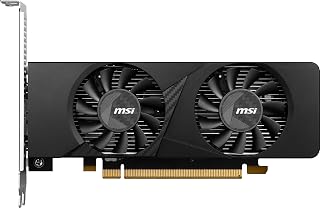
The MSI RTX 3050 LP is a low-profile graphics card built on NVIDIA's Ampere architecture, designed specifically for small form factor PCs, HTPCs, and compact builds. This card is ideal for budget-conscious gamers, content creators, and anyone looking to upgrade a space-constrained system without sacrificing modern gaming capabilities.
The RTX 3050 LP delivers impressive 1080p gaming performance, handling most modern AAA titles at high settings with consistent 60+ fps. It supports ray tracing and DLSS, allowing gamers to enjoy cutting-edge visual features at smooth frame rates. Esports titles run exceptionally well, with users reporting 200+ fps in competitive games like League of Legends. The card handles livestreaming with hardware encoding, making it viable for content creators in tight spaces.
A standout feature is the lack of external power requirements. The card draws all power from the PCIe slot, meaning it won't strain your PSU or require cable management headaches. Its compact 6.9-inch length and low-profile form factor fit seamlessly into small chassis without case modifications. The dual-fan cooling solution runs quiet under normal conditions, with GPU temperatures stabilizing around 78 degrees under sustained gaming load in compact enclosures.
The primary limitation is gaming resolution. This card is optimized for 1080p and cannot handle demanding 4K gaming at maximum settings. It's also an entry-level card, so expectations for ultra settings at 1440p should be tempered. A small number of users reported occasional fan noise during startup, though this typically resolves within seconds.
The MSI RTX 3050 LP is the best choice for small form factor builders seeking a capable, power-efficient GPU that requires no external power and delivers reliable 1080p gaming performance. Its proven track record in compact builds, combined with quiet operation and modern gaming features, makes it an exceptional value for its segment.
GPU and Memory: NVIDIA GeForce RTX 3050 with 6GB GDDR6 memory at 14 Gbps, 96-bit memory interface.
Clock Speeds: Base and boost clock speeds up to 1492 MHz for consistent high-performance gaming and creative workloads.
Physical Design: Low-profile form factor measuring 6.9 inches in length and 2.7 inches in width. Weighs 1.2 pounds. Features dual cooling fans optimized for compact spaces.
Connectivity: 1x DisplayPort 1.4a and 2x HDMI 2.1a for flexible multi-monitor configurations. PCI-Express x16 interface.
Power: No external power connectors required. Powered entirely through PCIe slot.
Maximum Resolution: Supports up to 3840 x 2160 (4K) displays through HDMI 2.1a.
Warranty: 3-year manufacturer warranty covering hardware defects.
Small Form Factor Builders: The low-profile design and compact footprint make this ideal for SFF PC enthusiasts building in cases like the NCase M1, Loque Ghost, or similar compact chassis.
HTPC Upgrades: Perfect for upgrading media center PCs and stylish entertainment systems where space is constrained and aesthetics matter.
Budget Gamers: Delivers strong 1080p gaming performance at a mid-range price point for gamers who prioritize value over maximum performance.
Content Creators: The hardware encoding capabilities support livestreaming and video editing workflows without consuming CPU resources, ideal for content creators in space-limited setups.
Office and Home Theater PCs: Great for users upgrading older systems who need reliable graphics without external power requirements or significant power supply upgrades.

The Dual edition offers an accessible entry point with 6GB of GDDR6 memory, ideal for 1080p gaming on a tight budget. Its 1500 MHz clock handles popular esports titles and lighter AAA games competently, while ray tracing support adds visual polish where performance allows. This card suits gamers building their first rig or upgrading from integrated graphics without breaking the bank.
Pros
- 20cm length and 2-slot design fit small-form-factor and pre-built systems
- DLSS 3 support boosts frame rates meaningfully in compatible games
- Dual Axial-tech fans with barrier ring keep temperatures low and noise quiet
- IP5X dust resistance and stainless steel bracket ensure long-term durability
Cons
- 6GB VRAM limits performance in demanding 4K gaming
- Ray-tracing remains secondary strength compared to traditional rendering
Entry-level gaming doesn't mean settling for compromises when the ASUS Dual RTX 3050 6GB delivers genuine 1080p capability in a compact, affordable package. Ampere architecture brings DLSS 3 support that meaningfully boosts frame rates in compatible titles, while the card handles esports games and lighter AAA releases at medium to high settings without stuttering. The 20cm form factor and 2-slot design solve the compatibility nightmare facing upgraders stuck with small-form-factor cases or pre-built systems where physical space and power budgets restrict options. Dual Axial-tech fans with barrier ring design push air aggressively downward while longer blades enabled by smaller hubs keep temperatures controlled and noise levels low during gaming sessions. The stainless steel bracket resists corrosion over years of use, and IP5X dust resistance protects internal components from buildup that degrades cheaper cards. For productivity users running 3D modeling or video editing on budget systems, this card provides acceleration that integrated graphics simply cannot match. The 6GB VRAM limitation matters only when pushing 4K resolution or maxing texture settings in the most demanding modern releases, scenarios outside this card's intended 1080p focus.
Budget gamers entering PC gaming or upgrading ancient hardware will find this card delivers smooth 1080p experiences in most titles. Small-form-factor builders constrained by case dimensions and power limits should prioritize this compact option. Productivity users needing GPU acceleration for 3D work or video editing without gaming-focused spending benefit from the Ampere architecture efficiency. Skip it if you're targeting 1440p or 4K gaming where VRAM becomes restrictive. Also avoid if you play exclusively demanding AAA titles at maximum settings, as the 6GB buffer will bottleneck visual fidelity.
GPU Architecture: NVIDIA GeForce RTX 3050 with Ampere SM, 2nd Gen RT Cores, and 3rd Gen Tensor Cores for DLSS 3 support.
Memory: 6GB GDDR6 with 1500 MHz memory clock speed, delivering adequate bandwidth for 1080p and light 1440p workloads.
Clock Speeds: OC Mode: 1500 MHz boost clock, Default Mode: 1470 MHz boost clock for flexible performance tuning.
Thermal Design: Dual Axial-tech fans, 2-slot form factor (20cm length, 7.9in x 4.7in), IP5X dust resistance, and stainless steel bracket.
Power: No external power connector required. PCIe x16 slot power delivery only, making it ideal for systems with limited PSU capacity.
Connectivity: HDMI 2.1, DisplayPort 1.4a, and DVI-D for multi-monitor setups and modern display standards.
Buying Guide
Memory Capacity and Bandwidth
Memory capacity determines how much texture data and assets your GPU can hold simultaneously, directly impacting performance at higher resolutions and detail settings. The 6GB cards like the ASUS Dual GeForce RTX 3050 6GB GDDR6 OC Edition handle 1080p gaming comfortably, but you’ll hit limitations in texture-heavy games at 1440p or when using ray tracing.
For broader versatility, 10GB options like the ASRock Intel Arc B570 Challenger 10GB OC GDDR6 provide breathing room for higher resolutions and future titles. The 16GB configuration in cards like the GIGABYTE Radeon RX 9070 XT Gaming OC 16G Graphics future-proofs your system for several upgrade cycles, though it pushes beyond strict budget territory.
Cooling Solution and Form Factor
Thermal performance directly affects sustained frame rates and component longevity. Dual-fan designs like those on the msi Gaming RTX 3050 Ventus 2X 6G OC Graphics Card balance cooling efficiency with reasonable noise levels, while triple-fan configurations on higher-tier cards move more air at lower RPMs for quieter operation under load.
Physical dimensions matter significantly for small form factor builds. The msi Gaming RTX 3050 LP 6G OC Graphics Card uses a low-profile design that fits compact cases where standard cards won’t, though you sacrifice some cooling headroom. Verify your case clearance before purchasing, as the larger cards can exceed 300mm in length.
Architecture and Feature Set
Modern GPU architectures bring meaningful improvements beyond raw performance metrics. The NVIDIA Ampere cards include dedicated ray tracing cores and tensor cores for DLSS upscaling, letting you enable ray traced lighting without destroying your frame rates. Intel’s Xe2-HPG architecture in the Arc B570 brings competitive XeSS upscaling that works across multiple brands.
The newer Blackwell architecture in the ASUS TUF Gaming GeForce RTX 5070 12GB GDDR7 OC delivers DLSS 4 with improved frame generation, though it pushes the upper limit of budget pricing. Consider whether you actually play titles that leverage these features, as they’re wasted silicon if you primarily play esports titles or older games. Understanding performance versus cost tradeoffs applies beyond RC hobbies and directly influences GPU value decisions.
Power Requirements and System Compatibility
Budget GPUs generally require modest power supplies, but verify your PSU has the correct connectors. Most cards in this range use a single 8-pin PCIe connector and draw 130-200 watts under load, meaning a quality 550W power supply handles them comfortably in most systems.
Display connectivity varies between models but most include DisplayPort 1.4a and HDMI 2.1a outputs for high refresh rate monitors. The Arc B570 steps up with DisplayPort 2.1 for future display compatibility. If you’re running multiple monitors or a high-resolution display, confirm the card supports your specific configuration before purchasing.
Final Thoughts
The budget GPU landscape in 2026 offers genuine performance at accessible price points, with your choice depending on whether you prioritize maximum value per dollar or future-proofing your build. The msi Gaming RTX 3050 LP 6G OC Graphics Card delivers the absolute floor for modern gaming features at the lowest cost, while the ASRock Intel Arc B570 Challenger 10GB OC GDDR6 offers exceptional value with its 10GB memory buffer and competitive XeSS technology for those willing to explore Intel’s growing ecosystem.
Frequently Asked Questions
What resolution should I target with a budget GPU in 2026?
Budget GPUs excel at 1080p gaming with high or ultra settings in most titles, delivering 60+ FPS consistently. Cards with 8-10GB of memory can push into 1440p territory with some settings adjustments, though you’ll need to lower ray tracing options or rely on upscaling technologies. If 4K gaming is your goal, you’ll need to move beyond budget options or accept significantly reduced detail settings.
Is ray tracing worth it on budget graphics cards?
Ray tracing on budget GPUs works best when paired with upscaling technologies like DLSS or XeSS, which maintain playable frame rates while enabling ray traced effects. The performance hit from ray tracing alone can drop you below 60 FPS without upscaling assistance. In competitive multiplayer games, most players disable ray tracing entirely to maximize frame rates regardless of their GPU tier.
How much power supply wattage do I need for these GPUs?
A quality 550W power supply handles any GPU in this budget category when paired with mainstream CPUs, though 650W provides comfortable headroom for future upgrades and high-power processors. Verify your PSU includes the required PCIe power connectors, typically one 8-pin connector for these cards. If you’re building a complete system, understanding power management principles helps avoid premature component failure across all your electronics.
Should I buy a new budget GPU or a used higher-tier card?
New budget GPUs offer manufacturer warranties, current-generation features like updated ray tracing cores and modern upscaling, plus guaranteed compatibility with the latest games. Used higher-tier cards may provide more raw performance but carry risks including missing warranties, potential mining wear, and outdated architectures that lack optimization for newer titles. For peace of mind and long-term reliability, new budget options typically represent better value unless you find an exceptional used deal from a verified source.




Write Your Review
No reviews yet. Be the first to share your experience!