

Building or upgrading your gaming rig for 1080p performance means navigating NVIDIA’s newest RTX 5060 lineup, where every manufacturer adds their own spin on cooling, clock speeds, and form factor. Choosing between GIGABYTE’s dual-fan efficiency, MSI’s white aesthetic, ASUS’s dual-BIOS flexibility, or a low-profile compact design affects everything from your case compatibility to thermal performance under load.
This guide evaluates four distinct RTX 5060 variants to match your specific build requirements, whether you prioritize acoustics, small form factor compatibility, or maximum cooling headroom. If you’re exploring GPU options across different performance tiers, our roundup of the best budget GPU for gaming covers cards from entry-level to enthusiast territory.
Quick Comparison
| Model | Link | Rating | Graphics Ram Size | Graphics Ram Type | GPU Clock Speed |
|---|---|---|---|---|---|
| 1 GIGABYTE GeForce RTX 5060 WINDFORCE OC 8G Graphics Card,...Highest ratedMost reviewed | Check price | 4.7 of 5417 ratings | 8 GB | GDDR7 | 2512 megahertz |
| 2 MSI RTX 5060 8G Ventus 2X OC White - Blackwell... | Check price | 4.6 of 5150 ratings | 8 GB | GDDR7 | 2527 megahertz |
| 3 ASUS Prime RTX 5060 8GB GDDR7 OC Gaming Graphics Card...Unavailable | Check price | 4.6 of 5152 ratings | 8 GB | GDDR7 | 2565 megahertz |
| 4 Gigabyte RTX 5060 OC 8GB GDDR7 Low Profile Gaming...Unavailable | Check price | 4.4 of 566 ratings | 8 GB | GDDR7 | n/a |
Ratings reflect the most recent data pull. Check each listing for current price and availability.

GIGABYTE GeForce RTX 5060 WINDFORCE OC 8G Graphics
Pros
- Excellent value-to-performance ratio for budget gaming builds
- Efficient 550W PSU requirement keeps system costs low
- Silent cooling with Zero Frozr 0 RPM idle mode
- Modern connectivity with HDMI 2.1b and DisplayPort 2.1b
- Premium build quality with reinforced backplate and thermal management
Cons
- 8GB VRAM may limit performance in ultra-demanding AAA titles at high settings
- PCIe 5.0 x8 configuration leaves bandwidth on the table compared to x16
- Positioned as entry-level, so performance gains over previous gen are incremental
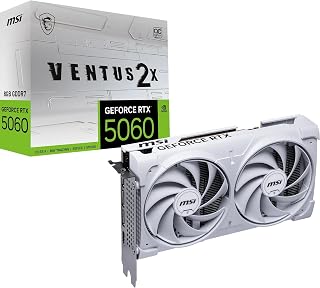
The MSI GeForce RTX 5060 Ventus 2X OC White is a compact, affordable graphics card designed for gamers and creators who want reliable 1080p performance with modern ray tracing. This factory-overclocked variant targets budget-conscious builders seeking better performance than integrated graphics without the premium price tag of higher-end models.
At its core, the RTX 5060 features NVIDIA's latest Blackwell architecture paired with 8GB of GDDR7 memory running at 28Gbps. DLSS 4.0 support gives the card significant performance boosts in compatible games, making 1080p gaming at high settings very achievable. The card handles both gaming and creative workflows like 3D rendering and video editing efficiently.
MSI's Ventus 2X design prioritizes thermals and silence through dual TORX Fan 5.0 coolers with paired blades and a Zero Frozr mode that stops fans entirely during light loads. The 197mm length and compact two-slot design make this card a practical fit for most mid-tower cases. A solid backplate with flow-through design reinforces structural integrity while internally premium electrical safeguards protect components.
The main limitations are the 8GB VRAM capacity, which may struggle in demanding AAA titles at ultra settings, and the PCIe 5.0 x8 bandwidth limitation. Power requirements are modest at 145W, requiring only a 550W PSU minimum. Connectivity is modern with three DisplayPort 2.1b outputs and one HDMI 2.1b for multi-display setups.
Overall, the RTX 5060 Ventus 2X OC White is a smart choice for gamers building tight budgets or upgrading from older entry-level cards. It delivers honest 1080p gaming performance with today's ray tracing features and efficient power delivery, backed by MSI's reputation for thermal engineering and build quality.
GPU: NVIDIA GeForce RTX 5060 (Blackwell Architecture)
Memory: 8GB GDDR7, 28Gbps, 128-bit bus
Clock Speed: 2527 MHz (OC)
Power: 145W, 8-pin connector, 550W PSU recommended
Interface: PCIe 5.0 x8
Cooling: Dual TORX Fan 5.0, Zero Frozr, heat pipes, large heatsink
Dimensions: 197mm length, 2-slot design
Weight: 511 grams
Outputs: 3x DisplayPort 2.1b, 1x HDMI 2.1b
Max Resolution: 7680x4320
Who Should Buy: Budget gamers targeting 1080p high refresh or 1440p medium refresh gaming, content creators needing efficient GPU acceleration, system builders with power or space constraints, and users upgrading from GTX cards or older architectures.
Performance Expectations: Expect 60+ FPS at 1080p ultra settings in most modern games with DLSS 4.0 enabled. Demanding AAA titles may require settings adjustments at 1440p. Ray tracing is fully supported but best experienced at 1080p for smooth frame rates.
System Requirements: Verify PCIe slot availability and case clearance for the 197mm length. Confirm your PSU meets the 550W minimum, with headroom for other components. The card draws power via single 8-pin connector, simplifying cable management.
Pros
- Excellent fit for small-form-factor and ITX builds without thermal compromise
- 0dB silent mode and dual BIOS give you control over noise versus performance
- Strong entry-level option for 1440p gaming with modern DLSS 4 features
- PCIe 5.0 support future-proofs your system for next-generation motherboards
- Aggressive pricing for a Blackwell-generation card with robust cooling design
Cons
- Limited 8GB VRAM may struggle with ultra-high settings in demanding AAA titles at 4K
- Entry-level performance tier, not suitable for professional 3D rendering or heavy compute workloads
- No customer reviews yet, so real-world reliability data is unavailable at launch
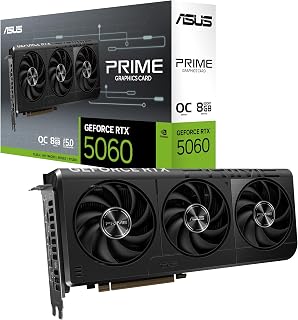
The ASUS Prime RTX 5060 OC is an entry-level gaming graphics card built on NVIDIA's latest Blackwell architecture. It targets budget-conscious gamers and small-form-factor PC enthusiasts who prioritize compact design and cool operation over raw power. With 8GB of GDDR7 memory and a 2565 MHz boost clock, this card is optimized for smooth 1440p gaming with modern ray tracing and DLSS 4 features.
Performance-wise, the 623 AI TOPS processing capability combined with DLSS 4 upscaling technology allows this card to punch above its weight in newer titles. The dual BIOS system lets you switch between Quiet and Performance profiles, giving you the flexibility to prioritize silent operation during browsing or unleash full performance when gaming matters. The 0dB fan technology keeps things remarkably quiet during light workloads, a valuable feature for living rooms and shared spaces.
Build quality shines in the 2.5-slot design, which maximizes compatibility with compact cases while improving thermal performance. The axial-tech fan design features a smaller hub with longer blades and a locking ring that directs airflow downward more effectively than traditional designs. At just 10.55 inches long and 4.72 inches wide, it fits snugly into small builds without sacrificing cooling efficiency. The triple DisplayPort 2.1b and single HDMI 2.1b connections provide flexible multi-monitor support and future-ready I/O.
The main limitation is the 8GB VRAM pool, which may require compromise on graphics settings in demanding AAA titles, especially at 4K resolution. This card is not designed for professional workloads like 3D rendering or machine learning training. Additionally, as a brand-new product, there are no real-world customer reviews yet, so long-term reliability data is still pending.
Verdict: The ASUS Prime RTX 5060 OC is a smart choice for 1440p gaming in compact systems and for anyone stepping up to the latest GPU generation without overspending. Its quiet operation, flexible performance tuning, and SFF-friendly design make it stand out in the entry-level space. If you value silence and small-form-factor compatibility over extreme performance, this card delivers solid value.
GPU Architecture: NVIDIA Blackwell (GeForce RTX 5060)
Memory: 8GB GDDR7 at 2565 MHz
Core Clock: 2535 MHz (Standard), 2565 MHz (OC Mode)
AI Performance: 623 AI TOPS
Outputs: 3x DisplayPort 2.1b, 1x HDMI 2.1b
Form Factor: 2.5-Slot, 10.55in x 4.72in x 4.3in (approx)
Cooling: Triple Axial-Tech Fans, 0dB Technology
Interface: PCIe 5.0
Max Resolution: 7680 x 4320 pixels
Weight: 0.7 kg
BIOS: Dual BIOS (Quiet and Performance profiles)
Who Should Buy: This card is ideal for gamers building compact ITX systems, upgrading from older generation GPUs, or playing demanding titles at 1440p with high refresh rates. It is also suitable for content creators working with lighter video editing tasks that benefit from NVIDIA's CUDA acceleration.
Who Should Skip: Professional 3D artists, machine learning engineers, and 4K gaming enthusiasts will find the 8GB VRAM limiting. Users with mid-tower cases who prioritize raw performance over compact design should consider higher-tier RTX 5070 or 5080 models instead.
Compatibility Notes: Requires PCIe 5.0 or 4.0 motherboard slot (backward compatible). Ensure your power supply meets NVIDIA's requirements for this GPU. The 2.5-slot design is optimized for compact cases; verify clearance in your specific case before purchase. DisplayPort 2.1b outputs require compatible monitors for maximum bandwidth.
Performance Expectations: Expect smooth 1440p gaming at high settings with ray tracing enabled in most modern titles. With DLSS 4 upscaling, even demanding AAA games become more playable. At 4K resolution, you will need to reduce graphics settings or rely heavily on upscaling technology.

Pros
- Excellent for compact and small form factor PC builds due to 182mm length
- Strong 1440p gaming performance with efficient power consumption
- DLSS 4 integration provides frame rate boosts in supported titles
- Premium cooling design with nano graphene lubricant extends card lifespan
- Solid 4.4/5 star rating from verified users confirms real-world reliability
Cons
- Limited to 1080p ultra or 1440p high for demanding AAA titles, not ideal for 4K gaming
- 8GB VRAM may become limiting in 3-4 years as game requirements increase
- Premium pricing for entry-level segment limits budget builder appeal
The Gigabyte RTX 5060 OC is an entry-level discrete graphics card powered by NVIDIA's latest Blackwell architecture. Designed for gamers and creators who need solid performance in a compact package, this card targets 1440p gaming enthusiasts and small form factor PC builders who refuse to compromise on performance.
The standout feature is its intelligent design pairing low-profile form factor with robust cooling. With a 182mm card length, it squeezes into ITX builds and SFF cases where full-size cards won't fit. Three fans with server-grade thermal conductive gel and nano graphene lubricant keep temperatures stable during extended gaming sessions, while the GDDR7 memory interface and PCI-E 5.0 support ensure smooth performance in current and upcoming titles with DLSS 4 support.
Build quality reflects Gigabyte's reputation for durability. The construction feels solid, and the precision fan design with graphene coating suggests this card will outlast typical consumer graphics cards. The 3-year warranty provides additional peace of mind for your investment.
The main limitation is performance ceiling. At 1440p with high settings, this card excels, but demanding AAA titles at ultra settings will require compromises. 4K gaming is not realistic, and the 8GB VRAM, while adequate today, may feel tight in 3-4 years as games evolve. The premium pricing for an entry-level card means budget builders might find better value elsewhere.
The Gigabyte RTX 5060 OC is a solid choice for 1440p gamers in compact builds who value reliability and quiet operation. If you need this exact form factor and performance level, this card delivers on its promises with proven real-world reliability backing it up.
GPU Architecture: NVIDIA GeForce RTX 5060 (Blackwell)
Memory: 8GB GDDR7, 128-bit interface
Memory Speed: 28000 MHz
Core Frequency: 2512 MHz
Outputs: 3x DisplayPort, 1x HDMI (supports up to 4 displays)
Max Resolution: 7680x4320 pixels
Interface: PCI Express 5.0
Form Factor: Low Profile, 182mm length, 330g weight
Cooling: 3-fan design with thermal gel and graphene lubricant
Warranty: 3 years
Ideal For: 1440p gamers building compact PCs, content creators needing reliable GPU compute in small form factors, esports players who prioritize smooth frame rates over ultra graphics, and anyone upgrading from older integrated graphics or entry-level discrete cards.
Skip This If: You need 4K gaming performance, want the absolute lowest price point, or require high VRAM (16GB+) for professional workloads. Consider higher-tier RTX models if you regularly play demanding AAA titles at maximum settings.
Buying Guide: Choosing Your RTX 5060 Variant
Cooling Architecture and Acoustics
The RTX 5060’s 145W thermal design power sits in a sweet spot where dual-fan solutions deliver excellent results without excessive noise. The GIGABYTE GeForce RTX 5060 WINDFORCE OC 8G Graphics employs WINDFORCE technology with alternating fan rotation, pushing air directly through a copper heat pipe array that maintains comfortable temperatures during extended gaming sessions.
MSI’s TORX Fan 5.0 design on the MSI GeForce RTX 5060 8G Ventus 2X OC White pairs traditional and dispersion fan blades to increase static pressure by 23% compared to previous generations. Both ASUS and MSI implementations feature 0dB idle modes that stop fans completely during light workloads, eliminating ambient noise when you’re browsing or watching content.
Low-profile cards like the Gigabyte GeForce RTX 5060 OC Low Profile 8G sacrifice some thermal mass for compact compatibility, running slightly warmer under sustained load but remaining within NVIDIA’s specifications. These variants excel in small form factor cases where dual-slot full-height cards simply won’t fit.
Form Factor and Case Compatibility
Standard RTX 5060 cards occupy 2 to 2.5 expansion slots and measure between 197mm and 242mm in length. The GIGABYTE WINDFORCE variant stretches to 242mm, requiring clearance verification in compact mid-tower cases, while the MSI Ventus 2X sits at a more universal 197mm that fits nearly every ATX and Micro-ATX chassis.
The ASUS Prime GeForce RTX 5060 8GB GDDR7 OC Edition occupies 2.5 slots with its enhanced heatsink array, delivering superior thermal performance at the cost of blocking adjacent PCIe slots in tightly packed motherboards. Builders working with Mini-ITX systems or slim HTPC enclosures should prioritize the low-profile GIGABYTE variant, which measures just 182mm and clears most restrictive case dimensions.
Weight distribution matters for vertical GPU mounts and older PCIe slots. The MSI Ventus 2X White weighs 511 grams, while standard dual-fan models range from 550 to 650 grams. Reinforced PCBs with metal backplates prevent PCB flex during installation and transport. For more guidance on matching components to your case constraints, explore our overview of best Z890 motherboard options that pair well with modern GPUs.
Factory Overclocking and Performance Headroom
Every RTX 5060 in this comparison ships with factory overclocks above NVIDIA’s reference 2475 MHz boost specification. The ASUS Prime variant pushes to 2565 MHz in OC mode, delivering an extra 3-5% frame rate uplift in GPU-bound scenarios at 1080p resolution with maxed settings.
Dual-BIOS implementations on the ASUS card let you toggle between Performance and Quiet profiles without software, prioritizing either maximum clocks or reduced fan curves. The GIGABYTE WINDFORCE OC and MSI Ventus 2X OC both include one-click overclocking utilities that apply validated profiles, though manual tuning with tools like MSI Afterburner typically yields another 50-80 MHz on top of factory settings.
Power delivery systems vary between models despite identical 8-pin connectors. The ASUS and GIGABYTE cards employ 6-phase VRM designs with premium capacitors, while the low-profile variant uses a more compact 4-phase layout sufficient for its thermal constraints. All models pull between 140W and 145W under gaming loads, requiring a minimum 550W power supply with adequate 12V rail capacity.
Display Connectivity and Multi-Monitor Support
The RTX 5060 generation standardizes on DisplayPort 2.1b and HDMI 2.1b, enabling 4K at 480Hz or 8K at 60Hz on compatible displays. Every card reviewed here provides three DisplayPort outputs plus one HDMI port, supporting up to four simultaneous displays without adapters or splitters.
DisplayPort 2.1b’s 80 Gbps bandwidth matters for upcoming ultra-high-refresh 1440p monitors and VRR implementations, future-proofing your setup as panel technology advances. HDMI 2.1b delivers full 48 Gbps throughput for 4K 120Hz gaming on OLED TVs with Auto Low Latency Mode and Variable Refresh Rate support.
Low-profile cards maintain identical port configurations despite their compact dimensions, though rear bracket spacing requires careful cable management in cramped cases. Flow-through backplate designs on the MSI and GIGABYTE models improve exhaust airflow when using all four display outputs simultaneously. Builders seeking broader GPU performance context can review our compilation of best GPU under $600 alternatives spanning multiple performance tiers.
Final Thoughts
The RTX 5060 lineup delivers Blackwell architecture and DLSS 4 across diverse form factors that accommodate nearly every build constraint. For standard mid-tower systems prioritizing value and effective cooling, the GIGABYTE GeForce RTX 5060 WINDFORCE OC 8G balances performance and acoustics exceptionally well, while compact builders working with Mini-ITX or slim cases should prioritize the Gigabyte GeForce RTX 5060 OC Low Profile 8G for its unique 182mm footprint and vertical compatibility.
Frequently Asked Questions
What power supply wattage does the RTX 5060 require?
NVIDIA recommends a minimum 550W power supply for RTX 5060 systems, though actual consumption peaks around 145W during gaming loads. Quality units from Corsair, EVGA, or Seasonic with 80 PLUS Bronze certification or higher provide adequate headroom for the GPU plus CPU, storage, and peripherals. Systems with high-wattage processors like Intel’s Core i9 or AMD’s Ryzen 9 may benefit from 650W units to maintain efficiency curves during simultaneous CPU and GPU loads.
Does the RTX 5060 support ray tracing and DLSS 4 in 2026?
Every RTX 5060 model implements NVIDIA’s Blackwell architecture with dedicated RT cores for hardware-accelerated ray tracing and fourth-generation Tensor cores for DLSS 4 frame generation. This enables playable frame rates with ray-traced reflections and global illumination in titles like Cyberpunk 2077 and Alan Wake 2 at 1080p resolution. DLSS 4’s multi-frame generation can triple rendered frames in supported games, delivering smooth 120+ fps gameplay even with demanding visual features enabled.
Will a low-profile RTX 5060 perform worse than standard models?
Low-profile RTX 5060 cards share identical GPU specifications and GDDR7 memory configurations with full-height variants, delivering the same computational performance in synthetic benchmarks and gaming scenarios. The primary difference appears in thermal behavior, where reduced heatsink mass causes slightly higher temperatures under sustained loads. This may trigger earlier boost clock throttling during extended gaming sessions, typically resulting in 2-4% lower average frame rates compared to dual-fan models with larger cooling arrays. If you’re evaluating other entry-level options, our guide to the best GPU under $250 explores alternative price points.
Can the RTX 5060 handle 1440p gaming effectively?
The RTX 5060 targets 1080p as its native resolution for maximum settings gaming, though it handles 1440p competently in less demanding titles or with quality settings adjusted to High instead of Ultra. Competitive multiplayer games like Valorant, Overwatch 2, and Counter-Strike 2 maintain 144+ fps at 1440p, while story-driven games such as Hogwarts Legacy or Starfield achieve 50-70 fps with DLSS Quality mode enabled. The 8GB GDDR7 memory buffer remains sufficient for current 1440p textures, though future AAA releases may require medium texture settings to avoid memory constraints.
Common questions
What does the RTX 5060 review say about its overall performance?
The RTX 5060 is a solid mid-range card that delivers smooth performance for most gamers at its launch MSRP of $299. It pairs 8GB of GDDR7 memory on a 128-bit bus with PCIe 5.0 and DLSS 4 support, giving it meaningful efficiency advantages over older generations. For budget-conscious builders who want modern features without stepping up to the RTX 5060 Ti, it covers the essentials well. Check live listings for current pricing.
Is the RTX 5060 worth it as a GPU purchase in 2026?
Yes, for gamers on a tight budget, the RTX 5060 is worth it if you primarily play at 1080p and want a new-generation card with DLSS 4 and GDDR7 memory. At a launch MSRP of $299, it competes with AMD's RX 9060 XT 8GB at the same launch MSRP. If your budget stretches further, the RTX 5060 Ti 8GB at a $379 launch MSRP offers a more comfortable experience. Check live listings for current pricing before buying.
How well does the RTX 5060 handle 1080p gaming?
The RTX 5060 is well suited for 1080p gaming, which is its primary target resolution. Its 8GB of GDDR7 memory is generally sufficient at 1080p, and DLSS 4 can push frame rates higher in supported titles. Demanding games at high settings should run comfortably, and lighter or older titles will run with plenty of headroom. It is the most capable card available at the $299 launch MSRP tier for this resolution.
Can the RTX 5060 handle 1440p gaming at acceptable frame rates?
The RTX 5060 can manage 1440p in many games, but with caveats. Its 8GB GDDR7 framebuffer and 128-bit memory bus can become limiting in demanding titles at this resolution, potentially requiring reduced settings. DLSS 4 Performance mode helps recover frame rates, making it more viable. For a comfortable 1440p experience without relying heavily on upscaling, stepping up to the RTX 5060 Ti or higher is worth considering. Check live listings for current pricing on each option.




Write Your Review
No reviews yet. Be the first to share your experience!