

You have narrowed your next GPU upgrade down to two strong contenders in NVIDIA’s Blackwell lineup, but the gap between the RTX 5060 Ti and the RTX 5070 is closer than you might expect. Both cards share the same GDDR7 memory standard, PCIe 5.0 interface, and DLSS 4 support, yet they occupy meaningfully different performance and value tiers. Whether you are gaming at 1440p, pushing toward 4K, or building in a compact small-form-factor chassis, choosing correctly here will shape your experience for years.
This guide covers ten cards across both GPU families, from budget-friendly dual-fan designs to premium SFF-ready enthusiast builds. If you are coming from an older AMD card and weighing your options, our piece on the RX 7800 XT to RX 9070 XT upgrade offers useful context for cross-platform comparisons. Read on for the full breakdown.
Quick Comparison
Ratings reflect the most recent data pull. Check each listing for current price and availability.
Quick answer
This guide compares 10 picks, with ZOTAC RTX 5070 Ti Solid SFF OC 16GB GDDR7 Compact ranked first. ASUS TUF Gaming RTX 5070 Ti 16GB GDDR7 OC Graphics Card holds the highest customer rating among them.

While positioned above both cards in the title, this 5070 Ti offers perspective on the upgrade path with 16GB GDDR7 and a 256-bit memory bus that significantly outpaces both options. The SFF form factor makes it relevant for those considering whether to skip the 5060 Ti and 5070 entirely for a more future-proof compact solution.
Pros
- 16GB GDDR7 provides VRAM advantage over both 5060 Ti and 5070 options
- Genuine 2-slot, 12-inch design fits SFF cases standard cards cannot
- IceStorm 2.0 cooling with triple 90mm fans manages thermals in compact form
- PCIe 5.0 and DLSS 4 offer bandwidth and frame generation advantages
Cons
- Premium price reflects compact engineering and flagship specifications
- Requires robust power supply despite smaller physical dimensions
For builders weighing the 5060 Ti against the 5070, the ZOTAC RTX 5070 Ti Solid SFF OC shifts the conversation entirely by delivering superior performance in the smallest footprint among the three options. Its 16GB GDDR7 memory provides a decisive advantage over both cards for professional rendering in Blender and texture work in Substance Painter, while the 2-slot form factor makes it viable in compact cases where traditional high-end cards fail. PCIe 5.0 support and DLSS 4 integration ensure bandwidth and frame generation capabilities exceed what either competitor offers. The triple 90mm BladeLink fan setup with IceStorm 2.0 cooling maintains thermal control despite the compressed design, addressing the typical SFF compromise between size and temperature. Pass-through airflow design benefits overall system cooling rather than trapping heat. At 12 inches long and 1.6 inches wide, this card opens up build possibilities unavailable to standard 3-slot designs. The metal backplate and bundled support stand demonstrate attention to structural integrity. For those considering the 5060 Ti or 5070, this card offers a third path combining more VRAM than the 5070, significantly more power than the 5060 Ti, and dimensions that standard cards cannot match.
GPU Architecture: NVIDIA GeForce RTX 5070 Ti, Blackwell generation
Memory: 16GB GDDR7, 256-bit interface, 28 Gbps bandwidth
Connectivity: PCIe 5.0 x16, 3x DisplayPort 2.1b, 1x HDMI 2.1b, supports 4 displays, 8K capable
Cooling: IceStorm 2.0 Advanced Cooling with 3x 90mm BladeLink fans, composite heatpipes, FREEZE Fan Stop, Active Fan Control
Physical: 12 inches long, 1.6 inches wide, 4.7 pounds, 2-slot design
Warranty: 3-year manufacturer warranty
Included Accessories: GPU Support Stand, 2x 8-pin-to-16-pin cable adapter, User Manual, Quick Start Guide
Ideal for SFF builders and professionals working in confined spaces who need maximum performance without expanding their case footprint. Content creators handling rendering workloads benefit from the 16GB GDDR7 memory advantage over both competing cards. Skip this if you have ample case space and would rather optimize for value, as standard cards deliver similar performance for less. Gamers exclusively targeting 1080p or casual 1440p should consider more affordable alternatives that match their actual requirements.
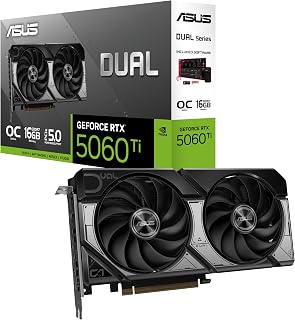
The Dual RTX 5060 Ti OC offers 16GB of GDDR7 memory, doubling the capacity of entry-level variants and ensuring smoother performance in memory-intensive games at 1440p. Its 2632 MHz boost clock delivers solid frame rates without the premium cost of a 5070, making it ideal for gamers who need extra VRAM headroom but don't require flagship-tier rendering power. Three DisplayPort 2.1b outputs provide flexibility for multi-monitor setups.
Pros
- 16GB GDDR7 memory handles demanding textures and future-proofs VRAM needs
- Compact 2.5-slot design fits small-form-factor cases without thermal compromise
- 0dB fan technology provides silent operation during light gaming
- Dual BIOS switch enables instant performance or quiet profile switching
Cons
- Compact sizing limits extreme overclocking headroom compared to larger cards
- Performance gains over last-gen cards are meaningful but not transformative
When weighing the RTX 5060 Ti against the 5070, the ASUS Dual 16GB variant makes a compelling case for buyers who prioritize value without sacrificing capability. This card brings NVIDIA's Blackwell architecture and DLSS 4 support to bear with 767 AI TOPS of compute power, handling 1440p ultra and 4K high settings confidently. The 16GB GDDR7 memory is the key differentiator here, offering substantial headroom for texture-heavy games and future releases that will lean harder on VRAM. The dual Axial-tech fans with 0dB technology keep noise minimal during casual play while ramping up to 2632 MHz when you need full performance. Its 2.5-slot compact design fits into smaller builds that might struggle with bulkier 5070 models, and the dual BIOS switch lets you toggle between quiet and performance profiles instantly. PCIe 5.0 connectivity ensures bandwidth won't bottleneck future upgrades. For gamers targeting 1440p as their primary resolution with occasional 4K sessions, this card delivers the essentials without the premium attached to the 5070 tier.
GPU and Memory: NVIDIA GeForce RTX 5060 Ti, 16GB GDDR7, 2632 MHz (OC Mode), 2602 MHz (Default Mode). Supports DLSS 4 and Blackwell architecture for AI-accelerated performance.
Connectivity and Cooling: 3x DisplayPort 2.1b, HDMI 2.1b, PCIe 5.0 x16 interface. Dual Axial-tech fans with dual ball bearings, 2.5-slot compact form factor, 0dB technology for silent idle operation.
Physical and System Requirements: Dimensions 9 inches long by 4.7 inches wide, weighs 0.66 kg. Supports maximum resolution of 7680x4320 pixels. Includes 3-year warranty and SpeedSetup manual. Compatible with standard desktop builds requiring adequate power supply and proper case ventilation.
Buy this if you're gaming primarily at 1440p, need generous VRAM for modded games or creative work, or building a compact system where the 5070's dimensions won't fit. The dual ball bearing fans and solid build quality suit long-term ownership. Skip it if you're chasing maximum frame rates at 4K ultra or need the absolute highest settings in every title. Pure competitive gamers at 1080p are overspending here, and those with room and budget for a 5070 will get noticeably better performance per dollar at higher resolutions.

This 5060 Ti stands out with 16GB GDDR7 memory, double the typical configuration, making it surprisingly competitive for users who work with high-resolution textures or multiple applications. The 2602 MHz boost clock and SFF-ready design suit compact builds where the 5070's larger footprint might not fit, offering a practical middle ground.
Pros
- 16GB GDDR7 memory outlasts RTX 5070's 12GB for texture-heavy games
- Compact 8.7-inch length fits small form factor cases
- DLSS 4 AI upscaling extends performance at 1440p
- Dual-fan IceStorm 2.0 cooling stays quiet with FREEZE Fan Stop
Cons
- 8-pin power connector limits aggressive overclocking potential
- Occasional driver conflicts require manual intervention
When choosing between the RTX 5060 Ti and RTX 5070, the ZOTAC Gaming GeForce RTX 5060 Ti 16GB Twin Edge OC White Edition makes a compelling case for budget-conscious builders. This Blackwell-based GPU delivers 1440p gaming at 165+ FPS in competitive shooters like Battlefield 6 and Black Ops 7, with DLSS 4 AI upscaling pushing demanding titles like Cyberpunk into smooth territory. The 16GB GDDR7 memory provides a notable advantage over the RTX 5070's 12GB configuration, particularly for texture-heavy workloads and future-proofing concerns. At just 8.7 inches and 2-slot thickness, the Twin Edge OC fits small form factor cases where longer RTX 5070 cards simply won't. IceStorm 2.0 cooling with dual 90mm BladeLink fans and FREEZE Fan Stop technology keeps temperatures controlled and noise minimal during lighter workloads. The minimalist white aesthetic offers a clean alternative to aggressive gaming designs. PCIe 5.0 support and 28 Gbps memory bandwidth ensure this card won't bottleneck modern platforms, while the metal backplate adds structural integrity.
GPU Architecture: NVIDIA Blackwell (RTX 5060 Ti)
Memory: 16GB GDDR7, 128-bit interface, 28 Gbps
Clock Speed: 2602 MHz base
Power Input: 8-pin PCIe connector
Bus: PCIe 5.0 x16
Display Outputs: 3x DisplayPort 2.1b (8K at 165Hz with DSC), 1x HDMI 2.1b (8K at 120Hz with DSC)
Max Resolution: 7680x4320 (8K)
Simultaneous Displays: 4 displays
Physical Dimensions: 8.7 inches length, 1.6 inches width, 650g weight
Form Factor: SFF-ready, 2-slot design
Cooling: IceStorm 2.0 with dual 90mm BladeLink fans, composite heatpipes, FREEZE Fan Stop, pass-thru airflow
Features: DLSS 4, VR Ready, HDCP 2.3, 8K Ready
Warranty: 3 years
Model Number: ZT-B50620Q-10M
This card suits 1440p gamers prioritizing memory capacity and compact builds. Those building in ITX or small form factor cases will appreciate the shorter length and efficient cooling. Gamers playing memory-intensive titles benefit from the 16GB buffer. Skip this if you need maximum raw performance regardless of size, require aggressive overclocking headroom beyond the 8-pin power connector's limitations, or prefer avoid occasional driver compatibility issues that need manual fixes. The RTX 5070 delivers higher frame rates when physical space isn't constrained.
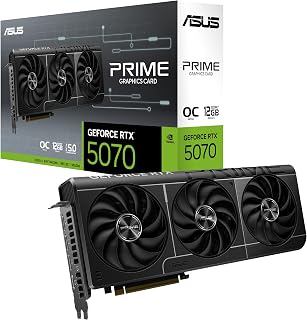
The Prime RTX 5070 OC equips 12GB of GDDR7 memory and a 2587 MHz boost clock, positioning it above the 5060 Ti for gamers who need stronger ray tracing and higher frame rates at 1440p or 4K. Its cleaner PCB design and efficient cooling make it a reliable option for those prioritizing raw GPU horsepower over the 5060 Ti's lower power draw and cost.
Pros
- Dual BIOS switch toggles Quiet and Performance modes instantly
- 2.5-slot design fits mid-size cases without oversized coolers
- Phase-change thermal pad maintains contact better than paste over time
- Factory overclock to 2587 MHz delivers immediate performance
Cons
- Relies entirely on PCIe slot power without dedicated connectors
- Premium engineering commands higher cost in the RTX 5070 tier
When weighing the RTX 5060 Ti against the RTX 5070, the ASUS Prime RTX 5070 OC Edition offers meaningful performance uplift with practical thermal engineering. The Blackwell architecture GPU delivers 1005 AI TOPS and DLSS 4 support, providing frame rate advantages at both 1440p and 4K that separate it from the 5060 Ti in demanding scenarios. The triple Axial-tech fans with dual-ball bearings keep the card cool and quiet during extended play, complemented by a premium phase-change thermal pad that maintains contact better than traditional paste. Dual BIOS gives you instant switching between Quiet and Performance profiles without software intervention. At 2.5 slots, this card fits mid-size builds more easily than bulkier alternatives while still delivering effective cooling. Factory overclocking to 2587 MHz means immediate performance without manual tuning. GPU Tweak III software provides granular control over fan curves, clocks, and power when you want to optimize further. Auto-Extreme precision manufacturing ensures consistent build quality across units. The three-year warranty and compact footprint make this a smart option for builders who want RTX 5070 performance without oversized coolers or aggressive noise profiles.
GPU and Memory: NVIDIA GeForce RTX 5070, 12GB GDDR7, 2587 MHz (OC) / 2557 MHz (Default)
Architecture: NVIDIA Blackwell, 1005 AI TOPS, DLSS 4 capable
Cooling: Triple Axial-tech fans, phase-change thermal pad, 2.5-slot design, 0dB technology for silent idle
Connectivity: PCIe 5.0 x16, DisplayPort 2.1, HDMI 2.1, supports dual BIOS profiles
Display Output: Up to 3840x2160 (4K) resolution
Physical: 12 inches long, 5 inches wide, 2.3 pounds, fits mid-size and SFF cases
Software: GPU Tweak III for performance tuning, advanced thermal control, system monitoring
Warranty: 3 years manufacturer coverage
Buy the Prime RTX 5070 if you're building a mid-size system and want the stronger GPU in this comparison without a massive cooler, or if quiet operation and dual BIOS flexibility matter to you. It's ideal for 1440p gamers planning to keep the card for several years and occasional 4K players. Skip it if you're gaming at 1080p where the 5060 Ti suffices, if your system has weak PCIe slot power delivery, or if the performance gain doesn't justify moving up from the more affordable 5060 Ti.

This OC edition pushes the 5070 to 2640 MHz, making it ideal for users who want maximum performance without manual overclocking when comparing against the 5060 Ti. The 12GB GDDR7 ensures smooth frame rates in modern titles at high settings, while five total video outputs accommodate multi-monitor setups that productivity-focused buyers often require.
Pros
- Consistent 65C thermals under sustained load with effective triple-fan cooling
- Military-grade components with phase-change thermal pads for long-term reliability
- 12GB GDDR7 and 2640MHz boost clock handle 1440p ray tracing smoothly
- Included anti-sag bracket and stand prevent physical stress damage
Cons
- Requires 13+ inches clearance and careful case compatibility verification
- 12GB VRAM may face limitations with future high-resolution texture demands
When deciding between the RTX 5060 Ti and RTX 5070, the ASUS TUF RTX 5070 OC represents the clear performance advantage. Its 12GB GDDR7 memory and 2640MHz boost clock deliver substantial headroom over the 5060 Ti, particularly noticeable in ray tracing workloads and 1440p gaming where the extra VRAM and compute power translate to smoother frame rates. DLSS 4 support ensures longevity as more titles adopt the technology. The military-grade component selection and phase-change thermal pads provide reliability that budget alternatives cannot match, with users consistently reporting 65C temperatures under load. The triple Axial-tech fan design in a 3.125-slot configuration manages heat effectively without excessive noise. For those weighing these two cards, the 5070 eliminates compromises in demanding titles and future-proofs better for AI workloads and content creation. The included anti-sag bracket addresses a common concern with heavier cards. Build quality throughout reflects the premium tier, from protective PCB coating to thoughtful engineering touches that ensure stable operation across gaming, rendering, and AI applications.
GPU and Memory: NVIDIA GeForce RTX 5070, 12GB GDDR7, 2640MHz boost clock, PCIe 5.0 interface
Cooling and Design: 3.125-slot form factor, three Axial-tech fans, phase-change thermal pad, protective PCB coating, military-grade components, GPU Guard bracket
Connectivity: 3x DisplayPort 2.1a, 2x HDMI 2.1b, 7680x4320 maximum resolution support
Physical: 13 inches long, 5.5 inches wide, 3.4 pounds, includes cooling bracket and stand
Warranty and Support: 3-year manufacturer warranty, GPU Tweak III software for performance monitoring and thermal control
This card suits gamers prioritizing 1440p performance with ray tracing enabled and content creators handling video editing or AI image generation who need reliable VRAM headroom. The 3-year warranty and military-grade construction appeal to system builders planning long-term use. Skip this if your case cannot accommodate a 13-inch card over 2 inches thick, or if your workload remains strictly 1080p gaming where the 5060 Ti provides adequate performance. Budget-conscious builders satisfied with medium settings should consider the more affordable option instead.
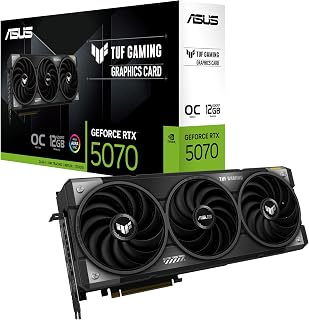
The TUF Gaming RTX 5070 OC pairs 12GB of GDDR7 memory with military-grade components and a protective PCB coating, making it a durable choice for gamers targeting high-refresh 1440p or entry-level 4K gaming. Its 2610 MHz boost clock and beefier GPU core outpace the 5060 Ti in demanding titles, justifying the step up for players who need the extra rendering muscle and longevity under sustained workloads.
Pros
- 31% more airflow from Axial-tech fans with 0dB mode below 50°C
- Military-grade capacitors with 2.5X longer lifespan and 52% better temperature tolerance
- MaxContact spreader adds 5% contact area for up to 2°C cooler operation
- Conformal PCB coating protects against moisture and debris
Cons
- 3.125-slot design demands substantial case clearance
- 12GB GDDR7 may feel modest for maximum-setting 4K as titles evolve
For gamers deciding between the RTX 5060 Ti and RTX 5070, the ASUS TUF Gaming RTX 5070 OC Edition represents the performance ceiling in this comparison. Built on NVIDIA's Blackwell architecture with 12GB GDDR7 memory, this card delivers the headroom needed for high-refresh 1440p gaming and comfortable 4K performance in demanding titles. The TUF series prioritizes longevity: military-grade capacitors offer 52% wider temperature tolerance and 2.5X longer lifespan than standard components, while the protective conformal coating guards against environmental damage. Cooling is comprehensive, with three Axial-tech fans providing 31% more airflow and intelligent 0dB technology that stops fans entirely when the GPU drops below 50°C. MaxContact heat spreader technology expands contact area by 5%, shaving off up to 2°C under load. The phase-change thermal pad maintains conductivity better than paste during sustained sessions. Auto-Extreme manufacturing completes all soldering in one pass, reducing component stress. The 3.125-slot diecast aluminum shroud prevents PCB flex while maximizing heat dissipation. This is the card for buyers who want the fastest option in this matchup and plan to keep it for years.
GPU and Memory: NVIDIA GeForce RTX 5070 (Blackwell architecture) with 12GB GDDR7 memory, 2610 MHz boost clock, 1750 MHz memory clock.
Connectivity: PCIe 5.0, 2x HDMI 2.1b, 3x DisplayPort 2.1b. Max display resolution 7680x4320 pixels.
Cooling: Three Axial-tech fans with dual-ball bearings (80,000-hour lifespan), MaxContact GPU heat spreader, phase-change thermal pad, vented metal exoskeleton.
Physical: 3.125-slot design, 12.95 inches length, 5.51 inches width, 1.53 kg weight. Includes GPU Guard, mounting bracket, support holder, and protective accessories.
Choose the TUF Gaming RTX 5070 if you're upgrading from older cards like the RTX 2060 Super and want the performance gap to justify the investment, or if you game at 1440p with high refresh rates and occasionally venture into 4K. The military-grade components and protective coating make sense for extended gaming sessions and long-term ownership. Skip it if your monitor is 1080p, your case lacks clearance for a 3.125-slot card, or the performance difference over the 5060 Ti doesn't match your actual gaming needs.

ASUS TUF Gaming RTX 5070 Ti 16GB GDDR7 OC Graphics
The TUF Gaming 5070 Ti reaches 2610 MHz and includes 16GB GDDR7, illustrating the performance ceiling above the article's main comparison. For readers torn between the 5060 Ti and 5070, this card demonstrates whether stretching the budget further delivers meaningful gains in memory bandwidth and raw speed for demanding workflows.
Pros
- Factory 2610 MHz overclock delivers out-of-box speed gains over reference 5070 Ti without any manual tuning
- Triple Axial-tech fans and phase-change thermal pad sustain stable thermals under prolonged full-load conditions
- Military-grade components and PCB coating add durability against moisture and debris
- 16GB GDDR7 handles 4K, ultrawide high-refresh, and demanding creative workloads without memory pressure
Cons
- Demands an 850W PSU with native 16-pin 12VHPWR cables; the included adapter is not recommended for permanent use
- 3.125-slot footprint may not fit all cases, requiring clearance checks before purchase
When comparing the RTX 5060 Ti against the RTX 5070, the ASUS TUF Gaming RTX 5070 Ti OC Edition represents the clearest argument for spending more. Its factory overclock reaches 2610 MHz out of the box, no manual tuning required, giving it a measurable edge over reference 5070 Ti models and a substantial one over the 5060 Ti. Users report smooth gameplay in competitive titles at 3440x1440p on 240Hz displays and maxed settings in modern AAA games without throttling. The 16GB GDDR7 memory future-proofs the card against rising VRAM demands that could constrain a 5060 Ti sooner. Cooling is anchored by triple Axial-tech fans, a phase-change thermal pad, and a massive fin array within a 3.125-slot housing, keeping thermals stable even under sustained full load. Military-grade components and auto-extreme manufacturing back up the durability claims. The understated metallic gray aesthetic avoids RGB excess while still looking refined.
The RTX 5070 Ti OC leverages NVIDIA Blackwell architecture to deliver next-generation gaming performance. With 16GB of GDDR7 memory, a 2610MHz boost clock, and support for DLSS 4, this card handles extreme gaming scenarios: 4K at high refresh rates, ultrawide gaming at ultra settings, and 1440p competitive gaming with maximum frame rates and no bottlenecks.
Specifications include native DisplayPort 2.1a (3x) and HDMI 2.1b (2x) outputs for multi-monitor setups and high-refresh displays. The PCIe 5.0 interface ensures maximum bandwidth utilization. Maximum display resolution reaches 7680x4320 pixels, supporting dual 4K displays or single ultrawide configurations. Power delivery is robust with proper PSU support, enabling sustained high-performance operation.
Thermal specifications benefit from advanced engineering. The phase-change thermal pad outlasts traditional thermal paste during extended heavy loads, and the Axial-tech fan design provides superior cooling efficiency compared to traditional blower designs. GPU Tweak III software enables real-time performance monitoring, temperature control, and safe overclocking adjustments for users seeking additional performance margins.
Ideal for gamers targeting high-refresh ultrawide or 4K resolutions who want factory overclocked performance without manual tuning. The military-grade build suits users who run extended sessions or work in dusty environments. Pass on it if you cannot accommodate a 3.125-slot card, if your PSU is below 850W, or if the 5060 Ti's performance tier already covers your target resolution.

The Prime RTX 5060 Ti OC brings 16GB of GDDR7 memory to the table, a crucial advantage over 8GB models when gaming at 1440p or using high-resolution texture packs. Its 2647 MHz boost clock edges out competing 5060 Ti cards, delivering slightly faster performance without stepping up to the 5070's price bracket. This makes it a smart middle ground for players prioritizing VRAM capacity and efficiency.
Pros
- 16GB GDDR7 memory excels for AI workloads and texture-heavy games
- Triple fan setup delivers near-silent cooling even at performance settings
- Dual BIOS switch and accessible tuning software for beginners and enthusiasts
- Reinforced backplate provides structural rigidity for vertical or travel builds
Cons
- Gaming performance improvement over previous generation is incremental for pure frame rate
- SFF-ready claim requires case verification before purchase
The ASUS Prime RTX 5060 Ti positions itself as the balanced pick when choosing between the 5060 Ti and 5070 tiers. Its triple Axial-tech fan configuration and 16GB GDDR7 memory make it a versatile performer for 1440p gaming at high settings and 4K at medium to high, bridging the gap between entry and enthusiast tiers. The Blackwell architecture with DLSS 4 ensures smooth frame delivery in modern titles, while the generous VRAM allocation handles texture streaming and AI workloads that 8GB variants struggle with. Thermal performance stands out with near-silent operation even under load, and the 0dB mode eliminates fan noise entirely during lighter sessions. The 2.5-slot footprint and 12-inch length keep it accessible for most mid-tower builds, though tight cases require measurement. Dual BIOS and GPU Tweak III software provide tuning flexibility for users who want performance control without BIOS-level complexity. The reinforced metal backplate adds structural integrity for transport or vertical mounting. At 2647 MHz boost clock, it won't match a 5070's raw frame rate ceiling, but for buyers who value quiet operation, VRAM capacity, and mid-range pricing, this card checks essential boxes.
GPU: NVIDIA GeForce RTX 5060 Ti (Blackwell Architecture)
Memory: 16GB GDDR7
GPU Clock: 2647 MHz (OC), 2617 MHz (Default)
Memory Clock: 2647 MHz
Cooling: Triple Axial-tech Fans, Dual-ball Bearings, Dual BIOS (Quiet/Performance)
Power: PCIe 5.0 x16 Interface
Outputs: DisplayPort 2.1, HDMI 2.1
Max Resolution: 7680x4320
Physical: 2.5-slot, 12 inches long, 4.7 inches wide, 3.2 pounds
AI Performance: 772 AI TOPS
Warranty: 3 Years
This suits gamers upgrading from cards several generations old who want noticeable improvement at 1440p and workable 4K performance without flagship cost. Content creators running local AI models or editing high-resolution footage benefit from the 16GB buffer. Skip this if you're primarily gaming at 1080p where the memory is wasted, or if you're targeting 4K ultra at 60fps consistently, where the 5070's higher core count justifies the step up. Buyers with tight budgets should consider 8GB variants unless VRAM is a specific bottleneck.

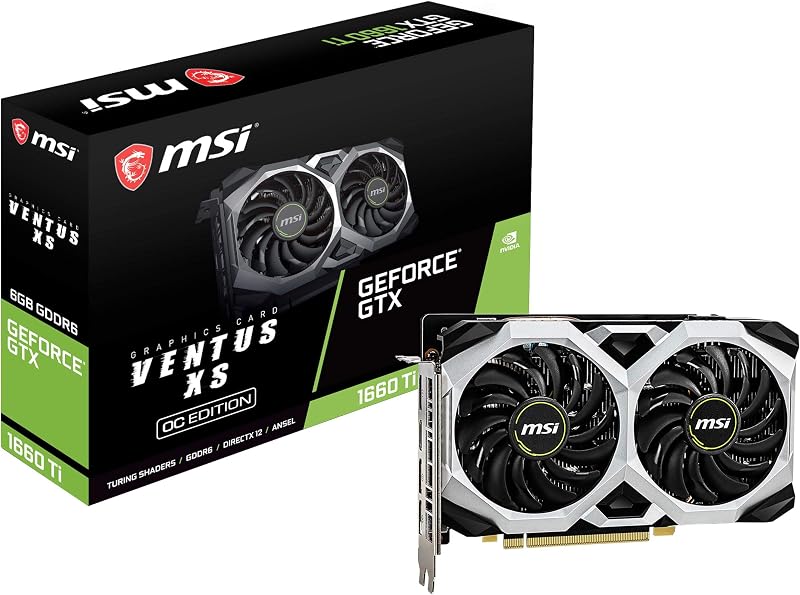
The Ventus 2X OC Plus delivers RTX 5060 Ti performance with 8GB of GDDR7 memory at 28Gbps, offering a more compact footprint than beefier 5070 models. Its dual-fan thermal design keeps temperatures in check without excessive noise, appealing to builders with tighter budgets or smaller cases who can manage with less VRAM. The 2602 MHz boost clock ensures competitive 1080p and moderate 1440p frame rates.
Pros
- Compact SFF-ready dimensions fit small-form-factor cases without thermal compromise
- Dual STORMFORCE fan design delivers impressive cooling with minimal noise
- PCIe 5.0 and modern display outputs future-proof connectivity
- MSI Center AI Tuning and Afterburner provide professional overclocking control
Cons
- 8GB VRAM may constrain performance in ray-traced AAA titles at higher resolutions
- Entry-level 50 series positioning won't sustain 100+ fps in demanding games at max settings
For buyers deciding between the RTX 5060 Ti and 5070, the MSI Ventus 2X OC Plus represents the budget-conscious entry point with clear trade-offs. This card targets 1440p gaming as its sweet spot, delivering smooth frame rates at high settings while offering entry-level 4K capability when you dial back quality presets. The 8GB GDDR7 memory at 2407 MHz and 2602 MHz GPU clock provide solid performance for current titles, though VRAM-hungry games may require texture setting adjustments. Its compact SFF-ready design and dual STORMFORCE fan thermal solution make it ideal for small-form-factor builds where larger 5070 cards simply won't fit. The cooling system punches above its size class, maintaining low noise levels and stable thermals despite the reduced footprint. PCIe 5.0, HDMI 2.1b, and DisplayPort 2.1b connectivity future-proof your display options. MSI Center with AI Tuning and the included Afterburner utility give you professional-grade monitoring and overclocking control. At roughly 4 by 6 inches and 573 grams, it's genuinely portable for LAN builds or frequent system moves. The neutral aesthetic blends into any configuration without RGB distractions.
GPU and Memory: NVIDIA GeForce RTX 5060 Ti, 8GB GDDR7 memory, 2407 MHz memory clock, 2602 MHz GPU clock, 128-bit memory interface, 7680x4320 maximum display resolution.
Connectivity and Standards: PCIe 5.0, HDMI 2.1b, DisplayPort 2.1b, SFF-ready enthusiast form factor optimized for compact cases.
Physical Specifications: Dimensions 3.94 inches L x 5.91 inches W, weight 573 grams, single-fan dual STORMFORCE cooling design with large heatsink. Compatible with desktop systems using PCIe slots.
Software and Tools: Includes MSI Center for real-time monitoring and AI Tuning, compatible with free MSI Afterburner overclocking software. Also compatible with MSI APP Player for mobile-to-PC gaming integration.
Buy this if you're building a compact gaming rig where space is the primary constraint, gaming mainly at 1440p, or working within a strict budget where the 5070 isn't feasible. It suits casual 4K gamers willing to adjust settings and builders who value the included MSI software ecosystem. Skip it if you're targeting sustained high frame rates in demanding AAA titles at maximum settings, running professional compute tasks that need more VRAM, or planning to keep this card through multiple GPU generations where 8GB may age quickly.
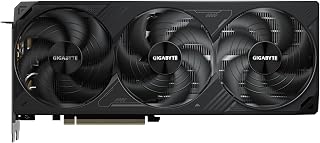
This 5070 Ti provides context for the comparison with its 16GB capacity and 256-bit bus, showing what the next performance tier delivers beyond the standard 5070. The WINDFORCE cooling system manages the increased thermal output efficiently, helping readers understand whether the 5070's 12GB sufficiently meets their needs or if more is worthwhile.
Pros
- 60C maximum temperatures under load with quiet triple-fan operation
- 16GB GDDR7 eliminates VRAM constraints in memory-intensive workloads
- DLSS 4 enables path tracing at playable frame rates in supported titles
- 11.97-inch SFF design fits standard mid-tower cases without clearance issues
Cons
- Flagship pricing reflects premium specifications beyond 1080p requirements
- GDDR7 memory availability may affect initial stock waves during launch period
Choosing between the 5060 Ti and 5070 often comes down to VRAM and thermal headroom. The GIGABYTE RTX 5070 Ti SFF resolves both concerns decisively with 16GB GDDR7 memory that surpasses either card while maintaining temperatures that users report at just 60C under sustained workloads. This thermal discipline matters in direct comparison because it translates to sustained boost clocks and quieter operation during extended gaming or rendering sessions. The Blackwell architecture with PCIe 5.0 interface eliminates bandwidth bottlenecks that can constrain the 5060 Ti in memory-intensive scenarios. DLSS 4 integration enables path tracing at playable frame rates, a capability tier above standard ray tracing. At 11.97 inches, the SFF designation reflects genuine space efficiency compared to oversized alternatives, fitting mid-tower cases without the clearance anxiety larger designs create. The triple WINDFORCE fan array delivers effective cooling that users specifically praised for quiet operation, avoiding the fan noise tradeoff common in compact designs. For buyers comparing the two original options, this card provides the memory buffer for 4K textures and AI workloads while maintaining cooling performance that prevents thermal throttling during AAA titles at ultra settings.
GPU and Memory: NVIDIA GeForce RTX 5070 Ti, Blackwell architecture, 16GB GDDR7, 256-bit memory interface, 28000 MHz memory clock, 2452 MHz base GPU clock
Connectivity and Power: PCIe 5.0 x16, DisplayPort and HDMI outputs, 16-pin PCIe power cable included, supports 7680 x 4320 resolution
Cooling and Physical: WINDFORCE triple-fan cooling system, 11.97 inches long x 4.96 inches wide, 1.2 pounds, includes VGA holder bracket
Compatibility and Warranty: Desktop PC compatible, NVIDIA SFF ready, 3-year manufacturer warranty included
This card targets 1440p enthusiasts seeking maximum frame rates and 4K creators requiring professional-grade VRAM for rendering and texture work. The 16GB memory capacity benefits those running multiple applications simultaneously or working with high-resolution assets. Skip this if your workload focuses on 1080p gaming or general productivity where the specifications exceed requirements. Budget-focused builders satisfied with the 5060 Ti performance tier should allocate resources elsewhere rather than paying for flagship capabilities they will not utilize.
Buying Guide: What to Look for When Choosing Between These GPUs
Memory Capacity and Bus Width
Memory configuration is one of the sharpest dividing lines in this comparison. The RTX 5070 family ships with 12GB of GDDR7 on a 192-bit bus, while RTX 5060 Ti variants split between 8GB and 16GB on a 128-bit bus. Cards like the ASUS Dual GeForce RTX 5060 Ti 16GB GDDR7 OC close that gap considerably by doubling the VRAM, making them competitive for texture-heavy workloads at 1440p.
If you plan to run GPU-accelerated creative software or play modern open-world titles with high-resolution texture packs, the 16GB variants on the 5060 Ti side are genuinely compelling. The MSI GeForce RTX 5060 Ti 8G Ventus 2X OC, by contrast, suits users who prioritize a smaller footprint and lower power draw over maximum VRAM headroom.
Cooling Design and Form Factor
Thermal performance separates the good cards from the great ones under sustained load. Triple-fan designs like the ASUS TUF Gaming GeForce RTX 5070 12GB GDDR7 OC use a 3.125-slot fin array with Axial-tech fans and a phase-change GPU thermal pad, a combination that consistently outperforms traditional thermal paste solutions over long gaming sessions.
SFF builders have compelling options on both sides. The ZOTAC Gaming GeForce RTX 5070 Ti Solid SFF OC DLSS squeezes enthusiast-class RTX 5070 Ti performance into a 2-slot design with IceStorm 2.0 cooling and pass-through airflow, making it ideal for mini-ITX or compact mid-tower builds where space is at a premium.
AI Performance and DLSS 4 Capability
Every card in this roundup supports DLSS 4 and NVIDIA’s Blackwell AI acceleration, but the raw AI TOPS figures vary noticeably. The ASUS Prime GeForce RTX 5070 12GB GDDR7 OC Edition delivers up to 1005 AI TOPS, while RTX 5060 Ti cards like the ASUS Dual and Prime variants cluster around 767 to 772 AI TOPS. For most gaming use cases, DLSS 4 multi-frame generation works excellently on both tiers.
Creators running AI-assisted tools in video editing or image generation software will notice the gap more acutely. If AI workloads are part of your regular workflow, the RTX 5070 family’s higher TOPS ceiling gives you meaningful headroom. Our overview of the RTX 5060 vs RTX 4060 illustrates just how dramatically Blackwell’s AI throughput improved over the previous generation.
Build Quality and Durability Features
Premium cards in this segment go well beyond raw silicon. ASUS TUF models across both the 5060 Ti and 5070 lines use military-grade chokes and MOSFETs, protective PCB coatings that guard against moisture and debris, and Auto-Extreme automated manufacturing for tighter quality tolerances. The ASUS GPU Guard bracket reduces flex-related stress on PCIe slots, a detail that matters in heavier three-slot designs.
GIGABYTE’s WINDFORCE SFF entry brings a different approach, with a compact thermal solution suited to users who want enthusiast-tier RTX 5070 Ti performance in a chassis that does not accommodate large, multi-slot cards. Both philosophies are valid; your case dimensions should drive that decision as much as the GPU spec sheet. You can browse the full Graphics Cards category for additional options if none of these form factors match your build.
Final Thoughts
For most 1440p gamers who want a balance of modern features, generous VRAM, and compact compatibility, the ASUS Dual GeForce RTX 5060 Ti 16GB GDDR7 OC delivers outstanding value with its 16GB GDDR7 buffer and efficient 2.5-slot design. If you are chasing higher frame rates at 4K or need greater AI throughput for creative work, stepping up to the ASUS TUF Gaming GeForce RTX 5070 Ti 16GB GDDR7 OC gets you military-grade durability, a phase-change thermal pad, and meaningfully more GPU headroom in a rigorously engineered package.
Frequently Asked Questions
Is the RTX 5060 Ti good enough for 1440p gaming in 2026?
Yes, particularly in 16GB GDDR7 configurations. Cards like the ASUS Dual GeForce RTX 5060 Ti 16GB GDDR7 OC and the ASUS Prime GeForce RTX 5060 Ti 16GB GDDR7 OC handle 1440p at high settings with DLSS 4 enabled comfortably. The 8GB variant from MSI is better suited to 1080p or lighter 1440p workloads where VRAM pressure is less of a concern.
How much faster is the RTX 5070 compared to the RTX 5060 Ti?
The RTX 5070 sits roughly one performance tier above the RTX 5060 Ti in rasterization workloads, with a wider memory bus (192-bit vs 128-bit) and higher AI TOPS that benefit both gaming and creative applications. The difference becomes most apparent at 4K or in GPU-limited scenarios at ultra settings. For 1440p gaming with DLSS 4 active, the gap narrows considerably, which is why many buyers find the 5060 Ti 16GB models to be the more pragmatic choice.
Which RTX 5070 card is best for a small-form-factor PC build?
The ZOTAC Gaming GeForce RTX 5070 Ti Solid SFF OC DLSS and the GIGABYTE NVIDIA GeForce RTX 5070 Ti SFF 16G are both designed specifically for compact builds, with 2-slot profiles and SFF-ready certifications. The ZOTAC adds IceStorm 2.0 cooling with composite heatpipes and pass-through airflow, while the GIGABYTE leans on its WINDFORCE system. Both are strong choices; your preferred brand ecosystem and chassis clearance will likely be the deciding factor. See our RTX 5070 ti price guide for a broader look at available models.
Does DLSS 4 make a significant difference on these cards in 2026?
DLSS 4 with multi-frame generation is one of the most impactful features on Blackwell cards, capable of multiplying rendered frame rates in supported titles beyond what raw GPU power alone delivers. All ten cards in this roundup support DLSS 4 natively, so you get the full benefit regardless of whether you choose a 5060 Ti or a 5070. The higher AI TOPS on RTX 5070 family cards can produce marginally sharper upscaling in demanding scenarios, but for everyday gaming the quality difference is subtle.




Write Your Review
No reviews yet. Be the first to share your experience!