

You’re building a new gaming rig or upgrading from an older card, and the RTX 5060 and RTX 5070 are both sitting in your budget range. The question isn’t which one is better in a vacuum, it’s which one matches your monitor, your games, and how long you plan to keep it.
This guide walks through the architecture differences, memory configurations, and real-world performance across 1080p, 1440p, and 4K. We’ve reviewed the top cards from ASUS, GIGABYTE, PNY, and ZOTAC to show you what each tier delivers and where the extra investment pays off.
Quick Comparison
Ratings reflect the most recent data pull. Check each listing for current price and availability.
Quick answer
This guide compares 10 picks, with ASUS Prime GeForce RTX 5070 12GB GDDR7 White OC Gaming ranked first. ASUS TUF Gaming RTX 5070 12GB GDDR7 OC - Blackwell has the most customer reviews. PNY NVIDIA GeForce RTX 5070 12GB GDDR7 Graphics Card leads this list on VRAM.

For readers building a white-themed system while stepping up from 5060-tier performance, this Prime White OC Edition offers the full 12 GB GDDR7 specification of the RTX 5070 class in a cohesive aesthetic package. Its 2557 MHz clock still comfortably exceeds what the 5060 architecture provides, and DisplayPort 2.1b output support ensures it can drive high-refresh monitors without becoming a bottleneck.
Pros
- 12 GB GDDR7 on a 192-bit bus clearly separates it from RTX 5060 VRAM configurations
- PCIe 5.0 interface keeps the comparison between GPU tiers free of interface bottlenecks
- Three-fan cooling supports sustained load without throttling at stock clocks
- DisplayPort 2.1b and HDMI 2.1b outputs cover all current high-refresh display types
Cons
- 2557 MHz clock is the lowest of the RTX 5070 cards here, limiting peak frame-rate comparisons
- Memory clock spec lists 2587 MHz, which is inconsistent with the GDDR7 28 Gbps figures seen on sibling cards
The ASUS Prime GeForce RTX 5070 White OC Edition occupies a practical middle position in the RTX 5060 versus RTX 5070 comparison. Its 2557 MHz boost clock is the most conservative of the RTX 5070 cards considered here, but it still represents a clear architectural step above the RTX 5060 tier, backed by 12 GB GDDR7 on a 192-bit bus and a PCIe 5.0 interface. The Prime line is traditionally aimed at builders who prioritize long-term stability and build quality over extracting the last few percentage points of clock speed, making it a sensible reference point for readers who want to understand the RTX 5070 tier without overclocked variables in the equation. Three fans provide adequate thermal headroom for the GPU's stock operating envelope. DisplayPort 2.1b and HDMI 2.1b outputs support current high-refresh displays on either connection type. For this article's comparison purpose, it defines the baseline RTX 5070 performance level, helping readers gauge whether the gap over the RTX 5060 is meaningful at their target settings.
GPU and Memory: NVIDIA GeForce RTX 5070 with 12GB GDDR7 memory, 2587 MHz (OC mode), 2557 MHz (Default mode)
Performance: 1005 AI TOPS (OC), NVIDIA Blackwell architecture, DLSS 4 support, 7680x4320 display resolution support
Cooling: Triple Axial-tech fans with barrier ring design, phase-change GPU thermal pad, 0dB technology for silent operation, dual-ball bearing construction
Design: 2.5-slot form factor, SFF-ready, 12 inches length, 5 inches width, 2.3 pounds weight
Connectivity: PCI-Express x16, DisplayPort 2.1b, HDMI 2.1b
Features: Dual BIOS switch (Quiet and Performance profiles), GPU Tweak III software, Auto-Extreme manufacturing, 3-year warranty
Best suited to readers building a stable, clean-aesthetic desktop who want to evaluate RTX 5070 performance at stock operating conditions rather than boosted clocks. The white design fits themed builds, and the ASUS Prime reliability focus appeals to those planning long ownership cycles. Skip it if you specifically want the highest clock speed the RTX 5070 can reach, or if you are comparing overclocked variants of both the 5060 and 5070 tiers.

The 8GB GDDR7 memory and 2512 MHz clock speed deliver solid 1080p and entry-level 1440p gaming performance at a more accessible tier. The WINDFORCE cooling system keeps temperatures in check during extended sessions, making this a practical choice if you need capable ray tracing and DLSS 4 support without stepping up to the premium RTX 5070 tier.
Pros
- Budget-friendly entry into RTX 50 series
- Dual-fan cooling keeps noise and temps manageable
- Compact design fits smaller cases easily
- Handles 1080p gaming and esports smoothly
Cons
- 8GB VRAM limits performance in texture-heavy games
- Significant performance gap versus 5070 at 1440p and 4K
In the RTX 5060 versus RTX 5070 comparison, the GIGABYTE RTX 5060 WINDFORCE OC makes the case for the budget-conscious tier. This card runs at 2512 MHz with 8GB of GDDR7 memory, handling 1080p gaming smoothly and delivering acceptable 1440p performance in less demanding titles. The WINDFORCE cooling system with dual fans keeps the card running efficiently without excessive noise or heat buildup, fitting the expectations for an entry-level GPU in 2026. Its compact form factor compared to the bulkier 5070 models makes it suitable for smaller builds or users with space constraints. For gamers primarily playing esports titles, older AAA games, or those who prioritize budget over maximum performance, this card delivers solid capability. However, the 8GB VRAM limitation becomes evident in texture-heavy modern games and limits future-proofing compared to the 5070's 12GB buffer. The performance gap is real: you sacrifice high-refresh 1440p smoothness, ray tracing capability, and VRAM headroom that define the 5070 experience.
GPU: NVIDIA GeForce RTX 5060 (Blackwell architecture)
Memory: 8GB GDDR7, 128-bit interface
Memory Clock: 28,000 MHz
GPU Clock: 2,512 MHz
Interface: PCIe 5.0 x16
Cooling: Dual-fan WINDFORCE system
Outputs: DisplayPort, HDMI
Max Resolution: 7680 x 4320 pixels
Dimensions: 7.83 inches L x 4.57 inches W
Power Profile: Dedicated graphics
Warranty: 3-year manufacturer coverage
Buy this if you're a budget-focused gamer playing at 1080p, prefer esports titles or older AAA games, and want to save significantly versus the 5070. It works well for casual gamers who don't need maximum settings or ray tracing. Skip it if you play modern AAA titles at 1440p with high settings, want ray tracing performance, or need the extra VRAM for content creation and future game releases that demand more than 8GB.

Pros
- Compact dual-fan design fits smaller cases where a larger 5070 card would not
- 2542MHz clock speed and 12GB GDDR7 deliver clear performance headroom over the 5060 tier
- DLSS 4 and 1000 TOPS AI capability future-proof the card for supported titles
- 0dB fan mode keeps the system silent during everyday and light workloads
Cons
- Compact form factor requires careful case selection to ensure adequate ventilation and clearance
- 5070-tier positioning means a higher investment compared to choosing the 5060
When the question is RTX 5060 vs RTX 5070, the ASUS Dual RTX 5070 makes the case for stepping up by combining Blackwell architecture, 12GB of GDDR7 memory, and a 2542MHz clock speed in a compact dual-fan package. The 5070 tier delivers a generational leap over older cards, and this model keeps that performance accessible to builders working with tighter case constraints. DLSS 4 support adds AI-driven frame generation that widens the gap further compared to a 5060 in demanding 4K titles. The Axial-tech fan design with its barrier ring and longer blade geometry extracts meaningful airflow from just two fans, while 0dB mode keeps the system silent during lighter workloads. Up to 1000 TOPS of AI throughput means the advantage extends beyond gaming into content creation pipelines. The trade-off versus a 5060 is size and power requirements, but buyers who can accommodate the hardware get a card built for 4K gaming rather than one that merely approaches it.
Memory and Architecture: 12GB GDDR7 memory, NVIDIA Blackwell architecture, PCIe 5.0 interface
Performance: GPU clock speed 2542MHz default, 2572MHz OC mode, 1000 TOPS AI performance, DLSS 4 support
Cooling: Dual Axial-tech fans, 0dB technology, compact form factor 9.8 inches length x 4.96 inches width
Connectivity: HDMI 2.1b, DisplayPort 2.1b, supports up to 7680x4320 resolution
Package Contents: 1x ASUS Dual RTX 5070, Model DUAL-RTX5070-O12G, Weight 2 pounds
Builders choosing between the 5060 and 5070 who want a clear generational ceiling rather than a compromise should consider this card. It suits compact-case enthusiasts and 4K gaming and content creation workflows where the extra VRAM and AI performance of the 5070 tier justify the step up. Those in smaller cases with limited ventilation or who mostly game at 1080p will find the 5060 tier sufficient and more practical.
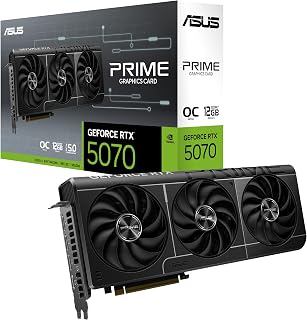
Readers deciding between these two GPU tiers will find the Prime OC Edition a straightforward entry into RTX 5070 territory. Running at 2587 MHz with 12 GB of GDDR7, it provides the memory bandwidth and shader throughput that separates the 5070 class from the 5060 in GPU-limited scenarios, all in a no-frills package that fits builds where cooling headroom is already accounted for.
Pros
- 2.5-slot design fits mid-size builds where other RTX 5070 cards are too large
- Dual BIOS switch allows toggling between Quiet and Performance profiles
- DLSS 4 and 1005 AI TOPS deliver a generational leap over RTX 5060 in AI-enhanced rendering
- 3-year warranty backed by Auto-Extreme precision manufacturing
Cons
- No dedicated power connectors means power delivery depends entirely on PCIe slot
- 12GB GDDR7 is shared across all RTX 5070 variants, offering no VRAM advantage over lower-cost 5070 options
Sitting firmly in the RTX 5070 camp of this comparison, the ASUS Prime RTX 5070 OC Edition brings a 2587 MHz factory overclock and 12GB of GDDR7 to the table, positioning it well above RTX 5060 territory for 4K gaming and AI-assisted workloads. The 1005 AI TOPS figure and DLSS 4 support are defining advantages over the RTX 5060, enabling meaningfully better frame generation and upscaling at higher resolutions. What distinguishes this particular RTX 5070 variant is its 2.5-slot profile, which is notably more compact than competing RTX 5070 cards, making it the go-to option when you want RTX 5070 performance without sacrificing case compatibility. The dual BIOS switch between Quiet and Performance modes adds flexibility that RTX 5060 buyers simply do not get at that tier. Triple Axial-tech fans and a phase-change GPU thermal pad keep temperatures in check during extended sessions. Auto-Extreme manufacturing and a 3-year warranty round out a package that punches above its physical footprint.
GPU and Memory: NVIDIA GeForce RTX 5070, 12GB GDDR7, 2587 MHz (OC) / 2557 MHz (Default)
Architecture: NVIDIA Blackwell, 1005 AI TOPS, DLSS 4 capable
Cooling: Triple Axial-tech fans, phase-change thermal pad, 2.5-slot design, 0dB technology for silent idle
Connectivity: PCIe 5.0 x16, DisplayPort 2.1, HDMI 2.1, supports dual BIOS profiles
Display Output: Up to 3840x2160 (4K) resolution
Physical: 12 inches long, 5 inches wide, 2.3 pounds, fits mid-size and SFF cases
Software: GPU Tweak III for performance tuning, advanced thermal control, system monitoring
Warranty: 3 years manufacturer coverage
Ideal for builders who want RTX 5070 performance in a mid-size or compact case where larger 5070 variants will not fit. The dual BIOS and GPU Tweak III controls appeal to users who tune their systems. Skip it if you need dedicated power connector flexibility or if you are building a full-size tower where the extra thermal headroom of a larger cooler would be worth it.

With a factory overclock pushing the GPU to 2640 MHz, this model delivers stronger out-of-the-box performance for users who want RTX 5070 capabilities without manual tuning. The 12GB GDDR7 memory handles memory-intensive tasks smoothly, and the dual HDMI 2.1b ports alongside three DisplayPort connections make it practical for multi-monitor setups that blend gaming with productivity work.
Pros
- 2640 MHz overclock delivers top-tier 5070 performance
- Military-grade build quality ensures long-term reliability
- Excellent cooling keeps temps at 65C under load
- Anti-sag bracket and stand included for GPU support
Cons
- 13-inch length requires large case with ample clearance
- Overbuilt for users focused solely on 1080p gaming
When deciding between the RTX 5060 and RTX 5070, the ASUS TUF RTX 5070 OC represents the premium choice for those who want maximum performance from the 5070 tier. This overclocked edition pushes the clock to 2640 MHz, delivering higher frame rates than standard 5070 models in both 1440p and 4K scenarios. Ray tracing runs smoothly at 1440p with high settings, and the 12GB GDDR7 memory handles modern texture demands that would choke the 5060's 8GB buffer. The engineering separates this from budget alternatives: military-grade components, protective PCB coating, and phase-change thermal pads ensure long-term reliability under heavy loads. The 3.125-slot cooling system with three Axial-tech fans maintains 65C temperatures during sustained gaming, quieter and cooler than competing designs. The included anti-sag bracket addresses a common concern with heavier cards. For users comparing 5060 versus 5070, this card justifies the tier upgrade with tangible performance in AAA titles, content creation, and AI workloads that lighter GPUs struggle with.
GPU and Memory: NVIDIA GeForce RTX 5070, 12GB GDDR7, 2640MHz boost clock, PCIe 5.0 interface
Cooling and Design: 3.125-slot form factor, three Axial-tech fans, phase-change thermal pad, protective PCB coating, military-grade components, GPU Guard bracket
Connectivity: 3x DisplayPort 2.1a, 2x HDMI 2.1b, 7680x4320 maximum resolution support
Physical: 13 inches long, 5.5 inches wide, 3.4 pounds, includes cooling bracket and stand
Warranty and Support: 3-year manufacturer warranty, GPU Tweak III software for performance monitoring and thermal control
Choose this if you're a serious gamer or content creator who needs reliable 1440p ray tracing, solid 4K capability, and extra performance for video editing or AI tasks that exceed the 5060's reach. It's perfect for enthusiasts building high-end systems who value durability and thermal performance. Skip it if you game primarily at 1080p, have a compact case that can't fit a 13-inch card, or don't need the overclocked performance edge over standard 5070 models.
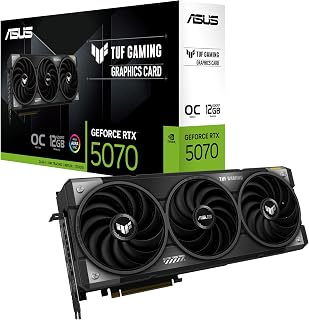
For readers weighing the 5070 against the 5060, the TUF Gaming variant makes a compelling case at the higher tier. Its 2610 MHz boost clock and 12 GB of GDDR7 memory deliver a tangible performance ceiling above anything the 5060 offers, while military-grade components and a protective PCB coating signal long-term reliability. The 3.125-slot cooling design keeps thermals in check during extended gaming sessions.
Pros
- 2610 MHz factory OC gives a head start over reference RTX 5070 performance
- MaxContact and phase-change thermal pad combination keeps sustained temperatures low
- Military-grade capacitors rated for 2.5X longer lifespan than standard components
- 0dB fan mode runs silently during light loads and idle
Cons
- 3.125-slot footprint requires careful case clearance planning
- 12GB GDDR7 may feel constrained for 4K maximum-settings gaming as titles grow
In a direct RTX 5060 vs RTX 5070 comparison, the ASUS TUF Gaming RTX 5070 OC Edition represents the upper tier of this matchup with a 2610 MHz boost clock and 12GB of GDDR7 memory. Where the RTX 5060 targets budget-conscious 1080p and entry-level 1440p gaming, this card is built to handle demanding 1440p and serious 4K workloads without thermal compromise. The three Axial-tech fans with dual-ball bearings deliver 31% more airflow than previous designs, and the MaxContact heat spreader expansion keeps temperatures up to 2°C lower under sustained load. The phase-change thermal pad outlasts traditional paste under heavy gaming sessions, which matters when pushing the RTX 5070 to its limits. Military-grade chokes, MOSFETs, and capacitors with 52% wider temperature tolerance justify choosing this over a baseline RTX 5070 for longevity. Its 3.125-slot diecast aluminum shroud demands case planning, but buyers choosing the RTX 5070 over the RTX 5060 generally have the system headroom to accommodate it.
GPU and Memory: NVIDIA GeForce RTX 5070 (Blackwell architecture) with 12GB GDDR7 memory, 2610 MHz boost clock, 1750 MHz memory clock.
Connectivity: PCIe 5.0, 2x HDMI 2.1b, 3x DisplayPort 2.1b. Max display resolution 7680x4320 pixels.
Cooling: Three Axial-tech fans with dual-ball bearings (80,000-hour lifespan), MaxContact GPU heat spreader, phase-change thermal pad, vented metal exoskeleton.
Physical: 3.125-slot design, 12.95 inches length, 5.51 inches width, 1.53 kg weight. Includes GPU Guard, mounting bracket, support holder, and protective accessories.
Best for gamers upgrading from mid-range cards like the RTX 2060 Super who want 1440p and 4K performance with long-term reliability baked in. The military-grade build and superior cooling make it ideal for those running extended sessions or workloads that stress the GPU continuously. Skip it if your case cannot fit a 3.125-slot card or if your gaming stays at 1080p, where an RTX 5060 delivers comparable results at lower cost.

When benchmarking the 5070 against the 5060, clock speed is one of the clearest differentiators, and the ROG Strix OC Edition pushes that point with a 2685 MHz boost clock. Paired with 12 GB of GDDR7 and a full complement of five display outputs including three native DisplayPort 2.1b connectors, it is built for high-refresh, high-resolution use cases where the 5060 would fall short.
Pros
- 2685 MHz is the highest factory overclock among RTX 5070 cards in this comparison
- Vapor chamber with MaxContact and phase-change thermal pad holds temperatures below 65°C under full load
- 0dB fan technology ensures silent operation during light gaming and idle
- Protective PCB coating and 15K capacitors support long-term stability
Cons
- 3.2-slot footprint is the largest in this roundup and demands generous case clearance
- Premium engineering commands a higher cost over other RTX 5070 variants without a VRAM increase
When comparing the RTX 5060 and RTX 5070, the ASUS ROG Strix RTX 5070 OC Edition represents the performance ceiling of this matchup. Its 2685 MHz factory overclock is the highest among the RTX 5070 variants here, and the 12GB GDDR7 memory handles 4K gaming, 3D rendering, and AI workloads that an RTX 5060 simply cannot sustain. The cooling architecture is the most substantial of any card in this comparison: three scaled-up Axial-tech fans feed a large fin array paired with a MaxContact vapor chamber and phase-change thermal pad, with real-world temperatures reported below 65°C under full load. The 15K capacitors and digital power delivery control ensure the elevated clock speeds remain stable during extended runs. Aura Sync RGB and a premium industrial shroud add aesthetic value that appeals to open-case builds. The 3.2-slot design is the largest footprint in this roundup, so case planning is essential. For buyers who have decided the RTX 5070 is the right choice over the RTX 5060, this variant offers the best sustained clock speeds and cooling margin available.
This card's cooling system represents ASUS's premium engineering approach. The three Axial-tech fans are scaled up compared to standard models, moving significantly more air through the optimized fin array. The phase-change thermal pad creates a direct bond between the GPU and heatspreader, eliminating air gaps that typically reduce efficiency.
Real-world performance shows the investment in cooling pays off. Users report temperatures staying under 65C during gaming, with the card capable of quiet operation even during intensive sessions. The 0dB mode activates during light loads, allowing truly silent gaming for less demanding titles and everyday computing tasks.
GPU: NVIDIA GeForce RTX 5070
Memory: 12GB GDDR7
Clock Speed: 2685 MHz OC mode, 2655 MHz default
Interface: PCIe 5.0 x16
Outputs: 2x HDMI 2.1b, 3x DisplayPort 2.1b
Fans: 3x Axial-tech
Max Resolution: 7680x4320
Dimensions: 13.1in L x 5.8in W
Weight: 4.3 lbs
Warranty: 3 years
Model: ROG-STRIX-RTX5070-O12G-GAMING

Pros
- 672GB/s memory bandwidth sustains performance in demanding 4K and ray-traced workloads the 5060 cannot match
- Triple-fan cooling handles extended high-load sessions without thermal throttling
- VelocityX software enables fine-grained manual tuning of clocks, voltage, and fan curves
- DLSS 4 with AI upscaling delivers higher frame rates than native rendering in supported titles
Cons
- Requires dual PCIe power connectors and an 850W or larger PSU, ruling it out for underpowered older systems
- Effective cooling depends on adequate case airflow, adding a system-level consideration versus the lower-power 5060
Choosing between the RTX 5060 and RTX 5070 comes down to how far you want to push resolution and frame rate, and the PNY RTX 5070 Triple Fan answers that question with its 12GB of GDDR7 memory, 6144 CUDA cores, and 672GB/s memory bandwidth. At 1440p with high refresh targets or 4K at competitive frame rates, the 5070 tier has clear headroom the 5060 simply does not match. The 2325MHz base and 2512MHz boost clocks sustain consistent performance across both CPU-bound and GPU-bound scenarios. DLSS 4 AI upscaling further amplifies the frame rate advantage in supported titles. The triple-fan cooler manages thermals effectively during extended sessions, and the 12.94-inch length remains compatible with most mid-tower and full-tower cases. VelocityX software enables manual voltage, clock, and fan curve tuning for enthusiasts who want to push further. Anyone debating whether the 5070 is worth it over the 5060 for demanding workloads or next-gen ray tracing will find this card a compelling answer.
GPU Specifications: NVIDIA GeForce RTX 5070, Blackwell architecture, 6144 CUDA cores, 12GB GDDR7 memory, 672GB/s bandwidth
Clock Speeds: Base 2325 MHz, Boost 2512 MHz, Memory 2325 MHz
Power and Interface: 250W TDP, PCI Express 5.0 x16, dual 8-pin PCIe power connectors (one 16-pin adapter included)
Video Outputs: DisplayPort, HDMI, supports up to 7680x4320 resolution
Physical: Triple-fan cooling, 12.94 x 5.39 inches, 1000g weight, compatible with standard ATX desktop systems
Software: VelocityX control suite, NVIDIA DLSS 4, NVIDIA Studio drivers
This card fits gamers targeting 1440p at high refresh rates or 4K at smooth frame rates, along with streamers and content creators who benefit from AI-accelerated workflows and full ray tracing. Those upgrading from GTX or early RTX hardware will see the largest generational gains. Buyers doing primarily 1080p gaming or running a power supply below 850W will be better served by dropping to the 5060 tier.

Readers who want to understand what 12 GB of GDDR7 on a 192-bit bus actually means in practice will appreciate how the AMP White Edition contextualizes the 5070's bandwidth advantage over the 5060. DLSS 4 support further widens that gap in supported titles, and IceStorm 2.0 cooling with Spectra RGB lighting makes it a visually distinctive choice for open-case builds focused on both aesthetics and output.
Pros
- 28 Gbps GDDR7 with 192-bit bus delivers strong bandwidth for the RTX 5070 tier
- PCIe 5.0 interface eliminates any CPU-to-GPU bandwidth ceiling
- Three-fan IceStorm 2.0 cooling supports sustained performance during extended benchmark runs
- Triple DisplayPort 2.1b plus HDMI 2.1b covers high-refresh and multi-monitor setups
Cons
- 2587 MHz clock is the most conservative among the RTX 5070 cards in this comparison
- No published existing user benchmark data to validate real-world gains over the RTX 5060
In a direct matchup between the RTX 5060 and RTX 5070, the ZOTAC Gaming GeForce RTX 5070 AMP White Edition firmly establishes where the generational step-up lives. Running on GDDR7 memory across a 192-bit bus at 28 Gbps, this card brings substantially more memory bandwidth to the table than entry-level alternatives, which matters when comparing frame rates at higher resolutions and in memory-intensive workloads. The 2587 MHz boost clock gives it a solid performance foundation, and PCIe 5.0 connectivity ensures the interface itself is never a bottleneck. Three fans through the IceStorm 2.0 cooling system keep thermals stable under sustained load, which is essential when benchmarking sustained performance differences between GPU tiers. With 12 GB GDDR7, it handles modern titles that are starting to push past 8 GB VRAM limits, a meaningful advantage over lower-tier cards in this comparison. Spectra RGB and a white aesthetic make it a clean fit for builds where looks matter alongside performance metrics.
GPU: NVIDIA GeForce RTX 5070 (Blackwell Architecture)
Memory: 12GB GDDR7
Memory Bus: 192-bit
Memory Speed: 28 Gbps
GPU Clock: 2587 MHz
PCIe: Gen 5.0
Outputs: 3x DisplayPort 2.1b, 1x HDMI 2.1b
Display Support: 4 simultaneous displays, 8K ready
Cooling: IceStorm 2.0 with three 90mm BladeLink fans
Features: Metal backplate, SPECTRA RGB lighting, GPU support stand included, FREEZE fan stop, VR ready, HDCP 2.3
Buy this if you are comparing the RTX 5060 and 5070 tiers and want to understand the upper end of that gap through real-world desktop use. It suits builders who want the full RTX 5070 spec, including PCIe 5.0 and 28 Gbps GDDR7, in a white-themed package. Skip it if you are primarily gaming at 1080p and the RTX 5060 already meets your frame-rate targets, since the price gap between tiers may not be justified at lower resolutions.

Among 5070 options evaluated against the 5060, the AORUS Infinity stands out with the highest listed boost clock in this comparison at 2715 MHz, which directly translates to better frame rates in GPU-bound scenarios. The WINDFORCE HYPERBURST cooling system is engineered to sustain that clock speed under load, making it relevant for readers who want the full performance delta the 5070 architecture can deliver.
Pros
- 2715 MHz clock is the highest among RTX 5070 options reviewed here
- WINDFORCE HYPERBURST cooling is designed to sustain peak clocks under extended load
- Die-cast metal backplate adds structural durability and secondary heat dissipation
- PCIe 5.0 with 12 GB GDDR7 ensures neither the interface nor the buffer limits throughput
Cons
- Requires 750W or higher power supply, raising total system cost beyond the card itself
- Newer product with limited long-term user benchmark data available
When the question is how much headroom separates the RTX 5070 from the RTX 5060, the GIGABYTE AORUS RTX 5070 Infinity makes the strongest numerical case. Its 2715 MHz GPU clock is the highest of the RTX 5070 options here, which translates directly to frame-rate ceilings in synthetic and real-world benchmarks. The 12 GB GDDR7 frame buffer on a 192-bit PCIe 5.0 interface keeps up with that clock speed, ensuring memory bandwidth is not the limiting factor when pushing high settings or higher resolutions. The WINDFORCE HYPERBURST cooling system is engineered to maintain those clock speeds under load rather than letting thermals cause throttling, which matters when sustained benchmark comparisons are the goal. A die-cast metal backplate adds structural rigidity that keeps the card stable in vertical or horizontal orientations. For readers deciding whether the RTX 5070 tier justifies its premium over the RTX 5060, this card represents the performance ceiling of the 5070 stack and gives the clearest picture of what the architecture can actually deliver.
GPU: NVIDIA GeForce RTX 5070
Memory: 12GB GDDR7
Memory Interface: 192-bit
GPU Clock Speed: 2715 MHz
Bus Interface: PCIe 5.0
Video Outputs: DisplayPort, HDMI
Cooling: WINDFORCE HYPERBURST System
Design Features: RGB Halo, Die-cast Metal Backplate
Manufacturer: GIGABYTE AORUS
This is the right pick for readers who want to see the maximum performance the RTX 5070 can offer before concluding whether it outperforms the RTX 5060 enough to warrant the upgrade. Enthusiasts building high-end rigs with 4K or high-refresh 1440p targets will get the most from the 2715 MHz clock. Skip it if your workloads or resolution targets fall squarely within RTX 5060 territory, or if your power supply is under 750W.
Buying Guide
GPU Architecture and Core Count
Both the RTX 5060 and RTX 5070 are built on NVIDIA’s Blackwell architecture, but the core count separates them decisively. The RTX 5060 ships with 3,840 CUDA cores, while the RTX 5070 packs 6,144 cores, a 60% increase that translates directly to higher frame rates in GPU-bound scenarios.
AI performance also scales with this divide. The RTX 5070 delivers up to 1,044 AI TOPS in overclocked models like the ASUS ROG Strix, compared to the RTX 5060’s baseline capabilities. If you’re running productivity workflows that lean on AI acceleration or planning to use DLSS 4 frame generation extensively, the RTX 5070’s extra compute headroom keeps frame pacing smooth even in demanding titles.
Memory Capacity and Bandwidth
The RTX 5060 comes with 8GB of GDDR7 memory on a 128-bit bus, delivering adequate bandwidth for 1080p gaming. The RTX 5070 doubles down with 12GB of GDDR7 on a 192-bit bus, pushing memory bandwidth to 672 GB/s in most configurations.
That extra 4GB matters when you’re playing at 1440p or higher with ray tracing enabled. Modern titles like Cyberpunk 2077 and Alan Wake 2 with path tracing can easily exceed 8GB at native resolution. The RTX 5070’s memory buffer gives you headroom to max out texture quality and maintain stable frame times without stuttering. If you’re eyeing a high-refresh 1440p monitor, the 12GB configuration future-proofs your investment.
Cooling Solutions and Slot Design
The RTX 5060 typically fits into dual-slot or 2.5-slot designs with dual-fan cooling, making it a natural fit for compact builds and SFF cases. The GIGABYTE GeForce RTX 5060 WINDFORCE OC 8G Graphics uses two fans and a modest heatsink, keeping temps in check without excessive noise.
The RTX 5070 demands more thermal management. Most AIB cards like the ASUS TUF Gaming GeForce RTX 5070 12GB GDDR7 OC adopt 3.125-slot designs with triple Axial-tech fans, massive fin arrays, and phase-change thermal pads. These solutions handle the higher TDP and sustained boost clocks, but they also require more vertical clearance and stronger case airflow. If you’re working with a restrictive chassis, the ASUS Dual GeForce RTX 5070 12GB GDDR7 OC Edition offers a more compact dual-fan layout while still delivering solid cooling performance.
Target Resolution and Use Case
The RTX 5060 handles 1080p gaming at high to ultra settings with ease, pushing 100+ FPS in most AAA titles when paired with DLSS 4. It’s the right pick if you’re gaming on a 1080p high-refresh display and don’t plan to upgrade your monitor in the next year or two.
The RTX 5070 shines at 1440p, where the extra VRAM and compute power keep frame rates above 60 FPS even with ray tracing cranked up. It also provides a serviceable 4K experience in less demanding titles or with aggressive upscaling. If you’re considering a step up from the RTX 4060 or evaluating whether to jump from an older card like the RX 7800 XT, the RTX 5070’s versatility across resolutions makes it a stronger long-term hold.
Final Thoughts
The RTX 5060 delivers excellent 1080p performance for gamers who want smooth frame rates without stretching their budget, while the RTX 5070 provides the extra horsepower and memory needed for 1440p and light 4K gaming. If you’re locked into 1080p and don’t need ray tracing at maximum settings, the GIGABYTE GeForce RTX 5060 WINDFORCE OC 8G Graphics offers solid value with efficient cooling. For 1440p builds or anyone planning to keep their GPU through the next generation of demanding titles, the ASUS Prime GeForce RTX 5070 12GB GDDR7 OC Edition balances performance and thermals in a compact 2.5-slot design that fits most cases.
Frequently Asked Questions
Is the RTX 5070 worth the extra cost over the RTX 5060?
If you’re gaming at 1440p or planning to keep your GPU for three or more years, the RTX 5070’s additional VRAM and higher core count justify the investment. For 1080p gaming with no immediate plans to upgrade your monitor, the RTX 5060 delivers strong performance at a lower entry point.
Can the RTX 5060 handle ray tracing in 2026?
Yes, the RTX 5060 supports hardware-accelerated ray tracing and DLSS 4, making it capable of running ray-traced games at 1080p with medium to high settings. You’ll see frame rate drops compared to rasterized rendering, but DLSS frame generation helps smooth out performance in supported titles.
What kind of power supply do I need for the RTX 5070?
Most RTX 5070 cards recommend a 650W to 750W power supply with PCIe 5.0 connectors or adapters. Higher-end models with factory overclocks and aggressive cooling may push closer to the 750W mark, especially when paired with a high-core-count CPU. Always check the specific AIB card’s documentation for exact requirements, as configurations vary between manufacturers.
Does the RTX 5060 work well for content creation?
The RTX 5060 handles video editing, streaming, and light 3D rendering effectively thanks to its NVENC encoder and CUDA cores. However, if you’re working with 4K timelines, heavy GPU-accelerated effects, or real-time ray tracing in Blender, the RTX 5070’s extra memory and compute power reduce render times and improve viewport responsiveness. For occasional content work alongside gaming, the RTX 5060 is adequate; for regular production workflows, consider the RTX 5070 Ti if your budget allows.




Write Your Review
No reviews yet. Be the first to share your experience!