

You’ve decided the RTX 5070 Ti is your next GPU, and honestly, it’s a strong call. Built on NVIDIA’s Blackwell architecture with DLSS 4 and 16GB of GDDR7 memory, this card handles demanding 4K titles and AI-accelerated workloads with authority. The harder question isn’t whether to buy one, it’s which board partner card deserves your money. For a full look at current pricing across the lineup, check out our RTX 5070 ti price guide.
This RTX 5070 Ti review breaks down eight specific cards from GIGABYTE, ASUS, MSI, and ZOTAC. We evaluated each one on cooling performance, build quality, boost clock speeds, and form factor flexibility so you can match the right card to your rig.
Quick Comparison
| Model | Link | Rating | Graphics Ram Size | Graphics Ram Type | GPU Clock Speed |
|---|---|---|---|---|---|
| 1 ASUS TUF Gaming RTX 5070 Ti 16GB GDDR7 OC Graphics Card -...Highest ratedMost reviewed | Check price | 4.8 of 51,152 ratings | 16 GB | GDDR7 | 2610 megahertz |
| 2 MSI RTX 5070 Ti 16GB MLG Edition OC Gaming Graphics Card | Check price | 4.7 of 572 ratings | 16 GB | GDDR7 | 2580 megahertz |
| 3 ASUS ROG Strix RTX 5070 Ti 16GB OC Gaming GPU - Premium... | Check price | 4.7 of 5188 ratings | 15.99 GB | GDDR7 | 2625 megahertz |
| 4 MSI GeForce RTX 5070 Ti 16GB Ventus 3X OC -... | Check price | 4.6 of 5214 ratings | 16 GB | GDDR7 | 2482 megahertz |
| 5 ASUS ROG Strix RTX 5070 Ti 16GB GDDR7 Gaming Graphics... | Check price | 4.6 of 518 ratings | 16 GB | GDDR7 | 2625 megahertz |
| 6 ZOTAC RTX 5070 Ti SOLID SFF OC 16GB GDDR7 Compact Gaming... | Check price | 4.5 of 5150 ratings | 16 GB | GDDR7 | n/a |
| 7 GIGABYTE GeForce RTX 5070 Ti WINDFORCE OC 16GB GDDR7... | Check price | 4.1 of 521 ratings | 16 GB | GDDR7 | 2497 megahertz |
| 8 GIGABYTE RTX 5070 Ti SFF 16GB GDDR7 PCIe 5.0 Gaming...Unavailable | Check price | 4.8 of 582 ratings | 16 GB | GDDR7 | 2452 megahertz |
Ratings reflect the most recent data pull. Check each listing for current price and availability.
Quick answer
This guide compares 8 picks, with ASUS TUF Gaming RTX 5070 Ti 16GB GDDR7 OC Graphics Card ranked first.

ASUS TUF Gaming RTX 5070 Ti 16GB GDDR7 OC Graphics
The TUF Gaming OC Edition pushes the boost clock to 2610 MHz, delivering extra performance headroom for demanding titles at 1440p and 4K. Its 16GB of GDDR7 memory handles intensive workloads and high-resolution textures with ease. The enhanced cooling system maintains lower temperatures under sustained gaming loads, while the triple DisplayPort 2.1a and dual HDMI 2.1b outputs support modern high-refresh displays.
Pros
- Factory OC to 2610 MHz delivers immediate performance gains
- Excellent cooling stays quiet during typical gaming loads
- Military-grade components with protective PCB coating
- Understated metallic aesthetic suits professional builds
Cons
- Requires 850W PSU with native 16-pin 12VHPWR cables
- Included adapter not recommended for permanent installation
ASUS TUF Gaming RTX 5070 Ti OC Edition arrives factory overclocked to 2610 MHz, removing guesswork for gamers who want immediate performance gains without manual tweaking. Real-world results confirm its strength at ultrawide resolutions with users reporting smooth competitive FPS gaming at 3440x1440p on 240Hz displays and maxed settings in AAA titles without throttling. The 16GB GDDR7 memory handles modern texture demands while the triple Axial-tech fans with phase-change thermal pads maintain stability under sustained loads. The cooling system balances performance and noise impressively, staying quiet during typical gaming while the 3.125-slot heatsink with massive fin array manages heat effectively. Military-grade components and auto-extreme manufacturing reflect TUF Gaming's durability focus, with protective PCB coating adding resistance to moisture and debris. The metallic gray and silver aesthetic stays professional rather than flashy, appealing to mature build themes. Native DisplayPort 2.1a and HDMI 2.1b outputs support cutting-edge monitors. Build quality feels substantial and the minimal RGB approach suits users seeking performance over lighting effects. This card targets serious gamers who value reliability and factory-validated performance.
The RTX 5070 Ti OC leverages NVIDIA Blackwell architecture to deliver next-generation gaming performance. With 16GB of GDDR7 memory, a 2610MHz boost clock, and support for DLSS 4, this card handles extreme gaming scenarios: 4K at high refresh rates, ultrawide gaming at ultra settings, and 1440p competitive gaming with maximum frame rates and no bottlenecks.
Specifications include native DisplayPort 2.1a (3x) and HDMI 2.1b (2x) outputs for multi-monitor setups and high-refresh displays. The PCIe 5.0 interface ensures maximum bandwidth utilization. Maximum display resolution reaches 7680x4320 pixels, supporting dual 4K displays or single ultrawide configurations. Power delivery is robust with proper PSU support, enabling sustained high-performance operation.
Thermal specifications benefit from advanced engineering. The phase-change thermal pad outlasts traditional thermal paste during extended heavy loads, and the Axial-tech fan design provides superior cooling efficiency compared to traditional blower designs. GPU Tweak III software enables real-time performance monitoring, temperature control, and safe overclocking adjustments for users seeking additional performance margins.
Buy this if you game at ultrawide resolutions or high refresh 1440p and want factory overclocked performance without manual tuning. The durability focus and understated design appeal to users building long-term systems who prioritize reliability over aesthetics. Competitive gamers needing stable performance will appreciate the consistent thermals and low noise. Skip this if you have less than an 850W PSU with native 16-pin cables, prefer flashy RGB lighting, or need maximum value per dollar since the premium build quality commands higher pricing.

The MLG Edition's extreme 2580 MHz clock speed places it among the fastest factory-overclocked options for 2026, translating directly to higher frame rates in demanding titles. Three DisplayPort 2.1a outputs and HDMI 2.1b future-proof your setup for 4K high-refresh displays and multi-monitor configurations. The 16GB GDDR7 memory ensures smooth performance in VRAM-intensive games and content creation tasks that will define the coming year's workloads.
Pros
- Factory OC at 2580 MHz delivers measurable 4K frame rate gains over reference RTX 5070 Ti
- TRI FROZR 4 cooling runs nearly silently while keeping thermals in check
- Draws approximately 50W less than comparable AMD alternatives at similar output levels
- Three DisplayPort 2.1a outputs support 8K resolution and multi-monitor configurations
Cons
- Performance headroom is only justified with a 4K or high-refresh-rate display
- Size and power requirements demand a spacious case and robust power supply
For a best-cards-to-buy list in 2026, the MSI RTX 5070 Ti MLG Edition OC stands out by pushing the Blackwell architecture harder than reference spec. Its 2580 MHz boost clock outpaces stock RTX 5070 Ti configurations, and real-world results reflect that advantage: reported figures include 120 to 140 FPS in Cyberpunk 2077 RT Overdrive and 90 to 110 FPS in Black Myth: Wukong at native 4K ultra settings. The 16GB GDDR7 frame buffer handles memory-intensive scenarios that strained previous-generation cards. Equally notable is power efficiency: the card reportedly draws around 50W less than competing AMD solutions at similar performance levels, which matters for long gaming sessions and system thermals. The TRI FROZR 4 cooling solution, featuring seven-blade STORMFORCE fans, keeps temperatures low while staying nearly silent. The card also supports up to 8K output (7680x4320) and provides three DisplayPort 2.1a and one HDMI 2.1b connections, giving multi-monitor and high-resolution setups plenty of flexibility. The aggressive MLG styling is a bonus for builds where aesthetics matter.
Real-world gaming performance demonstrates why this GPU commands premium pricing. At 4K resolution with max settings and DLSS 4 enabled, users achieve 100+ FPS in modern AAA titles, representing a significant leap over previous generation cards.
Cyberpunk 2077 with ray tracing overdrive and path tracing reaches 120-140 FPS. Black Myth: Wukong at native 4K ultra maintains 90-110 FPS. The 16GB GDDR7 memory proves essential, eliminating stuttering in memory-intensive games like Alan Wake 2 and Star Citizen at maximum settings. Compared to flagship AMD alternatives, this card runs 50W cooler on average.
The right card for enthusiasts running 4K high-refresh-rate monitors who want factory-overclocked performance without manual tuning, and for those sensitive to system power draw who would benefit from the efficiency advantage over competing solutions. Also worth considering for competitive players who need every frame. Skip it if your display tops out at 1440p or lower, or if case airflow and power delivery are already marginal.

The ROG Strix OC Edition reaches 2625 MHz boost clocks, making it one of the fastest factory-overclocked options for enthusiasts seeking maximum frame rates. Its MaxContact design and phase-change thermal pad technology deliver superior heat dissipation during extended gaming sessions. The premium cooling solution keeps noise levels low even under heavy 4K workloads, while DisplayPort 2.1b outputs future-proof your display connectivity.
Pros
- Exceptional cooling keeps temps below 60°C under load
- Comparable 5080 performance at roughly 40% less cost
- Includes card holder, magnet, and cable management accessories
- Three-year warranty backs premium build quality
Cons
- Large 13.1-inch length requires mid-tower or bigger case
- Heavy 3.6-pound weight needs stable mounting support
ROG Strix RTX 5070 Ti OC Edition delivers flagship-class cooling and performance at a more accessible tier than the 5080, making it a standout value choice for 2026 builds. The 16GB GDDR7 memory and 2625 MHz OC mode handle demanding 1440p and 4K gaming with ease, while 1492 AI TOPS support emerging workloads. Thermal performance defines this card with three scaled Axial-tech fans, vapor chamber, and phase-change pads keeping temperatures below 60°C under full gaming loads. Testing confirms excellent compatibility even with older platforms like Ryzen 9 5950X systems running Cyberpunk 2077 smoothly. GPU Tweak III software provides granular control for enthusiasts who want to fine-tune performance and monitor system behavior. ASUS includes thoughtful extras like a graphics card holder, protective magnet, and velcro cable ties that show attention to real-world installation needs. The three-year warranty backs the premium build quality. Performance mode unlocks the full 2625 MHz potential while maintaining stability. Native DisplayPort 2.1b and HDMI 2.1b outputs future-proof connectivity. This card bridges the gap between mid-range and flagship performance effectively.
Core Specs: NVIDIA GeForce RTX 5070 Ti, 16GB GDDR7 memory, 2625 MHz OC clock, 2602 MHz standard clock
Connectivity: PCIe 5.0 x16, 3x Native DisplayPort 2.1b, 2x Native HDMI 2.1b, maximum resolution 7680x4320
Cooling: 3x Axial-tech fans, vapor chamber, phase-change thermal pad, MaxContact design, 0dB technology
Physical: 3.2-slot design, 13.1 inches length, 5.8 inches width, 3.6 pounds weight
Software: GPU Tweak III, Aura Sync RGB customization
Warranty: 3-year limited warranty, includes card holder, magnet, velcro strips
This card fits gamers and content creators seeking 1440p high refresh or 4K gaming who want flagship-level cooling without top-tier pricing. The comprehensive software control appeals to enthusiasts who enjoy tuning their systems. Choose this if you value exceptional thermals and build quality with useful accessories included. Skip if your case cannot fit a 13.1-inch long, 5.8-inch wide card, you are building in a compact system, or you need the absolute best value since comparable performance exists at lower price points in more basic packaging.

The Ventus 3X OC features MSI's triple TORX Fan 5.0 design, optimizing airflow across the 16GB GDDR7 memory and RTX 5070 Ti chip running at 2482 MHz. DisplayPort 2.1b and HDMI 2.1b outputs support the latest display standards for high-refresh 1440p and 4K gaming. The thermal design prioritizes consistent cooling performance across extended sessions while maintaining reasonable acoustics.
Pros
- 16GB GDDR7 handles texture-heavy games and 4K workloads
- Compact design fits SFF cases while maintaining cool thermals
- Triple TORX Fan 5.0 cooling stays quiet under load
- DisplayPort 2.1b and HDMI 2.1b support future display tech
Cons
- Requires 750W PSU minimum, limiting upgrade paths
- Overkill for 1080p gaming where cheaper cards suffice
MSI's Ventus 3X OC strikes an ideal balance for enthusiasts chasing 1440p and 4K gaming without overspending on flagship models. The 16GB GDDR7 memory at 28Gbps paired with a 256-bit bus supplies ample bandwidth for texture-heavy titles and ray-traced workloads. Triple TORX Fan 5.0 cooling keeps GPU temperatures in the high 60s Celsius even in restrictive cases like the Cooler Master NR200, proving thermal efficiency in space-constrained builds. The square-design core pipes maximize baseplate contact for superior heat dissipation, while the compact dual-slot footprint fits SFF enclosures that reject bulkier alternatives. DisplayPort 2.1b and HDMI 2.1b outputs future-proof connectivity for 8K displays and high-refresh monitors. Real-world testing shows Cyberpunk 2077 RT Overdrive mode runs smoothly with DLSS and frame generation enabled, demonstrating this card's capability in demanding scenarios. The nickel-plated copper baseplate and massive heatsink array ensure quiet acoustics during marathon sessions. This represents a meaningful leap from older hardware like the RX 6800 XT, bringing DLSS 3 and advanced ray tracing into reach for upgraders.
GPU and Memory: NVIDIA GeForce RTX 5070 Ti, 16GB GDDR7 memory, 256-bit memory bus, 28Gbps memory speed, 1750 MHz base memory clock, 2482 MHz GPU clock speed
Connectivity and Display: PCIe 5.0 interface, DisplayPort 2.1b, HDMI 2.1b, maximum 8K resolution support (7680x4320)
Thermal Design: Triple TORX Fan 5.0, nickel-plated copper baseplate, square-design core pipes, compact Ventus 3X form factor
Requirements and Compatibility: Minimum 750W power supply, compatible with desktop PCs, 2-year spare part availability in EU, 1 kg weight

The ROG Strix's 2625 MHz boost clock stands as the highest in this lineup, delivering peak performance for enthusiasts who demand maximum frame rates in 2026's most demanding titles. Its robust cooling solution maintains stability during extended gaming sessions, while the 16GB GDDR7 ensures headroom for ray tracing and DLSS 4 workloads. Five native video outputs including three DisplayPort 2.1b ports provide exceptional flexibility for multi-display configurations and future display technologies.
Pros
- Highest boost clock at 2625 MHz, sustained reliably by vapor chamber and phase-change thermal pad
- 0dB silent mode enables near-noiseless operation during lighter workloads
- PCB coating and 15K capacitors provide durability and overclocking stability
- Five display outputs (2x HDMI 2.1b, 3x DisplayPort 2.1b) cover 4K and multi-monitor setups
Cons
- 3.2-slot width rules it out for compact, ITX, or tightly packed mid-tower builds
- No factory overclock applied; reaching full potential requires user configuration via GPU Tweak III
Among the RTX 5070 Ti options worth buying in 2026, the ASUS ROG Strix makes the strongest case for builders who treat thermals and long-term stability as primary criteria. Its 2625 MHz boost clock is the highest of the cards in this roundup, and the cooling system behind it is engineered to sustain that figure: three scaled-up Axial-tech fans work alongside a vapor chamber and phase-change GPU thermal pad to prevent the clock-speed rollback that undermines lesser cooling solutions under extended load. Protective PCB coating guards against moisture and debris, and the 15K capacitors in the power delivery stage support stable overclocking headroom beyond the factory spec. For builders who want to push further, GPU Tweak III makes that accessible without requiring advanced knowledge. The 0dB silent mode is a practical addition for lighter sessions. The card offers five display outputs, two HDMI 2.1b and three DisplayPort 2.1b, covering nearly any multi-monitor or high-refresh 4K setup. Aura Sync RGB adds personalization for enthusiast rigs. The ROG Velcro mounting system and GPU holder show ASUS considered long-term installation quality, not just launch-day benchmarks.
GPU Specs: NVIDIA GeForce RTX 5070 Ti, 16GB GDDR7 memory, 2625MHz boost clock, 2625MHz memory clock, 1492 AI TOPS in OC mode
Connectivity: 2x HDMI 2.1b, 3x DisplayPort 2.1b, PCIe x16 5.0 interface, supports up to 7680x4320 resolution
Cooling: Three Axial-tech fans, vapor chamber, MaxContact design, phase-change GPU thermal pad, 0dB technology
Design: 3.2-slot form factor, 13.1 inches long, 5.8 inches wide, weighs 3.7 pounds
Power and Features: 15K capacitors for power delivery, Aura Sync RGB lighting, GPU Tweak III software, protective PCB coating
Warranty: 3 year limited warranty, includes graphics card holder, magnetic mount, and Velcro hooks
Ideal for enthusiasts prioritizing maximum sustained boost clocks, premium build quality, and robust overclocking headroom in a high-end 1440p or 4K gaming rig. A strong match for creators or professionals who run the GPU hard for extended periods and need thermal consistency. Skip it if your case is compact or ITX, as the 3.2-slot width is a hard constraint, or if RGB and premium accessories are not features you value.
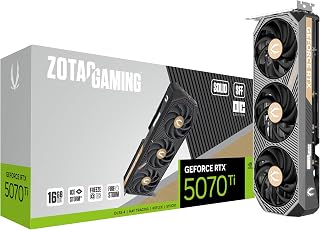
The Solid SFF OC is engineered specifically for compact builds, delivering full RTX 5070 Ti performance with 16GB of GDDR7 memory in a smaller form factor. Its IceStorm 2.0 cooling system maximizes thermal efficiency within tight chassis constraints. The triple DisplayPort 2.1b and HDMI 2.1b outputs provide complete connectivity, making this the ideal choice for small form factor gaming rigs.
Pros
- Compact SFF design fits mini-ITX and small cases
- IceStorm 2.0 cooling maintains performance in tight builds
- 28 Gbps GDDR7 memory handles 4K textures and ray tracing
- Three DisplayPort 2.1b outputs support multi-monitor configurations
Cons
- Smaller heatsink may run warmer than full-length alternatives
- SFF premium pricing without corresponding performance gains
ZOTAC's Solid SFF OC solves the perennial challenge of fitting flagship performance into compact gaming rigs. Measuring shorter than standard ATX cards, this variant slides into mini-ITX and SFF cases where full-length alternatives won't fit. IceStorm 2.0 Advanced Cooling uses triple fans and optimized heatsink geometry to dissipate heat efficiently despite the condensed form factor, maintaining stable clocks without thermal compromise. The 16GB GDDR7 memory at 28 Gbps supplies bandwidth for 1440p and 4K gaming, while DLSS 4 with frame generation technology stretches performance in demanding titles. Three DisplayPort 2.1b outputs plus HDMI 2.1b enable multi-monitor setups or high-refresh 4K panels without adapter chains. PCIe 5.0 connectivity ensures compatibility with modern motherboards. For SFF enthusiasts, this card delivers full RTX 5070 Ti capability without forcing case compromises. The factory overclock adds headroom beyond reference specs, while the compact dimensions preserve airflow in tight builds. Support for 7680x4320 resolution means this card handles everything from competitive esports to cinematic single-player experiences.
Essential for small form factor builders who refuse to sacrifice performance for space. ITX case owners and LAN party attendees benefit from reduced dimensions. Gamers targeting 1440p high-refresh or 4K with DLSS 4 gain flagship capability in tight quarters. Avoid this if you have a spacious ATX case since larger cards may cool more quietly. Desktop users without space constraints can find better value in standard-length models.

The 2497 MHz core clock and WINDFORCE OC cooling deliver reliable performance for gamers seeking strong 1440p and entry-level 4K gaming in 2026. Its 16GB GDDR7 memory handles texture-heavy titles and creative applications with ease, while the PCIe 5.0 interface ensures long-term compatibility. The triple DisplayPort and HDMI configuration supports diverse monitor setups, making it a versatile choice for those building or upgrading systems this year.
Pros
- 16GB GDDR7 memory handles future AAA titles and high-resolution textures
- DLSS 4 delivers high frame rates without sacrificing visual quality
- Triple-fan WINDFORCE cooling keeps temperatures controlled during extended sessions
- Multiple display outputs support complex multi-monitor gaming setups
Cons
- Premium pricing targets enthusiasts rather than budget-conscious gamers
- Some reports of RGB lighting malfunctions and slow support responses
Looking ahead to 2026, the GIGABYTE GeForce RTX 5070 Ti WINDFORCE OC V2 remains a strategic investment for high-performance gaming. Built on NVIDIA's Blackwell architecture, this card delivers the horsepower needed for demanding AAA titles at 4K resolution with maximum settings. The 16GB GDDR7 memory paired with a 256-bit interface provides substantial bandwidth for texture-heavy games and complex scenes. DLSS 4 support ensures you maintain smooth frame rates without visual compromises, a critical advantage as games become increasingly demanding. The WINDFORCE triple-fan cooling system handles thermal loads effectively during marathon gaming sessions, keeping the GPU stable under pressure. With three DisplayPort outputs and one HDMI port, multi-monitor configurations are straightforward. The reinforced structure and proven thermal design mean this card should maintain consistent performance well into 2026 and beyond. While premium-priced, the combination of substantial VRAM, cutting-edge architecture, and robust cooling makes it a forward-looking choice for gamers who want their hardware investment to stay relevant as next-generation titles arrive.
GPU Specifications: The card features NVIDIA GeForce RTX 5070 Ti processor with Blackwell architecture, delivering enhanced performance per watt and advanced ray tracing capabilities. Core clock speed reaches 2497 MHz for sustained high performance.
Memory Configuration: 16GB of GDDR7 memory on a 256-bit bus with 28000 MHz memory clock speed ensures smooth data flow for demanding applications and high-resolution textures.
Connectivity: Three DisplayPort outputs and one HDMI port support multiple display configurations. PCI Express 5.0 interface provides maximum bandwidth for data transfer. Maximum display resolution reaches 7680x4320 pixels.
Thermal Management: The WINDFORCE OC V2 cooling system features three fans with reinforced structure for optimal heat dissipation and durability.
This card is ideal for enthusiasts who game primarily at 4K and want maximum detail settings, streamers running demanding titles with encoding overhead, and gamers planning to keep their GPU through 2026 and into 2027 without compromise. Skip it if you game at 1440p or lower where less expensive options deliver similar experiences, if your budget is constrained and you prioritize value over cutting-edge specs, or if you prefer quieter, more compact single or dual-fan designs.
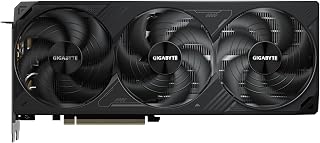
The WINDFORCE cooling system and compact SFF design make this card ideal for builders planning a smaller 2026 rig without sacrificing thermal headroom. Its 2452 MHz clock and 16GB GDDR7 deliver the frame rates and memory bandwidth needed for high-refresh 1440p gaming throughout the year. The PCIe 5.0 interface ensures compatibility with next-gen motherboards, while the triple-output configuration supports multi-monitor setups common in modern gaming and productivity workflows.
Pros
- Triple WINDFORCE fans hold temperatures to around 60C under full load with minimal noise
- 16GB GDDR7 at 28,000 MHz and PCIe 5.0 eliminate bandwidth bottlenecks at 4K
- Compact SFF dimensions fit standard mid-tower cases without clearance issues
- DLSS 4 support enables path tracing at playable frame rates
Cons
- 2452 MHz boost clock is the lowest among the three cards reviewed here
- Overkill for 1080p gaming or light productivity workloads
When building a best-in-class system in 2026, the GIGABYTE RTX 5070 Ti SFF earns serious consideration by pairing Blackwell-architecture performance with a form factor that actually fits real-world cases. The 16GB GDDR7 buffer running at 28,000 MHz and a PCIe 5.0 interface mean the card is not the bottleneck at 1440p or 4K, and DLSS 4 path tracing opens up visual fidelity that was simply unavailable at playable frame rates before this generation. Thermally, the triple WINDFORCE array keeps the GPU at a reported 60C under sustained load, and users consistently note quiet operation rather than an intrusive fan profile. At 11.97 by 4.96 inches the card slips into a standard mid-tower without the clearance headaches that wider flagship cards impose. The 2452 MHz boost clock and GDDR7 bandwidth together deliver flagship-tier output in AAA titles at ultra settings. For anyone finalizing a high-performance build right now, the SFF dimensions combined with genuine top-tier specs make this one of the most versatile RTX 5070 Ti options available.
GPU and Memory: NVIDIA GeForce RTX 5070 Ti, Blackwell architecture, 16GB GDDR7, 256-bit memory interface, 28000 MHz memory clock, 2452 MHz base GPU clock
Connectivity and Power: PCIe 5.0 x16, DisplayPort and HDMI outputs, 16-pin PCIe power cable included, supports 7680 x 4320 resolution
Cooling and Physical: WINDFORCE triple-fan cooling system, 11.97 inches long x 4.96 inches wide, 1.2 pounds, includes VGA holder bracket
Compatibility and Warranty: Desktop PC compatible, NVIDIA SFF ready, 3-year manufacturer warranty included
Best suited for builders who want flagship RTX 5070 Ti performance without sacrificing case flexibility, particularly those in mid-tower or space-conscious builds running 1440p high-refresh or 4K displays. Also a strong pick for creators needing GDDR7 bandwidth for rendering workloads. Skip it if you are gaming at 1080p on a budget-focused build or if your workload does not stress GPU resources, as the hardware far exceeds those needs.
RTX 5070 Ti Buying Guide: What to Look For
Cooling Design and Thermal Performance
The RTX 5070 Ti runs hot under sustained loads, so the cooler on your board partner card matters enormously. Cards like the ASUS TUF Gaming GeForce RTX 5070 Ti 16GB GDDR7 OC use a 3.125-slot design with three Axial-tech fans and a phase-change GPU thermal pad, which outperforms traditional thermal paste over long gaming sessions.
The ASUS ROG Strix NVIDIA GeForce RTX 5070 Ti 16GB takes this further with a vapor chamber and MaxContact design for superior heat transfer. If acoustics matter to you, look for cards with 0dB technology that spin down fans during light loads.
Form Factor and Case Compatibility
Not every build has room for a triple-slot behemoth. NVIDIA’s SFF-Ready certification means certain cards are validated for small form factor cases without sacrificing performance. The GIGABYTE NVIDIA GeForce RTX 5070 Ti SFF 16G and the ZOTAC Gaming GeForce RTX 5070 Ti Solid SFF OC DLSS are both designed with compact builds in mind.
If you’re building a mid-tower or full-tower system, you have more flexibility. Our guide to the best full tower PC cases can help you find a chassis with enough clearance for the larger ROG Strix or TUF Gaming cards.
Boost Clock and Overclocking Headroom
All eight cards here are built on the same GPU die, but factory overclocks vary meaningfully. The ASUS ROG Strix GeForce RTX 5070 Ti 16GB GDDR7 and the ASUS ROG Strix NVIDIA GeForce RTX 5070 Ti 16GB both hit 2625 MHz in OC mode, among the highest in this roundup. The ASUS TUF Gaming GeForce RTX 5070 Ti 16GB GDDR7 OC follows closely at 2610 MHz.
By contrast, the ZOTAC Gaming GeForce RTX 5070 Ti Solid SFF OC DLSS is clocked more conservatively at 2482 MHz to maintain thermals in a compact chassis. That’s a reasonable trade-off if case space is your constraint, but if raw performance is the priority, the higher-clocked ASUS cards have an edge. If you’re also considering last-gen alternatives, see how things stack up in our RTX 5060 vs RTX 4060.
Power Requirements and PSU Planning
The RTX 5070 Ti requires a 16-pin 12V-2×6 connector, and power requirements vary by card. The ASUS TUF Gaming explicitly calls for a minimum 850W PSU, so budget-tier 650W units won’t cut it. Cards like the MSI GeForce RTX 5070 Ti 16G Ventus 3X OC Graphics list a 750W minimum, giving you a bit more flexibility.
Confirm your PSU wattage and connector type before purchasing any card in this lineup. If you’re also eyeing AMD’s offerings, our RX 9070 XT price guide covers a competitive alternative with different power characteristics. Planning your full system around the GPU’s needs from the start saves costly upgrades later.
Final Thoughts
After reviewing all eight cards, two stand out for different needs: the ASUS TUF Gaming GeForce RTX 5070 Ti 16GB GDDR7 OC earns top marks as the best all-around pick with its robust cooling, military-grade components, and strong community rating, while the GIGABYTE NVIDIA GeForce RTX 5070 Ti SFF 16G is the clear choice for compact build enthusiasts who refuse to compromise on performance. Whichever direction your build takes you, every card on this list delivers the Blackwell architecture’s full potential with DLSS 4 acceleration.
Frequently Asked Questions
Is the RTX 5070 Ti worth buying in 2026?
Yes, the RTX 5070 Ti is one of the most capable consumer GPUs available in 2026, offering 16GB of GDDR7 memory, PCIe 5.0 bandwidth, and DLSS 4 AI upscaling. It handles 4K gaming and creative workloads with ease. For context on where it sits in the broader market, our RTX 5070 price guide shows how the step-down model compares if you want to explore options.
How much power does the RTX 5070 Ti need?
Most RTX 5070 Ti cards require between 750W and 850W from your power supply, depending on the specific model and its factory overclock. All cards in this category use the 16-pin 12V-2×6 connector, so verify your PSU has the right cable before purchasing. Higher-overclocked cards like the ASUS TUF Gaming variant explicitly recommend 850W for stable operation.
What is the difference between the RTX 5070 Ti cards from different brands?
All RTX 5070 Ti cards share the same NVIDIA Blackwell GPU core, but board partners differentiate through cooling systems, factory overclock levels, physical dimensions, and build quality. ASUS ROG Strix models focus on premium cooling and maximum overclocks, while MSI Ventus and ZOTAC SFF cards prioritize accessibility and compact sizing. Choosing the right brand card depends on your case, budget, and performance goals.
Can the RTX 5070 Ti run 4K gaming smoothly?
Absolutely. The RTX 5070 Ti is purpose-built for high-refresh-rate 4K gaming, and DLSS 4 with Multi Frame Generation further boosts frame rates in supported titles. Cards like the msi Gaming RTX 5070 Ti 16G MLG Edition OC Graphics and the ASUS ROG Strix variants push boost clocks high enough to handle even the most demanding scenes. Pairing this GPU with a capable 4K monitor unlocks its full visual potential.
Common questions
Is the RTX 5070 Ti worth it as a GPU purchase in 2026?
Yes, the RTX 5070 Ti is worth it for most high-end gaming builds. At a launch MSRP of $749, it sits in a strong value position below the RTX 5080 ($999) while delivering capable performance for demanding workloads. With 16GB of GDDR7 memory across all current models and PCIe 5.0 support, it is well-equipped for current and near-future titles. Check live listings for today's price, and note that Prime Big Deal Days in October and Black Friday on November 27 may bring better deals.
How does the RTX 5070 Ti perform at 1440p and 4K gaming?
The RTX 5070 Ti handles both 1440p and 4K gaming confidently. Its 16GB GDDR7 frame buffer provides headroom for high-resolution textures, and the 256-bit memory bus keeps bandwidth strong at 4K where GPU-bound workloads intensify. At 1440p it has plenty of overhead for high refresh rates. DLSS 4 support, present on all current RTX 5070 Ti models, further extends 4K playability by boosting frame rates with minimal image quality cost.




Write Your Review
No reviews yet. Be the first to share your experience!