

At 4K, a game can look spectacular yet still feel sluggish when a TV lacks variable refresh support or has limited high-bandwidth ports. The best 4k tv for gaming balances sharp detail with low-latency behavior, fluid motion, and HDR contrast that suits the room where you play.
We reviewed ten models with an emphasis on manufacturer-stated refresh rates, gaming features, panel technology, and everyday usability for console and PC players. If your game library needs faster loading alongside a new display, pair your setup with one of these external SSDs for gaming.
Quick answer
This guide compares 10 picks, with Roku 55" Select Series 4K QLED Smart TV with Voice ranked first. LG 55" OLED evo C4 4K Smart TV with AI Processor, 144Hz holds the highest customer rating among them. INSIGNIA 43 inch 4K Smart Fire TV with Alexa Voice has the most customer reviews.

Pros
- 4K QLED picture with HDR10 and HDR10+
- Simple Roku smart-TV interface
- Bluetooth headphone listening
- AirPlay 2 and voice-assistant support
Cons
- 60Hz refresh rate is not high refresh
- 330-nit maximum brightness
A gaming TV does not have to be complicated, and the Roku Select Series focuses on an easy route to 4K play alongside everyday streaming. Its 55-inch 4K QLED display supports HDR10, HDR10+, and HLG, while the high-contrast panel and Roku Smart Picture processing are designed to optimize incoming signals. Those attributes make it a sensible basic screen for players who also want a straightforward television for broadcast programs, films, and apps. The important qualification for this roundup is its 60Hz refresh rate. That places it outside the high-refresh class represented by faster gaming displays, so it is not the choice for buyers prioritizing the smoothest motion clarity. Its 330-nit maximum brightness is best suited to average rooms rather than very bright spaces. In return, the Roku interface keeps setup and daily navigation simple, with a clean Home Screen, voice remote with lost-remote finder, AirPlay 2, Bluetooth headphone listening, and Alexa, Google Assistant, and Siri integration. Choose it as a casual 4K gaming-and-streaming TV, not as a performance-focused high-refresh upgrade.
Display: 55-inch 4K UHD QLED, 16:9 aspect ratio, Direct LED backlight with local dimming, 330 nit peak brightness, 60Hz refresh rate
Picture Technology: HDR10, HDR10+, HLG support with Roku Smart Picture enhancement and motion optimization
Audio: Dual speakers optimized for speech clarity, Bluetooth 5.2 headphone connectivity, S/PDIF optical output
Connectivity: 4 HDMI ports, 2 USB ports (1x USB 2.0), Ethernet, Wi-Fi 6, Bluetooth 5.2, AirPlay 2, Miracast screen mirroring
Smart Features: Roku OS with 1000+ streaming apps, free live TV, voice remote with app shortcuts and remote finder, compatible with Alexa, Google Assistant, Siri
Physical: 48.3"W x 30.5"H x 12.7"D, 20.5 lbs with stand, 20.1 lbs without stand
Pros
- Outstanding motion handling with 165Hz native refresh rate keeps action fluid and crisp
- Exceptional brightness and contrast from Mini-LED backlighting with 3,000 dimming zones
- Anti-glare screen technology performs brilliantly in well-lit environments
- Competitive pricing for a premium Mini-LED TV with gaming-first features
- Comprehensive HDR support including Dolby Vision IQ and HDR10+ Adaptive
Cons
- Hisense is less familiar than Samsung or LG to some buyers, which may affect resale value
- 50-watt speaker system, while Dolby Atmos-equipped, may not match dedicated soundbar quality
- Weight of 37.5 pounds requires secure wall mounting or sturdy stand placement
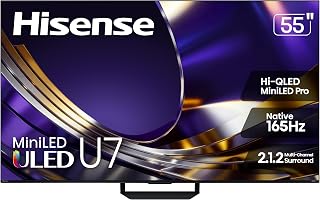
The Hisense U7 is a 55-inch 4K gaming TV built for speed and picture quality. It targets gamers, sports enthusiasts, and movie fans who want smooth motion, vibrant color, and bright, detailed images without spending $1,500 on a flagship set. The combination of 165Hz native refresh rate, Mini-LED backlighting, and AI-powered picture processing makes this TV stand out in the mid-premium segment.
Performance is where the U7 shines. The native 165Hz refresh rate handles fast-paced content without blur or stutter, while VRR 330 and Game Booster reduce input lag for competitive gaming. The Hi-QLED Mini-LED panel with 3,000 local dimming zones and 3,000 nits of peak brightness delivers stunning contrast, with bright areas that pop and dark areas that stay detailed. The Hi-View AI Engine Pro continuously adjusts color, contrast, and clarity, so content looks sharp whether you are streaming sports, playing games, or watching movies.
The anti-reflection coating is genuinely useful in bright rooms, cutting glare from windows and overhead lights without washing out the picture. The Devialet-tuned audio system with Dolby Atmos adds immersion for movies and games, though serious audiophiles may still want an external soundbar. Google TV with Gemini AI keeps navigation smooth and content discovery personalized across your favorite apps.
Potential drawbacks include Hisense's smaller brand presence compared to Samsung or LG, which could affect long-term support or resale. The 50-watt speaker system, while solid, is not a match for dedicated surround setups. At 37.5 pounds, wall mounting is strongly recommended for stability and aesthetics.
The Hisense U7 delivers genuine gaming performance and cinema-quality picture at a price that undercuts the competition. If you prioritize smooth motion, bright images, and responsive gameplay over brand prestige, this TV is a smart buy.
Native 165Hz refresh rate is the standout gaming feature, ensuring smooth, blur-free motion in competitive titles and fast-paced action films. Unlike TVs that interpolate motion, the U7 displays 165 true frames per second, eliminating artificial smoothing artifacts. VRR 330 and Game Booster 330 sync the TV to your console or PC, reducing input lag and tearing for responsive, fluid gameplay.
Black Frame Insertion and Motion Rate 480 enhance perceived smoothness even further. For esports players and action movie fans, this TV performs as well as gaming monitors at a fraction of the cost, all while delivering a large, immersive screen.
The Mini-LED panel with up to 3,000 local dimming zones provides pinpoint brightness control. Bright highlights stay vivid and intense even in well-lit rooms, while dark scenes retain depth and shadow detail. This full-array dimming approach is superior to edge-lit TVs and brings performance closer to OLED contrast at a lower price point.
Peak brightness of 3,000 nits ensures the TV remains visible in daylight and handles HDR content with authority. Pantone Validated Hi-QLED color ensures accuracy across all content types. The Hi-View AI Engine Pro runs continuously, analyzing each frame and making real-time adjustments for optimal color, contrast, and detail without over-processing.

Pros
- 144Hz refresh rate and 0.1ms response time
- Self-lit OLED pixels and very high contrast
- Dolby Vision, HDR10, and HLG support
- AI picture processing and upscaling
Cons
- Static game HUDs can raise burn-in concerns
- webOS may feel clunky to some users
High-refresh gaming is where the LG C4's specifications make the strongest case. The 55-inch 4K OLED evo panel pairs a 144Hz refresh rate with a 0.1ms response time, directly serving players who want smoother motion and rapid pixel response from a gaming TV. OLED's self-lit pixels deliver truly black blacks and a 1,000,000:1 contrast ratio, while Dolby Vision, HDR10, and HLG support broaden its HDR credentials. The a9 AI Processor 4K Gen7 handles picture processing and AI upscaling, so the set is positioned for more than dedicated game sessions. For this gaming-focused list, it is especially relevant to PlayStation 5, Xbox Series X, and PC players. OLED Motion provides additional motion enhancement, and the flat, ultra-thin-bezel design keeps attention on the screen. Buyers should weigh OLED-specific concerns before committing: static elements such as a game HUD displayed for long periods can raise burn-in concerns, although LG uses pixel shifting to mitigate that risk. The Magic Remote offers an alternative control style, but conventional arrow navigation remains available. This is a feature-led 4K choice for gamers who place panel response, contrast, and a 144Hz refresh rate ahead of a simpler streaming platform.
The C4 is genuinely one of the best gaming displays available at any price point. It offers 0.1ms response time, native 144Hz refresh rate, and full HDMI 2.1 support, which means you can run 4K gaming at high frame rates without compromises. NVIDIA G-Sync, AMD FreeSync Premium, and VRR eliminate screen tearing and stuttering.
Real-world testing shows PS5 and Xbox Series X games look phenomenal with HDR enabled. The Game Dashboard and Game Optimizer let you customize settings per console. Unlike traditional gaming monitors, you also get a full TV experience, making this versatile for both gaming marathons and everyday viewing. Many gamers have successfully replaced their monitors with this model.
You receive the 55-inch TV, Magic Remote (requires 2 AA batteries), wall mount hardware (VESA 300x200mm compatible), power cable, and documentation. Setup is straightforward: position the TV, connect power, run the webOS setup wizard, and connect to WiFi or ethernet. The Magic Remote pairs automatically during setup, though traditional IR remote functionality is always available as a fallback.
Important: LG recommends enabling pixel protection features if you plan to use the TV for office work or any static-content applications. Review burn-in prevention settings during initial setup to maximize long-term reliability.

Pros
- 4K Ultra LED resolution
- HDR10 and built-in upscaling
- Fire TV with Alexa voice remote
- DTS Virtual-X and HDMI eARC
Cons
- 60Hz refresh rate is not for competitive gaming
- 375-nit brightness trails higher-end options
Not every 4K gaming display in a roundup needs to chase high frame rates. The 43-inch INSIGNIA F50 is the compact, casual-play option, offering a 4K Ultra LED panel and a 60Hz refresh rate rather than the 120Hz or 144Hz performance that defines the faster choices here. That limitation makes it a poor match for competitive gaming, but it can serve players whose gaming shares a bedroom, secondary room, or streaming-first space. HDR10, high contrast, and a listed 375-nit maximum brightness shape its visual proposition, while built-in upscaling can improve lower-resolution material. Fire TV is integrated for streaming, and the Alexa voice remote provides voice control for searches and compatible smart-home devices. For sound, DTS Virtual-X is included, and HDMI eARC permits an external soundbar or speakers. The important distinction is straightforward: this television supplies 4K gaming, not high-refresh gaming. Movies, shows, and games limited to 60Hz align with its capabilities. Anyone choosing it for this article should value the smaller 43-inch format and smart-TV convenience more than the speed advantage available from the higher-refresh models.
Display: 43-inch 4K Ultra LED, 2160p resolution, 16:9 aspect ratio, 60Hz refresh rate, 375 nit brightness, HDR10 support
Audio: DTS Virtual-X immersive sound, optical audio input, 3.5mm headphone jack, HDMI eARC support
Connectivity: 3 HDMI ports, 1 USB 3.0 port, optical digital audio output, coaxial audio jack, Ethernet port, Wi-Fi 802.11 wireless, Bluetooth
Smart Features: Fire TV operating system with Alexa voice remote, access to Prime Video, Netflix, Disney+, Hulu, HBO Max, Fire TV Channels, Pluto TV, Tubi, and over 1 million free movies and episodes. Smart home hub with compatible device control, live camera feeds, and AirPlay support.
Mounting: VESA 200 x 300mm wall mount compatible, includes TV stand, dimensions 36.68 inches W x 23.6 inches H x 8.27 inches D
Warranty: 1-year manufacturer warranty. Model NS-43F501NA26.
Pros
- 4K 60Hz panel with Game Mode
- ALLM and VRR support
- Dolby Vision, HDR10+, and HLG
- AI 4K Upscaler and Fire TV
Cons
- Native refresh rate is limited to 60Hz
- 14-watt audio may benefit from a soundbar
Not every gaming setup needs a 120Hz panel, and the 43-inch Toshiba C350 is the compact 4K option for players whose priorities lean toward console convenience and picture processing instead. Its display refresh rate is 60Hz, so it cannot deliver the 120Hz gameplay sought by competitive or performance-focused players. Motion Rate 120 is included, but the panel itself is specified at 60Hz. For compatible gaming features, Game Mode provides Auto Low Latency Mode and Variable Refresh Rate. The REGZA Engine ZR, AI 4K Upscaler, and Super Contrast Booster shape its broader image proposition: 4K games can use its native UHD resolution, while lower-resolution material gets upscale processing. Dolby Vision, HDR10+, and HLG support give it support for three HDR formats. Fire TV keeps streaming and free or live TV within the same interface, while the Alexa voice remote offers voice navigation. This model makes sense as a 43-inch gaming screen where space matters and 60Hz is acceptable. Three HDMI ports support a modest collection of devices, though the limited number is worth planning around. Its 14-watt audio may also leave movie and gaming audio feeling lean without a soundbar.
Display: 43-inch LED 4K UHD, 16:9 aspect ratio, 60Hz refresh rate
Picture Technology: REGZA Engine ZR, AI 4K Upscaler, Super Contrast Booster, Ultimate Motion, Motion Rate 120
HDR Support: Dolby Vision, HDR 10 Plus, HLG
Audio: 14 watts with Dolby Atmos
Smart Features: Fire TV with Alexa voice remote
Connectivity: 3 HDMI, 2 USB ports, Wi-Fi, 3.5mm audio input
Gaming: ALLM, VRR, eARC support
Mounting: VESA 400x400mm, table mount and wall mount compatible
Dimensions: 37.9"W x 23.9"H x 8.9"D
Warranty: 1 year

Pros
- Mini LED backlighting
- HDR10+ support and high contrast
- Gaming Hub aggregates console and cloud titles
- Three HDMI ports, USB, and Bluetooth 5.3
Cons
- Supplied specifications list a 60Hz refresh rate
- Software dimming rather than full-array hardware dimming
The 43-inch Samsung M70H is the Mini LED choice for a compact 4K gaming space, but it needs a clear qualifier in a high-refresh-TV roundup: the supplied specifications list a 60Hz refresh rate. That makes it a better match for casual 4K play than for someone shopping specifically for native 120Hz performance. Motion Xcelerator Turbo+ and Gaming Hub remain gaming-oriented features, with the latter collecting titles from consoles and cloud services in one location. Mini LED backlighting is the central visual feature, supported by HDR10+ and high contrast. Samsung's supplied description also credits its Mini LED processing and Pure Color Spectrum technology with strong color, brightness, and contrast. The glossy screen finish can maximize brightness, though it can show reflections in a bright room. Connection options include three HDMI ports, USB, and Bluetooth 5.3, giving compact setups room for consoles and other devices. For this category, the M70H's appeal is picture quality and gaming organization rather than refresh-rate leadership. Its software-based Supreme Mini LED dimming is another compromise compared with full-array hardware dimming. Choose it for 43-inch Mini LED 4K viewing with gaming features, not as the article's strongest option for high-frame-rate play.
Display: 43-inch 4K LED with Mini LED backlight, 16:9 aspect ratio, 60Hz refresh rate, glossy finish
Picture Quality: Mini LED Processor 4K, Pure Color Spectrum (1 billion colors), HDR10+, Supreme Mini LED Dimming, Motion Xcelerator Turbo+, Color Booster
Smart Features: Samsung TV Plus (2,700+ free channels), Gaming Hub, Soccer Mode, Knox Security, SmartThings integration
Connectivity: 3 HDMI ports, 1 USB 3.0 port, Wi-Fi, Bluetooth 5.3, Ethernet compatible
Dimensions: 37.7W x 24H x 6.2D inches (with stand), 14.8 lbs
Warranty: 1 Year Manufacturer
Pros
- 4K panel with 120Hz refresh rate
- Mini LED picture enhancement
- HDR10+ and 1,000-nit maximum brightness
- Gaming Hub plus three HDMI ports
Cons
- Software-based rather than full-array dimming
- 120Hz mode requires manual optimization and may reduce sharpness
High-refresh gaming is the reason to consider the 55-inch Samsung M70H. Its 4K panel can run at 120Hz, and Motion Xcelerator Turbo+ is built to make quick on-screen movement look smoother. That combination places it more naturally with games featuring fast camera pans or frequent action than a standard 60Hz set. Mini LED picture enhancement, HDR10+ support, high contrast, and a specified peak brightness of 1,000 nits round out the visual case, while the glossy screen favors brightness but can reveal reflections in a bright room. Gaming Hub organizes titles from multiple platforms, which helps keep a console-and-streaming setup tidy. Three HDMI ports, USB, Bluetooth 5.3, and Wi-Fi provide the listed connection options for peripherals and entertainment gear. There is a tradeoff to understand before choosing it: its dimming is software based rather than full-array hardware dimming. Samsung also notes that the 120Hz setting requires manual optimization and can exchange some sharpness for smoother motion. For gamers who want a 55-inch 4K screen with a 120Hz specification and Mini LED features, those limitations are more important than the TV's smart extras.
Display: 55-inch 4K LED with Mini LED backlighting, 1000-nit peak brightness, 16:9 aspect ratio, glossy finish
Refresh Rate: 60Hz native, 120Hz with Motion Xcelerator Turbo+ (reduces sharpness)
Color & HDR: Pure Color Spectrum with 1 billion colors, HDR10+ support, Mini LED HDR, Color Booster technology
Audio & Input: 3x HDMI ports, 1x USB 3.0, Bluetooth 5.3, Wi-Fi, Ethernet connector
Dimensions & Weight: 48.2W x 29.9H x 7.8D inches, 22.5 lbs with stand, 21.8 lbs without stand
Mounting: Wall mount compatible (VESA 200x200mm), includes stand and remote
Software: Samsung Smart TV OS with Knox Security, requires Samsung Account for online features
Buy it if your gaming setup benefits from a 55-inch 4K display, 120Hz capability, and Mini LED picture enhancement, especially if you also want Gaming Hub, HDR10+, and several ways to connect devices. It suits players willing to adjust settings to favor smoother motion. Skip it if reflections are a major issue in your room, if you specifically require full-array hardware dimming, or if you do not want the 120Hz mode's stated sharpness-versus-fluidity compromise. Players content with 60Hz do not need its main gaming advantage.

Pros
- 4K 144Hz gaming on certain HDMI ports
- QLED display with broad HDR support
- Motion Rate 480 with MEMC Frame Insertion
- Google TV, voice control, and immersive audio formats
Cons
- Glossy panel can show reflections
- Not every HDMI port supports 4K at 144Hz
At 55 inches, the TCL T7 targets the player who wants high-refresh 4K gaming without stepping up to an oversized screen. Its supplied specifications list a 120Hz native refresh rate, while the product description identifies 144Hz gaming and Game Accelerator 240. Either way, the emphasis is on smoother fast action than conventional 60Hz sets, placing it squarely in this gaming-oriented group. The 4K QLED display supports Dolby Vision, HDR10, HDR10+, HLG, and Open HDR, giving it unusually broad stated HDR compatibility. Enhanced QLED color, Direct LED backlighting, and the listed QD-Mini LED picture enhancement are joined by Motion Rate 480 with MEMC Frame Insertion for motion processing. TCL’s AIPQ Pro processor is described as adjusting color and contrast scene by scene, which benefits games as well as movies, sports, and streaming. For players who use the TV for everything, the Google TV interface and voice control help with content access. Dolby Atmos, DTS:X, and DTS Virtual:X provide the stated audio formats. Gamers should note that only certain HDMI ports support 144Hz at 4K, so connection choice matters. The glossy panel can also show room reflections, an important consideration in bright setups.
The 144Hz refresh rate with Game Accelerator 240 sets the T7 apart from typical smart TVs. Console gamers benefit from smooth frame rates and minimal input lag, creating a more responsive feel during competitive play. Auto Game Mode automatically switches settings for optimal performance when a gaming console is detected.
The Motion Rate 480 with MEMC frame insertion further enhances motion clarity, reducing blur during fast camera pans and quick scene transitions. Note that 144Hz support is limited to specific HDMI ports, so verify your connections before setup. For esports and fast-paced titles, this TV performs exceptionally well at its price tier.

Pros
- Exceptional picture quality with rich QLED colors and high contrast that rivals much more expensive TVs
- Superb gaming and sports performance thanks to 144Hz native refresh rate and responsive input lag
- Excellent built-in audio with dedicated subwoofer delivers immersive sound without external speakers
- Massive 85-inch screen at an affordable price makes this outstanding value for large living spaces
- Easy setup and intuitive Fire TV interface for quick access to streaming services
Cons
- Fire TV platform has performance issues including slow app loading and occasional freezing when paused
- Voice activation can conflict with other Alexa devices in the same room, though it can be disabled
- Some users report the TV powers down after brief inactivity, creating interruptions during viewing
The TCL 85-inch QM64L is a massive 4K smart TV designed for anyone seeking theater-quality entertainment without spending on premium brands. It combines QD-Mini LED picture technology, gaming-focused features, and integrated surround sound to deliver a complete home entertainment solution out of the box. This is ideal for gamers, sports fans, and movie enthusiasts who prioritize performance over brand prestige.
The standout feature is the picture quality, powered by 500 local dimming zones that precisely control brightness across the screen. This QD-Mini LED approach delivers deep blacks and bright highlights simultaneously, creating contrast that competes with significantly more expensive displays. The 144Hz native refresh rate with Game Accelerator makes fast-moving content, especially gaming and sports, appear fluid and responsive. HDR10, HDR10+, and Dolby Vision support ensure movies and shows look detailed and vibrant.
The built-in Onkyo 2.1 audio system with a 20W subwoofer is genuinely impressive for a TV speaker setup. Paired with Dolby Atmos and DTS processing, this audio delivers clear dialogue and impactful bass that makes soundbars optional rather than mandatory. The bezel-less design maximizes screen real estate, making the 85-inch panel feel even more immersive in a living room.
The main drawback is the Fire TV interface, which several reviewers report as sluggish, unintuitive, and prone to freezing. Additionally, the TV's power management and voice activation features can create frustrating interruptions. These software-related issues don't affect picture or gaming quality, but they do impact daily usability.
The TCL QM64L 85-inch is a compelling choice for shoppers wanting big-screen entertainment with excellent picture and gaming performance at a reasonable price. The built-in audio and Fire TV integration make it a complete package, though potential buyers should be aware of the software limitations mentioned by users.
Display Technology: QD-Mini LED, 500 local dimming zones, 4K resolution, 144Hz native refresh rate, 85-inch bezel-less flat screen
Picture Quality: QD-Mini LED contrast, High HDR brightness, Enhanced QLED color up to 1.07 billion colors, Motion Rate 480, HDR10, HDR10+, Dolby Vision, HLG support, TCL AiPQ Pro processor
Gaming and Sports: Native 144Hz, Game Accelerator 288, VRR, ALLM, suitable for 144Hz gaming and high-motion content
Audio: Onkyo 2.1 system with dedicated 20W subwoofer, Dolby Atmos, DTS
Smart Features: Fire TV platform, Alexa+ voice control, support for Netflix, Disney+, Hulu, Prime Video, Apple TV
Connectivity: 4 HDMI 2.1 ports, 2 USB ports (1x USB 2.0, 1x USB 3.0), Wi-Fi, Bluetooth, Ethernet
Dimensions: 74.4 inches wide, 45.7 inches tall, 14.6 inches deep (without stand)
Warranty: 1-year manufacturer limited warranty
Gaming and Sports Enthusiasts: The 144Hz native refresh rate and Game Accelerator make this TV excellent for console gaming, PC gaming, and live sports viewing. Motion clarity and responsiveness are priorities for this audience.
Home Theater Fans: The QD-Mini LED contrast, HDR support, and built-in Onkyo surround sound deliver a premium cinematic experience without requiring expensive external components.
Budget-Conscious Big-Screen Buyers: At this price point, the 85-inch QM64L offers picture quality that rivals TVs costing significantly more, making it ideal for shoppers who want size and performance without flagship pricing.
Streamers and Content Creators: The Fire TV platform provides quick access to major streaming services, and the large bright screen showcases 4K content beautifully across different viewing conditions.
Bright Room Environments: High HDR brightness means this TV maintains vivid colors and detail even with windows open or lights on, making it suitable for family rooms and living areas with natural light.

Pros
- 4K panel with 144Hz refresh rate
- 3,000-nit listed maximum brightness
- SQD Mini-LED with LD2100 Precise Dimming
- Bang & Olufsen audio with wireless expansion
Cons
- Glossy screen can reflect room lighting
- Large 36-pound size requires planned placement
A large-screen gaming setup needs both speed and enough brightness to hold up outside a darkened room, and the TCL 75QM7L is built around those two demands. Its 4K SQD Mini-LED QLED panel pairs a 144Hz refresh rate with TCL Game Pack motion technology, giving this 75-inch set a clear place among high-refresh gaming TVs. The stated 3,000-nit maximum brightness is another meaningful advantage for daytime play and HDR material, while LD2100 Precise Dimming is designed to support high contrast, deep blacks, and smoother gradations. TCL also lists Super QLED processing, an UltraColor Filter, Advanced Color Purity Algorithm, and an AI Processor to reinforce color and picture processing. The scale is central to its appeal: a 75-inch screen can make multiplayer, open-world environments, and cinematic single-player games feel more expansive. HDR10 support rounds out the core format support. Its glossy finish is the key caveat for a bright room, even though the existing description notes an anti-reflective HVA 2.0 Pro panel. Built-in Bang & Olufsen audio and optional wireless speaker expansion add useful home-theater flexibility, but the 144Hz 4K panel is the reason it belongs in this gaming-focused lineup.
Display and Resolution - 75-inch 4K QLED with SQD Mini-LED backlight, 16:9 aspect ratio, 144Hz native refresh rate, 3000 nit peak brightness.
Picture Technology - LD2100 Precise Dimming with 2100+ local dimming zones, TCL Ultra Color Filter with 5nm particles, HVA 2.0 Pro anti-reflective panel, AIPQ Pro AI processor, Complete HDR support including HDR10.
Gaming Features - TCL Game Pack with 288 VRR, Game Bar, AMD FreeSync Premium Pro, Game Mode, low-latency processing for responsive gameplay.
Audio - Built-in speakers by Bang and Olufsen with Dolby Atmos FlexConnect, expandable with wireless subwoofer and satellite speakers, digital audio output.
Smart Features - Google Gemini Interactive AI, voice control, app control, ambient light sensor, wide viewing angles, bezel-less design.
Physical - Dimensions 65.6W x 39.2H x 14.5D inches, 36 pounds, wall mount compatible, includes remote, stand, power cable, and 1-year manufacturer warranty.
Buy it if a 75-inch screen, 4K 144Hz gaming, strong brightness, and Mini-LED contrast are priorities for a living-room or dedicated gaming space. It is especially relevant for players who mix fast games with HDR movies and want more capable built-in audio with an upgrade path to wireless speakers. Skip it if 60Hz play is sufficient, a smaller screen suits the room better, or reflections from a glossy screen would be a persistent concern. Its 36-pound size also calls for planned placement.
How to Choose a 4K Gaming TV
Start with the hardware you use most and the distance from your seating to the screen. A living-room TV does not need every desktop-display feature, but its ports, motion handling, and panel type should match your games and environment.
HDMI 2.1, VRR, and ALLM Support
HDMI 2.1 is important if you want a compatible console or PC to deliver 4K at 120Hz. Check how many high-bandwidth inputs are available, especially when your setup includes more than one console, a gaming PC, and an eARC soundbar.
VRR helps prevent screen tearing by matching the display refresh to the game output, while ALLM can switch the TV into its low-latency mode automatically. The LG 55-Inch Class OLED evo C4 Series Smart TV 4K lists four HDMI 2.1 inputs, and a 4K 240Hz monitor guide can help PC players decide whether a television or desk display fits their habits better.
Native Refresh Rate and Motion Clarity
A native 120Hz panel is an excellent baseline for console play because it can show compatible high-frame-rate modes smoothly. Higher refresh ceilings can benefit PC gaming, but the game and connected hardware must also produce enough frames to take advantage of them.
The LG C4 supports up to 144Hz, while the Hisense 55-inch U7 Mini-LED model lists a native 165Hz refresh rate. For mouse-and-keyboard esports where frame rate has priority over screen size, compare dedicated 500Hz gaming monitors and our picks for the best monitors for competitive FPS gaming.
Panel Type, HDR, and Your Room Lighting
OLED is compelling for dark-room gaming because self-lit pixels create remarkably deep blacks and precise shadow detail. Mini LED models are often the stronger choice in bright rooms, where high light output and local dimming help highlights remain visible against daylight.
QLED adds a wide color range, making animated worlds and HDR scenery look especially vivid. The TCL 75 Inch Class QM7L Series combines SQD-Mini LED technology, an anti-reflective panel, and up to 2,100 local dimming zones, while the Hisense U7 emphasizes high brightness and glare reduction for daytime play.
Screen Size, Seating Distance, and Smart Platform
Screen size changes how immersive a game feels, but a larger panel is only useful if your room gives it enough viewing distance. A 43-inch model can suit a bedroom, dorm, or compact gaming station, while 55-inch, 75-inch, and 85-inch TVs make stronger sense for shared living rooms.
Also consider the interface you will use every day, whether that is Fire TV, Google TV, Roku TV, webOS, or Samsung’s platform. If you game at a desk instead of from a couch, these 32-inch 4K monitor options offer a more focused alternative with a closer viewing position.
Final Thoughts
For premium dark-room gaming, the LG 55-Inch Class OLED evo C4 Series Smart TV 4K delivers exceptional contrast, four HDMI 2.1 inputs, and up to 144Hz motion. For a bright, expansive shared space, the TCL 85" QM64L High Contrast QD-MINI-LED 4K AI is a compelling fit with its large screen, Mini LED backlight, VRR, and native 144Hz capability.
Frequently Asked Questions
What refresh rate should a 4K gaming TV have in 2026?
A native 120Hz panel is the practical target for most current console players because it supports compatible 4K 120Hz modes. A 144Hz or 165Hz TV can add flexibility for gaming PCs. Prioritize VRR and a responsive game mode alongside the panel refresh figure.
Do PS5 and Xbox consoles need HDMI 2.1 for 4K gaming?
You can still play in 4K at 60Hz without HDMI 2.1. However, HDMI 2.1 is the connection standard that enables compatible 4K 120Hz gameplay, VRR, and other advanced gaming features. Verify the TV input specifications rather than assuming every HDMI port provides the same capability.
Is OLED, QLED, or Mini LED better for gaming?
OLED is ideal when deep blacks, precise contrast, and fast pixel response matter most in a darker room. Mini LED is often better for bright spaces because it can deliver stronger HDR highlights and effective local dimming. QLED models provide bold color and can offer a strong balance for mixed gaming and streaming use.
Can a 43-inch 4K TV work well for PC gaming?
Yes, a 43-inch 4K TV can work well if you have a deep desk or can sit far enough back to view the entire panel comfortably. Look for a game mode, VRR, and text clarity that suits work as well as play. If you prefer a smaller and more traditional desktop setup, compare these budget 1440p monitors before choosing a large television.






Write Your Review
No reviews yet. Be the first to share your experience!