

You have a high-end motherboard with a PCIe 5.0 slot sitting idle, and your current Gen 4 drive is starting to feel like a bottleneck. Whether you are rendering 8K footage, loading massive open-world games, or running local AI models, a Gen 5 NVMe SSD can cut transfer times nearly in half compared to the previous generation. The jump from Gen 4 to Gen 5 is not incremental; it is a fundamental shift in what desktop storage can do.
This guide is for builders, gamers, and creative professionals who want the absolute fastest internal storage available right now. If you are also putting together a high-performance rig, check out our roundup of the best PC cases for RTX 5090 builds to pair your new drive with a worthy chassis. Below you will find ten of the strongest Gen 5 NVMe options on the market, followed by a practical buying guide and answers to the most common questions.
Quick answer
This guide compares 10 picks, with fanxiang S910 1TB PCIe 5.0 NVMe SSD, 14000 MB/s Read ranked first. Samsung 990 EVO Plus 1TB NVMe SSD PCIe 4.0 Gen 4x4 M.2 holds the highest customer rating among them.

The 14,000 MB/s read speed puts this drive squarely in Gen 5 territory, delivering the raw throughput needed for peak performance in 2026. Hardware encryption protects sensitive data without sacrificing speed, while backward compatibility with PCIe 4.0 systems ensures flexibility across desktop and laptop configurations. TRIM support maintains consistent performance over time, critical for users who demand sustained high-speed transfers and minimal degradation during intensive workloads.
Pros
- Verified 12,000-14,000MB/s speeds in real-world testing
- Dynamic thermal control prevents throttling under load
- 750 TBW endurance and hardware encryption included
- Lightweight 9g design with installation kit provided
Cons
- No DRAM cache impacts some random access workloads
- Full Gen 5 speeds require compatible motherboard
The fanxiang S910 brings legitimate Gen 5 speed to builders who want future-proof performance without flagship pricing. Real-world testing confirms this 1TB drive consistently delivers 12,000 to 14,000MB/s, matching the PCIe 5.0 specification's 64 GT/s bandwidth and doubling what Gen 4 offers. That translates directly into faster game installs, quicker project loads for video editors working with 8K footage, and reduced wait times when processing AI training datasets. The intelligent thermal algorithm actively monitors NAND temperature and adjusts cooling dynamically, which users report keeps the drive stable even during extended rendering sessions or marathon gaming. Hardware AES-256 encryption and LDPC error correction protect data integrity, while 750 TBW write endurance ensures years of heavy use won't degrade performance. At just 9 grams in standard M.2 2280 format, installation is straightforward with the included screwdriver and guide. The drive maintains backward compatibility with Gen 4 and Gen 3 slots, though speeds drop accordingly. Where this drive makes tradeoffs is the absence of DRAM cache, which can slightly affect random access patterns compared to pricier competitors, but sequential workloads see negligible impact.
Storage Capacity: 1TB
Interface: PCIe 4.0 (M.2 NVMe)
Form Factor: M.2 2280
Sequential Read Speed: Up to 14,000 MB/s
Data Transfer Rate: 14,000 MB/s
Cache Memory: 1TB
Write Endurance: 750 TBW
Connectivity: PCIe x4
Weight: 9g
Security Features: AES-256 hardware encryption, LDPC error correction, RAID-like redundancy
Compatibility: Desktop, Laptop, PCIe 5.0, PCIe 4.0, PCIe 3.0 (backward compatible)
Special Features: Backward compatible, hardware encryption, TRIM support, dynamic thermal control
Warranty: 5-year manufacturer warranty
Included Accessories: Quick start guide, screwdriver kit
Ideal for content creators handling 8K video, gamers upgrading to Gen 5 platforms, or anyone running storage-intensive AI workloads who wants current-generation speed without overspending. The balanced approach to performance and value makes sense for builders prioritizing practical gains. Skip it if you need absolute peak random IOPS for database work or if your system still runs Gen 4, where cheaper alternatives deliver similar real-world results.

Samsung 990 EVO Plus 1TB NVMe SSD PCIe 4.0 Gen 4x4
Pros
- 7,150 MB/s read speed pushes Gen 4 performance limits
- 73% efficiency improvement reduces heat and power draw
- Intelligent TurboWrite 2.0 handles large file transfers smoothly
- Gen 5 forward compatibility extends upgrade lifespan
Cons
- Requires PCIe 4.0 or newer to unlock full performance
- Premium positioning may exceed budget for casual users
For a 2026 roundup focused on Gen 5 speed, the Samsung 990 EVO Plus occupies an interesting position as a Gen 4x4 and 5x2 hybrid drive. It delivers 7,150 MB/s reads and 6,300 MB/s writes, pushing the upper boundary of what PCIe 4.0 can achieve while maintaining forward compatibility with Gen 5 slots. The Intelligent TurboWrite 2.0 technology accelerates large file operations, making it particularly effective for video editing and 3D rendering workflows where sustained throughput matters. What sets this drive apart is its nickel-coated controller, which achieves 73% better power efficiency without sacrificing performance. This makes it a smart choice for laptop users who need speed but can't afford thermal throttling or battery drain. The M.2 2280 form factor fits any modern desktop or portable system, and backward compatibility ensures it works across a range of configurations. While it won't match true Gen 5 drives in raw bandwidth, it offers a compelling blend of real-world speed, thermal control, and efficiency that many Gen 5 contenders struggle to deliver. For users who want premium performance without the extreme power draw of cutting-edge Gen 5 hardware, this Samsung strikes an appealing balance.
Storage Capacity: 1TB
Interface: NVMe M.2 2280
Protocol: PCIe Gen 4x4 (compatible with PCIe 5.0 x2)
Read Speed: Up to 7,150 MB/s
Write Speed: Up to 6,300 MB/s
Form Factor: M.2 2280
Dimensions: 3.2" L x 0.9" W x 0.1" Th
Weight: 9g
Warranty: 5 Years Manufacturer
Color: Black
Model Number: MZ-V9S1T0B/AM
Gamers, content creators, and professionals upgrading laptops or desktops will appreciate the combination of high speed and efficient power draw. The thermal management and battery-friendly design make it especially valuable for portable workstations handling video or 3D projects. Skip this if you already have a PCIe 4.0 drive that meets your needs, or if you're building a cutting-edge Gen 5 system where only maximum bandwidth will do. Casual users with light storage demands won't benefit from the premium positioning.

Pros
- 10,000MB/s reads provide clear Gen 5 advantage for gaming
- DirectStorage compatibility ready for next-gen titles
- 2TB capacity fits modern game library requirements
- Backward compatible with older PCIe generations
Cons
- Speeds trail top Gen 5 drives in sequential workloads
- Desktop-only design assumes motherboard cooling
Corsair's MP700 Elite strikes a deliberate balance for Gen 5 adoption in 2026, offering 10,000MB/s reads and 8,500MB/s writes in a 2TB package optimized for gaming and DirectStorage workloads. While not chasing the absolute speed records of 14,000MB/s+ drives, this approach delivers meaningful Gen 5 advantages where they matter most: game load times, asset streaming in DirectStorage-enabled titles, and large file transfers. The high-density TLC NAND provides the capacity gamers need for modern 100GB+ installations while maintaining consistent performance. PCIe 5.0 x4 connectivity future-proofs the drive for upcoming DirectStorage games that will leverage faster storage for texture streaming and eliminate traditional loading screens. Backward compatibility with Gen 4 and Gen 3 slots means the drive works in older systems, though speeds scale down accordingly. The M.2 2280 form factor fits standard desktop slots without requiring adapters or special cooling solutions. DirectStorage support positions this drive to take advantage of Windows 11 gaming features as more titles adopt the technology. Desktop-focused design assumes adequate motherboard cooling rather than including a bundled heatsink, so case airflow matters for sustained performance.
Capacity: 2TB
Interface: PCIe 5.0 x4 NVMe
Form Factor: M.2 2280
Sequential Read Speed: Up to 10,000MB/s
Sequential Write Speed: Up to 8,500MB/s
NAND Flash: 3D TLC
Endurance Rating: 1,200TB written
Warranty: 5 years manufacturer
Dimensions: 3.15in L x 0.87in W x 0.09in Thickness
Weight: 0.01kg
Color: Black
Compatibility: Desktop PCs with PCIe 5.0 support
Best for gamers building new Gen 5 systems who want noticeable speed improvements in DirectStorage titles and faster game installs without chasing benchmark records. The 2TB capacity handles large game libraries comfortably. Skip it if you're a content creator needing maximum sequential speeds for video work, or if your desktop lacks PCIe Gen 5 support and adequate cooling. Gen 4 drives remain excellent for current gaming needs at lower cost.

Samsung delivers a category-leading 14,700 MB/s read speed, making this one of the fastest Gen 5 drives available. Innovative power and thermal control addresses the heat challenges inherent to PCIe 5.0, ensuring the drive maintains peak speeds during sustained operations. Hardware encryption adds security without bottlenecking performance, while the standard 2280 form factor guarantees compatibility with modern motherboards seeking maximum NVMe throughput.
Pros
- 14,700MB/s read speed leads Gen 5 performance tier
- 1,850K/2,600K random IOPS for instant file operations
- 49% power efficiency improvement with 5nm controller
- Samsung in-house manufacturing for consistent reliability
Cons
- Requires PCIe 5.0 motherboard for full speed advantage
- Premium pricing versus PCIe 4.0 alternatives
When sequential throughput matters most, the Samsung 9100 PRO delivers Gen 5 performance that justifies its premium positioning. Reading at 14,700MB/s and writing at 13,300MB/s, this 1TB drive outpaces PCIe 4.0 alternatives by roughly double while maintaining Samsung's reputation for in-house manufacturing quality. The 5nm controller achieves 49% better power efficiency than prior generations, and random performance hits 1,850K read IOPS with 2,600K write IOPS for workloads that demand rapid file operations. Compact 2280 dimensions and advanced thermal management keep throttling at bay during sustained transfers. Hardware encryption and Samsung Magician software integration round out the package. The core trade-off is clear: you need a recent motherboard with PCIe 5.0 support to extract full value, and typical daily computing shows minimal gains over cheaper Gen 4 options. For professionals moving large datasets, rendering 8K timelines, or compiling massive codebases where every second counts, this drive converts raw bandwidth into measurable productivity gains.
Interface: PCIe 5.0 x4 NVMe
Form Factor: M.2 2280
Capacity: 1TB (also available in 2TB, 4TB, 8TB)
Sequential Read Speed: Up to 14,700MB/s
Sequential Write Speed: Up to 13,300MB/s
Random Read IOPS: Up to 1,850K
Random Write IOPS: Up to 2,600K
Controller: 5nm Samsung proprietary controller
Security: Hardware encryption
Compatible Devices: Desktop PCs, Laptops (with PCIe 5.0 support)
Color: Black
Software: Samsung Magician with automatic firmware updates and drive health monitoring
Choose the 9100 PRO if you regularly transfer multi-gigabyte files, edit high-resolution video, run AI training workloads, or compile large software projects where transfer speed directly affects turnaround time. Recent system builders with PCIe 5.0 motherboards will see immediate returns. Skip this drive if your motherboard lacks Gen 5 support or your workload centers on web browsing, office documents, and light gaming where a PCIe 4.0 alternative delivers identical real-world responsiveness at lower cost.

With read speeds reaching 13,600 MB/s, this drive leverages TLC NAND for a balance of performance and endurance suited to demanding applications. Intel and Ryzen compatibility ensures seamless integration with current platforms, while hardware encryption secures data at speed. The inclusion of one month Adobe Creative Cloud adds value for content creators who need both raw transfer rates and professional software to maximize Gen 5 capabilities.
Pros
- 13,600MB/s read speeds lead the Gen5 field
- DirectStorage support reduces CPU load in compatible games
- Includes Acronis cloning software and Adobe CC trial
- Hardware encryption for data security
Cons
- Requires active cooling to prevent throttling
- Gen5 slot mandatory to unlock full performance
For users chasing absolute top-tier Gen5 performance in 2026, the Crucial T705 stands as one of the fastest consumer drives available. Its 13,600MB/s read and 10,200MB/s write speeds put it at the front of the pack, delivering measurable advantages in game load times and large file operations where every millisecond counts. The drive uses Micron's TLC NAND in a compact M.2 2280 package, keeping weight minimal at 9.9 grams while maintaining durability. DirectStorage support future-proofs the investment for compatible titles, offloading decompression from the CPU and reducing latency. The 1TB capacity handles modern AAA game libraries and creative workloads without constant management. Crucial bundles Acronis True Image for straightforward cloning and a one-month Adobe Creative Cloud subscription, adding tangible value for professionals working in photo, video, or 3D applications. Hardware encryption provides an extra security layer for sensitive data. Compatibility spans Intel and AMD platforms with Gen5 M.2 slots, making it a versatile pick for recent builds focused on maximum throughput.
Performance: Read speeds up to 13,600MB/s, Write speeds up to 10,200MB/s
Capacity: 1TB with M.2 2280 form factor
Interface: PCIe 5.0 NVMe with hardware encryption
Compatibility: Intel 13th/14th Gen, AMD Ryzen 7000, Xbox Series X/S, requires M.2 Gen5 slot
Warranty: 5-year limited warranty
Included Software: Acronis True Image, Adobe Creative Cloud All-Apps (1 month), Crucial Storage Executive
Buy the T705 if you're building or upgrading a high-end gaming rig or workstation with a Gen5-capable motherboard and need the fastest storage speeds currently available. Content creators handling 8K video or massive asset libraries will appreciate the exceptional throughput. Skip it if your system lacks a Gen5 M.2 slot, as the drive won't reach its full potential on older platforms. Also pass if you're not prepared to manage active cooling with a motherboard or aftermarket heatsink, since sustained workloads can trigger thermal throttling without proper airflow.

Pros
- 10,300MB/s read delivers Gen 5 speed at accessible pricing
- 2TB capacity handles large game libraries and projects
- DirectStorage and AI-ready architecture future-proof the investment
- 5-year warranty with stable thermal performance
Cons
- Some Windows 11 systems report 1.8TB capacity instead of 2TB
- 10,300MB/s falls below premium Gen 5 flagship speeds
The PNY CS2150 positions itself as an accessible Gen 5 entry point without sacrificing meaningful performance. Sequential speeds of 10,300MB/s read and 8,600MB/s write place it well ahead of PCIe 4.0 drives while undercutting premium Gen 5 competitors. That 2TB capacity gives ample room for modern game libraries and creative project files. Microsoft DirectStorage compatibility and AI-ready architecture ensure the drive stays relevant as software evolves to exploit Gen 5 bandwidth. TCG Opal 2.0 hardware encryption protects sensitive data, and thermal behavior remains stable around 47 degrees Celsius under typical loads. The 5-year warranty and TBW rating back PNY's confidence in long-term durability. Real-world testing confirms smooth performance with demanding games and rapid load times. The M.2 2280 form factor integrates cleanly with motherboard heatsinks on current platforms like ASUS TUF boards. Some Windows 11 systems report the drive as 1.8TB rather than the full 2TB, and speeds fall short of flagship Gen 5 models, but relative to its market position the CS2150 delivers strong value for users upgrading from older storage.
Storage Capacity: 2TB
Interface: NVMe PCIe Gen5 x4
Form Factor: M.2 2280
Sequential Read Speed: 10,300 MB/s
Sequential Write Speed: 8,600 MB/s
Cache Memory: 2TB
Encryption: TCG Opal 2.0
Compatibility: Desktop and Laptop (x86_64 platforms)
Special Features: Microsoft DirectStorage, AI-optimized architecture
Warranty: 5-Year Limited or TBW, whichever comes first
Technical Support: 24/7 US-based
The CS2150 suits gamers building or upgrading systems with PCIe 5.0 support who want Gen 5 speeds without flagship pricing, and content creators working with 4K footage who need fast project storage. The 2TB capacity accommodates large game libraries and rendering caches. Avoid this if your motherboard is still PCIe 4.0, if you need absolute maximum Gen 5 speeds for mission-critical workflows, or if the occasional Windows capacity reporting quirk is unacceptable for your use case.
Pros
- Up to 14,800MB/s read speed
- Up to 14,000MB/s write speed
- 2TB capacity
- Thermal-focused 12-layer PCB design
Cons
- Needs PCIe Gen 5x4 for full potential
- Extreme speed is unnecessary for lighter use
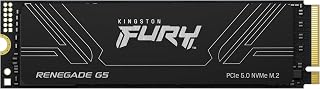
Raw throughput is the central reason for including Kingston's FURY Renegade G5 in a roundup of the fastest PCIe 5.0 NVMe SSDs. Its 2TB capacity combines with quoted read speeds of up to 14,800MB/s and write speeds of up to 14,000MB/s, placing it among drives aimed at demanding gaming and content-creation systems. That level of bandwidth targets the moments when storage delays matter most: loading games, moving large video files, and keeping applications responsive during intensive work. The Renegade G5's design supports that performance focus. Its dual-engine architecture, SM2508 controller, and DDR4 cache are intended to maintain performance under heavier workflows. Kingston also builds in thermal considerations through a 12-layer PCB, low-power cache architecture, an optimized Buck IC, and an advanced thermal design. The compact 9-gram form factor is suited to modern motherboards without interfering with RAM or cooling hardware. It is a particularly strong speed-first pick for a new high-end desktop or laptop with PCIe Gen 5x4 support, since older systems cannot access its full potential.
Capacity: 2TB (2048GB)
Interface: PCIe 5.0 x4 NVMe
Form Factor: M.2 2280
Read Speed: Up to 14,800MB/s
Write Speed: Up to 14,000MB/s
Cache Memory: 4GB DDR4
Controller: SM2508 (6nm lithography)
Weight: 9.07g
Warranty: 5 years
Compatibility: Desktop and laptop systems with PCIe Gen 5 M.2 support

The 14,900 MB/s read speed sets a new benchmark for Gen 5 performance, while the 11,000 MB/s write speed ensures balanced throughput for bidirectional workloads. At 2TB capacity, this drive provides ample space for large datasets and games without sacrificing the PCIe 5.0x4 interface speed. Advanced reliability features maintain consistency under heavy loads, essential for users pushing Gen 5 bandwidth limits in AI training or 8K editing workflows.
Pros
- 14,900MB/s reads place it among the fastest consumer drives available
- Excellent thermal management prevents performance throttling
- Over 2.3M IOPS handles complex multithreaded workloads
- Five-year warranty and monitoring software included
Cons
- Requires PCIe Gen 5 motherboard for full speed
- Premium positioning reflects cutting-edge technology
When raw speed defines your workflow, the WD_BLACK SN8100 delivers Gen 5 performance that redefines what's possible in 2026. This 2TB drive hits 14,900MB/s sequential reads and 11,000MB/s writes, putting it at the absolute peak of consumer storage capability. The engineering here goes beyond headline numbers: over 2.3 million IOPS in random operations means complex multithreaded tasks like AI model training or simultaneous 4K timeline scrubbing happen without stuttering. TLC 3D NAND paired with optimized thermal architecture prevents the throttling that plagued earlier Gen 5 drives, while 7.5W average power consumption keeps heat manageable even under sustained load. The compact M.2 2280 design fits modern desktop and laptop builds, and the five-year warranty backs Western Digital's confidence in long-term reliability. SanDisk Dashboard software provides health monitoring on Windows. This drive demands a PCIe Gen 5 motherboard to unlock its full capabilities, so older platform owners won't see these gains. For those building or upgrading to current-generation hardware, the SN8100 represents the speed ceiling for 2026.
Speed Performance: Sequential read speeds reach 14,900MB/s while sequential write speeds hit 14,000MB/s on 2TB-4TB models. Random performance exceeds 2,300,000 IOPS, enabling parallel access patterns common in professional applications and gaming.
Power Efficiency: Operating at 7.5W average, the SN8100 consumes approximately 100% less power than comparable PCIe Gen 4 drives, translating to cooler operation and lower system stress. This efficiency advantage becomes significant during extended workloads like rendering or simulations.
Capacity and Compatibility: Available in capacities up to 8TB, the drive supports Desktop, Laptop, and PlayStation 5 systems via its PCIe Gen 5x4 interface. The M.2 2280 form factor ensures compatibility with current generation motherboards that support PCIe Gen 5.
Buy this if you're a content creator rendering 8K footage, an AI developer training large models, or a competitive gamer who needs every millisecond advantage on a Gen 5 platform. The performance justifies itself when storage becomes the bottleneck in your workflow. Skip it if your motherboard lacks PCIe Gen 5 support or if your workload doesn't consistently push storage limits. Gen 4 drives still handle everyday gaming and productivity excellently at lower cost, making this overkill for casual users.

Pros
- 14,500MB/s read speed exploits full Gen 5 bandwidth
- NVMe 2.0 with Native Command Queuing for multi-threaded workloads
- DirectStorage support and PS5 compatibility broaden use cases
- 4.5 grams at 0.08 inches fits compact laptop and desktop builds
Cons
- Requires PCIe 5.0 motherboard for advertised performance
- Premium pricing limits appeal for budget-focused builds
Speed defines the Acer Predator GM9, and its PCIe 5.0 interface exploits every bit of Gen 5 bandwidth. Sequential reads peak at 14,500MB/s with writes reaching 11,000MB/s, putting this 1TB drive among the fastest consumer options available. NVMe 2.0 protocol and Native Command Queuing optimize multi-threaded operations for workloads that hammer storage with simultaneous requests. DirectStorage integration on Windows 11 accelerates game asset streaming, while PS5 compatibility extends its reach beyond PC platforms. The 2280 form factor weighs just 4.5 grams at 0.08 inches thick, slipping into laptops and desktops without spatial constraints. Backward compatibility means older systems accept the drive even if they cannot fully utilize Gen 5 speeds. For professionals rendering 8K timelines, training machine learning models, or loading massive simulation datasets, that raw throughput translates directly into reduced wait times. Competitive gamers benefit from faster level loading and texture streaming in DirectStorage-enabled titles. The core limitation remains platform dependency: without a PCIe 5.0 motherboard, the drive operates below its potential and premium pricing becomes harder to justify against PCIe 4.0 alternatives.
Capacity: 1TB
Interface: PCIe 5.0 NVMe 2.0
Form Factor: M.2 2280
Sequential Read Speed: Up to 14,500 MB/s
Sequential Write Speed: Up to 11,000 MB/s
Connectivity: PCIe x4
Compatibility: Desktop PC, Laptop, PlayStation 5
Special Features: DirectStorage Support, Native Command Queuing, Backward Compatible
Dimensions: 3.15" L x 0.87" W x 0.08" Th
Weight: 4.5g
The Predator GM9 targets 4K/8K video editors, AI researchers running compute-intensive training jobs, competitive gamers with DirectStorage-capable titles, and system builders assembling maximum-performance workstations where storage bottlenecks must be eliminated. You need a PCIe 5.0 motherboard to extract full value. Skip this drive if your platform is PCIe 4.0, your budget prioritizes cost efficiency over peak performance, or your workload involves general computing tasks that show no real difference between Gen 4 and Gen 5 speeds.

Pros
- 11,700MB/s reads place it among Gen5 elite
- Superior thermal stability compared to Gen5 peers
- DirectStorage ready for next-gen gaming optimization
- Backward compatible with older PCIe generations
Cons
- Requires heatsink for sustained performance
- DirectStorage game support still limited in 2026
The Corsair MP700 PRO earns its place among 2026's top Gen5 drives with read speeds hitting 11,700MB/s and writes reaching 9,600MB/s, delivering the kind of throughput that transforms everyday computing. Boot times shrink to seconds, game levels load nearly instantly, and moving gigabytes of data feels effortless. High-density 3D TLC NAND balances raw performance with longevity, while the drive's thermal behavior stands out in a segment known for heat issues. Users consistently report stable temperatures below 60°C with adequate cooling, making this one of the more thermally manageable Gen5 options. The standard M.2 2280 form factor ensures straightforward installation in modern desktop motherboards. DirectStorage integration prepares the drive for the next wave of gaming optimization, enabling GPU-direct transfers that bypass CPU bottlenecks. Backward compatibility with Gen4 and Gen3 slots provides flexibility, though speeds will scale down accordingly. For enthusiasts building around the latest Intel or AMD platforms with native Gen5 support, the MP700 PRO delivers speeds that genuinely justify the Gen5 investment without the thermal drama that plagues some competitors.
Interface: PCIe Gen5 x4 with NVMe 2.0 protocol
Capacity: 1TB
Form Factor: M.2 2280
Sequential Read Speed: Up to 12,400MB/sec
Sequential Write Speed: Up to 11,800MB/sec
Media Type: High-density 3D TLC NAND
Endurance: 3,000TB Total Bytes Written
Warranty: 5-year manufacturer
Compatibility: Intel Z790, AMD X670 platforms and beyond, backward compatible with PCIe 4.0 and 3.0
Cooling: Requires active cooling solution (motherboard heatsink or third-party M.2 cooler)
DirectStorage: Supported on compatible games with DirectX12 GPU featuring Shader Model 6.0
This drive suits enthusiasts and gamers upgrading to or building new high-end systems with Gen5 motherboards who want elite storage speeds without excessive thermal concerns. Creative professionals moving large video files or game assets will benefit from the sustained throughput. Skip the MP700 PRO if you lack proper cooling infrastructure, as even this thermally efficient drive needs a heatsink to maintain performance. Also pass if you're on a Gen4 platform, since you won't access the speeds that justify the premium over cheaper alternatives.
What to Look for When Buying a Gen 5 NVMe SSD
Sequential Read and Write Speeds
Sequential throughput is the headline spec for Gen 5 drives, and the range across this list is significant. The WD_Black SN8100 2TB NVMe SSD – PCIe 5.0×4 and the Kingston FURY Renegade G5 both push past 14,000MB/s read, while drives like the PNY CS2150 sit closer to 10,300MB/s. Neither end of that spectrum is slow, but your use case matters.
For large sequential workloads such as video editing or AI model loading, chasing the highest sequential numbers pays off. For everyday gaming and OS tasks, even the more modest Gen 5 drives are dramatically faster than anything Gen 4 can offer.
Random IOPS and Real-World Responsiveness
Sequential speed grabs attention, but random read and write performance governs how snappy your system actually feels. The Samsung SSD 9100 PRO 1TB, PCIe 5.0×4 M.2 2280 stands out here with up to 2,600K random write IOPS, which translates directly into faster game load screens, quicker application launches, and smoother multitasking under heavy workloads.
If your workflow involves a lot of small, scattered file operations, compiling code, managing large asset libraries, or running virtual machines, prioritize IOPS alongside sequential throughput rather than sequential numbers alone.
Thermal Management and Cooling Requirements
Gen 5 controllers run significantly hotter than their Gen 4 predecessors, and sustained performance depends heavily on keeping temperatures in check. Several drives on this list, including the Corsair MP700 PRO and the Corsair MP700 Elite, explicitly require a heatsink to maintain rated speeds. The fanxiang Gen 5 drive integrates a dynamic thermal control algorithm that monitors NAND temperature in real time, which is a useful feature if your case has limited airflow.
Check whether your motherboard includes an M.2 heatsink before you order. If it does not, factor in the cost of an aftermarket cooler. Drives that throttle under sustained load will not deliver the performance you paid for. Pairing your storage upgrade with a well-ventilated case is equally important, our guide to the best PC cases for RTX 5080 builds covers several chassis with strong M.2 cooling provisions.
Endurance, Warranty, and Platform Compatibility
TBW (terabytes written) ratings tell you how much data a drive can handle over its lifetime. The Corsair MP700 Elite leads this list with a 1,200 TBW rating on the 2TB model, while the Crucial T705 and fanxiang Gen 5 both carry five-year warranties backed by solid endurance figures. Longer warranties signal manufacturer confidence and protect your investment.
Compatibility is equally critical. Gen 5 slots are found on Intel Z790, AMD X670E, and newer platforms. The Crucial T705 is specifically optimized for Intel 13th and 14th Gen alongside AMD Ryzen 7000 processors. Verify your motherboard has a PCIe 5.0 M.2 slot before purchasing any drive on this list; running a Gen 5 SSD in a Gen 4 slot will cap its performance. If you are building a GPU-focused rig alongside your storage upgrade, our picks for the best GPUs under $500 can help you round out the build.
Final Thoughts
The Gen 5 NVMe market has matured quickly, and every drive on this list offers a meaningful upgrade over Gen 4 storage. For users who want the absolute peak of sequential performance and do not mind investing in proper cooling, the WD_Black SN8100 2TB NVMe SSD – PCIe 5.0×4 is a standout choice with its class-leading speeds and exceptional power efficiency. If you want proven reliability from a household name with outstanding random IOPS and a polished software ecosystem, the Samsung SSD 9100 PRO 1TB, PCIe 5.0×4 M.2 2280 delivers a well-rounded Gen 5 experience that suits both gamers and creative professionals alike.
Frequently Asked Questions
Is a Gen 5 NVMe SSD worth it in 2026?
For most everyday users, a Gen 4 drive is still sufficient. However, if you work with 8K video, large AI models, or professional content pipelines, the jump to Gen 5 is genuinely impactful. Sequential read speeds exceeding 14,000MB/s mean dramatically shorter transfer times for large files. As more software and games adopt Microsoft DirectStorage, the advantage of Gen 5 storage will only grow in 2026 and beyond.
Do I need a heatsink for a Gen 5 NVMe SSD?
Yes, in almost every case. Gen 5 controllers generate considerably more heat than Gen 4 equivalents, and without adequate cooling, most drives will throttle their performance under sustained loads. Many motherboards include an M.2 heatsink, but if yours does not, an aftermarket solution is strongly recommended. Some drives, like the fanxiang Gen 5 model, include integrated thermal management, but a physical heatsink remains the most reliable safeguard.
Will a Gen 5 SSD work in a Gen 4 M.2 slot?
Yes, Gen 5 NVMe drives are backward compatible with Gen 4 and Gen 3 M.2 slots. However, the drive will operate at the maximum speed supported by the slot, not at its Gen 5 rated speeds. If you are investing in a high-performance Gen 5 drive, make sure your motherboard has a PCIe 5.0 M.2 slot to fully utilize it. Pairing your build with a capable GPU is equally important, our guide to the best GPUs under $300 is a good starting point if you are budget-conscious on the graphics side.
How does Gen 5 NVMe improve gaming performance?
The most direct gaming benefit comes from Microsoft DirectStorage, which allows the GPU to load game assets directly from the SSD without routing through the CPU. Drives like the Corsair MP700 Elite and the PNY CS2150 are explicitly DirectStorage compatible, which can reduce in-game load times significantly in supported titles. Beyond DirectStorage, faster storage also means quicker game installs, faster patch applications, and snappier overall system responsiveness during gameplay sessions.




Write Your Review
No reviews yet. Be the first to share your experience!