

A voice-over recording can lose its impact when room echo, keyboard clicks, or sharp plosives distract from your script. The right microphone helps your delivery sound focused and natural, whether you narrate videos, record courses, create character voices, or produce podcast segments at home.
This guide to the best microphone for voice over covers straightforward USB choices, flexible USB/XLR models, traditional studio condensers, and a compact wireless option. We considered voice pickup, connection type, included accessories, monitoring controls, and real-world desk placement, plus a dependable external hard drive for reliable project backups can help keep finished takes organized.
Quick answer
This guide compares 10 picks, with Shure SM58 Pro XLR Dynamic Vocal Microphone - Industry ranked first. Logitech Blue Yeti USB Condenser Microphone has the most customer reviews.

For voice over work, a unidirectional polar pattern matters more than most specs on paper, since it rejects room noise and off-axis reflections that ruin a clean read. This handheld dynamic mic pairs with an audio interface via XLR, giving you a stable gain-staged signal rather than a noisy USB path. The included clip makes it easy to mount on a boom or stand for consistent mouth-to-mic distance during long script sessions.
Pros
- Unidirectional pattern rejects room noise and background hum
- Built-in grille reduces plosives and breath noise on close reads
- Rugged metal build handles daily studio use
- Warm midrange presence keeps narration clear and forward
Cons
- Requires an audio interface or mixer, adding setup cost
- No cable included with purchase
Voice over work lives and dies on rejecting room noise, and that's exactly where the SM58 earns its keep. Its unidirectional pickup pattern focuses tightly on your voice while ignoring the hum of computer fans, AC vents, or echo from an untreated room, which matters more for VO than almost any other use case. The built in grille tames plosives and breath noise on close mic reads without needing a separate pop filter, so scripts full of hard consonants stay clean. It's a corded XLR mic, which means you'll need an audio interface, but that setup also gives you more control over gain and tone shaping than a plug and play USB mic allows. For anyone recording narration, character voices, or commercial reads in a home booth or untreated space, the SM58's noise rejection and midrange presence boost help dialogue sit forward and intelligible, which is the whole job in voice over.
Connectivity and Interface: XLR connector, 1 channel, corded electric power. Requires audio interface or mixer for recording.
Audio Performance: Frequency response 50 Hz to 15 kHz with 78 dB signal-to-noise ratio. Unidirectional cardioid polar pattern for focused vocal pickup and ambient noise rejection.
Physical Design: Handheld form factor with metal enclosure, spherical grille, and integrated pop filter. Weight 310 g, dimensions 10.31 x 4.92 x 3.31 inches.
Package Contents: SM58-LC microphone, A25D swivel stand adapter, and protective storage bag. Includes 2-year manufacturer warranty.
Buy this if you're doing voice over in a room that isn't acoustically treated, since its noise rejecting pattern does real work there, or if you already own an interface and want a mic that holds up to daily use. Skip it if you want something you can plug straight into a laptop with no extra gear, or if you're chasing a specific studio condenser sound rather than the warm, forward dynamic tone the SM58 is known for.

The Mic Mini's active noise cancelling isolates your voice from background interference during mobile recording sessions, useful when capturing voice over work outside a treated studio. Its 300m transmission range with plug-and-play connectivity for iPhone and Android means you can record narration wirelessly with freedom of movement. The ultralight clip-on design stays comfortable during extended recording, and dual transmitters let you capture dialogue or interviews when voice over projects require multiple speakers.
Pros
- Dual noise cancellation modes adapt to quiet booths or noisy locations
- 10-gram transmitters eliminate handling noise and physical distraction
- 11.5-hour battery supports full recording days without recharge breaks
- Automatic limiting prevents clipping during dynamic vocal performance
Cons
- Single receiver restricts monitoring to one device at a time
- Positioned as entry-level option rather than studio-grade audio tool
Voice over work demands clean dialogue capture without handling noise or environmental interference, and the DJI Mic Mini addresses both priorities with dual noise cancellation modes and an omnidirectional polar pattern that isolates speech while rejecting unwanted artifacts. At 10 grams per transmitter, the system stays invisible during recording sessions, whether you're narrating from a home booth or capturing field audio for documentary work. The 11.5-hour combined battery life supports extended recording blocks without interruption, while automatic limiting prevents clipping when you lean into emphasis or raise your voice for character reads. The 300-meter wireless range offers flexibility for ADR sessions or multi-room setups, and the included windscreens handle breath plosives and HVAC noise effectively. Two transmitters and a mobile receiver make this a turnkey solution for solo narrators or interview-style podcast formats. While the DJI Mic Mini won't replace a condenser mic in a treated studio, it delivers reliable, location-flexible voice capture for creators who record outside traditional environments or need wireless mobility during production.
Model: DMMT01 (DJI Mic Mini)
Transmitter Weight: 10g per unit
Transmission Range: 300m maximum
Battery Runtime: 11.5 hours combined (two transmitters plus mobile receiver)
Connectivity: Bluetooth, Wi-Fi, USB Type-C
Polar Pattern: Omnidirectional
Noise Cancellation: 2 levels (Basic for quiet spaces, Strong for noisy environments)
Compatible Devices: iPhone 17/16/15 series, Android phones, PCs, tablets
Package Contents: 2 transmitters, 1 mobile receiver, 2 charging docks, 2 windscreens, 2 magnetic clips, carrying pouch, splitter charging cable
Special Features: Automatic audio limiting, clip attachment, compatible with DJI Osmo ecosystem
Best for voice over artists recording on location, podcasters capturing remote interviews, or content creators who need wireless freedom without sacrificing clarity. The dual transmitter setup suits two-person dialogue or backup recording workflows. Skip this if you're working exclusively in a treated home studio with a stationary mic setup, or if you need XLR connectivity and studio-grade frequency response for commercial VO clients expecting broadcast-standard fidelity. The mobile receiver limits this to smartphone and tablet workflows rather than traditional audio interfaces.

The T669 includes an 8.2ft detachable USB cable and boom arm stand in the box, giving voice over artists immediate flexibility for studio positioning without additional purchases. Its unidirectional polar pattern isolates your voice from room noise, critical when recording narration where clarity and focus matter. The gain knob offers real-time level control during long recording sessions, letting you adjust input sensitivity as your voice projection changes throughout the day.
Pros
- All-in-one bundle: boom arm, shock mount, pop filter, windscreen included
- Unidirectional pickup favors voice over ambient room sound
- Steel boom arm with wide rotation range for hands-free narration takes
- Durable metal mic body at a budget price point
Cons
- Cardioid pattern still picks up noise in untreated rooms
- USB Type-B connector may need an adapter for Type-C only devices
Voice over work lives or dies on clean, consistent vocal pickup, and the FIFINE T669 is set up to deliver exactly that right out of the box. Its unidirectional condenser capsule focuses on sound directly in front of it, which is the pattern you want when recording narration, since it favors your voice over room noise behind or beside the mic. The included boom arm and shock mount matter more for voice over than most other uses, since they let you get consistent mouth-to-mic distance take after take, which keeps your levels even across a script. The double-layer pop filter helps tame plosives and sibilance common in spoken narration. A 78db signal-to-noise ratio and 20Hz-20KHz frequency response give you a clean noise floor and full vocal range for narration work. For anyone recording voice over at home without a treated booth, this bundle removes several separate purchasing decisions and gets you a workable setup fast.
Audio Performance: Polar pattern is unidirectional (cardioid), frequency response spans 20Hz to 20KHz with 78dB signal-to-noise ratio and 70dB audible noise floor. Condenser capsule design captures detailed, nuanced audio ideal for vocals and instruments.
Connectivity: USB Type-A and Type-C connectors enable compatibility with most modern computers and laptops. Includes 8.2-foot detachable USB-B to USB-A/C cable for flexible positioning. Requires no additional drivers on Windows and Mac systems.
Physical Design: Metal enclosure construction with adjustable boom arm stand featuring 13-inch fixed horizontal arm and 30-inch maximum reach. C-clamp and detachable desktop mount options provide secure desk mounting. Total unit weight is 1kg with package dimensions of 16.5 x 9.61 x 2.99 inches.
Included Accessories: Condenser microphone, scissor boom arm stand with C-clamp, pop filter with double layers, windscreen, shock mount, 8.2-foot USB cable, metal ring adapter, and user manual. One-year manufacturer warranty included.
Good fit for narrators, e-learning voice talent, and hobbyists recording voice over demos or freelance gigs from a home desk, especially those who don't yet own a boom arm or pop filter. Skip it if you record in an untreated, echoey room, since the cardioid pattern will still pick up reflections and ambient noise. Also skip it if your setup only has USB Type-C ports without an adapter, or if you need Xbox compatibility.

The Blue Yeti's multipattern capability lets you switch between cardioid, bidirectional, omnidirectional, and stereo modes, making it adaptable for solo narration or multi-voice projects. Its 120 dB audio sensitivity captures vocal nuance and tonal range essential for professional voice work. Blue VO!CE effects provide onboard processing for vocal enhancement, useful when you need broadcast-ready sound without routing through external software during recording sessions.
Pros
- Tri-capsule array captures rich, detailed vocal tone with 100 dB SNR
- Four pickup patterns handle solo VO, dialogue, and stereo recording
- Onboard gain, mute, and zero-latency monitoring for precise session control
- Metal build with boom arm compatibility for professional mounting
Cons
- Requires Logitech G HUB download to access Blue VO!CE effects
- Larger desktop footprint than compact vocal mics
Voice-over work demands clarity, tonal depth, and the ability to capture subtle vocal nuance without competing microphones or complex routing. The Blue Yeti's tri-capsule condenser array excels here, recording rich, detailed voice with minimal self-noise thanks to its 100 dB signal-to-noise ratio. The cardioid pickup pattern isolates your voice while rejecting room reflections and background hum, crucial for clean narration takes. What sets this apart for VO professionals is the onboard control suite: instant mute for retakes, precise gain adjustment to match your vocal dynamics, and zero-latency headphone monitoring so you hear exactly what you're recording in real time. The metal construction and adjustable desktop stand provide positioning flexibility, or detach it entirely for boom arm mounting in a proper booth setup. Blue VO!CE software adds broadcast vocal effects and modulation when you need polish for commercial reads. The four pickup patterns extend versatility beyond solo narration if you ever need to record dialogue, interviews, or stereo ambient beds. It's a single USB microphone that handles the full spectrum of voice-over recording scenarios with professional results.
Audio Specifications
Frequency Response: 20 Hz - 20 kHz
Audio Sensitivity: 120 dB
Signal-to-Noise Ratio: 100
Microphone Form Factor: Tri-Capsule Array
Polar Pattern: Cardioid, Omnidirectional, Bidirectional, Stereo
Connectivity and Compatibility
Connector Type: USB
Compatible Devices: PC and Mac
Channels: 2
Number of Items: 1
Physical Specifications
Dimensions: 4.92 x 4.72 x 11.61 inches
Weight: 3.5 pounds
Enclosure Material: Metal
Color: Blackout
Power Source: USB Corded
Included Components
Blue Yeti USB Microphone
Desktop Stand
USB Cable
Instructions
Warranty
2-Year Manufacturer Warranty
Buy this if you're a voice actor, narrator, or content creator recording dialogue, commercials, audiobooks, or explainer videos who needs studio-grade vocal capture without an audio interface. It suits home studio setups where flexibility and onboard controls matter. Skip it if you're exclusively recording in a treated booth with dedicated preamps and XLR workflow, or if your budget is tight and you only need basic vocal recording without pattern switching or advanced features. Also pass if you prefer minimal desk footprint, as the Yeti is substantial.

Pros
- Exceptional value for professional-grade studio sound at this price point
- Extremely low self-noise (4dB) delivers crystal-clear recordings with virtually no hiss
- Effective cardioid rejection minimizes room noise and air conditioning hum
- Everything needed to start recording included in the box
- Reliable, durable construction with strong compatibility across audio interfaces
Cons
- Requires an audio interface and XLR connectivity, not plug-and-play for casual users
- Sensitive condenser design requires careful handling and appropriate preamp gain adjustment
- Phantom power requirement means incompatibility with some portable recording devices
The RØDE NT1 Signature Series is a large-diaphragm condenser microphone built for anyone serious about capturing professional-quality vocals. Whether you're a singer recording at home, a podcaster, a content creator, or a voice actor, this mic delivers the clean, warm studio sound that defines hits and professional productions. The included accessories make it a complete out-of-box solution for anyone with an audio interface.
What sets the NT1 apart is its combination of sonic character and technical excellence. The HF6 1-inch true condenser capsule produces rich bass, detailed midrange, and sparkling highs with a smooth, natural frequency response. The standout feature is the remarkably low 4dB self-noise, which means virtually zero hiss between takes. Real users consistently praise how effectively the tight cardioid polar pattern rejects room noise, air conditioning hum, and ambient interference, allowing your voice to shine without editing gymnastics.
Build quality reflects RØDE's precision manufacturing in Sydney. The mic feels solid and substantial in hand, and the included SM6 shock mount, pop filter, and 6-meter XLR cable are all legitimate studio-grade components, not flimsy afterthoughts. This matters because it means you're not fighting cheap accessories while learning proper mic technique.
The primary consideration is that this is a condenser microphone requiring phantom power and an audio interface, so it's not suitable for mobile recording or casual USB recording. Additionally, condenser mics are more sensitive to handling noise and proximity effects than dynamic mics, so proper technique and gain staging matter. These aren't drawbacks so much as realities of the condenser design.
The RØDE NT1 Signature Series delivers legitimate studio sound at a price that makes professional vocal recording accessible. With strong reviews from singers and content creators, proven reliability, and a 10-year warranty, it represents exceptional value for anyone upgrading from entry-level gear or building a first serious recording setup.
Technical Specs: Polar Pattern: Cardioid. Self-Noise: 4dB. Signal-to-Noise Ratio: 78dB. Connector: XLR. Diaphragm: 1-inch true condenser. Power: Phantom Power required. Frequency Response: Tailored for vocals and instrument recording. Dimensions: 2.05 x 2.05 x 7.44 inches. Weight: 313g. Color: Black. Warranty: 10 years with registration.
What's Included: NT1 Signature Series microphone (black), SM6 shock mount with integrated pop filter, 6-meter XLR cable, protective dust cover.
Is This Right for You? The NT1 Signature Series is ideal if you're recording vocals, instrument sources, voiceovers, or streaming content and want studio-quality sound. You'll need an audio interface with XLR input, a microphone stand or boom arm, and a computer. If you're serious about sound quality and willing to learn proper microphone technique, this mic delivers.
Setup Requirements: Audio interface (such as Focusrite Scarlett or Universal Audio), microphone stand or boom arm (compatible with standard 5/8-inch mounts), XLR cable to your interface, phantom power enabled on your interface, and recording software. All cables and the mount are included.
Compared to Alternatives: The NT1 Signature offers better value than premium condensers like the Shure KSM8 or Neumann U87, which cost multiple times more. It competes favorably against the Audio-Technica AT4040 while offering superior included accessories. For comparison, upgrading from budget USB mics or older dynamic microphones will be immediately noticeable.

The K669B's 78 dB audio sensitivity captures clear vocal detail without overloading the signal, important for controlled voice over delivery. Its unidirectional pattern rejects off-axis sound, keeping your narration clean when recording in untreated spaces. The included volume control and 6.5ft cable with USB-A and USB-C compatibility mean you can adjust monitoring levels and connect to modern laptops without adapters, streamlining your recording workflow.
Pros
- Cardioid pattern reduces background noise for cleaner vocal takes
- Metal construction and stable tripod stand included
- Built-in volume knob for real-time level adjustment
- USB Type-A and Type-C adapters included for broad compatibility
Cons
- 75 dB sensitivity offers less headroom than studio-grade condensers
- Requires careful placement to avoid plosives and maintain clarity
For voice-over beginners or creators producing YouTube narration, training videos, and social content, the FIFINE K669B offers a straightforward path to clearer vocal recordings. Its cardioid condenser capsule focuses on your voice while naturally reducing background noise and room reflections, a meaningful upgrade from built-in laptop mics or headset options. The 78 dB signal-to-noise ratio handles spoken word cleanly, and the metal construction provides durability without added cost. Setup is instant: plug the included 6.5-foot USB cable into your computer and start recording. The built-in volume knob lets you adjust levels on the fly during recording sessions, useful when switching between quiet narration and louder character reads. The desktop tripod stand keeps it stable and positions the mic at a practical height for seated recording. Optimal placement is 6 to 12 inches from your mouth to avoid plosives and maintain clarity. This mic won't replace professional XLR setups for broadcast or commercial work, but it serves the voice-over creator who needs reliable, clean vocal capture for online content, e-learning, or podcast narration without investing in interfaces, preamps, or complex signal chains.
Connectivity and Compatibility: USB Type-A and Type-C connectors. Works with Windows PC, Mac, PS4, PS5, and most streaming platforms including Discord, OBS, Twitch, and Zoom.
Audio Performance: Cardioid condenser microphone with 20Hz-20kHz frequency response, 78dB audio sensitivity and signal-to-noise ratio, 16dB audible noise level. Captures clear, natural vocals with minimal background interference.
Physical Design: All-metal construction with unidirectional polar pattern. Includes desktop tripod stand, 6.5-foot USB-B to USB-A/C cable, volume control knob, and user manual. Weight is 5.6 ounces. One-year manufacturer warranty included.
Buy this if you're launching a YouTube channel, recording e-learning modules, narrating social media content, or starting podcast production and need dependable vocal clarity on a starter budget. It works well for creators recording in moderately quiet spaces who value simplicity and immediate results. Skip it if you're recording audiobooks or commercial voice-over requiring broadcast-level fidelity, need manual gain control for session-to-session consistency, or plan to record in noisy environments where advanced noise rejection is critical.

The AM8's dynamic capsule with XLR and USB connectivity gives voice over artists the option to upgrade to an audio interface later while starting with direct computer connection now. Its built-in headphone jack with monitoring volume control lets you hear yourself in real time without latency, essential for pacing and timing narration. The mute function provides quick silence between takes, and the unidirectional pattern keeps your voice isolated from keyboard noise during recording.
Pros
- Dynamic capsule rejects room noise and keyboard clicks naturally
- Dual USB and XLR connectivity grows with your setup
- 80dB SNR delivers clean recordings without audible hiss
- Built-in headphone monitoring catches issues during takes
Cons
- RGB lighting and function keys disable in XLR mode
- XLR cable and boom arm sold separately
Voice over work demands clarity, consistency, and a microphone that rejects the distractions of an untreated home studio. The FIFINE AmpliGame AM8 delivers exactly that with its dynamic cardioid capsule, which isolates your voice while naturally suppressing keyboard noise, mouse clicks, and room reflections that plague condenser alternatives. The 80dB signal-to-noise ratio ensures clean recordings without audible hiss, critical when clients expect broadcast-ready takes. USB connectivity provides immediate plug-and-play recording on any workstation, while XLR output future-proofs your setup as projects scale. Real-time headphone monitoring through the built-in jack lets you catch plosives and sibilance during takes rather than in post-production. The metal construction and stable desktop stand handle repeated positioning adjustments across long recording sessions without drift or handling noise. RGB lighting and mute functionality add convenience for streamers doubling into voice over, though the lighting disables when using XLR mode. The included windscreen filters electrical interference, and built-in stand threads eliminate adapter hassles when mounting to a boom arm for optimal mouth positioning during extended narration sessions.
Best suited for voice over artists transitioning from gaming headsets or cheaper USB mics who need professional isolation without studio treatment. Ideal if you record in shared spaces where keyboard and environmental noise are constant challenges. Skip this if you already own an audio interface and prefer condenser sensitivity for nuanced character work, or if you need phantom-powered XLR-only operation. Also pass if RGB lighting is essential during XLR use, as function keys disable in that mode.
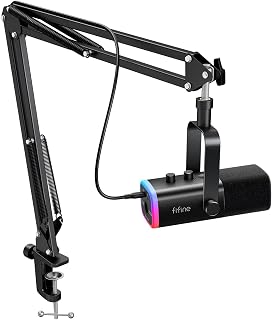
The AM8T bundles an XLR dynamic microphone with USB connectivity, letting voice over artists choose between direct computer recording or professional interface routing as projects demand. Its headphone jack with dedicated volume control enables zero-latency monitoring, critical for maintaining natural delivery and catching mistakes during narration. The mute function allows instant silence between takes, and the unidirectional pattern focuses on your voice while rejecting room reflections that muddy clarity.
Pros
- Condenser capsule captures vocal detail across 20Hz-20KHz range
- Complete kit includes boom arm, pop filter, shock mount, and windscreen
- USB plug-and-play operation on PC, Mac, and PlayStation
- Metal construction on microphone and boom arm for durability
Cons
- Cardioid pattern picks up some background noise in untreated rooms
- USB Type-B connector may need adapter for Type-C-only devices
Voice over work in home environments benefits enormously from the FIFINE T669's condenser sensitivity and comprehensive included accessories. The cardioid capsule captures vocal detail and presence across the full 20Hz-20KHz frequency range, delivering the clarity and warmth clients expect in commercial narration, audiobook production, and eLearning content. The 78dB signal-to-noise ratio keeps background hiss minimal during quieter passages, critical when recording at conversational levels for extended periods. USB connectivity eliminates the need for audio interfaces or phantom power, letting you start recording immediately on PC, Mac, or PlayStation without driver complications. The included boom arm provides full positioning control with 180-degree vertical rotation and 135-degree reach, essential for maintaining consistent mouth-to-capsule distance during long sessions. The double-layer pop filter handles plosives and breath noise that would otherwise require extensive editing, while the shock mount isolates the microphone from desk vibrations and accidental bumps. The 8.2-foot detachable cable offers flexibility in studio layout without limiting your movements. Metal construction throughout the microphone and arm ensures stability during repeated adjustments, and the cardioid pattern focuses on your voice while rejecting off-axis sound. For voice artists working from untreated rooms, the front-facing rejection helps but won't eliminate all ambient noise.
Audio Specifications: Frequency range 50Hz-16kHz, cardioid polar pattern, 80dB signal-to-noise ratio, -50dB sensitivity. Powered via USB for both connectivity and power on PC/Mac.
Physical Design: Black ABS plastic and metal construction, approximately 1 kg weight. Boom arm stand measures 12.6 x 4.72 x 1.97 inches with adjustable positioning and C-clamp. Accommodates desks up to 2 inches thick.
Connectivity and Ports: USB-C and XLR connectors, 3.5mm headphone jack with independent volume control, mute button with LED indicator, gain knob for level adjustment. Includes 8.2ft USB-C to USB cable, windscreen, and user manual.
Best for voice over professionals and aspiring narrators who need studio detail and a complete recording solution out of the box without separate accessory purchases. Perfect if you're recording audiobooks, commercials, or video narration where vocal nuance and presence matter. Skip this if you work in noisy, untreated environments where a dynamic microphone's rejection would serve you better, or if Xbox compatibility is required. Also pass if you prefer minimalist setups without boom arms and pop filters.

Pros
- Exceptional value for money with professional-grade audio quality at under $100
- Flexible connectivity and dual-mic capability make it ideal for various recording scenarios from solo to collaborative
- Effective noise cancellation handles real-world recording environments without requiring a treated booth
- Intuitive software control and multiple preset modes simplify setup and customization
- Sturdy metal construction and included desktop stand provide stable, reliable performance
Cons
- Wireless receiver occasionally ships missing from some units despite being listed in package contents
- Some users may find the noise cancellation adequate but not superior when compared to dedicated software solutions like NVIDIA Broadcast
- Camera/Lightning accessories sold separately, limiting immediate use with certain mobile devices
The MAONO PD200W is a hybrid wireless microphone engineered for podcasters, streamers, content creators, and anyone seeking professional audio without the professional price. It's designed for solo creators, co-hosted shows, gaming setups, and mobile recording scenarios where flexibility and ease of use matter as much as sound quality.
What sets this microphone apart is its three-in-one connectivity and intelligent design. The premium 30mm dynamic capsule delivers rich, clear vocal reproduction with an 82dB signal-to-noise ratio and handles up to 128dB SPL without distortion. The dual-microphone support through a single receiver is a game-changer for co-hosted content, recording each mic to its own track for precise editing. Users consistently report clean, natural sound with minimal background noise, even in untreated rooms.
Build quality is solid with a metal enclosure and stable desktop stand included in the box. The microphone feels durable and professional despite its affordable price point. The MaonoLink app provides genuine control with 4 master-tuned presets and adjustable EQ and reverb parameters, accessible from both PC and smartphone. The 60-hour battery life and 60-meter wireless range provide real creative freedom.
Minor drawbacks exist: the wireless receiver has occasionally shipped missing from some orders, and while the built-in noise cancellation is effective, some audiophiles layer it with additional software solutions for maximum clarity. Camera and Lightning adapters require separate purchase if you plan mobile compatibility beyond USB-C devices.
Verdict: The MAONO PD200W punches well above its weight class. For podcasters and creators on a budget who refuse to compromise on audio quality, this microphone delivers exceptional versatility and performance. It's a rare product that justifies its price while offering features typically found in more expensive competitors.
Audio Specs: Premium 30mm dynamic capsule, cardioid polar pattern, 82dB signal-to-noise ratio, 128dB maximum SPL, 16 kHz frequency response.
Connectivity: USB Type-C, XLR, wireless (60-meter range). Single receiver supports dual microphones. Compatible with audio interfaces, mixers, cameras, laptops, and smartphones.
Power: Battery-powered with up to 60 hours battery life (60 hours with RGB off). Powered by 1 C battery (included). Optional corded electric operation via USB.
Physical: Metal enclosure, black color, dimensions 8.78 x 7.4 x 4.84 inches, weight 1.32 kg. Includes desktop stand, Type-C receiver, USB-C to USB-A/C cable, Type-C adapter cable, and user manual.
Software: MaonoLink app (Mac and Windows compatible) offers 4 preset modes, EQ adjustment, reverb control, and RGB lighting customization. Warranty: 18 months.
Solo Podcasters: One wireless microphone with USB/XLR flexibility lets you record anywhere then sync with your DAW or streaming software. The noise cancellation handles home studio environments effectively.
Co-Hosted Shows: Dual-microphone support with separate track recording is built for interviews and collaborative podcasts. No more mixing two people through one channel or dealing with crosstalk.
Streamers: Wireless connectivity frees you from cable constraints during gaming or performance streams. The cardioid pattern minimizes keyboard and controller noise while keeping your voice prominent.
Content Creators: Whether filming YouTube videos, recording voiceovers, or producing music content, the three connectivity options work with phones, tablets, cameras, and computers. The included software puts audio control in your hands.
Who Should Wait: If you require phantom power or specialized XLR features, you'll want a dedicated XLR microphone. If you need exceptional noise cancellation without supplementary software, consider competing models with more advanced noise reduction.

This condenser microphone's 75 dB audio sensitivity captures vocal detail and tonal warmth needed for narrative work without requiring excessive gain that introduces noise. The 360° adjustable stand lets you position the mic precisely for your mouth angle and distance, important for consistent sound across long recording sessions. Its cardioid (unidirectional) pickup pattern isolates your voice from reflections and ambient sound, delivering the clean, focused audio voice over projects require.
Pros
- Large 14mm diaphragm captures clear, detailed vocal tone
- Cardioid pattern rejects side and rear noise for cleaner recordings
- One-tap mute button for instant silence between takes
- Built-in shock mount reduces vibration and handling noise
Cons
- No manual gain control limits level optimization across sessions
- Plastic construction less durable than metal alternatives
Voice-over recording on a budget no longer means compromising vocal clarity. This Amazon Basics condenser mic uses a 14mm large diaphragm to capture detailed, articulate voice with surprising fidelity for its entry-level positioning. The cardioid pickup pattern isolates your voice while actively rejecting side and rear ambient noise, essential when recording narration in home offices or untreated spaces. Plug-and-play USB connectivity works immediately on Windows and Mac systems without driver installation or configuration, letting you focus on your read instead of troubleshooting signal flow. The one-tap mute button gives you instant silence between takes, a practical feature during longer voice-over sessions when you need to cough, sip water, or pause for direction. The built-in shock mount and silicone rubber boot reduce vibration noise from typing or desk movement, keeping your recordings clean even in active workspaces. The 360-degree adjustable stand positions the mic for optimal capture angle, and the standard 5/8 inch mount thread means you can upgrade to a boom arm later without replacing the mic itself. The 75 dB signal-to-noise ratio handles spoken word effectively, though it lacks the headroom and manual gain control that advanced VO professionals require for session consistency.
Buy this if you're recording YouTube narration, internal training videos, podcast intros, or social media voice-overs and need immediate, fuss-free vocal recording without setup complexity. It suits creators working in moderately controlled environments who prioritize speed and simplicity. Skip it if you're a professional voice actor recording commercial spots, audiobooks, or broadcast content where manual gain control and extended frequency response matter, or if your recording space has significant ambient noise requiring higher isolation performance.
Setup takes under 60 seconds. Plug the USB cable into your computer, and the microphone appears as an available input device instantly. No driver downloads, no software installations, no configuration required. Windows 7 and newer, plus Mac OS 10.10 and higher, all recognize it automatically. Every major streaming and recording application (OBS, Streamlabs, Audacity, Discord, Zoom) works immediately without special setup.
The included stand works right out of the box and adjusts 360 degrees to position the mic at any angle. If you prefer a different mounting option, simply unscrew the stand and attach the mic to any tripod or boom arm with a standard 5/8 inch thread mount. The included shock mount helps isolate vibration, which is especially useful if you're typing while recording.
How to Choose a Microphone for Voice-Over Work
Choose USB for simplicity or XLR for a growing studio
A USB microphone connects directly to a computer, which makes it a sensible starting point when you want to record narration without an interface or mixer. The ultrawide monitor options for editing timelines can also make it easier to manage your recording software, script, and waveform view in one workspace.
The FIFINE T669 Studio Condenser USB Microphone is particularly convenient for a first voice-over station because its bundle includes a boom arm, shock mount, pop filter, and a long USB cable. For an even simpler desktop setup, the FIFINE K669B USB Microphone adds a physical volume knob, while the Amazon Basics Condenser Microphone for PC offers tap-to-mute and a compact adjustable stand.
Match the capsule type to your recording space
Large-diaphragm condenser microphones are highly detailed and can give narration a polished, open character, but they also hear more of the room. If you record in a quiet, treated space, the RØDE NT1 Signature Series Studio Condenser is a compelling XLR option, with a low-noise design plus a shock mount, pop filter, and cable in the box.
Dynamic microphones are often easier to manage in ordinary rooms because their cardioid patterns favor close speech and reduce off-axis distractions. The Shure SM58 Pro XLR Dynamic Vocal Microphone is a durable classic with integrated pop protection, while the FIFINE AmpliGame AM8 USB/XLR Dynamic Microphone gives you USB convenience now and an XLR upgrade route later.
Prioritize background-noise control and close placement
No microphone can completely erase an untreated room, so placement matters as much as the model you choose. Keep the microphone close, speak slightly across its front rather than directly into it, and use a pop filter or windscreen to reduce bursts from p, b, and t sounds. Closed-back monitoring also helps you catch hum and mouth noise early, and our IEM recommendations for focused audio monitoring can be useful when you want a compact listening setup.
For creators who need to move while recording interviews, mobile narration, or video segments, the DJI Mic Mini (2 TX + 1 Mobile RX), Ultralight brings compact transmitters, two noise-cancellation levels, automatic limiting, and a mobile USB-C receiver. The MAONO PD200W Hybrid Wireless Podcast Microphone takes a different approach with wireless, USB, and XLR operation, plus three-stage noise cancellation for flexible recording locations.
Look for controls that support your workflow
Headphone monitoring, a gain control, and a quick mute button make recording smoother because you can react without digging through software menus. The FIFINE AmpliGame AM8T XLR/USB Gaming Microphone includes a boom arm, headphone output, gain control, and a mute button, making it useful for voice-over creators who want an adjustable, ready-to-mount package.
If you regularly switch between solo narration, interviews, instrument capture, and streaming, the Logitech Creators Blue Yeti USB Microphone for PC offers four pickup patterns and onboard controls. For voice-over, cardioid is usually the practical setting because it emphasizes your voice, while the extra patterns add versatility for other projects. When transferring larger sessions between computers, a portable SSD for Mac projects can keep raw audio and edits close at hand.
Final Thoughts
For a dependable XLR vocal microphone in a modest home space, the Shure SM58 Pro XLR Dynamic Vocal Microphone remains a smart, durable choice. If you want an all-in-one studio-style kit that connects directly to your computer, the FIFINE T669 Studio Condenser USB Microphone offers an approachable path to clearer narration.
Frequently Asked Questions
What type of microphone is best for voice over?
A cardioid condenser is a strong fit when your room is quiet and you want detailed, studio-style vocal capture. A cardioid dynamic microphone is often the safer choice in a typical bedroom or office because close placement can reduce room reflections and background distractions. Your space and recording technique matter more than choosing a particular capsule style by name alone.
Do I need an audio interface for voice-over recording?
You need an audio interface or mixer for a traditional XLR microphone because it supplies the correct connection and gain control. USB microphones connect directly to a computer and are easier for beginners. Hybrid USB/XLR models are useful if you want to start simply and add studio gear later.
Can a USB microphone produce professional voice-over audio?
Yes, a well-positioned USB microphone can create clean, engaging narration for videos, online courses, podcasts, and ads. Record in the quietest available room, keep a consistent distance from the microphone, and monitor your gain so loud phrases do not distort. Editing is also faster with useful shortcuts, and a dedicated number pad for editing workflows can be a practical desktop addition.
How can I make voice-over recordings sound clearer in 2026?
Start by reducing noise at the source: turn off fans when possible, close windows, and move away from reflective walls. Use a boom arm to position the microphone near your mouth, then speak across the capsule with a pop filter in place. Record a short sample before a full session and listen through headphones for echo, hum, plosives, and inconsistent volume.





Write Your Review
No reviews yet. Be the first to share your experience!