

You have decided to go all-in on NVIDIA’s Blackwell architecture, and the RTX 5080 is sitting right at the sweet spot between the flagship 5090 and the mid-range tier. The challenge is not choosing the GPU itself; it is figuring out which board partner version actually matches your build, your case, and your workflow. With ten solid options on the market right now, the differences come down to cooling, clock speeds, slot width, and design philosophy.
This guide covers every major RTX 5080 variant available in 2026, from NVIDIA’s own Founders Edition to MSI’s premium SUPRIM SOC. Whether you are building a compact rig or a full-tower powerhouse, you will find a recommendation here. If you are also weighing case compatibility, check out our guide to the best PC cases for RTX 5080 builds before you buy.
Quick Comparison
Ratings reflect the most recent data pull. Check each listing for current price and availability.
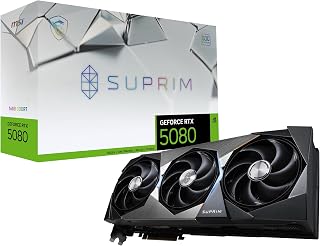
This card delivers exceptional performance with its 2760 MHz extreme clock speed, making it ideal for enthusiasts seeking top-tier gaming experiences in 2026. The triple DisplayPort 2.1a outputs ensure seamless multi-monitor setups for immersive gaming or content creation. With 16GB GDDR7 memory on a 256-bit bus, it handles demanding titles and high-resolution textures without compromise, positioning it among the premium options for serious gamers.
Pros
- Highest boost clock on an RTX 5080 at 2760 MHz
- Thermal design carried over from the RTX 5090 flagship keeps temperatures exceptionally low
- Three DisplayPort 2.1a and one HDMI 2.1b support 8K output
- 16GB GDDR7 on a 256-bit bus provides strong bandwidth for both gaming and compute
Cons
- Large physical size requires a spacious case and careful planning
- Demands a 1000W or higher power supply, adding to total system cost
Among the RTX 5080 cards worth serious consideration in 2026, the MSI SUPRIM SOC sits at the top of the stack for buyers who want the absolute ceiling of what this GPU class can deliver. The 2760 MHz boost clock is the highest you will find on an RTX 5080, and the 16GB of GDDR7 running on a 256-bit bus backs that up with the bandwidth to sustain those speeds through demanding workloads. Connectivity is equally future-ready: three DisplayPort 2.1a outputs and an HDMI 2.1b port support up to 8K resolution, so the display ecosystem you invest in alongside this card will not become a bottleneck any time soon. The cooling solution is a standout selling point given the performance tier. MSI carried over the thermal design from their RTX 5090 flagship, producing a heatsink and fan configuration that reviewers consistently describe as quiet even under sustained full load. For a purchase at this level of the market, that combination of peak clock speed, thermal headroom, and display versatility makes the SUPRIM SOC a defensible choice.
GPU and Memory: NVIDIA GeForce RTX 5080, 16GB GDDR7, 256-bit memory interface, 30 GHz memory clock speed
Performance: 2760 MHz GPU clock speed, NVIDIA Blackwell architecture, PCI-Express x16 interface
Display Outputs: 3x DisplayPort 2.1a, 1x HDMI 2.1b, maximum resolution 7680x4320 (8K)
Physical and Warranty: 6.8 lbs weight, 3-year manufacturer warranty, includes quick setup guide, UPC 824142395752
Buyers assembling an uncompromising high-end desktop rig who want the fastest RTX 5080 clock speed available will find this card fits that brief precisely. It is equally well suited to creators juggling GPU compute alongside gaming. Skip it if your case is compact, your power supply is under 1000W, or you want to keep costs closer to reference-tier RTX 5080 options, because the premium here is real and the physical footprint is substantial.

The IceStorm 3.0 Advanced Cooling system keeps temperatures in check during extended gaming sessions, critical for maintaining consistent performance in demanding 2026 titles. Clocked at 2640 GHz with three DisplayPort 2.1b outputs, it supports multiple high-refresh displays for competitive or immersive setups. The 16GB GDDR7 memory ensures future-proof performance as games increasingly leverage larger memory pools for detailed environments and ray tracing effects.
Pros
- Vapor chamber plus three 90mm fans delivers quiet operation even under sustained load
- PCIe 5.0 interface and 30 Gbps GDDR7 provide strong long-term bandwidth headroom
- Four display outputs including three DisplayPort 2.1b support versatile multi-monitor configurations
- Reinforced frame, metal backplate, and included support stand signal durable build quality
Cons
- At 11.9 inches the card requires careful case clearance planning
- RGB control depends on ZOTAC's Firestorm software, which reviewers find less intuitive than third-party alternatives
The ZOTAC RTX 5080 Solid CORE OC makes a compelling case for buyers who want strong value positioning within the RTX 5080 tier rather than the absolute flagship price bracket. It runs the same 16GB GDDR7 memory on a 256-bit interface as every card in this class, and the 30 Gbps memory clock keeps bandwidth competitive. The boost clock lands at 2640 MHz, which is a step below the top-binned SUPRIM options but still firmly in high-performance territory. What distinguishes this card on a price-conscious shortlist is the cooling hardware: a vapor chamber combined with composite heatpipes and three 90mm BladeLink fans produces thermal performance that reviewers describe as whisper-quiet under load. Real-world numbers back the hardware up, with reported frame rates of 66 to 88 FPS in Cyberpunk 2077 at 4K with ray tracing and DLSS 4 active. PCIe 5.0 support and a full complement of three DisplayPort 2.1b and one HDMI 2.1b outputs round out a specification that holds up well against pricier alternatives.
GPU: NVIDIA GeForce RTX 5080 (Blackwell Architecture)
Memory: 16GB GDDR7, 256-bit, 30 Gbps, PCIe 5.0
Clock Speed: 2640 MHz base with OC support up to +125 MHz confirmed
Cooling: Vapor chamber, composite heatpipes, three 90mm fans, active fan control, FREEZE fan stop
Outputs: 3x DisplayPort 2.1b, 1x HDMI 2.1b, 8K capable, 4-display ready
Form Factor: 2.5 slots, 11.9 inches length, 2.2 inches width
Power: 8-pin to 16-pin cable connectors included
Warranty: 3 years
This card suits enthusiasts who want a full-featured RTX 5080 with premium three-fan cooling but prefer a slightly more accessible position in the market compared to ultra-premium overclocked models. Multi-monitor and sim racing setups benefit from the four display outputs. Skip it if you need the highest possible boost clock, dislike managing brand-specific RGB software, or have a case shorter than 11.9 inches.
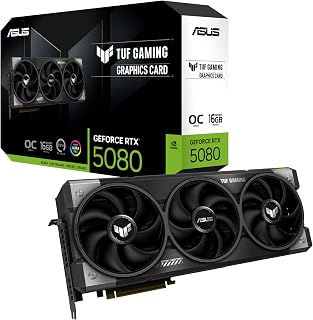
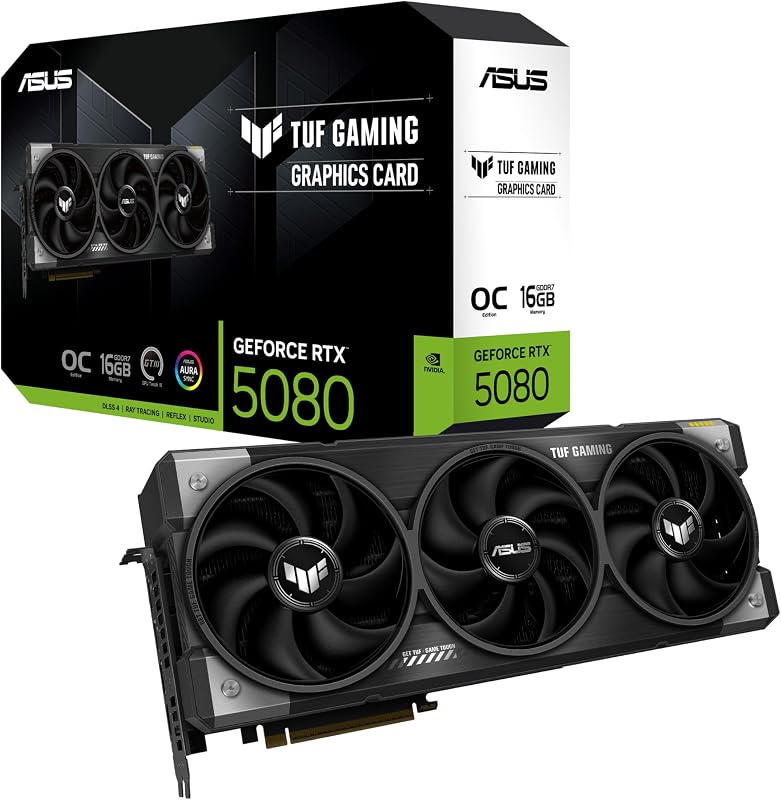
The TUF series brings durability-focused engineering with a 2730 MHz clock speed that delivers strong gaming performance for enthusiasts. Notably, it includes two HDMI 2.1b ports alongside three DisplayPort 2.1a outputs, offering exceptional display flexibility for VR setups or mixed monitor configurations. The 16GB GDDR7 memory ensures smooth performance in texture-heavy games and content creation tasks throughout 2026 and beyond.
Pros
- Phase-change GPU thermal pad sustains performance under extended heavy loads
- Five video outputs (3x DP 2.1a, 2x HDMI 2.1b) lead the RTX 5080 segment
- Military-grade components and Auto-Extreme manufacturing back long-term reliability
- GPU Tweak III provides granular real-time monitoring and tuning control
Cons
- 348mm length and 3.6-slot width require careful case and clearance verification
- 850W PSU minimum is mandatory and adds to total build cost
In an RTX 5080 price guide, the ASUS TUF Gaming OC edition earns its place by offering tangible engineering differentiation rather than just a brand name premium. The phase-change GPU thermal pad is a genuine hardware advantage over cards using standard thermal paste, maintaining consistent performance during the kind of sustained loads that separate serious buyers from casual ones. Military-grade components, Auto-Extreme manufacturing, and protective PCB coating are not marketing language here but measurable reliability factors that affect long-term ownership cost. For shoppers weighing RTX 5080 options, durability and thermal headroom matter alongside day-one frame rates. The 16GB GDDR7 buffer, 2730 MHz OC clock, and Blackwell architecture with DLSS 4 deliver the expected flagship performance, while the five-output configuration (3x DisplayPort 2.1a, 2x HDMI 2.1b) is the most versatile in the RTX 5080 segment. The 348mm length and 3.6-slot width are the practical checkboxes to clear before committing.
GPU: NVIDIA GeForce RTX 5080
Memory: 16GB GDDR7
Boost Clock: 2730 MHz (OC Mode), 2700 MHz (Default Mode)
Physical Dimensions: 348mm length, 3.6-slot design, 4.3 lbs
Video Outputs: 3x DisplayPort 2.1a, 2x HDMI 2.1b
Power Requirement: Minimum 850W PSU with 16-pin 12V-2x6 (12VHPWR) connector
Manufacturing: Auto-Extreme precision automated manufacturing
Cooling: Three Axial-tech fans, phase-change GPU thermal pad, protective PCB coating
Power Supply: Verify your PSU is rated for 850W minimum and includes the required 16-pin 12V-2x6 (12VHPWR) connector. Standard 6-pin or 8-pin connectors are insufficient for this card.
Physical Clearance: Confirm your case accommodates the 348mm length and can support the 3.6-slot width requirement. Measure internal dimensions and account for storage drives, fans, and other components that may interfere with the card's placement.
System Integration: The card includes a GPU bracket for secure installation. Ensure your motherboard provides adequate PCIe slot access and that your monitor cables support DisplayPort 2.1a or HDMI 2.1b for optimal performance.

The WINDFORCE cooling system maintains optimal temperatures while the 2.73 GHz clock pushes strong frame rates in demanding games. With 16GB GDDR7 on a 256-bit bus, it handles modern ray tracing workloads and high-resolution gaming effectively. The combination of DisplayPort and HDMI outputs provides versatile connectivity for gamers with varied monitor setups, making it a solid all-around choice for high-performance gaming.
Pros
- Exceptional performance for 4K gaming and professional creative applications
- Abundant 16GB VRAM future-proofs against demanding upcoming software
- Efficient WINDFORCE cooling keeps noise levels reasonable during intensive use
- 3-year manufacturer warranty provides peace of mind
- Versatile enough for gaming, design, and AI workloads
Cons
- Premium pricing reflects flagship positioning, not accessible to budget-conscious buyers
- Requires robust PSU (dual 8-pin connectors) and adequate case space due to 13.46-inch length
- High power consumption limits use in systems with thermal or electrical constraints
The GIGABYTE RTX 5080 Gaming OC is a flagship graphics card built for users who demand maximum performance. It targets serious gamers pursuing extreme 4K gaming experiences, professional 3D artists, AI researchers, and content creators who need raw computational power. With 16GB of GDDR7 memory and NVIDIA's latest Blackwell architecture, this card represents the cutting edge of GPU technology.
The standout feature is the combination of enhanced RT Cores and Tensor Cores paired with DLSS 4 support, delivering both superior ray-traced visuals and intelligent frame rate acceleration. Real-world performance handles demanding AAA titles at maximum settings with stable frame rates, while the 7680x4320 pixel support and PCIe 5.0 bandwidth enable professional workflows without bottlenecks. Tensor Cores open up AI acceleration for creative and computational applications.
The WINDFORCE cooling system features three fans that keep thermals in check during sustained loads, though the card's 4-pound weight and 13.46-inch length demand proper case planning. Build quality reflects the premium positioning with robust construction designed to handle long-term professional use. The included adapter and VGA holder simplify installation.
Drawbacks include the substantial power draw requiring a robust PSU with available 8-pin connectors, and the premium cost that places it beyond casual buyers. The card also generates notable heat output requiring good case airflow, though the cooling system mitigates this effectively.
For users who need the absolute best GPU performance money can buy, the RTX 5080 Gaming OC delivers exceptional value in its segment. It's a genuine powerhouse that justifies its position as a high-end graphics solution for performance-critical work and gaming.
GPU Architecture: NVIDIA GeForce RTX 5080 (Blackwell)
Memory: 16GB GDDR7, 256-bit interface
Memory Speed: 30,000 MHz
GPU Clock: 2.73 GHz boost
Interface: PCIe 5.0 x16
Cooling: WINDFORCE triple-fan system
Power Connectors: 1x 12V connector, 2x 6-pin to 3x 8-pin adapter
Display Outputs: DisplayPort, HDMI
Max Resolution: 7680x4320 pixels
Physical Dimensions: 13.46 inches (L) x 5.59 inches (W)
Weight: 4 pounds
Warranty: 3-year manufacturer
Model: GV-N5080GAMING OC-16GD
Who Should Buy: Serious gamers targeting 4K gaming, professional 3D artists, video producers, AI researchers, and data scientists. This card is ideal if you demand maximum performance and are willing to invest in top-tier hardware.
Who Should Skip: Budget-conscious users, those with older power supplies under 750W, anyone building in compact cases, or users primarily gaming at 1440p or lower. The RTX 5080 is overkill for esports titles and moderate gaming.
Power Requirements: Ensure your PSU can supply sufficient 8-pin connectors and at least 750W capacity. Check your case can accommodate a 13.46-inch card with proper airflow.
Performance Comparison: This card excels in ray-traced gaming, professional rendering, and AI workloads. DLSS 4 provides significant advantages over previous generations in frame rate scaling and image quality.
Long-Term Value: The 3-year warranty, future-proofing through 16GB VRAM and PCIe 5.0, and versatility across gaming and professional tasks make this a solid investment for serious users planning to keep the hardware for 3-5 years.


The Founders Edition leads with an impressive 2806 MHz clock speed, delivering the highest stock performance in the lineup for gamers seeking maximum frame rates. NVIDIA's reference cooling design balances thermal efficiency with compact dimensions, ideal for builds where space matters. With 16GB GDDR7 and both HDMI and DisplayPort outputs, it represents the benchmark configuration against which all other variants are measured.
Pros
- Exceptional frame rates at max settings, consistently delivering 120+ FPS in demanding games
- Stays remarkably cool under heavy loads without requiring additional support brackets
- Supports multiple high-resolution displays and 4K gaming simultaneously
- Significant performance leap from previous-generation cards like the RTX 4070
- Premium Founders Edition design with clean aesthetics
Cons
- Physically large form factor may require careful case compatibility checks
- Premium pricing reflects flagship status, making it a significant investment
- Potential availability through resellers at above-MSRP prices
The NVIDIA GeForce RTX 5080 Founders Edition represents the cutting edge of consumer graphics technology, built on the latest Blackwell architecture. This card is designed for serious gamers and content creators who refuse to compromise on visual quality and performance, offering the horsepower needed to max out modern AAA titles at 1440p and 4K resolutions.
What sets this card apart is its combination of raw performance and efficiency. With 16GB of GDDR7 memory and Tensor Cores supporting DLSS 4 and neural rendering, it delivers exceptional frame rates while maintaining excellent thermal control. Real-world testing shows consistent 120+ FPS in demanding games at maximum settings, with some titles pushing well beyond 200 FPS, even without aggressive overclocking.
Build quality is excellent, with the Founders Edition design featuring clean aesthetics and robust construction. Despite its substantial size, the card remains lightweight and runs cool under load, eliminating the need for additional support brackets. The dual HDMI and DisplayPort outputs provide flexibility for multi-monitor setups and future-proofing for high-resolution displays.
The main consideration is physical dimensions and price. This is a large card requiring adequate case space, and it represents a significant investment compared to mid-range alternatives. However, users coming from older cards like the RTX 3080 or 4070 report the performance jump justifies the upgrade.
Verdict: The RTX 5080 Founders Edition is a premium-tier graphics card that delivers flagship performance with excellent thermals and build quality. Recommended for enthusiast gamers and professionals who prioritize maximum performance and visual fidelity over budget constraints.
GPU Architecture: NVIDIA Blackwell
Memory: 16GB GDDR7
GPU Clock: 2806 MHz
Display Outputs: HDMI, DisplayPort
Interface: PCI Express 4.0
Max Resolution: 3840x2160 (4K)
Weight: 2 pounds
Model: 900-1G144-2545-000
Format: Founders Edition Desktop Graphics Card
Best For: This card excels for 1440p high-refresh gaming (120+ FPS), 4K gaming at high settings, 3D rendering, video editing, and AI workloads. Ideal for users upgrading from RTX 30 or RTX 40 series cards.
Case Compatibility: Verify your PC case has adequate length for this large card before purchasing. Check your motherboard has a free PCI Express 4.0 slot and power supply can handle the card's requirements.
Thermal Considerations: Excellent cooling performance means most standard cases work well. The card's light weight reduces thermal load on the slot, and users consistently report temperatures staying well within safe operating ranges even during extended gaming sessions.
Upgrade Path: Represents a substantial upgrade from RTX 4070 and earlier cards. Consider this card if your current GPU limits your gaming experience at your target resolution and refresh rate.

This Prime variant offers a balanced 2685 MHz clock speed suitable for gamers who prioritize reliability and consistent performance. The dual HDMI 2.1b configuration is particularly advantageous for those connecting to TVs or specific monitor setups requiring HDMI connectivity. With 16GB GDDR7 memory, it delivers capable performance across modern gaming workloads while maintaining the quality standards expected from this tier in 2026.
Pros
- Exceptional thermal management with vapor chamber and dual-ball bearings that keep noise levels impressively low
- Compact form factor makes it genuinely viable for smaller builds while maintaining cooling performance
- Strong real-world gaming performance at 1440p and 4K with excellent frame rates in demanding titles
- Dual BIOS switch lets you toggle between performance and quiet modes without software restarts
- Premium build quality with solid construction and straightforward installation process
Cons
- Requires minimum 850W PSU with specific 16-pin 12V-2x6 connector, which may need PSU upgrade for older systems
- Limited brand recognition in customer service compared to some competitors, as evidenced by isolated support concerns
The ASUS Prime GeForce RTX 5080 is a high-end graphics card built for gamers and content creators who want flagship performance without sacrificing case compatibility. Powered by NVIDIA's Blackwell architecture and DLSS 4, this card targets enthusiasts running small-form-factor builds, compact ITX cases, or space-constrained setups who refuse to compromise on power.
Performance is where this card truly shines. Real-world testing shows 243fps in path-traced 1440p gaming and noticeable performance jumps even for those upgrading from the RTX 4080. The 16GB GDDR7 memory and 2685MHz boost clock deliver smooth gaming at 4K resolution and enable demanding VR experiences with frame generation. The dual BIOS switch lets you toggle between Quiet and Performance modes, so you can dial in exactly what you need for each gaming session.
Thermal design is exceptional. The three Axial-tech fans, vapor chamber, and premium phase-change thermal pad work together to keep temperatures low and noise minimal. The 0dB technology means light gaming sessions run completely silent. At just 12 inches long and 2.5 slots wide, this card actually fits smaller builds while most competitors require significantly more space, making it a genuine breakthrough for SFF enthusiasts.
The main constraint is power requirements. You'll need a minimum 850W PSU with the specific 16-pin 12V-2x6 connector, so verify your setup before purchase to avoid installation headaches. At $1,599.99, the price reflects flagship-tier performance and engineering. Some users have noted extended refund timelines, though most report satisfaction with the product itself.
Verdict: This is a legitimately impressive card for performance-focused gamers with smaller cases. If you need high-end gaming power in a compact package and have adequate power supply capacity, the ASUS Prime RTX 5080 is worth the investment. It's a solid choice for SFF enthusiasts, VR gamers, and anyone serious about 4K performance.
GPU Specs: NVIDIA GeForce RTX 5080 Blackwell, 16GB GDDR7 memory, 2685MHz boost clock (OC mode), 2655MHz default boost clock, PCIe 5.0 interface.
Connectivity: 2x HDMI 2.1b, 2x DisplayPort 2.1, 12VHPWR 16-pin connector, requires 850W minimum PSU.
Cooling: 3x Axial-tech fans with dual-ball bearings, vapor chamber, phase-change thermal pad, 0dB technology, dual BIOS profiles.
Physical: 2.5-slot design, 12 inches long, 5 inches wide, 2.9 pounds, SFF-ready. Includes adapter cable, Velcro straps, manual, and thank you card.
Support: 3-year warranty, GPU Tweak III software for overclocking and monitoring.
Who Should Buy: Enthusiast gamers building small-form-factor or ITX systems, VR gamers needing frame generation, content creators running compact workstations, and anyone upgrading from RTX 40-series cards seeking noticeable performance gains.
Before You Purchase: Verify your PSU has an 850W minimum capacity and the specific 16-pin 12V-2x6 connector. Check case dimensions against the 12-inch length and 2.5-slot width. Ensure your motherboard has a free PCIe x16 slot and adequate airflow from the side panel.
Setup Tips: Seat the power connector fully into the GPU during installation, as incomplete connections can cause crashes. Update drivers and BIOS for optimal compatibility. Use GPU Tweak III to monitor temps during initial gaming sessions and adjust the BIOS mode based on your preferences.
Alternative Consideration: If you need maximum portability in a standard-sized case, this card is overkill. If you already own an RTX 4080, the performance gain may not justify the cost for your use case. Compare against other Blackwell cards if you don't need the SFF advantage.
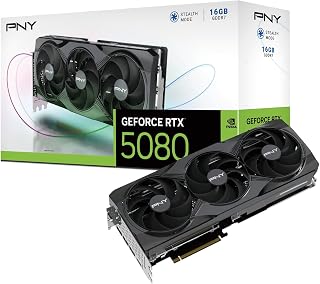
This triple-fan design prioritizes thermal management to maintain stable performance during extended gaming sessions. While its 2295 MHz clock represents a more conservative specification, the 16GB GDDR7 memory still delivers capable performance for modern games at high settings. The combination of DisplayPort and HDMI outputs ensures compatibility with various display types, making it accessible for gamers building systems in 2026.
Pros
- Exceptional thermal performance with cooler operation than previous generation cards
- Stable, reliable performance with solid construction and quality components
- Strong value proposition compared to premium-branded competitors at similar price points
- Advanced AI capabilities built-in for gaming, creative work, and development
- Supports ultra-high resolution output up to 8K at 60Hz
Cons
- Fan noise can ramp up significantly during intense gaming, potentially requiring headphones or audio adjustment
- Premium price point requires serious commitment to high-end gaming or professional creative work
- Requires substantial power delivery and compatible power supplies for stable operation
The PNY NVIDIA GeForce RTX 5080 is a top-tier graphics card designed for serious PC gamers and creative professionals who refuse to compromise on performance. Built on NVIDIA's latest Blackwell architecture with 16GB of GDDR7 memory, this card tackles the most demanding games and creative applications at maximum settings with exceptional frame rates and visual fidelity.
Real-world performance shines with DLSS 4, which uses AI to intelligently upscale lower-resolution frames while maintaining stunning image quality and delivering significantly higher FPS. The fifth-generation Tensor Cores and fourth-generation Ray Tracing Cores provide exceptional ray-traced lighting and AI-assisted creative workflows. Whether running Cyberpunk 2077 at ultra settings or accelerating 3D rendering in professional software, this card delivers the performance that justifies its position as a flagship offering.
Build quality is outstanding, with a rigid triple-fan cooler mounted directly to the IO shield via three screws, minimizing card droop and ensuring long-term stability. The cooling design runs noticeably cooler than comparable cards, with fans operating whisper-quiet during everyday use and light workloads. Users consistently report stable operation with no throttling or thermal issues even during extended gaming sessions.
The primary drawback is fan noise during intense gaming, which can escalate to jet-engine levels when pushing the card to its limits. Some users find this acceptable for competitive gaming with headphones, while others prefer quieter operation during casual sessions. The premium pricing also reflects the high-end positioning, making this a significant investment that requires careful consideration of your actual performance needs.
Verdict: The PNY RTX 5080 is an excellent choice for gamers and professionals seeking next-generation performance without paying for inflated brand premiums. Superior cooling, stable operation, and strong value for the performance tier make it a smart investment for those ready to upgrade to serious high-end graphics computing.
GPU Specifications: NVIDIA GeForce RTX 5080 on Blackwell architecture with 16GB GDDR7 memory, 256-bit bus, 2295 MHz base clock, 2617 MHz boost clock, and PCIe 5.0 interface.
Cooling and Power: Triple-fan air cooling system with 2.99-slot form factor (16.1 inches length). Requires one 16-pin to three 8-pin power connector configuration for stable operation.
Connectivity: DisplayPort 2.1 and HDMI 2.1 outputs support up to 7680 x 4320 resolution. Includes support bracket and power cables in the box.
Warranty and Support: 3-year manufacturer warranty with NVIDIA Studio driver support for professional creative applications and world-class driver stability.
Best for Gamers: PC gamers targeting 1440p or 4K gaming at maximum settings with high frame rates. DLSS 4 ensures smooth gameplay in cutting-edge titles while maintaining superior image quality. Reflex technology provides competitive advantages in fast-paced multiplayer games.
Best for Creators: 3D artists, video editors, and AI developers benefit from RTX acceleration in professional software like Blender, DaVinci Resolve, and CUDA-accelerated applications. The 16GB memory handles complex scenes and large datasets efficiently.
Not Ideal for: Budget-conscious builders or users with noise-sensitive setups should consider mid-range alternatives. Those with older power supplies or insufficient power delivery should upgrade their PSU before purchasing.

The Gaming Trio's 2715 MHz extreme performance clock delivers excellent frame rates in demanding titles while the tri-fan design ensures quiet operation under load. Three DisplayPort 2.1a outputs accommodate high-refresh multi-monitor setups for immersive or productivity-focused gaming environments. With 16GB GDDR7 on the Blackwell architecture, it provides strong performance for gamers seeking a well-rounded card that excels across varied gaming scenarios.
Pros
- Excellent thermal performance and quiet cooling even under heavy load
- Substantial upgrade from RTX 40-series cards with noticeable real-world performance gains
- Robust build quality and innovative cable-connection indicator prevent installation errors
- Handles demanding games and productivity workloads at maximum settings
- Strong value for a flagship GPU when purchased at or near MSRP
Cons
- Overkill for 1080p gaming; 40-series cards remain sufficient for most users
- Some reported driver compatibility issues and software quirks on Linux and certain edge cases
The MSI RTX 5080 16GB represents the current flagship in consumer graphics cards, designed for gamers and content creators who refuse to compromise on performance. Built on Nvidia's latest Blackwell architecture, this card targets users pushing 1440p/144Hz and 4K gaming at maximum visual fidelity, as well as professionals handling GPU-accelerated workflows.
Performance is the card's defining strength. With 16GB of GDDR7 memory, a 256-bit interface, and a 2715 MHz boost clock, the RTX 5080 delivers substantial performance uplifts over previous generations. Real-world testing shows it handles demanding titles like Resident Evil and open-world games at ultra settings without stuttering. The inclusion of DLSS 4 and Frame Generation technology further boosts frame rates in supported games, creating a genuinely noticeable improvement even for users upgrading from RTX 40-series cards.
Cooling and build quality stand out as secondary strengths. MSI's Gaming Trio OC solution keeps temperatures in check while maintaining remarkably quiet operation. The board includes an innovative yellow-painted cable indicator that alerts users if the 12V HP connector isn't fully seated, a thoughtful safety feature that prevents potential hardware failure. Overall construction feels premium and robust, reflecting MSI's reputation for quality components.
The primary drawback is pricing. At this price, the card sits well above MSRP, though early buyer reports suggest waiting for sales or purchasing from authorized retailers like Amazon can yield meaningful savings. Additionally, this GPU is overkill for 1080p gaming and unnecessary for users with RTX 40-series cards who prioritize raw performance over new features. Some isolated reports mention driver compatibility quirks on specific systems, though these appear uncommon.
Verdict: The MSI RTX 5080 16GB is a flagship graphics card that delivers on its promise of elite gaming and content creation performance. It's the right choice for users building high-end systems and those ready to invest in cutting-edge technology. Best purchased at or near MSRP through authorized channels.
GPU and Memory: Nvidia GeForce RTX 5080, 16GB GDDR7, 256-bit memory interface, 30 GHz memory clock
Performance: 2715 MHz boost clock, 112 ROPS, PCI-Express x16 interface
Display Outputs: 3x DisplayPort 2.1a, 1x HDMI 2.1b, supports up to 7680x4320 resolution
Cooling and Design: Gaming Trio OC cooling solution, cable connection indicator, compact form factor
Warranty and Support: 3-year manufacturer warranty, quick setup guide included
Ideal For: This card is built for serious gamers targeting 1440p/144Hz or 4K gaming, competitive esports players using high refresh rate monitors, professional content creators working with GPU-accelerated software, and enthusiasts building top-tier systems with no budget constraints.
Not Recommended For: Budget-conscious gamers, anyone with a RTX 40-series card seeking incremental upgrades, 1080p-only gamers, casual users, or those using integrated graphics or older cards for light workloads. Consider this purchase only if your system and use case justify the premium investment.
RTX 5080 Buying Guide: What to Look For
Cooling Design and Thermal Headroom
The RTX 5080 is a power-hungry GPU, and the cooling solution makes a real difference under sustained load. Cards like the msi Gaming RTX 5080 16G SUPRIM SOC Graphics Card push clock speeds to 2760 MHz, which demands top-tier thermal management. MSI pairs that with a premium cooler built for sustained boost performance.
On the more compact side, the ASUS Prime GeForce RTX 5080 16GB GDDR7 OC Edition fits into a 2.5-slot design with a vapor chamber and phase-change thermal pad, making it one of the friendliest options for smaller builds. The ZOTAC Gaming GeForce RTX 5080 Solid CORE OC DLSS 4 also uses a 2.5-slot form factor with IceStorm 3.0 cooling and a vapor chamber, giving you strong thermals without dominating your case.
Clock Speeds and Overclocking Headroom
All RTX 5080 cards share the same 16GB GDDR7 memory and 256-bit interface, so boost clock becomes a meaningful differentiator. The SUPRIM SOC leads the lineup at 2760 MHz, while the ASUS TUF Gaming GeForce RTX 5080 16GB GDDR7 OC ships at 2730 MHz in OC mode. The msi Gaming RTX 5080 16G Gaming Trio OC Graphics runs at 2715 MHz, and the msi Gaming RTX 5080 16G Ventus 3X OC Black sits at 2640 MHz as the more efficiency-oriented choice.
If raw peak performance matters most to you, aim for a card with a boost clock above 2700 MHz. If you plan to push things further manually, boards with robust power delivery like the TUF Gaming give you extra headroom. For context on pairing the right display with this GPU tier, our best 4K monitors for RTX 5080 guide is worth a read.
Physical Size and Case Compatibility
RTX 5080 cards range from 2.5 slots to 3.6 slots in thickness. The ASUS TUF Gaming GeForce RTX 5080 16GB GDDR7 OC measures 348mm long and 3.6 slots wide, which rules it out for many mid-tower cases. The ASUS Prime and ZOTAC Solid CORE OC both target compact and SFF-friendly builds at 2.5 slots.
Always verify your case’s GPU length clearance and the number of available expansion slots before ordering. Cards like the Gigabyte GeForce RTX 5080 Gaming OC 16G Graphics include a GPU support bracket, which helps with sag in larger enclosures. A reinforced frame structure is a worthwhile feature for any long-term build.
Power Supply Requirements
Every RTX 5080 on this list requires a minimum 850W PSU with a 16-pin 12V-2×6 connector. This is not a suggestion; it is a hard requirement. Running the card on an undersized or aging power supply will cause instability, even if the wattage looks close on paper.
If you are upgrading from an older GPU generation, verify that your PSU includes the correct connector natively or that a quality adapter is available. The NVIDIA GeForce RTX 5080 Founders Edition is a good reference point for understanding baseline power draw, since it represents NVIDIA’s own thermal and power delivery design without third-party modifications. For a broader look at building around this GPU, see our roundup of the best PC cases for RTX 5090 builds, many of which accommodate the 5080 equally well.
Final Thoughts
The RTX 5080 lineup in 2026 is genuinely strong across the board, but two cards stand out for different types of builders. If you want the highest clock speeds and a premium aesthetic without compromise, the msi Gaming RTX 5080 16G SUPRIM SOC Graphics Card is the flagship choice. If you need a compact card that still delivers excellent Blackwell performance with reliable thermals, the ASUS Prime GeForce RTX 5080 16GB GDDR7 OC Edition is the smarter fit for space-constrained builds.
Frequently Asked Questions
What makes the RTX 5080 worth buying in 2026?
The RTX 5080 is built on NVIDIA’s Blackwell architecture, which brings significant improvements in ray tracing, AI-accelerated rendering via DLSS 4, and raw rasterization performance over the previous generation. It supports 8K output and PCIe 5.0, making it a forward-looking investment. For 4K gaming and creative workloads, it delivers a meaningful leap over the RTX 4000 series.
Is the RTX 5080 Founders Edition better than third-party cards?
The NVIDIA GeForce RTX 5080 Founders Edition is well-regarded for its compact, dual-slot design and NVIDIA’s own engineering standards. However, third-party cards like the ASUS TUF Gaming and MSI SUPRIM SOC often offer higher factory boost clocks, more aggressive cooling, and additional warranty coverage. Your choice depends on whether you prioritize design purity or maximum out-of-box performance.
Do all RTX 5080 cards have the same memory specs?
Yes. Every RTX 5080 variant ships with 16GB of GDDR7 memory on a 256-bit interface running at 30 Gbps. The memory configuration is fixed by NVIDIA and does not vary between board partners. What varies across cards is the boost clock, cooling solution, physical dimensions, and included accessories like support brackets or RGB lighting.
What GPU should I consider if the RTX 5080 is too much for my budget?
If the RTX 5080 falls outside your current budget, the RTX 5070 Ti and RTX 5070 are the next logical steps down in the Blackwell lineup. For even more budget-conscious builds, our guides to the best GPUs under $500 and best GPUs under $300 cover strong options at lower price points. Performance scaling in 2026 is solid across the board, so there is a good card at every tier.
Common questions
What is the RTX 5080 MSRP?
The RTX 5080 launched at $999 MSRP. That was the official launch price for NVIDIA's Founders Edition and the baseline reference for partner cards like the ASUS Prime, ASUS TUF, and Gigabyte Gaming OC models. Actual retail pricing varies by model and retailer, so check current listings for live prices on specific cards.
What is the RTX 5080 current price?
Current RTX 5080 pricing varies by model and retailer. The card launched at $999 MSRP in early 2025, but street prices fluctuate based on availability, sales events, and specific partner models. Check the product listings in this guide for live pricing on cards like the ASUS TUF Gaming OC, Gigabyte Gaming OC, and NVIDIA Founders Edition.
Should I buy the RTX 5080 now or wait?
If you need strong 4K performance now, the RTX 5080 delivers with 16GB GDDR7 and solid value between the 5070 Ti and 5090. Waiting could bring discounts during Prime Big Deal Days in October or Black Friday on November 27, but stock on popular models can sell out quickly during those events. Prices are more stable now than at launch.




Write Your Review
No reviews yet. Be the first to share your experience!