

Building a high-end gaming rig around AMD’s RX 9070 XT demands a processor that can keep pace with its formidable graphics horsepower. Bottlenecking at the CPU level wastes the card’s potential, leading to stuttering frame times and underutilized GPU resources during intensive gaming sessions or creative workflows.
This guide evaluates six AMD Ryzen processors across the Zen 5 architecture, including standard models and cutting-edge 3D V-Cache variants. Whether you prioritize competitive esports frame rates, 4K gaming smoothness, or hybrid creator workloads, you’ll find a validated recommendation backed by real-world performance metrics. If you’re also considering processors for the RX 9070 standard model, many of these options apply equally well.
Quick Comparison
| Model | Link | Rating | CPU Speed | CPU Socket | Secondary Cache |
|---|---|---|---|---|---|
| 1 AMD Ryzen 5 9600X 6-Core Zen 5 Processor, 5.4 GHz, Socket...Highest rated | Check price | 4.9 of 54,060 ratings | 3.9 GHz | Socket AM5 | 6 MB |
| 2 AMD Ryzen 7 9800X3D 8-Core Gaming CPU with 3D V-Cache,...Most reviewed | Check price | 4.8 of 56,151 ratings | 4.7 GHz | Socket AM5 | 8 MB |
| 3 AMD Ryzen 7 9850X3D 8-Core Gaming CPU 4.7GHz Socket AM5... | Check price | 4.7 of 5432 ratings | 4.7 GHz | Socket AM5 | 8 MB |
| 4 AMD Ryzen 9 9950X 16-Core Processor - 5.7 GHz Gaming &... | Check price | 4.7 of 51,200 ratings | 4.3 GHz | Socket AM5 | 16 MB |
| 5 AMD Ryzen 9 9900X3D 12-Core Processor - High Performance... | Check price | 4.7 of 5340 ratings | 4.4 GHz | Socket AM5 | 12 MB |
| 6 AMD Ryzen 9 9950X3D 16-Core Processor | Gaming & Content... | Check price | 4.7 of 51,859 ratings | 4.3 GHz | Socket AM5 | 16 MB |
Ratings reflect the most recent data pull. Check each listing for current price and availability.

The 6-core configuration with 3.9 GHz base clock delivers solid gaming performance without bottlenecking the RX 9070 XT at 1440p and 4K resolutions. Its 65-watt TDP keeps power consumption and thermals manageable in compact builds while the Socket AM5 platform ensures compatibility with modern DDR5 and PCIe 5.0 features that complement high-end GPU performance.
Pros
- 65W TDP keeps thermals and noise low in RX 9070 XT builds
- 5.4 GHz boost and Zen 5 architecture eliminate CPU bottlenecks at 1440p
- Unlocked for overclocking headroom when needed
- Socket AM5 supports DDR5 and PCIe 5.0 for future upgrades
Cons
- No cooler included, adding to build cost
- Factory voltage set high, manual tuning recommended
Pairing a mid-tier CPU with the RX 9070 XT makes sense when you want to avoid bottlenecks without overspending on cores you won't use. The Ryzen 5 9600X brings 6 cores and 12 threads on Zen 5 architecture, reaching 5.4 GHz boost speeds while sipping just 65W of power. For GPU-bound gaming at 1440p and above, where the RX 9070 XT does the heavy lifting, this processor won't hold you back. It keeps frame pacing smooth in modern titles while leaving thermal headroom in your case. The unlocked multiplier lets you squeeze extra performance if needed, and Socket AM5 compatibility ensures you can tap into DDR5 and PCIe 5.0 when your motherboard supports it. Efficiency is the standout trait here: cool operation under load means quieter builds and less strain on your cooling setup. Factory voltage runs a bit high, so minor tuning can drop temperatures further. No bundled cooler means you'll shop separately, but the low TDP makes affordable air cooling perfectly viable. For builders targeting strong 1440p gaming with the RX 9070 XT, the 9600X delivers exactly what's needed without wasted cores or excess heat.
Processor Details: AMD Ryzen 5 9600X, 6 cores, 12 threads, Zen 5 architecture, Socket AM5
Clock Speeds: Base 3.9 GHz, Max Boost 5.4 GHz, unlocked multiplier
Power and Thermal: 65W TDP, air cooling recommended, efficient thermal design
Memory and Cache: 38 MB total cache (6 MB L2), DDR5-5600 support
Platform: Socket AM5 compatible, PCIe 5.0 ready on select motherboards, Windows 11 optimized
Package: 3-year manufacturer warranty, cooler not included
This fits builders pairing the RX 9070 XT in gaming-focused systems where the GPU drives performance and six fast cores suffice. Ideal for 1440p gamers prioritizing efficiency and quiet operation on a reasonable budget. Skip this if you run heavily threaded creative workloads alongside gaming, where 8+ cores show clear advantages, or if you already own a comparable 6-core chip. Also avoid if you expect a cooler in the box.

The 8-core design with 4.7 GHz clock speed provides excellent gaming headroom for the RX 9070 XT while handling background applications and streaming workloads. Its 140-watt thermal envelope balances performance with thermal management, and the architecture ensures smooth frame delivery without CPU-side bottlenecks in demanding titles at any resolution where this GPU excels.
Pros
- 96MB L3 cache delivers superior frame pacing with RX 9070 XT
- 8 cores and 5.2 GHz boost eliminate CPU bottlenecks at high refresh
- 140W TDP manageable with quality cooling in gaming builds
- Socket AM5 allows easy motherboard compatibility
Cons
- No bundled cooler increases total build cost
- Upgrade from 7800X3D shows limited gains at GPU-bound resolutions
When the RX 9070 XT meets a CPU bottleneck in demanding titles, the 9800X3D eliminates it entirely. This 8-core, 16-thread processor leverages stacked 3D V-Cache and 96MB L3 cache to deliver consistent frame pacing and superior 1% lows, exactly what matters when your GPU has power to spare. Zen 5 architecture pushes boost clocks to 5.2 GHz, handling CPU-intensive game logic and physics without breaking a sweat. The RX 9070 XT thrives at high refresh rates, and this chip ensures every frame arrives on time. Socket AM5 compatibility means drop-in upgrades for existing boards, and the 140W TDP stays manageable with quality air or AIO cooling. Users report stable long sessions with zero crashes, and thermals remain controlled under sustained load. The massive cache advantage translates to real gains in AAA titles and esports scenarios where frame consistency separates smooth from stuttery. No cooler ships in the box, so budget accordingly. For those upgrading from recent X3D chips, gains diminish at GPU-limited resolutions, but pairing this with the RX 9070 XT at 1080p or 1440p high refresh unlocks the full potential of both components.
Cores and Threads: 8 cores, 16 threads
Architecture: Zen 5 with 3D V-Cache
Base Clock: 4.7 GHz
Boost Clock: Up to 5.2 GHz
Cache Memory: 96MB L3 cache, 8MB secondary cache
Socket: AM5
Power Consumption: 140 watts
Manufacturing Process: Advanced node (Zen 5)
Compatibility: Windows 11, requires external cooler
Best For: This CPU excels for competitive gamers, esports players, AAA gaming enthusiasts, content creators, and anyone building a high-performance workstation. If you play demanding games, edit video, stream, or multitask heavily, the 9800X3D delivers performance that justifies the investment.
Consider If: You own an older CPU from the Ryzen 5000 or 7000 series and want the fastest gaming performance available. The generational jump offers meaningful real-world improvements in frame consistency and 1% lows across modern games.
Skip If: You primarily game at 1440p or lower resolutions on a mid-range GPU, where CPU performance is rarely the limiting factor. Also reconsider if you already own a 7800X3D, as the upgrade benefits are incremental unless you're targeting high-resolution content creation.
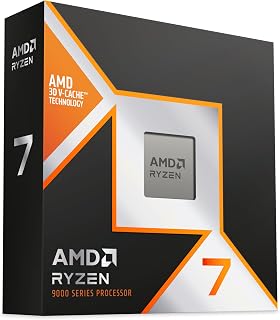
The massive 104 MB cache memory dramatically reduces frame time variance when paired with the RX 9070 XT, delivering smoother gameplay in cache-sensitive titles. Its 4.7 GHz clock speed across 8 cores ensures the GPU receives data efficiently while the Socket AM5 platform provides the bandwidth necessary for maximizing graphics card utilization in modern gaming scenarios.
Pros
- 5.6 GHz boost ensures RX 9070 XT never waits on CPU performance
- 3D V-Cache delivers exceptional frame consistency in modern games
- 8 cores handle gaming plus background tasks effortlessly
- Proven thermal performance with quality cooling solutions
Cons
- Premium pricing suits high-end builds only
- Warmer idle temperatures require good case airflow
Matching the RX 9070 XT with the fastest gaming processor available guarantees you'll never wonder if your CPU is limiting performance. The 9850X3D combines 8 cores, 16 threads, and a 5.6 GHz boost clock with 3D V-Cache architecture optimized for modern game engines. That 400MHz boost advantage over prior generations translates directly into tighter frame pacing and improved 1% lows, exactly what competitive and AAA gaming with a high-end GPU demands. Users report significant performance gains across demanding titles, with the RX 9070 XT fully utilized at 1080p and high-refresh 1440p scenarios. The chip maintains smooth operation under sustained load, with proper cooling keeping temperatures below 75 degrees Celsius during gaming sessions. Socket AM5 integration and 140W TDP fit standard builds, though idle temperatures run warmer than typical processors, requiring attention to case airflow. This pairing makes sense when you're targeting maximum frame rates in CPU-sensitive titles or competitive settings where every frame counts. For 1440p and 4K gaming where the GPU does most of the work, more affordable options deliver nearly identical results. The premium here buys certainty: no CPU bottleneck will ever limit what your RX 9070 XT can deliver.
Processor Series: AMD Ryzen 7
Model Number: 9850X3D
Cores/Threads: 8 cores, 16 threads
Base Clock: 4.7 GHz
Boost Clock: 5.6 GHz
Cache: 104 MB total (8 MB L2, 96 MB 3D V-Cache)
TDP: 140W
Socket: AM5
Process: 5nm
Warranty: 3 years
Part Number: 100-100001973WOF

The 16-core, 32-thread configuration excels for users pairing the RX 9070 XT with content creation workflows alongside gaming. Its 80 MB cache and 4.3 GHz speed handle rendering, encoding, and multitasking without compromising GPU performance, while the 170-watt specification reflects the processing power needed for professional workloads that leverage GPU acceleration.
Pros
- 5.7 GHz boost eliminates GPU bottlenecks at high resolutions
- 16 cores handle gaming plus background tasks effortlessly
- PCIe 5.0 support future-proofs RX 9070 XT bandwidth needs
- Unlocked multiplier allows performance tuning for enthusiasts
Cons
- Requires quality liquid cooling due to high thermal output
- 170W TDP demands robust PSU and case airflow
Pairing the RX 9070 XT with the Ryzen 9 9950X creates a zero-compromise setup for gamers who demand extreme framerates without bottlenecks. This 16-core Zen 5 processor delivers the raw single-thread speed and multi-core headroom needed to feed a high-end GPU at 1440p or 4K. The 5.7 GHz max boost ensures the RX 9070 XT stays fully utilized in CPU-bound scenarios, while the unlocked multiplier lets enthusiasts fine-tune for maximum gaming performance. Users report flat frame pacing and consistent 96+ FPS in demanding AAA titles, proof that the architecture handles high-refresh gaming with ease. The Socket AM5 platform brings PCIe 5.0 support on compatible X870 motherboards, future-proofing your build as GPU bandwidth demands grow. Stability is rock-solid across modern boards with zero crashes reported. The intelligent workload management is noteworthy: idling at 40W during desktop tasks, then scaling to 140W+ when gaming sessions heat up. This efficiency means the chip won't waste power when you're not pushing it, but has reserves ready when the RX 9070 XT needs maximum CPU support. The 3-year warranty adds confidence to this flagship investment.
Processor: AMD Ryzen 9 9950X
Cores/Threads: 16 cores, 32 threads
Architecture: Zen 5
Base/Boost Clock: 4.3 GHz base, 5.7 GHz max boost
Socket: Socket AM5 (AM5 platform)
TDP: 170 watts
Cache: 80 MB total (16 MB L2)
Memory Support: DDR5-5600
Platform Features: PCIe 5.0 support on select motherboards
Warranty: 3-year manufacturer warranty
Unlocked: Yes, for overclocking
This processor suits enthusiasts building a top-tier gaming rig around the RX 9070 XT, especially those who also run content creation workloads like streaming or video editing. Gamers chasing high-refresh 1440p or 4K performance will appreciate the headroom. Skip this if you're gaming at 1080p on a tight budget, as the 16 cores and premium cost are excessive for that scenario. Casual gamers who don't need workstation capability should consider more affordable options that still pair well with the RX 9070 XT.

Pros
- Exceptional gaming performance with 3D V-Cache technology optimization
- Runs cool and power-efficient compared to competing high-end processors
- High core count makes it excellent for professional content creation and streaming
- Straightforward installation and AM5 ecosystem compatibility
- Outstanding value for combined gaming and productivity performance
Cons
- Requires a compatible Socket AM5 motherboard and adequate cooling solution
- Premium price point may exceed budget for casual users or entry-level builds
The AMD Ryzen 9 9900X3D is a flagship 12-core processor designed for serious gamers, content creators, and power users who refuse to compromise on performance. Featuring 24 threads and AMD's advanced 3D V-Cache technology, this CPU excels at delivering frame rates in modern games while simultaneously handling heavy production workloads like video editing, 3D rendering, and streaming.
The standout feature is the impressive 140MB cache architecture, which combines a massive L3 cache with smart caching layers to keep your most-used data instantly accessible. Users report that the processor feels snappy and responsive across all applications, tearing through multitasking scenarios that would slow down conventional CPUs. The 4.4 GHz base clock provides plenty of headroom for both gaming and CPU-bound creative tasks without requiring aggressive overclocking.
Build quality is excellent and installation is straightforward for anyone familiar with AM5 socket systems. The processor runs remarkably cool thanks to its efficient 120W thermal design, meaning you can use more affordable cooling solutions than you might expect with a high-performance chip at this tier. Many users pair it successfully with standard AIO coolers and see temperatures well within normal operating ranges even during sustained workloads.
The primary consideration is that this is a premium component requiring a quality Socket AM5 motherboard and appropriate cooling infrastructure. It represents a significant investment, though the performance gains justify the cost for professionals and enthusiasts who will fully utilize the processing power. The 9900X3D bridges the gap between pure gaming optimization and workstation-class productivity.
Final verdict: The Ryzen 9 9900X3D is an exceptional choice for builders seeking a versatile, high-performance processor that dominates both gaming and content creation. Its combination of strong multi-core performance, low thermal footprint, and responsive cache architecture makes it one of the best processors available for demanding enthusiasts and creative professionals.
Core Configuration: 12 cores, 24 threads
Base Clock Speed: 4.4 GHz
Cache Memory: 140 MB total (12 MB L2, 128 MB L3 with 3D V-Cache)
Socket: Socket AM5
TDP: 120 watts
Manufacturing Process: Advanced TSMC process
Architecture: Zen 5 with 2nd Gen 3D V-Cache Technology
Model Number: 100-100001368WOF
Platform Support: Windows
Package Dimensions: 1.6 inches x 1.6 inches
Best for: This processor is ideal for gamers seeking maximum frame rates in competitive and AAA titles, content creators handling video production and 3D rendering, streamers who need both gaming performance and encoding power, system builders focused on AM5 platform, and professionals running multithreaded applications.
Consider alternatives if: You primarily play older or less demanding games and want to save money, you need workstation-specific features like ECC memory support, you prefer Intel platform ecosystem, or you have a strictly limited budget and cannot prioritize performance gains.
Not recommended for: Casual web browsing and office work users who would overpay for unnecessary performance, budget PC builders, or anyone who only plays lightweight indie titles.

Pros
- Elite dual-purpose performance for both high-refresh gaming and demanding renders
- Significantly faster than older 8-core and 14-core alternatives for content creation
- Better thermals and higher clock speeds than previous generation X3D chips
- Straightforward installation and broad AM5 motherboard compatibility
- Excellent value for professionals and enthusiasts buying a single powerful CPU
Cons
- Premium pricing places it outside budget-gaming builds, though single-threaded performance rivals lower-core alternatives
- Overkill for pure gaming; 9800X3D offers better frame-rate-per-dollar if rendering workloads are minimal
- Requires quality cooling and power delivery to sustain boost clocks and manage thermals
The Ryzen 9 9950X3D is a high-end desktop processor engineered for professionals and enthusiasts who refuse to compromise between gaming responsiveness and productivity throughput. With 16 cores, 32 threads, and 128MB of total L3 cache, it addresses a specific and valuable market segment: streamers, 3D artists, video editors, and power users running CPU-intensive workloads while gaming at high refresh rates.
Performance is exceptional across both use cases. The 2nd generation 3D V-Cache technology, now positioned under the compute cores rather than above them, eliminates the thermal constraints and clock-speed throttling that plagued the previous 7950X3D. Users report smooth sustained boosts to 5.7 GHz, making the chip capable of handling x265 rendering presets at speed and maintaining 100+ FPS in demanding titles when paired with flagship GPUs. The Zen 5 architecture and generous cache depth make CPU-bound simulations and heavy multitasking feel effortless.
Build and installation are straightforward on the AM5 platform. The processor ships in a standard desktop form factor, and compatibility with existing AM5 motherboards is broad. Temperature management is practical with a quality all-in-one cooler and proper case airflow, though power delivery and cooling infrastructure are prerequisites for stable sustained performance at this performance tier.
The main drawback is price and positioning. This chip commands a premium and is explicitly not the best choice for gamers who do nothing else; a 9800X3D or mid-range processor will deliver better value in pure gaming scenarios. Additionally, the 170W power envelope and thermal density mean cheaper or minimal cooling solutions will bottleneck the chip.
Verdict: The Ryzen 9 9950X3D is the right CPU for creators and enthusiasts building a machine that must excel at both gaming and professional workflows. It represents the maturation of AMD's X3D lineup and delivers legitimate performance improvements over prior generations, making it a sound investment for its intended audience.
This CPU is built for content creators who also game seriously, including video editors, 3D animators, software developers, and streamers. If your workday involves rendering or compiling and your evening involves competitive gaming or high-fidelity simulation, this is your chip.
It is not the optimal choice for pure gamers on a budget, office workers, or anyone whose workloads are single-threaded or memory-light. For those users, a lower-core-count processor or the 9800X3D offers better value.
Processor: AMD Ryzen 9 9950X3D, 16 cores, 32 threads
Architecture: Zen 5, Granite Ridge
Socket: AM5
Base Clock: 4.3 GHz
Boost Clock: Up to 5.7 GHz
Cache: 16MB L2, 128MB L3
Power: 170W TDP
Platform: Windows
Form Factor: Boxed desktop processor
Buying Guide: Choosing the Right Processor for Your RX 9070 XT
Selecting the optimal CPU involves balancing your workload demands, budget constraints, and future-proofing considerations. The following factors directly impact how well your processor complements the RX 9070 XT’s capabilities.
Core Count and Thread Configuration
Modern games increasingly leverage multiple threads, but the sweet spot varies by genre and resolution. Six-core processors like the AMD Ryzen™ 5 9600X 6-Core deliver exceptional 1080p and 1440p gaming performance while maintaining affordability, making them ideal for dedicated gaming builds without heavy background tasks.
For users who stream, edit video, or run virtual machines alongside gaming, eight-core and twelve-core options provide substantial headroom. The AMD Ryzen 9 9900X3D 12-Core Processor strikes a compelling balance for hybrid workloads, while sixteen-core chips cater to professional creators who demand maximum parallel processing capability. Similar considerations apply when evaluating processors for high-end NVIDIA cards in the same performance tier.
3D V-Cache Technology Benefits
AMD’s second-generation 3D V-Cache stacks additional L3 memory directly onto the CPU die, dramatically reducing latency for frequently accessed game data. This architectural enhancement translates to measurably higher frame rates in cache-sensitive titles like flight simulators, strategy games, and open-world RPGs without requiring higher clock speeds.
The AMD RYZEN 7 9800X3D 8-Core exemplifies this advantage with 96MB of total cache, delivering world-class gaming performance while maintaining thermal efficiency. Standard Zen 5 chips still excel in many scenarios, but 3D V-Cache models provide a tangible edge in CPU-bound gaming situations where every frame matters.
Clock Speed and Overclocking Potential
Base and boost clock specifications indicate raw processing velocity for single-threaded tasks. The AMD Ryzen™ 9 9950X 16-Core reaches 5.7 GHz maximum boost, offering blistering performance in lightly-threaded workloads and competitive esports titles where individual core speed dominates overall throughput.
All standard Ryzen 9000 series processors ship unlocked for overclocking, allowing enthusiasts to extract additional performance with adequate cooling solutions. If you’re investing in premium components like those found in high-end motherboards, manual tuning can yield meaningful gains, though 3D V-Cache models typically offer less overclocking headroom due to thermal constraints from the stacked cache design.
Platform Features and Future Compatibility
Socket AM5 represents AMD’s current desktop platform, supporting DDR5 memory and PCIe 5.0 connectivity on compatible motherboards. This infrastructure ensures your processor investment remains relevant as storage and graphics technologies evolve, with AMD committed to supporting the socket through multiple processor generations.
All six processors evaluated here integrate seamlessly with existing AM5 boards, though BIOS updates may be required for newer models. DDR5-5600 support comes standard across the lineup, providing ample memory bandwidth to feed the RX 9070 XT during texture-heavy gaming scenarios. For builders exploring complete system upgrades, our processor category overview provides broader context on current CPU landscape trends.
Final Thoughts
Your ideal processor depends on whether you prioritize pure gaming dominance or versatile productivity alongside entertainment. For gamers seeking the ultimate frame rate advantage in cache-sensitive titles, the AMD RYZEN 7 9800X3D 8-Core delivers world-class performance with exceptional thermal characteristics. Content creators and multitasking enthusiasts who need extreme parallel processing should consider the AMD Ryzen 9 9950X3D 16-Core Processor, which combines massive cache with sixteen cores for uncompromising capability across any workload you throw at it.
Frequently Asked Questions
Will a six-core processor bottleneck the RX 9070 XT at 4K resolution?
At 4K resolution, the GPU handles the overwhelming majority of rendering workload, shifting the bottleneck away from the CPU in most scenarios. A capable six-core processor like the AMD Ryzen™ 5 9600X 6-Core provides sufficient performance for 4K gaming, though eight-core models offer better headroom for background applications and future titles that leverage additional threads. The bottleneck concern becomes more relevant at 1080p where frame rates climb well above 144 FPS.
How much performance difference does 3D V-Cache actually provide in 2026?
Performance gains from 3D V-Cache vary significantly by game engine and resolution target. Cache-sensitive titles like Microsoft Flight Simulator, Total War games, and certain MMORPGs show 15-25% higher frame rates compared to non-V-Cache processors at equivalent core counts. Competitive shooters and GPU-bound 4K gaming scenarios show smaller but still measurable improvements ranging from 5-12%. The AMD Ryzen™ 7 9850X3D Desktop Processor exemplifies these advantages with second-generation stacked cache technology.
Do I need a separate CPU cooler for these processors?
None of the processors in this roundup include stock coolers, requiring separate thermal solutions. Six-core and eight-core models perform well with quality tower air coolers rated for 150W TDP or higher. The sixteen-core AMD Ryzen™ 9 9950X 16-Core officially recommends liquid cooling due to its sustained multi-core power draw during intensive workloads. Proper cooling directly impacts sustained boost clock performance and system longevity.
Which processor offers the best value for RX 9070 XT gaming builds?
Value calculations depend on your specific use case and monitor refresh rate targets. For dedicated gaming at high refresh rates, the AMD RYZEN 7 9800X3D 8-Core provides exceptional per-frame efficiency despite its premium positioning. Budget-conscious builders focused primarily on 1440p or 4K gaming gain tremendous capability from the AMD Ryzen™ 5 9600X 6-Core, which eliminates bottlenecks while preserving funds for faster storage or additional RAM. Those interested in similar pairings should also review our analysis of processors for the RTX 5070 Ti for cross-platform comparison.


Write Your Review
No reviews yet. Be the first to share your experience!