

You’ve got IP cameras, wireless access points, and VoIP phones to connect, but running separate power adapters to each device is a logistical headache. A Power over Ethernet (PoE) switch solves that by delivering both data and electricity over a single Ethernet cable. Whether you’re wiring up a home office, a small business, or a multi-floor commercial space, the right switch makes the whole setup cleaner and more reliable. If you’re also shopping for networking-adjacent gear, our roundup of Black Friday router deals is worth a look alongside this guide.
We evaluated ten of the most popular options available right now, covering everything from compact 5-port desktop units to enterprise-grade 48-port fully managed switches. The picks below span unmanaged plug-and-play models all the way up to cloud-managed platforms, so there’s something here for every skill level and budget.
Quick answer
This guide compares 10 picks, with NETGEAR 5-Port Gigabit PoE+ Switch, 63W Power Budget ranked first. TP-Link 5-Port Gigabit PoE Switch with 4 PoE+ Ports has the most customer reviews.

For a small home office or a starter camera setup, this 5-port option keeps things simple with unmanaged plug and play operation. It runs on a 240 volt supply and delivers full 1000 megabits per second Gigabit speeds across every port, so desktop workstations and PoE devices share bandwidth without bottlenecks. Anyone wanting a compact, low-maintenance switch to power a couple of access points or cameras will find this a fitting entry point into PoE networking.
Pros
- Five Gigabit ports, including four PoE+ ports
- 63W shared PoE power budget
- Unmanaged plug-and-play operation
- Metal, fanless desktop or wall-mount design
Cons
- No VLAN, traffic-management, or advanced controls
- Shared 63W budget limits high-draw device combinations
For a small network that needs to add power without adding configuration work, the NETGEAR GS305P is a focused PoE switch choice. It supplies five Gigabit connections: one standard 1G port and four 1G PoE+ ports, with a shared 63W power budget. That layout suits a compact setup where IP cameras, wireless access points, or VoIP phones need both network access and power over one cable. This is an unmanaged model, so it is aimed at a simple expansion rather than a network requiring VLANs, traffic controls, or other advanced administration. Plug-and-play operation removes software installation and configuration from the equation, while dynamic power allocation redistributes unused power to connected devices as needed. Its metal enclosure, fanless operation, and IEEE 802.3az Energy Efficient Ethernet make it a practical fit for a quiet desk, home office, conference room, or small-business location. Desktop and wall-mount placement broaden installation options. For the article's mix of network setups, it stands out as the straightforward pick when four powered endpoints are enough and ease matters more than management features.
Ports: 5 x 1.0Gbps Ethernet ports, 4 with PoE+ support
Power Budget: 63W total PoE+ capacity with dynamic allocation
Switch Type: Unmanaged, auto-negotiating
Design: Fanless, metal chassis
Dimensions: 9.5L x 6.7W x 3.4H inches
Mounting: Desktop or wall-mount with included kit
Power: 240V operation, Energy Efficient Ethernet enabled
Warranty: 3-year limited hardware warranty
Model: GS305P-300NAS
Included: 5-Port PoE Switch, power adapter, wall-mount kit, quick installation guide
Buy the GS305P if your setup needs up to four PoE+ devices alongside a single standard Gigabit connection and you prefer a switch with no management steps. It is especially appropriate for a home office, small business, or conference-room network that benefits from quiet fanless operation and desktop or wall placement. Skip it if you need VLAN support, traffic management, advanced controls, or more than five ports. It is also not the right fit when four high-draw PoE devices may collectively exceed its shared 63W budget.

Anyone building out a mid-size network with IP cameras, VoIP phones, and other networked gear will appreciate the 8 available ports paired with 62 watts of total PoE budget, enough headroom to power several devices at once. Easy Smart management adds VLAN and QoS control beyond basic plug and play switches, while the RJ45 interface and rating up to 123 degrees Fahrenheit suit closets or utility rooms where multiple devices need reliable power and data together.
Pros
- Eight Gigabit PoE+ ports
- Web controls for VLANs, QoS, and port monitoring
- 62W shared PoE+ power budget
- Fanless metal design with desktop or wall mounting
Cons
- 62W PoE budget is shared across all ports
- Not designed for enterprise redundancy or advanced features
Networks that have outgrown a basic unmanaged switch but do not need enterprise-scale complexity are the GS308EP's place in a PoE switch roundup. All eight Gigabit ports support PoE+, giving small offices and growing networks a way to connect and power IP cameras, VoIP phones, wireless access points, and other compatible network devices through their network cabling. The switch's 62W PoE+ budget is shared across the ports, so it is best planned around the actual power needs of the connected equipment. What separates this model from a simple plug-and-play option is web-based management. Users can configure VLANs, set QoS traffic priorities, and monitor port activity, creating more control for networks that carry different kinds of traffic. A compact metal housing and fanless design suit locations where silent operation matters, while desktop and wall-mount options provide placement flexibility. Gigabit connectivity on every port addresses modern office throughput needs. In the context of different network setups, this is the logical step-up selection for a smaller deployment that needs eight powered connections and useful oversight, but not the redundancy or advanced features sought by large enterprises.
Ports and Performance: 8 x 1.0 Gbps Gigabit Ethernet ports with auto-negotiation, 16 Gbps throughput capacity, supports Cat5e and Cat6 cabling.
Power-over-Ethernet: PoE+ on all 8 ports, 62W total budget, per-port and global PoE controls, uninterrupted power delivery for connected devices.
Physical Design: Dimensions 10.2 inches L x 10.2 inches W x 2.2 inches H, weighs 1.1 kg, metal construction with fanless operation, desktop or wall-mount installation.
Power and Temperature: 2V, 0.5A power adapter, operating range up to 123 degrees Fahrenheit, IEEE 802.3az energy-efficient Ethernet standard.
Management and Warranty: Web-based management interface with VLAN, QoS, and security features, 3-year limited hardware warranty, includes installation guide.
Choose the GS308EP for a small business, office, or growing network that needs up to eight Gigabit PoE+ connections plus manageable VLAN, QoS, and port-monitoring tools. It fits deployments powering a mix of cameras, phones, access points, and other compatible devices, provided their combined draw fits the 62W budget. Skip it if you only want an unmanaged, no-controls switch, if your power plan requires more than the shared budget supports, or if a larger enterprise network needs redundancy and more advanced capabilities.
Pros
- Exceptional value at under $40 with professional-grade features and build quality
- Fanless operation eliminates noise and maintenance concerns for continuous operation
- PoE power simplifies device deployment by eliminating separate power cables and outlets
- Metal construction provides superior durability and shielding compared to plastic alternatives
- Straightforward plug-and-play design suitable for non-technical users and quick installations
Cons
- Unmanaged switch lacks VLAN and advanced traffic control features needed for complex networks
- 65W power budget limits the number of maximum-power devices that can be simultaneously powered
- Single non-PoE port reduces flexibility for devices requiring non-PoE gigabit connections
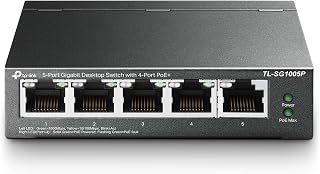
The TP-Link TL-SG1005P is a 5-port gigabit PoE switch engineered for small offices, home networks, and IoT deployments where simplicity meets functionality. It combines four PoE+ ports with one standard gigabit port, making it an all-in-one solution for powering and connecting IP cameras, wireless access points, VoIP phones, and other networked equipment without juggling multiple power adapters.
The standout feature is its impressive 65W power budget distributed across four PoE+ ports, each capable of supplying up to 30W. Real-world performance is rock solid, delivering stable gigabit speeds while simultaneously powering demanding devices. The plug-and-play architecture means no learning curve; connect your devices and they work immediately. Advanced QoS and IGMP Snooping capabilities ensure video streams remain smooth and voice calls stay crystal clear, a significant advantage over basic consumer switches.
Build quality is genuinely professional. The metal chassis provides excellent shielding and durability, while the compact 3.94 x 3.86 inch footprint suits desks and wall mounts equally well. Shielded ports prevent interference, and the fanless design eliminates mechanical failure points and noise concerns. The switch operates silently even in quiet office environments, a major plus for businesses and studios.
The main drawback is the unmanaged nature of the device, meaning you cannot configure VLANs or implement advanced traffic segmentation. For small deployments this is irrelevant, but growing networks may outgrow its capabilities quickly. Additionally, the 65W power ceiling becomes a constraint if you need to run multiple high-power PoE devices simultaneously, and having only one non-PoE port may feel limiting in mixed environments.
The TP-Link TL-SG1005P is an excellent value pick for anyone building a small network or upgrading from a basic unmanaged switch. Its combination of PoE capability, solid build quality, and hassle-free setup makes it ideal for installers, home labs, and small business deployments. The 3-year warranty backs the investment confidently.
Ports: 5x 10/100/1000 Mbps RJ45 with AUTO Negotiation and MDI/MDIX, 4x PoE+ supporting 802.3at and 802.3af standards
Power: 65W total PoE budget, up to 30W per port, 48V input, 1.25A current rating
Physical: Metal case, 3.94 x 3.86 x 0.98 inches, 0.8 kg, desktop or wall-mount capable
Performance: IEEE 802.3X flow control, port-based QoS with 802.1p and DSCP support, IGMP Snooping, fanless design for silent operation
Included: Power adapter, installation guide, limited lifetime warranty with 3-year coverage and support 6am to 6pm PST Monday through Friday
Best For: Home networks with IP cameras, small offices deploying wireless access points and VoIP systems, IoT installations, network closets, and media rooms where silent operation matters.
Consider Something Else If: You need managed switching with VLAN support, require more than 65W of simultaneous PoE power, or expect your network to scale beyond a handful of devices in the next 2-3 years.
Installation Tip: Position the switch centrally to minimize cable runs to powered devices. The compact size makes it ideal for mounting on walls or tucking behind desks using the included bracket holes. No software setup needed; connect power and devices simultaneously to begin operation.
Compatibility: Works with any IEEE 802.3af or 802.3at compliant device including most IP cameras, access points, access controllers, and powered speakers. Non-PoE devices connect to the fifth gigabit port without restriction.

Pros
- Highest-rated unmanaged PoE switch in its category with 4.7-star customer satisfaction
- Extended mode transmission distance eliminates need for additional power injectors in large deployments
- Silent fanless operation makes it ideal for noise-sensitive environments like offices and studios
- Sturdy metal casing and compact 7.72 x 4.76 inch footprint fit easily on desks or mounted on walls
- Comprehensive 3-year warranty and included power adapter reduce total cost of ownership
Cons
- Unmanaged switch lacks advanced features like VLAN support or traffic prioritization for complex networks
- 65W total PoE budget limits simultaneous high-power device connections compared to larger units
- No web interface means you cannot remotely monitor port status or configure PoE settings
The TP-Link LS108GP is an 8-port gigabit PoE+ switch designed for small to medium business networks, surveillance systems, and office environments requiring straightforward connectivity. It delivers enterprise-grade features in an affordable, compact package that prioritizes reliability and ease of use over complex management capabilities.
The standout performance feature is its extended PoE transmission capability, reaching up to 820 feet when Extend Mode is enabled. This eliminates the need for additional power injectors when deploying IP cameras, access points, or VoIP phones across larger properties. With 30W per port and 65W total budget, you can power multiple devices simultaneously, while the Auto Recovery mode automatically reboots dropped connections, reducing downtime in mission-critical deployments.
Build quality impresses with its durable metal chassis and compact 7.72 x 4.76 inch footprint. The fanless design ensures completely silent operation, making it suitable for noise-sensitive environments like recording studios, offices, or bedrooms. Desktop and wall-mounting options provide installation flexibility, while the included power adapter and 3-year warranty demonstrate TP-Link's confidence in product longevity.
The main limitation is the lack of management features. As an unmanaged switch, you cannot configure VLANs, monitor individual port activity, or adjust PoE power settings. Additionally, the 65W power budget may constrain simultaneous deployment of high-demand devices like PTZ cameras requiring 60W each. Heavy users should consider managed PoE switches, though most small deployments will find this budget sufficient.
The LS108GP represents exceptional value for plug-and-play networks. Its combination of extended transmission distance, silent operation, and proven reliability makes it the practical choice for growing businesses, surveillance installations, and home labs seeking hassle-free gigabit connectivity without premium pricing.
IP Camera Systems: Deploy surveillance cameras across large properties using extended PoE reach without additional power infrastructure.
Small Office Networks: Connect computers, printers, and network devices with reliable gigabit speeds in a quiet, unobtrusive form factor.
Access Point Expansion: Power and connect multiple wireless access points throughout buildings to extend WiFi coverage reliably.
Home Labs and Workshops: Build network infrastructure for learning, testing, or media centers where silent operation and compact size matter.

Pros
- True plug-and-play functionality eliminates installation complexity for non-technical users
- Dynamic power allocation intelligently redistributes resources to handle high-demand devices
- Completely silent fanless operation won't disturb office or home environments
- Compact, durable metal construction designed for both desktop and wall-mounted flexibility
- Energy-efficient operation reduces operational costs without sacrificing Gigabit performance
Cons
- 83W total budget may be limiting for applications with multiple high-power devices that each need 30W+
- Unmanaged design lacks VLAN, traffic prioritization, or monitoring features that managed switches provide
- No user reviews available at launch, so real-world reliability data is not yet established
The NETGEAR GS308PP is an 8-port PoE+ Gigabit switch designed for small to medium networks, IP camera systems, VoIP installations, and IoT deployments. It's built for users who need straightforward connectivity without the complexity of managed networking gear, making it ideal for small offices, retail locations, and surveillance integrators.
The standout feature is its dynamic PoE power allocation system combined with an 83W total budget. Unlike traditional switches that lock power per port, this model intelligently redistributes unused power to devices that need it most. All eight ports support Gigabit speeds with auto-negotiation, and the fanless design ensures completely silent operation, a critical advantage in customer-facing and residential environments.
Build quality is solid with a compact metal chassis measuring just 9.3 inches wide by 4 inches deep. The device weighs only 1.3 pounds and includes both desktop and wall-mount options, giving you flexibility for tight spaces or rack installations. The entire package ships with a power adapter, mounting kit, and installation guide.
The main drawback is the 83W power budget, which can be tight if you're connecting eight devices that each demand 20W or more. Additionally, as an unmanaged switch, it offers no VLAN support, traffic prioritization, or built-in monitoring, so advanced network management tasks aren't possible. The lack of customer reviews at launch means long-term reliability feedback is still pending.
Overall, the GS308PP is a reliable workhorse for straightforward PoE deployments. If you need silent, maintenance-free connectivity for cameras, wireless access points, or other powered devices and don't require advanced management features, this switch delivers excellent value and backed by NETGEAR's 3-year warranty.
Ports and Connectivity: 8 x 1.0 Gbps RJ45 Gigabit Ethernet ports with auto-negotiation. All ports support PoE+ with 83W total power budget and dynamic allocation.
Power and Energy: Interchangeable external 110V AC power adapter. Fanless design with IEEE 802.3az Energy Efficient Ethernet standard. Compliant with energy-saving protocols without performance loss.
Physical Specifications: Compact metal construction. Dimensions: 9.3 inches L x 4 inches W x 1.1 inches H. Weight: 1.3 pounds. Supports desktop and wall-mount installation with included mounting hardware.
Warranty and Support: NETGEAR 3-year limited hardware warranty. Model: GS308PP-100NAS. Unmanaged switch with plug-and-play setup, no software required.
Best For: Small office networks, IP surveillance systems with 4-8 cameras, wireless access point deployments, VoIP phone systems, IoT device installations, and network expansions where managed features aren't needed.
Power Budget Calculator: With 83W total, you can run eight 10W devices simultaneously, or four 20W devices plus additional lighter loads. Check your device power requirements before purchase to ensure the budget fits your needs.
Cable Compatibility: Works with existing Cat5e or Cat6 Ethernet cables. Cat6 recommended for Gigabit performance over longer distances, though Cat5e supports full speeds for typical deployments under 100 meters.
Installation Tips: Plug in the power adapter, connect your devices, and you're done. No configuration needed. For wall mounting, use the included kit. Place in a well-ventilated area, though the fanless design means no heat concerns like traditional switches.
Avoid If: You need VLAN segmentation, traffic prioritization, port monitoring, or advanced network management. For those features, consider managed switches from NETGEAR's higher-end product lines.

Pros
- Extremely reliable and durable, with many users reporting zero failures over extended deployments
- Intuitive web interface makes it accessible for small office staff without requiring command-line expertise
- Silent fanless operation eliminates noise, a significant advantage in shared office spaces
- Flexible management options through Omada Cloud, standalone web interface, or traditional CLI/SNMP access
- Excellent value for the feature set, combining managed capabilities with affordability compared to Cisco or Juniper
Cons
- 230W PoE budget may be limiting for installations requiring many high-power devices simultaneously
- Omada ecosystem terminology and interface design have a learning curve compared to more traditional networking platforms
The TP-Link SG2452LP is a 52-port managed Gigabit switch engineered for small to medium-sized business networks, remote offices, surveillance systems, and Wi-Fi deployments. It bridges the gap between simple unmanaged switches and complex enterprise equipment, offering professional-grade features at an accessible price point.
The standout feature is its 32 PoE+ ports with a 230W collective budget, enabling you to power dozens of devices without additional power infrastructure. Combined with the 104 Gbps switching capacity and 77.37 Mpps forwarding rate, real-world performance has proven rock-solid across diverse deployments. The four Gigabit SFP slots provide clean fiber connectivity for uplinks, and support for 9KB jumbo frames ensures efficient data transfer for bandwidth-intensive applications.
Build quality is excellent with a durable metal rackmount chassis measuring 17.3 by 13 inches and weighing 6.62 kg. The fanless passive cooling design is perhaps the most underrated feature, delivering completely silent operation even under full PoE load. This matters significantly in shared office environments where noise from networking equipment can be disruptive. The included rackmount kit, power cord, and rubber feet ensure straightforward installation.
Management flexibility sets this switch apart. You can centralize control through Omada Cloud for network-wide oversight and AI-driven insights, or run standalone with the intuitive web GUI that requires no command-line knowledge. Advanced L2 features including VLAN segmentation, QoS, IGMP snooping for IPTV, and ACL rules handle complex network requirements. Security capabilities like 802.1X authentication, IP-MAC binding, DHCP snooping, and storm control provide enterprise-level protection. The device carries CISA Secure-by-Design certification, demonstrating commitment to security fundamentals.
The main limitation is the 230W PoE budget, which constrains installations with many simultaneous high-power devices. Otherwise, this switch delivers exceptional reliability, silent operation, and feature density for its price. Backed by a genuine 5-year warranty and free support, it represents intelligent infrastructure investment for any growing business network.
Ports and Connectivity: 32 Gigabit PoE+ ports (802.3af/at, 30W max per port), 16 Gigabit non-PoE ports, 4 Gigabit SFP slots. Total switching capacity of 104 Gbps with 77.37 Mpps forwarding rate. Supports 9KB jumbo frames and 802.1Q VLAN segmentation.
Power and Physical: 230W PoE power budget. Fanless passive cooling design. Rackmount chassis dimensions 17.3 inches length by 13 inches width by 1.7 inches height. Weight 6.62 kg. Operating voltage 120V. Color black.
Management and Security: Omada Cloud Management Platform integration with zero-touch provisioning. Standalone management via web GUI, CLI (Telnet/SSH), SNMP, and RMON. Mobile app support. Features 802.1X authentication, IP-MAC-Port binding, DHCP snooping, ACL, DoS/DDoS protection, flood control, STP, SSHv2, and storm control.
Networking Features: Static routing, VLAN support, QoS, IGMP snooping, IPv6 support, port isolation, loop detection, LAG (Link Aggregation), and PoE recovery. Compliant with CE, FCC, and RoHS standards. Includes 5-year warranty with free technical support.
Best For: Small to medium-sized businesses, remote offices, multi-site deployments, surveillance installations, hospitality environments, healthcare facilities, and educational institutions seeking managed switching without enterprise complexity or cost.
Ideal Use Cases: Powering wireless access points and IP cameras across a facility via PoE, consolidating multiple older switches into a single silent unit, implementing network segmentation through VLAN policies, establishing reliable backup connectivity via port failover, and managing network growth without replacing core infrastructure.
Not Ideal For: Organizations requiring more than 230W PoE power simultaneously, environments where the Omada software ecosystem does not integrate with existing infrastructure, or deployments needing line-rate Layer 3 routing and advanced QoS at scale beyond this switch's design scope.

Pros
- Robust power management prevents overload by automatically deprioritizing ports when demand exceeds 60W
- PoE auto-recovery in Extend Mode keeps security cameras and access points online without manual monitoring
- Port Isolation mode prevents network storms by segmenting ports 1-8, improving stability
- Extended range support up to 820 feet via Extend Mode simplifies long-distance deployments
- Plug-and-play unmanaged design eliminates complex configuration, reducing setup time
Cons
- Limited 60W total power budget requires careful planning when deploying multiple high-power PoE devices
- Zero reviews available make it difficult to verify real-world performance and reliability
- Unmanaged switch lacks SNMP monitoring and advanced network diagnostics for complex enterprise deployments
The UGREEN 10-Port PoE Switch is designed for network professionals installing distributed systems like security cameras, wireless access points, and IP phones. With 8 PoE+ ports capable of delivering up to 30W each and 2 Gigabit uplink ports, this switch consolidates power delivery and networking into a single device, eliminating the need for separate power injectors.
The standout features center on reliability and ease of management. Auto-recovery automatically restarts powered devices when they go offline, a critical capability for security systems that must stay operational. The three operation modes (Standard, Port Isolation, and Extend) offer flexibility: Port Isolation prevents network loops by segmenting ports, while Extend Mode pushes PoE delivery up to 820 feet, enabling installations far from the central switch. All ports deliver consistent 1000Mbps throughput with minimal latency, supporting real-time video streaming and responsive IP phone calls.
Build quality appears solid with metal construction and a metal case that should handle professional environments. The switch includes a 24-month warranty, indicating manufacturer confidence in longevity. Its unmanaged design keeps setup simple, requiring only power and Ethernet cables to start operating. The intelligent power management system prioritizes which ports receive power if the 60W budget is exceeded, preventing system failures.
The main limitation is the 60W power budget, which may constrain installations with many high-power devices. Additionally, as an unmanaged switch, it lacks SNMP monitoring or advanced diagnostics, making it less suitable for large enterprise networks requiring detailed traffic analysis or centralized management.
For installers and small-to-medium network deployments, this UGREEN switch delivers practical value through robust power management, auto-recovery, and extended-range capabilities. It's a capable choice when you need reliable PoE delivery without enterprise-level complexity.
Ports and Connectivity: 10 Gigabit ports total (8 PoE+ ports at up to 30W each, 2 Gigabit uplink ports). Data transfer rate: 1000 Mbps. Interface: RJ45.
Power Specifications: Total PoE budget: 60W. Power delivery prioritization: automatic cutoff in reverse order (ports 8 to 1). Auto-detection of PoE and non-PoE devices. Short-circuit isolation per port.
Operation Modes: Standard mode, Port Isolation (VLAN) mode, and Extend Mode with PoE range up to 820 feet. PoE auto-recovery on ports 1-6 in Extend Mode.
Physical: Metal case construction. Color: Grey. Includes AC power cord, user manual, and all necessary cables. Model: 35372US. Warranty: 24 months.
Who Should Buy This Switch: Network installers deploying security camera systems, business network administrators setting up wireless access points and IP phones, and anyone needing reliable PoE distribution across distributed locations. Best for small-to-medium deployments with moderate power requirements.
Who Might Look Elsewhere: Large enterprise environments requiring SNMP management and detailed network analytics. Installations with multiple high-power PoE devices exceeding 60W total demand. Organizations requiring managed switch features like VLANs beyond port isolation.
Key Buying Considerations: Calculate your total PoE power needs to ensure they fit within the 60W budget. Confirm the maximum distance between your main network and powered devices, especially for extended deployments. Verify compatibility with your existing network equipment and cabling infrastructure.

Pros
- Immediate PoE power delivery eliminates need for separate power adapters on compatible devices
- Intuitive web interface makes network management accessible even for users without IT expertise
- VLAN and QoS features enable network segmentation and traffic prioritization for improved security and performance
- Compact fanless design runs cool and silent, fitting seamlessly into home offices and small server rooms
- Solid build quality with metal chassis and shielded ports resists interference and handles frequent use
Cons
- Web management interface uses HTTP instead of HTTPS, lacking encryption for sensitive configuration changes
- Limited VLAN functionality compared to enterprise-grade switches may not suit advanced network segmentation needs
- Total PoE power budget of 57W caps simultaneous power delivery across all 4 PoE ports
The TP-Link TL-SG108PE V3 bridges the gap between basic unmanaged switches and expensive enterprise equipment, making it ideal for small businesses, home offices, and homelab enthusiasts who need PoE functionality without overwhelming complexity. With 4 dedicated PoE ports and 4 standard Gigabit ports, this switch handles mixed networking needs elegantly.
The standout feature is its plug-and-play PoE capability that powers wireless access points, IP cameras, and VoIP phones directly without additional power supplies. Users consistently praise the effortless setup and immediate functionality, with one reviewer noting the access point powered up instantly upon connection. The web-based management interface, while requiring no software installation, gives you access to smart features like VLAN segmentation, QoS traffic prioritization, and detailed port monitoring when you need them.
Build quality impresses with a solid metal chassis, shielded RJ45 ports, and rubber feet that prevent movement. The fanless design runs completely silent and generates minimal heat, making it perfect for mounting in tight spaces or noise-sensitive environments. At just 16 ounces and 6.22 inches wide, it occupies minimal real estate on desks or shelves.
The main limitation is the lack of HTTPS encryption for the management portal, meaning configuration changes transmit unencrypted. Additionally, the 57W total PoE budget and 30W per-port maximum constrains simultaneous powering of power-hungry devices, though this suits most common use cases like access points and cameras.
This switch delivers legitimate managed switch capabilities at an accessible price point. If you need PoE power, gigabit speeds, and basic network management without enterprise overhead, the TL-SG108PE V3 represents excellent value.
Connectivity: 8x 10/100/1000Mbps Gigabit Ethernet ports with AUTO MDI/MDIX, 16Gb non-blocking switching fabric
Power Over Ethernet: 4x PoE ports (802.3af), 15.4W per port, 57W total PoE budget
Management: Web-based easy smart management interface, no software installation required
Features: VLAN support (port-based and 802.1Q), QoS with priority queuing, IGMP snooping, port mirroring, loop prevention, cable diagnostics, rate limiting, traffic monitoring
Physical: Metal chassis, fanless operation, dimensions 6.22"L x 3.98"W x 0.98"H, weight 16 ounces, operating temperature up to 104°F
Power Supply: 54V DC external adapter, maximum 75W consumption
Warranty: 3-year manufacturer limited lifetime warranty with 24/7 technical support
Perfect For: System administrators building small office networks, homelab enthusiasts experimenting with VLANs and network management, home office users powering access points and IP cameras, IT professionals seeking affordable managed PoE capabilities
Ideal Use Cases: Powering wireless access points across multiple floors, IP camera systems requiring PoE power, VoIP phone deployments, network segmentation in small businesses, basement or remote office ethernet expansion
Consider Alternatives If: You need enterprise-grade management with HTTPS encryption, require simultaneous high-power delivery across multiple devices exceeding 57W, operate in high-EMI industrial environments, or need advanced security features like port security or RADIUS authentication

Pros
- Generous 126W power budget supports multiple high-powered devices simultaneously without compromise
- True plug-and-play operation makes setup accessible to non-technical users and IT teams alike
- Durable metal construction and dual installation options (desktop/rackmount) provide flexibility for any space
- Intelligent port prioritization automatically manages power distribution to prevent network disruptions
- Energy-efficient design reduces operating costs while maintaining full performance
Cons
- Unmanaged switch lacks advanced features like VLAN support or traffic shaping for complex networks
- Limited to 8 ports, which may require additional switches as your network grows
- No onboard display or LED indicators for detailed port power monitoring
The TP-Link TL-SG1008MP is an 8-port Gigabit PoE+ switch designed for small to medium-sized businesses and offices that need to expand their wired network infrastructure. It's purpose-built for environments where you need to power and connect multiple devices like wireless access points, IP cameras, and VoIP phones through a single network cable.
The standout feature is its intelligent power delivery system. With 126W total power budget and up to 30W per port, the switch can simultaneously power multiple high-demand devices. The built-in port prioritization ensures that if total power draw approaches the limit, lower-priority ports gracefully power down rather than causing a system-wide failure. This reliability is crucial for businesses where network downtime costs money.
Build quality is solid across the board. The sturdy metal casing provides both durability and better heat dissipation compared to plastic alternatives. The switch ships with everything you need including the rackmount kit, rubber feet, and power cord. It can sit on a desk or mount in a standard server rack, giving you deployment flexibility depending on your physical infrastructure.
The main limitation is that this is an unmanaged switch, meaning it lacks advanced networking features like VLAN configuration, traffic shaping, or detailed monitoring dashboards. If your network requires these capabilities, you'll need to step up to a managed model. Additionally, 8 ports may feel limiting as your business grows, though you can always daisy-chain additional switches if needed.
The TP-Link TL-SG1008MP is a smart purchase for businesses prioritizing reliability and simplicity over advanced features. The plug-and-play setup, generous power budget, and 3-year warranty make it an excellent value proposition for powering a distributed network of devices without breaking your budget or adding IT complexity.
Understanding power allocation is key to getting the most from this switch. With 126W total power available across 8 ports, you can theoretically run 4 devices at maximum 30W each, or mix and match based on your needs. A typical wireless access point draws 15-20W, while an IP camera might use 10-15W and a VoIP phone uses 3-6W.
The port prioritization system automatically handles overload situations. If you connect devices totaling more than 126W, the switch disables lower-priority ports in sequence to protect your network. This failsafe prevents your entire system from crashing due to power drain, giving you peace of mind during peak usage periods.
Network Specifications: 8x Gigabit ports (10/100/1000 Mbps), IEEE 802.3at/af PoE+ standard, IEEE 802.3X flow control for reliable data transfer, 1000 Mbps data transfer rate per port.
Power Specifications: Maximum power output 153W (note: 126W practical budget per specifications), 53.5V operation, power consumption varies by load with up to 75% energy savings at partial loads.
Physical Specifications: Dimensions 11.57in L x 7.09in W x 1.73in H, weight 14.88oz, metal case construction, operating temperature range 1 to 40 degrees Celsius, includes installation guide, rackmount kit, power cord, and rubber feet.

Pros
- All 16 ports deliver true gigabit speeds with simultaneous PoE power delivery, eliminating the need for separate power infrastructure
- Extend Mode enables long-distance PoE transmission ideal for outdoor cameras, rooftop access points, and distributed IoT deployments
- Priority Mode guarantees consistent video quality for surveillance systems by prioritizing bandwidth on specific ports
- Isolation and IGMP Snooping modes prevent broadcast storms and unauthorized access, enhancing overall network stability
- Plug-and-play setup requires no complex configuration, while advanced users can leverage priority and isolation settings
Cons
- Extended Mode reduces speed to 10 Mbps, suitable for cameras but not for high-bandwidth devices requiring full gigabit transmission
- 120W total power budget limits simultaneous 30W devices to 4 ports, requiring careful power planning for larger deployments
- Desktop-only design lacks rack-mount option, which may not suit datacenter or large-scale infrastructure installations
The TP-Link TL-SG116P is a managed gigabit switch purpose-built for small to medium networks requiring power delivery to connected devices. It's ideal for IT professionals, system integrators, and network administrators deploying IP surveillance systems, wireless access points, or VoIP phones across dispersed locations.
The standout feature is its flexible power and connectivity architecture. All 16 ports provide simultaneous gigabit data and PoE+ power, with up to 30W per port. The 120W total power budget accommodates most professional deployments. The Extend Mode is particularly valuable for long-distance installations, pushing PoE transmission to 250m, though users should expect a speed reduction to 10 Mbps at maximum range. Priority Mode ensures critical devices like surveillance cameras maintain consistent bandwidth.
Build quality reflects TP-Link's reputation. The metal chassis is compact and fanless, creating a silent device suitable for offices and secure facilities. The included power adapter and installation guide facilitate quick deployment. The switch handles standard network management tasks, with isolation modes protecting against broadcast storms and supporting IGMP Snooping for multicast traffic.
The primary limitation is power budget scaling. If your deployment requires multiple devices drawing 30W simultaneously, only four ports can operate at full power capacity. Additionally, the Extend Mode's 10 Mbps speed trade-off means it's best reserved for low-bandwidth devices rather than general network extension.
The TP-Link TL-SG116P delivers excellent value for users requiring reliable PoE delivery across 16 ports. Its combination of full gigabit speeds, extended range capability, and automatic recovery features makes it a smart choice for growing networks. The 3-year warranty and responsive support provide confidence for critical deployments.
Connectivity: 16x RJ45 Gigabit PoE+ ports (802.3at/af compliant), 10/100/1000 Mbps
PoE Budget: 120W total, up to 30W per port
Transmission Range: Standard mode up to 100m, Extend Mode up to 250m at 10 Mbps
Power Supply: 53.5V external adapter
Operating Temperature: Up to 68 degrees Celsius
Dimensions: 11.26 inches L x 4.4 inches W x 1.16 inches H
Weight: 0.93 kg
Case Material: Metal
Design: Fanless, desktop form factor
Warranty: Limited lifetime warranty (3 years with full support)
Best For: IP camera surveillance systems, office VoIP deployments, wireless access point networks, and distributed IoT device management across medium-sized facilities or outdoor installations.
Consider If: You need simultaneous gigabit connectivity and power delivery to 16 devices without external power supplies at each location. Extend Mode makes this ideal for campus networks or outdoor coverage areas.
Skip If: You require more than 4 simultaneous full-power (30W) PoE devices or need speeds exceeding 10 Mbps at extended range. Rack-mount switches would better suit large datacenters.
Power Planning: Calculate your device power requirements first. Four cameras at 15W each consume 60W, leaving room for eight more lower-power devices. Prioritize critical devices for isolation and priority modes.
Installation Tip: Use Priority Mode for cameras and voice systems, Isolation Mode for guest networks or untrusted devices, and Extend Mode strategically for long-distance deployments where speed reduction is acceptable.
Buying Guide: What to Look for in a PoE Switch
Total PoE Power Budget
The power budget is the single most important spec to evaluate. It determines how many devices you can power simultaneously and at what wattage. A 5-port switch like the TP-Link TL-SG1005P, 5 Port Gigabit PoE Switch offers 65W across four PoE ports, which is plenty for a couple of cameras and an access point.
If you’re running a denser deployment, look at something like the TP-Link 8 Port Gigabit PoE Switch, which delivers a 126W budget across all eight ports. Always add up the maximum draw of every device before committing to a switch’s power rating.
Managed vs. Unmanaged
Unmanaged switches like the NETGEAR 5-Port PoE Gigabit Ethernet Unmanaged are pure plug-and-play. You connect them, they work, and there’s nothing to configure. That simplicity is ideal for home users or anyone who just needs reliable connectivity fast.
Managed and Easy Smart options, such as the NETGEAR 8 Port PoE Gigabit Ethernet Easy and the TP-Link TL-SG108PE V3, 8 Port Gigabit Easy, give you control over VLANs, QoS traffic prioritization, and per-port power settings. For small businesses handling VoIP or surveillance, that extra control is worth the slightly steeper learning curve. If you’re building out a full tech stack, our guide to gifts for tech lovers covers other network-friendly gear as well.
Port Count and Scalability
Think a step ahead when choosing port count. A 5-port switch covers a small home setup today, but if you’re planning to add devices over the next year or two, an 8-port or 16-port model gives you room to grow without buying another switch. The TP-Link TL-SG116P, 16 Port Gigabit PoE Switch offers 120W across all 16 PoE+ ports, making it a strong mid-range option for growing deployments.
For enterprise environments, the TP-Link SG2452LP, 48 Port Gigabit Omda Fully Managed switch scales up to 52 ports with Omada cloud management, VLAN segmentation, and a 230W PoE budget. That’s a different category entirely, aimed at IT teams managing larger infrastructure.
Extended PoE Range and Auto Recovery
Standard PoE runs up to about 100 meters. But for outdoor cameras or access points mounted far from your network closet, Extend Mode changes the math. The TP-Link LS108GP, 8 Port PoE Gigabit Ethernet supports PoE transmission up to 820 feet in Extend Mode, which is a genuine advantage for large properties or warehouses.
PoE Auto Recovery is another feature worth prioritizing if you’re running surveillance cameras. When a camera freezes or drops offline, a switch with Auto Recovery, like the UGREEN Ethernet Switch, 10-Port PoE Switch, automatically reboots the affected port without any manual intervention. That kind of hands-off reliability matters when you need continuous uptime. For related networking deals, check out our Black Friday laptop deals page if you’re also upgrading your workstation.
Final Thoughts
For most home users and small offices looking for a simple, reliable solution, the TP-Link TL-SG1005P, 5 Port Gigabit PoE Switch hits a strong balance of performance and ease of use with its fanless design, QoS support, and solid power budget. If you need more ports and a bit of management capability without jumping into full enterprise territory, the NETGEAR 8 Port PoE Gigabit Ethernet Easy is a well-rounded pick that grows with your network. Either way, pairing the right switch with your existing router and devices will make your whole setup noticeably more organized and dependable.
Frequently Asked Questions
What is a PoE switch and do I really need one?
A PoE switch delivers both network data and electrical power through standard Ethernet cables, eliminating the need for separate power adapters at each device. If you’re running IP cameras, wireless access points, or VoIP phones, a PoE switch is almost always the cleaner and more cost-effective solution. It reduces cable clutter and simplifies placement since you’re no longer tied to power outlet locations.
What’s the difference between PoE and PoE+?
Standard PoE (802.3af) delivers up to 15.4W per port, while PoE+ (802.3at) provides up to 30W per port. Most modern IP cameras and access points are designed for PoE+, so it’s generally worth choosing a PoE+ switch to ensure compatibility with current and future devices. All of the switches reviewed here support the 802.3at standard.
How many PoE ports do I need for a home security camera system?
That depends on your camera count, but a good rule of thumb is to match port count to your current camera total and then add two or three extra ports for future expansion. An 8-port switch covers most residential setups comfortably. If you’re building out a more comprehensive smart home network in 2026, our article on gifts for tech lovers highlights other connected devices worth considering alongside your cameras.
Can I use a PoE switch with non-PoE devices?
Yes. PoE switches automatically detect whether a connected device requests power, and they only deliver it when the device signals compatibility. Plugging in a standard laptop, printer, or non-PoE network device won’t damage anything since the switch simply passes data without supplying power to that port. It’s a fully backward-compatible setup.


Write Your Review
No reviews yet. Be the first to share your experience!