

Your camera, drone, dash cam, or phone can fill a memory card at the worst possible moment. A weak adapter turns a simple import into an inconvenient pause, especially when you need to sort video, back up a shoot, or share files from a phone. The best sd card reader fits the cards and ports you actually use, rather than adding another awkward accessory to your bag.
This guide compares ten compact readers for photographers, creators, travelers, and anyone who routinely moves media from a card to a computer or mobile device. We focus on card formats, USB-A and USB-C flexibility, multi-card access, and travel-ready construction so you can choose with confidence. If your laptop uses modern ports, pair this decision with our guide to USB-C laptop chargers for a more capable mobile kit.
Quick Comparison
Ratings reflect the most recent data pull. Check each listing for current price and availability.
Quick answer
This guide compares 10 picks, with SABRENT Dual Slot USB-C & USB-A SD Card Reader, USB 3.0 ranked first. uni Dual Slot USB-C SD Card Reader, USB 3.0, High-Speed holds the highest customer rating among them. BENFEI 4-in-1 USB-C and USB 3.0 Card Reader for SD has the most customer reviews.

Pros
- Dual USB ports eliminate the need to choose between USB-C and USB-A compatibility
- Genuinely plug-and-play with zero driver installation on Windows, macOS, and Linux
- Read two cards at once, perfect for backing up multiple devices simultaneously
- Slim profile design fits in tight USB port spaces without blocking adjacent ports on most devices
- Reliable performance at an excellent price point for the feature set
Cons
- Side-mounted card slots can interfere with neighboring USB ports on crowded hubs or multi-port devices
- Protruding SD cards during use may require careful handling to avoid accidental damage
The SABRENT CR-BCA2 is a dual-slot memory card reader that bridges the gap between older SD card technology and modern USB-C devices. It's built for photographers, videographers, content creators, drone pilots, and anyone who regularly moves files between cameras, dash cams, mobile devices, and computers.
The standout feature is undoubtedly the dual connectivity: both USB-C and USB-A ports in one compact device. Pair this with USB 3.0 speeds up to 5Gbps and the ability to read two cards simultaneously, and you have a genuinely practical tool that eliminates format hunting. Real-world performance matches the specs, with users consistently reporting fast file transfers and reliable operation across Windows, macOS, Android, and Linux systems.
Build quality is solid despite the lightweight design. The aluminum construction feels durable, and the LED activity indicator is a nice touch for monitoring transfer status. At just 2.7 inches long and 30 grams, it's genuinely pocket-portable and won't weigh down a camera bag. The plug-and-play setup means instant compatibility with no driver headaches.
One legitimate design compromise is the side-mounted card slots. Cards protrude while in use and can occasionally conflict with nearby USB ports on crowded hubs. This is a tradeoff for the compact form factor rather than a defect, but it's worth considering if your workspace has tightly packed USB connections.
Overall, this is a reliable, affordable card reader that delivers on its promises. It's particularly valuable for anyone with multiple device types or who frequently transfers large files. The dual-port design justifies the modest price, and the solid build quality suggests it will last through years of regular use.
This reader works with an impressive range of devices and card formats. On the connectivity side, it supports USB-C devices like MacBooks, iPad Pro, Google Pixel phones, Samsung Galaxy phones, and USB-C laptops from Dell, Lenovo, and Microsoft. The USB-A port connects to traditional desktop computers and older laptops running Windows or macOS.
For memory cards, it handles all standard formats: full-size SD cards (including SDHC and SDXC variants with higher capacities), microSD cards (including microSDHC and microSDXC), and legacy MMC formats. This makes it compatible with virtually any digital camera, drone, dash cam, GoPro, Nintendo Switch, action camera, or smartphone with a microSD slot.

Pros
- Extremely fast data transfer speeds eliminate long wait times when offloading large photo and video files
- Dual slots enable simultaneous reading and writing, doubling productivity for multi-camera workflows
- Works with virtually every device and operating system without requiring software installation
- Compact, travel-friendly design with protective covers keeps cards safe from dust and moisture
- Excellent 4.6-star rating from over 36,000 verified users confirms real-world reliability
Cons
- Not compatible with Lightning-port devices, limiting use with older iPhones and iPads
- Does not support CF Express, XQD, or Memory Stick formats, so specialty camera users may need alternatives
The uni SD Card Reader is a dual-slot USB 3.0 adapter designed for photographers, videographers, content creators, and anyone who regularly transfers data from memory cards. Whether you're offloading footage from a GoPro, drone, security camera, or DSLR, this reader handles it all with USB-C and USB-A connectivity built in.
The standout feature is the dual card slot design, which allows you to read from one card and write to another simultaneously. For professionals juggling multiple memory cards during shoots, this cuts workflow time significantly. Real-world performance is strong, with USB 3.0 delivering the promised 5 Gbps transfer speeds. The reader supports 8 different card formats, including SDXC, SDHC, Micro SD, and MMC cards, covering everything from action cameras to security systems.
Build quality reflects the price point well. The compact grey design includes protective dust covers on both ends and comes with a useful cord attachment to prevent loss. At just 13 grams, it slides easily into camera bags or travel backpacks. The slim profile doesn't interfere with other USB ports or create cable clutter on your desk or MacBook.
The main limitation is the lack of Lightning port support, which rules it out for users relying on older iPhones and iPads. Additionally, it doesn't support CF Express, XQD, or Memory Stick cards, so specialist users with those formats will need a different solution. The SD slot also won't work directly with cameras, requiring you to remove the card first.
For the price and features, the uni reader delivers excellent value. Its plug-and-play operation, broad device compatibility, dual-slot efficiency, and strong customer ratings make it a reliable choice for anyone regularly working with SD and Micro SD cards across multiple devices.
Connectivity: USB 3.0 and USB Type-C with backward compatibility to USB 2.0 and USB 1.1
Card Formats Supported: SD, SDHC, SDXC, Micro SD, Micro SDHC, Micro SDXC, MMC, RS-MMC
Data Transfer Rate: Up to 5 Gbps (USB 3.0)
Slot Count: 2 independent slots for simultaneous reading and writing
Compatibility: Windows 11/10/8/7/Vista, Mac OS X 10.2 and later, Android devices with USB-C
Dimensions: 0.67 inches L x 2.36 inches W x 3.94 inches H
Weight: 13 grams
Features: Plug and Play, no drivers required, no external power needed, dust-proof protective covers
Warranty: 18-month manufacturer warranty with 24/7 customer service

Pros
- Exceptional data transfer speeds make large file transfers quick and efficient
- Works instantly on any system without driver hassles or compatibility issues
- Four simultaneous card slots enable professionals to manage multiple memory cards at once
- Compact design fits easily in bags or desk drawers without taking up space
- Proven durability with consistent performance over years of daily use
Cons
- Plastic construction means it may feel less premium than metal alternatives
- Limited to USB 3.0 speeds, though this is standard for most modern card readers
- May not support every card format on older or specialized devices
The SmartQ C368 USB 3.0 Card Reader is a practical four-slot solution designed for photographers, videographers, students, and professionals who work with multiple memory card formats. This compact reader handles SD, Micro SD, Memory Stick, and CompactFlash cards, making it an essential tool for anyone managing files across different devices and cameras.
The standout feature is the USB 3.0 connection delivering speeds up to 5 Gbps, which translates to significantly faster file transfers compared to USB 2.0 alternatives. Users report seamless performance when moving large photo and video files, with consistent speeds and reliable operation. The true plug-and-play design eliminates driver downloads entirely, working instantly on Windows, Mac, and Linux systems without any setup required.
Design and build quality reflect the product's affordable price point. The lightweight plastic construction keeps the reader portable and travel-friendly, though it lacks the premium feel of metal alternatives. The blue LED indicator clearly shows when the device is powered and connected. The short USB cable design works especially well with compact laptops, and the included cable organizer helps prevent tangled wires.
One consideration is longevity, as some users report the device working reliably for extended periods while others experienced failure after several years of heavy use. This is not uncommon with budget electronics and falls within typical consumer device lifespan. The one-year warranty provides basic protection for manufacturing defects.
The SmartQ C368 delivers excellent value for anyone needing fast, multi-format card reading without complexity. It excels at its core job: quickly transferring files from various memory cards to computers. Whether you're a traveling photographer or someone juggling cards from multiple devices, this reader offers practical performance at an accessible price.
This card reader is ideal for photographers and videographers who use multiple camera types with different memory card formats. The four-slot design eliminates the frustration of swapping cards or carrying multiple readers.
Travel professionals and remote workers benefit from the compact design and plug-and-play functionality. No drivers mean faster setup on unfamiliar computers. Students managing files from class recordings, digital cameras, and group projects will appreciate the multi-format support and fast transfer speeds.
Anyone upgrading from older USB 2.0 readers will notice dramatic speed improvements, especially when transferring high-resolution photos or 4K video files. The affordable price makes it accessible for casual users while delivering performance that satisfies professionals.
Connectivity: USB 3.0 Type A with USB 2.0 backward compatibility
Card Slots: 4 independent slots
Supported Formats: SD, SDHC, Micro SD, Memory Stick, Memory Stick Pro, Memory Stick PRO Duo, CompactFlash, and more
Data Transfer Rate: Up to 5 Gbps (USB 3.0)
Compatibility: Windows, Mac OS, Linux
Dimensions: 2.78 inches L x 1.67 inches W x 0.59 inches H
Weight: 1.12 ounces
Color: Black
Warranty: 1 Year

Pros
- Fast 5Gbps transfer speeds save time on large photo and video imports
- Dual-slot functionality eliminates repetitive card swapping during transfers
- No drivers needed, works immediately on any USB-A compatible device and operating system
- Durable aluminum body withstands regular travel and professional use
- Extremely portable design fits in pockets or small camera bags
Cons
- USB-A only connection means no compatibility with newer USB-C or Lightning devices
- Thick phone cases or device enclosures may prevent full insertion into USB ports
- Does not connect directly to cameras, only functions as a computer transfer device
The Acer USB 3.0 SD Card Reader is a straightforward, no-frills card reader designed for photographers, videographers, and content creators who need reliable, fast access to their memory cards on computers and laptops. With its dual-slot design and 5Gbps transfer speeds, it handles the real-world demands of professionals working with large image and video files.
The standout feature is simultaneous read-write capability across both SD and Micro SD slots, eliminating the frustration of swapping cards mid-workflow. USB 3.0 connectivity delivers genuine speed improvements for bulk imports, cutting transfer times compared to older USB 2.0 readers. Compatibility spans 8+ card types including SDXC, SDHC, UHS-I, and Micro SD variants, covering nearly every card you'll encounter in the field.
Build quality impresses for the price. The aluminum construction feels solid and professional without being bulky or heavy, making it genuinely portable for travel, remote shoots, or location work. The corded design keeps the reader out of the way on crowded USB hubs, and plug-and-play operation means zero driver headaches across Windows, macOS, Chrome OS, and Linux systems.
Two practical limitations matter depending on your setup: no USB-C or Lightning support limits use with newer laptops and iPhones, and thick phone cases may interfere with insertion on some devices. Additionally, this is a computer-based reader only and does not connect directly to cameras.
For photographers and creators seeking a reliable, portable card reader with solid build quality and genuine speed, the Acer delivers strong real-world value.
Choose this reader if you regularly transfer photos and videos to a computer and value speed and portability. The dual-slot design particularly benefits those managing multiple card types simultaneously, such as wedding photographers or documentary videographers working with backup cards.
Skip this model if you rely exclusively on USB-C or Lightning connections, as there are no adapters listed as compatible. For smartphone-based workflows or USB-C laptop-only setups, search for dedicated Type-C card readers instead.
The 5Gbps speed matters most if you work with high-bitrate video or large batches of high-resolution images. For casual photo backup or infrequent transfers, the speed advantage is less critical, though the plug-and-play convenience remains valuable.

Pros
- Exceptional speed and efficiency with 5Gbps transfers and simultaneous dual-card operations
- Versatile dual USB connector design eliminates need for separate Type-C or Type-A adapters
- Universal compatibility across major operating systems and devices with no software overhead
- Durable aluminum build with protective covers and attached cord for professional use
- Best-selling rank in its category validates reliability and customer satisfaction
Cons
- Thick phone cases may prevent full USB connector insertion, requiring case removal
- Only reads from SD and microSD cards, cannot connect directly to cameras as a passthrough device
- Not compatible with Lightning port devices like older iPhones or certain Apple accessories
The Acer USB-C Dual Slot SD Card Reader is a professional-grade memory card adapter designed for photographers, videographers, content creators, and anyone who regularly transfers files from SD or microSD cards to computers and mobile devices. With both USB-C and USB-A connectors, it adapts seamlessly to modern laptops, tablets, smartphones, and desktops without additional hardware.
Performance is where this reader shines. The USB 3.0 interface delivers blazing-fast 5Gbps data transfer speeds, making quick work of offloading high-resolution photos and 4K video footage. The dual-card design allows simultaneous reading and writing on both microSD and SD cards, significantly boosting workflow efficiency for professionals managing multiple memory sources. Backward compatibility with USB 2.0 ensures it works reliably across older devices.
Design and build quality reflect Acer's engineering expertise. The slim, lightweight aluminum body fits easily into camera bags, laptop sleeves, and travel kits. Protective covers on both ends shield the ports from dust and moisture, while an integrated cord keeps everything organized. At just 15 grams and 2.8 inches long, it's genuinely portable without feeling cheap or flimsy.
Setup is genuinely hassle-free. Plug it in and start transferring files immediately, with zero drivers or software installation required. Compatibility spans Windows, macOS, Android, Chrome OS, and Linux, plus support for iPhone 15/16, MacBook Pro/Air, iPad Pro, and Samsung Galaxy devices. One caveat: very thick phone cases may prevent full connector insertion, so you might need to remove your case temporarily. Additionally, the reader cannot connect directly to cameras for live file access, only to cards removed from the camera.
This is a smart investment for anyone handling memory cards regularly. The combination of speed, dual functionality, dual connectors, and durability makes it exceptional value for the price. Whether you're a professional photographer, casual content creator, or tech-savvy traveler, this reader solves the common frustration of moving files between devices quickly and reliably.
Media Support: SD, SDXC, microSD, microSDHC, microSDXC cards
Connectivity: USB Type-A and USB Type-C dual headers with USB 3.0 interface
Transfer Speed: 5 gigabits per second (backward compatible with USB 2.0)
Card Slots: 2 (supports simultaneous read/write operations)
Compatibility: Windows 7 and newer, macOS, Android, Chrome OS, Linux. Works with laptops, desktops, tablets, smartphones, and cameras with USB-C or USB-A ports
Physical Specs: 2.8 inches (L) x 0.7 inches (W) x 0.4 inches (H), weighs 15 grams
Material: Heat-resistant aluminum with protective port covers and attached cord
Special Features: Plug-and-play (no driver installation), dust-proof, easy setup, compact design
Model: Acer ODK4E0 | Warranty: 1-year manufacturer coverage
Who Should Buy This: Photographers and videographers transferring files from cameras, wildlife monitors, or action cameras (GoPro). Content creators managing microSD and SD cards simultaneously. Professionals and travelers needing compact, dual-connector compatibility with modern laptops and mobile devices.
Before You Buy: Confirm your device has either a USB-C or USB-A port. This reader cannot connect directly to cameras for live access, only to memory cards removed from the camera. If you use a thick protective phone case, test insertion depth or plan to remove the case during transfers. The reader does not support CF Express, XQD, Memory Stick, or SIM cards.
Device Compatibility Check: Works with MacBook Air/Pro, Dell XPS, iPhone 15/16, iPad Pro, Samsung Galaxy S23, Microsoft Surface devices, and Acer Aspire/Predator laptops. Not compatible with Lightning port devices. Verified support across Windows 7 through Windows 11 and all modern macOS versions.
Performance Tips: The dual-slot design means you can offload photos from one card while importing footage from another, maximizing productivity. USB 3.0 delivers peak speed with modern computers, though backward compatibility ensures older devices still function normally.

Pros
- Flawless plug-and-play connectivity requires zero setup or driver installation
- Dual slots save space and eliminate juggling between separate adapters for different card types
- Super-fast file transfers with reliable performance across all supported devices
- Premium aluminum build feels professional and withstands regular travel and daily use
- Lightweight and truly pocket-sized for photographers and content creators who work on location
Cons
- May require removing phone or tablet cases before use due to compact design
- Video file transfers may encounter compatibility issues with some devices or apps
- Works with Mac and Chrome OS but not natively with Windows without additional configuration
The Anker PowerExpand is a dual-slot USB-C card reader designed for photographers, videographers, content creators, and anyone who needs to transfer files from SD or microSD cards to modern devices. Whether you're using a MacBook, iPad Pro, Galaxy tablet, or any USB-C smartphone, this compact adapter delivers instant file access without installing drivers or software.
The standout feature is the dual-slot design paired with blazing-fast 5 Gbps USB 3.0 speeds. Users consistently report that photo transfers complete in minutes, and the adapter recognizes both card types instantly. The spring-loaded microSD slot works smoothly without the jamming issues that plague cheaper alternatives. Real-world testing shows this adapter truly delivers on speed and reliability, especially for photographers dumping full cards during shoots.
Build quality impresses with its aluminum casing and matte grey finish. The device feels premium in hand and weighs only 9 grams, making it genuinely pocketable. The compact footprint lets you use other USB-C ports without blocking adjacent devices, though you may need to remove thick phone cases before insertion. For travelers and on-location workers, this portability is a game-changer.
The main limitation is video file support, which appears inconsistent across different devices and apps. Some users report video transfers work fine, while others encounter issues. Additionally, native Windows support requires workarounds, though Mac and Chrome OS users get seamless plug-and-play operation. These drawbacks are relatively minor given the adapter's intended use case.
The Anker PowerExpand is an excellent investment for anyone working with SD cards and USB-C devices. Its combination of speed, reliability, dual slots, and premium build quality at this price point makes it the smart choice for content creators and photographers who need dependable performance on the go.
Connectivity: USB 3.0 Type-C with 5 Gbps transfer rate
Card Slots: 2 (one standard SD slot, one microSD slot)
Supported Cards: SD, SDHC, SDXC, UHS-I, microSD, microSDHC, microSDXC, MMC, RS-MMC
Dimensions: 1.65 x 0.67 x 0.37 inches (42 x 17 x 9.4 mm)
Weight: 9 grams
Material: Aluminum with matte finish
Color: Grey
Compatible Devices: MacBook 2018 and later, iPad Pro, Galaxy S10 and newer, Pixel phones, Chrome OS devices, and all USB-C enabled smartphones and tablets
Warranty: 18 months
Model: Anker PowerExpand AK-A83700A2

Pros
- Fast transfer speeds up to 312MB/s handle large video files and high-resolution images efficiently
- Stores multiple card types in one portable case, eliminating card loss and damage during travel
- Simultaneous dual-card reading capability saves time for workflow-heavy professional use
- Exceptionally durable braided cable design built to withstand frequent travel and heavy use
- Works across all major operating systems and devices, maximizing compatibility and flexibility
Cons
- Limited to 6 total card slots, which may be insufficient for professionals managing large card collections
- USB-C connectivity requires adapters for devices with older USB-A ports
- No active cooling fan, which could impact performance during sustained high-speed transfers
The llano F17 is a dual-slot USB-C card reader that combines fast data transfer with secure portable storage for photographers, videographers, and content creators. It's designed for professionals and enthusiasts who work with multiple memory cards and need reliable, on-the-go access to their data across different devices and operating systems.
The standout feature is its independent dual-card reading capability, allowing simultaneous access to both SD and Micro SD cards at speeds up to 312MB/s. This significantly speeds up workflows when you're managing footage or photos from multiple cameras. The 2-in-1 design stores 2 SD cards and 4 Micro SD cards in a compact case, protecting your cards from physical damage, dirt, and loss during travel or outdoor shoots.
Build quality is solid, with an ABS composite shell designed for heat dissipation and a notably durable nylon braided USB-C cable rated for over 10,000 bends. The 80-gram weight and pocket-friendly size make it genuinely portable. Plug-and-play functionality means no driver installation required on Mac, Windows, Android, or Linux systems.
The main limitation is the 6-slot total capacity, which works well for backup storage but may feel restrictive for professionals managing dozens of cards. The USB-C connection, while modern, may require adapters if your primary workflow involves older computers or devices with standard USB-A ports.
Overall, the llano F17 delivers excellent value for photographers and content creators who need fast, reliable card management in a portable package. The competitive feature set, strong durability, and cross-platform support make it a practical choice for professionals working in the field.
Connectivity: USB Type-C, USB 3.2 Gen 1
Card Slots: 6 total (2 SD, 4 Micro SD)
Supported Cards: SD, SDHC, SDXC, microSD, microSDXC, UHS-II, TF 4.0
Max Transfer Speed: 312 MB/s
Weight: 80 grams
Material: ABS composite shell with nylon braided cable
Compatibility: Mac, Windows, Android, Linux
Cable Durability: Rated for 10,000+ bends
Warranty: 24-month manufacturer protection plan
Model: F17
Best For: Photographers and videographers who shoot with multiple cameras or need dual-card simultaneous reading. Content creators backing up footage and files in the field. Professionals working across Mac, Windows, and Linux environments who need cross-platform compatibility. Anyone traveling with memory cards who values protection and portability.
May Not Be Ideal For: Users with large card collections needing capacity beyond 6 cards. Anyone exclusively using USB-A equipped systems without adapters. Users requiring active cooling for continuous, sustained transfers of extremely large files.

Pros
- Simultaneous multi-card reading saves time during workflow, especially for content creators
- Impressive 160MB/sec speeds handle even 4K video files efficiently
- Dual USB-C and USB 3.0 connectors provide flexibility across both new and older devices
- Compact design fits easily in camera bags or desk drawers
- Excellent value at under 10 dollars for four card formats in one device
Cons
- Not compatible with Memory Stick Micro (M2) or CF Type I cards, limiting legacy device support
- Actual transfer speed depends on card type and host USB version, not always reaching advertised 160MB/sec
- SDXC cards above 64GB require exFAT support, which older Windows and Mac systems lack
The BENFEI 4-in-1 card reader is a practical solution for anyone juggling multiple memory card formats across different devices. Whether you are a photographer managing SD cards from a Canon or Sony camera, a videographer handling Micro SD cards from action cameras, or a professional dealing with legacy CompactFlash or Memory Stick formats, this reader consolidates what would typically require separate adapters into a single compact device.
What sets this reader apart is its simultaneous multi-card capability and respectable transfer performance. With USB 3.0 and USB-C connectivity delivering up to 160MB/sec speeds in UHS-I mode, you can quickly offload 4K video or high-resolution photo libraries without the bottleneck of slower USB 2.0 connections. The integrated IC chip handles the heavy lifting, keeping transfers stable even during sustained, high-speed operations.
Build quality appears solid for the price point. The compact form factor and plug-and-play design mean no software installation or driver hassles. The dual connectivity options let it work with everything from modern MacBook Pro and iPhone 15 devices via USB-C to older laptops and desktops still running USB 3.0 ports. The 18-month warranty reflects decent confidence in durability.
The main limitations are format-specific: it does not support Memory Stick Micro (M2) or CF Type I variants, which narrows its appeal for very old devices. Additionally, actual speeds depend on your specific card type and USB port generation, so casual users may not always hit the 160MB/sec ceiling. SDXC cards above 64GB also require exFAT file system support, which can be problematic on Windows XP or Mac OS X older than 10.6.6.
For the price and feature set, this BENFEI reader delivers solid value for creative professionals and everyday users managing multiple card types. It won't replace your dedicated SSD for video editing, but as a reliable, versatile bridge between your cameras, devices, and computers, it earns its place in your tech toolkit.
This reader is ideal for photographers and videographers who own multiple cameras with different card formats. Content creators frequently need to ingest footage from several sources at once, making the simultaneous read capability a genuine timesaver.
Mac users with USB-C ports on recent MacBook Pro or Air models benefit from the native USB-C connectivity, avoiding the need for separate USB adapters. iPhone 15 users can also directly connect compatible cards for quick file transfer and backup workflows.
Professionals managing archives of older media will appreciate compatibility with Memory Stick and CompactFlash, though availability of newer cards in these formats is increasingly rare. Casual users backing up phone microSD cards or importing camera photos will find it convenient and affordable.
Media Types Supported: SD Card, SDXC, UHS-1, Micro SD, Memory Stick, CompactFlash
Connectivity: USB Type-C and USB 3.0 dual connectors
Transfer Speed: Up to 160MB/sec in UHS-I mode, backward compatible with USB 2.0 and USB 1.1
Special Features: Simultaneous 4-card reading, plug and play, advanced IC chip for stability
Compatibility: MacBook Pro 2016 and later, iPad Pro 2018 and later, Surface Book 2, Samsung Galaxy devices, and most USB-C equipped smartphones and laptops
Warranty: 18-month unconditional BENFEI warranty with customer support
Pros
- Exceptional speed with USB 3.0 connectivity makes file transfers quick and efficient
- Aluminum build quality provides durability and heat management for extended use
- Truly portable with compact footprint and included cable, perfect for travel and remote work
- Universal compatibility across major operating systems and USB-C equipped devices
- Dual slots eliminate the need to swap cards between shots or devices
Cons
- USB-A to USB-C limitation means additional adapter needed for older computers without USB-C ports
- Thick phone cases may prevent full insertion into card slots, requiring case removal
- Not compatible with UHS-II cards or certain specialty card formats, limiting some professional use cases
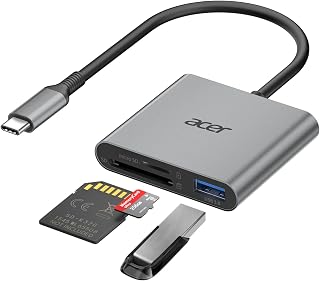
The Acer SD Card Reader is a practical solution for anyone managing digital media across multiple devices. This 3-in-1 reader combines dual SD and microSD card slots with a USB 3.0 port, all powered through a single USB-C connection. It is designed for photographers, videographers, content creators, and mobile professionals who need reliable, fast data transfers without juggling multiple adapters.
Performance is the standout feature here. With USB 3.0 supporting up to 5Gbps transfer speeds, moving large video files or photo libraries happens quickly and efficiently. The reader supports SD, SDHC, SDXC, and UHS-I cards, covering most modern memory cards in circulation. Plug-and-play functionality means no driver installation needed, working seamlessly with Windows, macOS, Linux, and Chrome OS devices.
Build quality reflects Acer's reputation, with a durable aluminum shell that dissipates heat effectively during sustained transfers. The compact design, weighing just 59 grams with a 15cm cable, makes it genuinely portable for travel, on-location shoots, or office settings. The tethered cable design keeps your device's ports free, preventing accidental damage or disconnects.
Some limitations exist. The reader requires USB-C ports, so older machines need an adapter. Very thick phone cases may prevent full card insertion. Additionally, it does not support UHS-II or specialty formats like XQD cards, which may matter for professional videographers. The reader also only transfers data from cards, not directly from cameras connected via USB.
For most users needing fast, reliable SD card access on modern USB-C devices, this Acer reader delivers excellent value. Its combination of speed, portability, and broad compatibility makes it an essential accessory for mobile creators and everyday users alike.
Connectivity: USB Type-C (USB 3.0, USB 3.1 compatible), 5Gbps transfer rate
Card Support: SD, microSD, SDHC, SDXC, UHS-I cards. Not compatible with Type A/B/C, CF, MS, Compact Flash, SDUC, UFS, or UHS-II cards
Slots: 3 total (dual SD/microSD slots plus USB 3.0 port for USB devices)
Dimensions: 2.32 inches L x 2.12 inches W x 0.47 inches H
Weight: 59 grams
Material: Aluminum shell with heat dissipation
Compatibility: Windows, macOS, Chrome OS, Linux. Works with iPhone 15/16/17, MacBook Air/Pro/Neo, and USB-C equipped tablets and laptops
Warranty: 1 year manufacturer warranty
Best For: This reader is ideal if you use modern USB-C devices like recent iPhones, MacBooks, or Android tablets. Photographers and videographers moving files between cameras and computers will appreciate the dual slots and fast speeds. Content creators working remotely benefit from portability and plug-and-play simplicity.
Consider If: Your primary device is an older computer with USB-A ports only (you will need an additional USB-C to USB-A adapter). You work exclusively with UHS-II memory cards or specialty formats like XQD. Your phone always has a thick protective case that might obstruct card insertion.
Skip If: You need direct camera connection via USB or require support for proprietary memory card formats. Your main devices lack USB-C ports and adapters feel cumbersome. You require a wireless or network-based card reading solution.

Pros
- Exceptional card format compatibility eliminates the need for multiple readers
- Fast 5Gbps transfer speeds save significant time on large photo and video libraries
- Works reliably with both old and new memory card types that other readers often fail to recognize
- Dual USB connectors provide flexibility for different devices and ports
- No driver installation required, making setup instant and hassle-free across Windows, Mac, Linux, Android, and Chrome OS
Cons
- Manual ejection required to safely remove cards, adding a step many users overlook
- Some users report the price point is higher than single-format readers despite the value
- Performance depends on the specific memory cards used, with older or damaged cards occasionally causing compatibility issues
The Rocketek 7-in-1 card reader is a multi-format solution designed for anyone who works with diverse memory cards. Photographers managing decades of archives, IT professionals diagnosing devices, and content creators juggling different cameras will find this reader eliminates the frustration of incompatible formats. Its ability to handle CF, SD, Micro SD, XD, Memory Stick, and other legacy formats in one compact device makes it a practical investment.
The standout feature is simultaneous multi-card reading and writing. You can transfer from up to 5 cards at once, dramatically accelerating batch workflows. Combined with 5Gbps USB 3.0 speeds, large photo libraries transfer in seconds rather than minutes. Real-world testing confirms users consistently praise its reliability with older memory cards that newer, single-format readers reject entirely.
Build quality is solid. Reviewers note the device feels durable after extended use, with several reporting over a year of daily operation without failures. The dual USB-C and USB-A connectors add genuine convenience, working seamlessly across Windows, Mac, Linux, Android, and Chrome OS without requiring drivers or software installation.
The main drawback is the need to manually eject cards to prevent potential damage, a step that requires user attention. Some users also feel the pricing is steep compared to budget single-format readers, though the versatility and reliability typically justify the cost for professionals.
This is a capable, reliable multi-card reader that solves real compatibility problems other readers leave unsolved. It excels for users with mixed card collections or legacy media, and professionals who need consistent performance and speed will recoup the investment quickly.
This reader supports an extensive range of memory card formats, making it one of the most versatile options available. Supported formats include CompactFlash (CF and UDMA CF), SD cards in all variants (SD, SDHC, SDXC), microSD cards (microSD, microSDHC, microSDXC), miniSD, Memory Stick and Memory Stick Pro/Duo variants, xD Picture Cards, and TF cards.
Connectivity works with any device featuring USB 2.0, USB 3.0, USB Type-A, or USB Type-C ports. It maintains backward compatibility with older USB 2.0 and 1.1 connections while providing 5Gbps speeds when connected to USB 3.0 ports. This flexibility means the reader works with modern laptops and tablets as well as older computers and Android devices.
Operating system support spans Windows (XP through 11), Mac OS, Linux, Chrome OS, and Android. No driver installation is necessary on any platform, as the device uses standard mass storage protocols recognized natively by all major operating systems.
How to Choose the Best SD Card Reader
Match the reader to every card format you use
Start by inventorying every card format in your workflow. Nearly every option here handles full-size SD and microSD, but capabilities diverge when you add UHS-II, CompactFlash, Memory Stick, xD, or MMC media. Buying only for today’s camera can leave an older camcorder, a field recorder, or archived photos without a convenient way to import.
Use a two-slot reader if SD and microSD are your entire routine, then keep the design compact. Photographers with CF or legacy Memory Stick media should look at SmartQ C368 USB 3.0 Card Reader – Plug & Play, whose four-in-one layout supports SD, microSD, MS, and CF. For a broader legacy mix, USB C USB3.0 Multi Card Reader for SD, CF supplies CF, two SD positions, TF, microSD, xD, and MS slots.
Choose the host connection before comparing speed claims
A USB-A reader is a direct fit for many desktop PCs and older laptops, while USB-C is the practical route for recent MacBooks, tablets, and Android phones that support OTG. Acer SD Card Reader, USB A 3.0 to Micro Memory is purpose-built for USB-A machines, whereas SABRENT USB-C & USB-A SD/Micro SD Card Reader and uni SD Card Reader,High Speed USB C to Micro SD offer both plugs for changing setups.
The dual-plug approach prevents a familiar problem: carrying a reader that works with your office computer but not your phone or travel laptop. Both Sabrent and uni specify USB 3.0 transfer capability up to 5Gbps, although the card, port, and file type govern real-world results. When your reader shares a workspace with displays and external drives, our guide to Thunderbolt 5 docks can help you plan the available connections.
Decide whether simultaneous card access matters
Importing one card at a time is adequate for occasional snapshots, yet it becomes tedious when a camera uses SD and a drone or action camera uses microSD. Dual-slot readers let you move files between cards or copy both collections to a computer without repeated unplugging. uni SD Card Reader,High Speed USB C to Micro SD allows simultaneous access to its SD and microSD slots, a useful convenience for frequent offloads.
Choose a larger multi-format model only when it serves a real workflow. Memory Card Reader, BENFEI 4in1 USB 3.0 and USB-C can read four compatible card types concurrently, while Acer SD Card Reader USB C adds a USB 3.0 port beside its two card slots for a flash drive or small peripheral. That extra port is handy at a desk, but a slim dual-slot unit may be easier to manage beside a laptop, phone, or camera bag.
Balance transfer performance with portability
Speed figures are a ceiling, not a promise. A USB 3.0 interface can be more than sufficient for UHS-I SD and microSD cards, but a slower card or USB 2.0 host will reduce throughput. For compatible UHS-II SD and TF 4.0 media, llano Micro SD Card Reader Case is the specialist option, rated for transfers up to 312MB/s and built to store two SD cards plus four microSD cards between shoots.
Physical details matter when the reader travels as often as your camera. Protective end caps, attached cords, LED activity lights, aluminum shells, and short cable runs all help avoid misplaced accessories and blocked ports. The Acer USB-A reader uses a corded aluminum body, while the SmartQ includes a cable organizer. For a tidier permanent workstation, an ergonomic laptop stand guide can keep the reader and cables within reach without crowding the desk.
Final Thoughts
Choosing comes down to the cards you need and the device in front of you: the SABRENT USB-C & USB-A SD/Micro SD Card Reader suits people who move between USB-A and USB-C, while the llano Micro SD Card Reader Case better serves creators with compatible UHS-II cards who also want protected card storage. Pick the simpler design when your work stays with SD and microSD, then reserve larger multi-format layouts for media you actually handle.
Frequently Asked Questions
What is the best SD card reader for a USB-C laptop or phone?
Look for a reader with a native USB-C connector and support for the cards you use. Anker SD Card Reader USB C is an ultra-compact choice with SD and microSD slots, while the dual-connector uni model provides more flexibility when you alternate between USB-C and USB-A devices. Your phone must support USB OTG or external storage, and a thick case may keep the connector from seating fully. For editing away from a desk, a stable portable surface from our lap desk picks can make card imports less awkward.
Do card readers need Wi-Fi or a special app?
Most of these readers are plug-and-play tools, so you connect the reader, insert the card, and manage files through the operating system’s normal file browser. They read the card itself, not a camera connected by cable, and they do not require a wireless network for local imports. If you want to send those files around a large home after copying them, see our router guide for large homes for the network side of that workflow. Always eject the card through your device before removing it to reduce the risk of a corrupted transfer.
Can I use an SD card reader with several cards at once?
Some models offer genuine concurrent access, while others merely provide several card slot types. The four-card BENFEI reader supports multiple compatible cards at one time, and the Rocketek unit is designed to read and write as many as five, which can reduce the shuffle of cards from cameras, drones, and archives. Your device sees each inserted card as separate storage, so name destination folders clearly before copying. Do not assume every slot can be active together without checking the product specifications.
Is USB 3.0 enough for a fast SD card reader in 2026?
Yes, in 2026, a 5Gbps USB 3.0 connection remains a strong match for most UHS-I SD and microSD cards and ordinary photo or video transfers. The full chain matters: an older USB port, a lower-rated card, a nearly full card, or many small files can slow the process. Creators using compatible UHS-II cards should select a reader that specifically supports that standard, such as the llano model. For everyday transfers, compatibility and reliable fit are usually more valuable than chasing a headline speed figure.


Write Your Review
No reviews yet. Be the first to share your experience!