

A NAS can have plenty of drive capacity and still feel slow when several people open shared folders, browse photo libraries, or edit media at once. The right SSD can improve responsiveness, but only if it suits your NAS bays, cache settings, and network. A capable router for a large house also helps your clients reach that storage reliably.
This guide to the best ssd for nas is for home users, creators, and small teams deciding between SATA storage drives and NVMe cache drives. We focus on fit, endurance, capacity, and real workflow limits, so you can choose an SSD with a clear role rather than simply chasing a headline speed figure. For a more comfortable editing station around your NAS, a well-chosen laptop stand for a desk can also help organize your client workspace.
Quick answer
This guide compares 10 picks, with Samsung 870 EVO 1TB SSD: 560MB/s SATA III 2.5" Internal ranked first.

Samsung 870 EVO 1TB SSD: 560MB/s SATA III 2.5"
For a NAS cache volume or a compact all-flash storage pool, the 1TB version balances useful capacity with straightforward SATA compatibility. Its 2.5-inch SATA III 6 Gb/s design fits NAS bays that accept SATA SSDs, while rated sequential speeds of up to 560 MB/s read and 530 MB/s write can improve file access and network-served workload responsiveness.
Pros
- Up to 560 MB/s sequential reads
- Up to 530 MB/s sequential writes
- 2.5-inch SATA III 6 Gb/s form factor
- Five-year limited warranty and up to 600 TBW endurance
Cons
- SATA limits sequential performance versus NVMe
- Limited to 1TB in this configuration
For a NAS that uses 2.5-inch SATA bays, the 1TB Samsung 870 EVO is aimed at adding solid-state capacity without moving beyond the platform’s SATA III connection. It combines a 2.5-inch form factor with SATA III 6 Gb/s, and its stated sequential ceiling is up to 560 MB/s reads and 530 MB/s writes. Those figures put it at the upper end of what the SATA interface can deliver, so it makes more sense as a SATA-based NAS choice than as a way to pursue NVMe-class speed. The drive uses MLC V-NAND and a larger variable buffer, elements Samsung positions for consistent performance during sustained heavy workloads. For NAS duties, its 1TB capacity can suit a SATA-based cache or storage role where the NAS supports that configuration. Samsung also reports compatibility testing with NAS systems. A five-year limited warranty and endurance rating of up to 600 TBW provide documented longevity specifications. Its main trade-off is connection speed: NVMe M.2 drives can offer significantly higher sequential performance in NAS units that support them.
Storage Capacity: 1TB
Form Factor: 2.5-inch
Interface: SATA III 6Gb/s
Read Speed: Up to 560 MB/s
Write Speed: Up to 530 MB/s
Cache Memory: 1GB
NAND Technology: MLC V-NAND
Endurance: 600 TBW
Warranty: 5-year limited (3-year standard coverage)
Encryption: AES 256-bit, TCG/Opal support
Compatibility: PC, Mac, Laptop
Weight: 3.04 ounces
Dimensions: 3.94" L x 2.76" W x 0.27" Th
Model Number: MZ-77E1T0B/AM
Buy the 870 EVO 1TB if your NAS accepts 2.5-inch SATA drives and you need a 1TB SSD for a SATA-based cache or storage role. It suits buyers who value a drive with NAS compatibility testing, MLC V-NAND, stated 600 TBW endurance, and a five-year limited warranty. Skip it if your NAS uses only M.2 NVMe slots, or if maximizing sequential throughput is the priority. Its SATA III connection tops out at 560 MB/s read and 530 MB/s write, while NVMe M.2 options can deliver more performance.
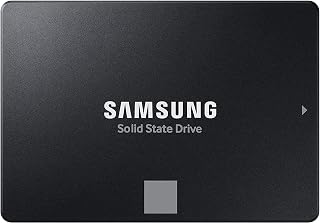
The 2TB configuration is better suited to a NAS that needs room for a larger cache tier or a modest SSD-based shared-data volume. With twice the capacity of the 1TB option, it leaves more usable space for active files, and its SATA III 6 Gb/s interface plus up-to-560 MB/s reads and 530 MB/s writes align with common SATA NAS hardware.
Pros
- Exceptional speed: 560MB/s read and 530MB/s write speeds handle 4K video, gaming, and file transfers with ease
- Trusted reliability: Samsung's pioneering V-NAND technology and 5-year warranty provide peace of mind
- Industry-leading compatibility: Tested with major chipsets, motherboards, NAS devices, and gaming consoles
- Strong customer satisfaction: 4.8-star rating with over 45,000 verified reviews
- Flexible capacity and affordability: 2TB model offers excellent value for mainstream users
Cons
- SATA interface limitation: Maxes out at 560MB/s, slower than newer NVMe SSDs which can exceed 3,500MB/s
- 2.5-inch form factor requires adapter cables in modern builds designed for M.2 slots
- Premium pricing compared to competing SATA drives with similar specs
The Samsung 870 EVO 2TB is a premium SATA solid-state drive designed for users who need reliable, fast storage without the complexity of NVMe setup. It's ideal for upgrading aging laptops and desktops, building budget-conscious gaming PCs, or archiving mission-critical files.
Performance-wise, the 870 EVO delivers impressive results with read speeds up to 560MB/s and write speeds up to 530MB/s. The larger variable buffer accelerates sustained write operations, making it excellent for 4K video editing, photo processing, and large file transfers. Real-world performance stays consistent thanks to Samsung's intelligent TurboWrite technology.
Build quality is exceptional. The drive features MLC V-NAND technology, enterprise-grade AES 256-bit encryption, and 2,400 TBW endurance rating. Compatibility testing across major platforms, NAS systems, and next-gen gaming consoles (PS5, Xbox Series X/S) ensures this drive works in virtually any modern system.
The main drawback is the SATA interface ceiling. While 560MB/s is plenty for most users, enthusiasts seeking cutting-edge speed should consider NVMe alternatives. Additionally, the 2.5-inch form factor requires cable routing in systems designed for M.2 drives.
Verdict: The Samsung 870 EVO 2TB is a best-in-class SATA SSD that balances speed, reliability, and broad compatibility. Its 5-year warranty and stellar customer reviews make it an excellent choice for upgraders and everyday users.
Capacity: 2TB
Form Factor: 2.5 inches
Interface: SATA III (6 Gb/s), backward compatible with SATA 3 Gb/s and 1.5 Gb/s
Read Speed: Up to 560 MB/s
Write Speed: Up to 530 MB/s
Cache: 32MB
Technology: MLC V-NAND
Endurance: Up to 2,400 TBW
Encryption: AES 256-bit (TCG/Opal 2.0, MS eDrive)
Shock Resistance: 1,500G, 0.5ms half sine
Warranty: 3-5 years manufacturer coverage
Weight: 3.04 oz
Dimensions: 3.94"L x 2.76"W x 0.27"Th
Model: MZ-77E2T0B/AM
Ideal Buyers: This drive is perfect for budget-conscious PC builders, laptop upgraders seeking reliable performance, content creators working with 4K video and large files, gamers consoles (PS5, Xbox Series X/S), and professionals who require enterprise-grade reliability without NVMe complexity.
May Not Be Ideal For: Users requiring maximum speed for professional video rendering or heavy database operations may benefit more from NVMe drives. Those with limited SATA ports in their system should consider compatibility before purchasing.
Best Use Cases: System upgrades for older PCs and Macs, gaming console storage expansion, network-attached storage (NAS), video editing workstations, and backup storage for creative professionals.

Pros
- Purpose-built for NAS use and 24/7 operating environments.
- Large 4TB capacity with responsive SATA III performance.
- Strong endurance for heavy read and write workloads.
- 5-year limited warranty adds long-term ownership support.
- Customer feedback highlights reliable operation and quieter NAS systems.
Cons
- SATA performance is slower than that of modern NVMe SSDs.
- Compatibility with a specific NAS enclosure, drive bay, or firmware should be confirmed before purchase.
- The 2.5-inch design may require a tray, bracket, or adapter in some NAS systems.
The Western Digital WD Red SA500 4TB is an internal 2.5-inch SATA SSD designed specifically for NAS systems. It suits home users, creative professionals, and small businesses that need dependable storage for shared files, backups, databases, and media libraries.
With read speeds up to 560 MB/s, the drive helps improve file access and overall NAS responsiveness compared with mechanical storage. Its caching-focused design is useful for frequently accessed content, while the endurance rating is intended to support demanding read and write workloads.
The compact 7mm form factor fits compatible NAS bays and internal drive configurations, and solid-state construction operates quietly with no moving parts. Customer feedback also describes reliable performance in Synology systems and noticeably quieter setups after replacing hard disk drives.
As a SATA SSD, it cannot match the peak throughput of NVMe storage, and users should verify NAS compatibility before installation. Some systems may also require a mounting tray or adapter for a 2.5-inch drive.
Overall, the WD Red SA500 4TB is a practical NAS upgrade for buyers who value capacity, low noise, endurance, and consistent SATA performance. It is especially well suited to multi-user storage, content libraries, backups, and other always-on workloads.

Pros
- Purpose-built for NAS workloads and business storage applications
- Strong listed read speed of up to 3,430 MB/s
- Compact M.2 2280 design works well in compatible NAS hardware
- Suitable for virtualization, collaborative editing, and multi-user tasks
- 5-year manufacturer limited warranty
Cons
- The 500GB capacity may be limiting for large media libraries, virtual machines, or extensive business data
- PCIe Gen3 performance is not as fast as newer PCIe Gen4 or Gen5 NVMe drives
- Compatibility depends on whether the NAS supports internal M.2 NVMe SSDs
The Western Digital WD Red SN700 is a 500GB internal NVMe SSD made for compatible NAS devices. It is aimed at NAS owners, small businesses, and professionals who need more responsive storage for virtualization, collaborative editing, and multi-user applications.
With a listed read speed of up to 3,430 MB/s, the drive is designed to reduce storage bottlenecks during everyday file access and demanding workloads. Its NVMe interface and PCIe Gen3 connectivity offer a responsive upgrade over conventional hard drive storage in supported systems.
The compact M.2 2280 form factor makes the SN700 suitable for NAS enclosures and other compatible internal storage platforms. Its WD Red positioning, 9.07-gram weight, and 5-year manufacturer limited warranty support its role as a purpose-built business and NAS component.
Capacity is the main limitation of this 500GB version, particularly for users storing large media collections, virtual machines, or extensive business files. Buyers should also confirm that their NAS supports M.2 NVMe drives and recognize that PCIe Gen3 is older than current Gen4 and Gen5 standards.
Overall, the WD Red SN700 is a practical choice for compatible NAS systems that need faster application response and dependable NVMe storage. It is most compelling for virtualization, collaborative workloads, and multi-user access where 500GB is sufficient.
Pros
- Designed specifically for NAS environments and demanding storage workloads
- Fast NVMe performance can improve system responsiveness and application loading
- 2TB capacity offers useful room for applications, active projects, and shared data
- Well suited to virtualization, collaborative editing, and multi-user multitasking
Cons
- PCIe Gen3 performance is behind newer Gen4 and Gen5 NVMe drives
- Compatibility depends on a NAS device supporting internal M.2 2280 NVMe drives
- May be more than basic NAS users need for simple file storage and backups
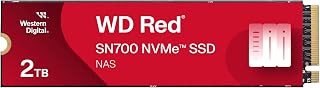
The Western Digital WD Red SN700 is a 2TB internal NVMe SSD built for compatible NAS devices. It is aimed at home offices, creative teams, and businesses that need faster shared storage for virtualization, collaborative editing, and multi-user applications.
With PCIe Gen3 connectivity and advertised speeds up to 3,400 MB/s, the drive is designed to make NAS systems feel more responsive. Its NVMe architecture can help reduce storage bottlenecks when applications, virtual machines, and shared projects are active at the same time.
The M.2 2280 form factor supports a compact internal installation, while the WD Red branding reflects its focus on NAS workloads. The 2TB capacity gives users substantial room for frequently accessed data, applications, and active work files.
There are some limitations to consider before buying. It requires a compatible NAS with an M.2 2280 NVMe slot, and its PCIe Gen3 interface is not as fast as newer Gen4 or Gen5 technology, while basic file-storage users may not benefit from its workload-focused design.
Overall, the WD Red SN700 is a strong choice for NAS owners who need responsive, dependable NVMe storage for demanding workloads. It offers a practical balance of capacity and performance for virtualization, collaborative work, and systems serving multiple users.

Pros
- Designed for heavy workloads, 24/7 NAS use, virtualization, editing, and database storage
- TLC flash, SLC caching, ECC, and listed power-loss protection support dependable everyday operation
- Includes two drives for flexible RAID, backup, or multi-device storage configurations
- Compatible with many popular NAS brands and standard 2.5-inch SATA systems
- Five-year replacement warranty with lifetime technical support
Cons
- SATA performance is substantially slower than modern NVMe SSDs for high-bandwidth workstation workloads
- Each drive provides 512GB, which may be limiting for large video libraries, virtual machines, or growing databases
- Compatibility should be checked carefully because the drives are not recommended for server models or SAN environments
The Gigastone High Endurance SSD bundle includes two 512GB 2.5-inch SATA III solid state drives aimed at NAS owners, home lab users, and professionals managing continuous workloads. It is also suitable for compatible PCs, laptops, NVR systems, RAID setups, and PlayStation 4 upgrades.
With TLC 3D NAND, SLC caching, and sequential read speeds up to 550MB/s, the drives are designed to keep file access and transfers responsive. Their high-endurance focus makes them a better fit for virtualization, collaborative editing, photo rendering, and database tasks than basic entry-level storage.
The compact 7mm form factor makes installation straightforward in compatible 2.5-inch SATA bays, while the listed shock, dust, and water resistance adds protection in everyday use. ECC, power-loss protection, silent operation, and broad compatibility with Synology, QNAP, and Asustor systems further support dependable NAS deployment.
There are practical limits to consider: SATA cannot match NVMe speeds, and 512GB per drive may feel restrictive for large media collections or multiple virtual machines. Buyers should also verify device compatibility, since Gigastone does not recommend this model for server models or SAN environments.
Overall, this two-pack is a sensible storage upgrade for users who need durable, quiet, and continuously available SSD capacity in a NAS or RAID setup. The five-year worldwide replacement warranty and lifetime technical support strengthen its value for home offices, creative workspaces, and personal labs.

Pros
- Designed for continuous NAS and RAID operation
- Fast SATA performance with TLC NAND and SLC caching
- Works with a broad range of NAS, PC, laptop, and PS4 devices
- Shock-resistant, dust-resistant, and waterproof design features
- Two-drive pack is useful for mirrored RAID 1 storage setups
Cons
- Some buyer feedback reports an early drive failure and difficulty reaching support
- SATA speeds are substantially lower than modern NVMe SSDs
- Not recommended for server models or SAN environments
The Gigastone GS-SSD-8400-1TBX2-B is a two-drive 2.5-inch SATA SSD package aimed at NAS owners, home lab users, and PC builders who need storage for continuous workloads. It is especially suitable for RAID configurations, virtualization, collaborative editing, databases, and media storage.
TLC 3D NAND and SLC caching support responsive file access, while sequential transfer speeds of up to 550MB/s make it a practical upgrade from a conventional hard drive. ECC and power loss protection are useful additions for systems handling important data, although actual performance depends on the host device and workload.
The compact 7mm 2.5-inch enclosure fits compatible NAS bays, desktops, laptops, and PlayStation 4 systems. Compatibility is listed for Synology, QNAP, and Asustor models, and the drive offers shock, dust, and water resistance features for added everyday protection.
Reliability feedback is not entirely consistent. Several buyers report stable operation in RAID 1, PC systems, and virtual machine environments, while another reports that one drive failed within 48 hours and experienced delayed support. It is also not intended for server models or SAN environments.
Overall, this two-drive pack is a sensible SATA option for buyers seeking NAS-focused endurance, RAID flexibility, and straightforward compatibility at a lower performance tier than NVMe storage. The 5-year replacement warranty adds reassurance, but buyers with mission-critical workloads should maintain backups and consider established enterprise storage alternatives.

Pros
- Designed for 24/7 NAS workloads, RAID storage, virtualization, and intensive file management
- Solid reported performance in RAID 1 and NAS setups, with speeds reaching approximately 500MB/s or more in user testing
- Broad compatibility with NAS systems, PCs, laptops, NVRs, and selected game consoles
- Silent 2.5-inch SATA III design is easy to integrate into many existing systems
- Long 5-year replacement warranty provides additional ownership support
Cons
- One customer reported that one drive failed within 48 hours, while support follow-up was delayed
- Reliability over long-term use is not fully established by the available customer feedback
- Not recommended for server models or SAN environments, limiting use in some enterprise deployments
The Gigastone GS-SSD-NAS-4TB-2PK-B is a two-pack of 2.5-inch SATA III solid state drives designed for NAS systems, RAID configurations, PCs, laptops, NVRs, and selected gaming consoles. Its high-endurance positioning makes it especially suitable for home labs, small offices, media storage, and other always-on environments.
With sequential read speeds of up to 530MB/s, 3D NAND flash, and SLC caching, these drives are built to keep file transfers and routine storage tasks responsive. Customer feedback includes positive reports of stable operation in RAID 1, Linux systems, and extended burn-in testing, although real-world performance depends on the host system and workload.
The compact 2.5-inch, 7mm form factor supports straightforward installation in compatible SATA bays. Dust-resistant, shock-resistant, and waterproof features add practical protection, while silent operation is well suited to office, home lab, and living-room setups.
There are important caveats for buyers who prioritize proven long-term reliability. One review describes an early failure in one of the two drives and delayed support communication, and the manufacturer does not recommend these SSDs for server models or SAN environments.
Overall, this Gigastone SSD two-pack is a capable option for compatible NAS and RAID users who value capacity, 24/7 workload support, and a long replacement warranty. It is best suited to home and small-business storage rather than mission-critical enterprise deployments where extensive reliability history and responsive support are essential.
Pros
- High 4TB capacity for large-scale storage and data consolidation
- Built for continuous 24/7 NAS operation and heavy workloads
- Up to 530MB/s sequential performance with SLC caching
- Broad compatibility with popular NAS brands, RAID configurations, PCs, and PS4
- Five-year replacement warranty with lifetime technical support
Cons
- SATA III performance is lower than that of modern NVMe SSDs
- Not recommended for server models or SAN environments
- The listing provides limited detail about exact endurance ratings, such as total terabytes written
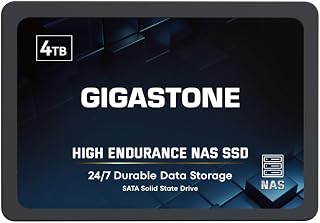
The Gigastone GS-SSD-8400-4TB-B is a 4TB high endurance internal SSD designed for NAS systems, RAID storage, NVRs, personal clouds, and demanding PC use. Its 2.5-inch, 7mm SATA format makes it a practical upgrade for compatible home labs, offices, and business storage setups.
Built for 24/7 workloads, the drive combines 3D NAND flash, SLC caching, ECC, power loss protection, and sequential speeds up to 530 MB/s. These features support smoother file transfers, collaborative editing, virtualization, database access, and large media workflows.
The compact SATA III design supports broad compatibility with Synology, QNAP, and Asustor NAS models, along with compatible laptops, PCs, and PlayStation 4 systems. Dust resistance, shock resistance, and waterproof construction add useful protection for everyday installation and handling.
Buyers should note that this is a SATA SSD, so it cannot match the bandwidth of newer NVMe drives. It is also not suggested for server models or SAN environments, and the available data does not specify a total terabytes written rating.
Overall, the Gigastone 4TB High Endurance NAS SSD is a strong fit for users who prioritize capacity, continuous-duty reliability, and broad SATA compatibility. The five-year replacement warranty and lifetime technical support further strengthen its appeal for home labs, creative workstations, and business NAS storage.

Pros
- Exceptional reliability for continuous 24/7 operation in NAS environments
- Dramatically improves NAS responsiveness and reduces file access latency
- Proven Western Digital quality with strong user satisfaction and positive reviews
- Excellent form factor compatibility with modern NAS systems
- Strong performance for workloads beyond caching, including video editing and database operations
Cons
- Premium pricing reflects NAS specialization, making it more expensive than general-purpose SSDs
- Limited to SATA interface speeds, cannot match NVMe performance for systems that support it
- 2TB capacity may feel limiting for large media libraries or enterprise deployments
The WD Red SA500 2TB is a NAS-specific SSD designed for users who demand reliable, high-performance storage in network-attached systems. This drive is built for small office networks, home labs, media centers, and anyone running a continuous NAS environment where uptime and consistency matter. Unlike general-purpose SSDs, it's engineered specifically for the constant read/write cycles that NAS systems experience daily.
The standout feature is its proven Western Digital 3D NAND technology combined with NAS-grade durability. It accelerates file access by caching frequently used data, significantly reducing latency in OLTP databases, 4K video editing workflows, and multi-user photo rendering. The real-world benefit is noticeable responsiveness in professional workloads, and the endurance ratings ensure it won't wear out under heavy use. Most users report consistent performance across months of continuous operation.
Build quality reflects WD's reputation for reliability. The compact 2.5-inch form factor with 7mm height fits seamlessly into modern NAS drive bays. The SATA III 6 Gb/s interface provides up to 560 MB/s performance, which is solid for NAS applications though not cutting-edge by SSD standards. The drive operates coolly and quietly, a plus for always-on systems.
The main drawback is the premium price tag relative to consumer SSDs, a trade-off for NAS-specific optimization and endurance ratings. Additionally, SATA speeds cap performance at 560 MB/s, which means systems supporting NVMe interfaces won't fully leverage their potential bandwidth. For very large deployments needing multiple drives, the cost can add up quickly.
Verdict: The WD Red SA500 2TB is an excellent choice if you operate a NAS system professionally or seriously. The build quality, endurance, and performance gains for caching make it worth the investment for reliable 24/7 storage. It's overkill for casual backup but essential for media centers, small businesses, or anyone whose work depends on responsive network storage.
Storage Capacity: 2TB (2000 GB)
Interface: SATA III 6 Gb/s
Form Factor: 2.5-inch, 7mm height
Technology: 3D NAND
Max Speed: Up to 560 MB/s
Compatibility: macOS v.10.9+, Windows 10+
Installation: Internal NAS drive
Brand: Western Digital
Series: WD Red SA500
Ideal For: NAS system owners, small business IT, media professionals, home lab enthusiasts, anyone running 24/7 network storage environments.
Best Use Cases: Caching in NAS systems, OLTP databases, 4K/8K video editing workstations, photo rendering farms, continuous multi-user file access environments.
May Not Be Best For: Budget-conscious users seeking basic backup, systems that don't require 24/7 uptime, applications needing NVMe speeds, very large-scale enterprise deployments.
How to Choose an SSD for Your NAS
An SSD upgrade should solve a specific bottleneck. Before buying, check your NAS documentation for supported drive types, cache rules, slot count, capacity limits, and firmware requirements. That preparation matters more than choosing the drive with the biggest sequential speed claim.
Confirm the physical interface and NAS support
A 2.5-inch SATA SSD fits a standard SATA bay, while an M.2 NVMe SSD needs a compatible M.2 slot that supports PCIe. These formats are not interchangeable, and some NAS units reserve M.2 slots for cache rather than general file storage.
The Samsung SSD 870 EVO SATA III 2.5” 1TB and 2TB models are sensible choices when you need a conventional SATA drive for a compatible bay. Western Digital WD Red SA500 SATA options are purpose-built for NAS use and caching. If your device has NVMe slots, the WD Red SN700 line is designed for higher-I/O NAS tasks. Creators moving files through a laptop can also benefit from a capable Thunderbolt 5 dock at the workstation side.
Choose cache, active storage, or a combination
SSD cache is most useful for frequently accessed small files, metadata, virtual machines, databases, and multi-user projects. It can make browsing and repeated access feel much quicker, even when your main storage pool still uses hard drives.
NVMe models such as the Western Digital 500GB WD Red SN700 NVMe Internal and its 2TB counterpart fit this job well when your NAS supports PCIe cache. A SATA SSD may be a better fit when you want quiet all-flash storage in an ordinary drive bay. Check whether your NAS supports read-only cache, read-write cache, or an SSD storage volume before deciding how much capacity to assign.
Prioritize endurance for continuous workloads
NAS drives can handle constant indexing, backups, synchronization, and cache writes, so endurance deserves more attention than peak speed. Look for a stated endurance rating, a meaningful warranty, and a drive designed for sustained activity rather than light desktop use.
The WD Red SA500 and WD Red SN700 ranges are positioned for always-on NAS workloads, including collaborative editing and virtualization. Gigastone High Endurance SSD models emphasize 24/7 operation, TLC or 3D NAND, SLC caching, ECC, and power-loss protection. The Gigastone 1TB High Endurance SSD (2-Pack) is particularly practical when you need matched SATA drives for a compatible mirrored or RAID setup.
Match drive speed to your network and workflow
SATA SSDs generally reach the ceiling of the SATA interface, while NVMe drives deliver much higher internal throughput. Yet a 1GbE network can become the limiting factor long before an SSD does. Your transfer performance depends on the NAS processor, RAID layout, client hardware, switch, and Ethernet connection as much as the drive itself.
For large media transfers, use sound network cabling and review this guide to the best Ethernet cable for gaming, since the same cable considerations apply to fast wired NAS connections. In a home or office with wired access points, cameras, and NAS clients, a suitable PoE switch can simplify the wider network layout. Upgrade the network path before expecting a cache drive alone to transform large sequential copies.
Final Thoughts
For a dependable SATA-based NAS upgrade, the Samsung SSD 870 EVO SATA III 2.5” 2TB is a strong option for compatible bays and everyday always-on storage needs. If your NAS supports PCIe cache and your workload includes virtualization, shared projects, or frequent file access, the Western Digital 2TB WD Red SN700 NVMe Internal is the more specialized choice.
Frequently Asked Questions
Is an NVMe SSD or SATA SSD better for a NAS?
Neither format is automatically better, because the right choice depends on your NAS hardware and intended use. NVMe drives are excellent for compatible cache slots and I/O-heavy tasks, while SATA SSDs are easier to use in standard drive bays. A SATA model can be the better purchase if your NAS lacks M.2 NVMe support or you need an all-flash storage volume.
Can I use a regular desktop SSD in a NAS?
You can use a regular SSD if your NAS supports its interface and form factor, but a NAS-oriented drive is often a safer match for constant activity. Drives such as the WD Red SA500, WD Red SN700, and Gigastone High Endurance range are built around the sustained read and write demands common in NAS use. Always confirm your NAS compatibility list and cache rules before installation.
How much SSD cache do I need for a NAS?
Start with the working data that gets opened repeatedly, rather than the total size of your NAS. A smaller cache can help document libraries, photos, and home backups, while virtualization, editing, and database workflows may benefit from more capacity. Monitor cache usage after setup and expand only when your NAS reports that the active data set needs it.
Will an SSD make my NAS faster over a home network?
An SSD can reduce latency and improve access to busy files, but it cannot bypass the limits of your Ethernet network. On a basic wired connection, large file copies may be limited by the network link rather than the SSD. In 2026, the most balanced upgrade pairs suitable NAS storage with capable client hardware, a solid switch, and properly configured networking.




Write Your Review
No reviews yet. Be the first to share your experience!