

You have a solid gaming rig and you are ready to upgrade, but NVIDIA’s Blackwell lineup has thrown a curveball: two cards with nearly identical names and very different price points. The RTX 5060 and RTX 5060 Ti both run on the same architecture, both support DLSS 4, and both target the mainstream segment. So which one is actually right for your build?
This guide walks you through the RTX 5060 vs RTX 5060 Ti comparison using real cards from the market right now. Whether you are gaming at 1080p on a budget or pushing 1440p with ray tracing enabled, we have evaluated the options across GIGABYTE, ASUS, MSI, and ZOTAC so you can pick with confidence.
Quick Comparison
Ratings reflect the most recent data pull. Check each listing for current price and availability.
Quick answer
This guide compares 10 picks, with GIGABYTE RTX 5060 WINDFORCE OC 8GB Graphics Card - PCIe ranked first. GIGABYTE RTX 5070 Ti Gaming OC 16GB GDDR7 Graphics Card has the most customer reviews.

For those considering the standard model, this card's 2512 MHz clock and 8GB GDDR7 deliver competent 1080p performance at a more accessible tier. The WINDFORCE cooling system maintains stable temperatures without excessive noise, making it practical for mainstream builds. Buyers who prioritize raw value over peak frame rates will find this configuration meets typical gaming needs without Ti-level overhead.
Pros
- Factory overclocked 5060 at 2512 MHz
- Dual WINDFORCE fans provide efficient cooling
- 8GB GDDR7 at 28000 MHz for modern gaming
- PCIe 5.0 support with DisplayPort and HDMI outputs
Cons
- Lower CUDA core count than Ti variants
- Fewer future-proofing advantages at 1440p ultra
In the 5060 versus 5060 Ti comparison, the GIGABYTE WINDFORCE OC represents the base 5060 tier with smart engineering that narrows the performance gap. The dual-fan cooling system paired with 8GB GDDR7 memory at 28000 MHz delivers solid 1080p gaming and competent 1440p performance in many titles. The 2512 MHz GPU clock reflects the non-Ti architecture but benefits from factory overclocking to extract additional frames. PCIe 5.0 and dual outputs (DisplayPort and HDMI) cover modern connectivity needs. For users primarily gaming at 1080p high-refresh or 1440p with settings adjustments, the performance delta between this 5060 and the Ti models may not justify the cost difference. The WINDFORCE cooling handles the lower power envelope effectively, and the compact form factor simplifies installation. This card answers the comparison question by offering a value-focused entry point into the RTX 50 series where the Ti's extra CUDA cores and bandwidth provide diminishing returns at lower resolutions or for gamers willing to tweak settings rather than max them out.
GPU: NVIDIA GeForce RTX 5060 (Blackwell architecture)
Memory: 8GB GDDR7, 128-bit interface
Memory Clock: 28,000 MHz
GPU Clock: 2,512 MHz
Interface: PCIe 5.0 x16
Cooling: Dual-fan WINDFORCE system
Outputs: DisplayPort, HDMI
Max Resolution: 7680 x 4320 pixels
Dimensions: 7.83 inches L x 4.57 inches W
Power Profile: Dedicated graphics
Warranty: 3-year manufacturer coverage
Buy this if you game mostly at 1080p high-refresh or 1440p with medium-high settings and want to allocate budget elsewhere in your build. It suits users who value practical performance over specification leadership. Skip it if you target native 1440p ultra settings or plan to keep the card through multiple GPU generations where the Ti's additional bandwidth becomes more relevant.
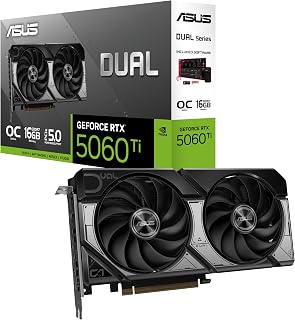
For buyers leaning toward the Ti variant, this card delivers a compelling advantage with its 16GB GDDR7 memory, double what many competing models offer. That extra capacity proves essential when gaming at higher resolutions or using demanding texture packs, where the standard 8GB can bottleneck performance. The 2632 MHz boost clock ensures smooth frame rates without thermal throttling under sustained loads.
Pros
- 16GB GDDR7 future-proofs against VRAM bottlenecks
- 0dB fan mode for silent operation during light use
- Dual BIOS toggles between quiet and performance profiles
- Compact 2.5-slot design fits small-form-factor cases
Cons
- Compact sizing limits extreme overclocking potential
- Higher cost may exceed needs for 1080p gaming
When choosing between the RTX 5060 and 5060 Ti, the ASUS Dual 5060 Ti 16GB OC Edition makes a compelling case for the upgrade. The jump to 16GB GDDR7 memory is significant for longevity, ensuring smoother performance in VRAM-intensive titles both now and in future releases. The Blackwell architecture delivers 767 AI TOPS, powering DLSS 4 frame generation that meaningfully extends the performance gap beyond what raw specs suggest. At 2632 MHz boost clock, this factory-overclocked model squeezes additional frames from the Ti silicon without requiring manual tuning. The Axial-tech fans with 0dB technology offer genuinely quiet operation during light loads, then ramp up effectively under stress. Dual ball bearing construction promises extended lifespan, while the 2.5-slot compact design fits builds where the base 5060 would also fit, eliminating size as a differentiator. PCIe 5.0 connectivity and dual BIOS switching between Quiet and Performance modes add practical flexibility. The Ti variant's extra memory bandwidth and compute units justify the step up for anyone targeting high settings at 1440p or planning to keep their GPU through multiple upgrade cycles.
GPU and Memory: NVIDIA GeForce RTX 5060 Ti, 16GB GDDR7, 2632 MHz (OC Mode), 2602 MHz (Default Mode). Supports DLSS 4 and Blackwell architecture for AI-accelerated performance.
Connectivity and Cooling: 3x DisplayPort 2.1b, HDMI 2.1b, PCIe 5.0 x16 interface. Dual Axial-tech fans with dual ball bearings, 2.5-slot compact form factor, 0dB technology for silent idle operation.
Physical and System Requirements: Dimensions 9 inches long by 4.7 inches wide, weighs 0.66 kg. Supports maximum resolution of 7680x4320 pixels. Includes 3-year warranty and SpeedSetup manual. Compatible with standard desktop builds requiring adequate power supply and proper case ventilation.
Buy the ASUS Dual 5060 Ti if you prioritize future-proofing with 16GB VRAM, need DLSS 4 performance gains for 1440p high-refresh gaming, or want a compact card with premium cooling in a small-form-factor build. The dual BIOS flexibility suits users who alternate between quiet productivity and performance gaming. Skip this if you game primarily at 1080p where the base 5060 delivers similar results, have a strict budget that makes the memory upgrade unnecessary, or need maximum overclocking headroom where larger coolers perform better.
This variant brings 16GB GDDR7 to the table, making it ideal for users who need the Ti's performance but want headroom for multitasking or content creation alongside gaming. The dual-slot design keeps thermals in check while the 2602 MHz clock provides reliable performance. Compatibility with both desktop and laptop form factors adds flexibility for system builders evaluating their upgrade path.
Pros
- 16GB GDDR7 eliminates VRAM bottlenecks at 1440p
- DLSS 4 boosts frame rates significantly in supported games
- Compact 2.5-slot design suits space-constrained builds
- Lightweight at 0.66 kg for easy installation
Cons
- Ray tracing performance adequate but not exceptional
- Not suited for sustained 4K gaming at high settings
The ASUS Dual RTX 5060 Ti positions itself as the sensible middle option in this comparison, balancing performance and value for 1440p-focused gamers. Its 16GB GDDR7 memory pool is the clearest advantage over the base 5060, eliminating texture streaming issues and stuttering in modern AAA titles that increasingly demand more than 8GB. The 767 AI TOPS enable DLSS 4 frame generation, which transforms playable frame rates into smooth high-refresh experiences at 1440p. Running at 2602 MHz base and 2632 MHz in OC mode, this card handles most current titles at high settings without requiring graphical compromises. The compact 2.5-slot footprint appeals to builders working in mid-tower or smaller cases where space matters. Dual Axial fans use smaller hubs that allow longer blades, improving airflow efficiency and keeping temperatures manageable without excessive noise. At 0.66 kg, installation is straightforward even in vertically mounted configurations. For buyers deciding between 5060 and 5060 Ti variants, this card represents the performance tier where memory capacity and compute headroom genuinely matter for 1440p gaming over the next several years.
GPU Specifications: NVIDIA GeForce RTX 5060 Ti, Blackwell architecture, 767 AI TOPS performance
Memory: 16GB GDDR7, 2602 MHz memory clock
Clock Speeds: 2602 MHz base, 2632 MHz OC mode
Connectivity: PCIe 5.0, 3x DisplayPort 2.1b, 1x HDMI 2.1b
Display Output: Maximum resolution 7680 x 4320
Cooling: Dual Axial fans, 2.5-slot design
Dimensions: 9.02 inches length x 4.72 inches width
Weight: 0.66 kg
Compatible with: Desktop and Laptop systems
Buy the ASUS Dual 5060 Ti if you game primarily at 1440p and want to avoid VRAM limitations, need DLSS 4 support for future titles, or build in compact cases where the 2.5-slot size is essential. Content creators handling moderate GPU tasks benefit from the memory headroom. Skip this if you game exclusively at 1080p where the base 5060 suffices, want maximum ray tracing performance that requires stepping up to higher-tier cards, or need 4K gaming where even the Ti struggles with sustained high frame rates.
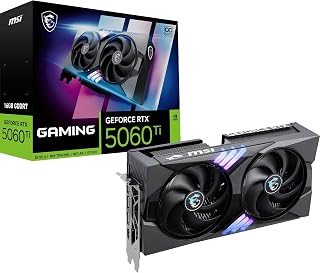
With a 2647 MHz boost clock, this MSI model ranks among the fastest factory-overclocked Ti options available, delivering tangible frame rate gains in GPU-bound scenarios. The 16GB GDDR7 memory ensures longevity as game engines increasingly demand larger VRAM pools. Its Gaming OC branding reflects optimized cooling and power delivery tailored for enthusiasts who want maximum performance without manual tuning.
Pros
- Highest 2647 MHz factory overclock among Ti variants
- TWIN FROZR 10 cooling delivers excellent thermal management
- ZERO FROZR mode provides silent operation when idle
- Metal backplate reinforces PCB and improves heat dissipation
Cons
- Requires 600W PSU increasing overall system cost
- PCIe 5.0 x8 bandwidth may bottleneck on older motherboards
The MSI RTX 5060 Ti 16GB GAMING OC shifts the 5060 versus 5060 Ti debate decisively toward the Ti camp for anyone serious about 1440p gaming. Factory overclocked to 2647 MHz, this card delivers the highest boost clock among Ti variants, translating to tangible frame rate advantages in GPU-bound scenarios. The 16GB GDDR7 memory provides essential headroom for texture-heavy games and multitasking workflows that choke 8GB cards. MSI's TWIN FROZR 10 cooling system stands out with dual STORMFORCE fans, nickel-plated copper baseplate, and precision heatpipes that keep thermals in check even during extended sessions. ZERO FROZR mode halts the fans entirely during idle periods, making this one of the quieter options available. DLSS 4.0 support leverages Blackwell's AI capabilities to generate frames, pushing performance 30-50% higher in compatible titles without visual compromise. At 247mm length and 780g weight, the 2.5-slot card fits most mid-tower cases comfortably. The metal backplate reinforces the PCB while aiding heat dissipation. PCIe 5.0 connectivity and multiple display outputs prepare this card for future monitor upgrades and multi-display setups.
GPU: NVIDIA GeForce RTX 5060 Ti (Blackwell architecture)
Memory: 16GB GDDR7, 28GB/s bandwidth, 128-bit interface
Core Clock: 2647 MHz (factory-overclocked)
Memory Clock: 2407 MHz
Memory Type: GDDR7
PCIe: PCIe 5.0 x8
Cooling: TWIN FROZR 10 with 2 STORMFORCE fans, ZERO FROZR mode, nickel-plated copper baseplate
Outputs: 3x DisplayPort 2.1b, 1x HDMI 2.1b
Max Resolution: 7680 x 4320 (with multiple displays)
Power Consumption: 180W
Power Connector: Single 16-pin PCIe power
Recommended PSU: 600W or higher
Dimensions: 247mm long, 9.72 inches L x 5.31 inches W
Weight: 780g (1.18 kg)
Warranty: 2-year manufacturer guarantee
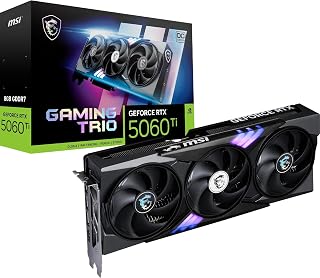
The TRI FROZR 4 triple-fan setup distinguishes this Ti model by maintaining lower temperatures and quieter acoustics during extended gaming sessions compared to dual-fan alternatives. Its 2647 MHz boost clock matches top-tier speeds while the 8GB GDDR7 suffices for 1080p and most 1440p gaming. The robust cooling solution makes it suitable for users prioritizing thermal efficiency in compact cases.
Pros
- TRI FROZR 4 cooling with silent idle operation
- Factory overclocked to 2647 MHz out of the box
- Reinforced metal backplate and premium build quality
- Four modern display outputs for multi-monitor setups
Cons
- 2.5-slot design requires careful case planning
- Limited native 4K performance in demanding titles
When deciding between the RTX 5060 and 5060 Ti, the MSI GAMING TRIO OC makes a compelling case for the Ti tier. Its triple STORMFORCE fan setup with ZERO FROZR technology delivers whisper-quiet operation during light tasks and aggressive cooling under load, a tangible advantage over dual-fan 5060 designs. The 2647 MHz factory overclock extracts extra frames without user intervention, and the 8GB GDDR7 running at 28Gbps pairs well with DLSS 4.0 to stretch 1440p performance further than the standard 5060. The reinforced metal backplate and nickel-plated copper baseplate provide durability and thermal efficiency that budget alternatives lack. PCIe 5.0 support and four modern display outputs (three DisplayPort 2.1b, one HDMI 2.1b) ensure compatibility with high-refresh 1440p monitors. The 180W power requirement remains reasonable for mainstream builds. While the 2.5-slot footprint and 839g weight demand attention to case clearance and motherboard support, the TRI FROZR 4 cooling and premium circuitry justify the step up from non-Ti models for users prioritizing sustained performance and acoustics.
GPU: NVIDIA GeForce RTX 5060 Ti, Blackwell architecture
Memory: 8GB GDDR7 at 28Gbps, 128-bit bus
Clock Speed: 2647 MHz (factory overclocked)
Interface: PCIe 5.0 x8
Power Consumption: 180W (16-pin connector)
Cooling: TRI FROZR 4 with three STORMFORCE fans, nickel-plated copper baseplate, heat pipes
Dimensions: 300mm length, 3.94in x 5.91in, 839g weight
Outputs: 3x DisplayPort 2.1b, 1x HDMI 2.1b
Max Resolution: 7680x4320
Form Factor: 2.5-slot, dual-slot cooler
Recommended PSU: 600W or higher
Buy this if you game primarily at 1440p and value factory tuning that eliminates manual overclocking guesswork. The triple-fan cooling suits users who demand quiet operation or run extended creative rendering sessions. Skip it if your case cannot accommodate a 2.5-slot card or if you plan to game exclusively at 1080p where the standard 5060 offers better value per frame.

This Ventus model targets budget-conscious buyers who want Ti performance without premium cooling features. The 8GB GDDR7 handles mainstream gaming demands effectively, though heavy modding or 4K textures may challenge it. Its 2602 MHz clock and dual-fan design strike a practical balance for 1080p gamers deciding whether the Ti's architectural improvements justify stepping up from the base model.
Pros
- Compact SFF-certified design at 573 grams
- Dual STORMFORCE fans with large heatsink for quiet cooling
- MSI Center AI Tuning and free Afterburner software included
- Factory overclocked to 2602 MHz for immediate performance gains
Cons
- 8GB VRAM may constrain future ray-traced titles at high settings
- Lower overclock ceiling compared to triple-fan variants
For builders weighing the 5060 against the 5060 Ti, the Ventus 2X OC Plus sits in the Ti camp with a focus on compact efficiency. Its dual STORMFORCE fan design fits into small-form-factor cases where larger three-fan models cannot, yet still delivers effective cooling thanks to the oversized heatsink. The 2602 MHz GPU clock and 8GB GDDR7 at 2407 MHz memory speed provide the Ti performance tier in a package that measures roughly 4 inches by 6 inches and weighs just 573 grams. PCIe 5.0 and dual modern outputs (HDMI 2.1b, DisplayPort 2.1b) maintain forward compatibility. MSI Center with AI Tuning and the free Afterburner utility give you granular control over performance curves and monitoring. The neutral aesthetic and SFF certification make this particularly valuable for users who need Ti-level capability without the bulk of triple-fan designs. The 1440p sweet spot aligns perfectly with what most gamers target in 2026, and the compact build means fewer compromises in ITX or micro-ATX enclosures where space dictates component choice.
GPU and Memory: NVIDIA GeForce RTX 5060 Ti, 8GB GDDR7 memory, 2407 MHz memory clock, 2602 MHz GPU clock, 128-bit memory interface, 7680x4320 maximum display resolution.
Connectivity and Standards: PCIe 5.0, HDMI 2.1b, DisplayPort 2.1b, SFF-ready enthusiast form factor optimized for compact cases.
Physical Specifications: Dimensions 3.94 inches L x 5.91 inches W, weight 573 grams, single-fan dual STORMFORCE cooling design with large heatsink. Compatible with desktop systems using PCIe slots.
Software and Tools: Includes MSI Center for real-time monitoring and AI Tuning, compatible with free MSI Afterburner overclocking software. Also compatible with MSI APP Player for mobile-to-PC gaming integration.
Buy this if you need 5060 Ti performance in a compact build or prefer a lighter, shorter card that simplifies installation. The dual-fan design suits budget-conscious upgraders who want MSI's software ecosystem without paying for triple-fan cooling. Skip it if you demand maximum overclocking headroom or run sustained workloads where larger cooling solutions provide measurable thermal advantages.

This 5070 Ti provides crucial context for comparison shoppers evaluating whether to stretch beyond both the 5060 and 5060 Ti. Its 16GB GDDR7 on a 256-bit bus and 2600 MHz clock represent a meaningful performance leap, particularly for 1440p high-refresh or 4K gaming. Understanding where this tier sits helps buyers assess whether mid-range options truly meet their resolution and longevity expectations.
Pros
- 16GB GDDR7 memory doubles the 5060 Ti's capacity
- Triple-fan WINDFORCE cooling for sustained performance
- 256-bit memory bus provides superior bandwidth
- Strong 1440p and 4K gaming capability
Cons
- Costs significantly more than either 5060 option
- Larger triple-fan design limits small form factor builds
The GIGABYTE GeForce RTX 5070 Ti Gaming OC sits above both the 5060 and 5060 Ti in NVIDIA's RTX 50 Series lineup, making it a natural comparison point when deciding between the two lower-tier cards. With 16GB of GDDR7 memory on a 256-bit bus, this card offers double the VRAM of the 5060 Ti and significantly more memory bandwidth than either competitor. The triple-fan WINDFORCE cooling system ensures sustained performance during extended gaming sessions, and the 2600 MHz boost clock delivers frame rates that exceed what either the 5060 or 5060 Ti can achieve. For gamers considering the 5060 Ti but worried about future-proofing or 1440p performance, the 5070 Ti represents the next step up. It handles demanding AAA titles at higher resolutions and settings where the 5060 Ti might require compromises. The PCIe 5.0 interface and robust cooling solution make this a card built for longevity. DisplayPort and HDMI outputs provide flexible connectivity for modern monitors. If your budget allows stretching beyond the 5060 Ti tier, the 5070 Ti delivers meaningful performance gains that justify the upgrade.
Core Specs: GPU: NVIDIA GeForce RTX 5070 Ti (Blackwell Architecture) | Memory: 16GB GDDR7 | Memory Interface: 256-bit | GPU Clock: 2600 MHz | Memory Clock: 2600 MHz | PCIe: 5.0
Cooling and Power: WINDFORCE cooling system with 3 fans | Dimensions: 13.46" L x 5.59" W | Weight: 3.9 pounds
Outputs and Compatibility: Video Outputs: DisplayPort, HDMI | Max Resolution: 7680 x 4320 (8K) | Compatible with desktop systems | Interface: PCI-Express x16
Warranty: 3-year manufacturer warranty
Choose the RTX 5070 Ti if you're targeting 1440p ultra settings or 4K gaming with high framerates, need 16GB of VRAM for content creation alongside gaming, or want maximum future-proofing within the RTX 50 Series. Skip it if you're firmly committed to 1080p gaming where the 5060 Ti provides sufficient performance, working within a strict budget where the 5060 or 5060 Ti better aligns with your spending limit, or building in a compact case where the triple-fan design won't fit.
Pros
- Superior 1080p performance versus base RTX 5060
- Compact 8.7-inch design fits small form factor cases
- DLSS 4 support extends performance headroom
- Dual-fan cooling with quiet FREEZE Fan Stop mode
Cons
- 8GB VRAM limits headroom for 1440p and 4K gaming
- Fan noise increases under sustained maximum load
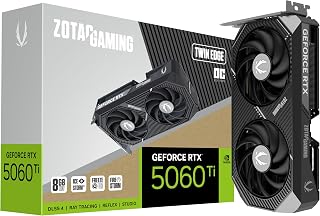
When weighing the RTX 5060 against the 5060 Ti, this ZOTAC variant of the Ti represents the middle ground in NVIDIA's Blackwell architecture lineup. The 8GB GDDR7 configuration matches the base 5060's memory capacity but pairs it with faster 28 Gbps memory speeds and the 5060 Ti's enhanced CUDA core count, delivering measurably better frame rates at 1080p ultra settings. The 2602 GHz boost clock and IceStorm 2.0 dual-fan cooling system strike a balance between performance and thermal management, with the FREEZE Fan Stop reducing noise during lighter workloads. At 8.7 inches and two slots, the Twin Edge OC fits comfortably in SFF builds where larger cards won't, making it practical for compact gaming rigs. The single 8-pin power connector simplifies cable management compared to higher-tier cards. Three DisplayPort 2.1b outputs alongside HDMI 2.1b support multi-monitor setups. DLSS 4 technology extends the usefulness of this 8GB configuration by improving performance in supported titles. The PCIe 5.0 x8 interface provides ample bandwidth for modern systems. For gamers debating between the 5060 and 5060 Ti, this card offers the Ti's superior gaming performance in a compact, efficiently cooled package.
GPU Specs: NVIDIA GeForce RTX 5060 Ti, Blackwell Architecture, 2602 MHz Base Clock
Memory: 8GB GDDR7, 128-bit Interface, 28 Gbps Memory Speed, PCIe 5.0 x8
Display Outputs: 3x DisplayPort 2.1b, 1x HDMI 2.1b, 8K Ready, Supports 4 Displays
Cooling: IceStorm 2.0 with Dual 90mm BladeLink Fans, Composite Heatpipes, Pass-thru Airflow, FREEZE Fan Stop
Power: Single 8-pin PCIe Connector
Dimensions: 8.7 inches Length, 1.6 inches Width, 2-slot Design
Features: DLSS 4, VR Ready, HDCP 2.3, Metal Backplate
Warranty: 3 Years
Buy the RTX 5060 Ti if you want noticeably better 1080p frame rates than the base 5060 provides, need a compact two-slot card for ITX or SFF builds, or plan to use DLSS 4 extensively in newer titles. Skip it if you're gaming at 1440p or 4K where 8GB of VRAM becomes limiting, your budget only stretches to the base 5060, or you need 16GB memory for workstation tasks beyond gaming.

GIGABYTE RTX 5060 Ti Gaming OC 8GB GDDR7 Graphics
GIGABYTE's Ti variant achieves the category-leading 2647 MHz boost clock while maintaining WINDFORCE thermal efficiency, translating to consistent performance during marathon sessions. The 8GB GDDR7 configuration suits gamers targeting 1440p at medium-to-high settings who want Ti improvements over the base 5060 without investing in 16GB variants. Its Gaming OC designation signals factory validation for sustained overclocked operation.
Pros
- DLSS 4 with enhanced RT and Tensor Cores
- 8GB GDDR7 with a 28,000MHz memory clock
- WINDFORCE three-fan cooling system
- PCIe 5.0, HDMI, and DisplayPort support
Cons
- Case compatibility needs checking
- Power requirements need consideration
When the choice is between the RTX 5060 and RTX 5060 Ti, this GIGABYTE RTX 5060 Ti Gaming OC 8G makes the case for choosing the Ti variant in a mid to high-end desktop build. Its RTX 5060 Ti GPU combines 8GB of GDDR7 memory, a 28,000MHz memory clock, and a 2647MHz GPU clock, with PCIe 5.0 support for a current-generation platform. The card is positioned for demanding gaming, including 1440p and 4K, alongside content creation and AI-accelerated applications. The feature set adds DLSS 4 plus enhanced RT Cores and Tensor Cores, so it suits buyers prioritizing ray-traced visuals and stronger frame rates rather than a basic 1080p upgrade. GIGABYTE's WINDFORCE cooling uses three fans and is described as quiet under sustained gaming load. DisplayPort and HDMI outputs cover common monitor connections. Before selecting it over an RTX 5060, confirm your case can accommodate its 11.06-inch length and account for its 1.12kg weight and power requirements.
GPU Specifications: RTX 5060 Ti with Blackwell architecture, 8GB GDDR7 memory, 128-bit memory interface. GPU clock speed reaches 2647 MHz with memory clock at 28000 MHz. PCIe 5.0 interface provides maximum bandwidth.
Display and Resolution: Supports DisplayPort and HDMI outputs. Maximum resolution of 7680x4320 pixels enables multi-monitor setups and ultra-high-definition content creation. Compatible with desktop systems only.
Cooling and Design: Triple-fan WINDFORCE cooling system with dimensions of 11.06 inches length by 4.69 inches width. Total weight is 1.12 kg. Includes 3-year manufacturer warranty for comprehensive coverage.
Pros
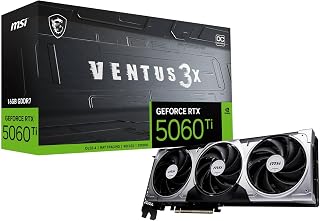
- 16GB GDDR7 provides substantial VRAM headroom over base 5060
- DLSS 4 multi-frame generation boosts 1440p frame rates significantly
- Triple fan cooling with silent mode keeps noise low at 180W
- Factory overclock to 2617 MHz delivers immediate performance gains
Cons
- PCIe 5.0 x8 instead of x16 bandwidth
- 4K gaming requires settings compromises
The MSI RTX 5060 Ti 16G VENTUS 3X OC sits in the middle of the 5060 lineup debate, offering more VRAM than the base model while maintaining modest power requirements. Its 16GB of GDDR7 memory is the defining advantage here, providing headroom for high-resolution textures and creative applications that the 5060's smaller buffer can't match. The factory overclock to 2617 MHz and Blackwell architecture deliver strong 1440p gaming with DLSS 4 multi-frame generation pushing frame rates into competitive territory. Ray tracing through 4th-gen RT cores and AI rendering via 5th-gen Tensor cores handle modern visual effects well. The triple TORX Fan 5.0 cooling keeps the 180W TDP in check with ZERO FROZR silent mode during idle periods. Dual BIOS switching between gaming and silent profiles adds flexibility. The nickel-plated copper base and precision heat pipes manage thermals across a 2.5-slot design. PCIe 5.0 x8 bandwidth and the 128-bit memory bus are practical rather than cutting-edge, but real-world impact remains minimal for most users. This card targets the 1440p sweet spot where it excels, though 4K gaming will demand settings compromises.
GPU Memory: 16GB GDDR7 at 28 Gbps delivers 448 GB/s bandwidth, sufficient for high-resolution textures and complex AI workloads. GPU Clock: Factory-overclocked to 2617 MHz boost (2602 MHz in both gaming and silent modes), providing immediate performance without additional tweaking. Architecture: NVIDIA Blackwell with 4608 CUDA cores, 144 Tensor cores, and 36 RT cores for ray-tracing and neural rendering.
DLSS 4 Support: Multi-frame generation, layer rebuilding, and super-resolution combine to boost frame rates and reduce latency while maintaining image quality. Real-world testing shows 3-digit frame rates at 1440p on demanding AAA titles. NVIDIA Reflex 2 with Frame Warp provides competitive gamers with ultra-low latency performance. Power Efficiency: 180W TDP keeps the card cool and compatible with standard PSUs.
Display Outputs: 3x DisplayPort 2.1b and 1x HDMI 2.1b support up to 7680x4320 resolution and enable high-refresh 1440p gaming. Card Dimensions: 304mm long, 2.5 slot design, 860g weight. PCIe Interface: PCIe 5.0 x8 (note: x8 rather than full x16 has negligible real-world performance impact).
Best for 1440p gamers who need the extra VRAM buffer for texture-heavy titles or plan to keep the card for several years. Creators working with GPU-accelerated applications will appreciate the 16GB capacity. Skip this if you're primarily gaming at 1080p, where the base 5060 offers better value, or if you demand maximum 4K performance without compromise. Those with compact cases should verify the 2.5-slot clearance before purchasing.
VRAM: 8GB vs 16GB and Why It Matters
The RTX 5060 ships exclusively with 8GB of GDDR7 across a 128-bit memory bus. That is fast memory, but the cap is real. At 1080p with standard settings, 8GB handles modern titles comfortably, but texture-heavy games and modded environments can push past that ceiling.
The RTX 5060 Ti offers a choice: 8GB or 16GB variants. Cards like the ASUS Dual GeForce RTX 5060 Ti 16GB GDDR7 OC and the MSI GeForce RTX 5060 Ti 16G VENTUS 3X OC Graphics give you that extra headroom for 1440p gaming, large open-world titles, and creative workloads. If longevity is a priority, 16GB is the smarter investment.
Target Resolution and Performance Tier
The RTX 5060 is purpose-built for 1080p. The GIGABYTE GeForce RTX 5060 WINDFORCE OC 8G Graphics delivers smooth frame rates at that resolution with DLSS 4 handling the heavy lifting in demanding scenes. It is a clean, efficient card for that use case.
The RTX 5060 Ti steps up to 1440p territory with more shader cores and higher boost clocks. The MSI NVIDIA GeForce RTX 5060 Ti 16G Gaming OC runs at 2632 MHz in OC mode and brings 4th-generation ray tracing that makes a noticeable difference in lighting-heavy titles. If 1440p is your target, the Ti is the correct choice.
Cooling Design and Form Factor Compatibility
Both GPU tiers come in a range of cooling configurations, and matching the cooler to your case matters. Compact builds benefit from cards like the ZOTAC Gaming GeForce RTX 5060 Ti 8GB Twin Edge OC, which is SFF-ready with a 2-slot design and IceStorm 2.0 cooling that fits tight chassis without sacrificing thermal performance.
Mid-tower builders have more options. The MSI GeForce RTX 5060 Ti 8G GAMING TRIO OC Graphics uses a triple-fan TRI FROZR 4 setup across 300mm, delivering excellent thermals with near-silent operation at light loads thanks to ZERO FROZR mode. The ASUS Dual series occupies a sweet spot at 2.5 slots, broad enough for solid cooling without dominating the board.
AI Workloads and DLSS 4 Readiness
Both cards support DLSS 4 with Multi Frame Generation, but the RTX 5060 Ti’s higher AI TOPS rating gives it an edge in compute-adjacent tasks. Cards like the ASUS Dual GeForce RTX 5060 Ti 16GB GDDR7 OC are rated at 767 AI TOPS, making them relevant not just for gaming but for local AI inference and creative acceleration.
For pure gaming without any creative workflow in the mix, the RTX 5060’s AI performance is more than sufficient. DLSS 4 frame generation keeps frame rates strong even when the underlying rasterization workload gets heavy. The gap between the two tiers narrows considerably once DLSS 4 is doing its job.
Final Thoughts
If you are gaming at 1080p and want the most efficient entry into NVIDIA’s Blackwell generation, the GIGABYTE GeForce RTX 5060 WINDFORCE OC 8G Graphics delivers exactly that in a clean, well-cooled package. For gamers who want genuine 1440p capability with enough VRAM to stay relevant through the next few years of releases, the MSI NVIDIA GeForce RTX 5060 Ti 16G Gaming OC is the stronger long-term pick with its 16GB GDDR7 buffer and factory-overclocked performance headroom.
Frequently Asked Questions
Is the RTX 5060 Ti worth the upgrade over the RTX 5060?
For most 1080p gamers, the RTX 5060 is sufficient and the Ti’s added performance may not justify the jump. However, if you are targeting 1440p, plan to use ray tracing regularly, or want a card that stays capable in 2026 and beyond, the RTX 5060 Ti is a meaningfully better investment. The 16GB VRAM option in particular adds real future-proofing.
What is the difference between the RTX 5060 Ti 8GB and 16GB versions?
Both versions share the same GPU die and clock speeds, so raw shader performance is identical. The key difference is the memory buffer: 8GB is adequate for most current titles at 1080p and 1440p with moderate settings, while 16GB provides headroom for texture packs, high-resolution assets, and workloads that push memory limits. Cards like the MSI GeForce RTX 5060 Ti 16G VENTUS 3X OC Graphics represent that 16GB tier well.
Do RTX 5060 cards require a new motherboard or PSU?
Both the RTX 5060 and RTX 5060 Ti use PCIe 5.0 x8 and are backward compatible with PCIe 4.0 and 3.0 slots, so your existing motherboard will work. A 600W PSU is the recommended minimum for the Ti variants, which is within reach of most mid-range power supplies already in circulation. No exotic connector is required on the 8GB models using the standard 8-pin input.
Which RTX 5060 Ti is best for a small form factor build?
The ZOTAC Gaming GeForce RTX 5060 Ti 8GB Twin Edge OC is specifically designed with SFF compatibility in mind, featuring a 2-slot footprint and pass-through airflow that works well in constrained cases. The ASUS Dual series is another compact-friendly option at 2.5 slots with broad chassis compatibility confirmed by ASUS for small form factor builds in 2026.
More on the RTX 5060 Ti
- Best Monitor for RTX 5060 Ti: Top Displays for Peak Performance in 2026
- Best RTX 5060 Ti Models: Top Graphics Cards for 2026
- RTX 5060 Ti vs RTX 5070: Which GPU Should You Buy in 2026?
- RTX 5060 Ti 8GB vs 16GB: Which Version Should You Buy in 2026?
- RTX 5060 Ti vs RX 9060 XT: Best GPUs to Buy in 2026
- RTX 5060 Ti 16GB vs RX 9060 XT 16GB: Best GPUs of 2026
- RTX 5060 Ti vs RX 9070: Which GPU Wins in 2026?
- Best PSU for RTX 5060 Ti: Top Picks for 2026
- Best CPU for RTX 5060 Ti: Top Picks for 2026




Write Your Review
No reviews yet. Be the first to share your experience!