

You have a mid-range budget and two compelling GPU generations staring you down. On one side sits NVIDIA’s Blackwell-based RTX 5060 with GDDR7 memory and DLSS 4. On the other, AMD’s RDNA 4-powered RX 9060 XT arrives with 16GB of GDDR6 and FSR 4 in its corner. Both cards target 1440p gaming, but they make very different trade-offs, and picking the wrong one for your setup can mean leaving real performance on the table.
This guide is for PC builders and upgraders who want a clear-eyed breakdown of both options in 2026. We have evaluated cards from ASRock, XFX, GIGABYTE, and YESTON across both GPU families so you can match the right board to your rig, your games, and your workflow.
Quick Comparison
Ratings reflect the most recent data pull. Check each listing for current price and availability.
Quick answer
This guide compares 10 picks, with Yeston Sakura Radeon RX 9060 XT 16GB GDDR6 Graphics ranked first. ASRock Radeon RX 9060 XT Challenger 16GB GDDR6 PCIe 5.0 holds the highest customer rating among them. Gigabyte Radeon RX 9060 XT 16GB GDDR6 Gaming Graphics has the most customer reviews.
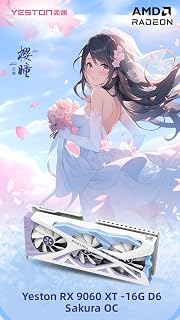
The Sakura edition provides the core 9060 XT experience with 16GB GDDR6 at a 2620 MHz clock, suitable for standard 1440p gaming without aggressive factory overclocking. Its aesthetic-focused design appeals to builders prioritizing case visuals, while maintaining the full memory capacity advantage that defines this GPU tier against competing 8GB options from team green.
Pros
- 16GB GDDR6 doubles the VRAM of the RTX 5060, reducing memory pressure at 1440p and 4K
- Confirmed 7680x4320 maximum resolution supports 8K display output
- 3320MHz boost clock and 2048 unified shaders with AMD FSR 4 and Anti-Lag 2 support
- Composite heat pipe cooling with dual ball bearing fans keeps thermals stable under load
Cons
- GDDR6 memory clock trails the RTX 5060's GDDR7 bandwidth despite the larger capacity
- Single 8-pin power connector may limit flexibility on some PSU cable configurations
In a direct RTX 5060 versus RX 9060 XT shootout, the Yeston Sakura makes the AMD case with straightforward numbers: 16GB of GDDR6 memory versus the RTX 5060's 8GB is the headline difference, and for buyers gaming at 1440p or pushing toward 4K, that frame buffer advantage is tangible. The GPU runs at a 2620MHz base clock and boosts to 3320MHz, while the card's confirmed 7680x4320 maximum resolution puts native 8K signaling on the table, a spec absent from the NVIDIA competitor in this matchup. AMD's FidelityFX Super Resolution 4 and Radeon Anti-Lag 2 round out the performance stack for supported titles. The Sakura's cooling solution pairs dual 9.1cm ball bearing fans running up to 2800 RPM with composite heat pipes and a nickel-plated copper base. ARGB lighting adds visual customization without inflating the 331x137x60mm footprint unduly. For the buyer choosing between these two GPUs, the Yeston delivers more memory and a higher verified maximum resolution.
GPU: AMD Radeon RX 9060 XT, 2048 unified shaders, 16GB GDDR6 128-bit memory interface
Clock Speeds: Base 2620MHz, Boost 3230MHz (STD), Variable 2780/3320MHz, Memory 2518MHz at 20Gbps
Output: Dual DisplayPort 2.1a, single HDMI 2.1b, maximum 7680x4320 resolution
Architecture: DirectX 12, PCI Express 5.0 x16, 6+3 phase power, 8-pin connector
Cooling: YFST4B-Y heat sink with 4x6mm composite heat pipes, dual 9.1cm ball bearing fans, adjustable to 2800 RPM with ARGB lighting
Physical: 331x137x60mm (excluding bracket), 342x152x60mm (including bracket), 1077g, Windows 10/11 compatible
Power: 650W PSU recommended, 1-year manufacturer warranty
The right pick for desktop gamers who want the RX 9060 XT's 16GB GDDR6 advantage over the RTX 5060's 8GB in a distinctive, well-cooled package. Strong for 1440p gaming and 4K aspirations. Skip it if you need NVIDIA-specific software features, if your case space is extremely tight, or if your PSU configuration makes a single 8-pin connector placement awkward.

The Challenger edition delivers a robust 3290 MHz boost clock, among the highest available for the 9060 XT, giving you extra performance headroom for competitive gaming at 1080p or 1440p. Its 0dB silent cooling mode switches off fans during light loads, perfect for quiet desktop use, while DisplayPort 2.1a support ensures compatibility with the latest high-refresh monitors.
Pros
- 3290 MHz boost clock is among the highest in the RX 9060 XT segment
- 16GB GDDR6 outpaces 8GB RTX 5060 configurations in VRAM-heavy workloads
- 0dB idle and mid-60s load temps deliver quiet, efficient everyday operation
- 249mm length and single 8-pin connector simplify installation in most existing builds
Cons
- 128-bit memory bus limits memory bandwidth compared to wider configurations at higher tiers
- Dual-fan cooling is adequate but less aggressive than triple-fan designs on premium alternatives
If the RTX 5060 vs RX 9060 XT comparison is your starting point, the ASRock RX 9060 XT Challenger 16GB OC represents the AMD side of that equation in a particularly well-executed form. Its 3290 MHz boost clock leads the field among RX 9060 XT variants, and the full 16GB GDDR6 over a 128-bit bus gives it a VRAM advantage over 8GB configurations of competing cards in this tier. RDNA 4 architecture with 32 compute units and hardware ray tracing support keeps it competitive against the RTX 5060 in both gaming and light professional workloads. Sustained temps in the mid-60s under full load, combined with 0dB idle operation, make it one of the quieter options in this comparison. The single 8-pin power connector and 550W PSU requirement lower the barrier for straightforward upgrades in existing systems. At 249mm, it fits comfortably in most cases without planning. The dual-fan cooler is a practical rather than aggressive solution, which keeps the card focused on its core purpose: delivering strong 1440p performance without the heat, noise, or power demands of larger alternatives.
GPU: AMD Radeon RX 9060 XT (RDNA 4, 32 Compute Units)
Memory: 16GB GDDR6 at 20 Gbps on 128-bit bus
Clock Speeds: 3290 MHz boost, 2700 MHz game clock
Output: DisplayPort 2.1a, HDMI 2.1b
Max Resolution: 7680x4320 pixels
Power: Single 8-pin connector, 550W PSU recommended
Size: 249mm (L) x 132mm (W) x 41mm (H), 2-slot design
Cooling: Dual fans, 0dB idle mode
Interface: PCIe 5.0 x16
Weight: 0.98 kg
Warranty: 2 years manufacturer
The right pick for buyers in the RTX 5060 vs RX 9060 XT comparison who prefer AMD's RDNA 4 architecture and want 16GB GDDR6 without stepping up to a higher tier. Works well for 1440p gamers and light content creators. Skip it if 4K gaming or intensive 3D rendering at high resolution is a regular workload, or if you specifically need NVIDIA features like DLSS.

This triple-fan configuration excels at thermal management during extended gaming sessions, keeping the 16GB GDDR6 memory cool even under sustained loads. The RDNA 4 architecture paired with dual DisplayPort outputs makes this well-suited for multi-monitor setups, though its 1900 MHz base clock sits conservatively compared to factory-overclocked alternatives in the same product tier.
Pros
- 16GB GDDR6 provides double the VRAM of the RTX 5060 for texture-heavy and 4K workloads
- Triple-fan cooling delivers reported quiet, thermally stable performance under gaming loads
- 3320MHz boost clock and RDNA 4 architecture handle demanding rasterized titles and VR well
- Compact 11.42-inch length fits a wide range of desktop cases without clearance issues
Cons
- Raytracing performance lags behind the RTX 5060 and comparable NVIDIA cards at this tier
- AMD driver software is less refined than NVIDIA's equivalent tooling
Choosing between the RTX 5060 and RX 9060 XT often comes down to VRAM and architecture philosophy, and the XFX Swift makes the RDNA 4 argument with 16GB of GDDR6 memory against the RTX 5060's 8GB. That doubled frame buffer matters at 1440p and becomes more pronounced as games scale toward 4K texture budgets. The Swift's 3320MHz boost clock and RDNA 4 core design underpin strong rasterized performance across demanding titles, and the architecture holds up well for VR. Where the RTX 5060 carries NVIDIA's software advantages, the XFX card counters with raw memory capacity and a triple-fan cooling system that users report keeps the card cool and quiet under sustained load. The compact 11.42-inch length and clean black styling make case integration straightforward. Raytracing performance is a genuine weakness relative to NVIDIA at this tier, and AMD's driver tooling remains less polished, but for buyers who prioritize memory headroom and rasterized gaming throughput, the Swift's specs align well with that need.
Core Specifications: AMD Radeon RX 9060 XT chipset, RDNA 4 architecture, 1900MHz base clock, 3320MHz boost clock, 16GB GDDR6 memory at 20GHz, PCI-Express x16 interface.
Display Outputs: 1x HDMI 2.0, 2x DisplayPort connectors support up to 3840x2160 resolution. Optimal for 1440p gaming or multi-monitor setups.
Thermal Design: XFX SWFT triple-fan cooling solution, compact 11.42-inch length, 1.5kg weight. Fits standard mid-tower cases with typical clearance requirements.
Warranty: 3-year manufacturer protection covers defects and failures, providing peace of mind for multi-year ownership.

The RTX 5060 brings GDDR7 memory and dedicated ray tracing cores, critical advantages if you prioritize cutting-edge features like DLSS 3 frame generation over raw memory capacity. Its 8GB buffer and 2512 MHz clock deliver strong 1080p performance with ray tracing enabled, though the smaller VRAM pool may constrain ultra-texture settings in newer AAA titles compared to 16GB alternatives.
Pros
- GDDR7 memory at 28000MHz clock delivers strong bandwidth for the RTX 5060 class
- PCIe 5.0 interface keeps the card compatible with current and next-generation platforms
- Dual-fan WINDFORCE cooling balances thermal performance with a manageable card size
- DisplayPort and HDMI outputs cover the full range of modern monitor and display configurations
Cons
- 8GB VRAM is half the frame buffer offered by RX 9060 XT cards in this direct comparison
- No maximum display resolution listed in specs, leaving 8K readiness unconfirmed
When the debate is RTX 5060 versus RX 9060 XT, the GIGABYTE WINDFORCE OC lands squarely on the NVIDIA side of the ledger. The RTX 5060 GPU runs at 2512MHz and pulls data through 8GB of GDDR7 at 28000MHz memory clock speed, giving it a meaningful bandwidth advantage over GDDR6 alternatives despite the smaller frame buffer. PCIe 5.0 support keeps the card future-ready as platform adoption grows. The dual-fan WINDFORCE cooling setup manages thermals without requiring a large footprint, fitting standard desktop cases without trouble. For buyers in this comparison who prioritize the RTX 50 Series feature set, including NVIDIA's software ecosystem and DisplayPort plus HDMI output flexibility, this card makes the case clearly. The 8GB allocation is the central tradeoff in this matchup against 16GB RDNA 4 competitors, and buyers running memory-hungry workloads or planning for 4K texture packs should weigh that gap carefully before committing.
GPU: NVIDIA GeForce RTX 5060 (Blackwell architecture)
Memory: 8GB GDDR7, 128-bit interface
Memory Clock: 28,000 MHz
GPU Clock: 2,512 MHz
Interface: PCIe 5.0 x16
Cooling: Dual-fan WINDFORCE system
Outputs: DisplayPort, HDMI
Max Resolution: 7680 x 4320 pixels
Dimensions: 7.83 inches L x 4.57 inches W
Power Profile: Dedicated graphics
Warranty: 3-year manufacturer coverage
Best suited for desktop builders who specifically want NVIDIA's RTX 50 Series platform and value GDDR7 bandwidth over raw frame buffer size. Gamers focused on 1080p and moderate 1440p workloads will find it capable. Skip it if your workload routinely hits VRAM limits, if you run memory-intensive creative applications, or if you are comparing against the 16GB RX 9060 XT cards and frame buffer headroom is a priority.
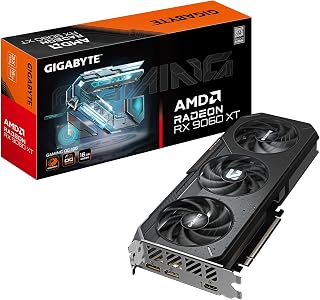
With its 2700 MHz GPU clock and Gaming OC branding, this option balances performance and reliability for mainstream 1440p gaming. The 16GB GDDR6 buffer provides ample headroom for texture-heavy titles and future-proofs your build against increasingly demanding games, while PCIe 5.0 compatibility ensures bandwidth won't bottleneck performance on modern motherboards.
Pros
- 16GB GDDR6 VRAM gives a clear buffer advantage in the RTX 5060 comparison
- WINDFORCE cooling holds temperatures below 68C with low fan noise under load
- PCIe 5.0 and 20000 MHz memory speed keep the platform future-ready
- Stable across both gaming and professional workloads like Cinebench
Cons
- Single HDMI port limits multi-monitor configurations relying on HDMI
- High-refresh 4K gaming pushes beyond this card's comfortable performance ceiling
In a direct RTX 5060 vs RX 9060 XT matchup, the GIGABYTE RX 9060 XT Gaming OC makes a compelling case on paper before a single frame is rendered. Built on AMD's RDNA 4 architecture with 16GB of GDDR6 and PCIe 5.0 connectivity, it brings a meaningful VRAM advantage into the comparison. At 1080p the card operates well within its comfort zone, and at 1440p on high to ultra presets it holds smooth, consistent frame rates across modern titles. Esports titles push very high FPS, and stability holds even under heavy workloads like Cinebench. The WINDFORCE cooling system keeps temperatures below 68 degrees Celsius under sustained load while fans stay notably quiet, which matters for longer gaming sessions. A 2700 MHz GPU clock and 20000 MHz memory speed underpin the performance figures. The single HDMI port is the most notable hardware limitation in a multi-monitor context, and 4K at high refresh rates is a stretch. For buyers in this comparison specifically concerned with the 1440p sweet spot and thermal behavior, this card lands in a strong position.
GPU Architecture: AMD RDNA 4, Radeon RX 9060 XT with 16GB GDDR6 memory and 20,000 MHz memory speed. Clock speed reaches 2,700 MHz with PCIe 5.0 interface for maximum bandwidth.
Gaming Performance: Delivers smooth 1080p gaming at ultra settings with frame rates exceeding 100 FPS in most titles. At 1440p on high to ultra settings, frame rates remain consistent and smooth. Esports games run at very high FPS with minimal temperature impact.
Display Support: Supports 7680x4320 resolution output via DisplayPort and HDMI, accommodating ultra-wide and professional multi-monitor configurations. Compact dimensions (11.06 inches length) fit most standard desktop cases.
Thermal Performance: The WINDFORCE cooling system excels, maintaining temperatures under 68 degrees Celsius during intensive workloads. Fans operate quietly throughout normal gaming and even demanding professional applications.
Ideal for 1440p gamers who want strong frame rates without thermal concerns, and for builders who prioritize quiet operation alongside raw performance. The 16GB GDDR6 buffer also suits content creators running GPU-accelerated workloads. Skip it if your monitor setup demands multiple HDMI connections or if high-refresh 4K is your primary target, where a higher-tier GPU would serve better.

The Steel Legend achieves a 3275 MHz boost clock, placing it near the top for factory-overclocked 9060 XT models. Its triple-fan 0dB cooling system goes silent during desktop tasks, then ramps up intelligently under load. The metal backplate adds structural rigidity and heat dissipation, making this suitable for builders prioritizing both acoustics and sustained performance.
Pros
- 3275 MHz boost clock is the highest among the RX 9060 XT cards in this comparison
- Triple-fan 0dB cooling runs completely silent during light gaming and office tasks
- FSR 4 support adds meaningful performance headroom in compatible titles
- Native RGB sync with ASRock motherboards requires no additional cables
Cons
- ARGB cable is not included, complicating independent lighting customization
- Some users needed BIOS tweaks to resolve initial PCIe detection issues
When stacking the ASRock RX 9060 XT Steel Legend against the RTX 5060, the 3275 MHz boost clock stands out immediately as the highest factory clock in this RX 9060 XT lineup. Combined with 16GB GDDR6, RDNA 4 architecture, 32 compute units, and third-generation ray tracing, the card is built squarely for the 1440p range where this comparison matters most. Over 100 fps in modern titles at high settings is the reported benchmark, and AMD FidelityFX Super Resolution 4 adds performance headroom when titles support it. Users upgrading from 3050-class hardware note dramatic frame rate and visual fidelity gains. The triple-fan cooling with 0dB technology goes completely silent during light loads, a genuine differentiator for living room or noise-sensitive setups. The metal backplate and military-grade components reinforce long-term reliability. The black and white design integrates well with modern builds, and RGB syncs with ASRock motherboards natively. Minor friction points include the missing ARGB cable and occasional PCIe detection issues that required BIOS adjustment on some builds.
GPU Specifications: AMD Radeon RX 9060 XT with RDNA 4 architecture, 32 Compute Units, 3rd Gen Ray Tracing, 2nd Gen AI Acceleration. 3275 MHz Boost Clock.
Memory: 16GB GDDR6, 2500 MHz memory clock.
Connectivity: DisplayPort 2.1a, HDMI 2.1b, PCIe 5.0 x16. Supports up to 8K 120Hz or 4K 240Hz displays.
Cooling: Triple striped-ring fans with ultra-fit heatpipes, 0dB passive cooling under low load.
Physical: 11.73 inches length, 2.01 inches width, 1155g weight. Metal backplate included. DisplayPort 2.1a, HDMI 2.1b.
Warranty: 2 years manufacturer coverage.
Best suited for PC builders targeting smooth 1440p gaming who also want the highest factory boost clock among RX 9060 XT options and silent operation during everyday use. Streamers and content creators benefit from the RDNA 4 feature set and ample VRAM. Skip it if you need plug-and-play RGB flexibility without BIOS adjustments, or if your case and BIOS combination has known PCIe detection quirks.

The white aesthetics distinguish this Swift edition for coordinated builds, while its 16GB GDDR6 memory matches the capacity advantage crucial when comparing against 8GB RTX alternatives. The 1900 MHz clock represents a conservative factory tune, prioritizing stability and longevity over peak benchmarks, suitable for builders who value reliable operation over squeezing every last frame.
Pros
- 16GB GDDR6 provides substantial VRAM headroom for 1440p and 4K gaming
- RDNA 4 architecture with a 3320 MHz boost clock sustains high frame rates
- Triple-fan cooling handles extended sessions without thermal issues
- Compact 10.63-inch length fits most mid-tower builds easily
Cons
- Requires a robust power supply to meet the card's demands
- Some older or less optimized titles may not fully leverage RDNA 4 efficiency
In a direct showdown between the RTX 5060 and RX 9060 XT, the XFX Swift RX 9060 XT OC White Edition makes a strong case for Team Red. The 16GB GDDR6 frame buffer is a meaningful advantage here, giving it headroom that becomes increasingly relevant at 1440p and 4K where VRAM capacity affects texture loading and stability in modern titles. Paired with the RDNA 4 architecture and a boost clock reaching 3320 MHz off a 1900 MHz base, the card sustains high frame rates in demanding workloads without thermal throttling, thanks to its triple-fan cooling solution. The dual DisplayPort and HDMI outputs keep multi-monitor setups well covered. At 10.63 inches, it fits comfortably in most mid-tower cases, removing one common friction point when choosing between competing cards. For buyers weighing raw memory capacity and architectural efficiency against Nvidia's feature set, this card's 16GB GDDR6 configuration is the headline differentiator that tips the balance for VRAM-sensitive workloads.
GPU: AMD Radeon RX 9060 XT (RDNA 4)
Memory: 16GB GDDR6 at 20 GHz
Clock Speeds: Base 1900 MHz, Boost 3320 MHz
Connectivity: 1x HDMI 2.1, 2x DisplayPort 2.1
Interface: PCI-Express x16
Cooling: Triple-fan design
Max Resolution: 4K (3840 x 2160)
Dimensions: 10.63"L x 4.88"W
Model: XFX Swift RX-96TSW16WQ

This Gaming OC variant pushes to 3320 MHz, the highest boost clock in this list for the 9060 XT, extracting maximum performance from the RDNA 4 silicon. The 128-bit memory bus paired with 16GB GDDR6 handles modern game textures comfortably at 1440p, while dual DisplayPort outputs simplify multi-screen configurations for productivity or immersive racing setups.
Pros
- 3320 MHz core clock is the highest factory speed across the RX 9060 XT options compared here
- Dual BIOS switch lets users toggle between performance and power-efficient modes
- 16GB GDDR6 handles VRAM-heavy workloads and content creation alongside gaming
- DisplayPort and HDMI outputs support multi-monitor setups without compromise
Cons
- 4K ultra settings push frame rates below comfortable thresholds for this mid-range class
- Mid-range positioning means driver optimization may trail behind flagship GPU priorities
The Gigabyte RX 9060 XT Gaming OC in this listing carries a 3320 MHz core clock, making it the highest-clocked variant among the RX 9060 XT options evaluated here against the RTX 5060. Backed by 16GB GDDR6 on a 128-bit bus and PCIe 5.0, it targets the same 1440p competitive range where the RTX 5060 comparison is most relevant. The WINDFORCE cooling system is shared with the other GIGABYTE variant but pairs here with that elevated clock, and the card maintains stable frame rates through extended sessions on demanding AAA titles with headroom for high-refresh monitors. A dual BIOS switch is a practical differentiator, letting users toggle between a performance-tuned and a power-efficient profile depending on workload or ambient conditions. DisplayPort and HDMI outputs handle multi-monitor setups without restriction. The trade-off, consistent with the rest of the RX 9060 XT class, is that ultra settings at 4K will compress frame rates. For buyers weighing clock speed as a tiebreaker in the RTX 5060 rivalry, this variant makes a direct argument.
GPU: Radeon RX 9060 XT
Memory: 16GB GDDR6
Memory Interface: 128-bit
Core Clock: 3320 MHz
PCIe Standard: PCI-E 5.0
Video Outputs: 2x DisplayPort, 1x HDMI
Cooling: WINDFORCE system
Features: RGB Lighting, Dual BIOS, Reinforced Structure
Model: GV-R9060XTGAMING OC-16GD

The RX 9070 XT offers a significant performance tier above the 9060 XT with its 3060 MHz clock speed and 16GB GDDR6 memory, making it ideal if you're willing to step up from the article's comparison bracket. Its PCIe 5.0 interface ensures future compatibility, and the dual-fan Gaming OC cooling system handles demanding workloads effectively for high-refresh 1440p gaming or content creation tasks.
Pros
- 160 to 220 fps at 1440p in modern AAA titles at high settings
- 16GB GDDR6 removes VRAM constraints affecting cards in the comparison tier
- PCIe 5.0 support ensures compatibility with current and future platforms
- WINDFORCE cooling with Hawk fans maintains quiet, stable thermals
Cons
- Requires a 750W power supply minimum, demanding more from existing systems
- 11.34-inch length requires case compatibility check before purchase
In a direct matchup between the RTX 5060 and RX 9060 XT, the GIGABYTE RX 9070 XT Gaming OC steps in as the clear upgrade path for buyers who want to leave that competition behind entirely. With a 3060 MHz boost clock, 16GB GDDR6, and PCIe 5.0 support, this card targets 1440p gaming with headroom to spare, consistently delivering 160 to 220 fps in modern AAA titles at high settings. That performance floor puts it well above the tier this article is comparing. The 16GB GDDR6 buffer eliminates VRAM pressure that affects both the RTX 5060 and RX 9060 XT in texture-heavy workloads, and 4K gaming at medium to high settings is achievable rather than theoretical. The WINDFORCE cooling system with Hawk fans and server-grade thermal gel keeps thermals controlled without significant noise. At 11.34 inches, case compatibility is worth confirming, and a 750W power supply is the minimum requirement. For anyone reading this comparison and finding both options underwhelming, this card resolves the dilemma by outclassing them both.
Core Specifications
GPU: AMD Radeon RX 9070 XT
Memory: 16GB GDDR6
Memory Clock: 2600 GHz
GPU Clock: 3060 MHz
Interface: PCIe 5.0 x16
Max Resolution: 7680 x 4320 (8K)
Physical and Connectivity
Dimensions: 11.34 inches (L) x 5.2 inches (W)
Weight: 1.78 kg
Output: DisplayPort
Power Connectors: Dual 8-pin (750W+ PSU recommended)
Cooling: WINDFORCE system with Hawk fans and thermal gel
Warranty and Support
Manufacturer: GIGABYTE
Warranty: 3 years
Model: GV-R9070XTGAMING OC-16GD
Gaming Performance at Common Resolutions
1440p Gaming: 160-220fps on most modern AAA titles at high settings. Excellent for competitive gaming and high-refresh monitors.
4K Gaming: Playable at high settings on most titles, medium settings on demanding new releases. Solid for content creators monitoring in 4K.
Esports Titles: 300+ fps possible on optimized competitive games for ultra-high refresh gameplay.
Real-World Use Cases
Best suited for 1440p gaming at 144+ fps, 4K content creation workflows, professional 3D rendering, and VR gaming. Handles flight simulators like DCS at high settings with 4K head tracking. Eliminates VRAM constraints for media professionals working with large files.
Driver Recommendations
Run DDU (Display Driver Uninstaller) before installation if upgrading from another card. Install latest AMD drivers for maximum stability and performance. Update BIOS if required by your system for PCIe 5.0 compatibility.

Stepping up to the RX 9070 XT tier, the Prime edition offers a 3030 MHz clock and broader memory bandwidth for users who need more than the 9060 XT delivers. Its three native DisplayPort 2.1a outputs support multiple 4K displays simultaneously, making this particularly valuable for creative professionals who game on the side or need GPU acceleration for rendering workloads.
Pros
- Dual BIOS with Quiet and Performance modes for flexible thermal and noise control
- Idle temps of 28 to 32 degrees Celsius with near-silent fan operation in Quiet mode
- 16GB GDDR6 handles 4K gaming and creative workloads beyond the mainstream comparison tier
- Power draw typically 15 to 20W below competing cards at similar performance levels
Cons
- 12.3-inch length requires case clearance verification before installation
- Some users encountered driver issues at launch, though these resolved with updates
Where the RTX 5060 vs RX 9060 XT debate centers on efficiency and value at the mainstream tier, the ASUS Prime RX 9070 XT reframes the question by offering meaningfully more performance for buyers willing to step up. Its 3030 MHz boost clock, 16GB GDDR6, and PCIe 5.0 interface handle 4K gaming and demanding creative workloads that push the limits of both cards in this comparison. Users report 50 percent FPS gains over older mid-range hardware, and the dual BIOS design gives practical control: Quiet mode holds idle temps at 28 to 32 degrees Celsius with near-silent fans, while Performance mode reaches full boost without thermal throttling. GPU temps stay under 60 degrees Celsius even during sustained load, backed by a phase-change thermal pad setup. Power draw of 180 to 190W, typically 15 to 20W below competing cards at this performance tier, is a meaningful efficiency advantage. The 2.5-slot form factor preserves airflow compatibility, and Linux integration is well supported. Initial driver issues appeared for some users but resolved with subsequent updates rather than pointing to hardware problems.
Memory and Bus: 16GB GDDR6, 256-bit interface, 3030 MHz memory clock
Architecture: AMD Radeon RX 9070 XT, PCIe 5.0 x16, 3030 MHz boost clock (OC mode), 2480 MHz game clock (OC mode)
Connectivity: 3x DisplayPort 2.1a, 1x HDMI 2.1b, maximum resolution 7680 x 4320
Cooling: 3x Axial-tech fans with dual-ball bearings, phase-change thermal pad, 0dB idle technology, 2.5-slot design
Software: Dual BIOS switch (Quiet and Performance profiles), GPU Tweak III for performance tuning and monitoring, ASUS GPU Guard protection
Dimensions and Power: 12.3 inches long, 5.1 inches wide, approximately 1500g, estimated 180-190W typical draw
Warranty: 3-year manufacturer coverage
Ideal for gamers upgrading from mid-range cards who find the RTX 5060 and RX 9060 XT too close to call and prefer to step beyond both. Creators handling 3D rendering, AI workloads, or high-resolution video editing will appreciate the 16GB buffer and thermal stability. Skip it if the performance tier of the article's comparison cards fully covers your workload, or if physical clearance for a 12.3-inch card is a constraint.
VRAM Capacity and Memory Architecture
This is the single biggest hardware gap between the two camps. The RX 9060 XT ships with 16GB of GDDR6 on a 128-bit bus across every model we reviewed, including the ASRock Radeon RX 9060 XT Challenger 16GB OC and the XFX Swift AMD Radeon RX 9060 XT OC Triple Fan. That much VRAM provides headroom for high-resolution texture packs, modded games, and creative workloads without compromise.
The GIGABYTE GeForce RTX 5060 WINDFORCE OC 8G Graphics card counters with faster GDDR7 memory, which delivers more bandwidth per gigabyte, but you are working with half the raw capacity. For most 1440p titles in 2026 that is workable, but it can become a bottleneck in memory-hungry scenes or when running multiple applications simultaneously.
Upscaling and AI Feature Sets
NVIDIA’s DLSS 4 with Multi Frame Generation is a genuine generational leap for RTX 5060 owners. It can multiply output frame rates in supported titles with strong image quality, making the card punch above its raw rasterization numbers in compatible games.
AMD answers with FSR 4, which now uses a machine-learning model rather than a spatial algorithm. Every RX 9060 XT card we assessed, from the ASRock Radeon RX 9060 XT Steel Legend 16GB GDDR6 to the XFX Swift AMD Radeon RX 9060 XT OC White, includes AMD FidelityFX Super Resolution 4 and AMD Fluid Motion Frames. FSR 4 also works across a broader range of games and is not locked to AMD hardware, which matters if you ever switch platforms.
Cooling Design and Acoustics
Thermal performance varies more by board partner than by GPU family here. The ASRock Radeon RX 9060 XT Steel Legend 16GB GDDR6 uses a triple-fan layout with 0dB mode, meaning the fans stop entirely under light loads. The XFX Swift AMD Radeon RX 9060 XT OC Triple Fan also runs three fans with a boost clock up to 3320 MHz, keeping thermals well-managed under sustained load.
If your case has limited clearance, take note of physical dimensions. The ASRock Challenger measures just 249mm in length and occupies two slots, making it one of the more compact options in this roundup. The Yeston Sakura Radeon RX 9060 XT 16G GDDR6 Computer, by contrast, stretches to 331mm and includes a distinctive ARGB lighting system with dual 9.1cm ball-bearing fans running up to 2800 RPM.
Resolution Target and Use Case Fit
Both GPU families are engineered around 1440p as their sweet spot. The GIGABYTE Radeon RX 9060 XT Gaming OC 16G Graphics card and its GIGABYTE counterpart both hit boost clocks at 3320 MHz, making them capable of smooth high-refresh 1440p in demanding titles. If you occasionally push to 4K, the 16GB VRAM on RX 9060 XT cards offers a meaningful buffer.
For ray tracing workloads, the RX 9060 XT’s RDNA 4 architecture brings 3rd Gen Ray Tracing hardware that closes the gap with NVIDIA considerably compared to prior AMD generations. If ray tracing in specific titles is your priority, the RTX 5060 still leads, but AMD’s advantage in VRAM and open ecosystem features makes it a stronger all-rounder for most mainstream builders in 2026.
If you find yourself weighing GPU upgrades alongside a broader rig refresh, the considerations are not unlike planning any gear-heavy purchase. Thinking through compatibility, dimensions, and future-proofing is as important here as it would be choosing hardside spinner luggage that holds up trip after trip.
Final Thoughts
For builders who want maximum VRAM headroom and a strong open-platform feature set, the ASRock Radeon RX 9060 XT Challenger 16GB OC stands out as a well-rounded, compact card with a proven 3290 MHz boost clock and excellent user ratings. If DLSS 4 and GDDR7 bandwidth matter more to your specific game library, the GIGABYTE GeForce RTX 5060 WINDFORCE OC 8G Graphics delivers NVIDIA’s latest Blackwell architecture in a reliable dual-fan package at a lower entry point.
Frequently Asked Questions
Is the RX 9060 XT better than the RTX 5060 for 1440p gaming?
In raw rasterization at 1440p, the RX 9060 XT generally matches or edges out the RTX 5060 in most titles, and its 16GB VRAM advantage becomes noticeable in texture-heavy games. The RTX 5060 closes or reverses the gap in titles with strong DLSS 4 support, especially when Multi Frame Generation is enabled. Your game library is the deciding factor.
Does the RTX 5060 only come with 8GB of VRAM in 2026?
Yes, the RTX 5060 currently ships with 8GB of GDDR7 across all available board partner models. NVIDIA offsets this with faster memory bandwidth compared to GDDR6, but the raw capacity difference versus RX 9060 XT’s 16GB is a real consideration for future-proofing. If VRAM headroom is a priority, AMD’s offering has a clear structural advantage here.
Which RX 9060 XT card is the best value option?
The ASRock Radeon RX 9060 XT Challenger 16GB OC earns high marks for its compact two-slot footprint, solid boost clock, and 0dB silent mode, making it a strong pick for smaller cases and budget-conscious builds. For those who prefer a more premium triple-fan setup with extra overclocking headroom, the XFX Swift AMD Radeon RX 9060 XT OC Triple Fan and ASRock Radeon RX 9060 XT Steel Legend 16GB GDDR6 are both well-regarded alternatives confirmed by strong user ratings.
Should I consider stepping up to the RX 9070 XT instead?
If your budget allows and you plan to game at 4K or push high-refresh 1440p in the most demanding titles, the step up to an RX 9070 XT is worth evaluating. The GIGABYTE Radeon RX 9070 XT Gaming OC 16G Graphics card and the ASUS Prime Radeon RX 9070 XT 16GB GDDR6 OC Edition both offer meaningfully higher performance headroom with the same RDNA 4 feature set. Just as you would weigh carry-on versus checked luggage for international travel based on how much you are carrying, the right GPU tier depends on how hard you plan to push your system.




Write Your Review
No reviews yet. Be the first to share your experience!