

Building around AMD’s flagship Ryzen 9 9950X3D means you need a motherboard that can handle its 170W TDP, support DDR5 overclocking, and provide the connectivity modern gaming and productivity workflows demand. The wrong board bottlenecks performance or forces compromises on storage, networking, or expansion. The right one transforms your system into a powerhouse.
This guide evaluates 10 motherboards across X870E, X870, and B850 chipsets, covering everything from premium flagship models to value-focused options. Whether you prioritize PCIe 5.0 storage, USB4 connectivity, or robust power delivery for sustained workloads, you’ll find a board that matches your build and budget. If you’re also planning your GPU upgrade, check out our best GPU under $500 guide for pairing recommendations.
Quick answer
This guide compares 10 picks, with GIGABYTE X870E AERO X3D Dark Wood AM5 Motherboard, PCIe ranked first. AMD Ryzen 9 9950X3D 16-Core Processor | Gaming & holds the highest customer rating among them.

Pros
- Exceptional power delivery and thermal design for stable high-end gaming and workloads
- Comprehensive PCIe 5.0 and USB4 connectivity future-proofs your system
- DIY-friendly design with EZ-Latch and screwless components reduces build complexity
- Dual 5GbE and WiFi7 deliver industry-leading network performance
- Supports up to 256GB DDR5 memory with AMD EXPO optimization
Cons
- High-end feature set may be overkill for casual gaming or general computing
- Limited real-world reviews available to validate long-term reliability
The GIGABYTE X870E AERO X3D Dark Wood is a premium AM5 motherboard engineered for enthusiasts, content creators, and high-performance gamers. This board sits at the top of the X870E lineup and targets users who demand cutting-edge connectivity, robust power delivery, and future-proof technology for their next-generation Ryzen builds.
The standout features include PCIe 5.0 support with 4 M.2 slots, WiFi7 connectivity paired with dual 5GbE LAN, and a muscular 16+2+2 power phase design. The 8-layer PCB with premium chokes and capacitors ensures stable power delivery under load. Real-world benefits include dramatically faster NVMe storage speeds, seamless high-bandwidth networking, and reliable overclocking headroom for power-hungry processors.
Build quality is exceptional with an integrated I/O shield, advanced thermal armor featuring a one-piece VRM heatsink with 7 W/mK thermal pads, and M.2 thermal guards. The design is DIY-friendly, with EZ-Latch technology enabling single-click GPU release and screwless M.2 installation. These thoughtful touches reduce build time and frustration.
Potential drawbacks include the premium $499.99 price point, which is steep for users without specific connectivity or performance needs. The advanced feature set may feel excessive for casual builders or general computing tasks. Additionally, with only 3 user reviews available, long-term reliability data remains limited.
Verdict: The X870E AERO X3D Dark Wood is an outstanding choice for enthusiasts and professionals seeking maximum performance, future-proof connectivity, and premium build quality. The combination of PCIe 5.0, WiFi7, dual 5GbE, and robust power delivery makes this board a compelling foundation for high-end Ryzen systems.
Processor Support: Socket AM5, compatible with AMD Ryzen 9000, 8000, and 7000 series processors.
Memory: 4 DDR5 DIMM slots, supports up to 256GB, native speed 5200 MHz with AMD EXPO support.
Storage: 4 M.2 slots (2x PCIe 5.0, 2x PCIe 4.0), 4 SATA ports for legacy drives.
Connectivity: 1x PCIe 5.0 x16 slot, 2x USB4 Type-C with DisplayPort Alt, WiFi7, Bluetooth 5.4, dual 5GbE LAN, 13 USB ports total.
Power Delivery: 24-pin main connector, 16+2+2 digital power phase with 8-layer PCB. Warranty: 5-year manufacturer coverage.
Best For: High-end gamers, content creators, system builders, and enthusiasts seeking premium AM5 platform features and future-proof technology.
Consider This If: You value PCIe 5.0 NVMe speeds, WiFi7 and dual 5GbE connectivity, robust power delivery for overclocking, and DIY-friendly design. You're building a top-tier Ryzen system and want no compromises on connectivity or performance.
Skip If: You're on a tight budget, building a mid-range system, or don't need WiFi7, USB4, or PCIe 5.0 support. Budget AM5 alternatives offer solid performance at lower price points.

Pros
- 16-core Zen 5 architecture with 3D V-Cache for gaming and productivity
- X870E chipset with PCIe 5.0, Wi-Fi 7, and dual USB4 ports
- 16+2+1 power stages handle 170W TDP without thermal issues
- AI-driven tuning features simplify overclocking and cooling optimization
Cons
- No cooler included; requires high-performance tower or AIO solution
- Premium combo pricing limits appeal for budget-focused builds
When building around the Ryzen 9 9950X3D, the bundled ASUS TUF X870E-PLUS removes the complexity of motherboard selection while delivering a platform engineered specifically for this flagship chip. The 16+2+1 power stage design handles the 170W TDP without thermal throttling, critical for sustaining the 5.7 GHz boost clock across all 16 cores during extended gaming sessions. The X870E chipset brings PCIe 5.0 connectivity for next-generation graphics cards and storage, while Wi-Fi 7 and dual USB4 40 Gbps ports ensure the system stays relevant for years. The 144 MB total cache of the 9950X3D paired with DDR5-8000 support creates a memory subsystem that eliminates bottlenecks in cache-sensitive games and creative applications. AI Overclocking and AI Cooling II simplify tuning for users who want maximum performance without manual voltage tweaking. The comprehensive heatsink array keeps VRMs cool during all-core workloads, whether rendering video or compiling code. This combo targets builders who prioritize proven compatibility and want both components validated to work together at their full potential right out of the box.
Processor: AMD Ryzen 9 9950X3D, 16 cores/32 threads, 5.7 GHz max boost, 144 MB L2+L3 cache, 170W TDP, Socket AM5, unlocked for overclocking
Motherboard: ASUS TUF Gaming X870E-PLUS, ATX form factor, AMD X870E chipset, PCIe 5.0 support, 4 M.2 slots (2x PCIe 5.0, 2x PCIe 4.0), 4x SATA ports, 20x USB ports, 2x USB4 Type-C (40 Gbps), Wi-Fi 7, Bluetooth 5.4
Memory Support: Dual-channel DDR5 up to 256 GB, 8000 MHz support, 4 DIMM slots
Storage: PCIe 5.0 x16 slot, multiple M.2 options for NVMe drives
Connectivity: 2.5 Gb Ethernet, Wi-Fi 7, USB4, comprehensive USB ecosystem
OS Support: Windows 11/10 64-bit Edition
Enthusiasts building a high-end gaming or workstation rig should buy this combo for guaranteed compatibility and optimized performance. The 32-thread count suits content creators running simultaneous encoding and editing tasks. Professionals who need PCIe 5.0 storage bandwidth will appreciate the forward-looking chipset. Skip this if you already own a compatible AM5 board or prefer to mix and match components independently. Budget builders should look elsewhere, as this combo commands premium pricing for premium features.

Pros
- 24 DRPS 110A SPS power design
- Seven onboard Gen5 and Gen4 M.2 slots
- USB4, Wi-Fi 7, and dual LAN
- Dynamic Dashboard III for status monitoring
Cons
- E-ATX size requires a compatible case
- Feature set exceeds simpler AM5 builds
A Ryzen 9 9950X3D build calls for a motherboard that can pair flagship CPU performance with extensive expansion, and the MEG X870E GODLIKE MAX is configured for precisely that class of system. Its AMD X870E chipset and AM5 socket support Ryzen 9000-series desktop processors, while the 24 DRPS 110A SPS power design targets demanding enthusiast configurations. DDR5 support reaches a stated 256GB maximum, with memory clock support listed at 8400 MHz. Expansion is a major reason to consider this E-ATX board for a 9950X3D workstation or no-compromise gaming machine. It supplies seven M.2 slots spanning Gen5 and Gen4, and the M.2 XPANDER-Z SLIDER GEN5 adds two further high-speed storage options. PCIe 5.0, USB4 Type-C at up to 40Gbps with 4K 120Hz display output, Wi-Fi 7, Bluetooth 5.4, and both 10Gbps and 5Gbps LAN equip it well for large projects and fast networks. Dynamic Dashboard III provides real-time status monitoring before Windows starts, while magnetic M.2 shields, tool-free PCIe release, and EZ Control Hub simplify work inside the system.
Socket and Compatibility: Socket AM5, supports AMD Ryzen 9000, 8000, and 7000 series processors on X870E chipset.
Memory: 4x DDR5 DIMM slots, supports up to 256GB, rated for 9200+ MT/s OC, 8400 MHz standard.
Storage: 2x M.2 Gen5 onboard, 3x M.2 Gen4 onboard, 2x M.2 Gen5 via M.2 XPANDER-Z SLIDER GEN5 (7 total), 4x SATA 6Gb/s ports.
Connectivity: Wi-Fi 7 (802.11be) with Bluetooth 5.4, Marvell 10G LAN, Realtek 5G LAN, USB4 Type-C 40Gbps with 4K display support, 7.1 USB High Performance Audio with Audio Boost 5 HD, S/PDIF output.
Power Delivery: 24 DRPS (110A SPS) VRM with OC Engine, dual 8-pin CPU connectors, 64MB BIOS ROM.
Physical: E-ATX form factor, 18.5 inches length, 15.6 inches width, 6.8 inches height, 16 ounces, 10-layer PCB with 2oz copper, 3-year warranty.
Buy this board if the Ryzen 9 9950X3D is the center of an E-ATX gaming system or professional workstation that needs abundant M.2 expansion, USB4, and wired networking beyond a single Ethernet port. It also suits users who value onboard status monitoring and tool-reducing installation features. Skip it if your case accepts only ATX-sized boards, or if your build does not need seven M.2 slots plus the additional XPANDER-Z SLIDER GEN5 options. Builders seeking a straightforward, less elaborate AM5 platform should look elsewhere.

This 16-core processor with 144 MB of cache and Socket AM5 compatibility forms the foundation for any build targeting the 9950X3D. Its 170-watt TDP and 4.3 GHz speed establish the power delivery and cooling requirements that will drive your motherboard selection. Understanding these specifications helps you match the right board to maximize this chip's gaming and multithreaded performance potential.
Pros
- 128MB L3 cache with 2nd-gen 3D V-Cache eliminates the thermal throttling that affected the previous generation
- Boost clocks reach 5.7 GHz for strong single-threaded gaming performance
- 16 cores and 32 threads handle heavy creative workloads and multitasking without slowdown
- Broad AM5 motherboard compatibility simplifies build planning
Cons
- 170W power envelope requires a premium cooler and capable motherboard VRM
- Overkill for gaming-only builds where a less expensive X3D chip delivers comparable frame rates
The Ryzen 9 9950X3D brings something rare to the AM5 platform: a processor that handles both sustained professional workloads and high-refresh gaming without meaningful compromise. Sixteen cores and 32 threads cover heavy multitasking, x265 rendering, and CPU-intensive simulations, while the 128MB of total L3 cache fed by 2nd-generation 3D V-Cache technology keeps latency-sensitive gaming workloads fast. The redesigned cache placement beneath the compute dies removes the thermal ceiling that limited the previous generation, allowing boost clocks to reach 5.7 GHz under real workloads. Zen 5 architecture amplifies that further, making the chip feel responsive whether you are encoding video or pushing 100-plus FPS in demanding titles paired with a flagship GPU. Installation follows standard AM5 conventions, and compatibility across current motherboards is broad. The 170W thermal envelope demands a capable cooler and solid VRM motherboard, so pairing choices matter significantly at this tier.
Streamers, 3D artists, and video editors who also game at high refresh rates will get the most from this chip. It is built for people running CPU-intensive applications alongside games rather than choosing between them. Pure gamers with no productivity workload should skip it entirely; a 9800X3D delivers better value in that scenario. Budget builders should also look elsewhere given the demanding cooling and power delivery requirements.
Processor: AMD Ryzen 9 9950X3D, 16 cores, 32 threads
Architecture: Zen 5, Granite Ridge
Socket: AM5
Base Clock: 4.3 GHz
Boost Clock: Up to 5.7 GHz
Cache: 16MB L2, 128MB L3
Power: 170W TDP
Platform: Windows
Form Factor: Boxed desktop processor

The 80A SPS VRM delivers robust power delivery essential for sustaining the 9950X3D's 170-watt demands during intensive workloads. DDR5 support up to 8400 MT/s overclocked ensures memory bandwidth keeps pace with the processor's 16 cores. Wi-Fi 7 and PCIe 5.0 connectivity future-proof this ATX build without sacrificing the thermal headroom X3D chips need.
Pros
- 14-phase 80A SPS VRM provides stable power delivery for the 9950X3D's 170W envelope
- Dual M.2 Gen5 slots and PCIe 5.0 x16 match the throughput demands of professional workloads
- DDR5 support up to 8400-plus MT/s extracts full memory bandwidth for the Zen 5 architecture
- Wi-Fi 7 and 5G LAN offer workstation-grade connectivity at a B850 price point
Cons
- B850 chipset limits some advanced overclocking and multi-device PCIe configurations compared to X870E
- Single 5G LAN port offers no redundancy for network-critical professional environments
Pairing a 170W processor like the 9950X3D with the right motherboard starts with power delivery, and the MSI MAG B850 Tomahawk MAX WiFi addresses that directly. Its 14-phase VRM with 80A SPS power stages provides stable, sustained delivery that handles demanding Ryzen processors without throttling under load. For a chip that depends on consistent power to reach and hold 5.7 GHz boosts, this is a meaningful foundation. PCIe 5.0 x16 ensures a flagship GPU operates at full bandwidth alongside the processor, while dual M.2 Gen5 slots keep storage from becoming a bottleneck in content creation pipelines. DDR5 support reaching 8400-plus MT/s unlocks the memory bandwidth the 9950X3D can actually use. Wi-Fi 7, Bluetooth 5.4, and 5G LAN provide connectivity befitting a high-end workstation build. Heavy 2oz copper PCBs and solid heatsinks throughout suggest the board is built to run hard over time, which matters in a workstation context.
Chipset and Socket: AMD B850 Chipset, Socket AM5 (Supports Ryzen 9000/8000/7000 Series)
Memory Support: 4x DDR5 DIMM slots, up to 8400+ MT/s (OC), 1DPC 1R configuration
Storage Connectivity: 1x M.2 Gen5 x4 (128Gbps), 1x M.2 Gen5 x4 (128Gbps), 1x M.2 Gen4 x4 (64Gbps), 1x M.2 Gen4 x2 (32Gbps), 6x SATA ports
Power Delivery: 14-Phase Duet Rail Power System, 80A SPS VRM, dual 8-pin CPU connectors, 24-pin ATX main power
Expansion Slots: 1x PCIe 5.0 x16 (128GB/s) with Steel Armor II, multiple PCIe Gen3/Gen4 slots
Networking: Wi-Fi 7 (802.11be) with Bluetooth 5.4, Realtek 5G LAN, USB 20G Type-C
Audio: 7.1 USB High Performance Audio with Audio Boost 5, S/PDIF output support
Thermal Management: 7W/mK MOSFET thermal pads, extended heatsinks, EZ M.2 Shield Frozr II, Combo-fan header (3A)
Warranty: 3-Year Manufacturer Limited Warranty
Builders pairing the 9950X3D with a high-end GPU for simultaneous gaming and content creation will find this board covers every practical need without requiring an X870 chipset premium. It suits creators who want Gen5 storage, fast DDR5, and reliable wireless in one package. Anyone who needs dual 10G LAN or multiple PCIe 5.0 slots for extreme storage arrays should look at X870E boards instead.
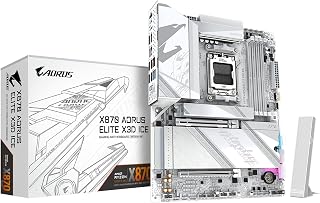
Its 16+2+2 power phase design provides the clean, stable current necessary for the 9950X3D's demanding power profile during sustained gaming or rendering. Four M.2 slots with PCIe 5.0 support offer ample high-speed storage expansion. USB4 connectivity and WiFi 7 round out a feature set that complements this processor's high-end positioning with modern I/O.
Pros
- 16+2+2 power phase design on an 8-layer PCB delivers stable power to the 9950X3D's 16 cores
- Dual PCIe 5.0 M.2 slots plus two PCIe 4.0 slots match the CPU's storage bandwidth needs
- WiFi 7 and 5 GbE Ethernet provide fast connectivity for gaming and large transfers
- 5-year warranty adds long-term confidence for a high-investment platform
Cons
- Only two SATA ports limits builders who rely on multiple traditional hard drives or SATA SSDs
- WiFi 7 antenna must be purchased separately, adding a minor inconvenience to an otherwise complete package
Pairing the Ryzen 9 9950X3D with the GIGABYTE X870 AORUS Elite X3D ICE delivers a well-balanced platform that does not force you to pay for features you will never use. The 16+2+2 power phase design on an 8-layer PCB provides the stable, clean power delivery a 16-core X3D processor demands under sustained gaming or creative workloads. Dual PCIe 5.0 M.2 slots plus two PCIe 4.0 slots give the 9950X3D fast storage paths that match the CPU's memory bandwidth capabilities, while the DDR5 support at 5200 MHz rated speed feeds its cores efficiently. WiFi 7 and 5 GbE Ethernet ensure network throughput is never a bottleneck during online gaming or large file transfers. Up to 256 GB DDR5 capacity leaves plenty of headroom for memory-intensive workloads. The EZ-Latch ecosystem, Q-Flash Plus BIOS updating, and a 5-year warranty make this a practical, confidence-inspiring foundation for an expensive chip like the 9950X3D without pushing into unnecessary luxury territory.
Core Architecture: Socket AM5, AMD X870 chipset, supports Ryzen 9000/8000/7000 series processors. Up to 256GB DDR5 memory across 4 DIMM slots with AMD EXPO support and 5200 MHz speeds.
Storage Connectivity: 4x M.2 slots (2x PCIe 5.0, 2x PCIe 4.0) for NVMe SSDs, 2x SATA ports for traditional drives. Form factor is standard ATX at 12.01 inches long.
Expansion and I/O: 1x PCIe 5.0 x16 slot, 2x USB4 Type-C with DisplayPort Alt mode, 1x USB 3.2 Gen 2 Type-C, 2x USB 3.2 Gen 2 Type-A, 4x USB 3.2 Gen 1 Type-A, plus front USB headers. 5 GbE Ethernet and WiFi 7 with Bluetooth 5.4.
Power and Cooling: 24-pin main power connector, 16+2+2 digital power phases with premium chokes and capacitors, advanced VRM heatsinks for thermal management. 8-layer PCB construction ensures signal integrity and stability.
Builders who want the performance ceiling of the 9950X3D without spending heavily on the motherboard itself will find this board hits a strong sweet spot. Gamers and streamers who value WiFi 7, fast storage, and solid power delivery over flagship aesthetics or extreme overclocking tools are well served here. Skip it if you need more than two SATA ports for legacy storage, or if you plan multi-GPU workloads requiring additional PCIe x16 slots.

The 8+2+2 phases digital VRM handles the 9950X3D's power requirements while maintaining efficiency for builds prioritizing value. DDR5 support reaching 8200 MHz overclocked delivers sufficient memory bandwidth for gaming workloads where X3D cache shines. WiFi 7 and PCIe 5.0 M.2 support ensure connectivity options match the processor's premium gaming capabilities.
Pros
- PCIe 5.0 primary M.2 slot supports next-generation storage speeds for large file workflows
- WiFi 7 provides future-ready wireless in a workstation or dual-use gaming setup
- DDR5 support up to 8200 MHz OC delivers useful memory bandwidth for the Zen 5 architecture
- EZ-Latch Plus screwless M.2 and quick-release PCIe slots simplify hardware maintenance
Cons
- 8+2+2 phase VRM is modest for sustained heavy all-core loads from a 170W processor
- Early reports of BIOS inconsistencies mean firmware verification is necessary before finalizing a build
The Gigabyte B850 EAGLE WIFI7 ICE is a reasonable entry point for an AM5 build centered on the 9950X3D, provided you understand where it fits in the performance tier. Its 8+2+2 phase digital VRM offers stable power delivery for Ryzen 9000 series processors, though builders running the 9950X3D at sustained all-core loads should monitor thermals carefully given the more modest phase count compared to higher-end boards. The primary M.2 slot runs at PCIe 5.0 speeds, which is valuable for large creative file workflows, and DDR5 support reaches 8200 MHz OC for solid memory bandwidth. WiFi 7 keeps wireless connectivity current, and the 2.5 GbE LAN handles most wired needs. The EZ-Latch Plus screwless M.2 mounting and quick-release PCIe slots simplify maintenance in a workstation that may see regular hardware swaps. Early BIOS inconsistency reports are worth noting; verifying firmware before a full build is advisable.
Chipset: AMD B850
Socket: AM5 (supports Ryzen 7000/8000/9000 series)
Form Factor: ATX (9.61in L x 12.01in W x 1.38in H)
Memory: Dual Channel DDR5, 4 DIMM slots, up to 256GB, 8200MHz (OC), AMD EXPO support
Storage: 3x M.2 slots (1x PCIe 5.0 x4, 2x PCIe 4.0 x4), 4x SATA 6Gb/s connectors
Connectivity: WiFi 7 (802.11be), 2.5 GbE LAN, 1x HDMI, 9 USB ports (4x USB 2.0, 2x USB 3.2 Gen 2 Type-A, 2x USB 3.2 Gen 2 Type-C)
PCIe: 1x PCIe 5.0 x16 slot, 2x PCIe 4.0 x16 slots (x4 mode), 4x PCIe slots total
Power: 24-pin main + 8-pin CPU connector, 8+2+2 phase digital VRM
BIOS: Award-based with multi-theme UI, Q-Flash Plus, Dual BIOS
Weight: 1000g
Platform Support: Windows 11 compatible

With 18+2+2 power stages, this board delivers exceptional current delivery for the 9950X3D's 170-watt TDP with thermal headroom to spare. Dynamic OC Switcher intelligently manages power states to optimize X3D gaming performance. Five M.2 slots and USB4 provide extensive expansion for storage-intensive content creation workflows alongside competitive gaming.
Pros
- 18+2+2 power stages at 110A each handle the 9950X3D's sustained workloads without throttling
- Dynamic OC Switcher and Core Flex give granular control over X3D cache core behavior
- Three PCIe 5.0 M.2 slots plus two PCIe 4.0 slots offer maximum fast-storage expansion
- Dual USB4, WiFi 7, and 5Gb Ethernet future-proof the build's connectivity
Cons
- Feature depth and premium cost make it overkill for builders who only need basic gaming performance
- Advanced tuning tools like AI OC and multiple OC modes add complexity that can overwhelm first-time builders
The Ryzen 9 9950X3D is one of the most demanding AM5 processors available, and the ROG Strix X870E-E Gaming WiFi is built to match that ambition. Its 18+2+2 power delivery with 110A per stage keeps voltage rock-steady across all 16 cores whether you are gaming, rendering, or doing both at once. The Dynamic OC Switcher and Core Flex let you fine-tune how the 9950X3D's V-Cache cores are leveraged, while AI Overclocking removes the guesswork for builders who want optimized performance without manual tuning. Five M.2 slots, three of them PCIe 5.0, mean storage will never limit the CPU's throughput. Dual USB4 ports, WiFi 7, and 5Gb Ethernet round out a connectivity suite that keeps pace with the processor's capabilities. The Q-Release mechanisms and pre-mounted I/O shield are practical touches that make installing a flagship build less frustrating. For a chip that costs as much as the 9950X3D, this board provides a foundation that fully unlocks its potential rather than quietly holding it back.
Socket and Compatibility: AMD AM5 Socket, compatible with Ryzen 9000, 8000, and 7000 series processors. Supports up to 192GB DDR5 memory across 4 DIMM slots at speeds up to 320MHz.
Power and Storage: 18+2+2 power stages rated for 110A per stage. Six SATA 3 ports for traditional drives. Five M.2 slots total: three PCIe 5.0 slots and two PCIe 4.0 slots, all with robust cooling.
Connectivity: Dual USB4 Type-C ports, one USB 20Gbps Type-C front-panel connector, one USB 10Gbps port with PD 3.0 up to 30W, nine additional USB 10Gbps ports. WiFi 7 (802.11be) with Realtek 5Gb Ethernet. One HDMI port and optical S/PDIF output.
Physical Specs: Standard ATX form factor measuring 14.4 x 11.1 inches. Weighs 2.4kg. Three-year manufacturer warranty. Pre-mounted I/O shield included.
Builders pairing the 9950X3D with high-end workloads, such as 3D rendering, game development, or heavy streaming setups, will get full value from the power delivery and advanced OC tools here. Content creators wanting WiFi 7 and USB4 for fast peripheral and network throughput will appreciate the connectivity depth. Skip it if you want a straightforward gaming build without overclocking ambitions; the feature complexity and premium cost exceed what a no-frills gaming setup requires.
Pros
- Exceptional single and multi-threaded performance for gaming, streaming, and content creation simultaneously
- Generous power delivery system handles heavy overclocking without throttling
- Modern I/O with WiFi 7, USB4, and high-speed Ethernet future-proofs your system
- Solid build quality with thick PCB and thermal management designed for sustained performance
- Reviewers confirm reliable stability and easy installation for experienced builders
Cons
- Requires separate tower or liquid cooler (not included with processor)
- Premium pricing makes this a significant investment compared to mid-range alternatives
- Packaging quality from this seller appears inconsistent based on customer feedback
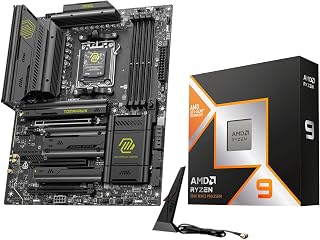
The AMD Ryzen 9 9950X3D paired with the MSI MAG X870E Tomahawk is a powerhouse combo engineered for enthusiasts who demand top-tier gaming performance and professional workload handling. This pairing targets high-end gamers, content creators, and system builders who prioritize raw speed and platform longevity over budget constraints.
The 9950X3D's 16 cores and 32 threads deliver exceptional multi-threaded performance, while the next-gen 3D V-Cache technology provides a meaningful gaming advantage through improved cache efficiency. The 5.7 GHz max boost sustains demanding workloads without throttling when paired with adequate cooling. Real-world performance scales across gaming, streaming, rendering, and productivity applications simultaneously, making this processor overkill for gaming alone but exceptional for hybrid workflows.
The X870E motherboard complements the processor with robust power delivery, dual 8-pin connectors, and a 14+2+1 power phase configuration supporting overclocking enthusiasts. PCIe 5.0 M.2 slots enable NVMe drives that saturate bandwidth, while WiFi 7 and USB4 position the platform at the bleeding edge of connectivity. The board balances performance features with user-friendly touches like tool-free M.2 installation and extended heatsinks for thermal management.
Build quality is professional-grade with thick copper PCB layers and server-level materials, though one reviewer noted inconsistent packaging from this seller. The combo requires a separate CPU cooler, adding cost to an already premium investment. Factory DDR5 memory support without pre-installed sticks means additional spending to complete the system.
This combo represents a complete platform investment rather than an incremental upgrade. It excels for users building a future-proof system and demanding maximum performance, but the cost and required cooling solution make it overkill for casual gaming or general productivity.
Processor: AMD Ryzen 9 9950X3D, 16-core, 32-thread, 5.7 GHz boost, 144 MB L2+L3 cache, 170W TDP, Socket AM5, unlocked for overclocking.
Motherboard: MSI MAG X870E Tomahawk WiFi, ATX form factor, AMD X870E chipset, 14+2+1 power phase, dual 8-pin CPU power connectors.
Memory Support: DDR5 dual-channel up to 256 GB, native 8400+ MHz (OC).
Storage: 2x PCIe 5.0 x4 M.2 slots, 2x PCIe 4.0 x4 M.2 slots, 4x SATA 6Gb/s ports.
Connectivity: WiFi 7, Bluetooth 5.4, USB4, 5G LAN, 2x USB 40Gbps Type-C, 1x HDMI, 21 total USB ports.
Platform: Windows 11/10 64-bit support, compatible with Ryzen 9000, 8000, and 7000 series processors.
Who Should Buy: High-end gamers planning to keep their system for 3+ years, content creators running video editing or 3D rendering, streamers, and overclocking enthusiasts who value maximum performance and future upgrade potential.
Who Might Skip: Budget-conscious builders, casual gamers, general productivity users, or anyone who already owns a capable AM5 system. The price premium does not justify the upgrade for light workloads.
What You Need to Add: A quality tower or all-in-one liquid cooler (recommended 280mm or larger given the 170W TDP), DDR5 memory (32 GB minimum recommended), PCIe 5.0-compatible NVMe drive, and a robust 1000W plus power supply.
Platform Benefits: Socket AM5 ensures access to current-gen and next-gen Ryzen processors, meaning your motherboard investment will remain relevant for future CPU upgrades. PCIe 5.0 connectivity future-proofs your system for emerging high-speed storage and expansion cards.

Two M.2 Gen5 slots offer cutting-edge storage performance that matches the 9950X3D's processing capabilities for data-intensive applications. DDR5 memory support up to 8400 MT/s overclocked ensures the memory subsystem won't bottleneck those 16 cores. Wi-Fi 7 and 5G LAN provide redundant high-speed networking options critical for competitive gaming and content streaming.
Pros
- X870E chipset with 14-phase 80A power stages and dual 8-pin connectors fully supports the 9950X3D's power draw
- DDR5 overclocking up to 8400+ MT/s pushes memory bandwidth as high as the platform allows
- Two PCIe Gen 5 M.2 slots with Shield Frozr II thermal protection prevent storage throttling under load
- Dual USB4 with 8K output support and WiFi 7 deliver top-tier connectivity without add-in cards
Cons
- Long-term durability data is limited given the board's recent release
- Feature density and cost exceed what users who only game at 1080p or 1440p will realistically utilize
The MSI MAG X870E Tomahawk Max WiFi runs on the X870E chipset rather than X870, and that distinction matters for the 9950X3D. The 14-phase Duet Rail Power System with 80A SPS stages, backed by dual 8-pin CPU connectors, delivers the kind of sustained, clean power a 16-core X3D chip needs under prolonged rendering or gaming sessions. DDR5 support reaching 8400+ MT/s in overclocking mode lets the 9950X3D's memory-sensitive workloads run at their upper limit. Four M.2 slots, two running PCIe Gen 5, give fast sequential storage across the build, and each slot sits behind a Shield Frozr II thermal solution to prevent throttling. The PCIe 5.0 x16 slot at 128 GB/s ensures a high-end GPU runs without any interface-level limitation. Dual USB4 Type-C ports supporting 8K at 60Hz output, WiFi 7, Bluetooth 5.4, 5G LAN, and 7.1-channel HD audio with Audio Boost 5 round out a suite that leaves nothing on the table for demanding users. The 2oz thickened copper PCB adds structural and thermal integrity throughout.
Chipset: AMD X870E with Socket AM5 support for Ryzen 9000, 8000, 7000 processors
Power Delivery: 14-phase Duet Rail power system, 80A SPS, dual 8-pin CPU connectors
Memory: 4x DDR5 DIMM slots, up to 256GB capacity, 8400+ MT/s overclocking support
Storage: 2x M.2 Gen5 (128Gbps), 2x M.2 Gen4 (64Gbps), each with Shield Frozr II thermal protection
Graphics: 1x PCIe 5.0 x16 slot (128GB/s) with Steel Armor II reinforcement
Connectivity: WiFi 7 with Bluetooth 5.4, 5G LAN, 2x USB4 Type-C (40Gbps with 8K/60Hz display support), 7.1-channel HD audio with Audio Boost 5
Cooling: Extended heatsinks, MOSFET thermal pads (7W/mK), combo-fan header (3A)
Physical: ATX form factor, 11.97" x 9.57", 1.79 kg weight
Enthusiasts building around the 9950X3D for competitive gaming, high-resolution content creation, or workstation-grade multitasking will find the X870E chipset and dual 8-pin power delivery genuinely useful at this core count. Streamers and creators who want 8K USB4 output and WiFi 7 without a separate capture or network card benefit directly from the dense rear I/O. Skip it if your workload is purely gaming and you do not need the extra connectivity headroom; the cost outpaces what straightforward gaming requires.
Buying Guide: What to Look for in a Ryzen 9 9950X3D Motherboard
Power Delivery and VRM Quality
The 9950X3D’s 16 cores draw significant power under sustained loads, especially when running all-core workloads or precision boost overdrive. Look for boards with at least 14-phase VRM designs rated for 80A or higher per stage. Premium models like the MSI MEG X870E GODLIKE MAX, E-ATX deliver 24-phase digital VRM with 110A stages, ensuring stable voltage delivery even during extended rendering sessions or competitive gaming marathons.
Thermal management matters just as much as raw phase count. Boards with substantial heatsinks, heat pipes connecting VRM and chipset coolers, and high-conductivity thermal pads (7W/mK or better) prevent throttling during summer heat or in restrictive cases. The GIGABYTE X870E AERO X3D Dark Wood AMD AM5 ATX uses a true one-piece VRM heatsink design that dissipates heat more effectively than segmented solutions.
Memory Support and Overclocking Headroom
DDR5 compatibility is standard on AM5, but maximum supported speeds vary dramatically. Budget boards top out around 6400 MT/s, while enthusiast models push 8400 MT/s and beyond with AMD EXPO profiles. The MSI MAG X870E Tomahawk MAX WiFi Motherboard, ATX and similar high-end boards hit 8400+ MT/s in single-DIMM-per-channel configurations, crucial for memory-sensitive workloads like video editing or simulation.
Four DIMM slots provide capacity for 128GB or 256GB total, but filling all four slots typically reduces maximum stable frequencies. If you plan to run 64GB or more, verify the board’s qualified vendor list (QVL) includes your chosen memory kit at your target speed. When building a complete high-performance system, consider matching your board choice with displays from our best 4K monitor for RTX 5080 roundup.
Storage and Expansion Slots
PCIe 5.0 M.2 slots future-proof your storage as next-generation SSDs reach 14 GB/s sequential reads. X870E boards typically offer two or more Gen5 M.2 slots, while X870 and B850 models provide at least one. The ASUS ROG Strix X870E-E Gaming WiFi AMD AM5 X870 includes three PCIe 5.0 M.2 slots plus two Gen4 slots, accommodating massive game libraries and project archives without compromising speed.
Graphics card support centers on the primary PCIe 5.0 x16 slot, which all these boards provide. Reinforced slots with metal shielding prevent GPU sag and maintain signal integrity with heavy cards. Some boards add EZ-release mechanisms that let you remove GPUs without fumbling with retention clips, a small convenience that matters during upgrades or troubleshooting. If you’re still deciding on a case, our best PC case for RTX 5090 guide covers chassis options with excellent GPU clearance and airflow.
Connectivity and Networking
USB4 ports deliver 40 Gbps bandwidth and support DisplayPort Alt Mode for single-cable monitor connections. Premium X870E boards include dual USB4 Type-C ports on the rear I/O, while mid-range models offer one or none. Wi-Fi 7 support appears across most 2026 releases, providing multi-gigabit wireless speeds and improved latency over Wi-Fi 6E in congested environments.
Wired networking ranges from 2.5 GbE on budget boards to dual 5 GbE or even 10 GbE on flagship models like the MSI MEG X870E GODLIKE MAX, E-ATX. If you transfer large project files to network storage or stream high-bitrate content, prioritize boards with 5 GbE or faster Ethernet. For builders who game at high refresh rates, see our best 1440p monitor for RTX 5070 for display pairing suggestions.
Final Thoughts
Choosing the best motherboard for your Ryzen 9 9950X3D comes down to balancing power delivery, connectivity, and feature depth against your actual workflow needs. For creators and enthusiasts who demand absolute top-tier VRM, seven M.2 slots, and cutting-edge connectivity, the MSI MEG X870E GODLIKE MAX delivers flagship performance without compromise. If you want excellent X870E features at a more accessible tier with strong overclocking support and USB4, the GIGABYTE X870E AERO X3D Dark Wood offers a compelling blend of design, thermals, and expansion. Whichever board you choose, pair it with adequate cooling and quality components to let the 9950X3D reach its full potential.
Frequently Asked Questions
Do I need an X870E board for the Ryzen 9 9950X3D, or will X870 or B850 work?
The 9950X3D works perfectly on X870, B850, and even older B650/X670 boards with updated BIOS. X870E adds extra PCIe 5.0 lanes and USB4 support, which matters if you need multiple Gen5 M.2 slots or high-speed external connectivity. B850 boards provide excellent value for gaming-focused builds where dual USB4 ports aren’t essential. Choose based on your expansion and connectivity requirements rather than chipset prestige.
How important is VRM phase count for the Ryzen 9 9950X3D?
VRM phase count matters less than total power delivery capacity and thermal design. A 14-phase VRM rated for 80A per stage handles the 9950X3D’s 170W TDP with headroom for boost clocks. Budget boards with 10-phase designs work fine at stock settings but may struggle with sustained all-core workloads or PBO tuning. If you plan heavy productivity work or extended gaming sessions, prioritize boards with robust heatsinks and at least 14 phases.
Can I use DDR4 RAM with the Ryzen 9 9950X3D?
No. The AM5 platform exclusively supports DDR5 memory. All motherboards compatible with the 9950X3D require DDR5 modules. This represents a platform requirement, not a board-specific limitation, so you’ll need to budget for DDR5 kits regardless of which motherboard you choose.
What’s the benefit of PCIe 5.0 M.2 slots in 2026?
PCIe 5.0 SSDs deliver sequential read speeds exceeding 12 GB/s, nearly double Gen4 drives. This matters for workflows involving large file transfers, 8K video editing, or game development. For typical gaming and productivity, Gen4 drives remain excellent and often more affordable. Having Gen5 slots future-proofs your build as drive prices drop and more software takes advantage of extreme storage bandwidth. Our best monitor for RTX 5070 ti discusses similar performance considerations for displays.


Write Your Review
No reviews yet. Be the first to share your experience!