

When every millisecond counts in competitive gaming, your monitor becomes the critical link between your reaction time and victory. Whether you’re tracking enemies in fast-paced shooters or executing frame-perfect combos in fighting games, a 360Hz display eliminates motion blur and delivers the smoothness professional esports players demand. This guide covers the top 360Hz gaming monitors available in 2026, from budget-conscious options to premium OLED panels that redefine visual quality.
Quick Comparison
Ratings reflect the most recent data pull. Check each listing for current price and availability.

This display offers a dual-mode refresh rate that switches between 165Hz at full 4K and 330Hz at 1080p, giving competitive players the flexibility to prioritize frame rate when it matters most. The 0.03ms response time eliminates ghosting during rapid flicks, while the OLED panel delivers perfect blacks and vivid contrast that make enemies pop against dark backgrounds. G-SYNC and FreeSync Premium Pro ensure tear-free gameplay across both NVIDIA and AMD setups.
Pros
- Dual-mode operation: 4K/165Hz or Full HD/330Hz depending on game type
- 0.03ms response time eliminates ghosting and motion blur
- OLED panel with 1.5M:1 contrast reveals details in dark scenes
- Fully adjustable stand with tilt, height, swivel, and pivot
Cons
- Glossy finish reflects ambient light and requires controlled lighting
- Input switching between devices is inconvenient for multi-system setups
The LG 32GX850A-B stands out in the 360Hz tier by offering dual refresh modes that adapt to different competitive scenarios. While many ultra-high refresh displays lock you into a single resolution, this 32-inch OLED lets you run Full HD at 330Hz for fast-paced shooters like Counter-Strike or Valorant, then switch to native 4K at 165Hz when slower tactical games benefit from visual clarity. The 0.03ms response time eliminates motion blur entirely, critical when tracking opponents across the screen. OLED technology delivers a 1.5 million to one contrast ratio and DisplayHDR True Black 400 certification, meaning dark map corners and shadow details remain visible without crushing blacks or washing out highlights. The 98.5% DCI-P3 color gamut ensures accurate color reproduction for both competitive play and content creation. G-SYNC and FreeSync Premium Pro support prevent screen tearing across both NVIDIA and AMD hardware. The fully adjustable stand includes tilt, height, swivel, and pivot functions, letting you dial in ergonomics for marathon sessions. Three UL certifications for flicker-free operation, low blue light, and anti-glare treatment address eye strain during extended play.
Display: 32-inch 4K UHD (3840 x 2160) glossy OLED, 16:9 aspect ratio, 0.18mm pixel pitch
Performance: 165Hz at 4K or 330Hz at Full HD, 0.03ms response time (GtG), 1500000:1 contrast ratio, 275 nits brightness
Color: VESA DisplayHDR True Black 400, 98.5% DCI-P3 gamut, HDR10 support
Connectivity: 1x DisplayPort, 2x HDMI 2.1, 3x USB 3.0, 2x audio outputs
Adaptive Sync: NVIDIA G-SYNC Compatible, AMD FreeSync Premium Pro
Stand: Height, tilt, swivel, and pivot adjustment. Dimensions: 28.1"W x 24.4"H x 9.8"D, 20.1 lbs
Certifications: UL Anti-Glare, UL Flicker-Free, UL Low Blue Light
Warranty: 2-year manufacturer coverage



Buying Guide: What to Consider When Choosing a 360Hz Gaming Monitor
Panel Technology and Response Time
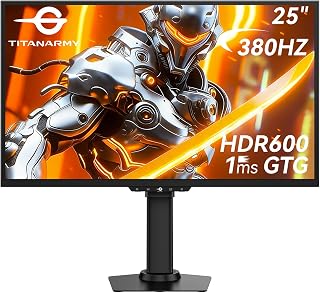
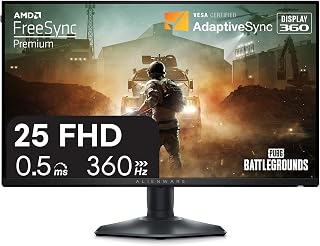
The panel type fundamentally shapes your gaming experience. Fast IPS panels like those in the Alienware 25 Gaming Monitor AW2523HF 24.5″ IPS LED and TITAN ARMY U255T 24.5″ Gaming Monitor, QHD deliver excellent color accuracy with 99% sRGB coverage while maintaining 0.5ms to 1ms response times. These monitors balance competitive performance with vibrant visuals suitable for both gaming and content creation.
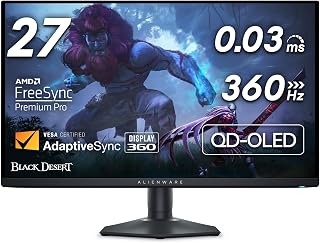
QD-OLED technology represents the premium tier, offering 0.03ms response times that virtually eliminate ghosting. The Alienware AW2725DF OLED Gaming Monitor and msi MPG 271QRX QD-OLED, 27 OLED Gaming Monitor provide infinite contrast ratios and true blacks impossible on LCD panels. If you primarily play competitive shooters where clarity matters more than HDR content, Fast IPS delivers excellent value. For players who want the absolute best motion clarity and visual depth across all game types, QD-OLED justifies the investment.
Resolution: 1080p vs QHD
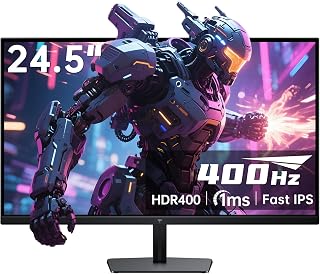
Full HD 1080p monitors like the KTC 24.5 Inch 400Hz Gaming Monitor offer maximum frame rates with less GPU demand, making them ideal for competitive esports where performance trumps visual fidelity. The 24.5-inch screen size maintains sharp pixel density at 1080p, and reaching 360Hz or even 400Hz becomes achievable with mid-range graphics cards.
QHD 1440p displays provide 78% more pixels, delivering noticeably sharper image quality for immersive single-player games and productive work between gaming sessions. The LG 32GX850A-B 32″ UltraGear 4K UHD (3840 x 2160) even offers dual-mode functionality, switching between 4K at 165Hz and 1080p at 330Hz depending on your game type. Consider your GPU power and whether you value competitive frame rates or visual detail more heavily when making this choice.
Adaptive Sync and HDR Support
Adaptive sync technology eliminates screen tearing without the input lag of traditional V-Sync. Most displays support both AMD FreeSync Premium Pro and are NVIDIA G-SYNC Compatible, ensuring smooth gameplay regardless of your graphics card. The AOC 27″ Gaming Monitor QHD 360Hz QD OLED NVIDIA carries official NVIDIA certification for verified performance with GeForce cards.
HDR capabilities vary significantly across models. Entry-level monitors may claim HDR support but lack the peak brightness to deliver meaningful improvements. Look for VESA DisplayHDR 400 certification at minimum, with DisplayHDR True Black 400 on OLED panels providing the most dramatic contrast enhancement. The KTC 24.5 Inch 400Hz Gaming Monitor includes HDR 400 with 128% sRGB color gamut, bringing HDR gaming to a more accessible segment. For those interested in exploring other high-performance displays, check out our guide on the best laptops for computer science students which covers portable options with excellent screen quality.
Ergonomics and Connectivity
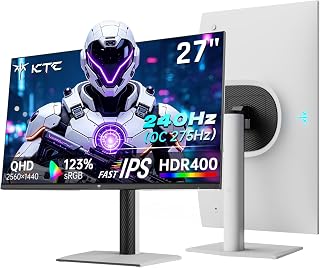
Proper ergonomics prevent fatigue during extended sessions. Prioritize monitors with height, tilt, swivel, and pivot adjustment like the KTC 27 Inch 240Hz Gaming Monitor. Vertical pivot rotation proves valuable for coding or browsing between matches, while VESA 100x100mm mounting compatibility allows desk clamp or wall installation for maximum flexibility.
Connection options determine maximum refresh rates and multi-device setups. DisplayPort 1.4 typically delivers the full 360Hz experience at 1080p and 1440p, while HDMI 2.0 often caps at 240Hz. The Z-Edge 27 inch Curved Gaming Monitor includes dual DisplayPort and dual HDMI connections, making console and PC switching seamless. USB-C with DisplayPort Alt Mode, found on premium models, provides single-cable connectivity for laptops while delivering power and data simultaneously.
Final Thoughts
Choosing the right 360Hz gaming monitor depends on balancing performance demands, visual preferences, and budget constraints. For competitive players prioritizing pure speed and value, the KTC 24.5 Inch 400Hz Gaming Monitor delivers exceptional refresh rates with HDR 400 at an accessible entry point. If you demand the ultimate in motion clarity with stunning OLED visuals for both competitive and immersive gaming, the Alienware AW2725DF OLED Gaming Monitor combines QD-OLED technology with true 360Hz performance and infinite contrast for an uncompromising experience.
Frequently Asked Questions
Do I need a powerful GPU to run games at 360Hz?
Reaching 360fps consistently requires a high-end graphics card, especially at 1440p resolution. Competitive esports titles like CS2, Valorant, and Overwatch 2 are well-optimized and achievable with mid-to-high-range GPUs at 1080p. For graphically demanding AAA games, you’ll need flagship cards to approach 360fps, though adaptive sync technology ensures smooth gameplay even when frame rates fluctuate below the maximum refresh rate. Many competitive players lower graphics settings to prioritize frame rate over visual fidelity.
Is there a noticeable difference between 240Hz and 360Hz monitors?
The improvement from 240Hz to 360Hz is less dramatic than the jump from 144Hz to 240Hz, but professional players and sensitive users can perceive the reduced motion blur and improved tracking clarity. The difference becomes most apparent in fast-paced scenarios with rapid camera movements or tracking fast-moving targets. If you’re upgrading from 144Hz, the improvement is significant. If you already own a quality 240Hz display, the upgrade priority depends on how seriously you pursue competitive gaming and whether you have the GPU power to sustain those frame rates.
Should I choose OLED or Fast IPS for competitive gaming in 2026?
Fast IPS panels offer excellent competitive performance with lower risk of burn-in, making them ideal for extended sessions displaying static UI elements. QD-OLED provides superior motion clarity with 0.03ms response times and infinite contrast, but requires more careful usage to prevent image retention. For pure competitive gaming where the monitor displays varied content, either technology performs exceptionally well. If you also consume HDR content, watch movies, or play story-driven games, OLED’s visual advantages become more compelling despite the slightly higher maintenance awareness required.
What screen size is best for 360Hz gaming?
Most competitive players prefer 24.5 to 27-inch displays because the entire screen remains within peripheral vision without requiring excessive head movement to track corners. The smaller viewing area reduces eye travel time during intense matches. At 1080p, 24.5 inches maintains sharp pixel density, while 27 inches works well for 1440p resolution. Larger displays like 32 inches suit immersive single-player gaming better than competitive scenarios. Consider your desk depth and how close you sit when selecting size, as proper viewing distance affects both comfort and competitive performance.
Common questions
What is the best esports monitor for competitive gaming in 2026?
A 360Hz display at 1080p remains the sweet spot for esports, delivering the fastest response times and highest frame rates for competitive titles like Valorant, CS2, and Apex Legends. The 24.5-inch form factor is preferred by pros because it requires less eye movement and fits tournament setups. Look for Fast IPS panels that combine speed with better color accuracy than older TN screens, and make sure your GPU can push 360+ fps in your main games to fully benefit from the refresh rate.




Write Your Review
No reviews yet. Be the first to share your experience!